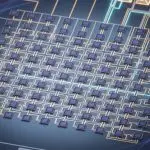
Researchers at the University of Stuttgart have demonstrated measurement-based quantum computing on a silicon photonic chip, a significant step toward scalable quantum processors. The team generated entangled photonic states with up to four qubits and attained fidelities of 0.89 and 0.76 for four-photon star and linear graph states, respectively. These resource states enabled the implementation of both single- and two-qubit gates, as well as the successful execution of Grover’s search algorithm and the Deutsch, Jozsa algorithm. These results establish the feasibility of reconfigurable four-photon measurement-based quantum computing on an integrated photonic platform and provide a foundation for future larger-scale implementations.
Photonic Chip Fabrication with Silicon-on-Insulator (SOI)
Silicon-on-insulator (SOI) technology is now capable of hosting complex quantum computations, as researchers successfully implemented measurement-based quantum computing (MBQC) on a chip fabricated using this material platform. This achievement bypasses the need for direct photon-photon interactions, a persistent challenge in scaling quantum processors, and represents a step toward practical quantum devices. The work, detailed in a recent publication, centers on generating and manipulating entangled photonic qubits directly on an integrated circuit. The team’s silicon photonic chip encodes four qubits using a dual-rail system across eight modes, leveraging tuneable beamsplitters and phase shifters to create postselected entangling gates. Single photons at a wavelength of 1550 nanometers are generated via spontaneous parametric down-conversion (SPDC) and coupled into the chip via grating couplers. The researchers state that this is the initial stage of their experimental setup.
Crucially, the chip’s design allows for the creation of both four-photon star and linear graph states, essential resources for MBQC protocols. Stabiliser measurements confirm the quality of these entangled states, with fidelities reaching 0.89 and 0.76 for four-photon star and linear graph states, respectively. These resource states were then used to demonstrate fundamental quantum algorithms. The chip’s architecture, comprising multi-mode interferometers acting as balanced beam splitters and thermo-optic phase shifters, is key to this functionality. “The chip consists of three sections: state preparation, reconfigurable entangling gates, and state analysis,” the team explains, highlighting the integrated nature of the system. The use of SOI allows for miniaturisation and robust implementation of complex circuit architectures.
The pursuit of scalable quantum computation has increasingly focused on measurement-based quantum computing (MBQC) as a promising alternative to gate-based approaches. Unlike traditional methods requiring precise, deterministic interactions between photons, MBQC leverages pre-prepared, highly entangled states, known as graph states, and extracts computation through a series of adaptive measurements. Recent work demonstrates a step forward in this field, with the successful implementation of MBQC on an integrated silicon photonic chip capable of generating entangled states with up to four qubits. Central to this advance is the creation of high-fidelity graph states. These resource states were not merely created for demonstration; they were actively used to perform computations. The chip itself utilizes silicon-on-insulator (SOI) technology, a material platform offering mature fabrication processes and low propagation losses, essential for miniaturization and robust circuit architectures. The researchers verified the quality of the generated states through stabiliser measurements, confirming genuine multi-partite entanglement.
High-fidelity entangled states are central to their success. They achieved fidelities of 0.89 and 0.76 for four-photon star and linear graph states, respectively. These figures represent an improvement in the quality of generated entanglement on an integrated platform, indicating precise control over the quantum states.
Researchers have moved beyond simply creating entangled states, actively employing them to perform computations with up to four qubits encoded on a single integrated circuit. This approach relies on adaptive measurements performed on highly entangled graph states, a technique that shifts the complexity from building precise quantum gates to accurately characterizing and measuring these pre-prepared states. “These resource states enable the implementation of a range of MBQC protocols, including a non-Clifford single-qubit gate,” the researchers note, highlighting the versatility of their approach. The ability to run recognizable algorithms signifies a move toward practical quantum computation.
Grover & Deutsch-Jozsa Algorithms Demonstrated on PICs
Researchers have successfully executed recognizable quantum algorithms, Grover’s search and the Deutsch-Jozsa algorithm, using a silicon photonic chip containing just four qubits. This achievement bypasses a major hurdle in quantum computing: the need for direct, deterministic interactions between photons, instead relying on a technique called measurement-based quantum computing (MBQC). The team achieved fidelities of 0.89 and 0.76 for these states, respectively, indicating a high degree of accuracy in creating the necessary quantum correlations. Crucially, the chip itself, fabricated using silicon-on-insulator technology, allows for complete control over the quantum process. The ability to run established algorithms, rather than simply creating entangled states, marks a significant step forward.
Grover’s search algorithm, known for its potential to speed up database searches, and the Deutsch-Jozsa algorithm, which determines whether a function is constant or balanced, were both successfully implemented on this four-qubit system. This demonstration confirms that the chip is not merely a state generator, but a functional quantum computer, albeit a small one. The implications of this work extend beyond the successful execution of these algorithms.
Source: https://arxiv.org/abs/2607.07890

See today’s quantum computing news on Quantum Zeitgeist for the latest breakthroughs in qubits, hardware, algorithms, and industry deals.