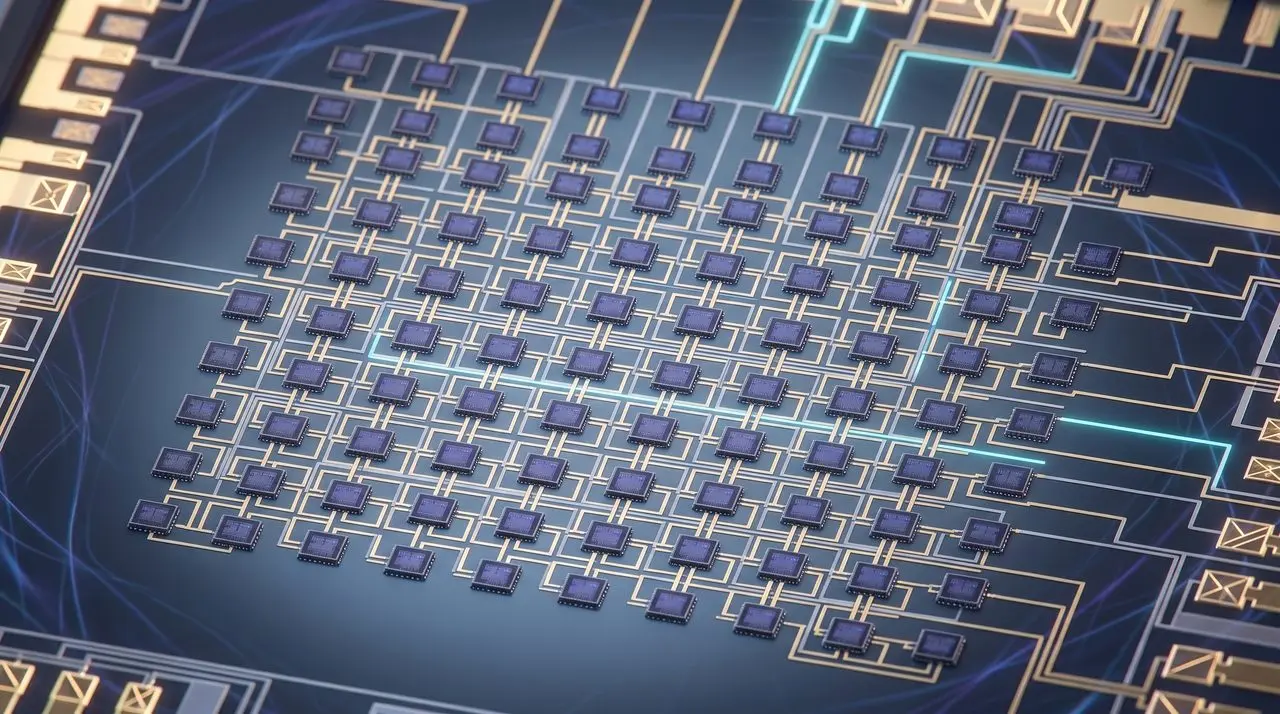
Researchers have, for the first time, confirmed the existence of three-component cat-like quantum states within a three-photon chip, moving beyond the standard two-component configuration. The work demonstrates quantum coherence through observed three-photon Rabi oscillations and direct Wigner function measurements, revealing a dynamic in phase space arising from macroscopic temporal interference.
This oscillation frequency directly measures the energy gap separating the qutrit from the excited states, establishing a new time-domain method for verifying qutrit protection. However, the team identified a parasitic higher-order pump term as the primary limitation on achievable photon numbers, indicating a clear path for future development.
Three-Photon KPO Realisation Confirms Qutrit Manifold
The chip’s three-component cat-like states, distinguished by photon and Fock number modulo 3, establish a new approach to encoding quantum information beyond the standard two-component states. These states, designated |0C⟩, |1C⟩ and |2C⟩, form the qutrit manifold and are defined by the occupancy of photon numbers that are multiples of three, where ‘n’ represents any non-negative integer. The symmetry inherent in these states is not merely a mathematical curiosity. It is actively enforced by the Hamiltonian governing the system, providing a more robust foundation for high-dimensional quantum logic.
This design contrasts with previous three-photon KPO demonstrations which operated in the semiclassical regime and failed to exhibit quantum coherence or dynamics despite extensive theoretical predictions. A signal observed in phase space is a highly sensitive indicator of population leakage from the intended qutrit manifold, arising from macroscopic temporal interference between the cat-qutrit manifold and excited states.
Specifically, the team measured the frequency of resulting oscillations in the mean photon number, providing a direct, time-domain measurement of the energy gap separating the qutrit from the excited states. The observed recovery of the total qutrit manifold population toward unity, apart from minor oscillations caused by imperfect state preparation, further confirms the protective effect of the energy gap. This recovery contrasts sharply with the decay observed in a separate, unprotected state, | C⟩, where the population diminished over time.
Single-photon loss, for example, drives a cyclic population transfer within the qutrit manifold, a process distinct from the standard ladder-like decay seen in conventional transmon-based qutrits. While this cyclic transfer doesn’t immediately destroy the quantum information, it does represent a potential source of error that must be addressed for practical applications.
The team acknowledges that preparing a superposition of the qutrit states, necessary for certain quantum operations, presents a challenge due to the need for precise phase control. A measurement-based state preparation approach, previously demonstrated in two-photon KPOs, is proposed as a more convenient method for creating the desired localized state, though its implementation in the three-photon system requires further investigation.
The energy gap does not suppress population leakage induced by photon loss or high-frequency dephasing noise. “We stress that this energy gap protects against population leakage caused by dephasing noise with little spectral weight at or above the gap frequency,” the paper states, clarifying the scope of the protection offered by the qutrit manifold.
Engineered Quantum Tunnelling Creates Protected Bosonic Qutrit
A newly realized three-photon Kerr parametric oscillator (KPO) demonstrates a key characteristic of protected qutrits: a dynamic in phase space, where interference between qutrit states maintains a constant mean photon number, unlike un-driven systems. This observation, detailed in recent work, confirms the formation of three-component cat-like states within the chip and validates the potential of this approach as a robust platform for quantum information processing.
This optimization was inspired by recent work from NEC, and the resulting chip allows for the experimental realization of a three-photon KPO, a feat previously hindered by limitations in observing quantum coherence and dynamics. The researchers extracted parameters like pump amplitude, and KPO transition frequency by comparing two-dimensional Rabi oscillation plots with simulations, enabling precise control over the system’s behavior.
The identification of the higher-order pump term as a limiting factor is particularly significant, as it provides a concrete target for further development. “We identify the influence of higher-order pump terms as the primary physical mechanism suppressing the size of the KPO states compared to theoretical predictions for a purely three-photon driven system,” the paper states, highlighting the need to mitigate this interference to maximize the protective capabilities of the qutrit.
Simulations incorporating single-photon loss, a common source of decoherence, yielded reasonable agreement with experimental data, demonstrating the model’s accuracy and providing a pathway for predicting and addressing future challenges. In conventional qubits, cross terms in superposition vanish due to orthogonality, but this is not the case within the protected qutrit manifold. Consequently, single-photon loss, which would typically cause a cat state to decay towards the vacuum, is significantly suppressed, preserving the quantum information encoded within the system.
Extending the platform to implement a protected ququart, a four-level quantum system, represents a logical next step, particularly given its potential for realizing autonomous quantum error correction (QEC). The researchers suggest that a deeper theoretical investigation into the interplay between tunnelling dynamics and experimental contributions to relaxation processes would yield valuable insights for minimizing decoherence in parametrically driven quantum processors. The team’s findings elucidate the basic quantum properties of the three-photon KPO and establish a foundation for its use as an alternative qutrit platform.
The ability to engineer quantum tunnelling in phase space offers a promising approach to creating protected logical qubits with biased-noise properties, a valuable requirement for building fault-tolerant quantum computers. Further research will focus on refining the KPO design and exploring strategies for mitigating the identified limitations, ultimately aiming to improve the performance of this innovative quantum technology.
Wigner Function Measurements Reveal Three-Component Cat-Like States
These measurements, alongside observed three-photon Rabi oscillations, establish a clear signature of quantum coherence in the engineered system, demonstrating a novel approach to observing superposition. The resulting interference patterns exhibited a characteristic three-fold symmetry, a direct consequence of the three-photon pump used in the experiment and a key indicator of the generated quantum state’s unique properties.
This establishes a time-domain method for verifying the protective capabilities of the qutrit, offering a new way to assess the stability of the quantum information encoded within it. The observed energy gap is key, as it suppresses population leakage into non-computational subspaces, a primary source of decoherence in quantum systems.
The eigenstates of the three-photon KPO are demonstrably three-component cat-like states, distinguished by their photon number modulo 3. Specifically, states with a photon number of 3n, where n is a non-negative integer, are occupied in the |0C and | states, highlighting the unique quantum properties of this system. This finding highlights a specific area for future optimization, suggesting that mitigating this interference is key for maximizing the protective capabilities of the qutrit.
The researchers emphasize that protection, in this context, denotes the suppression of population leakage into the non-computational subspace, a critical requirement for building robust quantum systems. The work demonstrates the potential of this three-photon KPO as a protected qutrit platform.
Energy Gap Measurement Validates Qutrit Manifold Protection
The energy gap protecting a newly realized qutrit, a quantum bit using three-component cat-like states, has been directly measured through observation of its temporal dynamics, confirming a key prediction of the platform’s protective capabilities. Oscillations in the mean photon number, stemming from macroscopic interference between the qutrit manifold and excited states, provide a time-domain verification of this energy gap, establishing a novel method for assessing qutrit protection against decoherence.
This measurement goes beyond simply demonstrating coherence. It quantifies the barrier shielding the quantum information from environmental noise, a critical step toward practical quantum computation. Analysis of the system’s time evolution revealed that the qutrit manifold is not merely stable, but actively protected by this energy gap, preventing population decay towards the vacuum state.
Unlike conventional qubits, where state decay typically follows a ladder-like pattern, single-photon loss in this system induces a cyclic population transfer between the |0C⟩ and |2C⟩ states within the qutrit manifold. This distinct behavior, coupled with the recovery of population within the qutrit manifold, rather than a simple decay, demonstrates a resilience to low-frequency dephasing noise. Simulations aligning with experimental data further support this conclusion, showing good agreement between measurements and models excluding dephasing effects. The team found that the observed discrepancy between simulated and measured relaxation times could not be determined from the source.

See today’s quantum computing news on Quantum Zeitgeist for the latest breakthroughs in qubits, hardware, algorithms, and industry deals.