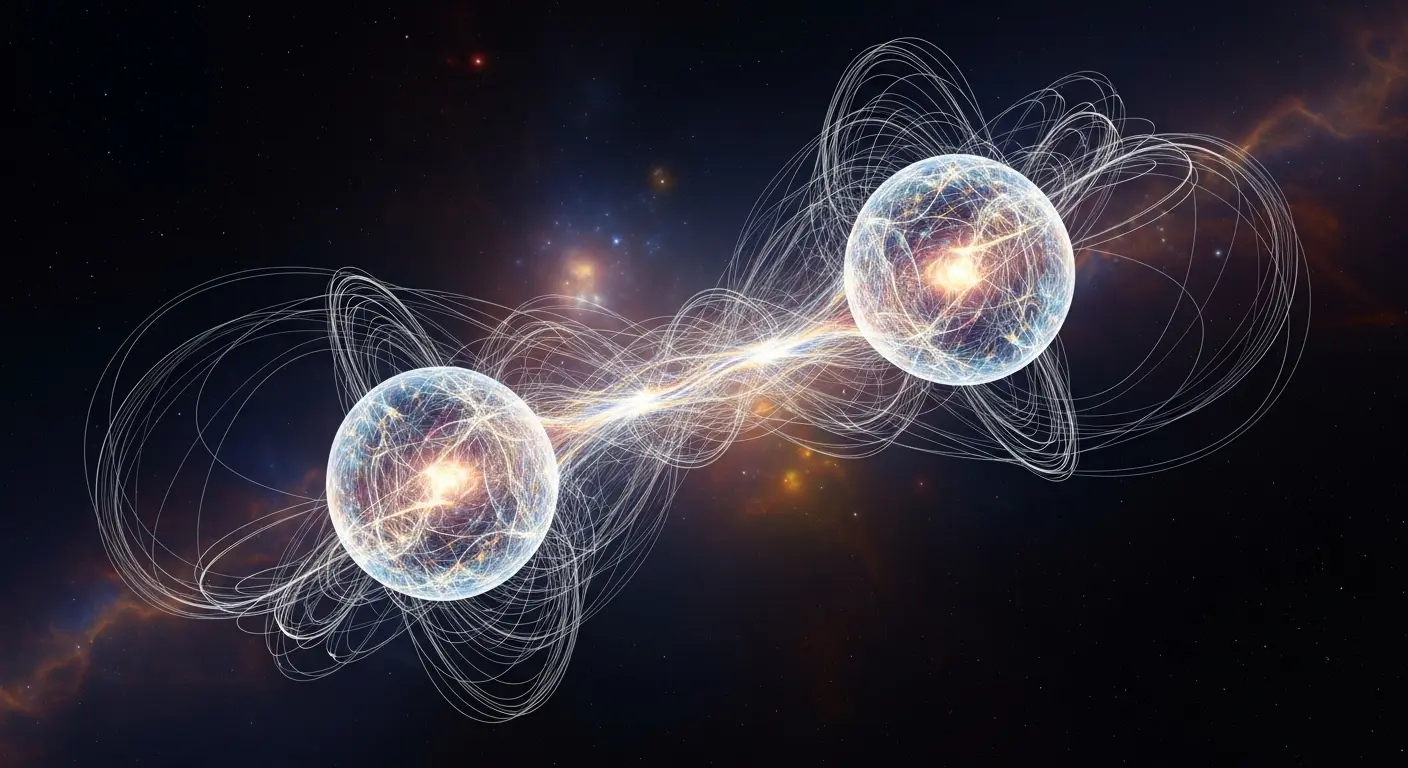
Distributing entanglement directly between error-corrected logical qubits presented challenges for scalable quantum networks; fidelity was limited by qubit decoherence and errors during photon generation. Remotely entangled Gottesman, Kitaev, Preskill (GKP) qubits have been achieved, a type of error-correcting code, between spatially separated trapped ions with over ninety-five percent fidelity. This breakthrough combines established techniques in motional control and photonic networking to improve upon previous methods.
Remotely entangled Gottesman, Kitaev, Preskill (GKP) qubits were successfully created; these represent information using continuous properties rather than simple on/off states like traditional quantum bits. The achievement involved linking two spatially separated trapped ion systems via photons to establish this connection with over ninety-five percent accuracy. By combining existing techniques for controlling atomic motion and photonic networks, limitations imposed by errors during photon creation and loss of coherence within the qubits themselves have been overcome.
Researchers from Keio University and 3Advanced ICT Research Institute, National Institute of Information and Communications Technology achieved over ninety-five percent fidelity in remotely entangling error-correcting quantum bits; these aren’t standard ‘on/off’ bits but utilise continuous properties to encode information, akin to encoding data within the subtle movements of an atom rather than simple switches. This breakthrough uses established techniques combining control of atomic motion with photonic networks, linking two spatially separated trapped ion systems via photons.
A key challenge overcome was minimising errors during photon creation and maintaining coherence within the qubits themselves; imagine trying to maintain a perfectly swinging pendulum while simultaneously giving it tiny “kicks” each time a signal is sent or received, alongside external disturbances causing wobble.
High Fidelity GKP Qubit Entanglement Enables Practical Quantum Communication
Entanglement now exceeds 95% fidelity, a sharp leap from previous methods hampered by qubit decoherence and errors during photon generation. This threshold unlocks practical long-distance quantum communication using established trapped-ion technologies where previously such high accuracy was unattainable. Keio University researchers and collaborating institutions demonstrated a heralded protocol generating remote entanglement between Gottesman, Kitaev, Preskill (GKP) qubits encoded within spatially separated trapped ions; internal electronic states mediated interactions with emitted photons.
Their analysis considered realistic limitations including imperfect squeezing of the atomic state, loss of photons during transmission, recoil effects impacting ion momentum, and both heating and dephasing affecting coherence, factors often overlooked in theoretical models but critical for real-world implementation. Achieving 6 decibels of squeezing yields a logical fidelity of 91.78%, which improves to 98.82% at 15 decibels, demonstrating how important precise control is for high-accuracy results. Single-rail encoding suffers increasing infidelity as photon loss rises, while polarization encoding remains stable under ideal conditions; at ten percent photon loss rate, single rail methods show noticeable impact on fidelity.
High Fidelity Entanglement Advances Scalable Quantum Networking Despite Simulation Limitations
Over ninety-five percent fidelity has been demonstrated in remotely entangling these advanced qubits. However, detailed simulations to fully assess performance against real-world imperfections beyond those already considered remain unaddressed; this is a key caveat. Building quantum networks demands progress at every layer despite the absence of thorough simulations detailing wider realistic error ranges.
The team’s heralded protocol remotely entangled GKP qubits by utilising continuous atomic motion for encoding, a departure from conventional ‘on or ‘off states found in standard quantum bits. This approach links spatially separated trapped ion systems via photons, interfacing each ion’s internal electronic structure with its motional state to enable entanglement distribution. Numerical analysis confirms that exceeding ninety five percent fidelity remains achievable even when accounting for limitations such as imperfect squeezing (reducing noise), photon loss during transmission and unwanted heating affecting qubit coherence.
Over ninety-five percent fidelity was achieved in remotely entangling Gottesman, Kitaev, Preskill qubits encoded in trapped ions. This demonstration of distributed entanglement is important because scalable quantum networks require the ability to share entangled states between distant, error-corrected qubits. The protocol utilizes motional control and photonic networking operations already demonstrated in experiments, linking ion systems with photons while considering factors like photon loss and atomic motion. Analysis showed achieving fifteen decibels of squeezing improved logical fidelity to nearly ninety-nine percent; single rail encoding proved more susceptible to performance degradation from photon loss than polarization encoding.
👉 More information
🗞 Remote Gottesman-Kitaev-Preskill Entanglement Generation between Trapped Ions
✍️ Haruki Aoki, Kazufumi Tanji, Shohei Kiryu, Masahiro Takeoka and Junko Ishi-Hayase (Keio University)
🧠 ArXiv: https://arxiv.org/abs/2610.21754

See today’s quantum computing news on Quantum Zeitgeist for the latest breakthroughs in qubits, hardware, algorithms, and industry deals.