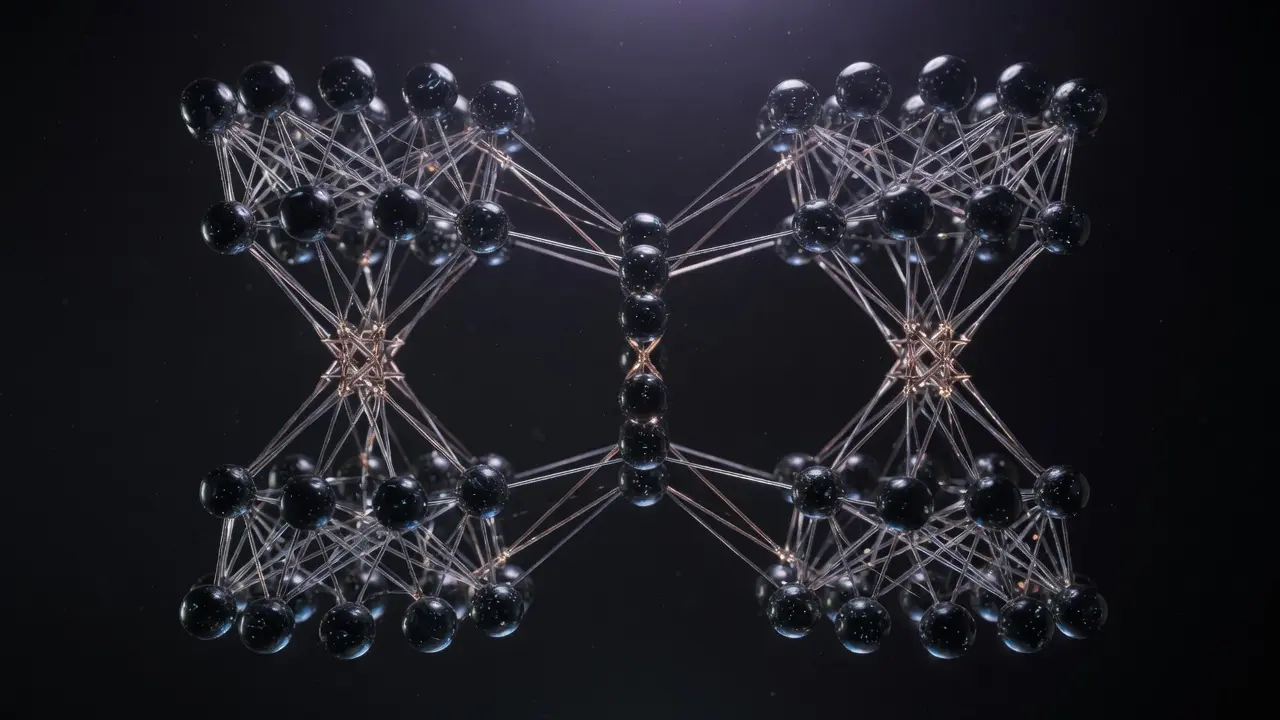
Quantum memories now simultaneously store information and sense external forces, overcoming previous fundamental trade-offs. A system using finite-energy bosonic codes enables an oscillator to protect a qubit while measuring weak displacements from outside influences. Quantum memories can simultaneously store information and detect external forces, functions that were previously mutually exclusive. They achieve this by encoding data across multiple parts of an oscillator, a system exhibiting rhythmic motion, and capturing force signals in its internal component.
This approach allows for the detection of weak influences without compromising the stored quantum state, even with continuous energy loss from the system. Finite-energy bosonic codes spread out data across many particles in a specific pattern to minimise errors, allowing an oscillator to protect data while measuring subtle shifts caused by outside influences. Encoding logical parts of the information into distinct sections of an oscillating system captures force signals within its workings, enabling detection without compromising stored data despite inevitable signal degradation due to energy loss, similar to listening to music through static.
Decoupling Quantum Memory Protection From Continuous Force Sensing
Memory infidelity, a measure of how accurately quantum information is stored, has been reduced to O(γr+1), representing a major leap in the stability of quantum memories. Previously, simultaneously sensing external forces and protecting encoded qubits was fundamentally incompatible due to inherent trade-offs between measurement sensitivity and error suppression. This breakthrough involved encoding logical qubit amplitudes across multiple wave packet sites within an oscillator while capturing force signals in a shared internal coordinate, effectively decoupling protection from continuous probing.
The new approach allows for exact state-independent readout even with photon loss, important for maintaining data integrity during sensitive measurements, and minimizes residual correlations between memory and probe states down to O(γr+2). Benchmarks using superconducting circuits revealed that the six-packet code yielded the lowest error rate at 20 microseconds with an entanglement fidelity exceeding 99.99%, balancing dephasing suppression and Kerr sensitivity, a non-linearity affecting signal accuracy. Even after applying ‘Kerr reversal’ techniques to correct distortions, this six-packet code continued to outperform other encodings at longer durations of up to 80 microseconds.
Finite Energy Bosonic Codes Isolate Qubit Amplitudes Across Oscillator Wave Packets
The technique of ‘finite-energy bosonic codes’ was employed, akin to spreading a secret message across many particles in a specific pattern; it protects fragile quantum information by distributing it rather than concentrating it in one place. Logical parts representing the actual data being stored were encoded across distinct wave packet sites within an oscillating system, imagine dividing sections of a vibrating string to hold different pieces of information.
Any external force acting on the oscillator is captured not *within* these data-holding packets but instead in a shared internal component, effectively isolating signal from noise and allowing for accurate measurement without disturbing the protected qubit.
Their code utilised (2r+2) packets. This decoupling enables continuous probing without compromising data protection, addressing challenges faced by alternative methods that struggle with trade-offs between detecting weak signals and suppressing errors. The approach allows exact state-independent readout under photon loss; further investigation revealed benefits plateau as they increase the number of wave packets encoding data.
Wave Packet Encoding Balances Quantum Protection with Force Sensitivity
A team from Nanjing University and collaborating institutions successfully built a system where fragile quantum information can be both protected *and* used to detect incredibly faint external forces, this is vital for building more stable and sensitive quantum sensors capable of probing previously inaccessible phenomena. However, increasing the number of wave packets appears to yield diminishing returns on investment beyond a certain point. Despite this limitation, their achievement remains significant: they’ve demonstrated a working system that simultaneously safeguards delicate quantum data *and* measures tiny forces, a feat previously thought difficult to achieve.
Information in this new approach is encoded across multiple ‘wave packets’, essentially splitting it into parts to protect against disruption from external noise or errors during processing. This technique allows for continuous probing without compromising data protection by distributing fragile quantum information rather than concentrating it in one place.
Researchers demonstrated that a single oscillator could both detect an external force *and* actively protect an unknown qubit using finite-energy bosonic codes. This is important because sensing and error correction typically create opposing demands on the system, sensors need to register weak signals, while codes usually suppress them as errors.
By encoding information across (2r+2) wave packets and separating the force signal, they achieved readout independent of logical state under photon loss γ, suppressing memory infidelity to O(γr+1). The authors identified preferred encoding regimes for implementation with superconducting quantum circuits based on benchmarks against dephasing and nonlinearity.
👉 More information
🗞 Force Sensing in a Recoverable Bosonic Quantum Memory
✍️ Tairong Bai, Wen Zheng, Haoyang Cai, Xianke Li, Yangyang Ge, Kun Zhou, Xiangmin Yu, Yu Zhang, Shaoxiong Li, Xinsheng Tan, Jie Zhao and Yang Yu (Nanjing University)
🧠 ArXiv: https://arxiv.org/abs/2610.39208



See today’s quantum computing news on Quantum Zeitgeist for the latest breakthroughs in qubits, hardware, algorithms, and industry deals.