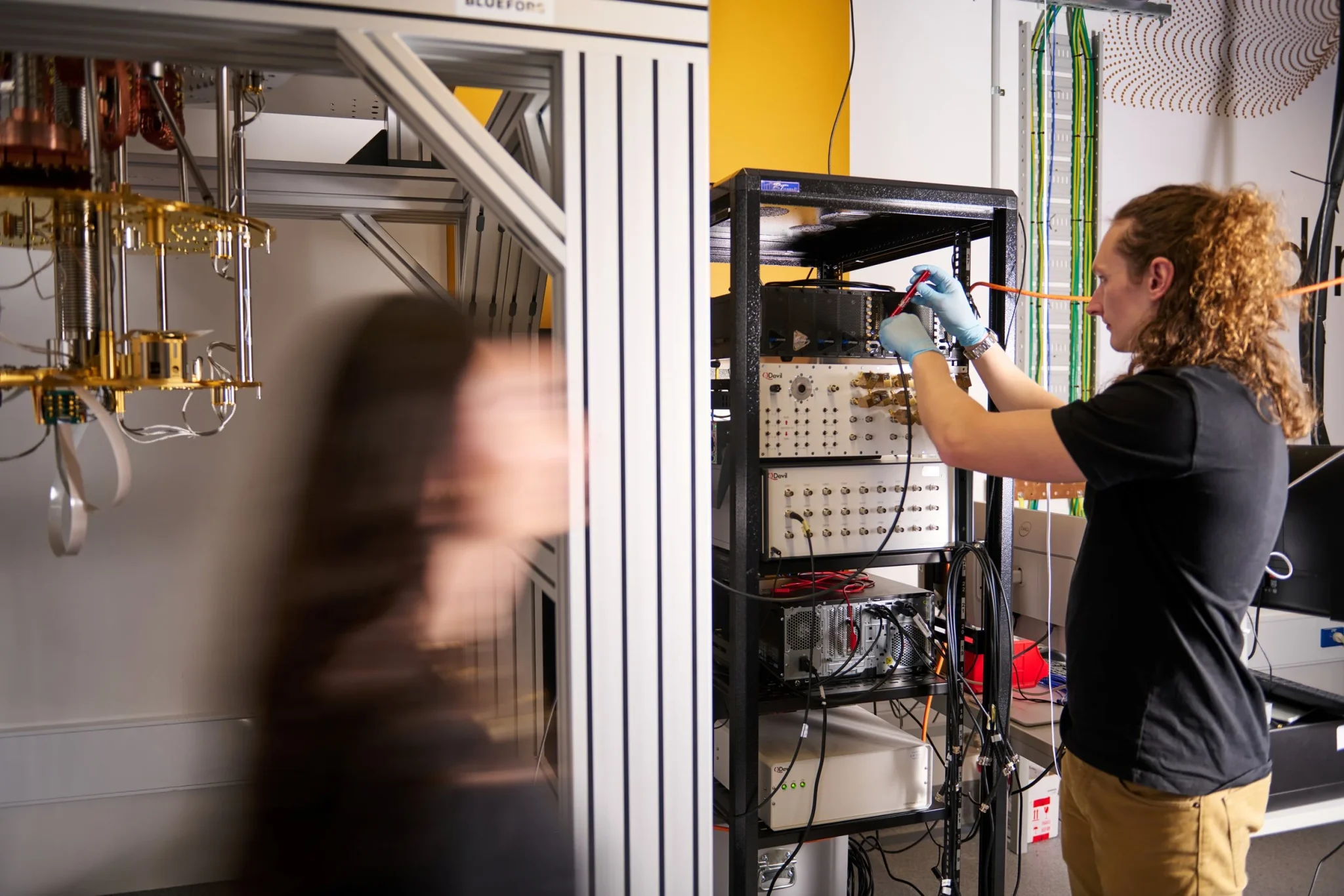
Dell Technologies has deployed a high-performance computing cluster directly inside Diraq’s Sydney laboratory, forging a uniquely close link between quantum processing and classical infrastructure. This co-location is designed to overcome latency challenges inherent in many quantum workflows, particularly for Diraq’s silicon spin qubits which operate at very high speeds.
“We’re working with Dell to create integrated systems that call classical AI and CPUs for the big number crunching,” explains Diraq CEO and Founder Andrew Dzurak, “Then, when there’s a specific hard problem, you call the quantum processing unit.” The collaboration aims to demonstrate how tightly integrated classical compute can support real-time quantum operations.
Co-Located System Validates Low-Latency Quantum-Classical Connectivity
Initial tests within the co-located system have validated baseline latency figures important for hybrid quantum-classical workflows, confirming Dell’s HPC infrastructure and Diraq’s quantum processor can operate as a single coordinated computing environment. This setup isn’t simply about connecting two machines, but about minimizing the time it takes for information to travel between them, a critical factor in complex quantum computations. The collaboration extends beyond hardware integration to focus on orchestration, adapting Dell’s existing capabilities to manage task distribution between classical servers and the quantum processor.
This orchestration layer translates workloads into sequences combining classical computation with quantum operations, scheduling them efficiently and collecting results without bottlenecks. Automated qubit calibration and tuning represent an early use case, where classical resources analyze data and rapidly adjust the quantum device, demonstrating a practical application of the integrated system.
Diraq’s approach to qubit fabrication, building silicon spin qubits on standard CMOS foundry lines, is central to its vision of scalable quantum computing, the company says. The company aims to fit millions of qubits on a single chip, allowing a single cryogenic refrigerator to house a utility-scale quantum computer that can be integrated seamlessly into data centers worldwide. This strategy contrasts with architectures requiring extensive external control systems, as Diraq believes increasing on-chip qubit density is the limiting factor, not qubit quality itself.
The company’s partnership with NVIDIA saw Diraq and NVIDIA collaborate in October 2025, a partnership focused on low-latency hybrid links. “It’s vital that we create hybrid systems with quantum computers working alongside high-performance AI,” Dzurak emphasized, “The type of problems that quantum computers are going to be really good at are actually too difficult for AI.” Exploring potential applications, the team is analyzing areas like drug discovery, where both AI and simulation place significant demands on classical computing. This work aims to identify scenarios where quantum acceleration, integrated into existing HPC workflows, can complement, rather than replace, classical methods.
The collaboration also examines large-scale optimization problems in logistics, supply chains, and financial modeling, areas where classical algorithms struggle with exponential complexity. “The really complex problems in the world need systems that bring different types of compute together,” said John Roese, Dell Global CTO and Chief AI Officer, highlighting the potential for synergistic computing. Diraq, having recently opened a U.S. tech hub in Los Angeles and assembled a 20-person team on August 25, 2026, is actively expanding its capabilities to support these hybrid workflows and deliver on the promise of scalable, integrated quantum-classical systems.
We’re working with Dell to create integrated systems that call classical AI and CPUs for the big number crunching.
Andrew Dzurak, Diraq’s CEO and Founder
Dell Orchestration Adapts HPC for Hybrid Quantum Workflows
Dell has deployed a small, dedicated high-performance computing cluster directly within Diraq’s Sydney laboratory, establishing a unique test environment for co-located quantum and classical computation. This physical proximity, rather than relying on remote access, is central to minimizing latency, a critical factor for many quantum workflows, and allows for evaluation of real-time operations without performance bottlenecks. “Once we have viable, cost-effective, at-scale quantum systems, it changes everything,” said Dzurak.
Diraq’s roadmap states a target of integrating over two million silicon spin qubits on a single chip by 2031, a stated goal that relies on continued advancements in CMOS manufacturing techniques. “We’re getting closer to real systems, and it’s great to see the focus on qubits that can be democratized around the world, and can actually solve problems at scale,” Dzurak added. Beyond technical validation, Diraq and Dell are actively exploring potential hybrid quantum-classical applications, including drug discovery, where both AI-driven simulations and quantum acceleration could offer significant benefits, according to the company.
“The term of the day is hybrid quantum-classical computing,” said Roese. “Generative AI was a big deal,” Dzurak stated. “Quantum is potentially a bigger deal because it will build on the shoulders of giants.”
It’s vital that we create hybrid systems with quantum computers working alongside high-performance AI.
Andrew Dzurak, Diraq’s CEO and Founder
Silicon Qubits Enable Scalable, Data Center Integrated Quantum Computing
The co-location of Dell Technologies’ high-performance computing infrastructure within Diraq’s Sydney laboratory isn’t a remote connection, but a physical integration designed to minimize latency, an important factor for many quantum applications. Diraq’s silicon spin qubits, notable for their operational speed, demand rapid communication with classical control systems, and this setup allows evaluation of real-time performance without bottlenecks, the firm reports.
This work aims to prove quantum processors can be integrated using existing data center practices, avoiding the need for entirely new operational models. Diraq’s recent expansion to Chicago, aiming for thousands of qubits by 2029, and the opening of a U.S. tech hub in Los Angeles on August 25, 2026, assembling a 20-person team, demonstrate a commitment to scaling operations beyond Australia.
The company, founded in 2022 and now employing about 130 people, has raised US$140M+ in funding, and is one of only 11 companies selected for Stage B of DARPA’s Quantum Benchmarking Initiative. Diraq also signed a letter of intent with the US Department of Commerce for up to $38 million, representing a stated intention rather than funds received. This integrated approach, combining silicon qubits with established HPC infrastructure, positions Diraq to deliver scalable quantum computing solutions for complex challenges.
The term of the day is hybrid quantum-classical computing.
John Roese, Dell Global CTO and Chief AI Officer



See today’s quantum computing news on Quantum Zeitgeist for the latest breakthroughs in qubits, hardware, algorithms, and industry deals.