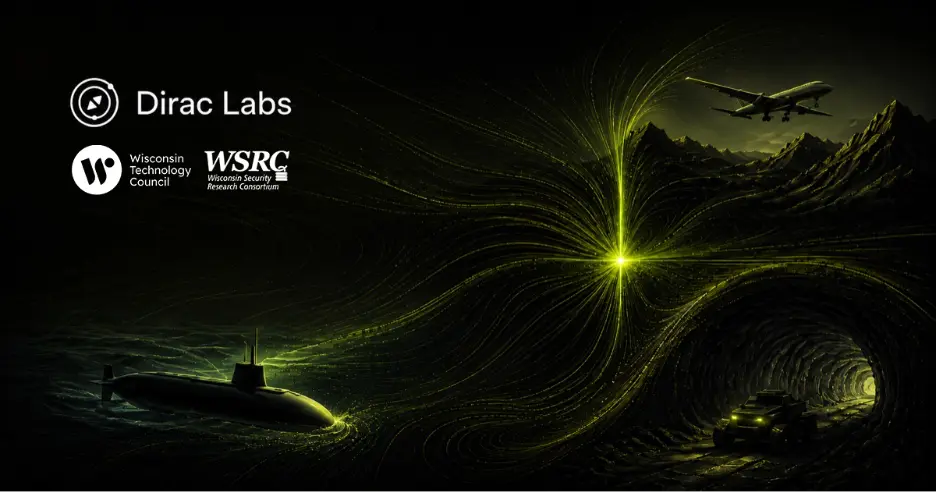
Lake Michigan is being proposed as “Area 52,” a secure testing ground for Navy autonomous systems, because of its unique position as the only Great Lake entirely within U.S. territory and its existing restricted military airspace. Retired U.S. Navy captain Jerry Hendrix initially proposed the initiative, mirroring the Air Force’s Area 51, to create a safe environment for developing unmanned platforms away from potential surveillance.
Dirac Labs, a University of Wisconsin-Madison spinout, will contribute its quantum universal positioning system to the Wisconsin Security Research Consortium, offering resilient navigation in environments where GPS fails; “Assured PNT is no longer a niche requirement,” says Dorota Grejner-Brzezińska, Vice Chancellor for Research at the University of Wisconsin-Madison, “It’s a prerequisite for operating in contested environments.”
Wisconsin Security Research Consortium Integrates Dirac Labs’ Quantum Navigation
Dirac Labs’ affiliation with the Wisconsin Security Research Consortium (WSRC) will accelerate the deployment of its quantum-based positioning system for use in challenging environments. The Madison-based company’s technology measures Earth’s magnetic field with extreme precision, offering a passive and resilient alternative to GPS that cannot be jammed or spoofed. This capability directly addresses a critical need for autonomous maritime missions, particularly for platforms operating underwater or in areas with limited GPS access. The integration builds on the Autonomous Heartland initiative, aiming to establish Wisconsin as a hub for autonomous and maritime technology.
WSRC, led by the Wisconsin Technology Council, connects universities, manufacturers and government partners to encourage defense research and economic development. “As the Great Lakes become a proving ground for autonomous maritime systems, having GPS-independent navigation developed right here in Madison is a real win for Wisconsin and for the nation.” This collaboration is also closely tied to the Area 52 initiative, a proposed secure testing ground on Lake Michigan for Navy autonomous and unmanned platforms.
Lake Michigan’s unique characteristics, being entirely within U.S. Maggie Brickerman, president of the Wisconsin Technology Council, explained that “Area 52 is more than a test range concept; it’s an economic development strategy for the state.” She continued, “When a quantum navigation company spun out of UW–Madison chooses to grow in Wisconsin and contribute to that effort, it validates what we’ve been telling federal partners: the research, the talent, and the industrial base are already here. Our job is to keep connecting them.” Dirac Labs’ sensors are designed for smooth integration into existing systems, connecting through standard GPS ports to avoid costly platform re-engineering. The company is also prioritizing scalability by designing its sensors to be manufactured using established semiconductor foundry infrastructure, unlike many quantum sensing technologies.
Sanket Deshpande, co-founder and CEO of Dirac Labs, emphasized the importance of this approach. “The platforms that need precise navigation the most — submarines, subsurface systems, and uncrewed vehicles operating under jamming — are exactly the ones GPS can’t serve,” he said. The company’s technology addresses a growing concern within the Department of Defense regarding the vulnerability of GPS to jamming and spoofing.
The absence of reliable positioning, navigation, and timing (PNT) data impacts not only military operations but also commercial applications in fields like mining, ocean science and autonomous infrastructure monitoring. “Dirac Labs was born in a UW–Madison lab, and joining WSRC connects us to the researchers, federal sponsors, and mission owners who understand that problem firsthand,” Deshpande added.
“It gives us a direct path to move our sensors from prototypes to the field, with Wisconsin partners alongside us.” The WSRC’s support will be instrumental in transitioning Dirac Labs’ technology prototypes to real-world deployments, solidifying Wisconsin’s position in the rapidly evolving field of autonomous systems and secure navigation.
Area 52 is more than a test range concept; it’s an economic development strategy for the state.
Maggie Brickerman, president of the Wisconsin Technology Council, which leads WSRC
Source: https://www.diraclabs.com/



See today’s quantum computing news on Quantum Zeitgeist for the latest breakthroughs in qubits, hardware, algorithms, and industry deals.