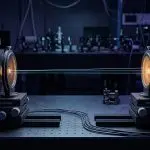
IonQ’s Superion 256 quantum computer will be the first quantum processing unit installed at NVIDIA’s Accelerated Quantum Research Center, marking the first on-premise quantum deployment for the facility. The installation will directly link the IonQ system with an NVIDIA GB200 NVL72 system via NVIDIA NVQLink, with workloads managed by the open NVIDIA CUDA-Q platform.
“Every supercomputer will become a quantum supercomputer,” said Timothy Costa, vice president and general manager for quantum at NVIDIA. This collaboration aims to accelerate the development of scalable quantum supercomputers capable of tackling complex challenges across fields like finance, materials science, and drug discovery.
Superion 256 QPU Integrates with NVIDIA’s GB200 NVL72 System
This integration is not merely co-location; the Superion 256 will connect via NVIDIA NVQLink, a high-bandwidth, low-latency interface designed to facilitate rapid data exchange between quantum and classical processors. The resulting hybrid system will initially focus research on areas including financial services portfolio optimization, materials science, and drug discovery through computational chemistry, complex challenges expected to benefit from the combined resources.
NVIDIA’s commitment to this integration extends beyond hardware, with workloads orchestrated by the open NVIDIA CUDA-Q platform. This platform, bolstered by recent advancements like the cudaq-algorithms library launched on May 14, 2026, provides a shared framework for quantum-GPU co-design and supports open-source development.
NVIDIA reported on July 28, 2026, a quantum calibration model functioning across six qubit modalities, further illustrating its investment in diverse quantum technologies. IonQ anticipates first customer deliveries of the Superion 256 in 2027, with installation at the NVAQC scheduled for next year, signaling a phased approach to scaling quantum-classical hybrid computing. Niccolo de Masi, IonQ Chairman and CEO, stated that deploying their Superion 256 into environments like NVIDIA’s NVAQC will benefit partners through the scalable architecture and robust manufacturability of the system.
Every supercomputer will become a quantum supercomputer.
Timothy Costa, Vice President and General Manager for Quantum at NVIDIA
NVAQC Advances Hybrid Quantum-Classical Computing Research
This connection bypasses conventional data transfer bottlenecks, enabling sub-microsecond communication between the quantum processor and NVIDIA’s GPU infrastructure, a critical factor for hybrid algorithm development. Researchers aim to prototype large-scale systems and generate open-source results guiding future quantum-GPU co-design, extending beyond proprietary solutions.
The company views this partnership as a catalyst for a new era in computing, anticipating multiple generations of Superion systems will realize the potential of NVIDIA’s AI platforms. This era will be unlocked by multiple generations of Superion systems and NVIDIA’s industry-leading AI platforms,” de Masi continued.
Generative AI and Quantum Algorithms Solve Optimization Challenges
Generative AI’s potential to accelerate quantum computing extends beyond algorithm development, as demonstrated by a recent study using NVIDIA’s CUDA-Q platform. That research introduced a framework combining generative AI with distributed quantum algorithms specifically designed to tackle complex combinatorial optimization challenges, a critical step toward practical quantum applications. These complex use cases demand computational power exceeding the capabilities of current classical systems, and the combined strengths of IonQ’s quantum hardware and NVIDIA’s AI infrastructure offer a potential solution.
The Superion 256 is available for order now, with initial customer deliveries expected in 2027, signaling a move toward wider accessibility of advanced quantum computing resources. Installation at NVAQC is scheduled for next year.



See today’s quantum computing news on Quantum Zeitgeist for the latest breakthroughs in qubits, hardware, algorithms, and industry deals.