⚡ QC News

The latest news and developments in quantum computing
Quantum Zeitgeist Weekly Digest
Technology News September 5, 2026

Quantum Zeitgeist Weekly Digest

Welcome to this week’s quantum technology digest. This compilation covers advances across hardware development, software tools, and early applications of quantum computing. Several articles demonstrate IBM’s continued leadership, with updates to its processors, error mitigation techniques, and simulation capabilities.
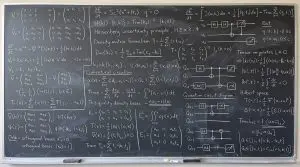
A blackboard of quantum circuit diagrams and matrix algebra
Quantum Computing September 5, 2026

Quantum Measurement, How Reading a Qubit Works

Quantum measurement pulls one classical answer out of a quantum state, and the Born rule of 1926 gives each outcome a probability equal to the squared magnitude of its amplitude. Readout fidelities are quoted above ninety-nine percent, and readout speed sets how fast an error-correction cycle can turn, so hardware teams spend more effort on it than on the qubits.
A blue lattice of qubits on the left fragmenting into streams of binary and error messages on the right
Quantum Features September 5, 2026

The Steane Code Explained

Andrew Steane's 1996 code uses a classical Hamming code from 1950 twice, once for bit flips and once for phase flips, so seven physical qubits protect one logical qubit. Its cheap gates alone cannot compute anything a classical machine cannot, and the T gate that fills the gap comes from magic state distillation, the largest cost in any fault-tolerant design.
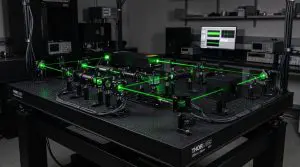
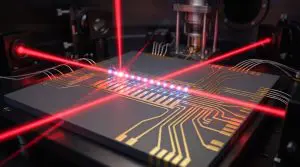
A complex optical setup is displayed on a dark table in a laboratory setting, dominated by green laser beams.
Quantum Features September 5, 2026

How Do Photonic Quantum Computers Work?

Photonic quantum computers encode a qubit in a single particle of light, steer it through a programmable maze of glass and count it with superconducting detectors, and the chips come off ordinary 300 millimetre semiconductor lines. As of mid-2026 no photonic platform has demonstrated a peer-reviewed logical qubit, and PsiQuantum's Nature paper puts fault tolerance at millions of physical qubits.
What Now For Quantum Stocks?
Technology News September 5, 2026

What Now For Quantum Stocks?

Five years ago this month, a quantum company rang the opening bell on a US exchange for the first time. That company was Arqit, a British quantum encryption firm briefly valued at close to $3 billion, now valued considerably less. Seven pure-play quantum computing companies have followed it onto American markets since, and between them they have produced a five-year record that deserves closer inspection.
A roulette wheel with the ball settling into a numbered pocket
Technology News September 5, 2026

Edward Thorp, The Man Who Beat The Odds

Edward Thorp used the Kelly criterion, derived from Claude Shannon's information theory, to beat blackjack in Beat the Dealer in 1962 and then to run Princeton/Newport Partners for nearly twenty years. He is not a quantum scientist, and his rule of staking only a measured edge is awkward to apply to a technology whose odds are still moving.
A sprawling node-and-edge graph with one gold path traced through it
High Performance Computing September 5, 2026

NVIDIA speeds up financial clustering with GPU factorization

Quant strategies group instruments for portfolio construction, risk aggregation, statistical arbitrage, and trade surveillance, but incorrect groupings can obscure risk and fail under stress. AdaptGrow, a GPU-accelerated matrix factorization algorithm, turns correlation and tail-dependence matrices into clusters and factor loadings at single-GPU and multi-node scale.
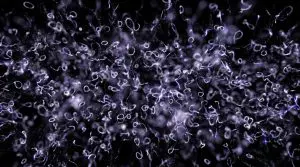
This microscopic view shows numerous, elongated cells suspended in a dark background with a predominantly purple and grey colour palette.
Quantum Research News September 4, 2026

Researchers Image Spatial Vacuum Fluctuations of a Quantum Field

Directly visualising the inherent uncertainty within empty space has long remained an elusive goal. Now, images from a Bose, Einstein condensate reveal spatial patterns arising from quantum vacuum fluctuations, a feat previously limited to observing their indirect effects via electromagnetic sampling. This system uniquely emulates a massive relativistic sine-Gordon field, enabling laboratory studies beyond current theoretical capabilities.