
NVIDIA is enabling financial firms to analyze market dependencies at a scale using AdaptGrow, a GPU-accelerated matrix factorization algorithm, the company says. The technology allows for the creation of financial instrument clusters from rolling correlation and tail-dependence matrices, moving beyond traditional methods limited to This pipeline produces “hard clusters, soft factor loadings, and structural-break signals,” separating routine variation from actual structural change, a critical distinction for accurate risk assessment and trade strategy.
AdaptGrow converged in 13.0 seconds on correlation and 12.4 seconds on TPDM when tested on a 100,000-instrument matrix distributed across three seeds in FP32. Scaling to one million instruments required 64 GB200 GPUs across 16 nodes, completing individual correlation factorization and tail-dependence factorization measurements. The result, according to NVIDIA, scales from a single GPU to multi-node infrastructure without changing the solver interface.
GPU Factorization Enables Financial Instrument Clustering at Scale
AdaptGrow, a GPU-accelerated matrix factorization algorithm developed by NVIDIA, now processes dependence matrices containing up to one million financial instruments, exceeding the capabilities of traditional methods limited to moderate scales. This advancement addresses a core bottleneck in quantitative strategy development, where grouping instruments is essential for portfolio construction, risk aggregation, and trade surveillance.
The algorithm’s efficiency stems from a trace-based formulation that reduces peak storage requirements from approximately 20n² bytes to 4n² bytes, plus smaller factor buffers, where ‘n’ represents the number of instruments. The need for increased scale arises from the computational demands of analyzing financial dependencies; a dense, single-precision floating-point dependence matrix requires roughly 40 gigabytes for 100,000 instruments and escalates to four terabytes for one million instruments.
While hard clustering methods offer computational speed, they struggle to accurately represent complex market relationships, particularly at sector boundaries and when assessing graded exposures relevant to risk budgeting. These methods assign each instrument to a single group, potentially obscuring nuanced connections.
Soft factorization techniques, such as SymNMF, address these limitations by providing factor loadings that reflect the degree to which an instrument belongs to a particular cluster, but historically faced scalability issues with dense matrix objectives. The algorithm’s ability to identify structural breaks in market dependencies is particularly valuable. Researchers can now separate routine market variation from genuine shifts in relationships between financial instruments, improving the accuracy of risk assessment and trade strategy development.
This is achieved through a dynamic adjustment of the algorithm’s parameters, guided by the eigenvalue spectrum of the dependence matrix. Specifically, the algorithm seeds its initial parameters from the gap between eigenvalues. An approximate average reciprocal index (ARI) of 0.83 was achieved when compared to SymNMF on well-separated correlation matrices. For practical implementation, the team recommends replacing synthetic data generators with actual returns tables, while maintaining the same windowing, dependence estimation, factorization, and monitoring stages.
Initial analysis should focus on inspecting leading eigenvalues from a representative window to determine the optimal number of clusters, ‘k’, at the point of clearest separation between signal and noise. Maintaining a fixed ‘k’ across subsequent windows ensures comparability of stability scores. Lavinia Ghita, a solutions architect manager at NVIDIA, notes her work focuses on large-scale AI systems, with emphasis on distillation methods, domain-adaption techniques and model compression methods for efficient AI pipelines.
Her research also covers foundation‑model architectures for time‑series analysis and the development of general methods for modeling structure and latent dynamics in temporal processes, the documentation states. The source repository and clustering_through_time. ipynb notebook are available at NVIDIA/SymNMF-factors, allowing other researchers to replicate and extend these findings.
Memory-Efficient SymNMF Formulation Scales to 100,000 Instruments
A memory-efficient formulation of SymNMF now permits factorization of dependence matrices containing up to 100,000 financial instruments on a single NVIDIA GB200 GPU, overcoming a historical limitation of dense matrix objectives. Previously, such implementations were restricted to problems with moderate instrument counts, hindering analysis at realistic scales; the new approach reduces peak storage requirements from approximately 20n² bytes to 4n² bytes, a substantial decrease for large datasets.
This optimization is achieved through a trace-based formulation that eliminates intermediate calculations, streamlining the process and conserving valuable memory resources. The workflow underpinning this advance constructs inputs from rolling return windows, utilizing both Pearson correlation for broad co-movement and the tail pairwise dependence matrix (TPDM) to capture joint behavior during extreme market observations.
SymNMF represents each instrument as a row of nonnegative factor loadings, offering a soft representation of relationships; applying an argmax function to these loadings generates hard cluster labels when discrete groupings are desired. AdaptGrow, a single adaptive solver, manages both correlation and tail-dependence inputs by dynamically selecting between full-batch and block-stochastic gradients based on the eigenspectrum, removing the need for manual solver selection or tuning.
This unified approach simplifies the pipeline and enhances its adaptability to varying input structures. For problems exceeding the capacity of a single GPU, a distributed implementation row-shards the dependence matrix, reducing communication complexity to O(nk) rather than O(n²), and enabling factorization of one million instruments. This scaling capability is crucial for analyzing increasingly complex financial landscapes and extracting meaningful insights from vast datasets.
The resulting pipeline delivers not only hard cluster labels and soft factor loadings but also structural-break signals, allowing analysts to identify shifts in market dynamics and adapt their strategies accordingly, according to NVIDIA. SymNMF, by retaining soft factor loadings, avoids this issue, providing a more complete and informative representation of instrument dependencies. In such scenarios, a hard spherical partition becomes unstable, while SymNMF continues to provide interpretable soft and hard clustering results.
This ability to handle flat spectra is critical for analyzing tail dependence, where extreme events often drive the most significant market movements. “SymNMF retains graded factor loadings in H, which is the useful output when hard cluster labels are no longer well defined,” the researchers explain, emphasizing the method’s robustness in challenging conditions. In a synthetic experiment, the TPDM revealed cross-sector dependence among stressed sectors that was muted in the correlation matrix, even though the hard cluster labels remained unchanged.
This highlights the complementary nature of the two inputs and the ability of SymNMF to uncover hidden relationships. This open-source approach encourages collaboration and accelerates the development of advanced financial modeling techniques, ultimately enabling more informed decision-making in complex and dynamic markets.
NVIDIA Acceleration Optimizes Pipeline Stages with cuBLAS & NCCL
This optimization is critical because a dense FP32 dependence matrix demands roughly 40 GB for 100,000 instruments, escalating to 4 TB for 1 million instruments, a scale previously prohibitive for single-GPU processing. NVIDIA acceleration is integrated throughout the entire pipeline, using specialized libraries to maximize performance at each stage. PyTorch dispatches the dominant single-high precision (SH) matrix multiplications to cuBLAS, a highly optimized BLAS library for NVIDIA GPUs, the firm reports.
The cuSOLVER library then performs the spectral probe used for rank and solver selection, a crucial step in determining the optimal parameters for the factorization process. Optional Parquet ingestion and preprocessing are handled by cuDF, allowing these operations to remain on the GPU and avoid costly data transfers. For deployments requiring even greater scale, PyTorch Distributed row-shards the S matrix while maintaining a replica of the H matrix on each worker node.
This distributed approach, combined with NVIDIA’s NCCL library, allows for efficient communication. NCCL facilitates all-gathers of the row-sharded S·H products and all-reductions of the gradients, ensuring that communication scales with O(nk) data rather than the full O(n²). This reduction in communication overhead is vital for achieving high performance across multiple nodes. The environment is packaged as an NVIDIA NGC PyTorch container with cudf-cu13, streamlining deployment and ensuring compatibility with NVIDIA’s software ecosystem.
In testing, a 100,000-instrument matrix was distributed across four GB200 GPUs for accelerated execution, though the input data itself fit on a single GB200. Scaling to 1 million instruments, where the 4 TB matrix was row-sharded across 64 GB200 GPUs, demonstrated the system’s ability to handle truly massive datasets.
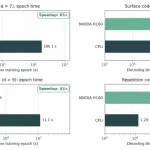
Full-batch AdaGrad completed the correlation factorization in approximately 2 minutes, while AdaptGrow completed the tail-dependence matrix factorization in approximately 4 minutes, NVIDIA reports. These results highlight the efficiency gains achieved through GPU acceleration and distributed computing. These are individual factorization measurements, not end-to-end timings for all 250 temporal windows. The million-instrument results represent separate distributed scale tests and require infrastructure comparable to the published configuration.
The repository’s scripts, specifically scripts/run_distributed.py, configure multi-node execution using either torchrun or Slurm, providing flexibility for different computing environments. Detailed deployment instructions are available in scripts/README.md. Dhruv Desai, a senior solutions architect at NVIDIA focusing on capital markets, explains that his background spans quantitative finance and applied ML/AI research, by the company’s account. Prior to NVIDIA, Desai worked at BlackRock and Vanguard. Lavinia Ghita’s research focuses on large-scale AI systems, with emphasis on distillation methods, domain-adaption techniques and model compression methods for efficient AI pipelines.
Synthetic Data Validates Clustering and Stress-Event Detection
The use of synthetic data proved crucial in validating AdaptGrow’s ability to detect structural breaks in financial instrument dependencies, a capability previously difficult to assess with real-world market data alone. Researchers generated a dataset with a known shift in underlying relationships to rigorously test the algorithm’s performance, establishing a benchmark for identifying genuine changes in market behavior versus typical fluctuations.
This approach allowed for precise measurement of the approximate average reciprocal index (ARI), tracking how consistently instruments were grouped across rolling windows and revealing a clear drop when the synthetic reclassification event occurred, with baseline ARI values reaching approximately 0.93 for correlation and 0.80 for tail-dependence matrices. AdaptGrow’s success in this validation stems from its use of Symmetric Non-negative Matrix Factorization (SymNMF), which addresses limitations inherent in traditional hard clustering methods.
While computationally efficient, hard clustering assigns each instrument to a single group, a strategy that falters at sector boundaries and obscures the nuanced exposures vital for accurate risk budgeting, NVIDIA claims. SymNMF, in contrast, produces soft factor loadings, retaining graded exposures even when clear-cut cluster assignments are no longer appropriate, and enabling a more flexible approach to portfolio construction and risk management.
The validation process also highlighted the importance of rank selection in SymNMF, noting that synthetic data with a planted rank of 24 provided a clear eigenvalue gap for identification. However, the researchers caution that real-world data may not exhibit such a distinct separation, necessitating a combined approach that considers both spectral analysis and the interpretability and stability of the resulting clusters.
The workflow passes dependence matrices and selected rank to AdaptGrow, which returns factor loadings, with row-wise argmax producing hard cluster labels, and the ability to switch between full-batch AdaGrad and block-stochastic updates depending on input characteristics. This adaptability allows AdaptGrow to function effectively with both clean-gap and flat-spectrum inputs, broadening its applicability across diverse market conditions, NVIDIA says. Beyond simply identifying clusters, AdaptGrow’s output, soft loadings, hard labels, and stability diagnostics, supports a range of quantitative strategies.
These include statistical arbitrage, momentum signals, market-neutral portfolio construction, exposure control, and risk budgeting, all while providing a mechanism for detecting structural breaks in market dependencies. Spherical k-means remains a computationally efficient alternative when sectors are angularly well-separated and hard clusters suffice, but SymNMF offers a more versatile solution capable of delivering both soft and hard clustering results.
The team demonstrated AdaptGrow’s performance using 250 synthetic windows, comparing SymNMF against a spherical k-means baseline, and reproducing all results in a companion notebook. This notebook details the generation of the synthetic return stream, construction of rolling correlation and tail-dependence matrices, rank selection, and the derivation of both hard and soft cluster outputs. The resulting data can be used to calculate adjusted Rand index stability scores and detect the planted structural break, providing a comprehensive assessment of the algorithm’s capabilities.
His background, spanning quantitative finance and applied ML/AI research, informed the development of AdaptGrow and its focus on addressing real-world challenges in capital markets, according to NVIDIA. This experience underscores the growing demand for scalable and robust solutions in the financial industry, and AdaptGrow represents a step towards meeting that need.
The source repository, NVIDIA/SymNMF-factors, and the associated notebook provide a complete and reproducible workflow, allowing researchers and practitioners to explore the algorithm’s capabilities and adapt it to their specific needs. This combination of accessible code, detailed documentation, and rigorous validation positions AdaptGrow as a valuable tool for navigating the complexities of modern financial markets and identifying critical shifts in market behavior.
Source: https://developer.nvidia.com/blog/gpu-accelerated-clustering-for-financial-instruments-at-scale/



See today’s quantum computing news on Quantum Zeitgeist for the latest breakthroughs in qubits, hardware, algorithms, and industry deals.