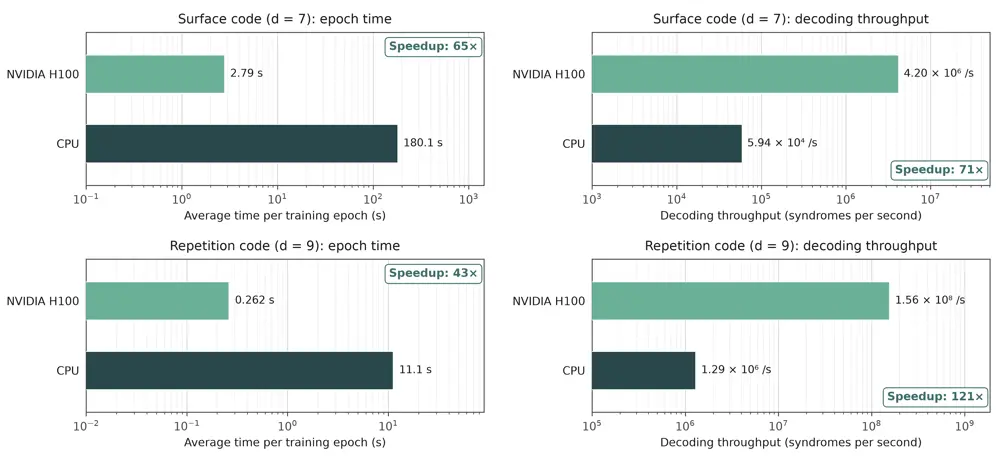
Riverlane is dramatically accelerating quantum error correction calibration by shifting a critical computational step to NVIDIA GPUs. Graph-based decoders, essential for identifying and correcting qubit errors, require regular updates to remain accurate as qubits change; as the team explains, “a decoder is only as good as its picture of the noise.” The company reports a single NVIDIA H100 GPU now completes a training epoch on the surface code in 2.8 seconds, a process that previously took three minutes on a single CPU core. This speedup addresses a key bottleneck where every moment spent recalibrating leaves the quantum device vulnerable to accumulating errors.
Riverlane’s Local Clustering Decoder Accelerated by NVIDIA H100 GPUs
Riverlane’s Local Clustering Decoder (LCD) now processes over four million surface-code syndromes per second, a rate achieved by using the computational power of a single NVIDIA H100 graphics processing unit. This performance represents a substantial reduction in calibration time for quantum error correction, shrinking a process that previously required three minutes to complete in under three seconds. The speedup addresses a critical challenge in maintaining decoder accuracy; as noise characteristics shift due to factors like temperature fluctuations and gate degradation, the decoder’s internal weights must be updated to reflect the evolving error landscape.
These weights are not static; they must be continuously refined to account for the dynamic nature of quantum systems. The team demonstrated a 65-fold acceleration in training epochs for surface code calibration using the H100, compared to a single CPU core and a 43-fold improvement when calibrating for repetition code experiments.
This means the system can more rapidly adapt to changes in qubit behavior, minimizing the window of vulnerability during the recalibration process itself, Riverlane says. While the H100 significantly accelerates the decoding step, the complete calibration epoch also includes tasks that remain CPU-bound, such as updating the decoder’s policy and constructing the candidate weights. On repetition codes, these overhead tasks currently consume a larger portion of the epoch time, highlighting the need for thorough optimization across the entire classical processing stack.
The team found that adding more GPU cores yields diminishing returns. 32 cores only achieved a 23-fold speedup compared to a single core, due to the increasing overhead of distributing and collecting results, according to Riverlane. This suggests that a balanced approach, combining GPU acceleration with specialized hardware for other tasks, may be the most effective path forward.
The adoption of GPUs for quantum error correction aligns with a broader trend of integrating these processors into the quantum control stack. Hardware vendors are now designing low-latency interconnects between quantum processors and GPUs, and NVIDIA has already released its own GPU-based decoders, including the Ising pre-decoder and belief propagation decoders. Google has also employed similar calibration methods in its Willow experiments, and groups at IBM and various academic institutions are actively developing their own noise-learning approaches, the company says.
As quantum systems scale to larger numbers of qubits, the complexity of calibration increases exponentially; more qubits necessitate the calibration of thousands of additional weights, and longer computation times exacerbate the effects of noise drift. Riverlane anticipates that decoder recalibration will become a key component of a heterogeneous classical architecture for quantum error correction.
This future architecture may use GPUs for learning and optimization tasks, while dedicated QEC systems, such as Deltaflow, provide the real-time processing required for fault-tolerant quantum computation. Deltaflow is designed to scale alongside quantum computers by combining specialized QEC hardware and software, recognizing that future fault-tolerant systems will require a mix of GPUs, FPGAs and ASICs to meet the increasing complexity of QEC workflows.
GPU-Based Calibration Reduces Surface Code Epoch Time by 65x
The calibration of quantum error correction decoders now occurs in 2. This acceleration stems from the decoder’s ability to process hundreds of thousands of syndromes simultaneously, a feat previously unattainable without substantial delays. The speedup isn’t merely about faster computation. It directly addresses the inherent vulnerability of quantum systems during the calibration process itself, minimizing the window where accumulating noise can corrupt data.
Beyond the overall epoch time, the GPU implementation delivers a 71-fold increase in decoding throughput for surface code experiments, reaching approximately 4.2 million syndromes decoded per second compared to roughly 59,000 on a CPU core. This raw decoding power is further amplified by the efficiency of the H100, which maintains a threefold speed advantage on surface codes even when using all 32 cores, while simultaneously freeing the CPU for other essential control tasks.
The gains extend to repetition codes as well, where the H100 achieves a 121-fold speedup in syndrome processing, reaching 155 million per second. The benefits of GPU acceleration extend beyond speed to the accuracy of the decoder itself. Each calibration epoch refines the decoder’s understanding of the specific noise characteristics of the quantum hardware, starting from either a generic noise model or a basic device estimate.
This iterative process, where candidate weights are tested against experimental data, results in a substantial reduction in logical error rate, with improvements ranging from several percent to a factor of two depending on the code used. “Each epoch, the loop tests a batch of candidate weights against experimental data and shifts towards the ones that give the lowest LER, so the prior gradually adapts to both the real hardware and the decoder using it,” explains the research.
The architecture of the decoder is key to this performance. By assigning a dedicated thread to each decoding instance, the system can process tens of thousands of shots in parallel within a single run. To maintain efficiency, edge weights are stored as 7-bit integers, a precision level sufficient for the surface code experiments conducted. This optimization minimizes memory usage without sacrificing accuracy, allowing for even greater parallelization.
The team’s work directly tackles a previously identified limitation of the method, runtime, reducing calibration from minutes to seconds and enabling routine recalibration between experiment runs, Riverlane reports. This shift towards routine recalibration is particularly important as quantum systems grow in complexity. As the number of qubits increases, so too does the number of weights that need to be calibrated, and the time required for noise to drift. This creates a scaling challenge that GPUs are uniquely positioned to address.
The process of recalibrating a decoder is fundamentally a learning problem, and the parallel processing capabilities of GPUs accelerate this learning process to a practical tempo. The adoption of these calibration methods is no longer confined to research labs. This convergence suggests a growing consensus on the importance of dynamic calibration for achieving reliable quantum computation. The result is a shrinking gap between characterizing the device and running the experiment, allowing for more training iterations and ultimately, better initial priors for error correction.
Learned Weights Improve Logical Error Rate for Quantum Processors
Calibration of decoder weights now benefits from a shift in computational location, allowing for more frequent updates and improved logical error rates. Riverlane’s approach uses the parallel processing capabilities of graphics processing units to accelerate a critical step in quantum error correction, specifically the decoding phase of the calibration loop.
This optimization directly addresses the challenge of maintaining an accurate decoder “prior”, its understanding of the noise affecting qubits, as the quantum processor operates. The speedup is significant because the calibration process must occur between data collection and the start of an experiment, meaning every moment spent recalibrating is time the device is idle and noise characteristics are changing.
The team’s work focuses on decoding as the most time-consuming element of the calibration loop, and by moving this onto a GPU, they have demonstrably reduced the time required to refine decoder weights, the company’s account states. “Calibration sits between characterising the device and running the experiment,” the researchers explain, noting that faster calibration ensures the decoder’s initial assumptions align with the actual noise present during operation.
The methodology relies on multi-agent reinforcement learning, where candidate weight sets are evaluated by decoding “sensors”, small distance-5 codes used as local probes of the error landscape. Each sensor’s performance, measured by its logical error rate, provides a reward signal that guides the learning process.
The GPU’s role is to accelerate the decoding of these training shots, enabling more iterations and ultimately, more accurate weights, Riverlane claims. The practical implications extend beyond improved performance within a single experiment. The adoption of GPU acceleration is also aligned with broader trends in quantum computing infrastructure. Hardware vendors and GPU manufacturers are increasingly integrating these processors directly into the quantum control stack, establishing low-latency interconnects to facilitate faster data transfer.
While GPUs offer a significant boost, the researchers acknowledge that a truly fault-tolerant quantum computer will require a more heterogeneous classical computing stack. They envision specialized systems handling different error-correction tasks, with GPUs playing an important role in accelerating the computationally intensive process of decoder calibration and weight optimization. The team’s work highlights the importance of a dynamic approach to error correction, where the decoder is continuously refined to match the evolving characteristics of the quantum hardware.

See today’s quantum computing news on Quantum Zeitgeist for the latest breakthroughs in qubits, hardware, algorithms, and industry deals.