⚡ QC News

The latest news and developments in quantum computing

This microscopic view shows numerous, elongated cells suspended in a dark background with a predominantly purple and grey colour palette.
Quantum Research News September 4, 2026

Researchers Image Spatial Vacuum Fluctuations of a Quantum Field

Directly visualising the inherent uncertainty within empty space has long remained an elusive goal. Now, images from a Bose, Einstein condensate reveal spatial patterns arising from quantum vacuum fluctuations, a feat previously limited to observing their indirect effects via electromagnetic sampling. This system uniquely emulates a massive relativistic sine-Gordon field, enabling laboratory studies beyond current theoretical capabilities.
A row of tall, light-grey classical columns lines a dark exterior staircase leading to a building entrance.
Quantum Research News September 4, 2026

Hse University Proposes New Coherent State Construction for Billiards

Coherent states in complex systems have traditionally demanded extensive computation or relied upon approximations that struggle with irregular boundaries. Now, a new mathematical technique offers an alternative by constructing these states without explicitly calculating eigenstates for certain geometries. This allows analytical solutions, utilising established functions like those of Jacobi and Riemann, for quantum billiards including one-dimensional wells and Coxeter shapes.
Adult learners at desks facing a whiteboard of faint diagrams
Artificial Intelligence September 4, 2026

OpenAI’s GPT-6 Astra masters advanced math, scores 98% on FrontierMath

GPT-6 Astra, bringing together years of research, is the world’s most intelligent and aligned model, state-of-the-art on computer use, browsing, software engineering, cybersecurity, science, and professional work. Astra saturates FrontierMath Tier 4 with a 98% score, having already helped solve long-standing open problems in mathematics.
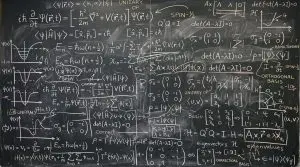
A chalkboard covered in complex quantum physics equations dominates the frame, set in a dimly lit room.
Quantum Research News September 4, 2026

Researchers Predict Stable Bosonic Ground State Despite Collapse Risk

Quantum collapse, the tendency of wave functions to destabilise under attractive forces, can now be suppressed by interparticle repulsion exceeding a critical value of one quarter. This work reveals how repulsive interactions not only prevent this collapse but also establish ground states where none previously existed. Furthermore, it demonstrates that even rapidly expanding potentials can sustain localised bound states, challenging conventional expectations.
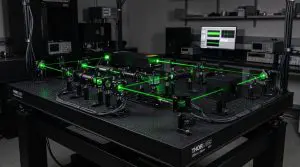
A complex optical setup is displayed on a dark table in a laboratory setting, dominated by green laser beams.
Deep Tech September 4, 2026

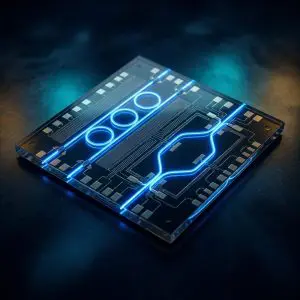
PhotonDelta’s photonic chips correct light distortion for faster imaging

Zhiyu Chen explored how optical functions can be implemented on photonic chips to overcome limitations of systems that control and measure light, such as those used for fast wireless communication and biomedical imaging. Photonic chips guide and process light, similar to how electronic chips process electrical signals, and Chen’s research focuses on controlling light through disordered media like biological tissue, correcting distortion for applications including imaging and sensing.
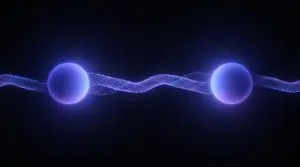
Two luminous purple spheres are connected by a flowing, wavy blue energy line against a dark background.
Quantum Hardware September 4, 2026

Researchers Detect Entanglement Patterns in 100-Qubit Systems

Can we accurately map how entangled multiple qubits are without measuring their complete state? This method now classifies block structures with over 95% accuracy across simulations involving up to 100 qubits, a substantial improvement upon previous techniques limited to classifying only 19. The protocol successfully identifies these arrangements within superconducting processors containing up to 13 qubits before limitations arise from noise.