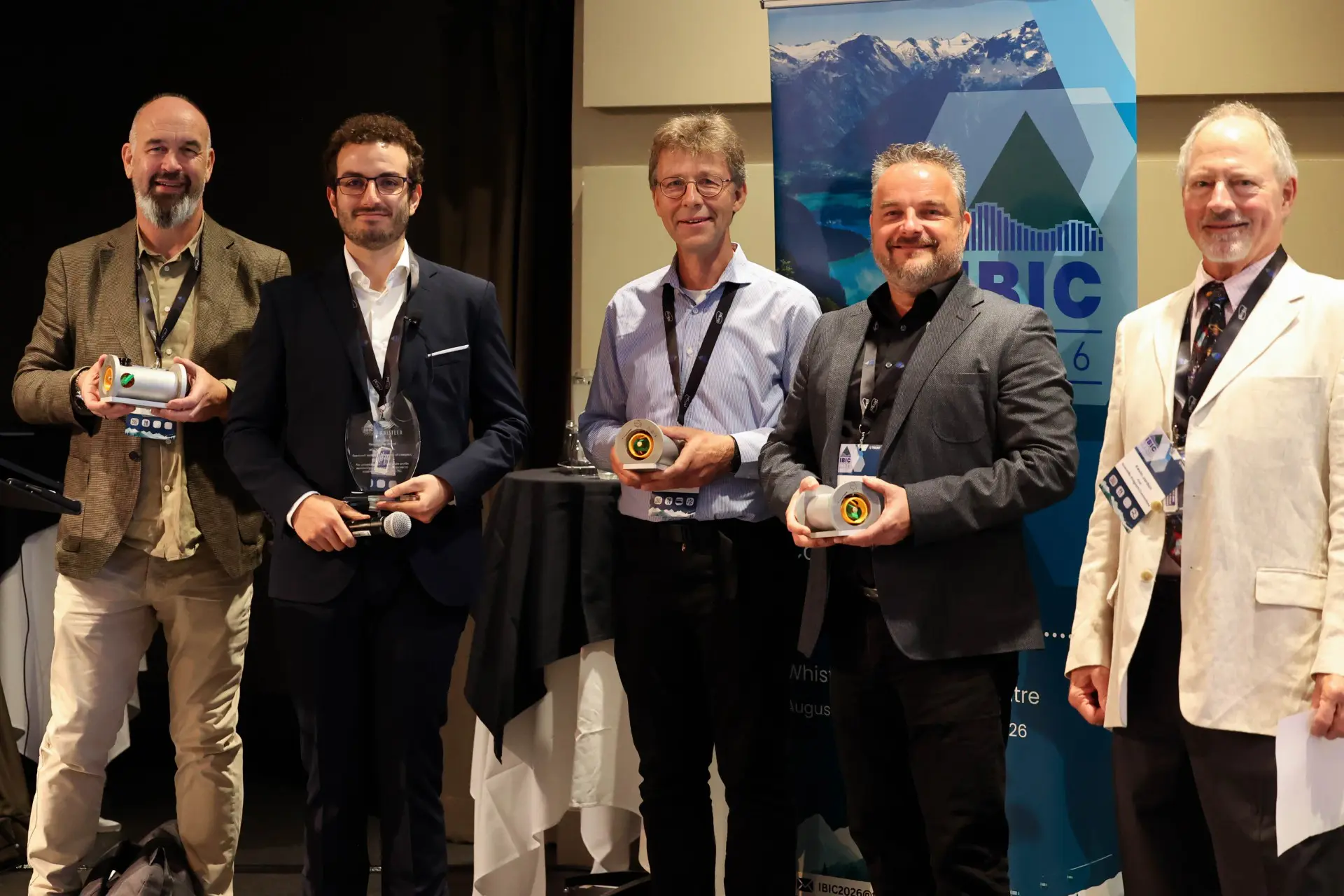
After more than 20 years of research, University of Liverpool physicist Professor Carsten Welsch has received the Faraday Cup Award for his leadership in developing the Beam Gas Curtain (BGC) monitor. This diagnostic instrument, created in collaboration with CERN and the GSI Helmholtz Centre, measures high-intensity particle beams without disturbing them, a longstanding challenge in accelerator physics. The award will be presented at the International Beam Instrumentation Conference (IBIC 2026) in Whistler, Canada, recognizing demonstrated performance of the BGC monitor now in continuous operation at the Large Hadron Collider.
QUASAR Group’s Beam Gas Curtain Monitor Earns Faraday Cup Award
Initial research into gas-jet-based beam diagnostics began approximately twenty years ago, evolving from an early concept into a key component of the LHC’s operational infrastructure. The BGC monitor addresses a significant challenge in accelerator physics: measuring high-intensity particle beams without disrupting their trajectory. Conventional methods often interfere with beam stability, hindering precise control and data acquisition.
This instrument utilizes a precisely shaped curtain of supersonic gas intersecting the particle beam, generating a faint light signal that reveals the beam’s profile and quality. Researchers at Liverpool spearheaded the original concept and system design, alongside the development of associated measurement and analysis techniques.
CERN contributed expertise in integrating the technology within the demanding environment of the LHC, while GSI provided specialist knowledge in beam instrumentation, imaging, and simulation. The resulting BGC monitor has now been approved for continuous operation, delivering high-precision measurements of both proton and heavy-ion beams and supporting preparations for the High-Luminosity LHC.
“Without the close and fruitful collaboration between our group at the Cockcroft Institute, CERN and GSI, and the commitment of generations of PhD students and postdoctoral researchers, this project would never have come so far.” Beyond fundamental physics, the gas-curtain technique has already found application in measuring proton beams used in cancer therapy, suggesting broader potential for non-invasive diagnostics in future accelerator facilities. The project received support from the Science and Technology Facilities Council and CERN, demonstrating a commitment to advancing particle beam instrumentation and its applications.
I am delighted to receive this award after more than 20 years of research, and it is wonderful that it was awarded to the entire collaboration. Without the close and fruitful collaboration between our group at the Cockcroft Institute, CERN and GSI, and the commitment of generations of PhD students and postdoctoral researchers, this project would never have come so far.
Professor Carsten Welsch, Head of Accelerator Science at the University of Liverpool

See today’s quantum computing news on Quantum Zeitgeist for the latest breakthroughs in qubits, hardware, algorithms, and industry deals.