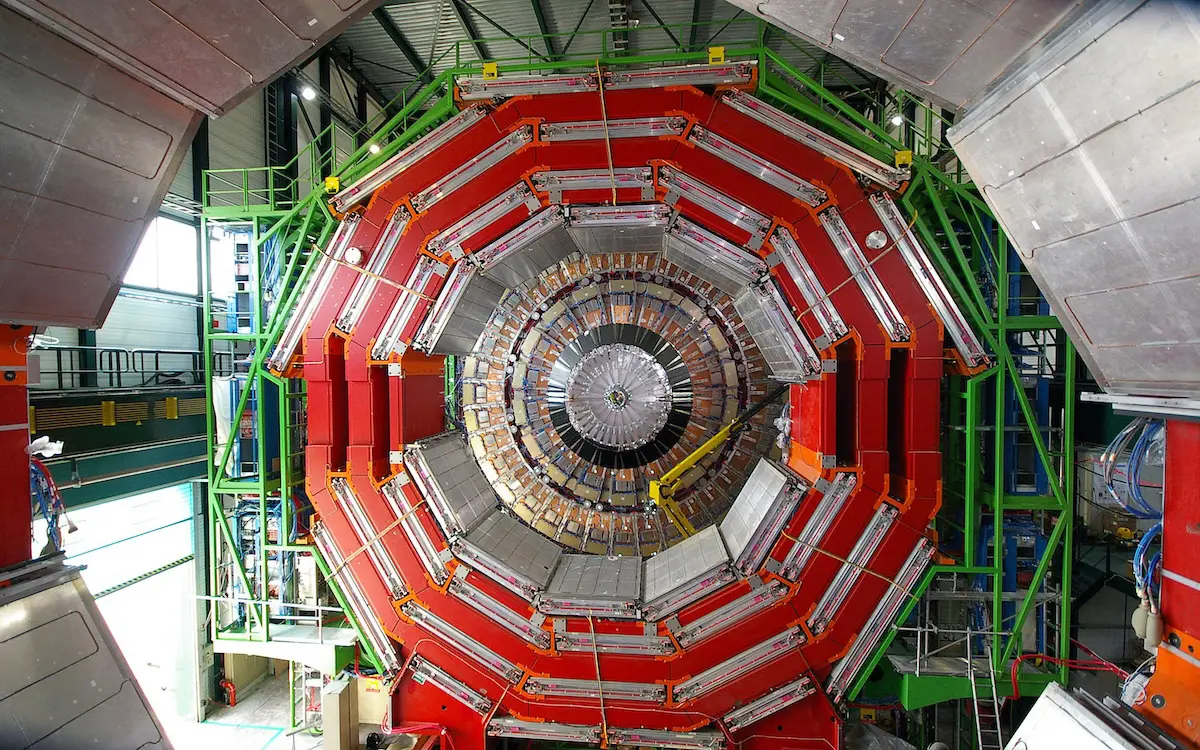
A $1 million Department of Energy award has enabled a University of Kansas and Fermilab team to build two High-Luminosity Zero Degree Calorimeters for the Compact Muon Solenoid at CERN’s Large Hadron Collider. These detectors will be fabricated and assembled at KU’s Mechanical Prototyping Lab, tested at Fermilab, and then installed at the collider to support research planned for mid-2030.
“This project connects the full chain of experimental science,” says Michael Murray, KU professor of physics & astronomy and CMS HL-ZDC upgrade project leader. “Detectors assembled in Lawrence will be tested in a high-energy beam at Fermilab, installed at CERN, and used by an international collaboration to answer fundamental questions about matter.”
KU Builds HL-ZDC Detectors for CERN’s Large Hadron Collider
The HL-ZDCs represent an advancement over their predecessors, the legacy ZDCs currently in use at CMS, which supported the collider’s first three operational periods. The upcoming High-Luminosity LHC will subject detectors to substantially higher radiation levels and collision rates, necessitating instruments that are narrower, faster, and more radiation-resistant.
Georgios Krintiras, a KU postdoctoral researcher, explains that measurements from the HL-ZDCs are vital for characterizing collisions between lead nuclei, noting that “in collisions between lead nuclei, the number and pattern of forward-moving neutrons help determine whether the nuclei struck nearly head-on or only glanced past one another.” This data is essential for both studying the quark-gluon plasma, a state of matter theorized to have existed in the early universe, and identifying ultraperipheral collisions where nuclei interact electromagnetically.
Beyond the scientific implications, the project provides valuable hands-on experience for KU students, offering opportunities to contribute at every stage, from precision manufacturing to software development. After assembly in Lawrence, each HL-ZDC will be shipped to the Fermilab Test Beam Facility for testing, and KU researchers will collaborate with Fermilab specialists on simulations and data analysis.
Murray highlighted the educational benefits alongside the scientific goals, stating, “Kansas students will have the opportunity to contribute at every step.” The completed calorimeters are slated for installation at CERN before the first heavy-ion data collection of the High-Luminosity LHC era, currently scheduled for mid-2030, solidifying KU’s role in the future of particle physics research.
In collisions between lead nuclei, the number and pattern of forward-moving neutrons help determine whether the nuclei struck nearly head-on or only glanced past one another.
Georgios Krintiras, KU Postdoctoral Researcher

See today’s quantum computing news on Quantum Zeitgeist for the latest breakthroughs in qubits, hardware, algorithms, and industry deals.