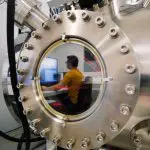
Analyzing 25% of its experimental data, the Muon g-2 collaboration at Fermilab has conducted the most sensitive direct search ever for a muon electric dipole moment (EDM). This is the first such search performed at the U.S. Department of Energy’s Fermi National Accelerator Laboratory and only the third globally in the last 50 years.
The experiment utilizes a 50-foot-diameter superconducting magnetic storage ring repurposed from Brookhaven National Laboratory’s 2001 experiment, revealing that if a muon EDM exists, it is smaller than currently detectable. “If you set it all up and you tune all of the parameters of the experiment to measure the magnetic dipole moment as well as possible, there’s also, coincidentally, some sensitivity to the electric dipole moment,” said Joe Price, a co-lead of the EDM analysis from the University of Liverpool.
Muon g-2 Experiment Constrains Muon Electric Dipole Moment
This search, utilizing data representing 25% of the total collected, builds upon only two prior attempts to measure the muon EDM in the last half-century; the previous investigations occurred at CERN in 1978 and at Brookhaven National Laboratory in 2009. The significance of this search lies in its potential to illuminate the imbalance between matter and antimatter in the universe; detecting a muon EDM would violate fundamental symmetries and offer clues to this enduring mystery. The current result constrains the muon EDM to less than 1.1 × 10⁻¹⁹ e·cm at 95% confidence, a 1.5 times more stringent limit than the previous measurement from Brookhaven.
This measurement is possible because the g-2 experiment’s primary focus, measuring the muon’s magnetic dipole moment, coincidentally provides sensitivity to the EDM. Essential to this analysis were specialized detectors called “trackers,” comprising 32 layers of aluminum-coated mylar straws used to map the muon beam’s profile.
Brendan Casey, a senior scientist at Fermilab, explained that “The trackers were essential in mapping the profile of the beam. Without them, we could not have extracted g-2 or the EDM from the data,” adding, “They really turned out to be an absolute necessity.” Gavin Hesketh, EDM analysis co-lead from College London, emphasized that “The primary measurement of the g-2 experiment is sensitive to new physics unrelated to the matter-antimatter asymmetry,” while “The electric dipole moment search gives us this sensitivity.” This initial result, derived from a quarter of the total dataset, already surpasses the data volume of the entire Brookhaven experiment.
If you set it all up and you tune all of the parameters of the experiment to measure the magnetic dipole moment as well as possible, there’s also, coincidentally, some sensitivity to the electric dipole moment.
Joe Price, co-lead of the EDM analysis from the University of Liverpool
Trackers Enable Precise Muon EDM and Beam Mapping
Specialized detectors, known as trackers, comprised 32 layers of aluminum-coated mylar straws and registered the paths of charged particles within the 50-foot-diameter superconducting storage ring. These trackers weren’t initially part of the experiment’s core design for measuring the muon’s magnetic moment, but quickly became indispensable when the beam’s initial profile deviated from expectations. Brendan Casey, a Fermilab senior scientist who received a DOE Early Career Research Award in 2012 to fund the tracker’s design and prototyping, explained the critical role of the detectors.
The team, a collaboration including institutions like Boston University, Northern Illinois University, the University of Liverpool, and University College London, even enlisted students from the Illinois Mathematics and Science Academy to assist with prototyping and quality control. The trackers allowed scientists to discern the number of positrons, the antimatter counterparts of electrons, traveling upwards versus downwards, a crucial measurement for the EDM search.
While the experiment did not detect a non-zero EDM, it established a new upper limit of |dm| < 1.1 × 10⁻¹⁹ e·cm at 95% confidence level, improving upon the previous measurement from Brookhaven by a factor of 1.5. The success of the tracker system underscores its importance for future, even more precise measurements planned in Japan and Switzerland, marking the first such search conducted at a U.S.
The primary measurement of the g-2 experiment is sensitive to new physics unrelated to the matter-antimatter asymmetry.
Gavin Hesketh, EDM analysis co-lead from University College London
Source: https://www.fnal.gov/




See today’s quantum computing news on Quantum Zeitgeist for the latest breakthroughs in qubits, hardware, algorithms, and industry deals.