Christina Wang of Fermilab has received the American Physical Society’s Mitsuyoshi Tanaka Award in Experimental Particle Physics for developing novel techniques to detect dark matter, a substance theorized to comprise approximately 85% of all matter in the universe. Wang’s work centers on two complementary detection methods, long-lived particle searches and quantum sensing, that expand the search for physics beyond the Standard Model, a well-tested theory unable to explain phenomena like the origin of dark matter. Her innovative approach utilizes the Compact Muon Solenoid detector at CERN, repurposing its 75 million sensors to extend the observable state of decaying particles. “I am deeply honored to receive the Tanaka Award,” said Wang, “Seeing the list of previous recipients makes this award even more meaningful to me.” These advances offer new avenues to understand the mysterious substance known only through its gravitational effects.
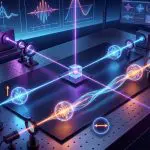
Approximately 85% of the universe’s matter is believed to be dark matter, a substance that remains unobserved despite its pervasive gravitational influence on visible matter. Christina Wang’s work at Fermi National Accelerator Laboratory is addressing this fundamental mystery through innovative detection techniques. Her thesis details two complementary approaches, one of which centers on identifying long-lived particles, those that decay slowly and are difficult to observe due to their weak interactions. Wang’s technique reimagines how the CMS experiment detects these elusive particles by leveraging its 75 million electronic sensors, originally designed for muon detection, to amplify the signal from decaying particles. Instead of relying on direct observation, the method creates a cascade of secondary long-lived particles, effectively extending the timeframe in which they can be detected, which significantly enhances the sensitivity of the CMS detector to these faint signals. Complementing this, Wang also explores quantum sensing technology, utilizing superconducting nanowire single-photon detectors to identify extremely faint light signals potentially emitted by dark matter candidates; this method aims to reduce noise and improve the ability to detect these subtle interactions.
Scientists theorize that dark matter makes up roughly 85% of all matter in the universe.
While gravitational effects confirm its existence, identifying the particles themselves requires innovative detection methods, particularly for low-energy candidates previously beyond experimental reach. These detectors, designed to minimize noise, enhance the ability to identify individual low-energy photons, a crucial step in discerning dark matter signals from background radiation. By repurposing the 75 million electronic sensors originally intended for muon detection, her team created a system capable of observing the decay products of long-lived particles, extending their observable lifespan and increasing detection probability. The dual strategy of long-lived particle searches and quantum sensing offers complementary avenues for exploration, broadening the scope of potential dark matter discoveries and addressing limitations inherent in single-method approaches. The development of these sensitive detectors promises to refine the search for these faint signals, potentially revealing the nature of dark matter and revolutionizing our understanding of the cosmos.
Her method uses the 75 million electronic sensors inside CMS, originally designed to detect muons, to create a shower of secondary long-lived particles, extending their observable state.


See today’s quantum computing news on Quantum Zeitgeist for the latest breakthroughs in qubits, hardware, algorithms, and industry deals.