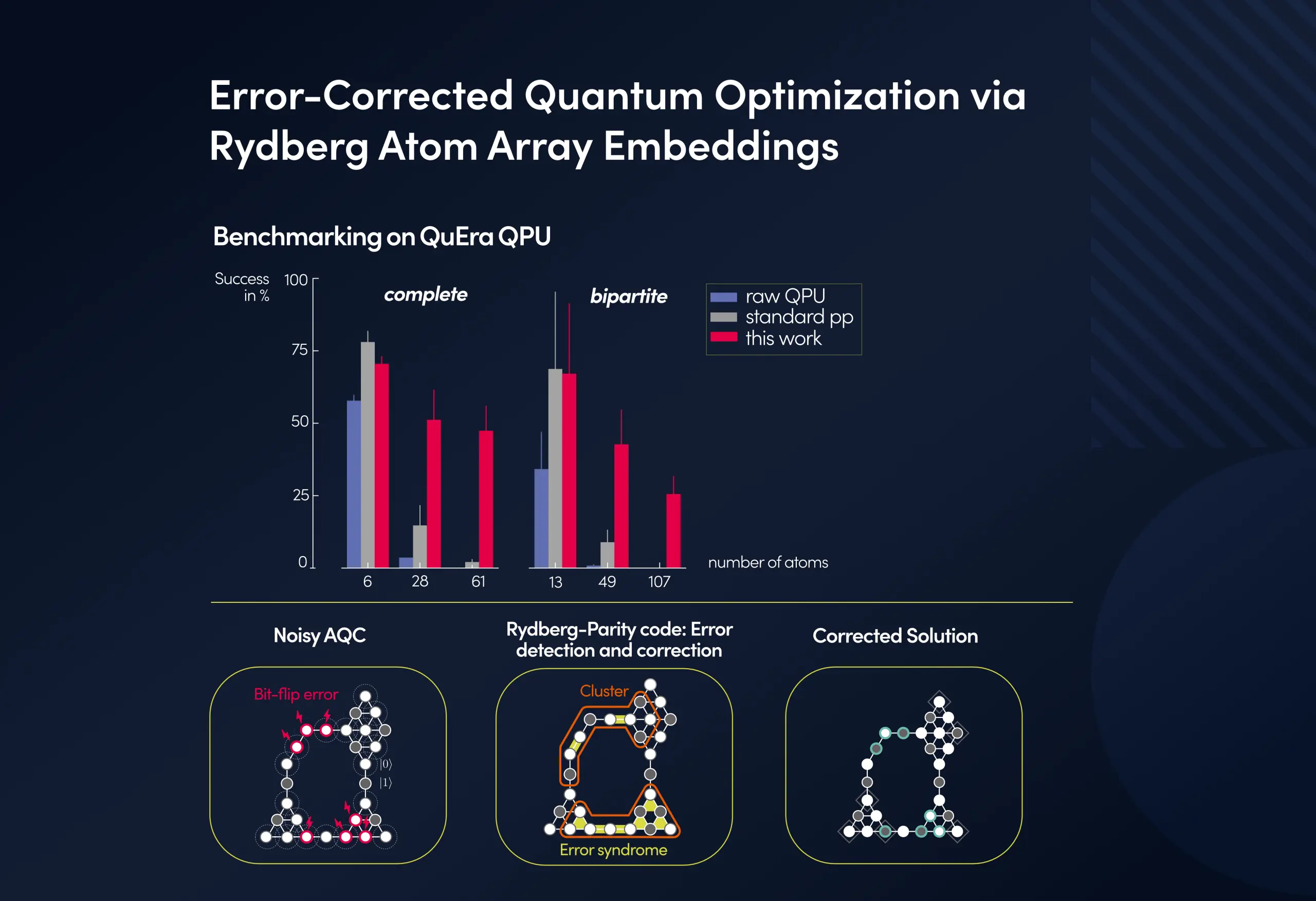
Researchers at ParityQC, the University of Innsbruck, and QuEra Computing have demonstrated error correction in quantum optimization by using the atoms added to expand problem-solving capacity, the company says. The team ran an optimization problem using 107 atoms on the QuEra Aquila QPU, revealing that “ancillary atoms” aren’t simply overhead, but an “intrinsic resource for error correction.” This approach groups atoms into “superatoms,” each constrained to host a single excitation, effectively forming a classical error-correcting code within the quantum system. The researchers’ tailored Cluster decoder recovered exact solutions with at least an 8 percent success rate, even when standard methods failed.
Rydberg-Parity Embedding Enables Error Correction in Atom Arrays
The researchers demonstrated this functionality by running optimization problems on the QuEra Aquila QPU with up to 107 atoms, achieving a success rate that surpasses bare hardware and standard post-processing techniques. The core innovation lies in how the embedding process is viewed. Rather than simply a method for mapping complex problems onto the hardware, it’s now understood as a co-designed architecture where computation and error correction are intrinsically linked.
The team’s analysis of the ParityQC Architecture-based Rydberg embedding revealed that the resulting superatoms form the basis of this error correction. This means the Rydberg blockade, which restricts each superatom to a single excitation, isn’t just a physical constraint but a mechanism for detecting errors. The specific properties of this, including qubit overhead and encoding rate, are dictated by the topology of the original optimization problem being solved.
Decoding the nonlinear error syndromes generated by this embedding required a new algorithm, dubbed the Cluster decoder. Standard decoders designed for linear codes proved inadequate because the Rydberg-Parity code is inherently nonlinear. The Cluster decoder operates by forming clusters around detected errors and attempting to resolve them using predefined lookup tables of the gadgets. If a cluster cannot be uniquely corrected, the decoder dynamically expands its scope, merging overlapping clusters until a valid configuration is found or the entire graph is encompassed.
Every cluster successfully resolved is guaranteed to represent a valid codeword within the embedded graph, ensuring the correction of errors. Results showed that both the Cluster decoder and a standard GreedyMIS algorithm improved success rates compared to raw experimental data. However, the performance gap between the Cluster decoder and GreedyMIS widened as the problem size increased.
Specifically, for the largest layout, the Cluster decoder recovered target solutions with an average success rate of at least around 8 percent, a result unattainable with either the raw data or the GreedyMIS algorithm. The applicability of this approach extends beyond the specific ParityQC Architecture, according to the company. The researchers demonstrated that the same superatom syndrome and Cluster decoder can be applied to other blockade-based Rydberg gadget layouts, including crossing lattices and 3D quantum wires, all exhibiting similar error-correction thresholds.
More broadly, the Cluster decoder is designed to function with layouts constructed from a finite set of bounded-size gadgets, provided their admissible configurations are known and propagate deterministically. This work builds upon previous findings from ParityQC, where the Cluster decoder was also applied to results obtained from a globally driven, ParityQC Architecture-based neutral-atom array, yielding a significant improvement in the probability of reaching the target state.
As Andrew Byun and colleagues state in their preprint, ‘Error-Corrected Quantum Optimization via Rydberg Atom Array Embeddings’, the embedding is a hardware mapping and an architecture for quantum optimization. The team’s findings suggest a pathway toward building more robust and scalable quantum optimization systems by using the inherent properties of the hardware itself for error mitigation., the company says.



See today’s quantum computing news on Quantum Zeitgeist for the latest breakthroughs in qubits, hardware, algorithms, and industry deals.