Delay-resolved Hong, Ou, Mandel interference now examines how periodic driving alters two-photon exchange within a collectively coupled cavity. Analysing coincidence traces, measurements of correlated photon arrivals, reveals drive-dependent branches linked to the Floquet-polariton spectrum, detailing changes not visible through single-photon measurements alone. Specifically, this technique identifies a shift in dominant physical output order as the drive is varied, providing quantitative targets for future experiments exploring light-matter interactions.
Analysing how light interacts within cavities is key for quantum optics, but conventional techniques struggle to fully characterise these interactions when external forces are applied. Delay-resolved Hong, Ou, Mandel (HOM) coincidences reveal subtle changes in two-photon exchanges inside driven cavity systems, going beyond existing measurement capabilities. By linking theoretical predictions with measurable quantities, it offers clear guidance for future experiments focused on controlling complex quantum phenomena involving light and matter.
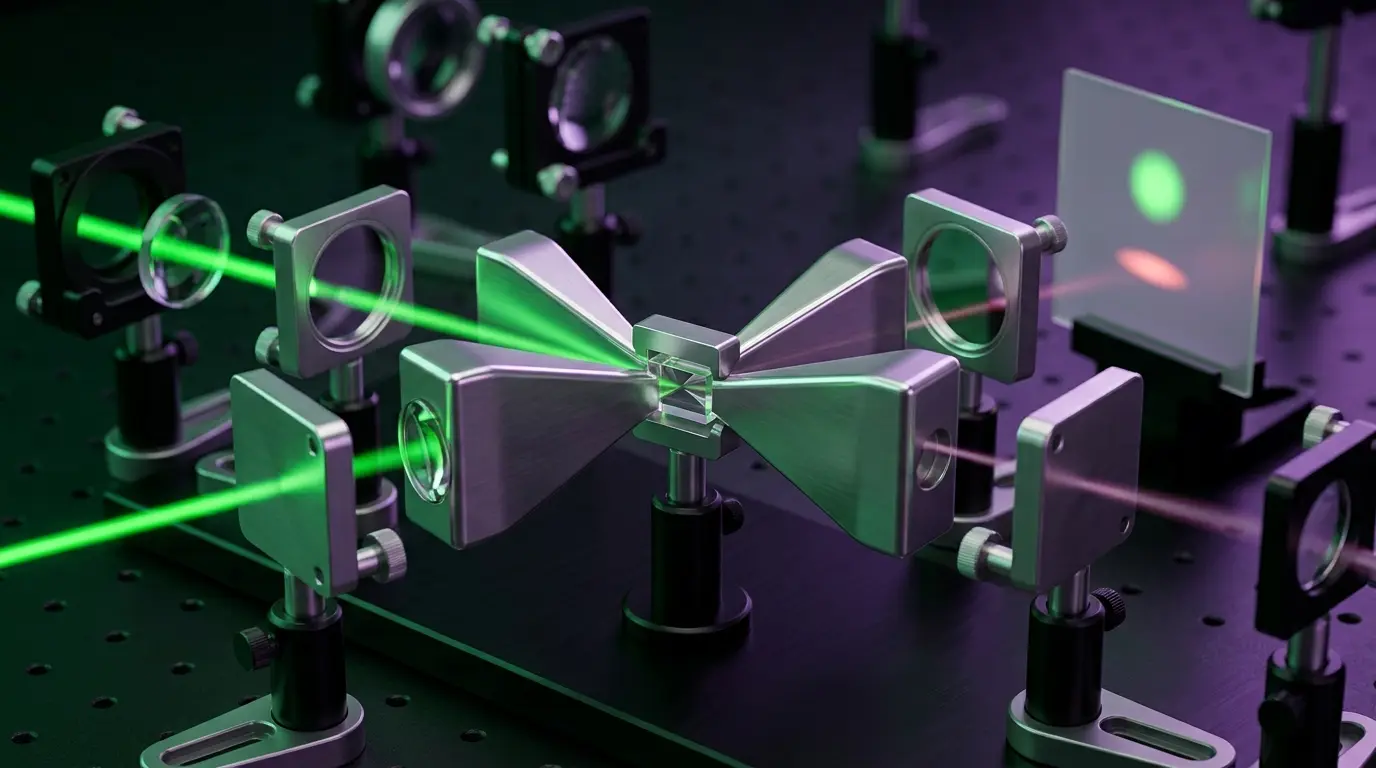
Analysing how light interacts within cavities is key for quantum optics, but conventional techniques struggle to fully characterise these interactions when external forces are applied. A HOM interference experiment checks if two photons arrive at the same time; think of it as testing whether two runners cross the finish line simultaneously. Researchers demonstrate that by “flashing” or modulating an input signal, similar to strobe lighting altering perceived motion, they can observe unique energy levels within the driven cavity known as Floquet polaritons.
Delay-resolved HOM interference maps active exchange pathways in coupled cavities
Delay-resolved Hong, Ou, Mandel (HOM) interference now detects shifts in dominant physical output order, a transfer previously invisible to single-photon sideband populations, as drive parameters change within collectively coupled cavities. This capability crosses a threshold where two-photon exchanges become quantifiable targets for advanced quantum control techniques; conventional methods could not probe these subtle alterations in light-matter interactions beyond simply observing transmission or reflection. Analysing coincidence measurements between photons after they interact with a periodically driven cavity reveals drive-dependent “exchange branches” linked to unique energy levels called Floquet polaritons and their associated weight distributions.
Detecting pairs of photons arriving at slightly different times through coincidence measurements reveals subtle shifts in how light interacts within collectively coupled cavities when driven by external signals, uncovering “exchange branches” connected to the unique energy levels known as Floquet polaritons. Single-photon sideband populations are unable to detect such changes in two-photon interactions; this behaviour isn’t replicated by those simpler methods. The team also mapped coincidence trace responses over both drive frequency and amplitude, linking them to Fisher information, a metric quantifying how sensitive measurements can be to control parameters.
Floquet forcing obscures two-photon interactions detectable via advanced interferometry
While manipulating light within cavities offers exciting possibilities for quantum technologies, fully understanding how external forces alter photon interactions remains a challenge; conventional single-photon approaches often fall short when characterising these complex dynamics. Theoretical work highlights that sideband analysis fails to capture the subtle shifts in two-photon exchange induced by periodic driving, known as Floquet forcing, a key limitation of existing methods.
By demonstrating how delay-resolved Hong, Ou, Mandel interferometry reveals previously hidden details about two-photon exchange under external control, clear targets are provided for future experiments and new avenues open up to explore complex quantum dynamics.
This measurement technique maps two-photon exchange under external control, providing data for validating theoretical models of light manipulation within cavities. A frequency-entangled signal photon scatters from the driven cavity while its idler serves as a delayed reference; this setup allows precise timing measurements. Future work can map coincidence trace responses over drive frequency and amplitude to give quantitative targets for experiments.
Theoretical research demonstrated that Floquet forcing, periodic driving of a system, alters interactions between pairs of photons within a collectively coupled cavity, an effect not detectable using standard methods like sideband population analysis. The team showed delay-resolved Hong, Ou, Mandel interferometry could probe these changes in two-photon exchange by analyzing interference patterns created with entangled photons.
This approach reveals shifts in the way photon exchanges occur as the external drive is adjusted, providing data linked to Fisher information which quantifies measurement sensitivity; future studies can map coincidence trace responses over varying drive parameters for experimental validation.
👉 More information
🗞 Drive-tunable Floquet exchange spectroscopy with Hong–Ou–Mandel interference
✍️ Eric R Bittner (University of Houston)
🧠 ArXiv: https://arxiv.org/abs/2610.38878

See today’s quantum computing news on Quantum Zeitgeist for the latest breakthroughs in qubits, hardware, algorithms, and industry deals.