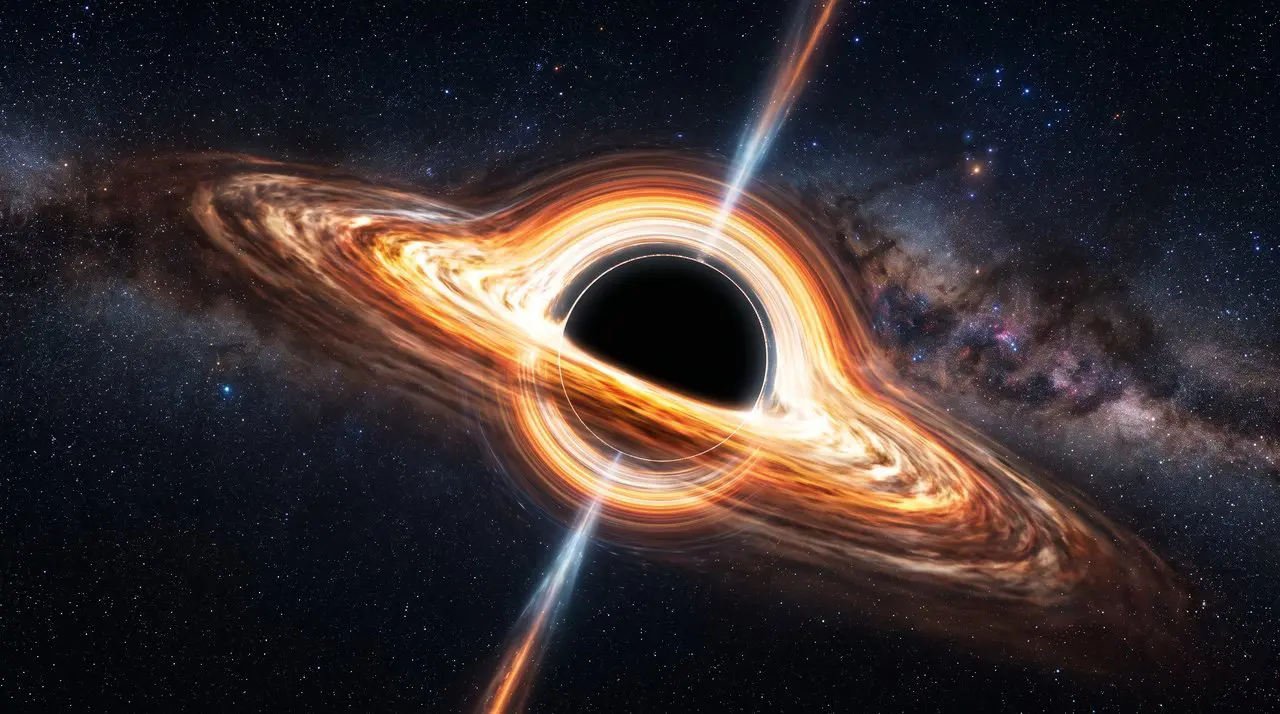
A runaway black hole, designated RBH-1, is tracing an extraordinary path through intergalactic space, marked by a 202,000 light-year-long trail extending from its origin. Researchers from UC Santa Barbara and University of Texas at Austin have reconstructed the violent merger that launched this super-massive black hole, providing the first account of a collision predicted by general relativity.
The findings, published in Physical Review Letters, detail a scenario where misaligned spins were key to achieving the observed velocity of nearly 1,000 kilometers per second, “like the recoil of a fired cannon,” according to co-author Tejaswi Venumadhav. This reconstruction will aid in preparing for future gravitational wave observations.
RBH-1’s Velocity Reveals Extreme Black Hole Merger
The velocity of RBH-1 provides direct evidence of an exceptionally powerful black hole merger. Initial observations from the Hubble Space Telescope in 2022, followed up with the James Webb Space Telescope in 2025, revealed a thin, 202,000 light-year-long trail marking the black hole’s path, a feature indicative of extreme force.
Tejaswi Venumadhav, an associate professor in UCSB’s Department of Physics, initially found the scale of the ejection surprising; he said, “I was initially surprised by how extreme this sounds, but then I realized it probably had to be the case in order to have produced the dramatic feature visible in telescopes.” This event challenges previous understandings of galactic evolution. More than 7.5 billion years ago, the galaxies harboring the merging black holes would likely have already consolidated into single galactic centers, meaning the parent black holes had to overcome significant gravitational forces to collide.
General relativity predicts that 5-10% of black hole mergers should result in a substantial “kick” to the resulting black hole, but RBH-1 represents the first confirmed observation aligning with this prediction. Current detectors like LIGO and Virgo primarily capture high-frequency waves from stellar-mass black hole collisions, while super-massive black hole mergers emit at much lower frequencies. Observations like this will be important for interpreting future data from the planned Laser Interferometer Space Antenna. Now that JWST is operational, researchers anticipate discovering more runaway black holes and furthering our understanding of these violent cosmic events.
We benefitted from talking to astronomers from all over the world who had come there to participate.
Tousif Islam, Postdoctoral Scholar at UCSB’s Kavli Institute for Theoretical Physics (KITP)
Misaligned Spins Drive Runaway Black Hole Recoil
Misaligned spins appear critical to explaining the extraordinary velocity of RBH-1, the runaway black hole observed departing its host galaxy. Calculations reveal the heavier black hole involved in the merger likely spun at 70-75% of the theoretical maximum permitted by general relativity, with a significant tilt akin to a wobbling top.
This precession, according to lead author Tousif Islam, a postdoctoral scholar at UCSB’s Kavli Institute for Theoretical Physics, was essential; he explained, “The two black holes had to be spinning fast, and their spins had to be misaligned.” Initial estimates based on standard merger models predicted recoil velocities around 200 kilometers per second, far below the observed 1,000 kilometers per second. The team’s reconstruction demonstrates that the combination of high spin and misalignment provided the asymmetric “kick” necessary to eject the resulting black hole at such a speed.
This connects what telescopes see to what the planned Laser Interferometer Space Antenna, or LISA, will hear, as the merger’s low-frequency gravitational waves would have been undetectable by current instruments like LIGO and Virgo. The discovery of RBH-1, initially flagged by a 2022 Hubble Space Telescope observation and confirmed with James Webb in 2025, represents a rare opportunity to validate predictions about extreme black hole mergers, promising a richer understanding of these powerful cosmic events and the role of spin in shaping their aftermath.
But when super-massive black holes merge, they broadcast in a much lower frequency.
Tousif Islam, Postdoctoral Scholar at UCSB’s Kavli Institute for Theoretical Physics (KITP)
Galaxy Collision Preceded Super-massive Black Hole Merger
The extraordinary trail extending 202,000 light-years from the galaxy suggests a catastrophic event propelled the super-massive black hole, designated RBH-1, into intergalactic space. Researchers reconstructed the merger that likely initiated this journey, revealing a collision between two black holes approximately 5 billion years ago. The team’s simulations show that misaligned spins were essential; without them, the merger would have produced a different outcome, lacking the force to launch the black hole on its current trajectory. This discovery connects observations from the James Webb Space Telescope with expectations for future gravitational wave detections.
This connects what telescopes see to what LISA will hear.
Tejaswi Venumadhav, Associate Professor in UCSB’s Department of Physics

See today’s quantum computing news on Quantum Zeitgeist for the latest breakthroughs in qubits, hardware, algorithms, and industry deals.