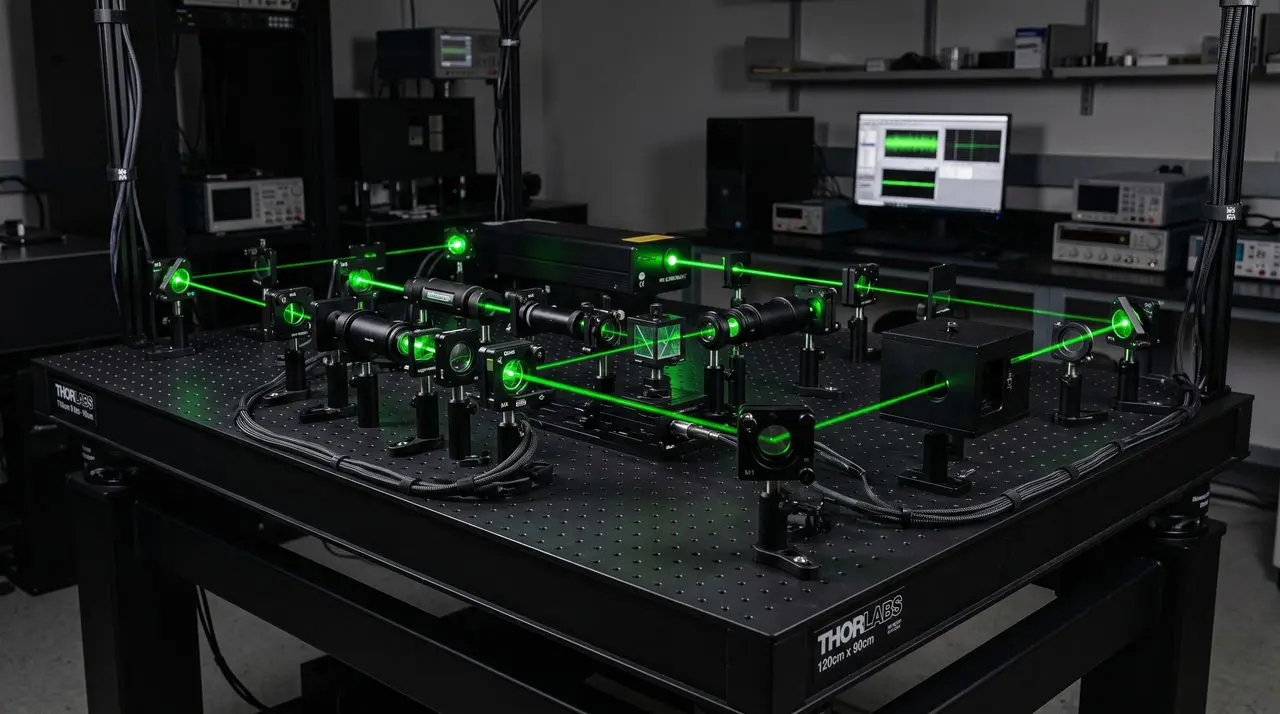
Zhiyu Chen completed his PhD on September 3rd, detailing a new approach to optical systems using indium phosphide photonic chips. Chen’s research addresses limitations in speed and size by controlling light even as it passes through disordered media like biological tissue; his system operates faster than conventional technologies and includes on-chip amplifiers to boost output power.
He also demonstrated that intentionally designed disorder can be harnessed, integrating a disordered surface with an optical phased array to steer light beams rapidly without moving parts, a method allowing for wider steering angles and improved distinction between closely spaced angles. The results contribute to developing more compact LiDAR and optical communication systems.
Indium Phosphide Chip Corrects Light Distortion in Disordered Media
An indium phosphide photonic chip rapidly corrects light distortion as it passes through complex materials, a capability demonstrated by Zhiyu Chen in newly completed doctoral research. Chen’s work, defended on September 3rd at the Department of Electrical Engineering, addresses a longstanding challenge in optics; conventional systems often rely on bulky lenses or moving parts to manage light, hindering miniaturization and speed. The chip guides and processes light similarly to how electronic chips handle electrical signals, offering a pathway to more compact optical systems.
The system’s ability to control light through disordered media, like biological tissue, is particularly noteworthy, as these materials typically scatter and distort light beams. Correcting this distortion is important for applications ranging from biomedical imaging to communication in challenging environments.
This improvement allows for more precise light delivery and enhanced signal strength in previously difficult-to-access areas. Chen also harnessed disorder itself as a functional element within the chip’s design. “This array can rapidly steer a light beam without the need for moving parts,” Chen explains, highlighting a key advantage over conventional beam-steering methods. This approach expands the range of angles over which light can be directed and improves the system’s ability to differentiate between closely spaced angles, benefiting LiDAR and optical communication technologies.
Chen created an on-chip spectrometer by integrating a disordered region into a silicon photonic chip, enhancing its ability to distinguish between closely spaced wavelengths of light. The spectrometer requires only a single detector, significantly reducing both cost and complexity, and potentially enabling widespread use in environmental monitoring, industrial sensing, agriculture, and healthcare. The research, supported by PhotonDelta and the China Scholarship Council, demonstrates that combining photonic chips with disordered structures offers new avenues for controlling and analyzing light.</p, the company says.


See today’s quantum computing news on Quantum Zeitgeist for the latest breakthroughs in qubits, hardware, algorithms, and industry deals.