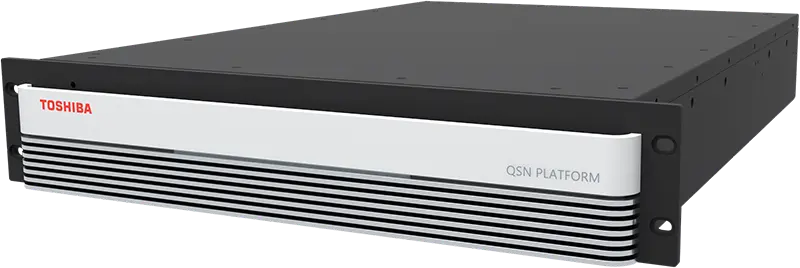
Toshiba Corporation launched its Quantum-Safe Networking (QSN) Platform, a new system designed to integrate quantum-safe security with existing network infrastructures without requiring a complete overhaul. The platform supports deployments ranging from a single connection to large metro networks, addressing a need for scalable quantum security solutions. By simplifying deployment and reducing costs, Toshiba aims to help organizations transition to quantum-safe security and turn the quantum-safe transition into a strategic advantage. Hiroshi Tsukino, Vice President of ICT Solutions Division at Toshiba Corporation, states: “The quantum-safe transition represents the largest cryptographic transformation in history.”
QSN Platform Architecture Enables Scalable Quantum-Safe Network Integration
The Toshiba QSN Platform integrates quantum-safe security into existing network infrastructure without requiring complete overhauls, a departure from solutions often demanding extensive rebuilding. This platform supports diverse network topologies, ranging from single dedicated connections to complex metro, hub-and-spoke, ring, mesh and long-distance networks, demonstrating a scalability uncommon in early quantum-safe implementations. Centralized control, standards-based integration, and adaptive key delivery are core features, allowing organizations to adjust to evolving threats and requirements without significant disruption.
Toshiba brings over 25 years of quantum research and development to this platform, building on a 150-year engineering history and experience with tier-one communications providers. The platform’s transceivers consolidate transmission and reception into a single unit, reducing hardware requirements, while optical switching within hubs connects multiple sites more efficiently than traditional point-to-point systems. Combining Post-Quantum Cryptography, or PQC, with other quantum technologies, the QSN Platform addresses current government mandates and recommendations for quantum-resistant key exchange.
This combination allows organizations to strengthen network resilience and scale protection according to their specific needs, a critical advantage as the threat from quantum computing increases. A company representative said, “Toshiba QSN Platform dramatically simplifies the rollout of quantum-safe protection by reducing both cost and complexity across large-scale networks.” Service providers can offer differentiated quantum-safe services, creating new revenue streams beyond simply mitigating risk. The platform’s architecture enables operators to serve multiple customers and nodes from a single exchange-based unit, eliminating the need for dedicated hardware for each link.
This shift positions quantum security not just as a necessary expense, but as a potential profit center. The company aims to empower customers to build secure, future-ready networks capable of withstanding the next generation of cyber threats.
Toshiba QSN Platform dramatically simplifies the rollout of quantum-safe protection by reducing both cost and complexity across large-scale networks. It will transform network deployments by enabling operators to serve multiple customers and nodes from a single exchange-based unit, eliminating the need for dedicated hardware per link.
Andrew Shields, Vice President of Toshiba Europe and Head of its Quantum Technology Division
Post-Quantum Cryptography and QKD Deliver Multi-Layered Security
The Toshiba QSN Platform consolidates quantum technologies into a single architecture, allowing organizations to layer security measures according to specific needs and risk profiles. This scalability addresses a critical gap in current deployments, which frequently struggle to extend protection beyond isolated links. The platform’s design is notable because organizations do not need to rebuild existing network infrastructure to implement quantum-safe security, a significant reduction in both cost and disruption.
The platform integrates Post-Quantum Cryptography, or PQC, alongside advanced quantum technologies like Quantum Key Distribution and Quantum Random Number Generation. This combination allows for a tiered approach to security, with PQC providing quantum-resistant key exchange to meet current government mandates and QKD offering the highest possible level of protection against future computational attacks. Toshiba emphasizes that these technologies are also resistant to increasingly sophisticated AI-driven attacks targeting algorithmic cryptography vulnerabilities.
The ability to tailor security levels is important, as not all data requires the same degree of protection, and a flexible system optimizes resource allocation, the company says. The launch of the QSN Platform responds to the growing threat of “harvest now, decrypt later” attacks, where encrypted data is intercepted and stored for future decryption once quantum computers become powerful enough to break current encryption standards.
The quantum-safe transition represents the largest cryptographic transformation in history. A transformation of that scale cannot happen overnight. Organizations need to begin protecting their most critical networks and data today, while establishing a clear path to extend that protection as threats evolve and new standards and operational requirements are introduced.
Hiroshi Tsukino, Vice President, ICT Solutions Division, Toshiba Corporation


See today’s quantum computing news on Quantum Zeitgeist for the latest breakthroughs in qubits, hardware, algorithms, and industry deals.