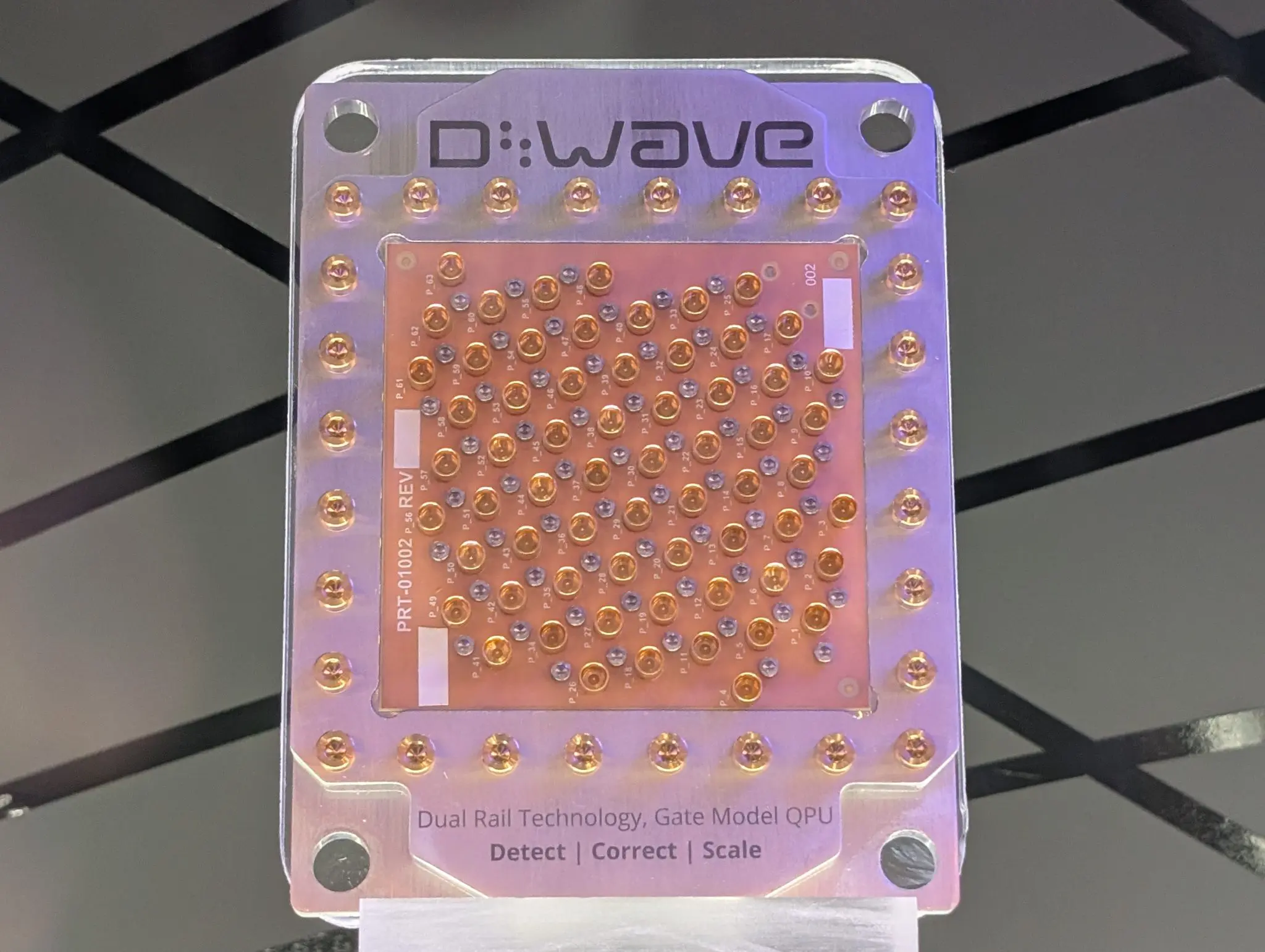
D-Wave launched its gate-model quantum computing simulator beta program granting BBVA, FirstQFM, Florida Atlantic University and the Jülich Supercomputing Centre early access to a new approach to error correction. The company asserts that the biggest challenge in building practical quantum computers isn’t adding qubits, but achieving error correction, and this program positions these organizations to lead in developing error-aware programming. Andrei Petrenko, Vice President, Gate Product Management, says the simulator allows users to experiment with identifying and adapting to errors at the physical-qubit level during computation.
Dual-Rail Architecture Enables Error Detection at the Qubit Level
D-Wave’s dual-rail qubit architecture provides visibility into errors as they occur, enabling a more efficient path to quantum error correction, according to the company. This approach differs from conventional methods by treating common errors, specifically photon-loss events, as erasures, errors with a known location, allowing for correction with fewer resources. The hardware can detect these errors and identify the affected qubit, a capability central to the company’s error awareness strategy.
Real-time quantum-classical control further enhances this system by analyzing data while quantum algorithms are running, within the qubits’ coherence time. This allows the system to adapt subsequent quantum operations based on detected errors, rather than waiting until a computation is complete, D-Wave says. By combining built-in error detection with this real-time control, D-Wave predicts achieving a logical error rate of 10−6, or one error in one million operations, could require only 100 to 200 physical qubits per logical qubit.
The company asserts that this error awareness approach is a key differentiator, allowing them to focus on efficient error correction rather than solely on increasing qubit count. The beta program launched on October 7, 2026, signaling a commitment to this new direction in gate-model quantum computing.
D-Wave Simulator Beta Program Facilitates Error-Aware Programming
The simulator’s architecture is designed specifically for error-aware programming, offering users visibility into error data within quantum computations. This access allows developers to move beyond theoretical models and begin prototyping post-NISQ applications, testing and refining error-aware algorithms in a practical environment. D-Wave anticipates that this approach will enable researchers to build more robust quantum systems by understanding and mitigating errors at a fundamental level, according to the company.
D-Wave intends for the beta program to generate tangible results, anticipating significant advancements from its early access partners. “We’re very excited to see the results that come out of the beta program and look forward to sharing the work that our beta customers accomplish,” said Petrenko.
The company is actively soliciting further interest in the simulator, offering a pathway for developers to request future access and prepare for the evolving landscape of quantum computing. By focusing on error awareness, D-Wave aims to provide a more pragmatic path towards realizing the potential of fault-tolerant quantum computation, offering a different approach to the challenges currently facing the field.
Real-Time Control Reduces Qubit Requirements for Error Correction
This architecture facilitates a unique form of error awareness, offering users new tools and data to explore advanced post-noisy intermediate-scale quantum (post-NISQ) use cases and ultimately achieve fault tolerance.
Petrenko’s background in quantum hardware, including a Ph.D. from Yale University focused on quantum error correction, informs the company’s strategy. He spearheads the gate-model product strategy at D-Wave with a focus on cultivating a strong customer ecosystem and user experience with the dual-rail qubit architecture.



See today’s quantum computing news on Quantum Zeitgeist for the latest breakthroughs in qubits, hardware, algorithms, and industry deals.