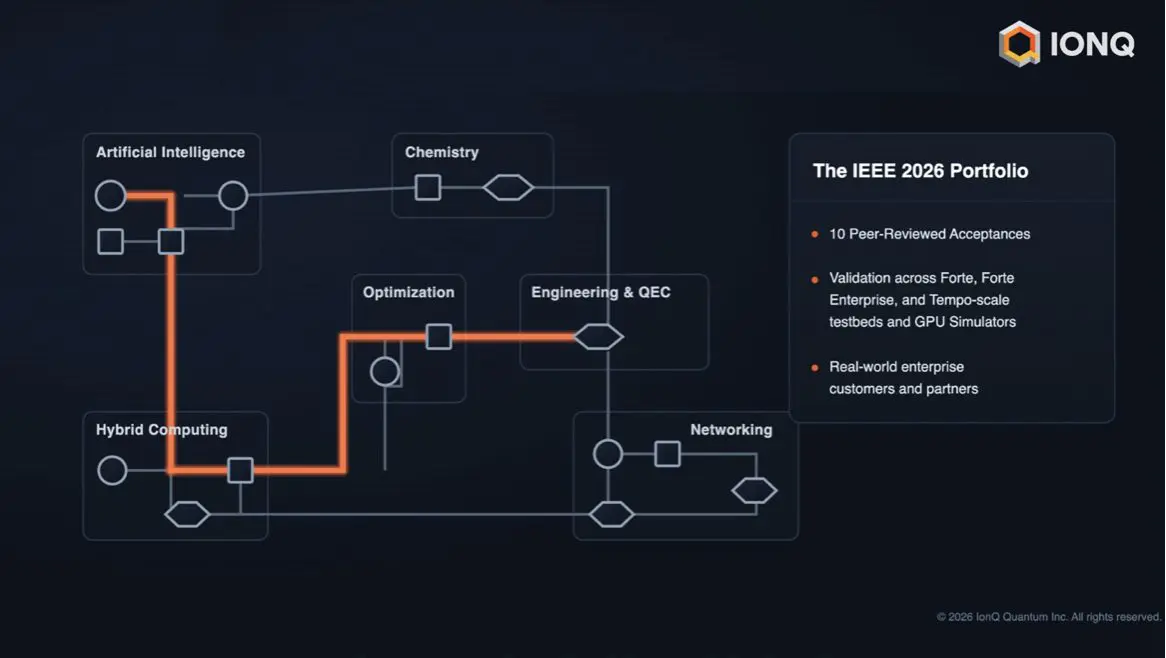
IonQ and its research partners are demonstrating a shift from theoretical quantum computing to practical application, with 10 peer-reviewed papers accepted at IEEE QCE26, the company says. The research mirrors a historical transition seen with GPUs and deep learning, where a surge in processing power reshaped the software landscape. IonQ notes that advances in parallel compute are driving a new paradigm. IonQ’s work earned both Best and 3rd Best papers in the Quantum End-to-End Hybrid Case Studies track, including a study detailing “Protein Folding on a 64-Qubit Trapped-Ion Hardware.”
- IonQ is showcasing major research momentum at the event, earning 4 medals across 10 accepted peer-reviewed papers, including two first-place wins for work on quantum-accelerated AI fine-tuning and quantum-accelerated engineering simulations.
- With partner Synopsys, IonQ integrated a quantum-classical solver into Synopsys/Ansys LS-DYNA for Finite Element Analysis, scaling workflows to 150 qubits in NVIDIA simulations and 36 qubits on IonQ Forte hardware. The work showed best-case wall-clock-time improvements of 14.6% in simulation and approximately 12% on real hardware.
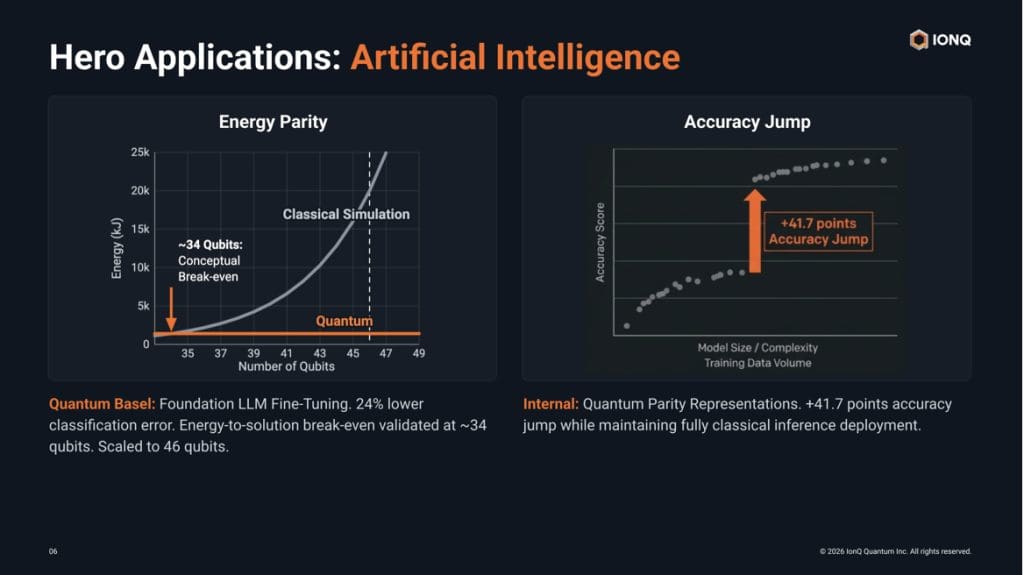
- On the AI side, IonQ and QuantumBasel successfully executed these quantum fine-tuning circuits on real QPU hardware, an IonQ Forte Enterprise machine, achieving a 24% reduction in error over classical fine-tuning baselines in the ideal/noiseless simulation case. Analysis of the energy consumed by these circuit runs demonstrated a clear path to favourable energy efficiency for quantum hardware, with a suggested break-even energy-to-solution crossover point near 34 qubits when compared with classical simulation.
- IonQ and Kipu studied six peptides using a geometrically constrained lattice model with protein-folding workloads of 46-61 qubits. In what IonQ believes is the largest showcase of trapped-ion quantum protein folding optimisation to date, researchers applied bias-field digitised counterdiabatic quantum optimisation for lattice protein folding on up to 61-qubit instances on a 64-qubit Barium development system similar to the forthcoming IonQ Tempo line.
Protein Folding Benchmarked on IonQ’s 64-Qubit Trapped-Ion System
IonQ and Kipu collaborated to apply bias-field digitised counterdiabatic quantum optimisation to lattice protein folding on up to 61-qubit instances, using a 64-qubit Barium development system similar to the forthcoming IonQ Tempo line. This work represents what the companies believe is the largest demonstration to date of trapped-ion quantum protein-folding optimisation, moving beyond theoretical exercises to tackle a computationally demanding biological problem.
IonQ, founded in 2015 and now publicly listed as IONQ on NYSE, develops and commercially sells trapped-ion quantum computers, a technology where qubits are encoded in the internal states of individual ions held and controlled by electromagnetic fields. The choice of trapped-ion technology is significant, offering long coherence times, the duration qubits can maintain their quantum state, and high fidelity operations, important for complex algorithms like those used in protein folding simulations. This contrasts with superconducting qubit approaches, which often prioritize qubit count over coherence.
IonQ’s system allows for all-to-all qubit connectivity, meaning any qubit can directly interact with any other, simplifying the implementation of certain quantum algorithms and reducing the need for complex qubit routing, according to the company. The company has raised a total of $4.03 billion to fund continued development of its hardware and software stack and expand its partnerships.
A recent collaboration with the Korea Institute of Science and Technology Information aims to advance quantum-high-performance computing hybrid approaches, while a partnership with FormationQ and the University of Cambridge will deploy IonQ’s quantum systems for research purposes. Beyond protein folding, IonQ’s 64-qubit system was also used in a study demonstrating the first high-fidelity hardware simulation of complex 3D advection-diffusion fluid behavior, a key step for computational fluid dynamics, the firm reports. Researchers from IonQ and Ansys executed this simulation using the hybrid Quantum Lattice Boltzmann Method (QLBM) algorithm framework on IonQ’s Forte systems and the Barium development system.
IonQ’s work extends to machine learning, with research published on Quantum Parity Representations for Classical Machine Learning, aimed at minimising hardware costs during AI model inference. This research showed a 54% lower error rate than direct physical Trotter runs when combined with Nvidia’s accelerated computing software, suggesting potential for more efficient AI workflows.
The company’s also refining its internal noise-modelling capabilities, as described in the paper “Spectral-Interpolation Framework for Colored Noise in Quantum Circuits,” presented by co-author Dor Gabay. These advancements collectively suggest a growing maturity in the field, with IonQ positioned as a key player in translating quantum potential into tangible results.
Quantum-Accelerated Linear Algebra Improves FEA Simulation Performance
Finite element analysis (FEA) simulations saw performance gains when integrated with a quantum-classical solver for the Graph Partitioning Problem, according to research presented at the IEEE QCE26 conference. The work, a collaboration between IonQ and Synopsys/Ansys, focused on reducing computational costs within complex FEA meshes, achieving wall-clock-time improvements of 14.6% using NVIDIA’s CUDA-Q/cuTensorNet simulations and approximately 12% on IonQ Forte hardware when testing meshes of up to 35 million elements, the company states.
This integration targeted sparse-matrix processing, a significant bottleneck in many industrial simulations, and scaled to 150 qubits in simulation and 36 qubits on actual hardware. This focus on end-to-end performance, rather than purely theoretical advances, is a key differentiator for the company, positioning it to capitalise on growing demand for quantum solutions in enterprise settings.
Hybrid Quantum-Classical Workflows Enhance Supply Chain Logistics
IonQ and Einride achieved up to a 12.1% increase in shipments through a hybrid quantum-classical workflow designed to optimise fleet scheduling and address disruptions caused by shipment cancellations and similar issues. The collaboration focused on solving a complex combinatorial optimization problem inherent in logistics, where idle gaps in schedules create inefficiencies. Quantum-derived solutions served as a warm start for Einride’s existing optimiser, delivering measurable improvement without altering operational costs, as detailed in research presented at IEEE QCE26.
The company’s research extends beyond logistics, demonstrating integration of quantum computing into established engineering software, the company’s account states. Hardware runs on IonQ’s trapped-ion system matched simulations for instances up to 35 qubits, while larger problems up to 130 qubits were simulated, highlighting quantum computing’s potential value for large-scale logistics. This integration signifies a move toward seamlessly weaving quantum workflows into existing enterprise tools, rather than requiring entirely new infrastructure.
DQAOA-GPT Integrates AI for Quantum Combinatorial Optimisation
IonQ and QBasel jointly demonstrated a quantum-enhanced approach to fine-tuning foundational AI models, earning a first-place award for the research titled “Measuring Accuracy and Energy-to-Solution of Quantum Fine-Tuning of Foundational AI Models” at IEEE QCE26. The collaboration produced a method to improve model accuracy and reduce the energy needed to reach a solution, a critical step toward more efficient artificial intelligence. This work highlights a growing connection between quantum computing and AI, moving beyond theoretical exploration toward practical applications in machine learning.
This strategy, IonQ suggests, offers a more immediate pathway to realizing the benefits of quantum computation. The team’s approach uses quantum circuits to refine the parameters of classical AI models, improving accuracy and reducing computational cost, IonQ claims. This is particularly relevant for complex tasks where traditional optimization methods struggle to find optimal solutions.
IonQ is also exploring applications of quantum computing in healthcare, specifically to address missing data in Electronic Health Records (EHRs). In collaboration with Quantum Signals, the team validated a hybrid quantum-classical training framework for gradient-based optimization of Quantum Neural Networks (QNNs) on near-term processors, IonQ says. The framework was tested on the MIMIC-III dataset, which contains tens of thousands of patient EHRs, to intelligently fill in missing clinical data.
This work demonstrates the potential of quantum machine learning to improve data quality and provide valuable information from complex medical datasets, a critical step toward more effective patient care. “Scalable On-Hardware Training of Quantum Neural Networks and Application to Clinical Data Imputation” details this approach.
This integration aims to reduce computational overhead and tackle larger optimisation challenges than iterative variational optimisation techniques previously allowed. This research tackled the notoriously difficult problem of protein folding, a key challenge in drug discovery and materials science. By employing counterdiabatic quantum optimization on IonQ’s 64-qubit trapped-ion system, the team demonstrated a potential pathway to simulating complex molecular interactions, according to the company.
This approach could significantly accelerate the development of new therapies and materials. Einride, an electric freight transportation firm, partnered with IonQ to address the complex combinatorial optimization problem of idle gaps in fleet scheduling. Quantum-derived solutions, integrated into Einride’s existing optimizer, delivered up to 12.1% more shipments in the best-performing scenario without increasing operational costs.
IonQ’s Research Pillars: Bridging Industrial Impact, AI, and Resilience
IonQ’s papers detail how IonQ is scaling hybrid quantum-classical workflows up to 150 qubits, aiming to improve the economics and efficiency of industrial simulations, and illustrate direct interfacing between IonQ’s quantum hardware and classical high-performance computing. These advancements centre around three structural pillars defining IonQ’s full-stack approach, the first being “Real-World Industrial Impact & Optimisation.” Here, IonQ and its partners are applying hybrid quantum-classical workflows and hardware to commercial challenges intractable for classical computers alone.
The research shows that discovered binary vector words improved mean accuracy by 23.9% to 41.7% over classical baselines. This improvement isn’t merely academic; it signals potential measurable operational efficiency gains within existing enterprise workflows, a key focus of IonQ’s strategy. The platforms of today’s Noisy Intermediate-Scale Quantum era are evolving toward the fault-tolerant systems of tomorrow. Beyond optimisation, IonQ is also addressing architectural resilience and the challenges posed by quantum noise.


Collaboration with NVIDIA and qBraid showcased IonQ Tempo’s unique mid-circuit measurement (MCM) capabilities, used to reduce errors during complex chemical and molecular simulations. The company’s approach emphasises extracting maximum computational utility from current-generation systems through sophisticated noise modelling and hardware features, rather than relying solely on the arrival of fault-tolerant quantum computers.
The convergence of academic and commercial timelines is a key objective for IonQ, and the company is actively positioning quantum computing as a functional component of the broader modern computing ecosystem. This collaborative approach extends to funding and compute resources, as shown by IonQ’s partnership with Qollab, which provides compute credits and funding for open-source quantum experiments.
The results presented at IEEE QCE26, including the Best Paper award for “End-to-End Performance of Quantum-Accelerated Large-Scale Linear Algebra Workflows,” signal a shift from theoretical exploration to practical application. IonQ believes these concrete architectural milestones will further accelerate quantum computing’s adoption, establishing it as a functional component of modern computing.
The company’s fabrication of a fully integrated 256-qubit quantum processing unit on its Superion 256 platform, while not reflected in the currently operated qubit count, demonstrates a commitment to scaling quantum hardware for future applications, the company says. “We expect that the impact of sharing these concrete architectural milestones with the global IEEE community will be the further acceleration of quantum computing toward the center of this ecosystem.”


See today’s quantum computing news on Quantum Zeitgeist for the latest breakthroughs in qubits, hardware, algorithms, and industry deals.