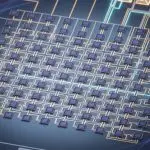
MIT researchers have built a chip containing hundreds of nanoscale devices, each with a viscoelastic polymer layer measuring just 2 nanometers. These devices mimic neuron firing through reconfigurable motion, potentially leading to more efficient computing platforms. The technology minimizes components by integrating computing functions into the material itself, opening opportunities for low-power applications like wearable health devices. “Complex and coupled nanoscale phenomena can provide tremendous opportunities for new approaches to information processing,” says Farnaz Niroui, an associate professor at MIT and senior author of the research.
Viscoelastic PDMS Enables Nanoscale Mechanical Reconfiguration
Featuring a 2-nanometer layer of polydimethylsiloxane (PDMS), a viscoelastic polymer, the core of the new nanoscale devices dictates how they process information through mechanical means. This material’s unique property of slowly returning to its original shape after compression is central to the technology’s function; it allows the devices to retain a “memory” of past electrical signals and forces. “PDMS is viscoelastic, which means that after being compressed, it takes time to return to its original state.
This allows the devices to dynamically remember the history of forces and voltages applied to them, and convert that history into an electrical response,” explains researcher Satterthwaite. This inherent memory capability minimizes the need for separate data storage components, streamlining the design and reducing energy consumption. The integration of PDMS addresses a significant hurdle in nanoscale mechanical computing: overcoming strong adhesive forces between closely spaced surfaces.
Conventional attempts at building nanoscale mechanical computers often failed because the surfaces would irreversibly stick together, preventing the necessary mechanical transformations for computation. The MIT team circumvented this issue by sandwiching the PDMS between two metal electrodes, effectively creating a nanoscale spring.
“The soft material serves as a ‘nano-spring,’ to help balance the forces to achieve nanoscale mechanical reconfiguration in a controlled and reversible manner,” Niroui clarifies, detailing how the polymer’s elasticity prevents permanent adhesion and enables repeated, reliable operation. Applying a voltage causes the plates to attract and compress the PDMS, altering the electrical current and initiating a computational step.
This approach represents a shift in how computing functionality is implemented, moving beyond traditional electronic circuits towards a more integrated material-based system. “Here, we harness the intrinsic mechanical properties of materials to engineer device-level dynamics, such that the material building blocks play a much more active role in defining device functionality than conventionally considered,” Niroui states, emphasizing the fundamental change in design philosophy. The researchers envision applications extending to “edge” computing, where devices perform data processing locally, such as in wearable health monitors.
The team’s current chip contains hundreds of these devices, demonstrating a move towards scalability and practical implementation, and they are actively working to refine the design and optimize performance. “The performance highly relies on the memory introduced using the soft polymer. We can intentionally engineer this over a large design space to meet the requirements of the desired applications,” they report, suggesting a high degree of tunability for diverse applications.
The concept, they suggest, draws inspiration from biological systems. “You can think of an octopus as continuous computing matter, with computing, memory, sensing, and actuation distributed throughout its body,” Niroui adds, highlighting the potential for creating truly integrated and adaptable computational platforms. The team believes they have created a platform that embodies the core principles of biological computing.
Complex and coupled nanoscale phenomena can provide tremendous opportunities for new approaches to information processing and integrating multiple functionalities, such as computing, sensing, and actuation. This could enable levels of energy efficiency, autonomy, and reconfigurability in nanoscale devices and systems that are challenging to achieve with conventional computing platforms.
Farnaz Niroui, an associate professor of electrical engineering and computer science (EECS), a member of the Research Laboratory of Electronics (RLE)
Bioinspired Design Mimics Neuron Firing Behavior
Voltage applied to a chip gradually compresses a layer of polydimethylsiloxane (PDMS), accumulating stimulus until a threshold is reached, enabling these devices to achieve neuron-like function through a mechanical process mirroring biological systems. This compression, and subsequent relaxation, mimics the firing of a neuron, passing information within the network without reliance on traditional electrical charge accumulation. Researchers demonstrated this artificial neuron behavior by applying voltage and observing the resulting mechanical response of the polymer, a key step toward scalable neuromorphic computing.
PDMS is viscoelastic, which means that after being compressed, it takes time to return to its original state. This allows the devices to dynamically remember the history of forces and voltages applied to them, and convert that history into an electrical response.
Peter Satterthwaite, EECS graduate student
Compact Platform Achieves Energy-Efficient Computing
Low-power edge computing stands to benefit from a new platform developed at MIT, potentially enabling interactive medical and environmental monitoring systems alongside smart robotics. This biological model guided the development of a platform capable of performing calculations through physical transformations, such as movement and compression, at an incredibly small scale. While similar bioinspired platforms exist at larger scales, shrinking the device to the nanoscale presents unique challenges and opportunities. A key hurdle overcome by the MIT team was achieving reversible nanomechanical transformations, a process complicated by strong adhesive forces between surfaces at that scale.
The incorporation of computing and memory within a single device, rather than relying on external components, is central to the platform’s potential for high energy efficiency and a reduced footprint. The ability to tailor the device’s performance to specific applications is also a significant advantage. This intentional manipulation of the polymer’s memory allows for optimization based on the demands of various use cases. The researchers’ work, detailed in Science Advances, demonstrates a pathway toward more adaptable computing systems, potentially revolutionizing how information is processed in nanoscale devices.
You can think of an octopus as continuous computing matter, with computing, memory, sensing, and actuation distributed throughout its body.
Farnaz Niroui, an associate professor of electrical engineering and computer science (EECS), a member of the Research Laboratory of Electronics (RLE)



See today’s quantum computing news on Quantum Zeitgeist for the latest breakthroughs in qubits, hardware, algorithms, and industry deals.