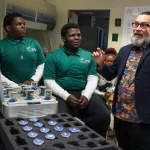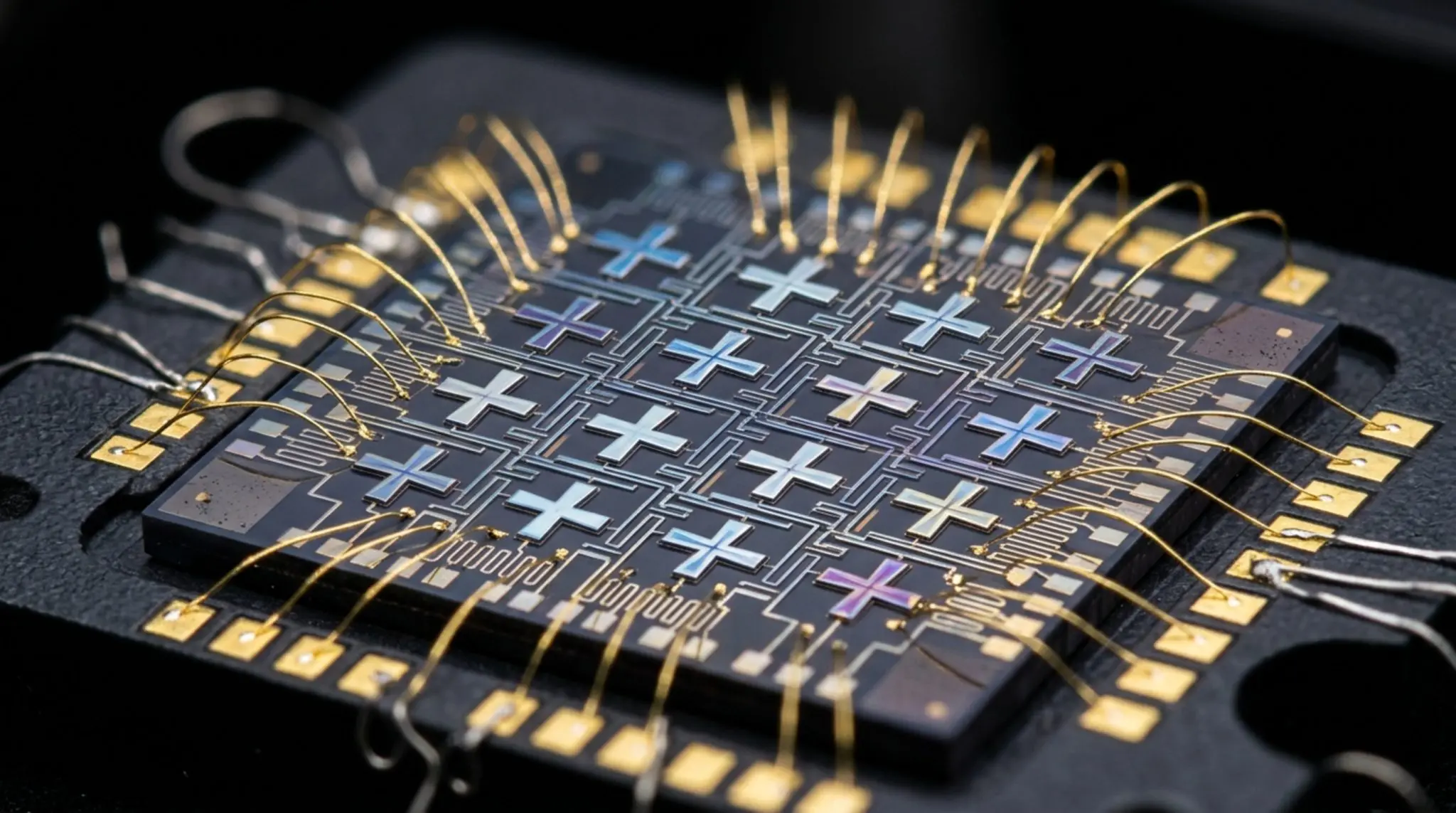
A $27.9 million National Science Foundation grant over five years will support a new collaborative effort to overcome a stagnation in quantum computing hardware. The MARQUIS institute, focused on Manufacturable and Resilient superconducting Quantum Information Systems, aims to move beyond experimental prototypes by fundamentally reinventing the materials used to build quantum processors.
Valla Fatemi, assistant professor of applied and engineering physics at Cornell, will serve as deputy director, bringing Cornell’s expertise to the multi-institutional project. “The whole community has been using essentially the same materials technology for about a quarter century,” says director Nathalie de Leon of Princeton University, highlighting the need for a new approach to achieve scalable quantum computers.
MARQUIS Institute Addresses Quantum Processor Scalability Challenges
Led by Princeton University, the institute unites expertise across materials science, quantum devices, and semiconductor processing, spanning nine research institutions including Cornell University. “There’s a huge barrier to solving the problem,” Fatemi said, emphasizing the need for collaborative expertise to overcome limitations. The MARQUIS institute will focus on materials innovation and establishing standardized methods for validating designs and testing them in mid-scale processors. This approach aims to bridge the gap between academic lab experiments and the large-scale processors needed for practical quantum algorithms.
Fatemi’s research group will concentrate on developing and characterizing new types of Josephson junctions, critical components for manipulating quantum information, and will leverage advanced facilities at Cornell, including the NanoScale Facility and the Center for Materials Research. “This confluence of facilities at Cornell puts our team in an excellent position to impact quantum hardware as part of this new institute,” Fatemi stated.
The team also anticipates valuable knowledge transfer from semiconductor fabrication experts, as “we can learn from each other as part of the process of basic science and invention,” according to Fatemi. De Leon added, “We can see that the materials limitations are going to be one of the next big bottlenecks,” and the institute represents a concerted effort to address this critical issue.
This confluence of facilities at Cornell puts our team in excellent position to impact next generation quantum hardware as part of this new institute.
Fatemi, who research illustrates the kinds of advances the institute will pursue
Fatemi & Cornell Advance Josephson Junction Fabrication Techniques
Cornell University will play a key role in a new national effort to overcome longstanding materials challenges hindering the development of scalable quantum computers. A primary focus for Cornell researchers will be the development of novel Josephson junctions, critical components in superconducting qubits. Current fabrication methods rely on aluminum and aluminum oxide, utilizing a polymer stencil mask technique unchanged for over 25 years. Fatemi’s group is exploring alternative approaches, including using krypton gas to deposit tantalum on silicon at lower temperatures, enhancing compatibility with existing semiconductor manufacturing processes.
Another project involves a resist-free method for fabricating junctions using etched silicon trenches, reducing contamination and expanding material possibilities. “That’s one of the reasons I’m excited about being part of this multidisciplinary team,” Fatemi said, emphasizing the potential for cross-disciplinary learning and innovation.
The institute’s work addresses a stagnation in foundational materials technology despite rapid advancements in quantum computing theory and device design. Cornell’s advanced facilities, including the Cornell NanoScale Facility and the Cornell Center for Materials Research will be crucial for characterizing these new materials and junctions, as De Leon added.
The whole community has been using essentially the same materials technology for about a quarter century.
Nathalie de Leon, a professor of electrical and computer engineering at Princeton, who will direct the new i



See today’s quantum computing news on Quantum Zeitgeist for the latest breakthroughs in qubits, hardware, algorithms, and industry deals.