
Welcome to this week’s quantum technology digest. We’ve assembled the ten most impactful stories from the past seven days, covering advances in hardware, algorithms, and commercialization. This week demonstrates the breadth of activity in the field, with developments ranging from error correction tools to potential impacts on cryptocurrency security.
Several articles point to a clear focus on scaling quantum systems. IBM demonstrated a modular cooling architecture to connect processors, while Quanta Computer partnered with Quantinuum to expand manufacturing capabilities. Alongside hardware progress, researchers at Google Quantum AI and IBM are refining algorithms to improve efficiency in areas like cryptography and linear equation solving.
Beyond technical achievements, the quantum ecosystem continues to mature. IonQ expanded access through a Canadian partnership, and Pasqal announced plans for a public listing. These developments signal growing confidence in the technology’s commercial viability and a broadening of the industry landscape.
1. Google Quantum AI Lowers Threshold for Bitcoin Cryptographic Attack

Google Quantum AI estimates a quantum attack on Bitcoin’s secp256k1 cryptography could require as few as 1200 logical qubits and 90 million Toffoli gates, significantly fewer resources than previously believed. The team’s analysis, validated with a zero-knowledge proof, demonstrates that fast-clock quantum computers could target unconfirmed transactions in the public mempool. This finding accelerates the timeline for potential cryptocurrency vulnerabilities and shows the need for a transition to Post-Quantum Cryptography.
2. Quantum Threat to Crypto: 500,000 Qubits May Be Enough to Break Codes

Google Quantum AI’s Ryan Babbush and colleagues determined that cracking current encryption could require as few as 500,000 qubits, a significant reduction from prior estimates. Their research revealed that approximately 90% of current crypto-systems depend on elliptic curve cryptography, making them particularly vulnerable to quantum attacks. The team verified their hacking algorithm with a publicly available, independently verifiable proof, demonstrating a potential quantum shortcut to break systems currently considered secure, though Oratomic estimates a similar breach could occur with 26,000 physical qubits over a longer timeframe. Experts urge a swift transition to post-quantum cryptography to address this accelerated threat.
3. Quantum Algorithm Accelerates Solving Linear Matrix Equations

A team at Google Quantum AI developed a quantum algorithm that solves the Sylvester equation, a common linear matrix equation, more efficiently than classical methods. The algorithm uses a block-encoding technique to construct the solution matrix, allowing faster access to its properties without directly preparing a quantum state. Results indicate the algorithm’s computational demands scale favorably with problem size, and it can efficiently tackle problems within the BQP complexity class, demonstrating potential speedups in linear algebra. Researchers also collaborated with Macquarie University on this work.
4. IBM Links Quantum Processors with Novel Modular Cooling System

IBM has demonstrated a new modular cooling architecture by successfully linking two cryogenic cells in Poughkeepsie, New York. This system overcomes limitations of single-chip quantum processor scaling through interconnected, box-shaped cells that minimize signal degradation and thermal interaction. The technology supports long-range quantum interconnects, which were first demonstrated in 2024, and is a foundational component of IBM Quantum Starling, with the company planning for this architecture to be used in fault-tolerant quantum computing by 2029. Future cell versions are anticipated to house at least 2,000 qubits each.
5. Quanta Computer Partners with Quantinuum to Scale Quantum System Manufacturing
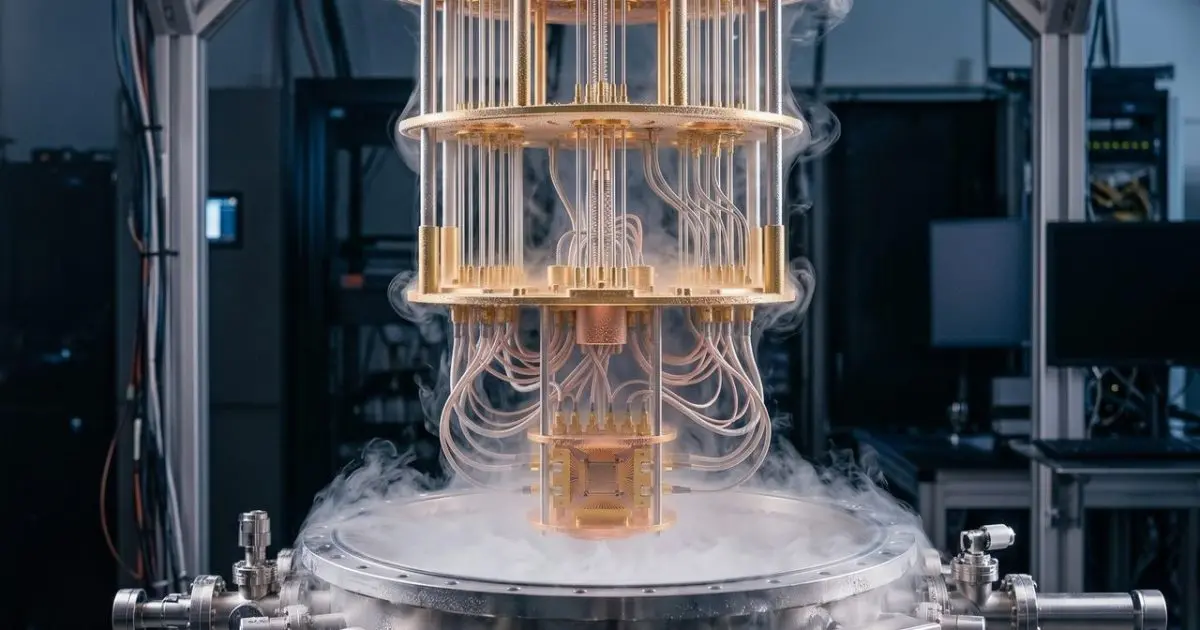
Quantinuum and Quanta Computer are collaborating to build hardware infrastructure for scalable quantum computers. This partnership focuses on manufacturing and deploying Quantinuum’s existing QCCD architecture, rather than solely on qubit development. Quantinuum asserts this collaboration will move quantum computing beyond lab-based physics breakthroughs toward practical, large-scale production. The companies are co-developing hardware to support future generations of Quantinuum’s systems and establish reliable supply chains.
6. IonQ, qBraid, and NVIDIA Cut Chemistry Simulation Errors by 54%

IonQ, qBraid, and NVIDIA report a 54 percent reduction in errors during quantum chemistry simulations. This improvement stems from combining Generalized Superfast Encoding and Clifford Noise Reduction with mid-circuit stabilizer measurement on IonQ’s trapped-ion systems, and accelerating computations with NVIDIA’s cuQuantum SDK. The approach actively corrects errors during computation, rather than relying on post-processing, and utilizes the unique characteristics of trapped ions for greater accuracy and efficiency in areas like drug discovery and materials science.
7. Quantum Algorithms Expand Simulation to Systems with “Memory” Effects

IBM Research and Massachusetts Institute of Technology scientists have developed quantum algorithms to efficiently simulate non-Markovian systems, which consider past states when determining future behavior. These algorithms achieve an exponential speedup in simulating linear Volterra integro-differential equations – equations describing systems with memory – compared to classical methods, even when the system’s “memory” is strong (M ≥ 1). This advancement overcomes previous computational limitations and expands the range of physical and chemical processes that can be accurately modeled, including complex interactions in quantum chemistry and materials science.
8. IonQ Partners with Canada’s FABrIC to Expand Quantum Access

IonQ has become a cloud quantum computing provider for Canada’s FABrIC Quantum Computing Sandbox, a program funded by the Government of Canada’s Strategic Response Fund. This collaboration, formalized through a memorandum of understanding with CMC Microsystems, integrates IonQ’s trapped-ion systems into FABrIC’s infrastructure to connect Canadian academics and businesses with quantum resources. CMC Microsystems will manage access to IonQ’s technology, aiming to accelerate the development of quantum expertise and applications within Canada’s innovation ecosystem. The partnership intends to move Canadian innovators beyond simply accessing quantum computers to actively applying them in their work.
9. Riverlane Demonstrates Quantum Error Correction Tools at IEEE Quantum Week

Riverlane is demonstrating quantum error correction (QEC) tools at IEEE Quantum Week, offering hands-on experience with its open-source software, Deltakit, and a new interactive game. Demonstrations of both Deltakit and Deltaflow, along with beginner-focused workshops, were scheduled throughout the week to increase accessibility to QEC techniques. Riverlane collaborated with Qblox and Amazon during the event, including a live QEC experiment with Qblox and an AWS Braket panel session on software and hardware interfaces for QEC. Top scorers in the game competed for a Meta Quest VR headset and other prizes, awarded on September 17.
10. Pasqal Quantum Computing Firm Set for Public Listing Via Merger

Bleichroeder Acquisition Corp. II shareholders will vote on August 25, 2026, to merge with Pasqal Holding SAS, a move that will take the quantum computing company public on Nasdaq. Founded in 2019, Pasqal currently has around 300 employees and serves over 25 organizations including Saudi Aramco, LG Electronics, and IBM. The company has secured more than $300 million in funding and aims to advance the development of scalable quantum computing technology. Pasqal is also a member of the IBM Quantum Network, strengthening its industry connections.



See today’s quantum computing news on Quantum Zeitgeist for the latest breakthroughs in qubits, hardware, algorithms, and industry deals.