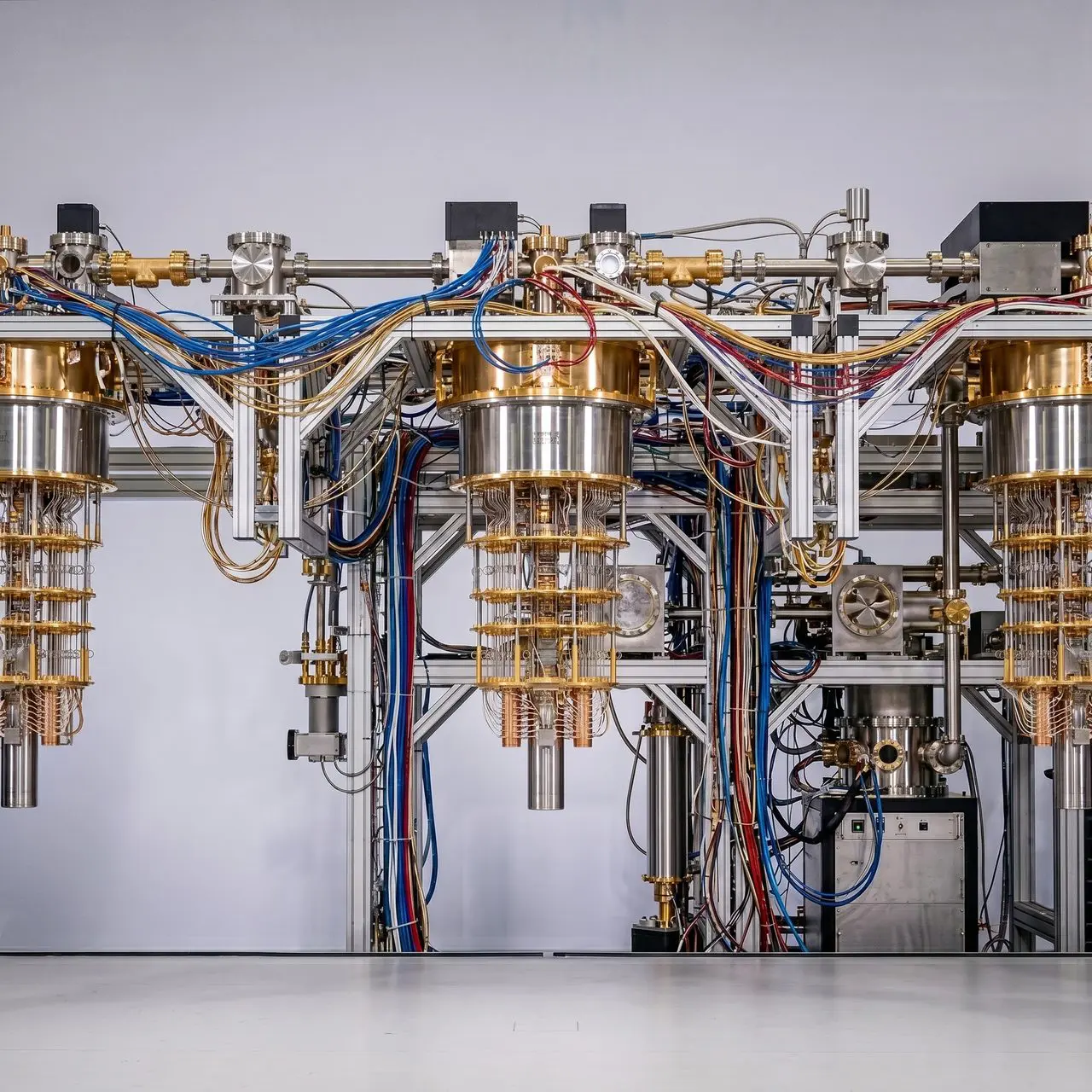
LG Electronics researchers are applying quantum computing to the design of new quantum technologies, a development detailed in research published on July 29, 2026. The team at Toronto AI Lab completed work encompassing data curation, formal analysis, investigation, software development, validation, and visualization. This approach signals a strategy where quantum computers are not simply the target of innovation, but also the tools driving it. The research focuses on interacting spin systems, essential components for quantum sensors, single-photon sources, and quantum processors.
Quantum-Computer-Aided Framework for Simulating Spin Systems
Researchers at Toronto AI Lab, a division of LG Electronics, have demonstrated a novel application of quantum computing, using a quantum computer to design quantum technologies, a strategy signaling a shift in how these systems are developed. Published on July 29, 2026, in Quantum Science and Technology, the work details a framework for simulating interacting spin systems, crucial components for devices like quantum sensors and single-photon sources.
This approach moves beyond simply pursuing quantum computation and instead leverages its power for materials discovery and optimization. The team, comprised of Juan Naranjo, Thi Ha Kyaw, Gaurav Saxena, Kevin Ferreira, and Jack S Baker, focused on modeling the complex behavior of electron spins in solid materials. Their framework incorporates several key interactions, zero-field splitting, the Zeeman effect, hyperfine interactions, dipole-dipole spin-spin interactions, and electron-phonon decoherence, to accurately represent real-world conditions.
Central to their methodology is a combination of gray-encoded qudit-to-qubit mappings, qubit-wise commuting aggregation, and a multi-reference selected quantum Krylov fast-forwarding (sQKFF) hybrid algorithm. This allows for the simulation of extended-time dynamics even with the limitations of current and near-future quantum hardware. The research involved a comprehensive methodology explicitly labeled with “Data curation, Formal analysis, Investigation, Software, Validation, Visualization, Writing – original draft, Writing – review & editing,” indicating a hands-on, practical focus extending beyond theoretical modeling.
Numerical simulations successfully computed operationally useful quantities, including autocorrelation functions up to nanosecond timescales, microwave absorption spectra, and the norm of coherence. Importantly, the team achieved an 18-30% reduction in gate counts and circuit depth for time-evolution circuits when compared to unoptimized implementations; this efficiency gain is critical for running complex simulations on noisy quantum computers. To validate their framework, the researchers used the nitrogen vacancy center in diamond as a testbed.
Benchmarking against classical simulations revealed that reference-state selection within the sQKFF algorithm is the primary factor influencing accuracy at a given hardware cost. This finding provides valuable insight for optimizing the simulation process and maximizing the utility of limited quantum resources. The team acknowledges that the data supporting their findings are not publicly available due to commercially sensitive information, but state that the data are available upon reasonable request from the authors.
The researchers claim this methodology provides “a flexible blueprint for using quantum computers to design, compare, and optimize solid-state spin-qubit technologies under experimentally realistic conditions.” The ability to accurately simulate these systems promises to accelerate the development of advanced quantum devices, potentially unlocking new capabilities in sensing, communication, and computation. This work represents a significant step toward utilizing quantum computers not just as processors, but as essential tools in the design and engineering of future quantum technologies.


See today’s quantum computing news on Quantum Zeitgeist for the latest breakthroughs in qubits, hardware, algorithms, and industry deals.