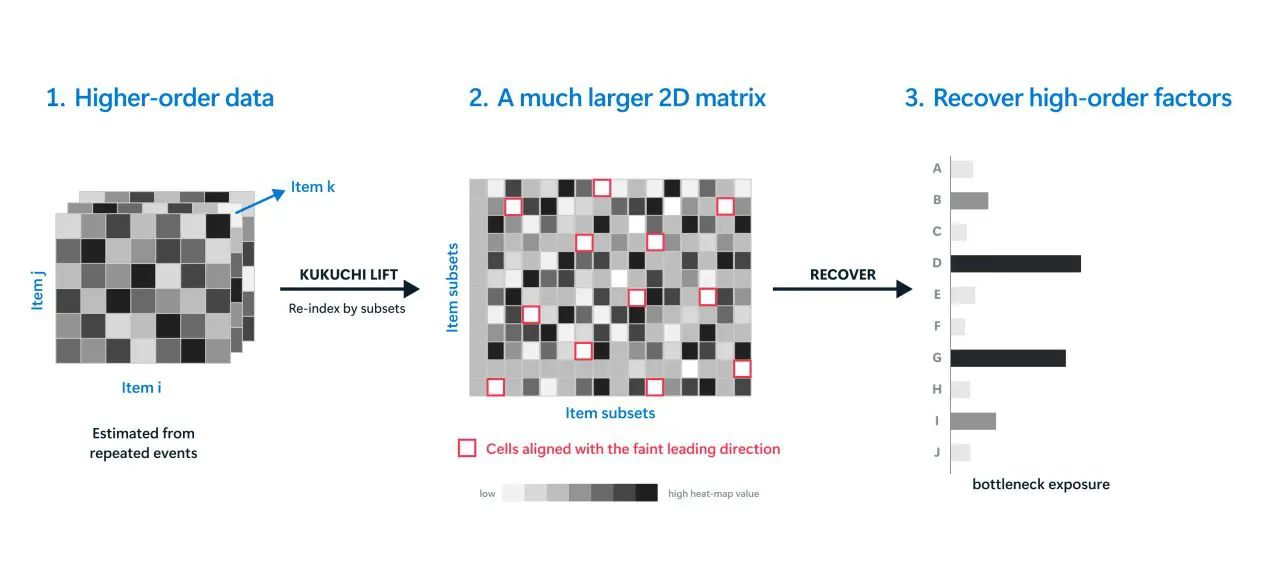
LSEG is collaborating with Microsoft in an early-stage evaluation of quantum data analysis methods, applying Quantum Tensor PCA to mortgage prepayment analysis. The partnership centers on Quantum Tensor PCA, a new capability within the Microsoft Quantum Development Kit designed to identify weak signals in noisy, high-dimensional datasets where traditional analytics often fall short.
“Many real-world datasets involve relationships that extend beyond simple pairwise interactions,” Microsoft notes, suggesting the technology could uncover hidden patterns across complex variables like market risk and ESG factors. Researchers aim to assess whether the quantum approach can deliver substantially faster analysis on future fault-tolerant quantum computers.
Quantum Tensor PCA for High-Dimensional Data Analysis
LSEG is applying Quantum Tensor PCA to mortgage prepayment analysis, a notoriously complex financial modeling challenge. The selection of mortgage prepayment analysis demonstrates a commitment to addressing problems where subtle relationships significantly impact risk assessment and forecasting accuracy.
The core of this approach lies in its potential to surpass classical techniques when analyzing datasets with intricate, multi-variable relationships, a limitation of many existing analytical tools. This speedup is not merely incremental; the team hopes to achieve superquadratic improvements over the best-known classical methods, a claim supported by work detailed in Chakrabarti, Fontana et al.’s publication, “End-to-end quantum algorithms for tensor problems.” Microsoft’s investment in topological qubits, including the Majorana 1 chip developed in February 2025, is intended to underpin the hardware foundation for these future computations, though verified fault-tolerant operation remains a key milestone.
Beyond finance, the QDK for analytics aims to provide tools for investigating datasets across diverse fields, including life sciences, infrastructure, and materials science. This broad applicability stems from the algorithm’s ability to identify weak signals obscured by noise, a common challenge in high-dimensional data. Hastings’ research, “Accelerating Classical and Quantum Tensor PCA,” further illuminates the potential of this technique to extract meaningful insights from complex data landscapes.
Microsoft’s commitment extends to supporting the development of reusable data representations and quantum primitives, enabling researchers to rapidly transition from problem definition to executable quantum experiments, and the company’s $200,000 research program through 2026 funded academic work on fault-tolerant quantum computing, the company says. The development of Quantum Tensor PCA is not solely about algorithmic innovation; it also requires a unified, modular interface to facilitate seamless integration with existing analytical workflows.
LSEG’s contribution of domain expertise ensures that the findings are relevant and actionable within established financial modeling practices. “QDK for analytics helps researchers and organizations begin that work today by exploring complex data, investigating hidden patterns and risks, and preparing for a future of quantum-enabled decision making,” according to the company. Microsoft’s Azure Quantum cloud platform provides the infrastructure for these experiments, and the Q# programming language, launched with the Quantum Katas on January 26, 2023, offers a means to express and execute these quantum algorithms.
LSEG Collaboration Evaluates Financial Risk Modeling
LSEG is now applying Quantum Tensor PCA to mortgage prepayment analysis, credit analytics, and counterparty credit risk, specific financial modeling areas poised for evaluation with the new Microsoft Quantum Development Kit for analytics. This targeted approach moves beyond generalized quantum computing exploration, focusing on practical applications within the financial sector and establishing a clear test case for the technology’s potential.
The collaboration aims to determine if the quantum approach can discern subtle patterns currently obscured in complex financial datasets, a challenge traditional methods often struggle to address. The selection of these initial areas reflects a deliberate strategy to address problems where higher-order relationships between variables are critical, according to Microsoft and LSEG’s joint statement.
Traditional matrix-based techniques, while effective for simpler analyses, can miss crucial correlations when dealing with datasets exhibiting interactions across multiple dimensions simultaneously. LSEG intends to integrate findings into its existing analytical workflows, ensuring any potential benefits are measurable within established operational frameworks.
Beyond these initial use cases, LSEG and Microsoft are also evaluating Quantum Tensor PCA’s applicability to ESG risk factors, market data feed reliability, and fixed-income index analytics, demonstrating a broad scope for potential impact, according to the company. Microsoft will provide technical guidance and research tools throughout the evaluation process, while LSEG contributes its deep domain expertise, ensuring the research remains grounded in real-world financial challenges.
This collaborative model is central to the private preview of QDK for analytics, where Microsoft is actively seeking feedback from invited participants with complex datasets and defined success metrics. Microsoft emphasized that feedback from domain experts will be essential to understanding which analytical challenges are best suited to these emerging techniques. The private preview phase will allow Microsoft to refine the developer experience and prioritize future research directions based on real-world needs, moving beyond theoretical potential toward demonstrable value.
This focus on integration with existing data science ecosystems, allowing researchers to utilize familiar tools for data preparation, model evaluation, and visualization, is a key component of the QDK for analytics strategy. By providing classical baselines and reference tools, Microsoft aims to facilitate rigorous testing and reproducibility of results, fostering trust and transparency in the emerging field of quantum data analysis.
Microsoft QDK Analytics: Tools and Ecosystem Integration
Microsoft is integrating classical baselines and reference tools within the Quantum Development Kit for analytics, enabling rigorous testing and reproduction of results for external validation. This focus on comparability ensures findings aren’t isolated to the quantum realm, but can be assessed against established statistical analyses and trusted classical implementations. The inclusion of these tools addresses a critical need for transparency and verification as researchers explore the potential of quantum algorithms in data science. This partnership extends beyond theoretical exploration; Microsoft will provide research tools and technical guidance to LSEG throughout the evaluation process.
The teams will jointly determine where higher-order methods can deliver tangible benefits, moving beyond simply demonstrating algorithmic capability to proving practical impact within a real-world financial context, the firm reports. “By bringing together emerging quantum analytics research and real-world financial expertise, this collaboration will help produce evidence for where these methods could have practical impact,” the companies stated.
This iterative approach ensures the library evolves in response to practical needs, rather than pursuing purely theoretical advancements. The private preview phase also allows Microsoft to evaluate priority scenarios and shape the research roadmap, focusing on areas where quantum algorithms can offer the most significant advantages.
Hastings noted, “Accelerating Classical and Quantum Tensor PCA,” while Chakrabarti, Fontana et al. detailed “End-to-end quantum algorithms for tensor problems.” The development of QDK for analytics reflects a broader recognition that realizing the potential of quantum computing requires more than just hardware advancements. It demands a concerted effort to discover, test, and refine quantum algorithms for problems where they can demonstrably outperform classical approaches.
The company’s internal funding and June 22, 2026 shift of its quantum resource estimator to the qdk.qre Python module further demonstrate its dedication to building a comprehensive quantum ecosystem.