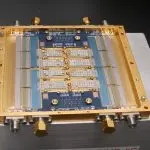
Researchers at ETH Zurich have, for the first time, combined vibrating memory devices, mechanical resonators, with superconducting qubits, departing from conventional quantum computing approaches. Yiwen Chu and her colleagues are storing information not electromagnetically, but as mechanical vibrations within a quantum chip, significantly increasing the system’s storage capacity; the process resembles the vibrating strings of a guitar producing musical notes. This new architecture intentionally mirrors classical digital computers, separating processing from working memory for greater efficiency. “The interaction between the quantum processor and the quantum memory provides a crucial foundation for establishing quantum computers as a powerful and reliable way to perform computations that are not feasible with conventional computers,” says Yiwen Chu, a professor of Hybrid Quantum Systems. The team demonstrates both fundamental and advanced quantum calculations, providing proof of feasibility and laying the groundwork for a fully programmable quantum computer.
Vibrational Memory: Resonators and Quantum Information Storage
The ability to densely pack information into a small space remains a critical hurdle in quantum computing, and researchers are now exploring an unexpected avenue: mechanical vibrations. This departure from conventional approaches significantly increases the potential storage capacity within a given volume, offering a pathway toward more scalable quantum processors. The system functions much like a guitar; the resonators, akin to vibrating strings, each produce unique vibrational modes that represent distinct memory slots, with variations within those modes encoding specific information states. Unlike a guitar string governed by classical physics, these quantum vibrations operate under the rules of quantum mechanics, allowing for superposition and entanglement, properties unavailable to traditional computing. The team demonstrates the feasibility of this approach by successfully performing both fundamental computational operations and more advanced quantum calculations, with the quantum Fourier transform and period finding serving as examples of tests confirming the system’s capability.
These tests, detailed in the journal Science, confirm that the system is fundamentally capable of performing any quantum computation. Mechanical resonators offer advantages over traditional electromagnetic memory, being significantly smaller and more compact, while also maintaining quantum states for longer periods. Chu notes that this physical manifestation of data storage within the system is a promising step toward building a truly powerful and reliable quantum computer.
The Quantum Fourier Transform is a fundamental computational procedure required for many quantum algorithms. The period-finding algorithm we implemented served as a demonstration of how this procedure can be used”, explains Igor Kladarić, doctoral student in Chu’s team and co-author of the publication.
Igor Kladarić, doctoral student in Chu’s team
Superconducting Qubits Integrated with Mechanical Resonators
The pursuit of scalable quantum computing has historically focused on electromagnetic systems for both processing and memory, but a new architecture emerging from ETH Zurich challenges this convention by integrating superconducting qubits with mechanical resonators. Yiwen Chu and her colleagues have, for the first time, coupled these disparate technologies, creating a system where information is stored not in electromagnetic fields, but as physical vibrations. This departure from established methods addresses a critical bottleneck in quantum computer development: storage capacity and physical footprint. Unlike traditional quantum memory, which relies on electromagnetic storage, this novel approach utilizes mechanical resonators, tiny components that vibrate when storing information. These vibrations, akin to the strings of a guitar, each represent a distinct piece of information, with different vibrational modes corresponding to available memory slots.
The benefit of this design is significant; mechanical resonators are substantially smaller and more compact than their electromagnetic counterparts, potentially enabling denser and more scalable quantum processors. These resonators exhibit longer coherence times, preserving quantum states and reducing information loss. They tested the system using the quantum Fourier transform and a period-finding algorithm as demonstrations of its capabilities. The researchers intentionally mirrored classical computer architecture, separating processing, handled by superconducting qubits, from working memory, provided by the vibrating resonators.
In our quantum working memory, however, information is not stored electromagnetically – as is usually the case today – but rather in the form of mechanical vibrations.
Yiwen Chu, Professor of Hybrid Quantum Systems
Quantum Chip Architecture Mimics Classical Digital Systems
Departing from prevalent designs that tightly integrate processing and storage, Chu and her colleagues have separated these functions, establishing a framework that could significantly enhance scalability and reliability. This approach centers on utilizing mechanical resonators, tiny vibrating components, as a quantum memory, a departure from the electromagnetic memory commonly employed in existing quantum processors. The team’s innovation lies in creating a system where a superconducting qubit functions as the central processing unit, analogous to a CPU in a conventional computer, while information is stored as mechanical vibrations within the quantum memory. This architecture allows for increased storage capacity, as the resonators, much like the strings of a guitar, can vibrate in multiple modes, each representing a distinct memory slot.
The researchers detailed their findings in Science, demonstrating that their approach can successfully perform both fundamental computational operations and more advanced quantum calculations, providing proof of feasibility and laying the groundwork for a fully programmable quantum computer. The use of mechanical resonators, smaller and more compact than electromagnetic counterparts, also offers the advantage of longer quantum state stability, extending information storage time and paving the way for more robust and scalable quantum systems.
Increased Storage Capacity & Stability via Mechanical Vibration
The pursuit of scalable quantum memory has led researchers to explore unconventional materials and architectures, and a recent development at ETH Zurich demonstrates a significant leap forward by leveraging the principles of mechanical vibration. This approach, detailed in the journal Science, moves beyond simply storing information; it fundamentally alters how that information is held. Unlike conventional quantum systems that rely on electromagnetic fields to maintain quantum states, this new architecture stores information as physical vibrations within the mechanical resonators. Chu explains, “Our quantum chip contains tiny components that start to vibrate when storing information.” These vibrations, analogous to the vibrating strings of a guitar, offer a denser and more stable means of data storage. Each resonator can vibrate in multiple modes, effectively creating numerous memory slots within a compact space. This separation is crucial for scalability, as electromagnetic memory, while precise, is comparatively bulky and limits the potential for miniaturization.
Mechanical resonators, however, are significantly smaller and support a greater number of vibrational modes, allowing for more information to be stored in a given volume. These vibrations exhibit enhanced stability, extending the duration for which quantum information can be reliably held. The team is now focused on scaling up the system, aiming to demonstrate the reliability of this architecture in larger, more powerful quantum computing systems.
Mechanical resonators, by contrast, are significantly smaller and more compact. They also offer greater storage capacity, because they support many different vibrational modes and can therefore store more information simultaneously than electromagnetic memory.
Source: https://ethz.ch/



See today’s quantum computing news on Quantum Zeitgeist for the latest breakthroughs in qubits, hardware, algorithms, and industry deals.