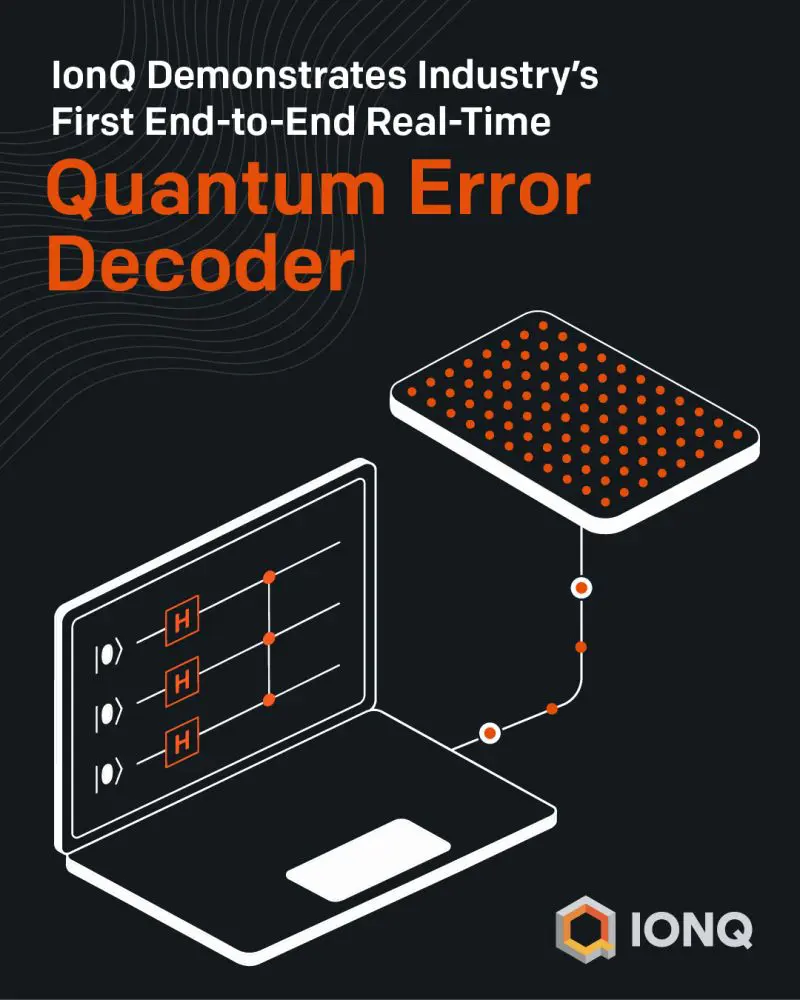
IonQ has demonstrated the first end-to-end real-time quantum error correction decoder running on a single, standard CPU, a feat previously considered a major bottleneck in building practical quantum computers, the company says. The company evaluated the decoder across circuits simulating up to 408 logical qubits and over 31.5 million quantum operations, introducing a mere 0.02% delay to the overall computation. This achievement validates IonQ’s Walking Cat architecture and suggests classical hardware limitations won’t hinder future quantum system growth.
Real-Time Decoding Achieves 31.5 Million Quantum Operations
IonQ’s newly demonstrated quantum error correction decoder processed over 31.5 million quantum operations, a scale previously unattainable for real-time correction and signifying a substantial advance in quantum processing capability. The decoder’s performance was achieved while introducing only 0.02% ‘stretch’ time, minimizing delays and maintaining continuous quantum computation, a critical factor for complex calculations. This low latency is particularly noteworthy given the computational demands of error correction, historically a major bottleneck in quantum computing development.
The system’s ability to function using a single, standard CPU challenges the expectation that robust error correction requires specialized, massive computing infrastructure. “Successfully validating real-time decoding across hundreds of logical qubits and over millions of logical operations is an important milestone,” said Nicolas Delfosse, paper co-author and quantum research lead at IonQ.
This decoupling of quantum processing from specialized classical hardware opens a path toward more accessible and scalable fault-tolerant quantum computers, potentially lowering the barriers to entry for researchers and developers. IonQ fabricated its first fully integrated 256-qubit quantum processing units on its Superion 256 platform earlier in September, a fabrication milestone preceding this decoder demonstration, according to the company.
John Gamble, Vice President at IonQ Architecture, stated, “IonQ is enabling cost-effective quantum system scaling through direct verification of each component.” This empirical validation helps build reliable and predictable quantum computers, and the decoder’s performance supports IonQ’s broader vision for fault tolerance, prioritizing speed, cost-effectiveness, and energy efficiency. “Empirical evidence like this supports our vision for fault tolerance where time-to-solution, cost-to-solution, and energy-to-solution are always our North Star,” added Gamble.
Successfully validating real-time decoding across hundreds of logical qubits and over millions of logical operations is an important milestone. the fact that our decoder runs on a single CPU provides a practical path to commercial-scale fault-tolerant quantum computing.
Nicolas Delfosse, paper co-author and quantum research lead at IonQ

See today’s quantum computing news on Quantum Zeitgeist for the latest breakthroughs in qubits, hardware, algorithms, and industry deals.