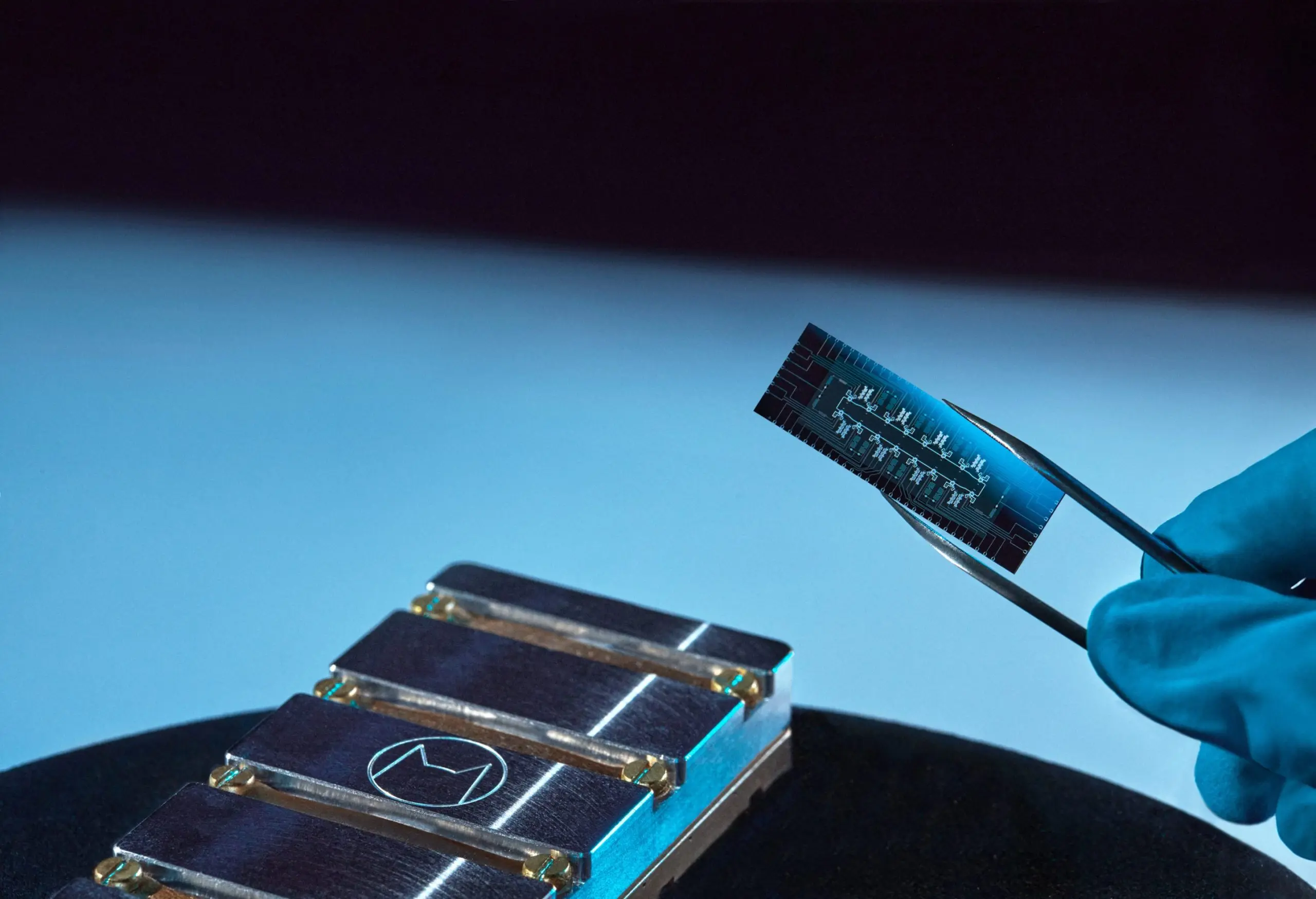
Alice & Bob has completed and tested three independent cat-qubit demonstrators as part of Phase 1 of France’s PROQCIMA quantum program, a key milestone in the 10-year initiative, the company says. The company assembled demonstrators using both 6-qubit and 12-qubit chips, showing its ability to operate multiple hardware configurations while validating core error-correction architecture on real hardware.
Results include measured performance of noise-biased CNOT gates and a measure-and-reset sequence for auxiliary qubits, with the program set to narrow five participating companies down to two after year eight. “The race for fault-tolerant quantum computing is a question of who will master one of the defining technologies of this century, and France starts from a position of real strength,” says Théau Peronnin, CEO of Alice & Bob.
PROQCIMA Phase 1: Alice & Bob’s Three Cat-Qubit Demonstrators
The company successfully operated a 12-qubit chip as part of its Phase 1 deliverables for France’s PROQCIMA program, demonstrating a key step in the development of fault-tolerant quantum computing hardware. This chip was one of three independent cat-qubit demonstrators assembled and tested by the company, alongside two built on 6-qubit chips, to assess the technical feasibility of its approach, according to PROQCIMA.
The demonstrators focused on validating the core operations of error-correction architecture using physical hardware, a critical milestone for the 10-year program. Multiple cycles of a three data qubit repetition code were also completed, representing the smallest code capable of correcting a quantum error, and the logical error rate across the full register was measured to track progress toward fault tolerance.
While the logical error rate has not yet fallen below the threshold for error correction, the measurements provide a baseline for future improvements. The company also developed a digital twin of the processor based on measured performance data. Simulations run on this twin indicate areas for improvement to operate below the error-correction threshold, with a focus on extending qubit coherence consistently across the chip. The operation of the demonstrators was also supervised by the company’s proprietary MnR software, which monitors and recalibrates qubits around the clock, the company says.
Running while the QPU was idle, the software measured performance across more than 50 indicators per qubit, detecting when a qubit drifted and required recalibration. Previously, detecting and correcting drifts could cost up to a day of operating time, but the software keeps the processor at a consistent performance level.
The PROQCIMA program, led by the French Defense Innovation Agency and the Direction générale de l’Armement, will now narrow the field of five participating companies. Three candidates will continue after the first four years, with a final selection of two companies beyond year eight to continue development of 1,000 logical qubit prototypes. “Our PROQCIMA Phase 1 results show that the cat-qubit approach, combined with our expertise, can lead this race and push the frontiers of science.
Our PROQCIMA Phase 1 results show that the cat-qubit approach, combined with Alice & Bob’s expertise, can lead that race and push the frontiers of science.
Théau Peronnin, CEO, Alice & Bob




See today’s quantum computing news on Quantum Zeitgeist for the latest breakthroughs in qubits, hardware, algorithms, and industry deals.