Haiqu is officially unveiling AgenticOS on October 7, 2026, a system designed to address a critical flaw in AI-assisted scientific research: subtle alterations to underlying science during calculations. The new platform provides quantum researchers with AI agents that validate findings at every step, preventing errors that might produce seemingly correct but inaccurate results.
“Turning a promising research idea into a real experiment demands years of specialized, hands-on expertise,” said Mykola Maksymenko, co-founder and CTO of Haiqu, “AgenticOS takes on much of that labor-intensive work, freeing up researchers.” AgenticOS aims to reduce the time required to complete quantum projects by automating tasks traditionally requiring extensive expertise.
AgenticOS Validates Quantum Project Accuracy with Multi-Agent Verification
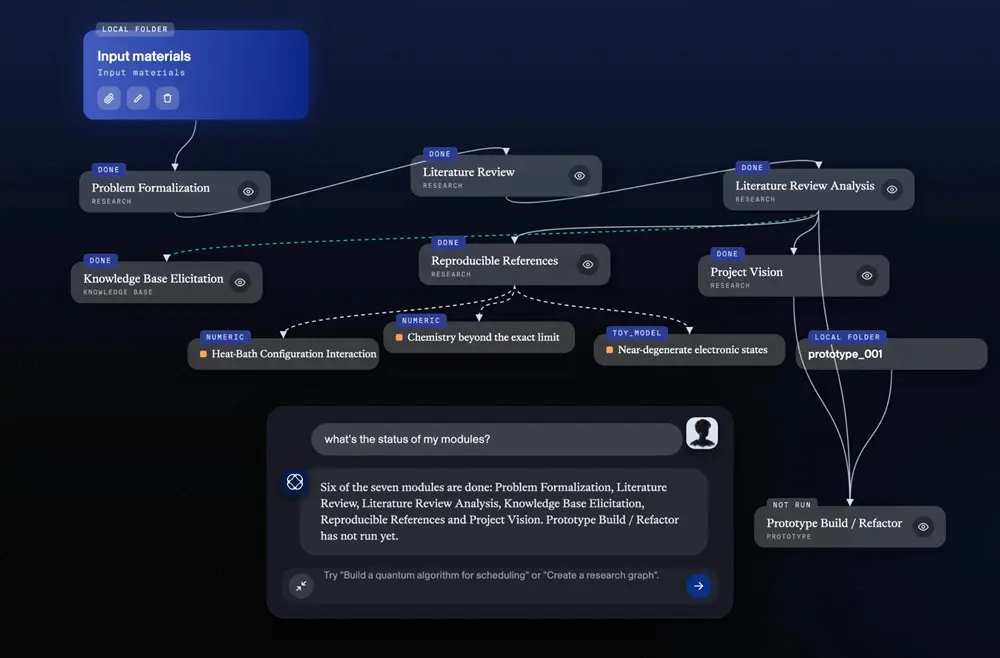
Haiqu’s AgenticOS shows its investigative process as a map of connected research tasks. Results are checked against classical baselines, tests, critic agents and human review, with formal verification. Scientists decide what gets locked, which tasks run on their own and where a human signs off. This reduction was achieved by building an experiment on a 3-by-3 grid, allowing for cross-checking against an exact classical solution before running it on an IBM quantum computer.
This capability addresses a critical issue in quantum research where AI agents can subtly alter underlying science during calculations, potentially shifting molecular geometries or introducing unapproved approximations. The system then proposed a calibration that aligned the hardware result with the output of an error-free quantum computer using the same method, indicating a path toward larger, classically unsolvable simulations.
The core innovation lies in AgenticOS’s multi-agent verification process, where researchers design a quantum project and assign teams of AI agents to validate findings at each stage, Haiqu says. Scientists maintain control by deciding which tasks are automated and where human sign-off is required, ensuring accuracy throughout the process. Haiqu asserts that being able to organize, ground, and check an AI agent’s work is as important for scientific research as improving the models themselves.
The company believes that those who can trust the output of their AI will be the ones who succeed, and AgenticOS was built to provide that trust. Companies can request access and book a demo now, while academic researchers can apply for free access through the company’s Academic Program, including Haiqu SDK credits for computing workloads.
Turning a promising research idea into a real experiment demands years of specialized, hands-on expertise in highly technical methods, all of which takes time and resources.
Mykola Maksymenko, co-founder and CTO of Haiqu
Hubbard Model Experiment Reduces Circuit Depth by 75% on IBM Quantum Hardware
Haiqu demonstrated a reduction in quantum circuit depth while simulating a complex physics problem, a feat accomplished using its new AgenticOS platform and IBM quantum hardware. The simulation focused on a two-dimensional Hubbard model, specifically a “doped, frustrated with diagonal hopping” version used to investigate high-temperature superconductivity in cuprates, a notoriously difficult calculation for classical computers. The Haiqu SDK and Runtime further enhance the efficiency of quantum computations, offering data loading, circuit compression and error mitigation techniques.
The Runtime supports execution on simulators and quantum processors from multiple providers, with reported time and cost reductions of up to 1,000 times. This integrated approach, where a single platform manages the entire workflow from problem definition to hardware execution, is intended to accelerate the pace of quantum research.
The ones that pull ahead will be the ones that can trust what it produces, and that’s exactly what we built AgenticOS to do.
Source: https://haiqu.ai/academic


See today’s quantum computing news on Quantum Zeitgeist for the latest breakthroughs in qubits, hardware, algorithms, and industry deals.