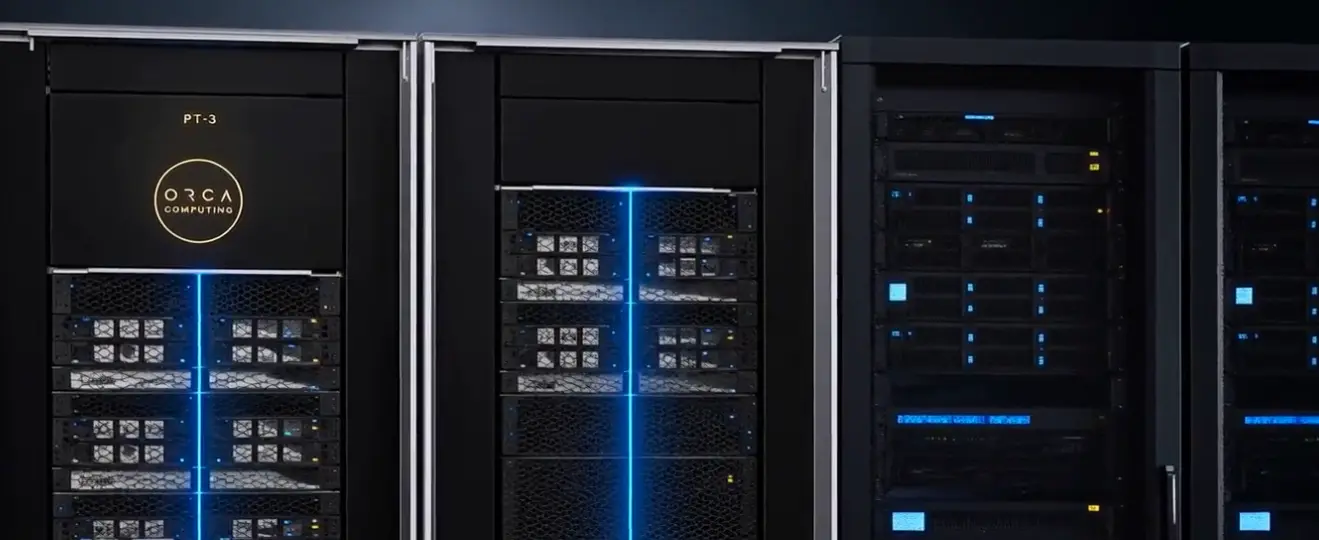
ORCA Computing has launched the PT-3, a photonic quantum computer designed to deliver commercial quantum advantage and now operating within Digital Realty’s Innovation Lab in London. The system is already yielding results in scientific AI; an extension of the NVIDIA Proteína model, run alongside the PT-3, improved the identification of novel protein structures by 20 percent over classical baselines.
“By integrating our photonic quantum computer with NVIDIA accelerated computing, we have taken a critical first step in the future of hybrid quantum supercomputing,” said Richard Murray, Co-founder and CEO of ORCA Computing. The PT-3 also accelerates industrial optimization, solving a 25,755-variable unit commitment benchmark with solution quality competitive with leading commercial tools.
PT-3 Achieves 20% Protein Design Improvement with NVIDIA Proteína
The extension of NVIDIA’s Proteína model, powered by the PT-3, improved the ratio of useful proteins by 20 percent when identifying novel protein structures, exceeding the performance of classical baselines. This advancement stems from a hybrid quantum-classical approach, training the model on 32 NVIDIA Hopper GPUs alongside the PT-3 using 64 photons in 128 qumodes, the company says. The resulting system generated proteins with a different mix of secondary structures, demonstrating an increased capacity for designability in the generative AI model.
This builds upon earlier successes with ORCA’s PT-2 system, which previously produced around twice as many strong peptide binders as classical AI, results that were validated through laboratory testing. The PT-3’s impact extends beyond protein design into industrial optimization, specifically in addressing complex energy scheduling problems. Working with JIJ Inc., bp and the UK’s National Quantum Computing Centre, ORCA applied the PT-3 to a 25,755-variable unit commitment benchmark.
The hybrid quantum-classical workflow completed the benchmark in approximately one hour, a performance increase of over 12 times compared to its predecessor while maintaining comparable solution quality. In testing detailed in a recent white paper, the resulting solutions were competitive with industry-standard commercial optimization solvers and ultimately surpassed them in finding the best solutions with extended runtime. Operating within two standard racks and consuming 6 kW, the PT-3 distinguishes itself from many quantum systems through its relatively low barrier to entry and rapid deployment.
The computer becomes operational within hours of installation, a significant advantage for researchers and businesses seeking to integrate quantum capabilities into their existing infrastructure. The PT-3 is built to scale; it upgrades in the field, so customers who start today keep building on the same system.
“Our partnership with ORCA reflects a shared ambition to make quantum computing practical for business,” said Séamus Dunne, Managing Director, UK & Ireland, Digital Realty. Sam Stanwyck, Director of Quantum Product at NVIDIA, added, “With the PT-3, ORCA is bringing photonic quantum computing and NVIDIA accelerated computing together in a system researchers can use to develop and test new applications.” Through Digital Realty, enterprise users can now put it to work on their most challenging workloads. Customers are trialling use cases in life sciences, defence, energy and logistics.
“The value of a computing platform is in what researchers build on it,” Stanwyck said, “ORCA’s extension of NVIDIA’s Proteína model to generate a different range of protein structures with improved designability is a great example of what can be accomplished when these tools come together.”
With the PT-3, ORCA is bringing photonic quantum computing and NVIDIA accelerated computing together in a system researchers can use to develop and test new applications.
Sam Stanwyck, Director of Quantum Product at NVIDIA



See today’s quantum computing news on Quantum Zeitgeist for the latest breakthroughs in qubits, hardware, algorithms, and industry deals.