Researchers from the University of Regensburg, Philipps-Universität Marburg, and Forschungszentrum Jülich have, for the first time, visualized electrons in graphene seemingly bypassing established rules of energy transfer. The team observed electrons “jump” from energy level one, two and three directly to level twenty, a phenomenon they describe as a Landau-Zener-Majorana transition.
“If you want to know who has won a race, you have to watch all participants,” explains Vincent Eggers, first author of the study, published in Nature. This observation, achieved through a novel combination of laser technology and electron microscopy, could inform the development of high-speed semiconductor electronics.
Landau-Zener-Majorana Transitions Visualized in Graphene
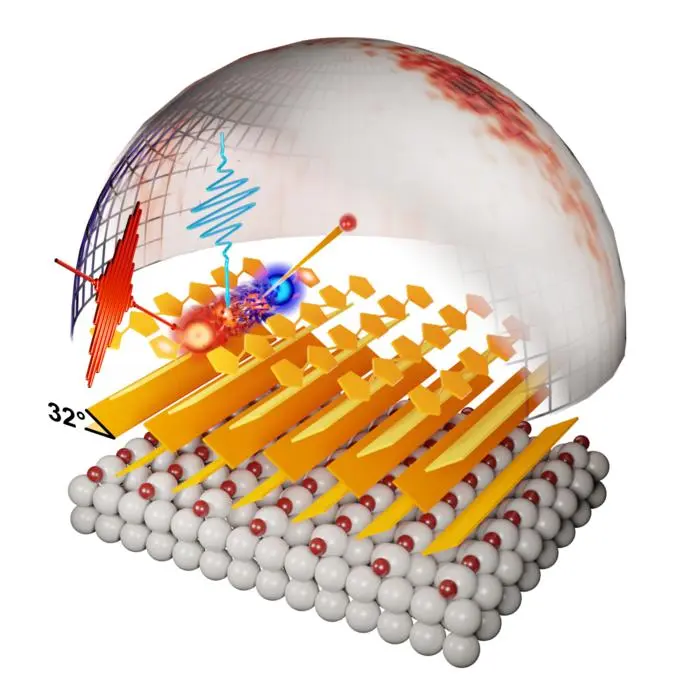
The observation of electrons bypassing seventeen energy levels in graphene confirms a phenomenon called a Landau-Zener-Majorana transition, a quantum mechanical process previously theorized but never directly visualized. This behavior, likened to an elevator skipping floors, occurs when electrons are accelerated through the material’s band structure under the influence of a strong electric field generated by a light pulse. The precision required for these experiments necessitated graphene with near-perfect atomic structure, ensuring that impurities would not interfere with the delicate quantum dynamics.
This ensures that impurities do not obscure the delicate quantum dynamics of the electrons,” emphasizes Stefan Tautz, highlighting the importance of material quality. The team also used “rotated” graphene, a specialty material developed at Jülich, which further clarified the observation of these quantum dynamics.
The measurements were based on tailor-made, atomically thin carbon layers of the highest purity, which were produced at. The resulting slow-motion images revealed how electrons are accelerated by the electric field of a light pulse and switch between energy bands as they move.
The team reports on this achievement in its latest study, published in the renowned international journal Nature. The ability to track electrons across the entire energy landscape of a solid in real time, as the team has now demonstrated, represents a step towards realizing that potential, Jülich says.
“Our team worked on this experiment for many years.” The team also noted the need to observe a large number of electrons simultaneously to capture those undergoing the quantum mechanical transition, a challenge overcome through the innovative combination of technologies employed. The findings not only advance fundamental understanding of quantum mechanics but also provide valuable insights for the development of electronic technologies.
Our team worked on this experiment for many years. Now, we can track electrons moving across the entire energy landscape of a solid in real time.
Rupert Huber
High-Purity Graphene Enables 100% Band Gap Tunneling
The ability to observe electrons tunnel directly between energy states with complete efficiency has been demonstrated in graphene, a feat previously considered improbable given established quantum mechanical principles. Researchers achieved one hundred percent tunneling probability as electrons traversed the band gap, bypassing intermediate energy levels in a process likened to an elevator skipping multiple floors. This observation hinges on the use of exceptionally pure graphene samples and a novel imaging technique combining laser technology and electron microscopy.
The team’s success stems from manipulating the material’s electronic structure with intense light fields, inducing Landau-Zener-Majorana transitions, according to Jülich. These transitions, long theorized to be important for high-speed semiconductor electronics, were directly visualized for the first time.
This meticulous material preparation, coupled with the advanced imaging system, allowed for the capture of ultrafast electron transitions in real time. The method also provides insights into factors limiting precise electron control, which is important for future technological advancements. Understanding how electrons navigate the energy landscape within a solid is fundamental to designing electronic devices. The ability to directly observe these transitions, rather than inferring them through indirect measurements, offers a new level of control and understanding.
“Likewise, we must observe as many electrons as possible at one time to catch those that undergo a quantum mechanical transition while moving,” the team noted. The findings suggest a pathway toward controlling electrons not only with electrical voltages but also with the extremely rapid oscillations of light, potentially leading to significantly faster and more efficient semiconductor technologies.
If you want to know who has won a race, you have watch all participants.
Vincent Eggers, first author of the study
Source: https://www.fz-juelich.de/en/news/archive/press-release/2026/a-quantum-elevator-in-slow-motion-video



See today’s quantum computing news on Quantum Zeitgeist for the latest breakthroughs in qubits, hardware, algorithms, and industry deals.