

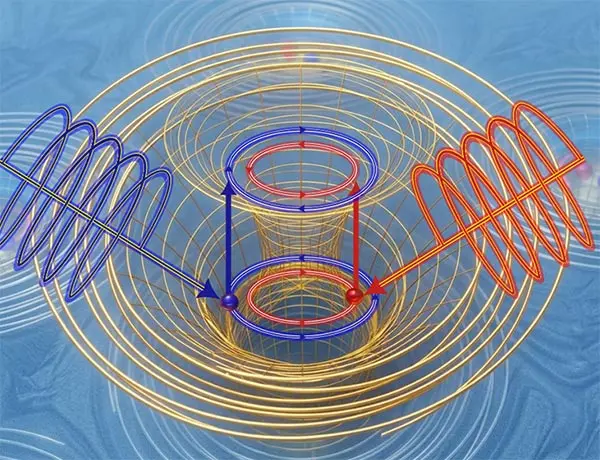
Rutgers physicists have distinguished two groups of particles trapped within the magnetic vortices inside a superconductor, a detail previously unobservable with conventional techniques. The research published in Physical Review Letters, used ultrathin layers of material grown using a molecular beam epitaxy system in Seongshik Oh’s Topological Quantum Matter Engineering Lab. “To improve superconductors, scientists need to understand what vortices contain and how they behave,” said Girsh Blumberg, a Distinguished Professor and a co-author of the study. Understanding these internal structures could lead to more reliable superconducting materials for use in powerful magnets.
Iron-Based Superconductors Enable Separation of Vortex Particle Groups
The ability to distinguish between two particle groups trapped within magnetic vortices represents a new level of detail in superconductor research, enabled by the use of iron-based materials. Girsh Blumberg, a Distinguished Professor at Rutgers, and colleagues used the unique properties of these materials to achieve separation previously undetectable with conventional methods. The team’s work, detailed in Physical Review Letters, focused on iron-based superconductors possessing narrow vortex cores, a key characteristic allowing for the differentiation of energy levels within the vortices.
“The technique is especially useful because it can separate the contributions of two different groups of particles,” Blumberg said. By varying the composition of these films, specifically the amount of selenium, the researchers observed shifts in the ratio of the two particle groups trapped within the vortices.
One sample exhibited nearly four particles of one group for every particle of the other, while the second sample displayed a roughly equal distribution. These differing ratios, maintained despite similar superconducting transition temperatures, demonstrate a direct link between material composition and the internal structure of the magnetic vortices. “Earlier methods could detect the trapped states but could not reveal this difference as directly,” Blumberg said.
This separation was achieved through the use of polarized light, probing transitions between quantum states within the vortices. The team identified that the two particle groups respond differently to light of different “handedness,” or polarization, allowing them to be distinguished. “By looking for these transitions with light of different handedness, you can separate them,” Blumberg described, outlining the core principle behind the technique.
The resulting data provides a more complete picture of the complex interactions occurring within these vortices, which are often described as being confined spaces. This detailed understanding is important because the movement of these vortices can lead to energy loss in superconductors, hindering their practical application in technologies like MRI scanners and particle accelerators. “This study provides a new way to look inside them,” Blumberg concluded, suggesting the approach could be extended to investigate other superconductors with similar characteristics.
The technique is especially useful because it can separate the contributions of two different groups of particles.
Girsh Blumberg, a Distinguished Professor in the Department of Physics and Astronomy in the Rutgers School of Arts and Sciences
Terahertz Light Measures Polarization Shifts Within Magnetic Vortices
The team measured how light polarization interacted with these confined particles, establishing a new method for probing the internal structure of superconductors. This technique relies on the differing reactions of each group to light vibrating in clockwise versus counterclockwise patterns, allowing for individual study of their properties. The ability to differentiate these groups stems from the unique way terahertz light interacts with the quantum states of the particles.
Researchers observed that one group absorbed energy most efficiently from light with a left-handed polarization, while the other favored right-handed light. Mathematical calculations, informed by the light measurements, yielded estimates of vortex size and the duration of the particles’ responses to the terahertz radiation. Beyond size, the team quantified how strongly each group resists changes in velocity or direction, a property important for understanding energy loss within the superconductor.
They also determined the magnetic field strength required to disrupt superconductivity for each group, providing insights into the material’s overall stability. “It’s like Swiss cheese, with many holes,” Blumberg said, drawing a comparison between the vortices and the holes in cheese to illustrate the confined spaces where these particles reside. These films allowed for precise measurements of the terahertz light’s interaction with the vortices. The team’s work builds on a 1964 prediction that trapped particles within vortices would occupy distinct energy levels, now directly observable through polarized light.
To improve superconductors, scientists need to understand what vortices contain and how they behave.
Girsh Blumberg, a Distinguished Professor in the Department of Physics and Astronomy in the Rutgers School of Arts and Sciences



See today’s quantum computing news on Quantum Zeitgeist for the latest breakthroughs in qubits, hardware, algorithms, and industry deals.