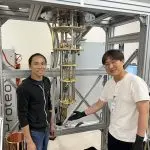
D-Wave Quantum has launched a beta program for its gate-model quantum computing simulator, offering organizations like BBVA, FirstQFM, Florida Atlantic University and the Jülich Supercomputing Centre early access to technology designed for efficient quantum error correction. Built around D-Wave’s dual-rail superconducting technology, the simulator aims to reduce hardware demands as quantum systems scale, a critical step toward practical applications, the company says.
“Quantum error correction is a defining challenge in the race to commercially useful gate-model quantum computing,” says D-Wave CEO Dr. Alan Baratz, “By giving leading organizations early access to our simulator, we’re enabling them to explore a fundamentally more efficient approach to fault tolerance.”
Dual-Rail Technology Enables Efficient Error Correction
This simulator uses D-Wave’s dual-rail superconducting technology, a foundation recently validated by research published in Nature demonstrating a high-fidelity two-qubit entangling gate that preserves inherent error-detection advantages. The beta program participants gain early access to the simulator through D-Wave’s Leap quantum cloud service and Ocean SDK, according to the company. The core innovation lies in the dual-rail approach to error mitigation, which differs from traditional quantum error correction schemes.
Instead of requiring a large number of physical qubits to encode a single logical qubit, D-Wave’s architecture aims to harness error detection to improve the quality and reliability of quantum computations with lower hardware overhead. Alan Baratz, CEO of D-Wave, stated this simulator allows organizations to explore this more efficient approach to fault tolerance and the applications it may unlock.
FirstQFM intends to apply its proprietary foundation models to explore how detected errors and real-time control can improve quantum computation quality within the simulator. BBVA, the Spanish multinational banking group, is focused on potential applications in financial services, specifically portfolio optimization, fraud detection and derivatives valuation.
Robert Loredo, executive director of the FAU Center for Quantum Technologies, emphasized the program’s impact on workforce development, stating, “By beta testing quantum simulators early, D-Wave and FAU have given our students and faculty real, hands-on experience with the tools that will shape the industry.” Dr. Arslan Munir, a professor at FAU, plans to investigate how error-aware, qubit-efficient approaches can improve the robustness of quantum machine learning models. The company anticipates offering flexible development bundles combining simulator access, future gate-model systems and expert guidance to support research and development efforts.
Quantum error correction is a defining challenge in the race to commercially useful gate-model quantum computing.
Dr. Alan Baratz, CEO of D-Wave
D-Wave’s commitment to both architectures positions it uniquely in the evolving quantum landscape.
D-Wave’s simulator represents a step forward in giving researchers practical tools to explore the potential of error-aware quantum computing.
Dr. Kristel Michielsen, director of JSC
Florida Atlantic University (FAU) and the Jülich Supercomputing Centre (JSC) are also participating in the simulator beta program. BBVA is investigating applications within financial services using D-Wave’s simulator, specifically exploring how quantum computing could address complex computational challenges.
Quantum computing could open new approaches to some of the financial services industry’s most complex computational challenges.
Escolástico Sánchez Martínez, quantum principal manager at BBVA


See today’s quantum computing news on Quantum Zeitgeist for the latest breakthroughs in qubits, hardware, algorithms, and industry deals.