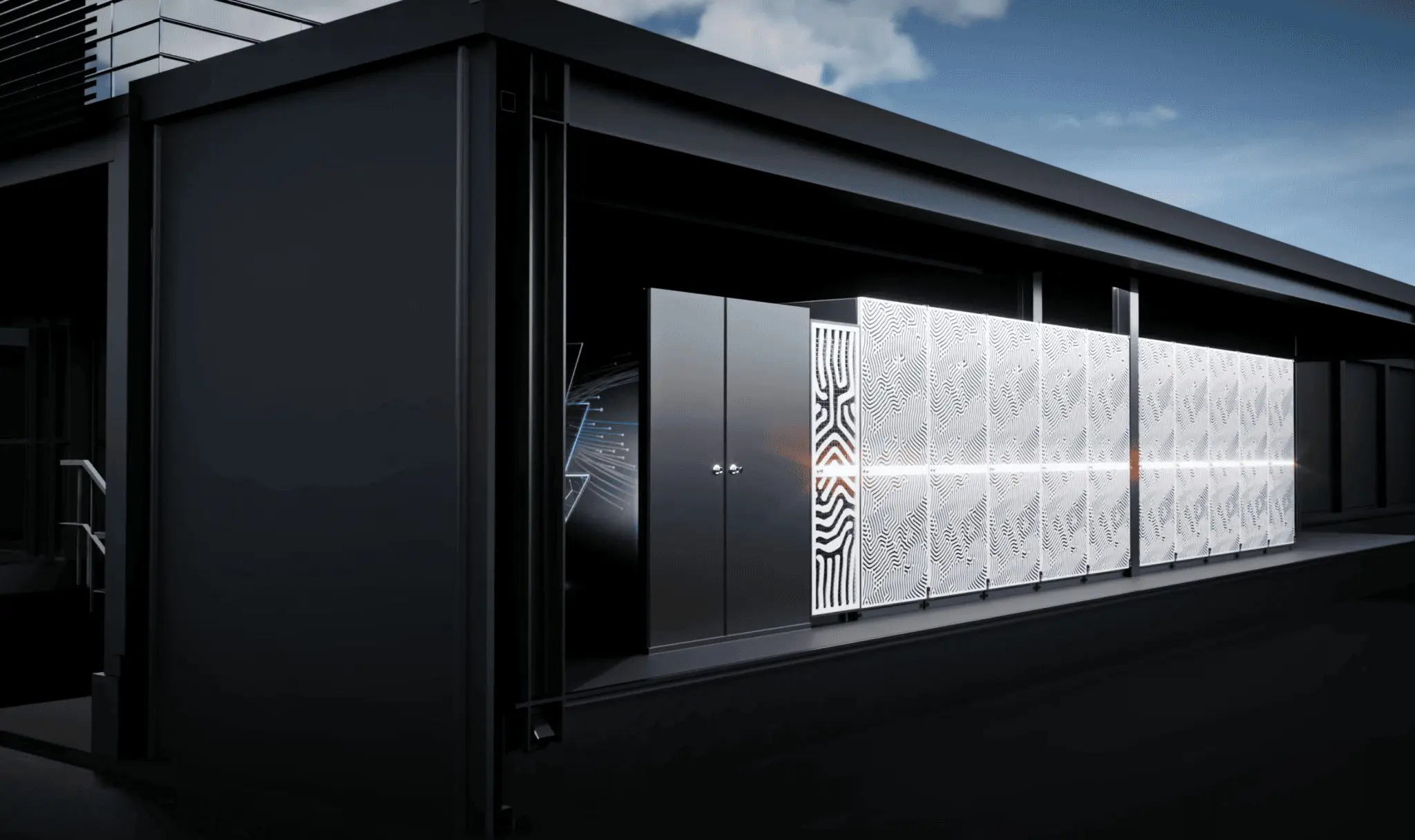
Researchers at the Jülich Supercomputing Centre (JSC), in collaboration with NVIDIA, have achieved a new milestone in quantum simulation by fully simulating a 50-qubit system on the JUPITER supercomputer. This surpasses the previous record of 48 qubits simulated by Jülich researchers and their Japanese counterparts on Japan’s K supercomputer in 2019, demonstrating the growing capabilities of Europe’s first exascale computer. Utilizing JUPITER’s architecture, which uses NVIDIA’s Grace CPUs and Hopper GPUs for its GH200 superchip architecture, the team tackled the immense computational challenge of representing each qubit’s superposition of states. “HPC-based simulators can act as a perfect flight simulator,” explains Dr. Hans De Raedt of JSC’s Quantum Information Processing group, allowing researchers to isolate algorithmic errors from hardware limitations as they develop future quantum computers.
JUPITER Supercomputer Achieves 50-Qubit Quantum Simulation
JUPITER, Europe’s fastest high-performance computing system and the first in the region to exceed the exascale threshold, was central to this milestone. Accurately modeling quantum systems is crucial given the challenges in building physical quantum computers, which are expensive and prone to errors. Dr. De Raedt explains, “Building a quantum computer is incredibly expensive and the hardware is still very noisy and prone to errors.” Researchers face exponential growth in computational demands as qubit counts increase; simulating 50 qubits requires tracking over a quadrillion possibilities. To overcome this, the team utilized 4,096 nodes of JUPITER, generating more than a petabyte of data, and implemented a novel memory compression technique that reduced memory requirements eightfold.
This simulation provides a flight simulator for quantum algorithms, allowing researchers to test their ‘flight plans’, the quantum algorithms, in a controlled environment where the correct answer is known. This enables researchers to isolate errors originating in the algorithm itself from those inherent in the hardware. The resulting JUQCS-50 will serve as a foundational element within JSC’s quantum user facility, the Jülich UNified Infrastructure for Quantum computing (JUNIQ), and a benchmark for future quantum systems seeking to prove quantum supremacy.
Building a quantum computer is incredibly expensive and the hardware is still very noisy and prone to errors.
Dr. Hans De Raedt, researcher in JSC’s Quantum Information Processing (QIP) group and collaborator on the project
The team overcame substantial memory and data management challenges inherent in simulating quantum systems, where each qubit exponentially increases computational demands. Simulating even a modest number of qubits requires tracking a vast number of possibilities; 50 qubits necessitate managing over a quadrillion possibilities simultaneously. This allowed JUQCS-50 to operate efficiently on both GPUs and CPUs. Dr. De Raedt explained, “Since so much data cannot fit on a single chip, we must chop up the data and spread it across thousands of JUPITER’s nodes, and we orchestrate data movement so that when gates need to interact with different parts of the data, they can find them without creating a ‘traffic jam’ on the system’s network.” He also noted that “Due to the hardware’s sensitivity, trying to measure qubits inside a physical quantum computer causes the system state to collapse,” highlighting the simulator’s value in isolating errors and benchmarking future quantum systems.
JUPITER, Europe’s fastest high-performance computing system, was instrumental in this feat, demonstrating its capacity to handle the immense computational demands of quantum modeling. Simulating quantum systems requires accounting for the superposition of each qubit, exponentially increasing memory requirements; tracking 50 qubits necessitates managing over a quadrillion possibilities. This involved distributing data across 4,096 nodes of JUPITER and orchestrating data movement to avoid network congestion, as explained by Dr. The simulator also serves as a benchmark for future quantum systems, requiring them to demonstrate superior speed and accuracy to justify their development.
The pursuit of practical quantum computation received a significant boost as researchers successfully simulated a 50-qubit quantum computer on the JUPITER supercomputer, establishing a new benchmark and demonstrating the crucial role of high-performance computing in advancing the field. Simulating quantum systems presents immense computational challenges; each qubit introduces exponential growth in required memory, necessitating innovative approaches to data management. The team developed a novel memory compression technique, reducing memory requirements eightfold, resulting in the JUQCS-50 simulator. JUQCS-50 isn’t merely a simulation tool; it is a vital capability for benchmarking gate fidelity and throughput, essential metrics for demonstrating quantum supremacy, the point at which a quantum computer can demonstrably outperform classical computers. “If JUQCS can calculate a specific circuit in 10 minutes, a real quantum system needs to be able to do this with high accuracy in seconds to be a viable alternative to the current state-of-the-art in classical computing,” he said, positioning JUQCS-50 as a digital twin for a 50-qubit quantum system and a foundational element of JSC’s quantum user facility, JUNIQ.
HPC-based simulators can act as a perfect flight simulator. They allow us to test their ‘flight plans,’ meaning the quantum algorithms, in a controlled environment where we know exactly what the answer should be. This helps us separate errors in the algorithm from errors in the hardware.
Dr. Hans De Raedt, researcher in JSC’s Quantum Information Processing (QIP) group and collaborator on the project



See today’s quantum computing news on Quantum Zeitgeist for the latest breakthroughs in qubits, hardware, algorithms, and industry deals.