This guide follows 19 hardware talks at IEEE Quantum Week 2026 in Toronto, from company keynotes to a single film of tantalum. Most of them asked how a machine of a few hundred qubits becomes a machine of a million.
On the morning of Friday 18 September, in Hall G of the Metro Toronto Convention Centre, Matthias Troyer of Microsoft gave the quantum hardware crowd an unflattering picture of its own work. Seen from the engineering side, Troyer said, a quantum computer is mostly a classical machine joined to a fast network. The quantum calculation is a side effect of the classical signals sent down the cables to the qubits. Microsoft builds qubits too, which gave the remark its edge. Troyer was telling a room of qubit makers, whose quantum hardware roadmaps filled the week, to look harder at the cables.
Nobody has yet agreed what a qubit should be made of. Superconducting circuits sit in fridges colder than deep space, ions and neutral atoms float in a vacuum held by electric fields or focused lasers, and photons run through glass at room temperature. Spin qubits hold single electrons in silicon. Each choice trades one strength for another, and the contest between them fills most conference programmes. Toronto’s hardware talks spent less time on that contest than on what every camp shares, which is a set of wires for every qubit.
The roadmaps all aim at about a million qubits. Error correction bundles many weak physical qubits into one strong logical qubit, and the chemistry or code breaking that would pay for a machine needs thousands of logical ones. Taken together, the 19 talks followed here suggest that the wiring around each qubit now sets the pace toward that million, more than the qubit itself. The question for a builder has moved from which qubit to how to feed a million of them.
The strongest case against that reading came from Xanadu. In Monday’s keynote Rafal Janik said the firm’s Aurora machine still loses so many photons that correcting its errors today would make its results worse. David Rivas of Rigetti warned on Friday that a logical qubit is often weaker than the physical qubits it is built from. On their account physics still sets the pace, and better cables will not rescue a qubit that leaks. For photons, that objection holds today.
Yet the speakers closest to the hardware kept coming back to cables. Sahar Daraeizadeh of Intel counted up to 13 control voltages for a single spin qubit. At Duke, Mitchell Peaks built a voltage board for an ion trap at a small fraction of the price of the commercial unit it replaces. In Hannover, Eike Iseke’s group filled holes in glass with gold, so that a trap chip’s signals can leave from below and not over its fragile edge. Even IonQ’s newest chip swaps its lasers for a microwave antenna built into the chip.
Strangely, the plainest argument for the cable came from economics. Troyer worked back from what a chemist would pay to use a machine every day and arrived at about ten dollars of control and readout for each qubit. At that price a rack of instruments for each qubit is out of the question, so the layer that shapes every pulse has to move into custom chips. Troyer’s model was Ethernet, which already turns a noisy wire into a near-perfect link with codes and checks. On that reckoning the million-qubit machine will be settled in the cable trays, by the people who can price them.
What it is. Quantum hardware is the physical qubit and everything around it, from the refrigerator or vacuum chamber to the cables, voltage sources and chips that control it. Every platform must scale from hundreds of qubits to about a million for error-corrected machines.
What QCE26 showed. Xanadu, QuEra and IBM put dates between 2028 and 2033 on their plans, while IonQ and Microsoft gave qubit counts and costs. Most plans grow by joining modules or chiplets.
Where the firm numbers came from. The best measured results were small parts, such as a tantalum film that rings about four times longer and an ion-trap voltage board for about $750. Wiring and control came up again and again.
The caution. The roadmap dates came from company keynotes with little outside data behind them. Several device designs here exist only as models.
Photons and the loss budget
Photonic machines carry their qubits in light, so they run warm and their qubits travel well between chips and racks. Their enemy is loss. Every lost photon takes information with it. Xanadu’s keynote looked at that loss from the top of the machine, and a paper on resource states looked at it from the bottom.
Xanadu says photon loss is the last wall
Rafal Janik, chief operating officer of Xanadu, took the Monday keynote at short notice. Janik defined a useful machine as one that can run billions of gates on hundreds of logical qubits without failing, and argued that photons carry the lowest risk of getting there. Aurora, the firm’s latest machine, fills four racks and runs at room temperature. Only the parts that herald the input photons need cooling.
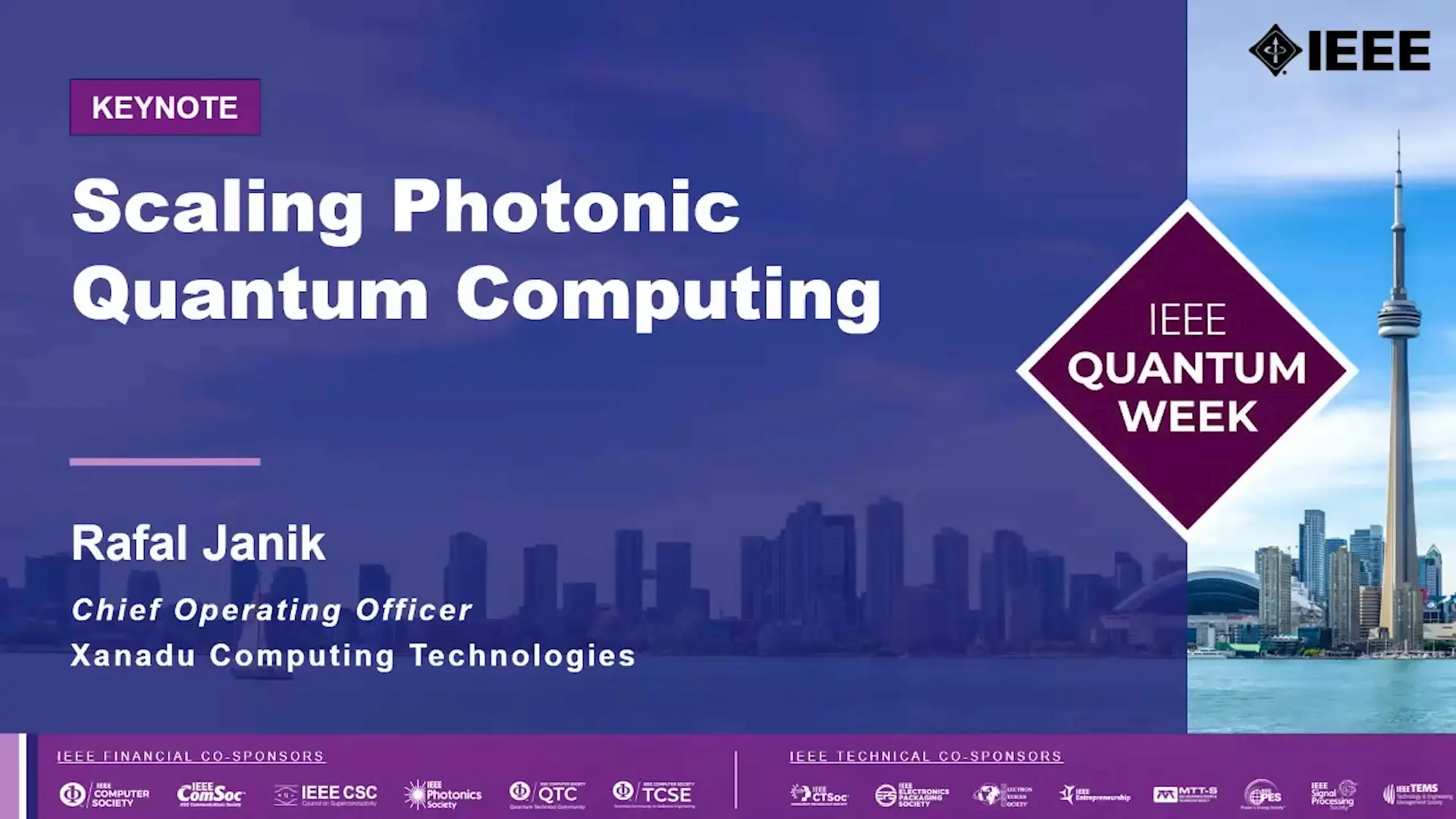
Janik was candid about photon loss, the one gap Xanadu has left to close. Aurora sits above the error-correction threshold, the noise level below which adding correction starts to help, so correction would hurt it today. Janik said process losses fell 60 percent last year, and the fibre joint now passes more than 98 percent of the light where it once lost close to half. Janik wants first fault-tolerant qubits in 2029 and a 500-logical-qubit machine by 2030.
Xanadu’s factory filled much of the hour. Canada is putting 195 million Canadian dollars into a Toronto plant that Janik called Inception, and Janik said its packaging lines should be running by this time next year. Asked how many modes make a logical qubit, Janik gave Aurora 24 of them by a loose test and said a strict one needs about 500 cluster nodes.
A hybrid method grows photonic resource states faster
Carolyn Mayer presented a paper with Anand Ganti and Uzoma Onunkwo on how to build a big photonic machine from small parts. In this scheme, small linked bundles of photons called resource states are joined by a kind of measurement called a fusion. Making the bundles is slow. Mayer said each fusion works only half the time, even on perfect hardware.
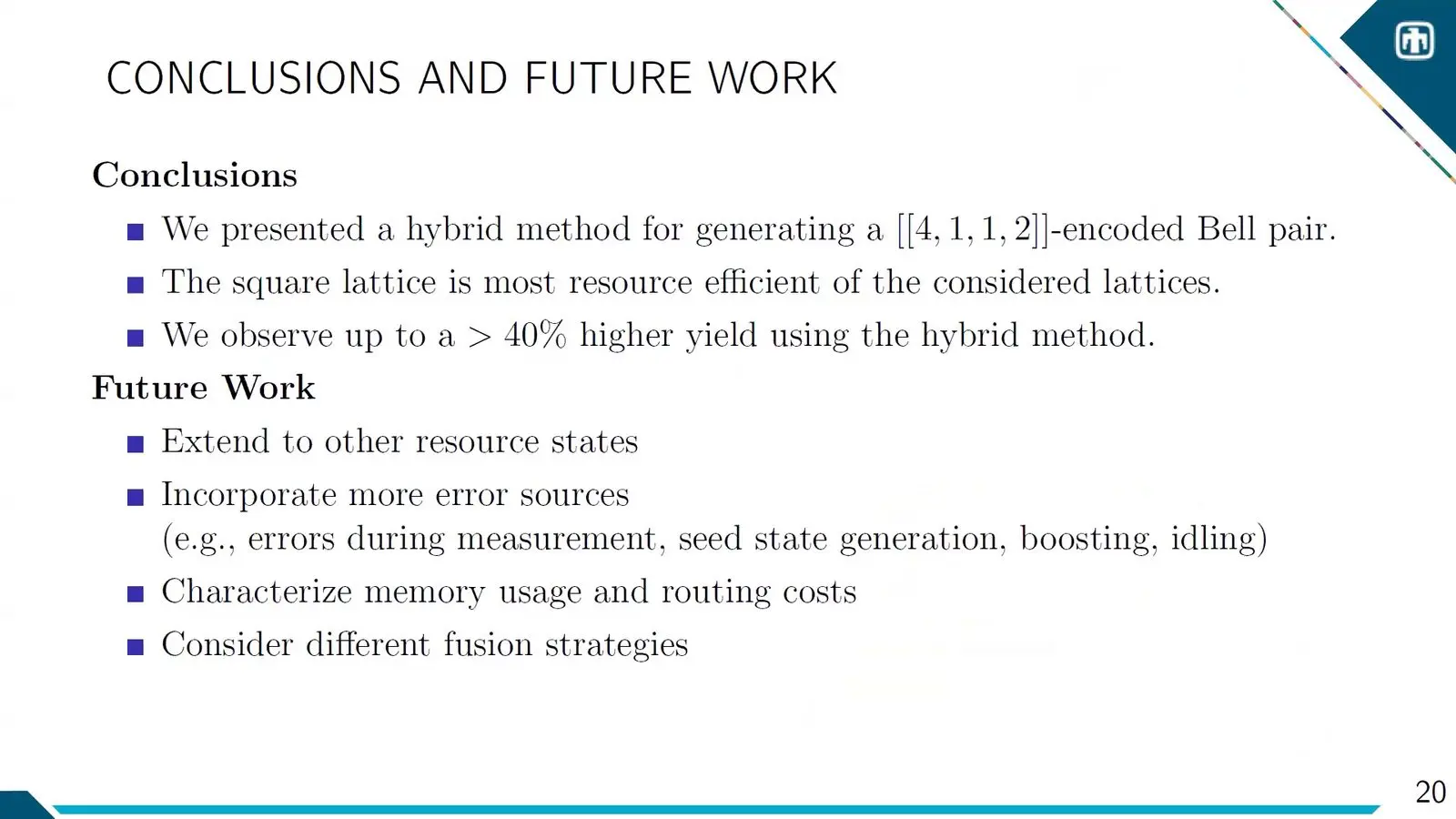
Their target was a four-qubit encoded pair. One method tries many copies at once and keeps one that works, while another fuses the leftovers into a lattice and searches it for a usable ring. Mayer’s hybrid tries the copies first and keeps the lattice in reserve. Mayer claimed it beats the other methods by more than 40 percent at some points on a square lattice, though the cost of the boost step never entered the plots.
Quantum hardware roadmaps from ions, atoms and Microsoft
The keynotes and the closing panel set out how each camp plans to reach a machine that can correct its own errors. The dates sat close. Xanadu, QuEra and IBM each named years between 2028 and 2033, while the routes differed far more, from a microwave antenna on IonQ’s chip to the codes QuEra fits to its atoms.
IonQ swaps lasers for microwaves on the chip
IonQ took the whole Tuesday keynote. John Gamble, vice president of architecture, traced five generations of machines from Harmony in 2019 to Tempo in 2025. Superion, launched the week before, starts at 256 qubits and drives its ions with a microwave antenna built into the chip, where earlier machines used lasers that scatter light and add bulk. The chip is made at SkyWater, the foundry IonQ bought this year.
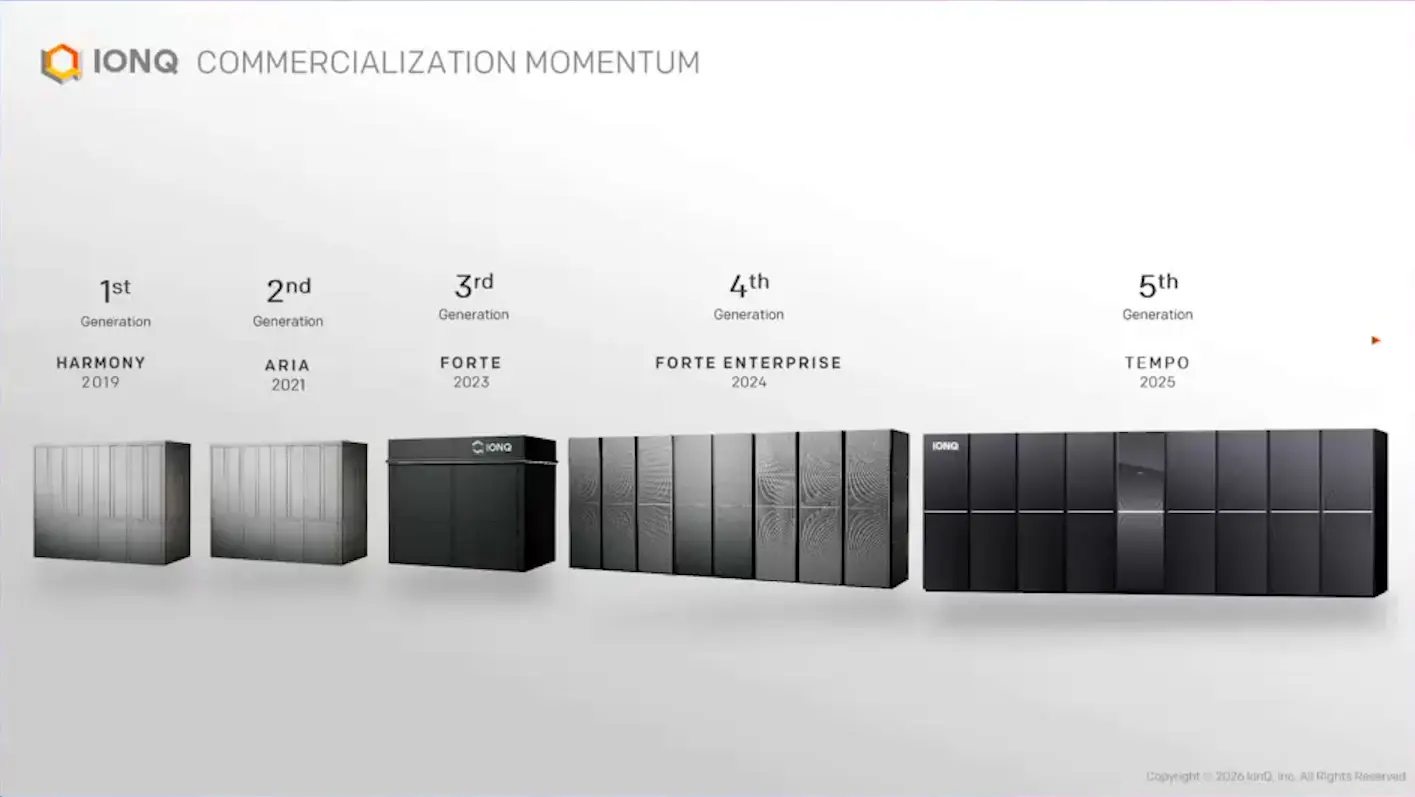
Gamble’s design splits the chip into zones for memory, for making special states and for replacing lost ions. Gamble expects a small fault-tolerant machine at 10,000 qubits, and tiling chips could take it to about 200,000. Martin Roetteler, who leads work on uses, said the 256-bit keys that guard digital assets could fall in under a month on fewer than 20,000 qubits. Roetteler said nobody has reached production yet.
QuEra matches codes to atoms
Nathan Gemelke, co-founder of QuEra Computing, opened the last block of a Thursday workshop. QuEra holds each atom in an optical tweezer, a tightly focused laser beam, and moves the atoms between zones of the machine as the program runs. Gemelke listed two-qubit gates near 99.85 percent fidelity in the lab. Gemelke said QuEra is probably three or four years from meaningful work.
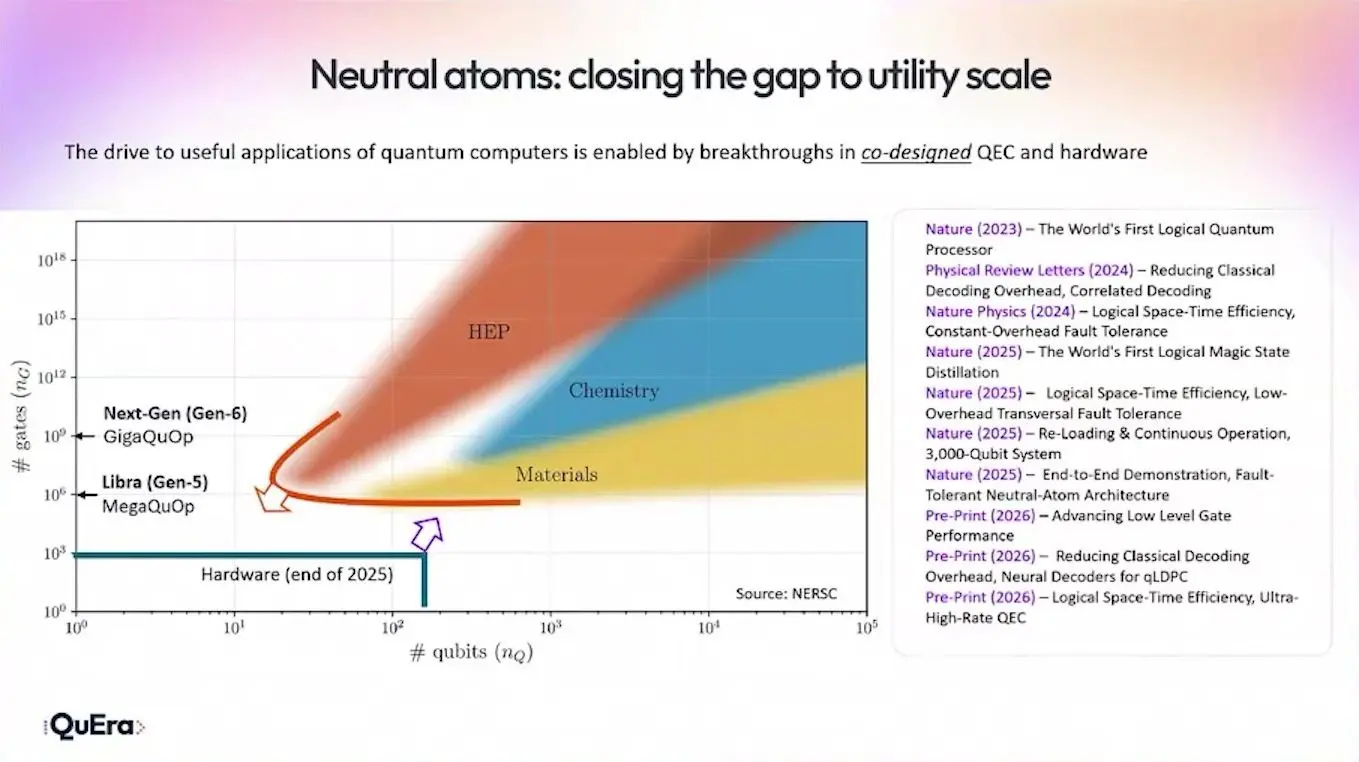
Gemelke’s main theme was co-design. It means picking an error-correcting code to suit both the hardware and the job it has to do. New codes need far fewer qubits than the standard surface code, Gemelke said, though none is yet proven in practice. Imaging one atom takes about a millisecond, so Gemelke expects distance from a supercomputer to matter little for atom machines.
Microsoft prices control at ten dollars a qubit
Matthias Troyer, technical fellow at Microsoft Quantum, gave the Friday keynote. Troyer priced daily use at about 1,000 dollars per molecule, the cost at which Troyer’s chemist friends would use a machine every day. Working back from that price, Troyer arrived at about 10 dollars a qubit for control and readout. Racks of instruments cannot meet it. A thousand separate signal generators, Troyer said, would push the whole machine to a billion dollars, ten times the 100 million dollars Troyer set as the ceiling for the whole machine at scale.
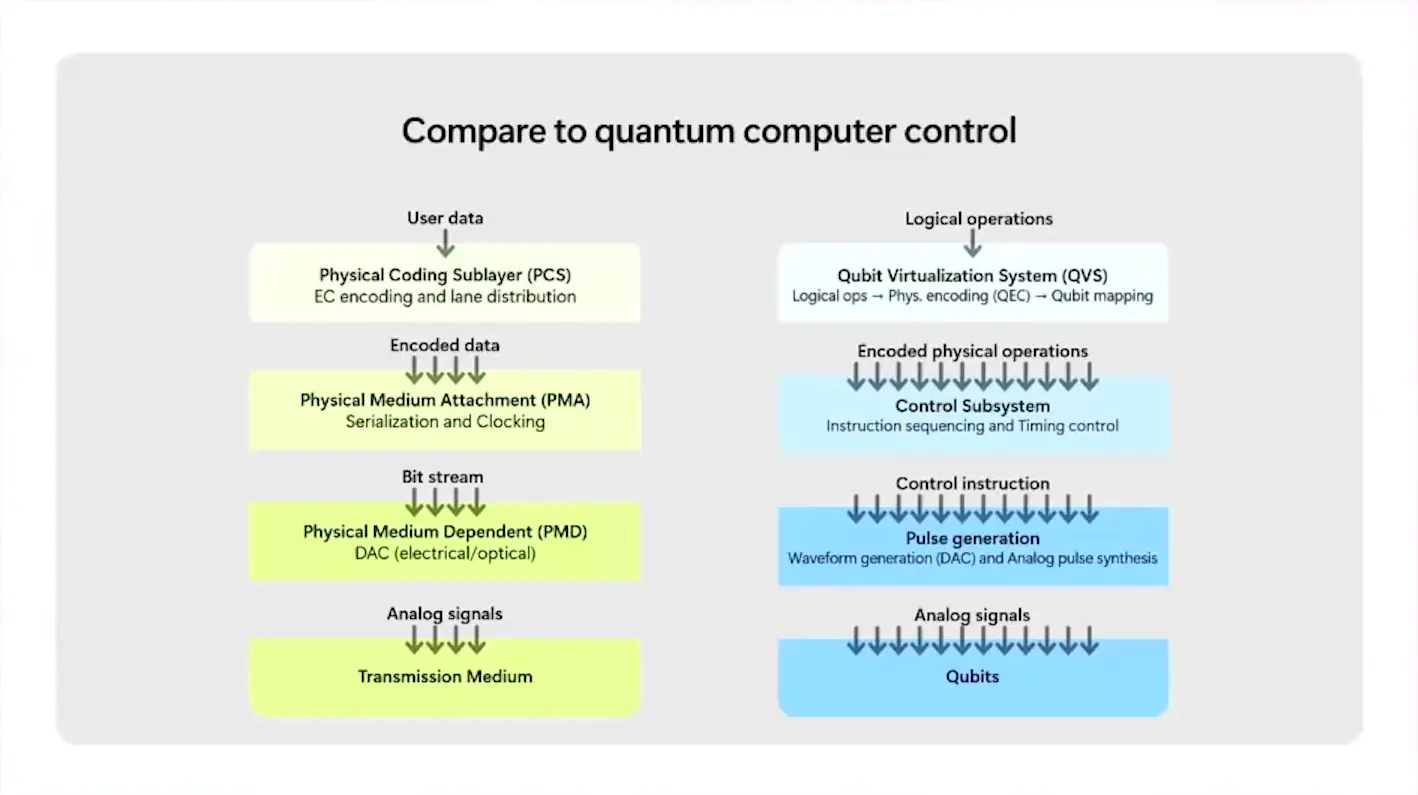
For about 1,000 logical qubits, the pulses on the physical qubits would run at a billion to ten trillion a second. No software can issue that many, so Troyer wants the pulse layer built in hardware right where the cables enter the cold. Troyer’s model is the network, since Ethernet already turns a raw error rate near one in a million into a final rate near ten to the minus 22. Troyer favours Microsoft’s topological qubit. Its readings are switched by a simple digital pulse, and Troyer said Microsoft is shipping a system on this plan to QuNorth in Denmark.
The scaling panel splits on logical qubits
David Rivas of Rigetti chaired Friday’s panel on how to scale up. Maxime Dupont of Rigetti described tiling small chiplets into 36-qubit units. Jason Orcutt, speaking for IBM, said IBM has moved from the surface code to a layout built for a bicycle code, with modules joined by microwave links in systems due in 2029 and 2033. Jonathan Wurtz of QuEra said Libra is due to reach 256 logical qubits in 2028.
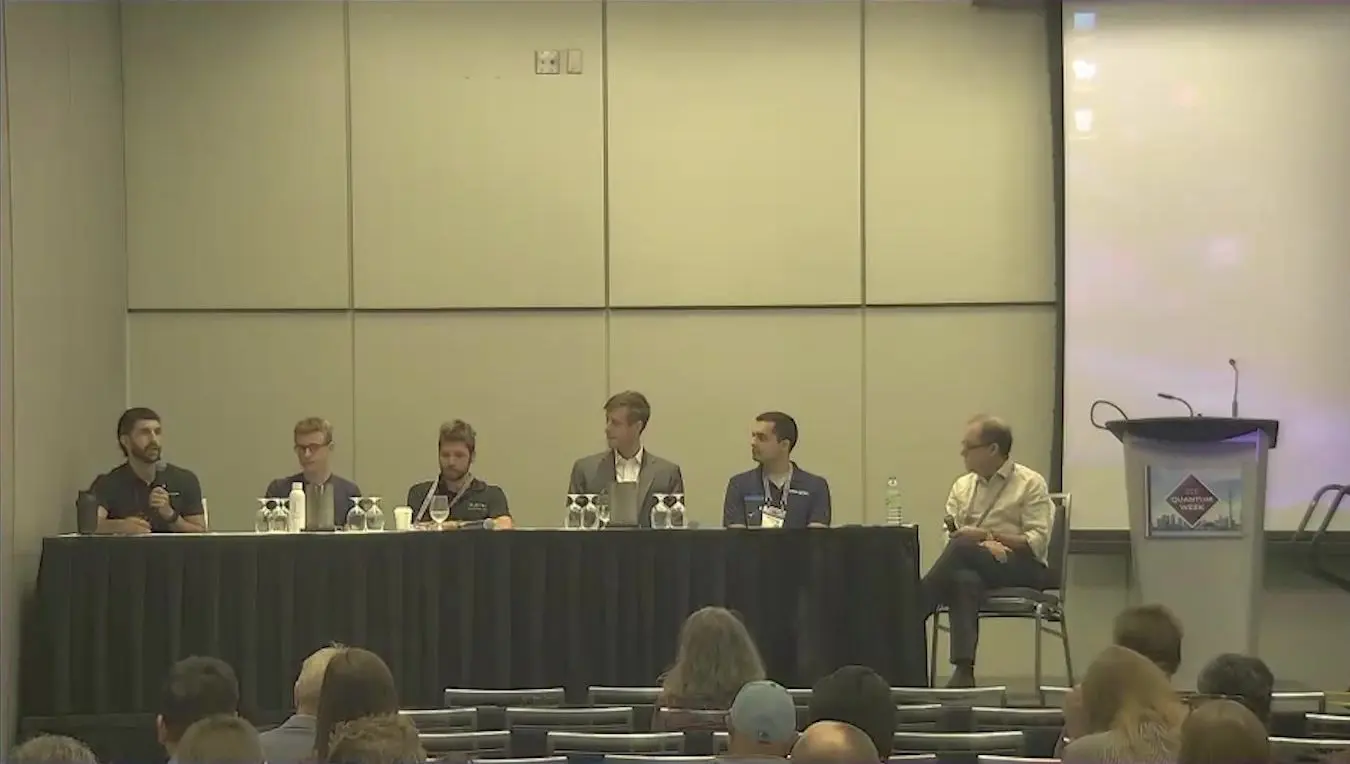
Enrico Rinaldi of Quantinuum said some logical errors on the firm’s ion machines are already lower than the physical errors beneath them. Rinaldi agreed that true fault tolerance needs every part below the threshold at once. Pranav Gokhale of Infleqtion cited an array of 1,600 atoms. Asked about readout, Dupont said the electronics above the chip, which drive the qubits and read them back, are the tight part of the system.
The wiring problem
Every qubit needs signals in and signals out. At a few dozen qubits that means a bundle of cables, but at a million it means a new design for the whole machine, and four talks showed where the strain appears first.
Intel counts 13 voltages per spin qubit
Sahar Daraeizadeh, who leads error-correction work in Intel’s quantum architecture group, described spin qubits driven only by voltage pulses. Three electrons in three tiny wells of silicon form one qubit, and Intel builds them in its Oregon fab with the same tools it uses for transistors. Its chip, Tunnel Falls, holds four such qubits. Daraeizadeh said Intel now has about 33.
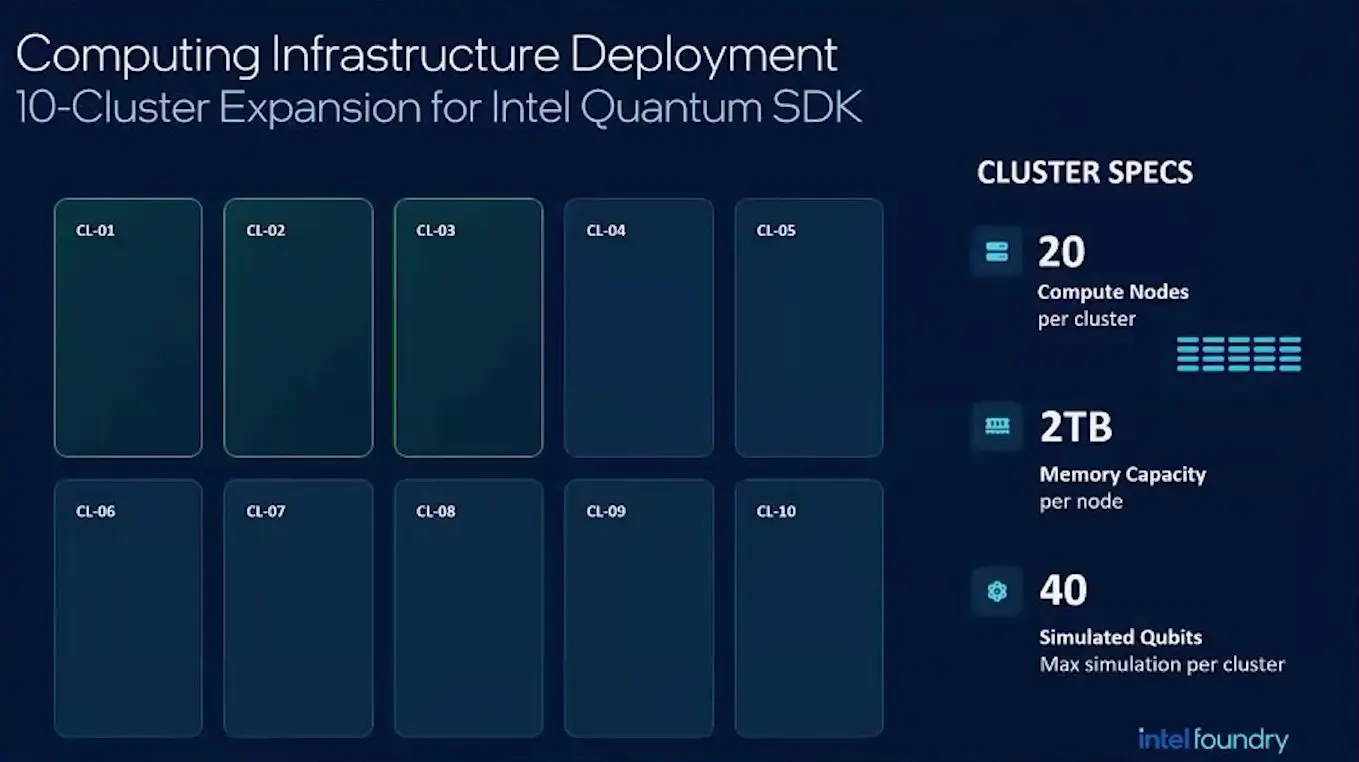
Daraeizadeh named wiring as the next hurdle. One qubit can need up to 13 gate voltages, and sending raw error-correction data out of the fridge would take about half a terabit a second. Daraeizadeh favours decoding in layers, so that each level cuts the data before passing it on. For now Intel’s control processor is still an emulator.
Duke builds an ion-trap voltage board for $750
Mitchell Peaks of the Duke Quantum Center presented a paper with Mia Kaarls and Crystal Noel. Ion traps hold their ions in place with voltages on many small electrodes, and Peaks said that Sandia’s Enchilada trap alone has about 400 of them. The lab’s 32-channel commercial unit cost $6,500. It also let in noise.
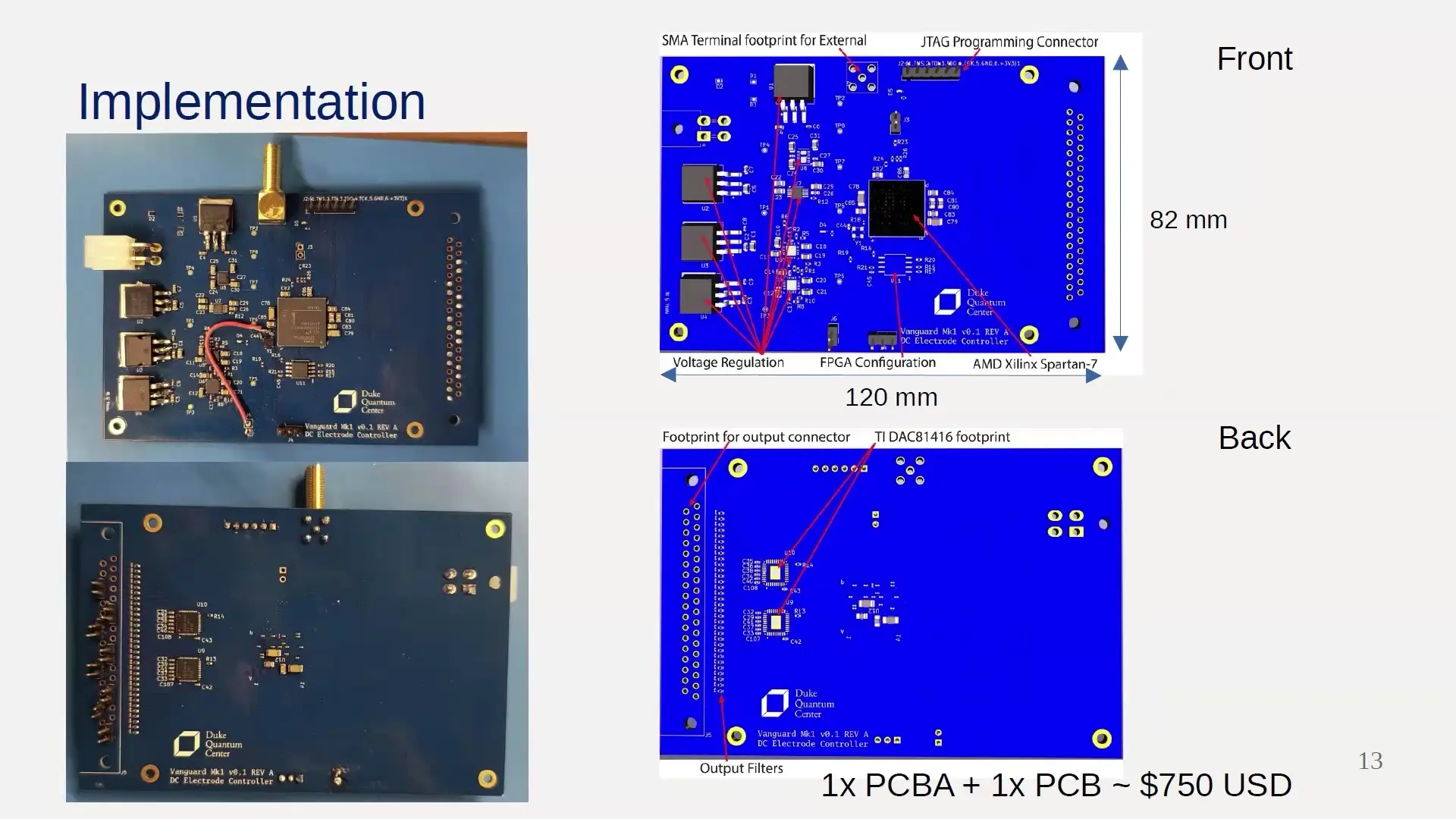
The board they built, called Vanguard, measures 120 by 82 millimetres and has 32 outputs between plus and minus 10 volts. It costs about $750. On a spectrum analyser no channel could be told apart from ground, which is the quiet the team wanted. Vanguard has not yet held an ion, and up to 96 channels are planned for a 96-qubit machine at Duke.
Hannover fills glass vias with gold
Eike Iseke of Christian Ospelkaus’s group at Leibniz Universität Hannover presented work that won a best-paper award in the QTEM track. Trap chips are usually joined to their board by fine wires bonded over the edge, which Iseke called fragile and a hard limit on how many lines fit. The team’s answer is to cut holes through the glass by laser and fill them with gold. Early tries left gaps.
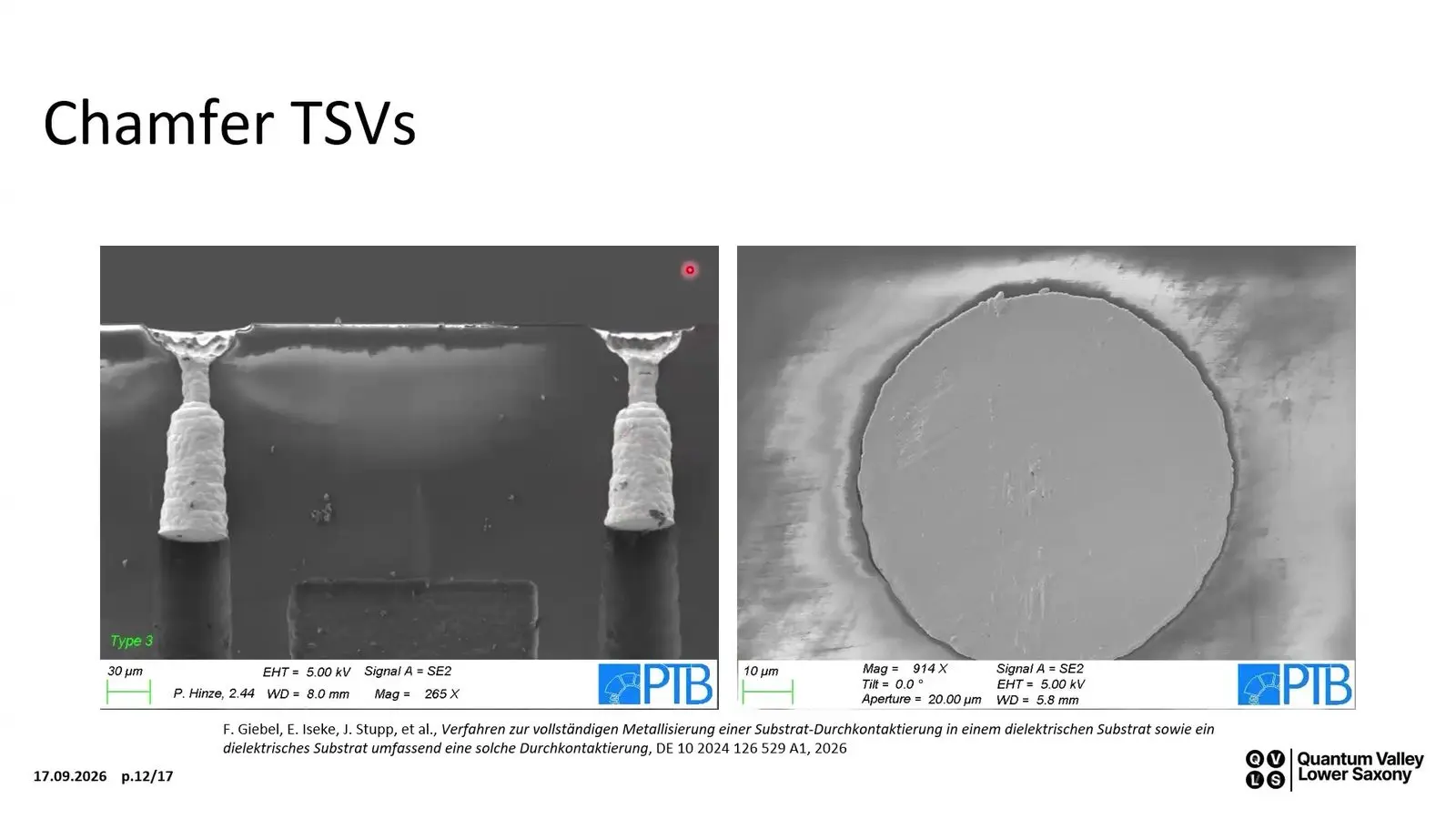
Gold plated in from the walls sealed the top of each hole before the hole was full. The team changed the hole’s shape to a chamfer and then a narrow tunnel, so the gold now grows in one flat front from one side of the wafer to the other. A patent is pending. Iseke said 99.99 percent of the vias on a wafer conducted, though Iseke showed no trapping data from the new chips.
Tin in diamond is easy to drive and hard to time
Eric Rosenthal of Sygaldry, a startup in Ann Arbor, presented work from the Vuckovic group at Stanford. Their qubit is the tin vacancy, a single tin atom that sits in a gap in the diamond crystal, where it holds a spin and gives off light that can carry the spin’s state. Tin sends about 60 percent of its light into the useful colour, against about 3 percent for the better-known nitrogen vacancy. It stays coherent up to a few kelvin.
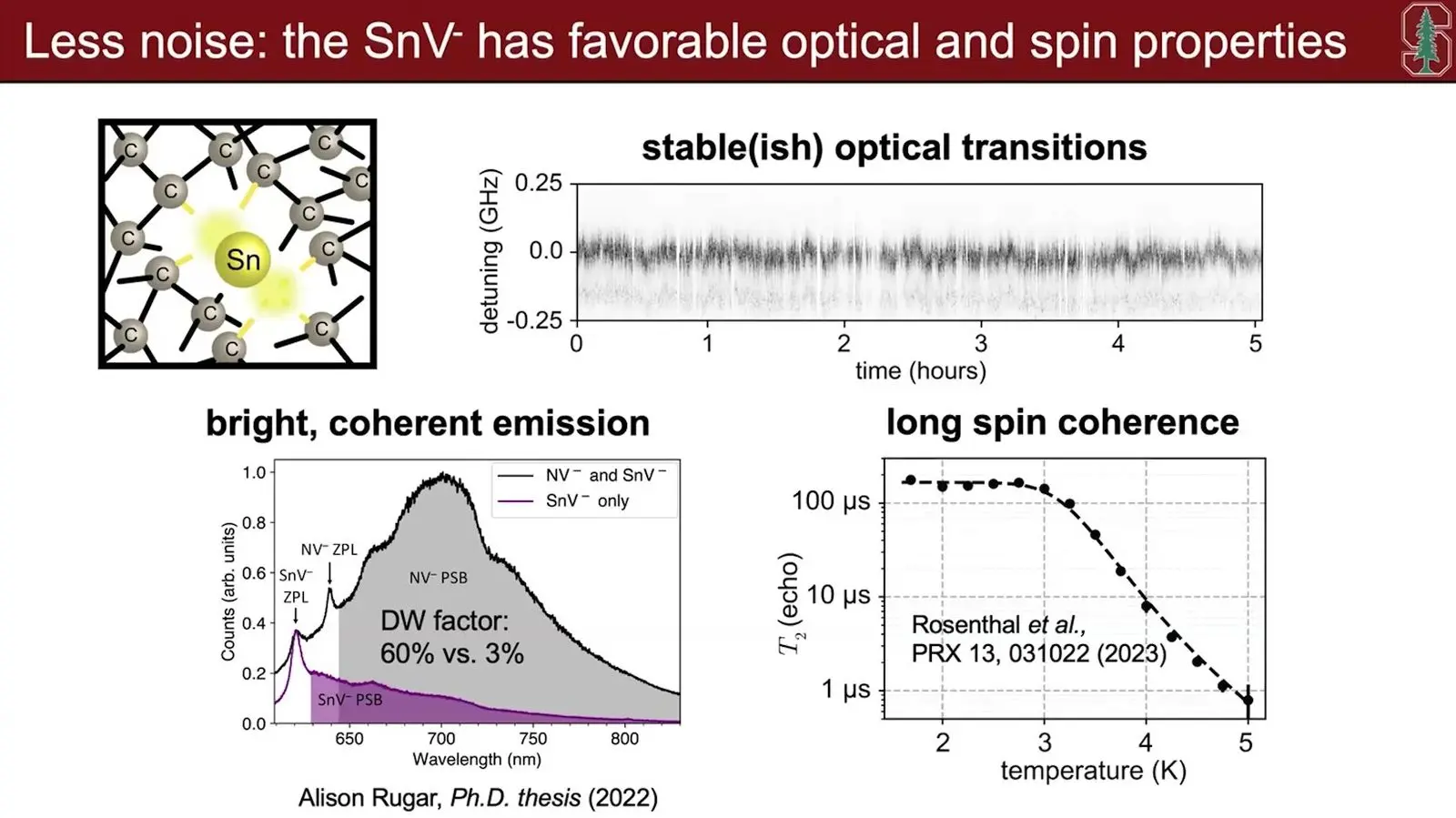
A single echo pulse stretched the spin’s coherence from under a microsecond to about 100 microseconds. Asked what electronics would help most, Rosenthal said these qubits are easy to drive. Timing them is hard. For a network, photons from separate nodes have to arrive at the same moment and look exactly alike, or they cannot be joined.
Quantum hardware materials and device design
The slowest progress in quantum hardware happens in thin films and device models, where a gain can take years to show up in a working qubit. Seven talks worked at that level. Only Singer’s tantalum films came with measurements of a real device, and the other six rest mostly on models and simulations.
A tantalum buffer makes resonators ring four times longer
Moritz Singer, a PhD student at the Technical University of Munich, presented work on tantalum films for qubit circuits. Tantalum has given such qubits long lives since work at Princeton in 2021, and the team compared stacks of it to see why some do better than others. They grew three stacks on silicon and tested them with twelve resonators.
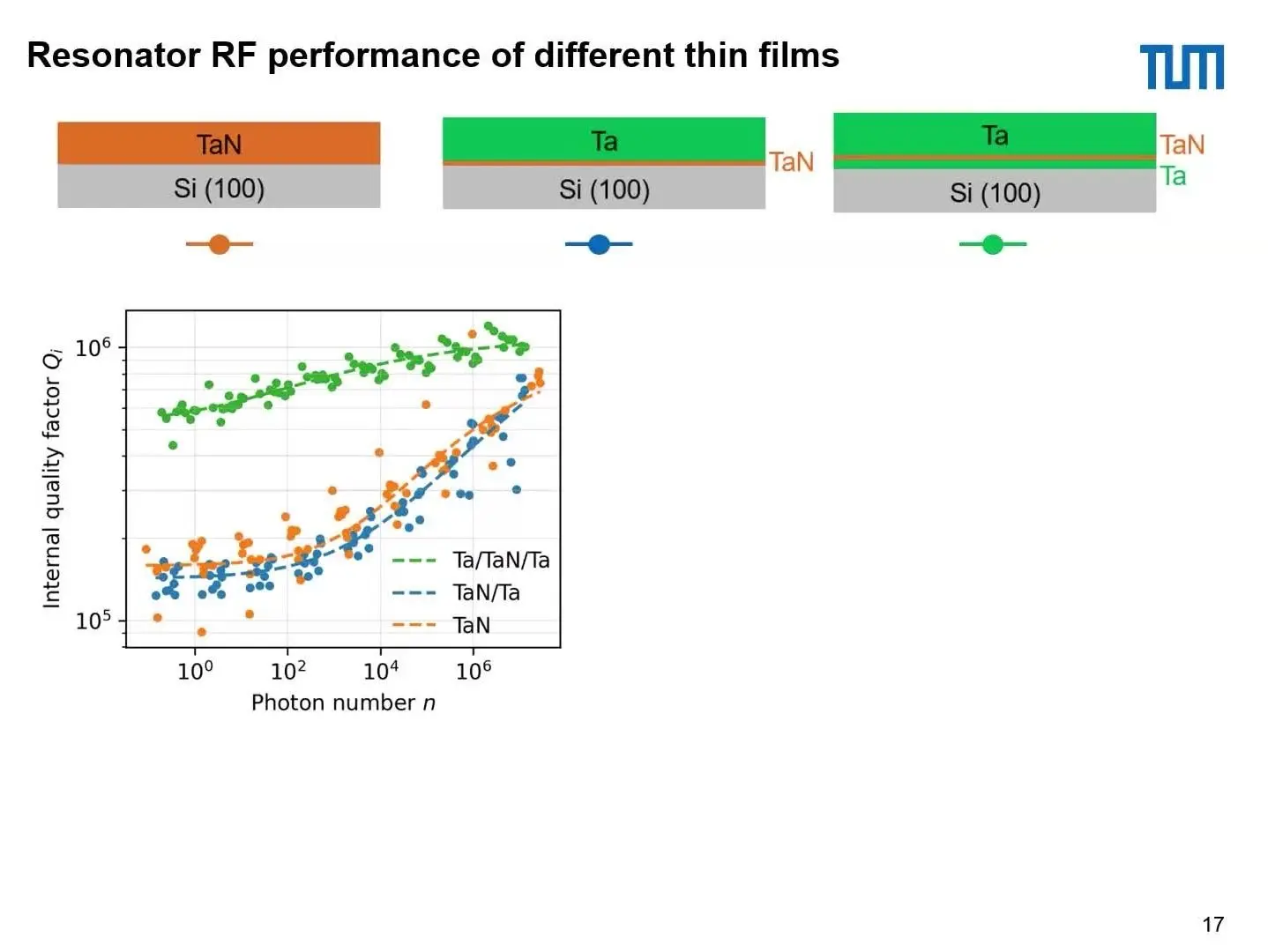
The two plain stacks rang for about the same time, with an internal quality factor near 150,000. A thin tantalum buffer under the seed layer raised that to about 590,000, about four times better. Cross-section images showed a badly warped join where the nitride met the silicon, and a much smoother join where the tantalum met it instead. Singer blamed nitrogen forced into the silicon.
San Jose State models a two-chip qubit package
Hiu Yung Wong of San Jose State University presented for a student who has since graduated. The work models a flip-chip system, in which two chips of superconducting qubits are bonded face to face with a coupling layer between them, as a way to pack and wire more qubits. Coupling grew large once the gap fell under 200 micrometres. The team used Keysight’s QuantumPro and QuTiP.
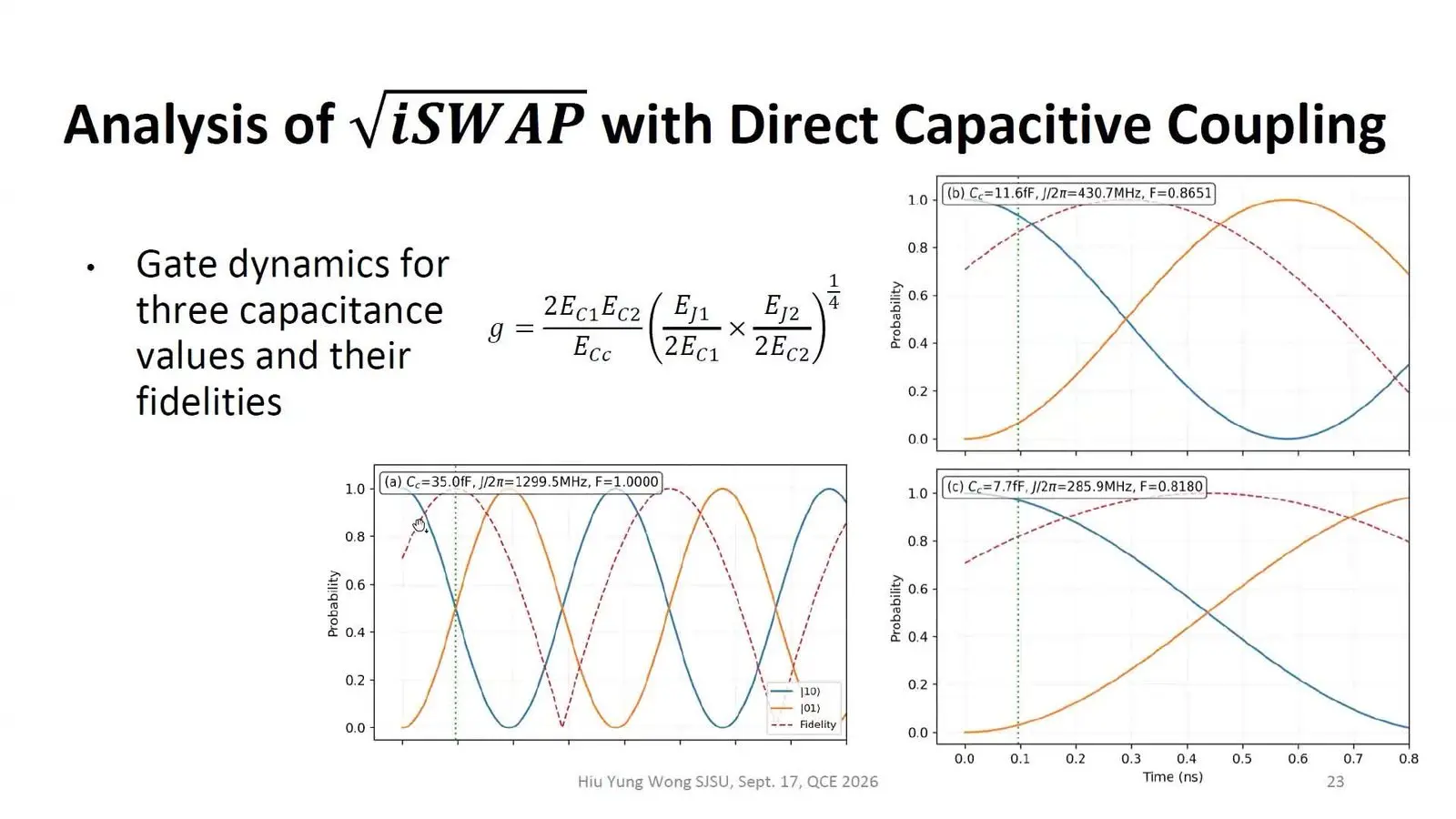
In the model, a resonator in the middle layer gave a gate fidelity of 0.9869 in about 100 billionths of a second. Wong told a questioner that the air bridges and long vias exist only in a model that assumes perfect control.
Penn State proposes topping up idle qubits
Abhishek Shringi of Penn State presented work led by Movahhed Sadeghi under Mahmut Kandemir. The question is whether the energy a qubit loses while it sits idle can be pushed back in, during a short window, before the loss ruins the result. In the model, a smart refresh cut a measure of output error by 11.67 percent on deep circuits. Trials on IBM machines used plain gates as a stand-in.
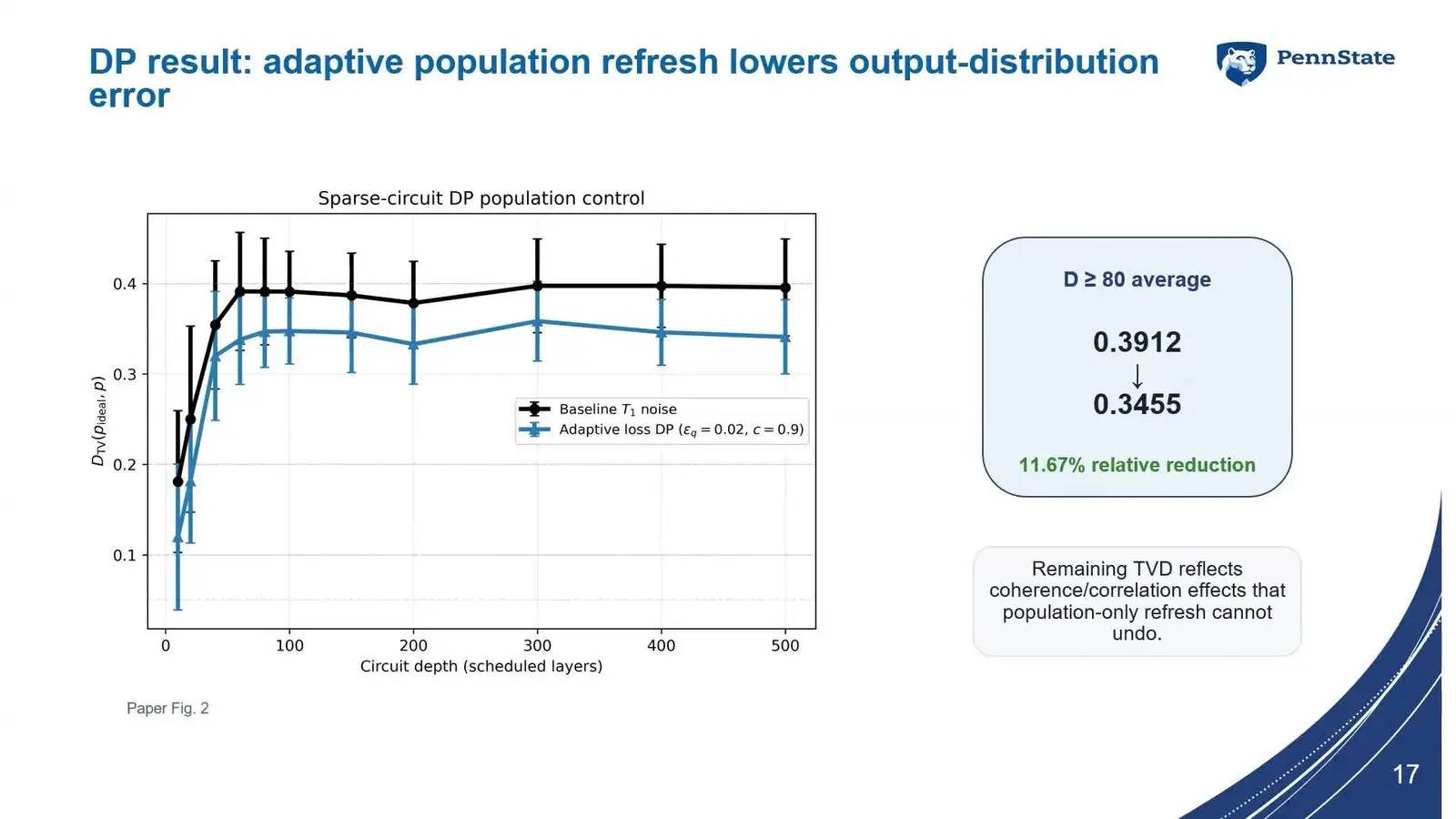
Shringi said the device that would do the pushing has not been built. The scheme also leaves dephasing alone, and dephasing is the other main way a qubit loses its information.
Clemson maps Majorana devices from fewer readings
Nathan Jones of Clemson presented MEDA. Its target is the Majorana zero mode, a state at the edge of a superconducting wire that researchers hope will shrug off local noise and so make a sturdy qubit. A dense map of a device’s conductance can take days or weeks to measure, and MEDA learns the map from far fewer readings.

On simulated devices, Jones said, measuring 10 percent of the grid stays competitive, with most of the score coming in the first 10 to 20 percent. The method weakens where devices are messiest. Those are the devices where a shortcut would help most. High disorder breaks the phase map into small islands, and the hit rate falls as disorder grows.
Georgia Tech simulates a whole qubit chip on 6,724 GPUs
Jackie Yao of Georgia Tech cut a whole superconducting chip, 9.43 millimetres across, into 11.4 billion cells. One nanosecond of it took 1.5 million steps to simulate on 6,724 NVIDIA A100 GPUs. That is a lot of machine for a tiny slice of time. The work was done at Lawrence Berkeley National Laboratory with Irfan Siddiqi, Qi Tang and Andy Nonaka, and the solver, ARTEMIS, keeps the junction’s non-linear behaviour in the model as it steps through time.
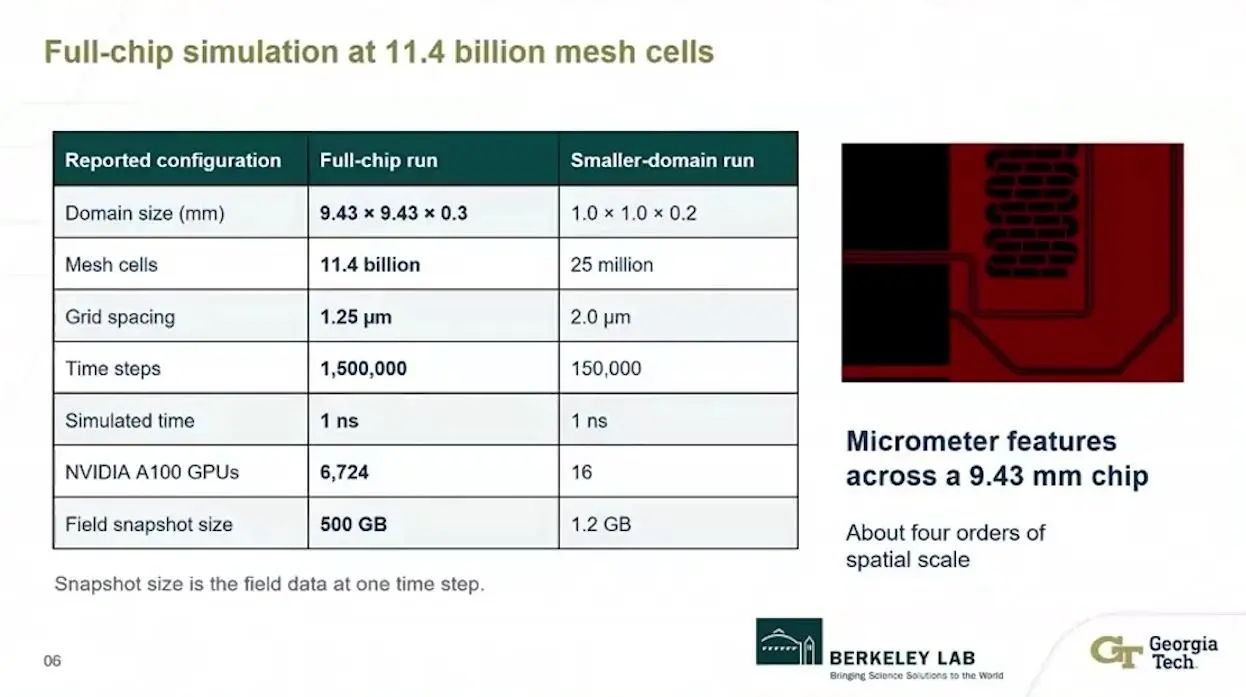
On the Perlmutter supercomputer, the time per step levelled off as runs grew to more than 2,000 GPUs with the same work on each. One snapshot of the field fills 500 gigabytes. A smaller box of 1 millimetre a side needs 25 million cells on 16 GPUs.
The metal is still treated as a perfect conductor. A model of a real superconductor is the next step, and an AI agent that draws a layout and then calls the solver to check it has so far only run in one direction.
Google says meshing limits superconducting chip design
Zlatko Minev of Google Quantum AI said meshing, the slicing of a chip into small cells for simulation, sets the pace of superconducting hardware design. Small effects matter. On a single resonator joined to a transmon, a plot of the qubit’s mode looks local, yet Minev put its mixing with the resonator at 1 percent.
Qubit frequencies sit in the gigahertz and the couplings in the kilohertz, parts per 10,000 and sometimes per 100,000, so a model has to be very fine to see them at all. A paper still to come will map how a transmon couples anywhere inside a 100-qubit chip. Users want one thing most. That is support for the Palace solver in Quantum Metal, Minev said.
Delft finds dense spin-qubit arrays pay more for crosstalk
Sebastian Feld of TU Delft asked whether more links between qubits make a spin-qubit array better. In simulation, once crosstalk was added, a densely linked array paid a 26 to 61 percent larger penalty than a sparse one. That held at every error rate tested. With good compiling, Feld said, a sparse array can match a dense one at making entanglement, so its weak point becomes moving quantum states around.
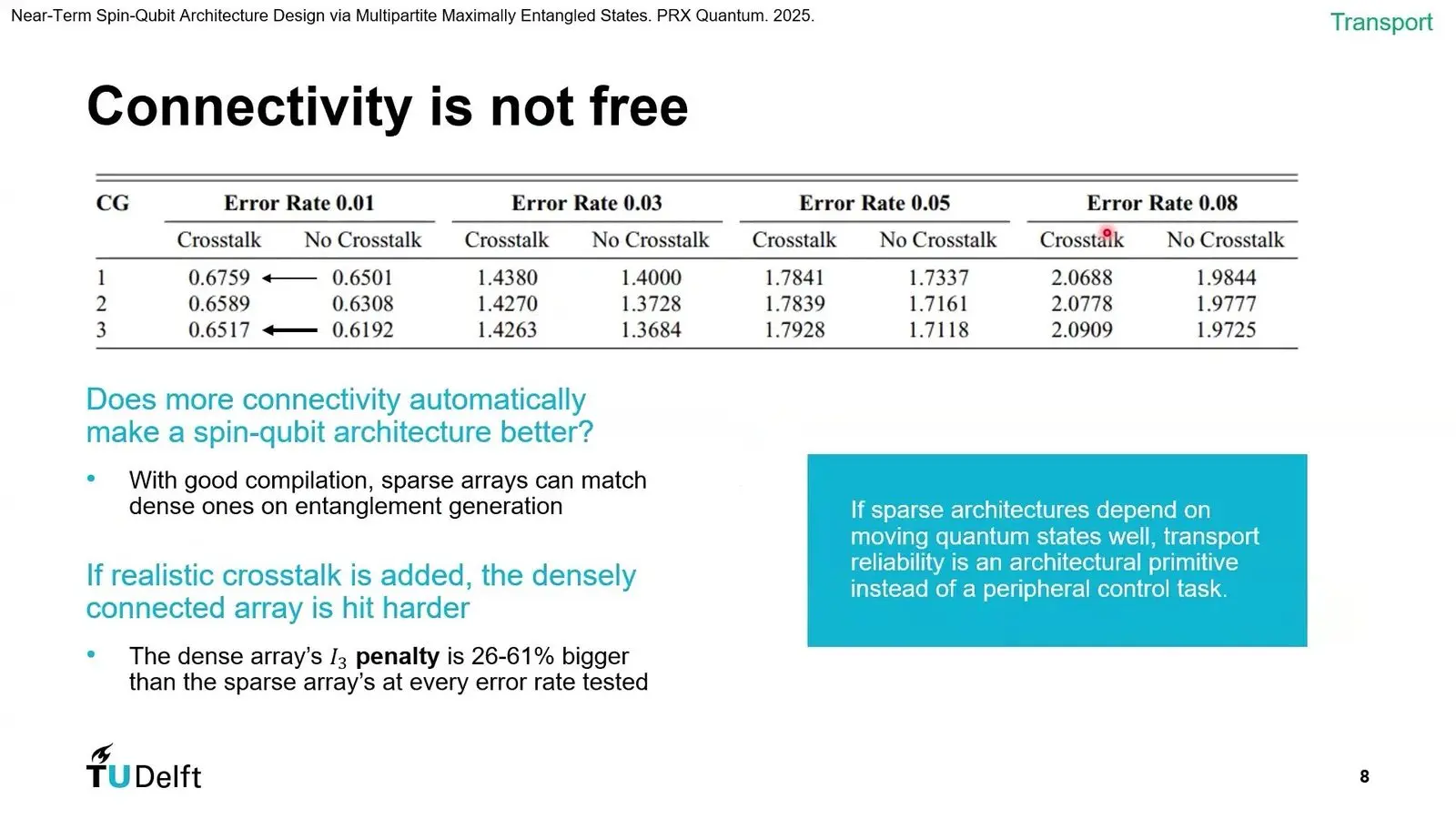
Feld then turned to shuttling, moving one electron along a chain of quantum dots. An agent trained by reinforcement learning on an ideal model was tested against disorder, in work credited to a 2026 master’s thesis by Mankrit Singh. Fidelity fell at six and seven dots. From eight, training failed on some seeds, and Feld said that falls short of any claim that the problem is solved.
Programming and spacing neutral atoms
Neutral-atom machines drive many atoms with one laser, and the atoms feel each other at a distance. Two talks dealt with what that means for programs and for gates run side by side.
Pasqal’s QoolQit writes atom programs without units
Francesco Ferrulli, product manager of QoolQit at Pasqal, put the library on top of Pulser, the firm’s toolkit for experts, which is written in physical units and tied to one device. QoolQit lets a user change machines without rewriting the pulses. Positions carry no units. The closest pair sits at distance 1, and drive and detuning are set against the strongest pull a device allows.
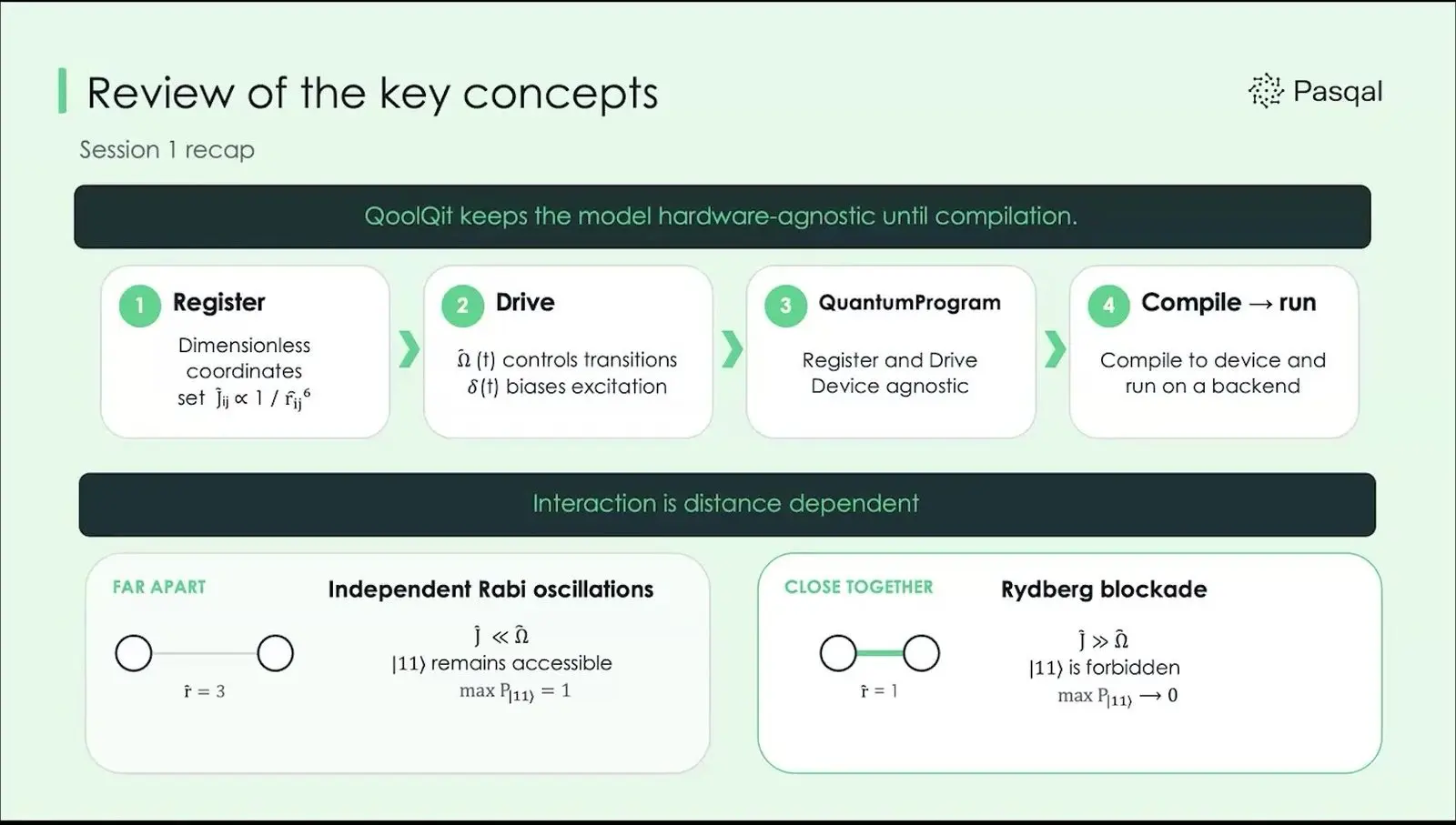
Vittorio Vitale of Pasqal showed the Rydberg blockade at work. Two atoms close together cannot both be pushed into the Rydberg state, in which one electron sits far from the nucleus. On an emulator a pair at distance 3 reached a probability of 1 of both being excited, while a pair at distance 1 stayed near 0.
Compiling turns the program into a Pulser sequence for a named device. A drive of 0.4 failed the default compile against a cap of 0.22, and a profile that pushes the drive to the device’s limit accepted it by stretching the pulse to about 2,000 nanoseconds. Every run used a local emulator. No Pasqal processor was run.
Stevens finds the minimum Rydberg spacing too tight
Xinyi Li of Stevens Institute of Technology studied gates run side by side on neutral atoms. The pull between atoms falls off with the sixth power of distance and never reaches zero, so gates running at once still nudge each other a little. The rules set a floor. At 10 micrometres, the smallest spacing they allow, the worst stage saw about 10 times the error budget.
Spacings of 15 and 18 micrometres pushed most stages well below 1 percent of the two-qubit budget of 0.0046. A decoder for sparse codes, BP-OSD, soaked up much of the effect in a surface code, but left a logical error of about 1.7 times 10 to the minus 3 per round at distance 5. Wider spacing did not always make the schedule longer, Li said.
What it means for buyers and builders
Anyone choosing a platform or funding a lab should ask about the wiring before the qubit count. That means asking how many control lines each qubit needs, what each line costs and where it plugs in. The roadmap dates at QCE26 came from company keynotes, while the firmest numbers came from small pieces of hardware such as Singer’s films, Peaks’s board and Iseke’s glass. Buyers should ask for numbers like those.
Even those parts stop short. The Duke board has not yet held an ion, and Iseke showed no trapping data from the Hannover chips. Our hardware guide and fault tolerance guide keep the score as those tests arrive, and Troyer’s ten dollars a qubit is the figure to hold every roadmap and every new platform against. Troyer’s target will be met in the cable trays or not at all.
Frequently asked questions
What is quantum hardware?
Quantum hardware is the physical machine that holds and controls qubits. It includes the qubits themselves, made from superconducting circuits, trapped ions, neutral atoms, photons or spins, plus the cooling, lasers, cables and electronics around them. At QCE26 much of the discussion was about that surrounding equipment.
Which qubit type is best?
No qubit type has won. Superconducting qubits are fast but need large refrigerators and many cables. Ions and atoms are identical by nature and hold their state for long stretches, but their gates are slower. Photons run at room temperature but are easily lost, and spin qubits suit chip factories but need several finely tuned voltages each.
Why do roadmaps talk about a million qubits?
Qubits make errors far more often than transistors, so useful machines must bundle many physical qubits into one reliable logical qubit. Each logical qubit may need hundreds of physical ones. Valuable chemistry or code breaking is expected to need thousands of logical qubits, which adds up to about a million physical qubits. That is why quantum hardware roadmaps are drawn toward that number.
When will fault-tolerant quantum computers arrive?
At QCE26 company speakers placed them between 2028 and 2033. Xanadu said 2029 for first fault-tolerant qubits, QuEra said 256 logical qubits in 2028, and IBM named systems in 2029 and 2033. These are company roadmaps, and none was checked by an outside party at the conference.
What is the wiring problem in quantum computing?
Each qubit needs its own control and readout signals. Intel counted up to 13 voltages for one spin qubit, and an ion trap may need hundreds of electrode voltages. At a million qubits that becomes impossible with separate instruments, so builders are moving control into custom chips and new packaging.
What happened at IEEE Quantum Week 2026?
IEEE Quantum Week 2026, also called QCE26, ran from 13 to 18 September at the Metro Toronto Convention Centre. This guide covers 19 of its hardware talks, from keynotes by Xanadu, IonQ and Microsoft to papers on films, boards and glass vias.
This guide is based on 19 talks, keynotes, a tutorial and a panel at IEEE Quantum Week 2026 (QCE26), held at the Metro Toronto Convention Centre from 13 to 18 September 2026, and on the published conference programme. Names follow the programme. Affiliations and titles not listed there are as speakers gave them. Results are stated as each speaker presented them, and several device designs are models or simulations. Company roadmaps and claims are the companies’ own.
- Photonics and quantum sensing
- Control electronics, calibration and readout
- Quantum error correction and decoders
- Fault-tolerant compilation and magic states
- Modular and distributed quantum computing
- Quantum computers in supercomputing centres
- Compilers, circuit synthesis and languages
- AI and language models for quantum software
- Testing and reproducible quantum experiments
- Benchmarks, error mitigation and quantum advantage
- Quantum state preparation, oracles and arithmetic
- Quantum optimisation, QAOA and annealing
- Quantum machine learning
- Chemistry, materials and life sciences
- Differential equations and fluid dynamics
- Power grids and energy
- Quantum finance
- Logistics, climate, databases and games
- Quantum networks and key distribution
- Quantum security and post-quantum cryptography
- Quantum education and workforce
- Policy, standards and the quantum business

See today’s quantum computing news on Quantum Zeitgeist for the latest breakthroughs in qubits, hardware, algorithms, and industry deals.