

This guide follows 39 talks on teaching and the quantum workforce at IEEE Quantum Week 2026 in Toronto. The kits are cheap and their reach is wide, while the proof that students learn is still thin.
On the Sunday afternoon of 13 September, in Room 604 of the Metro Toronto Convention Centre, Ghislain Lefebvre of the Université de Sherbrooke shone a green laser through a gate made of maple syrup, agave syrup and clear tape. The gate was a Hadamard, the basic move that puts a qubit into an even mix of its two states, and the sugars twisted the light as it passed. The laser is ordinary light, so the kit models a photon qubit with classical light. The whole set costs under 100 Canadian dollars. That price is a fair measure of how far quantum education has come, and of how far it still has to go.
Quantum computing changed who needs to know it. A company that builds quantum machines hires physicists, and it also hires engineers to wire the fridge, programmers to write the tools and managers to sell the result. Most of them will never solve a wave equation. They need a working grasp of vectors, chance and a few rules for how gates change a qubit, and the speakers in Toronto were busy finding cheaper and earlier ways to teach exactly that.
The 39 talks covered here point one way. From school kits to summer schools, courses, hackathons and panels on circuits and hiring, they suggest that first contact with quantum ideas is now cheap and easy to arrange. What students carry away from that contact has barely been measured, and the path from a first lesson to a course, a degree or a job thins quickly. The field has made the cheap part of teaching cheaper still, and left the costly part, proof and follow-through, largely undone.
The best case against that view came from Waterloo. Michael Grabowecky presented the record of USEQIP, a two-week summer school now in its seventeenth year, and its 2025 survey of former students found 55 percent working in quantum information science. Programmes like this are how a young field learns. A fair critic also has to grant that a course cannot be tested until it exists, and several courses shown in Toronto had not yet met a class.
The hardware talks made the strongest showing. Beside Lefebvre’s syrup sat John Donohue’s kits for teaching secure key exchange, which swap the costly parts of a real link for a laser, wave plates and solar panels. On Monday Evan Reeves of the University of Illinois Chicago showed a teaching set for magnetic resonance with 460 dollars of parts. Behind all of them sits one belief. Students learn what a qubit is by handling one, and a syrup gate on a desk teaches more than a matrix on a board.
The proof was thinner, and many speakers said so. Results rested on single classes or pilots, some of about five students and few above 40, mostly on how students rated their own learning, and almost never on a comparison with a group taught another way. Lei Zhang’s module at the University of Maryland, Baltimore County was the one talk with a test of significance. Lefebvre gave no student outcomes at all. A review of programmes worldwide by Sara Ayman Metwalli found the same thing. It said that programmes measure who takes part more readily than what they learn.
Yet the sharpest finding of the week concerned geography. Laura Akesson of George Mason University mapped American programmes outside the school day and found most of the student ones within 20 miles of a top research university. Akesson asked what remains when the one or two people packing the boxes move on. Speakers for Africa and Latin America described a similar thinning path. Syrup and tape can be posted anywhere. The people who know what to do with them travel far less.
What it is. Quantum education now runs from school kits and summer schools to university courses and hackathons. The aim is a workforce that can build, program and sell quantum machines.
What changed at QCE26. Hands-on kits fell to a few hundred dollars or less, from a syrup gate under 100 Canadian dollars to a 460-dollar teaching spectrometer. One Canadian toolbox reached about 8,000 school students.
The warning. Most results rested on one small class, some of about five students, and on self-reports. Almost none used a comparison group.
The gap. In one American count, 71 percent of student programmes sat within 20 miles of a top research university. Speakers from Africa and Latin America described the same thinning path after first contact.
Quantum education kits you can build for a few hundred dollars
The oldest obstacle to teaching quantum hardware is price. A commercial teaching set for magnetic resonance runs to several thousand dollars, so most students meet the subject only on paper and never touch the thing itself. Seven talks showed ways round that.
Sherbrooke builds a quantum gate from maple syrup
Ghislain Lefebvre is the interim head of the Institut quantique at Sherbrooke. Lefebvre builds gates for under 100 Canadian dollars, and their qubit is the way laser light is lined up, the direction in which it shakes as it travels. Clear tape turns it one way and sugar in water turns it another, with the two kinds of sugar twisting in opposite ways.
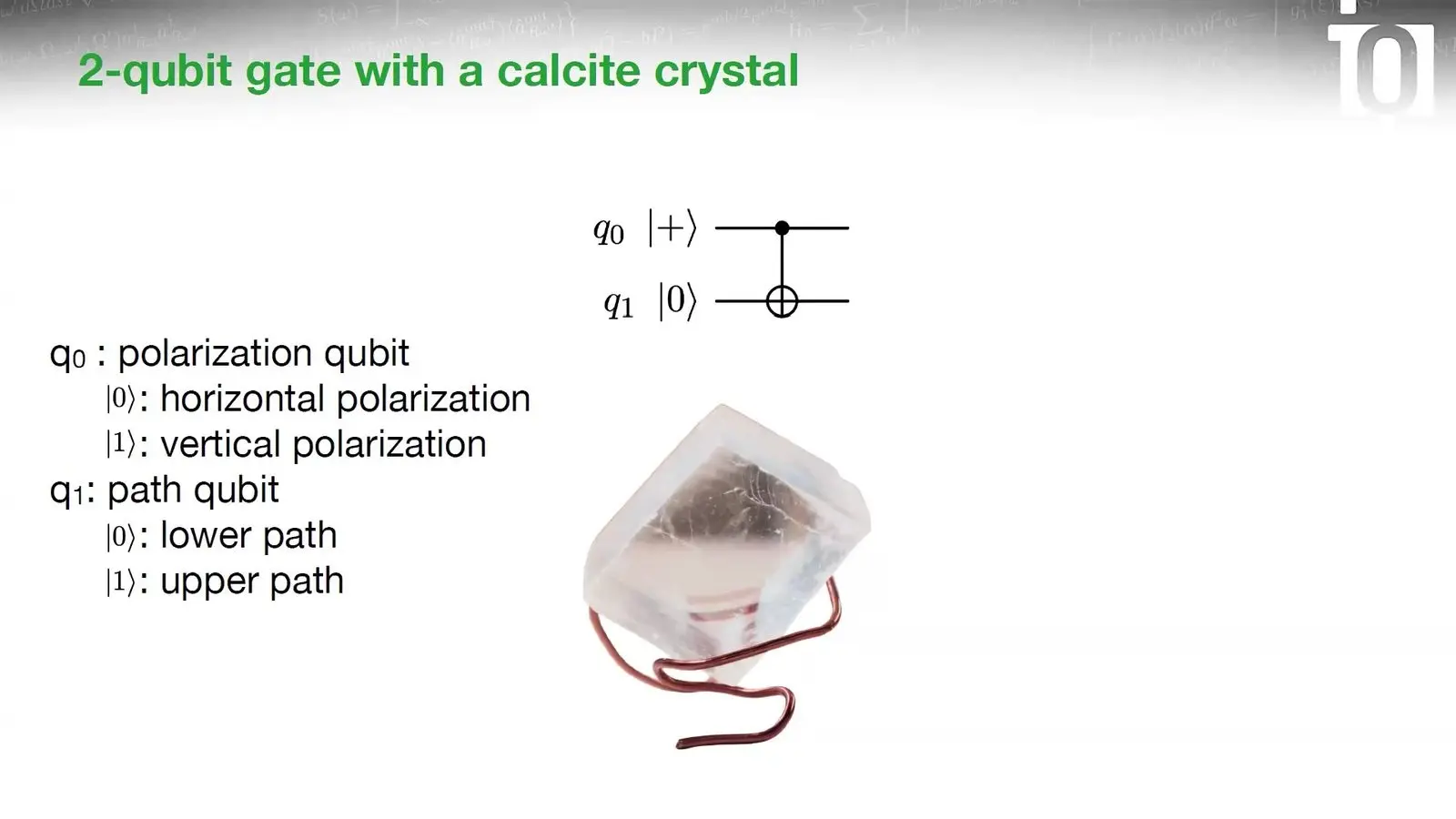
Maple and agave syrup on either side of two layers of tape make a Hadamard gate. Lefebvre showed it working with a green laser, though the maple container turns the light slightly too far. A hidden piece of tape runs Deutsch’s algorithm, a classic first test of whether a hidden function is constant or balanced, and a calcite crystal turns polarisation and path into two linked qubits. Lefebvre gave no figures on what students learned. Their laser is classical, so the kit models a photon qubit with ordinary light, though Lefebvre said the same physics holds for single photons.
Waterloo teaches secure keys with solar panels
John Donohue of the Institute for Quantum Computing at Waterloo teaches with quantum key distribution. That is a way to share a secret key using single photons. Their bench maps a real link onto cheap parts, with a laser as the photon source, wave plates to set the state, open air as the channel and solar panels as the detectors.
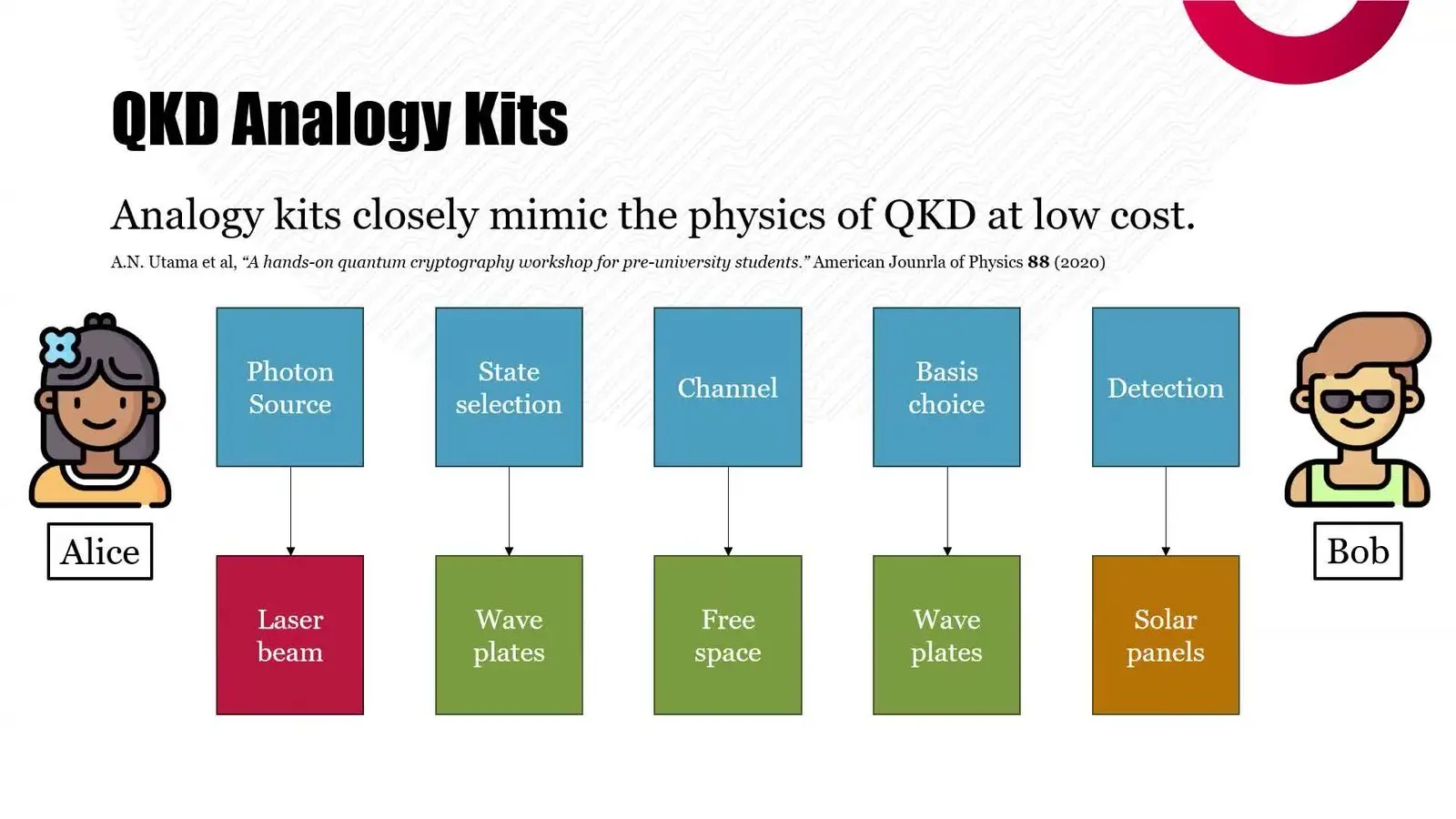
Each kit costs about 200 dollars. Turned by hand it runs at about half a hertz, or at about 10 hertz with an add-on, which is enough for a key of about a thousand bits in a workshop of 60 to 90 minutes. The lab keeps about 12 kits ready. Students rated them highly, and partners have taken copies to teachers in Texas.
Hand-held model qubits for a five-minute key exchange
Sohum Thakkar and five co-authors make model qubits that are balls you hold in the hand. Shaking one measures it. Bumping two together entangles them and rotating one applies a gate, and Thakkar said the balls reproduce real measurement statistics for up to five qubits.
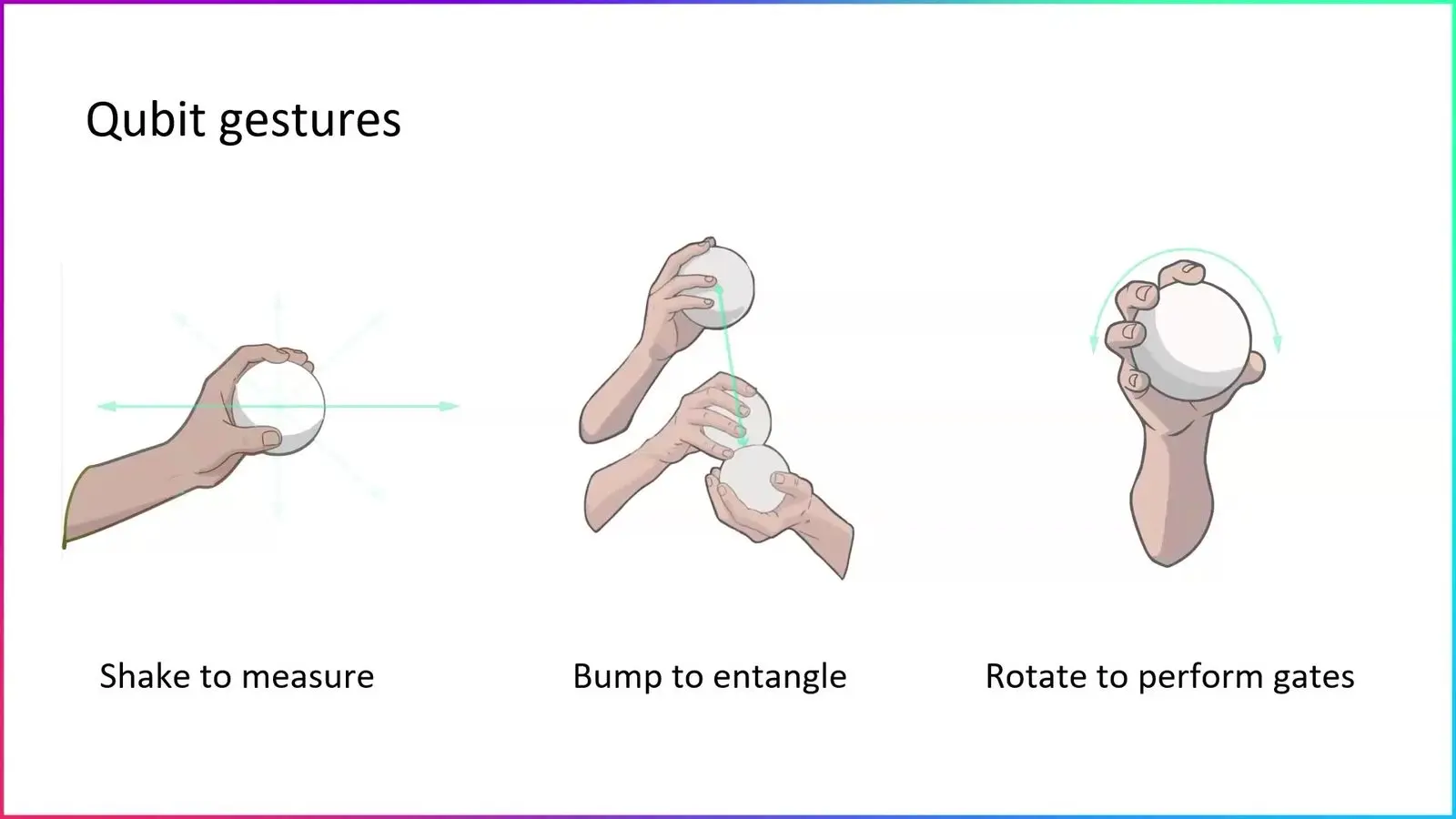
In a five-minute demonstration two volunteers shook an entangled pair three times, turned the bits into an animal and both called out eagle. Thakkar presented this as sharing a secret key. A test of 16 high school students followed the event, with no comparison group, and the set supports more than 15 labs, including a Bell test and teleportation, Thakkar said. Some 45 institutions have pre-ordered it.
A magnetic resonance qubit for 460 dollars
Evan Reeves, a PhD student at UIC, co-founded a nonprofit called SpinQuorum. Reeves came with a paper and four co-authors. Their kit uses magnetic resonance, or NMR, which reads the spin of the protons in water as the qubit, here in the Earth’s own magnetic field, while a shop-bought teaching unit costs between 6,325 and 7,025 dollars.
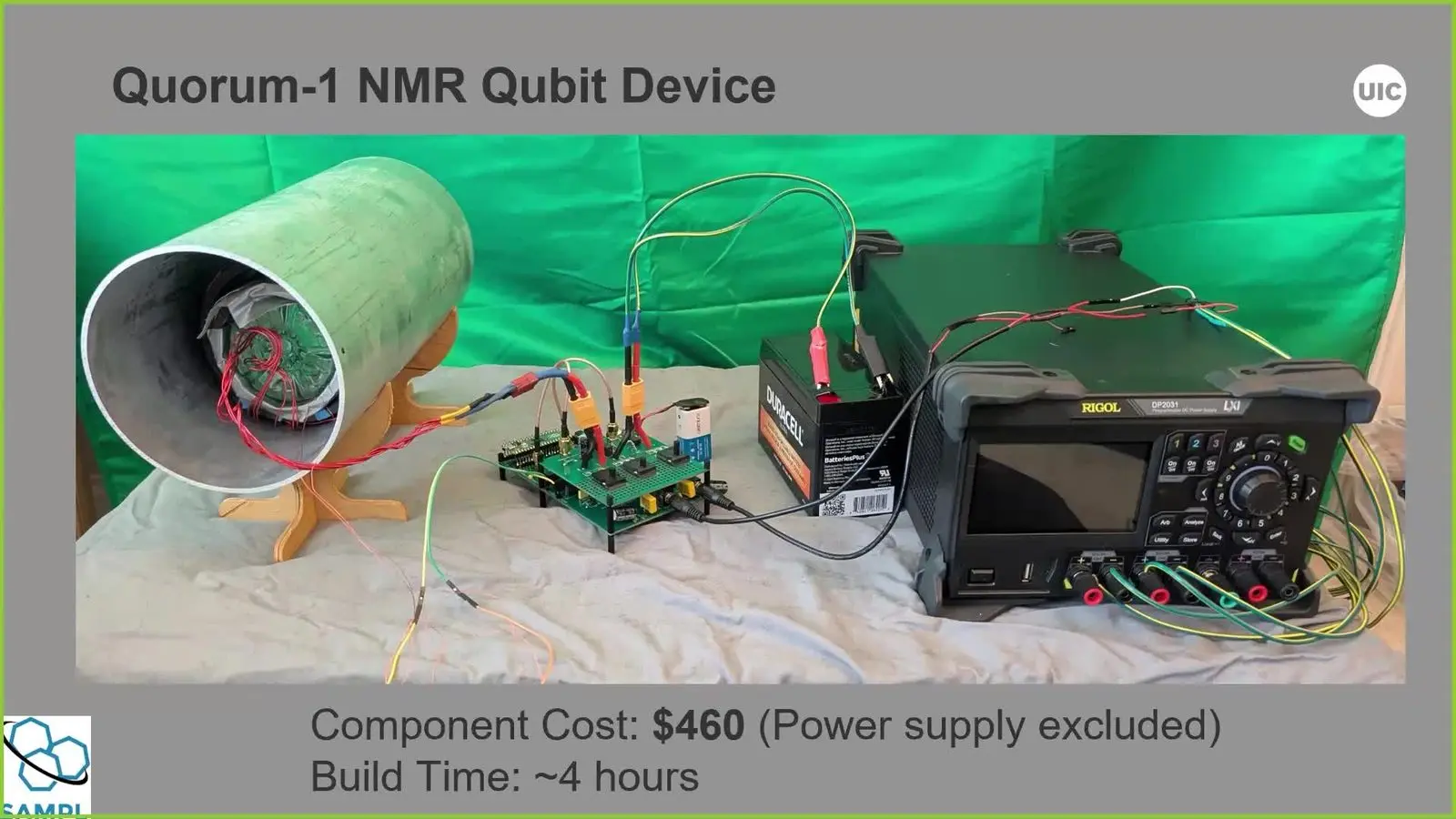
The Quorum-1 uses 460 dollars of parts. A practised builder finishes one in under four hours, and the team called it about ten times cheaper than the cheapest commercial teaching NMR. The files are open under an MIT licence. Reeves chose cost over precision, so the error bars are wide and Reeves would keep the box off a research bench.
A diamond sensor kit for 170 dollars
Reeves came back with a second kit, Quorum-NV. Its heart is a nitrogen-vacancy centre, a tiny defect in diamond that glows less when microwaves hit its resonance. A green laser, a red filter and a light sensor on a small board show that dip near 2.87 gigahertz, with a contrast of about 1.7 percent.
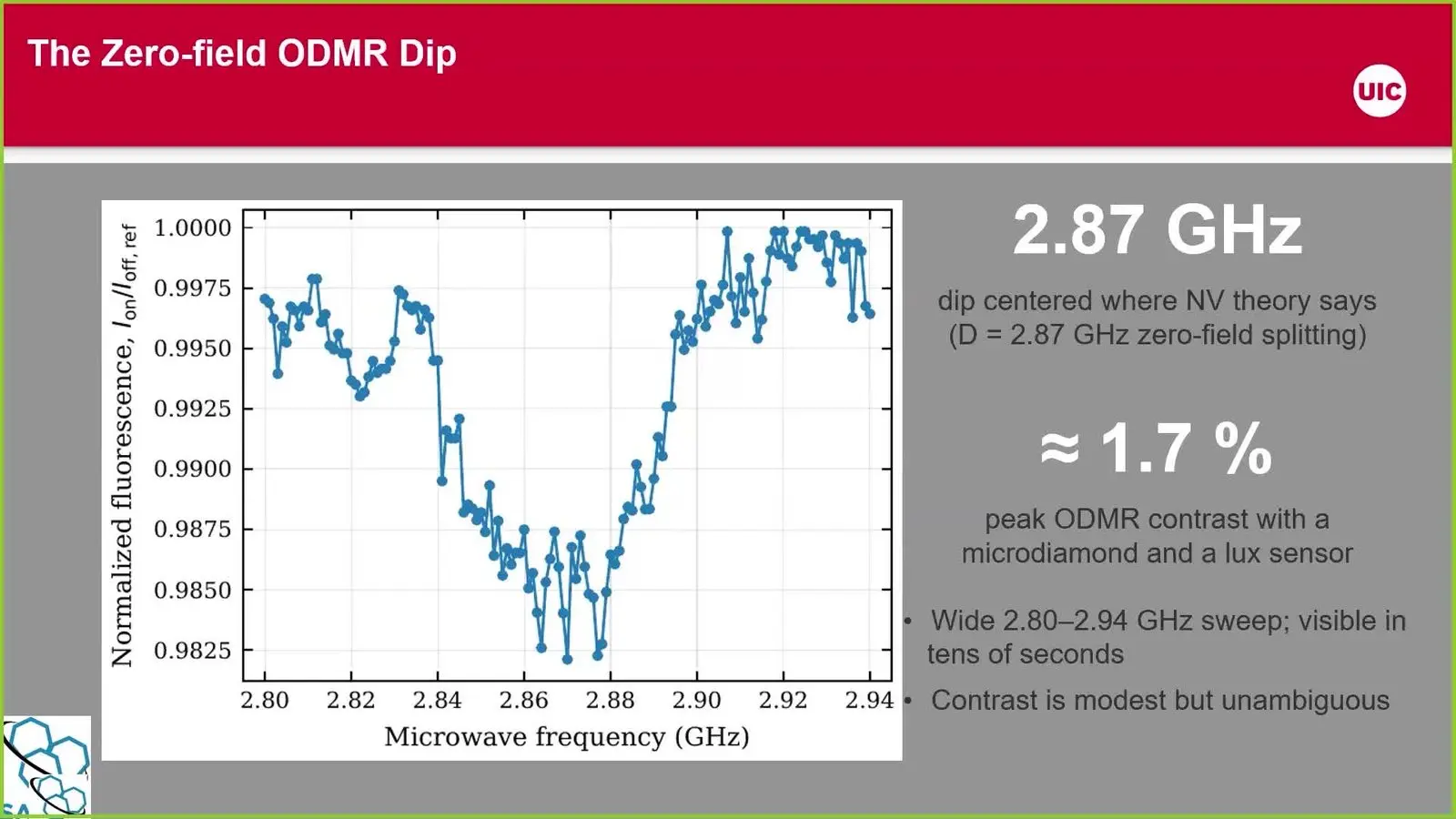
The parts cost 170 dollars. A first build might take about two hours, and the built price moved during the talk from 425 dollars to 450. When asked why one reading showed a single dip, Reeves left the answer to their co-author Ivan Viti, who designs most of the hardware.
Students get a real superconducting qubit to calibrate
Kristina Callaghan of Quantum Machines ran this tutorial as a class. Shawn Morales of a college in New Mexico told the room about a group of more than 70 colleges that train quantum technicians, and Monica Van Dieren of NVIDIA ran the screen while the class did the work. Callaghan began with a sum.
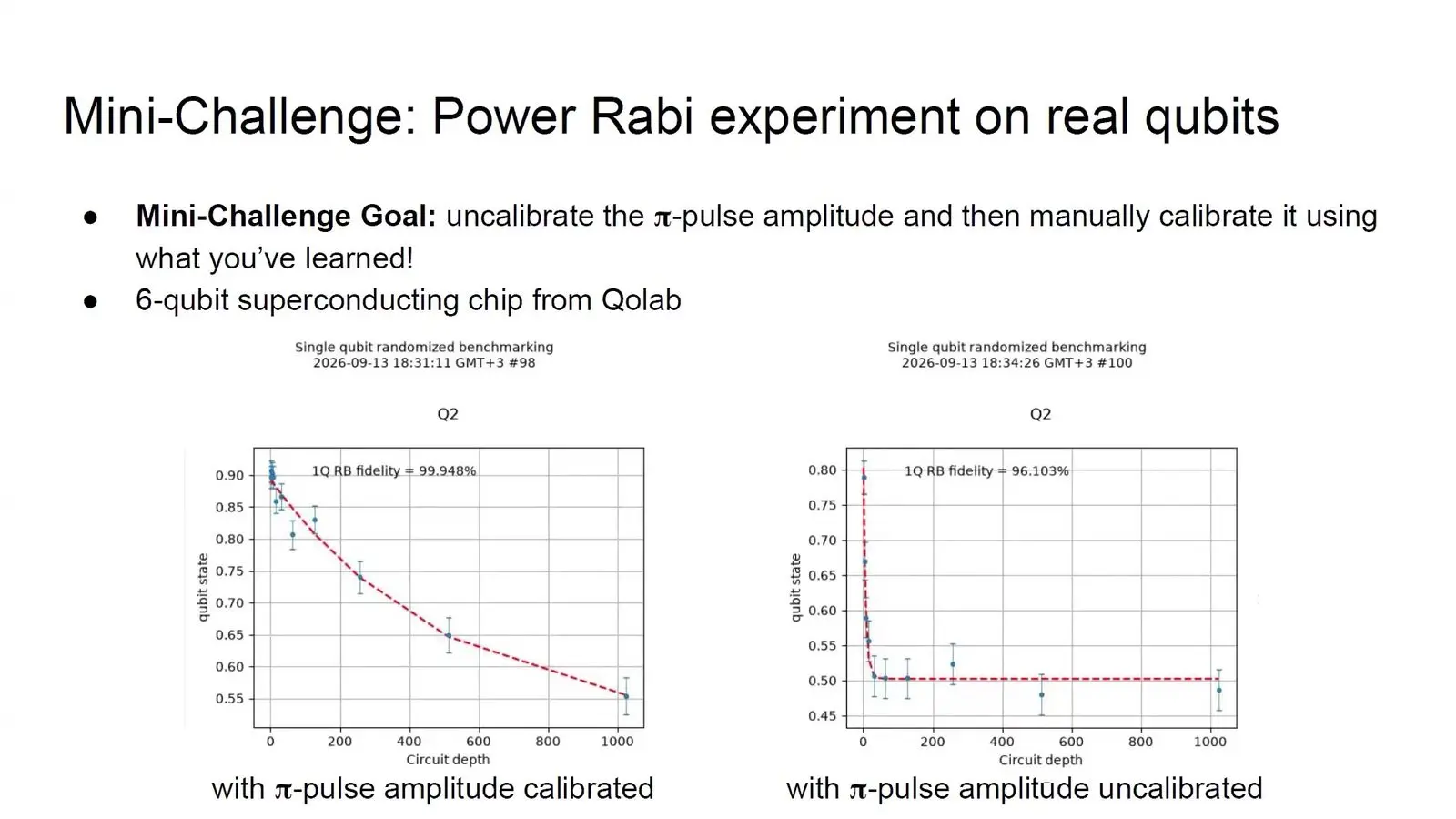
At 99 percent success per gate, a 100-gate circuit works only 36 percent of the time. Every gate has to be tuned. Gates reach a superconducting qubit as microwave pulses, and the room learned to tune one by sweeping the pulse strength up until it flips the qubit from one state to the other. Each attendee then got a login to one qubit of a six-qubit Qolab chip at a centre Quantum Machines operates, and the tool hid the answer, so students had to read the right pulse strength off the plot.
Hong Kong designs a chip with free tools
Ferris Prima Nugraha of the Hong Kong University of Science and Technology teaches chip design with only free software. Similar short courses need a paid solver. Students go from the algorithm down to the layout in four modules on a shared 32-core server, and the homework tunes a single qubit and a coupled pair to set frequencies.
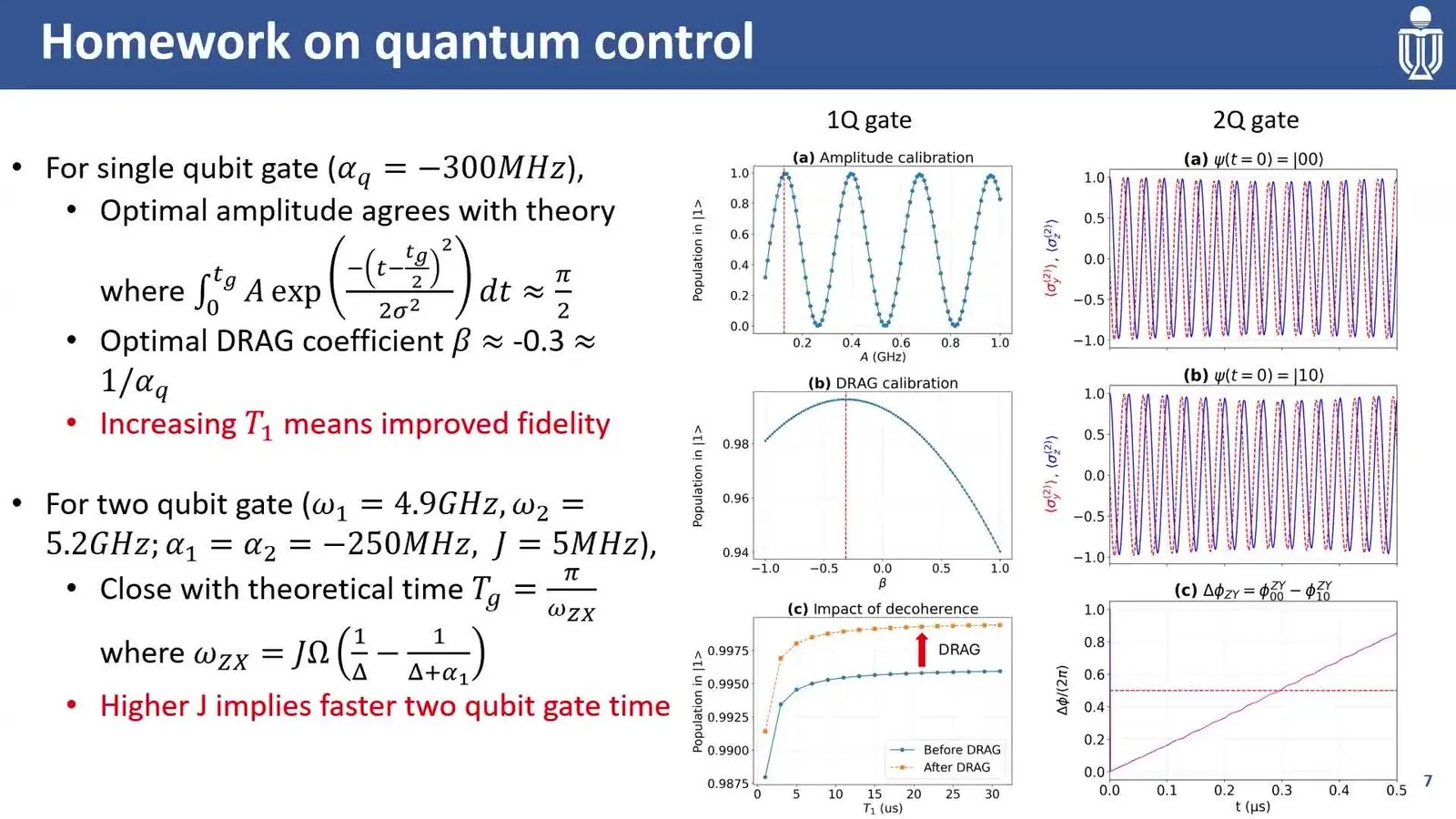
Students adjust lengths until the layout matches the design, then hand in a file ready for a chip foundry, the same kind of file that a commercial design team sends off at the end of its work. Fifteen graduate students took the first run. They found the layout the steepest part.
Bringing quantum into school classrooms
School is where the field hopes to widen its intake. American speakers call it K-12, the years from kindergarten to the end of high school, and six talks dealt with what to teach there, where it reaches and how to stop teachers making the same lesson twice.
Most US programmes sit near a top university
Laura Akesson taught in schools for 22 years. Now a doctoral candidate at George Mason, Akesson mapped quantum camps and workshops that run outside the school day, after ten interviews with programme leaders changed their plan. Akesson stands behind 34 student programmes and 51 teacher programmes.
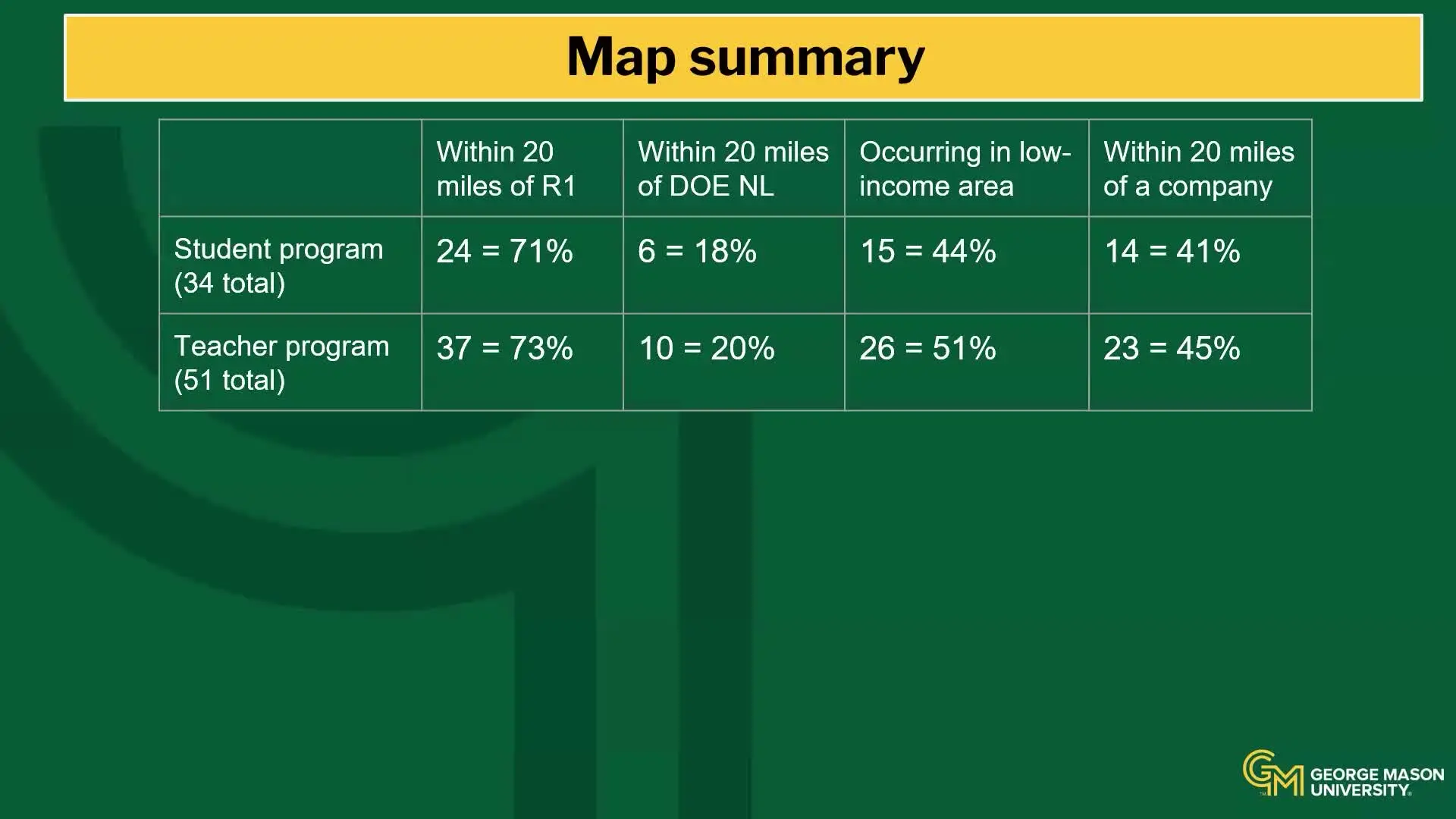
Of the student programmes, 24, or 71 percent, sit within 20 miles of a top research university. That compares with 18 percent near a national lab of the Department of Energy and 41 percent near a company, so by their count far more of it sits near universities than near labs or firms. Low-income areas hold 15, a count Akesson called small. Several programmes rest on one or two people packing boxes, and Akesson asked what happens when that champion leaves.
Teachers want lessons that fit the timetable
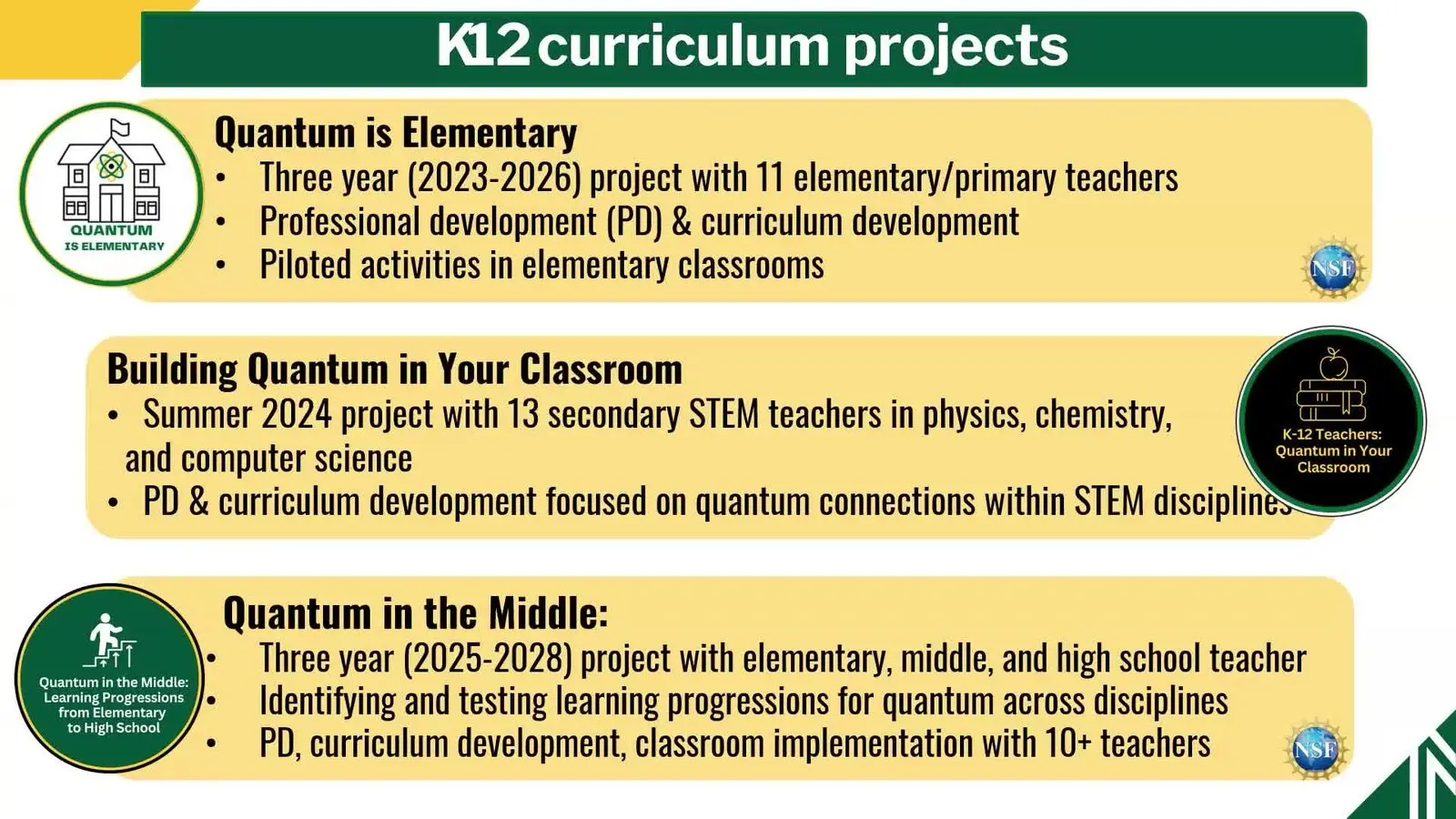
Nancy Holincheck of George Mason works with teachers to write the lessons. Their three projects covered 11 primary teachers from 2023 to 2026, 13 secondary teachers in the summer of 2024 and a middle school project, paid for by the federal government, that runs to 2028. Teachers help choose the questions.
The work now leans towards ideas that come before quantum, such as chance, the structure of atoms and scale. These fit into units the timetable already has. A lesson with no link to the required course will not be taught, however good it is and however keen the teacher may be to give it a place in the year. Almost every teacher named a lab tour as what they would remember, and Holincheck said lab tours do not scale.
A framework for school skills that is not yet tested
Raquel Coelho of the University of Pittsburgh says a lesson that works is only the first question. Coelho cited about 70 years of school reform in which early gains faded time and again, and Coelho said each new technology has arrived in schools as an add-on of its own. There is no spare room in the school day.

Coelho builds on a National Academies report that names seven lasting skills for data and computing. With colleagues Coelho sketches a quantum list beside them. Coelho called the list incomplete and untested, and said the shared skills belong in school from the very first years, with special courses kept for later in high school.
A catalogue of 161 free school activities
Brean Prefontaine of Duke presented for the National Q-12 Education Partnership. No single site holds the free school activities on quantum, so from May to September 2026 the team searched by hand and tagged each one by grade, time, subject and concept. They left out costly kits, textbooks and videos.
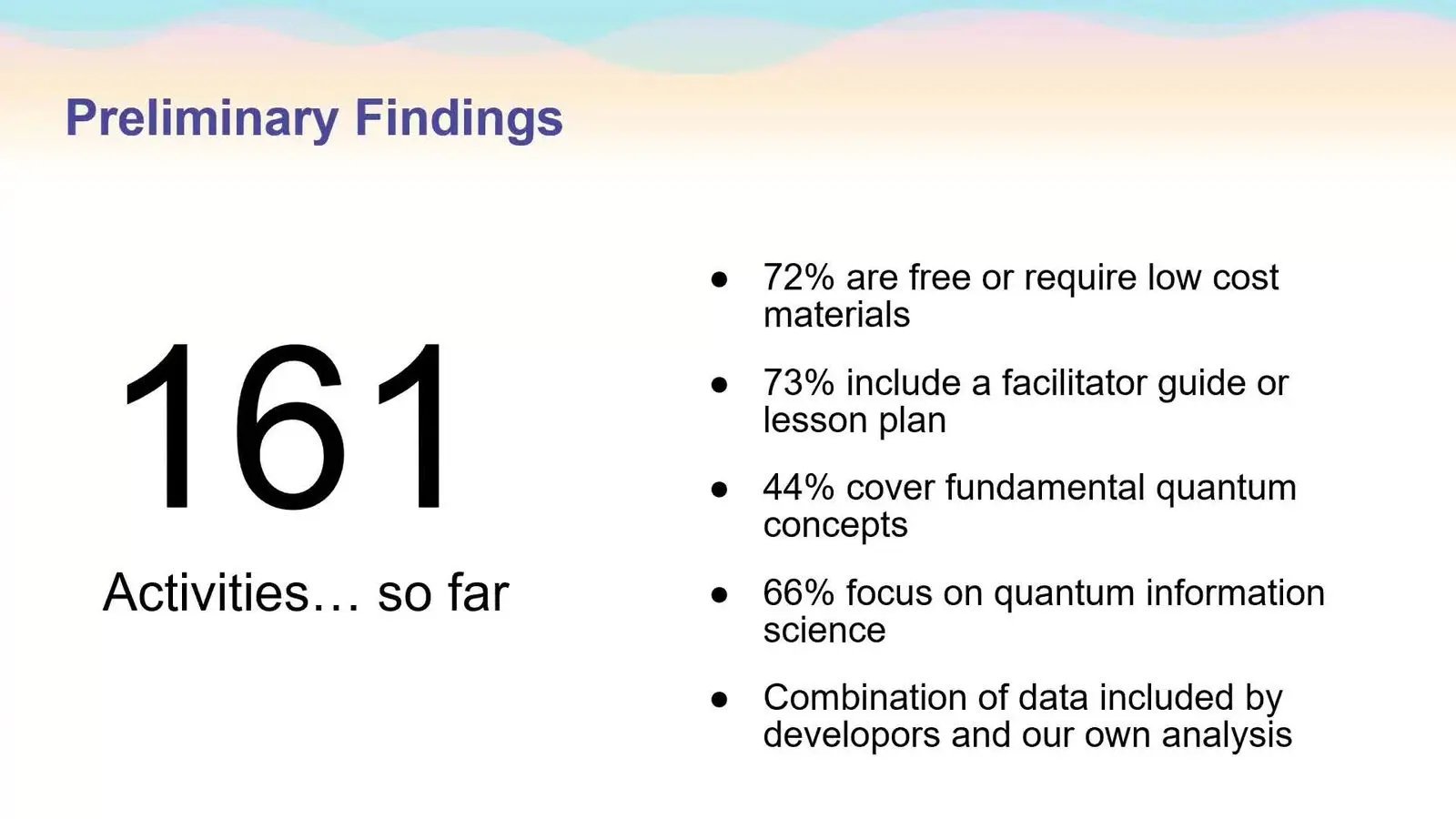
The team has logged 161 activities. Most are for high school physics. About 72 percent need little extra kit and 73 percent include a guide for the teacher, though no study yet says which of the activities change what students understand. The list was still a spreadsheet at the time of the talk.
Waterloo’s toolbox reaches 8,000 school students
A speaker from the QuEST team at Waterloo and Toronto explained how the toolbox works. Kits are packed centrally and posted to teachers, who pick activities from a catalogue, and one activity that hides a message in light went to 17 locations in 2025. The catalogue stays on the web.
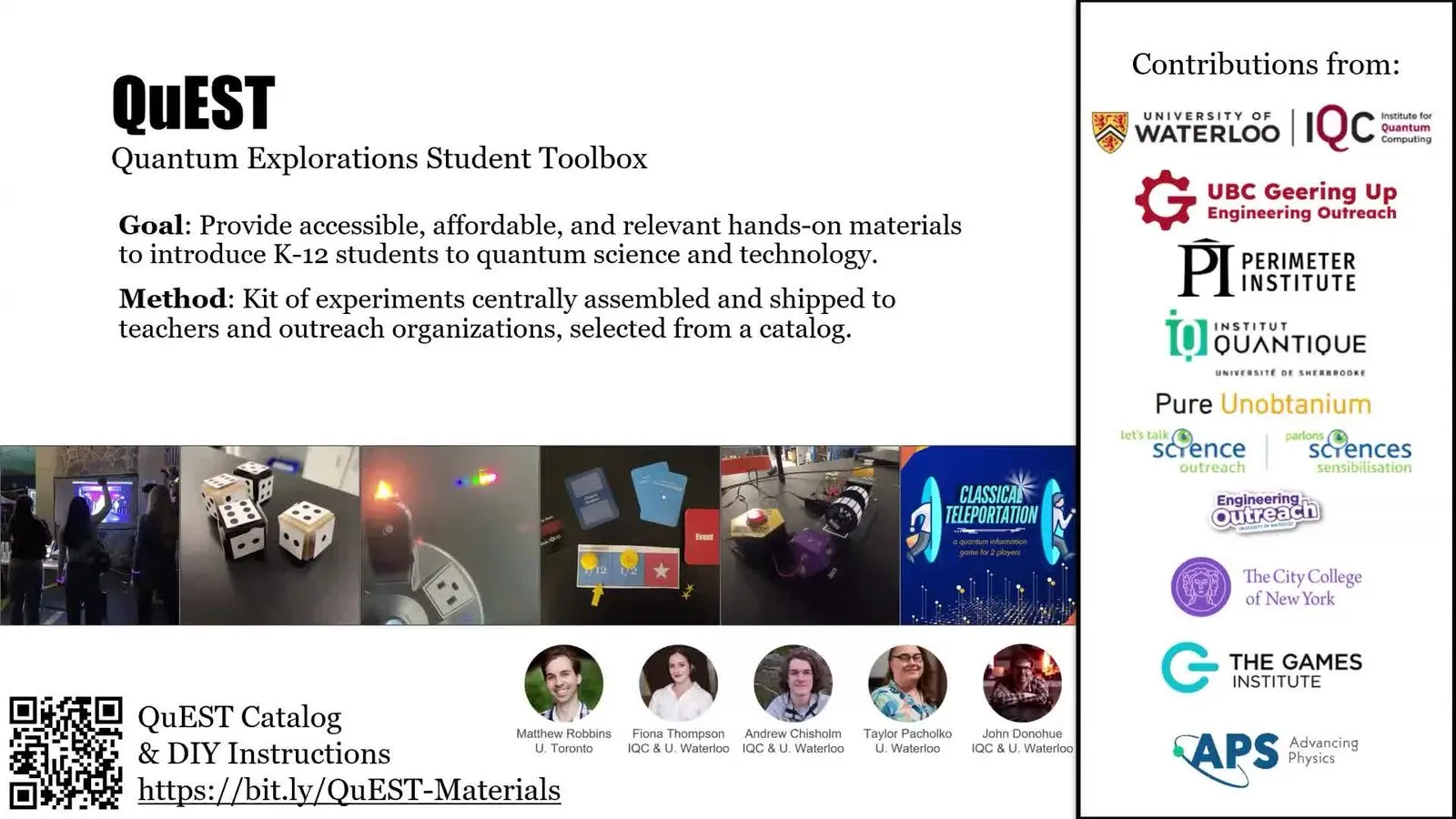
The kits reached 40 places in nine provinces and the territories. More than 110 events drew over 10,500 people, about 8,000 of them school students and 285 of them teachers, with help from partners such as the Perimeter Institute and Sherbrooke. The talk gave no measure of what those students took away.
Teaching quantum ideas through language
Nithin Raveendran of the University of Arizona wants young students to grasp quantum ideas before the maths. While mentoring high school students on error correction, Raveendran saw that students who were good with words got stuck as soon as the first lesson asked for vectors. So Raveendran starts with words.
Their running example is the word bank. It means a place for money or the edge of a river until context picks the meaning, an analogy for how measurement settles a quantum state. Raveendran was careful to say the wordplay has none of the real maths, so that comes later.
Teaching quantum computing through code
Most colleges teach quantum computing as code. Ten talks covered courses, browser tools and teaching notes, and several of them faced a newer problem that every computing teacher now faces. A language model can write most of the set work.
NVIDIA gives student teams four roles
Monica Van Dieren of NVIDIA spent more than 20 years on a university faculty. Van Dieren cited two white papers from this summer, one from MIT and one from the Computing Research Association, saying a model can now write nearly any assignment a course sets. Job adverts have moved on too.
Their answer is a team that agrees a classical baseline and a budget for qubits and runs before any model writes code. Four roles carry the work, from a lead who writes the specification to a quality owner who runs the tests and the classical comparison. The notes are free on NVIDIA’s CUDA-Q Academic site. Both white papers point to oral exams as the check that remains.
PsiQuantum teaches fault-tolerant algorithms with exercises
Matija Zesko and Mariia Mykhailova of PsiQuantum teach how to write programs for fault-tolerant machines. These are the future computers that will use error correction to run long jobs, and Zesko said job adverts already ask for people with this skill, while good teaching notes are scarce. So the firm wrote its own, a short introduction and a 17-chapter textbook.
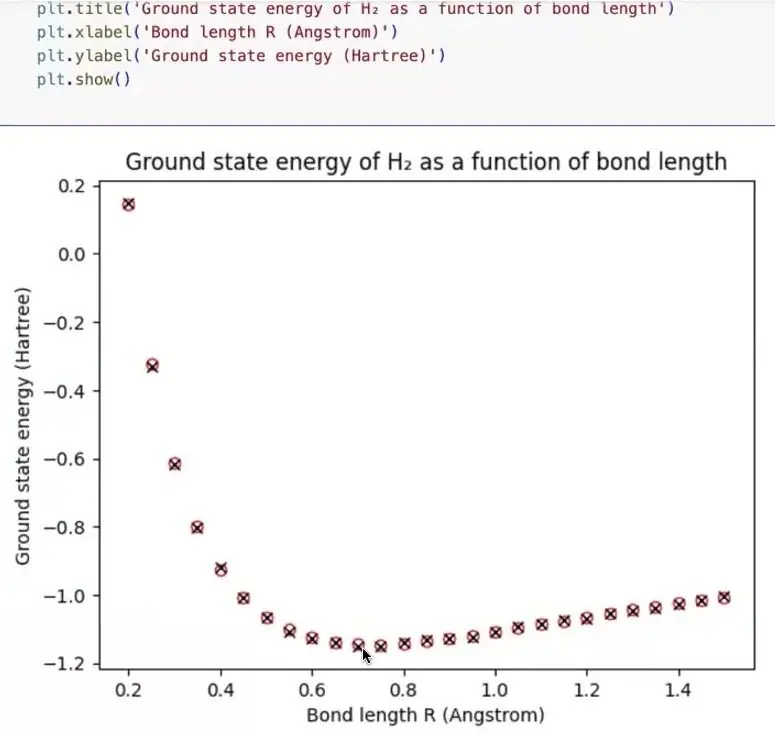
Mykhailova then worked through short drills, called katas, live on screen, with a checker that shows the right answer whenever a student gets one wrong. A simple quantum adder took four steps. Another drill plotted the energy of hydrogen against the distance between its atoms. Mykhailova said students hand in homework written by AI without running the tests that come with it.
Grover’s search, taught with its limits
Md Zamilur Rahman of Algoma University wrote six Qiskit modules for a course planned for the coming winter. Algoma has no quantum class yet. Qiskit is IBM’s widely used programming toolkit, and the modules cover six ways to find a shortest path, three where Grover’s search speeds up a step and two included to show no gain.
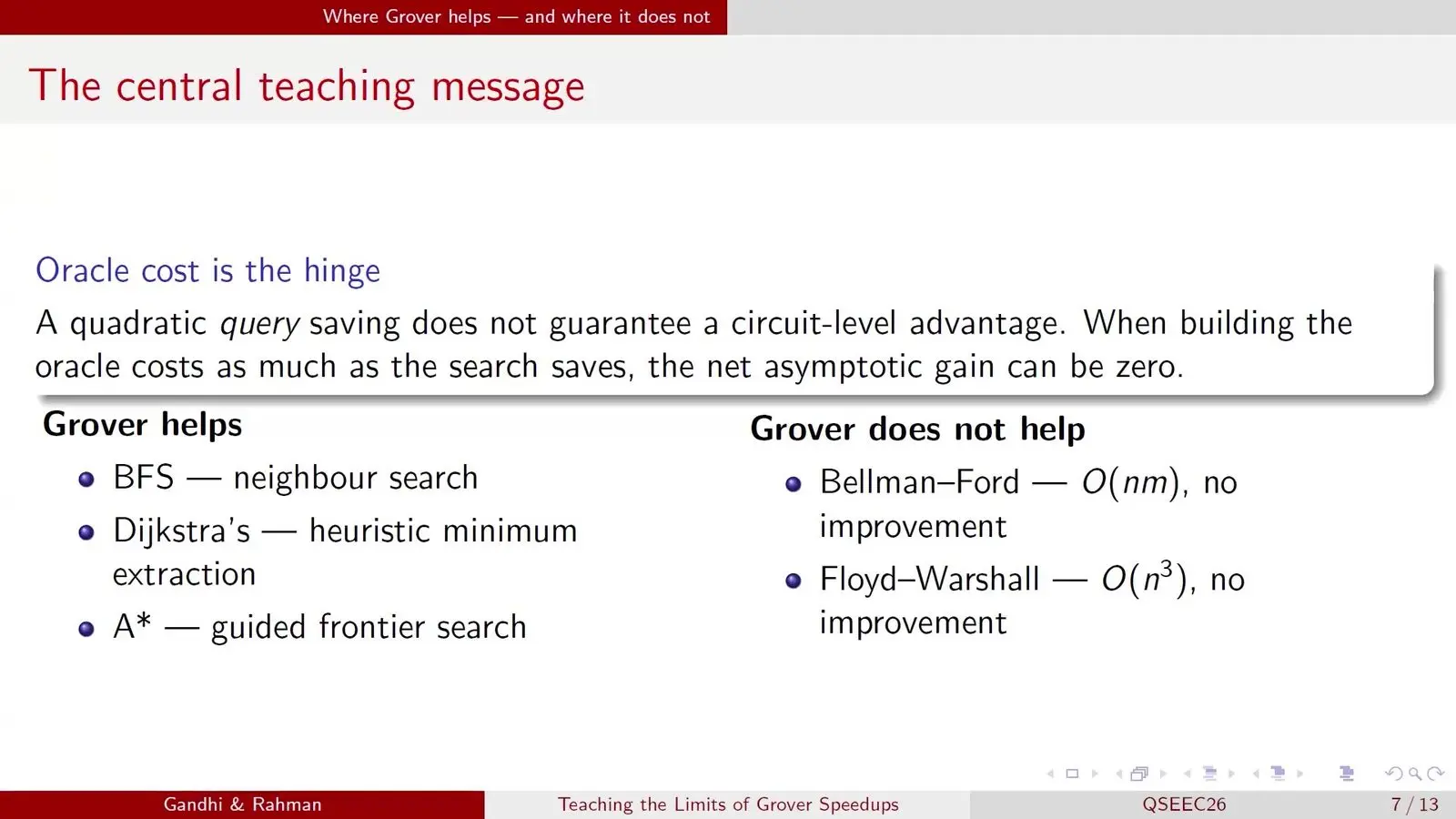
Rahman warned that fewer queries do not promise a cheaper circuit if the oracle, the part of the search that spots a right answer, is itself costly to build. A small count of queries can hide a big circuit. Circuit depth climbs fast as the graph grows. Going from eight to sixteen nodes in the graph, one method’s circuit depth rose from about 2,000 to about 18,000.
A browser tool that replays an optimiser step by step
Gregory Byrd of NC State showed a browser tool built by their former teaching assistant, Syed Farhan Ahmad. It replays QAOA, a common optimisation algorithm, one layer at a time. Students can watch the cost layer change only the phases of the state, and then watch the next layer turn those phases into changed odds for each answer.

The tool also handles penalties for constraints. Byrd’s spring class has not used it yet, and no study has been run, though Byrd plans a twelve-item test and a usability target before it reaches a class.
A drag-and-drop tool with no circuits at all
Ryan Abusaada, a recent master’s graduate of Georgia Tech, wants newcomers to run an algorithm with no circuits, no linear algebra and no code. Their tool is called BOQS. Coloured squares stand for bits, circles with arrows stand for qubits with a phase, and wrenches stand for functions.
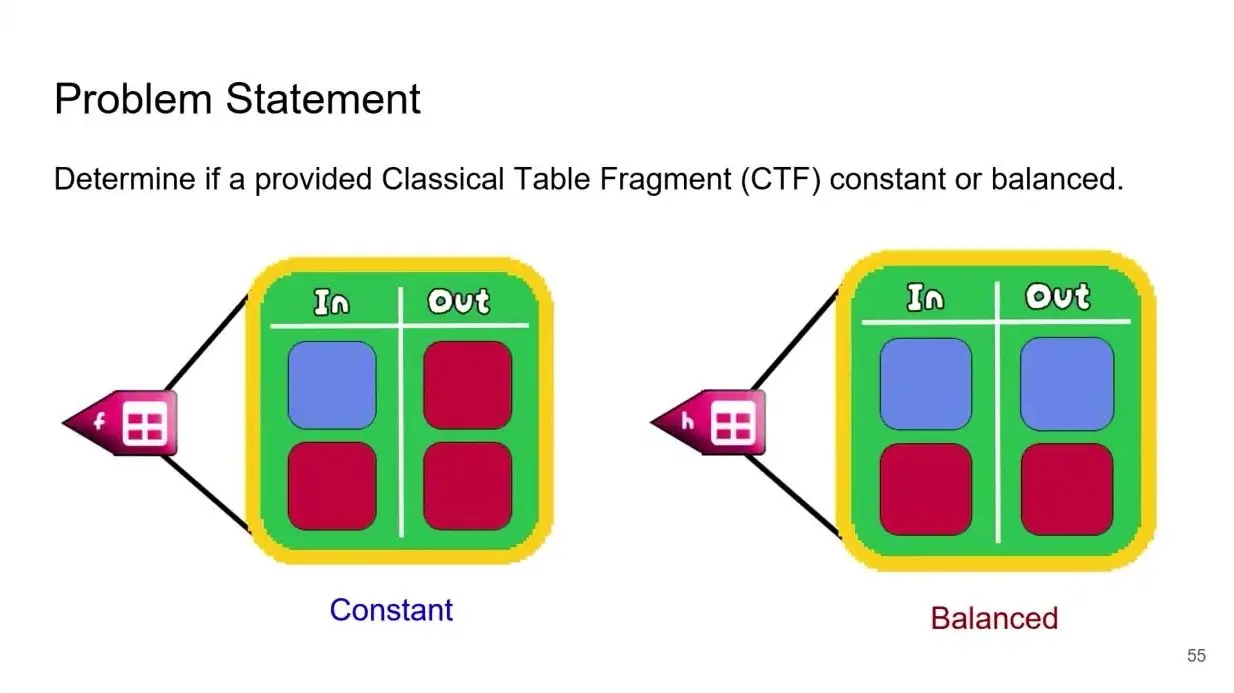
Abusaada walked through Deutsch’s algorithm, ending with a red square that marks a balanced function. Asked where the algorithm’s second qubit went, Abusaada said it sits inside the box as a helper the student never sees, which is the point of the design. The tool has not been released.
An AI tutor that needed three agents
Iizalaarab Elhaimeur, a student at Old Dominion University, built a tutor with Nikos Chrisochoides. It puts a lecture, a chat and a coding notebook side by side. A single AI agent mixed up its tasks and invented answers, so the team split the work across three agents and stripped names from student data before storing it.
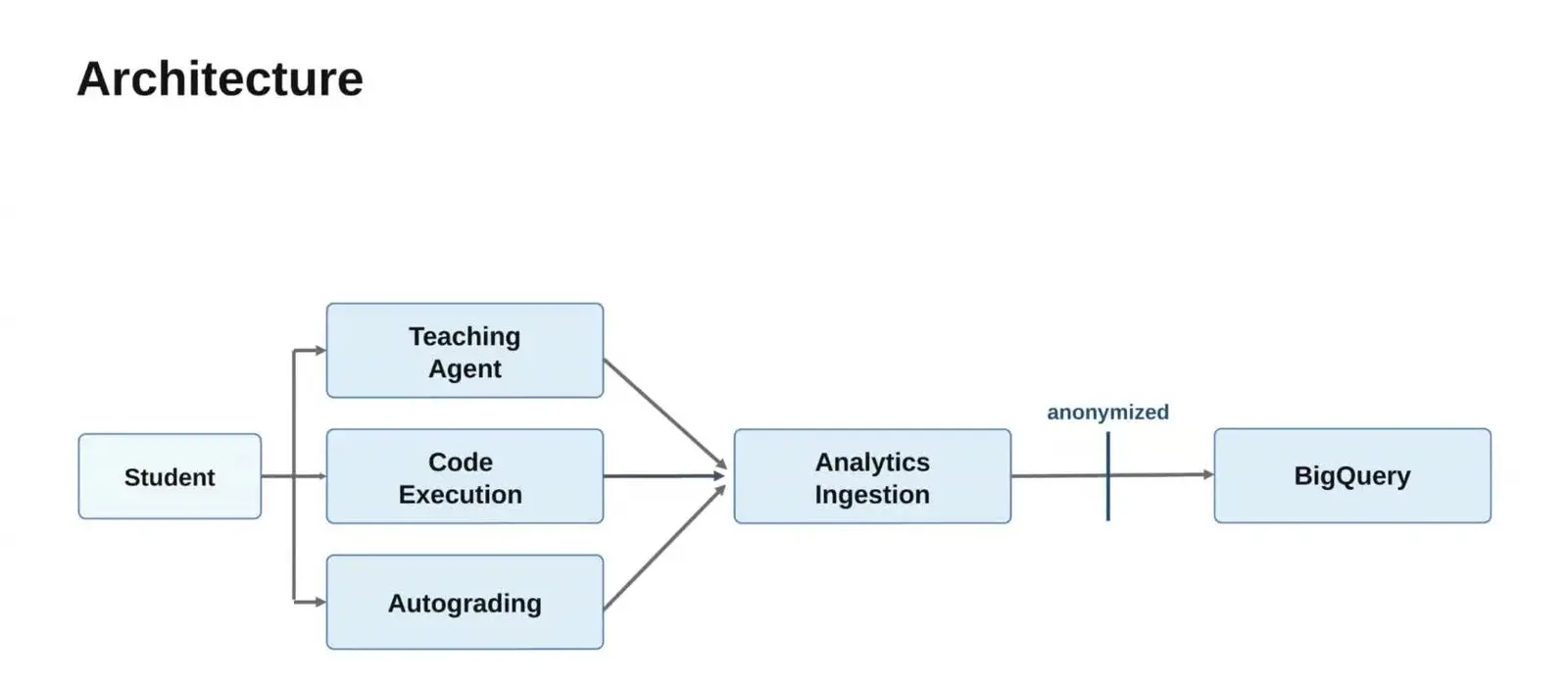
About five graduate students logged over 10,000 events in a semester. The single agent made four errors in keeping tasks apart and the split design none, though a model judged the outputs and the sample is small. Students tended to drop off where the single-qubit exercises ended.
A software engineering course in Toronto
Andriy Miranskyy taught a new elective at Toronto Metropolitan University in the winter of 2025. Of 40 students, 34 finished. Only two of the 24 who filled in a survey had met the subject before, and their goal was simple, a student who can read a short program and change it.
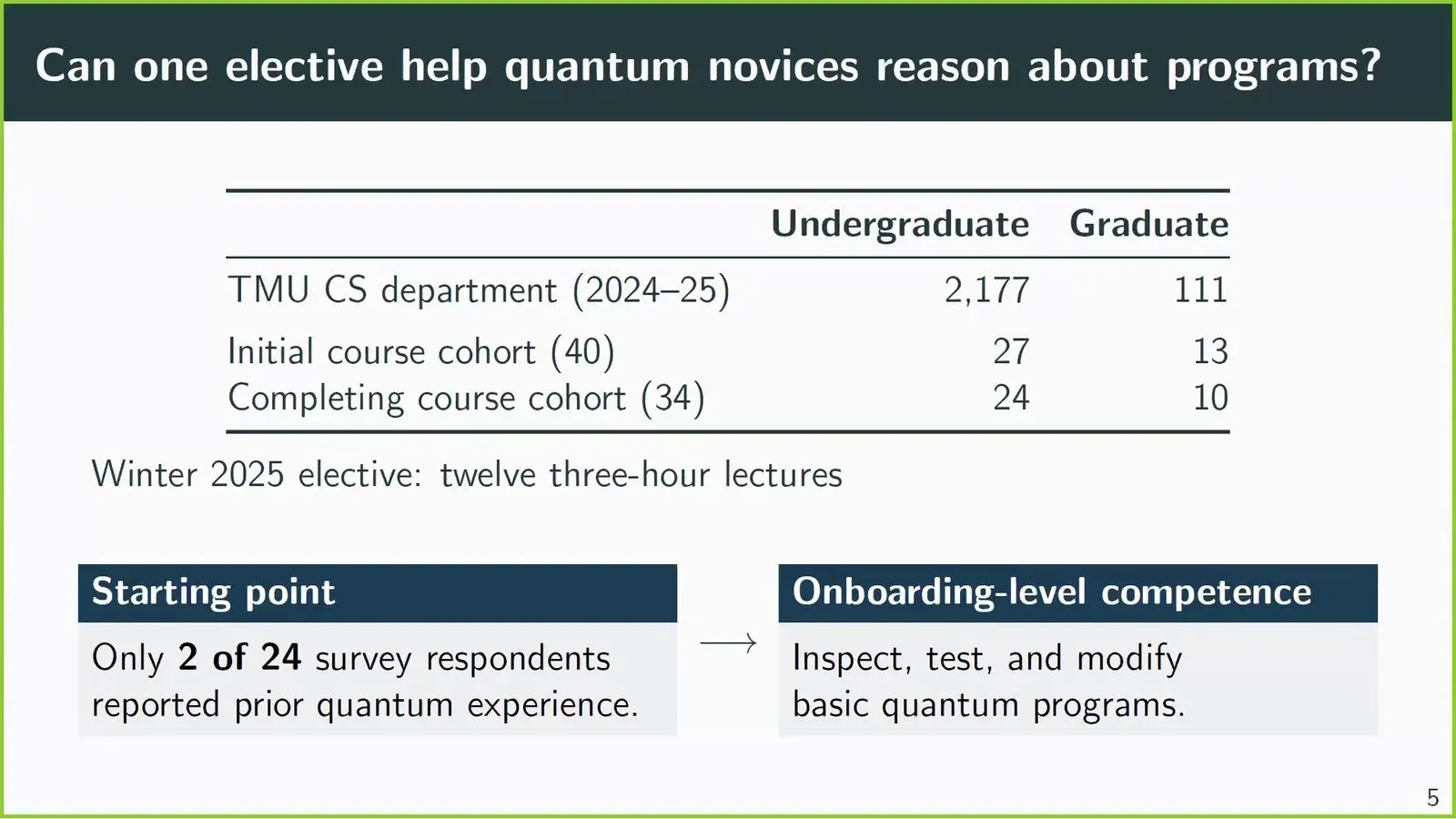
Algorithms were the hardest part. Moving a program between toolkits came up as a real problem when one toolkit could not read a newer circuit format. Miranskyy called their own evidence descriptive and said the set work had been too easy.
Munich teaches circuit design with Scratch blocks
Damian Rovara of the Technical University of Munich wanted students to see loops. A Grover circuit drawn out in full gets very long, and a loop is the classical way to write the same thing in a few lines, so the group added Scratch blocks. These are the visual bricks many children first learn to code with, here made for gates, measurement and counting resources.
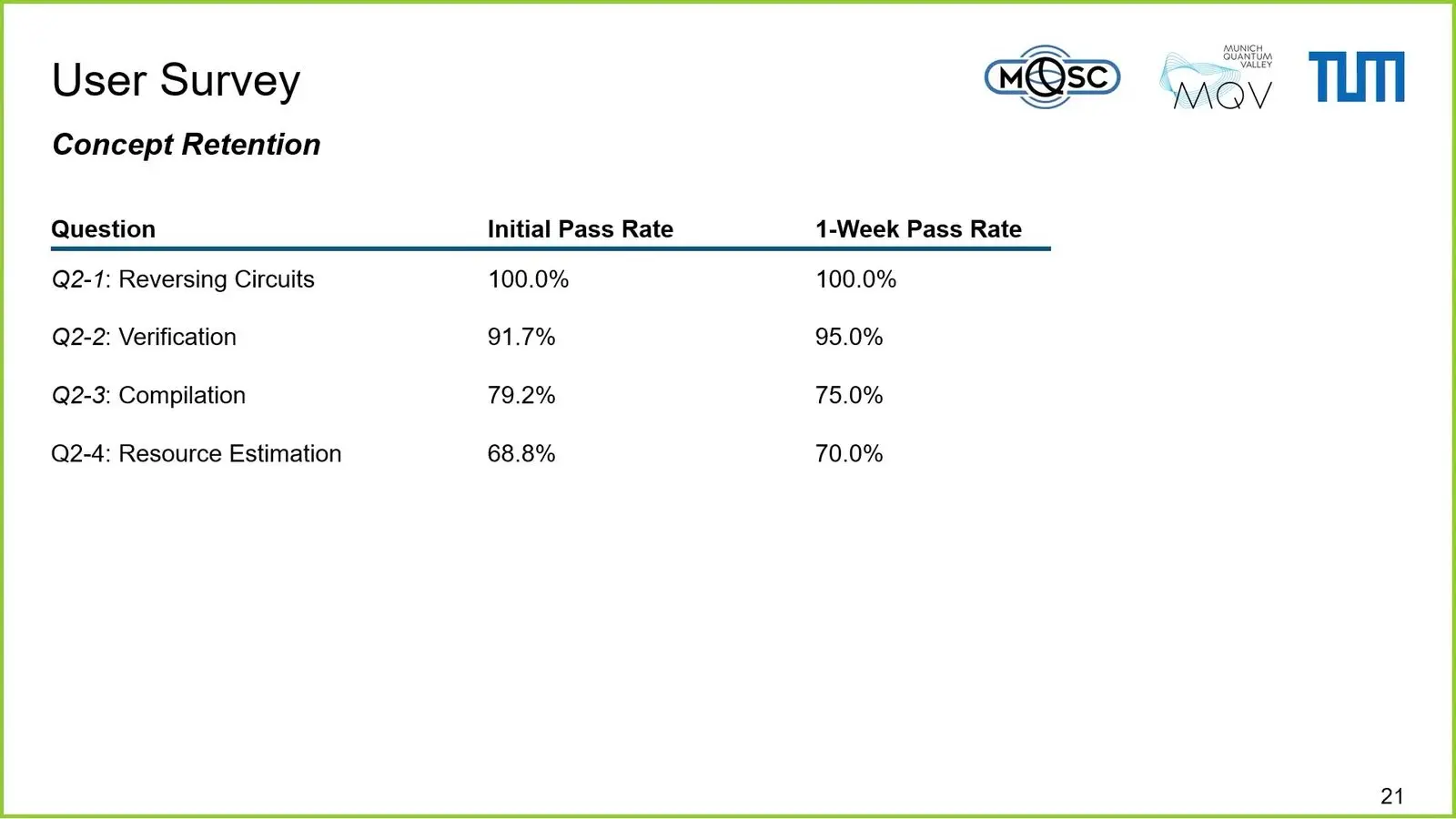
Twenty-four students took a quiz. Most came from computer science and almost none had used Scratch before. A week later, scores for checking a circuit moved from 91.7 to 95 percent, while estimating resources barely moved, from 68.8 to 70 percent, which Rovara put down to chance in a small group.
A one-week module on post-quantum cryptography
Lei Zhang of the University of Maryland, Baltimore County built a one-week module with four colleagues. Its subject is post-quantum cryptography. That is ordinary software built on maths problems that a quantum computer should not be able to crack. The team tried it in two courses, one for undergraduates and one for graduate students, and added a timed race to factor numbers and a run of quick quizzes on the web.
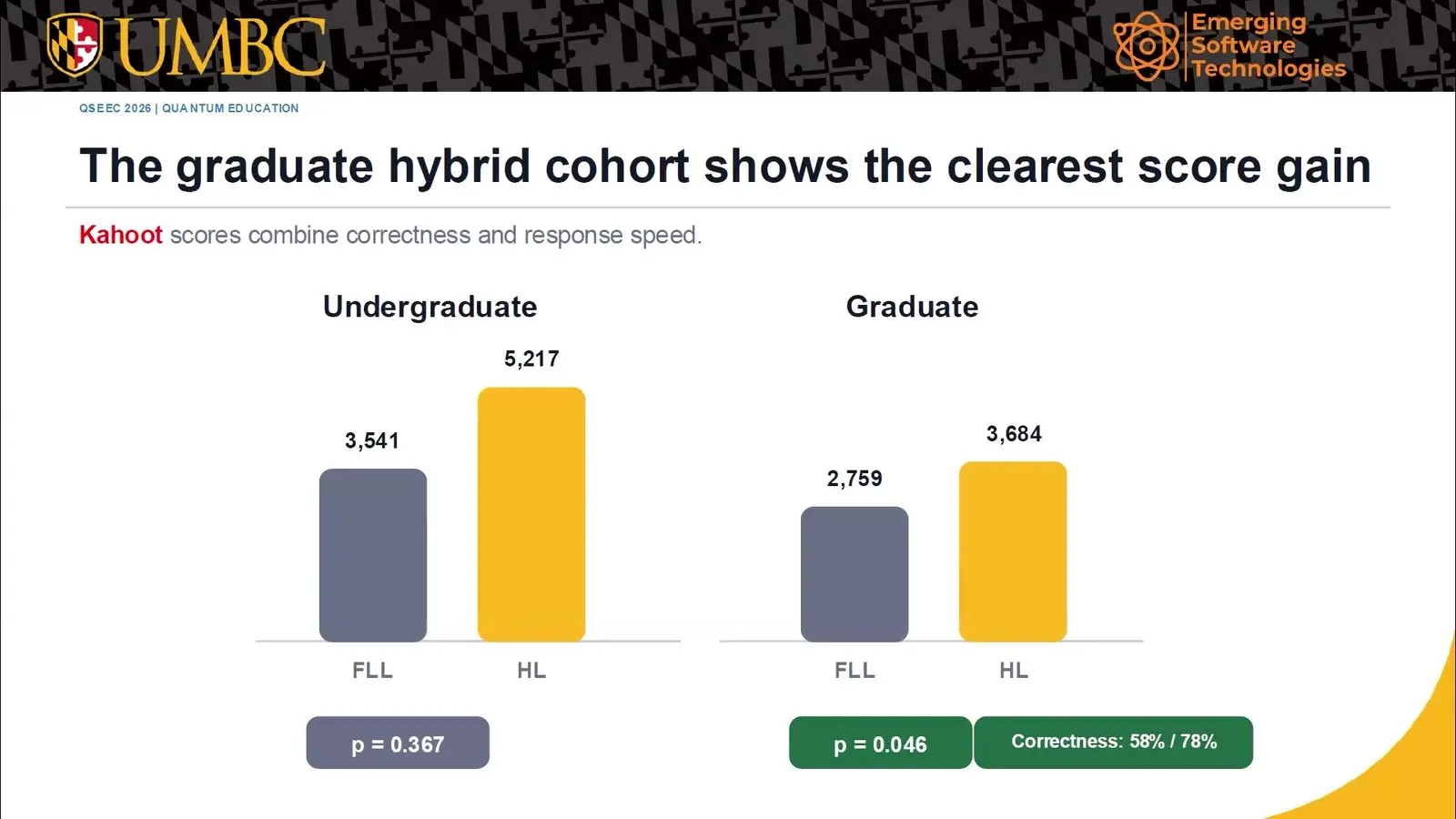
Adding seminars led by students raised graduate quiz scores from 58 to 78 percent correct, with a p-value of 0.046, just under the usual cut-off of 0.05. The undergraduate change was not significant. The data cover two semesters at one university.
A post-quantum course that scores itself
Muhammad Adeel of the University of North Texas at Dallas presented a fifteen-week course design. It starts with classical ciphers. It then moves through the new NIST standards to key distribution and the algorithms of Shor and Grover, and it names the risk of data stored now and broken later as the near threat.
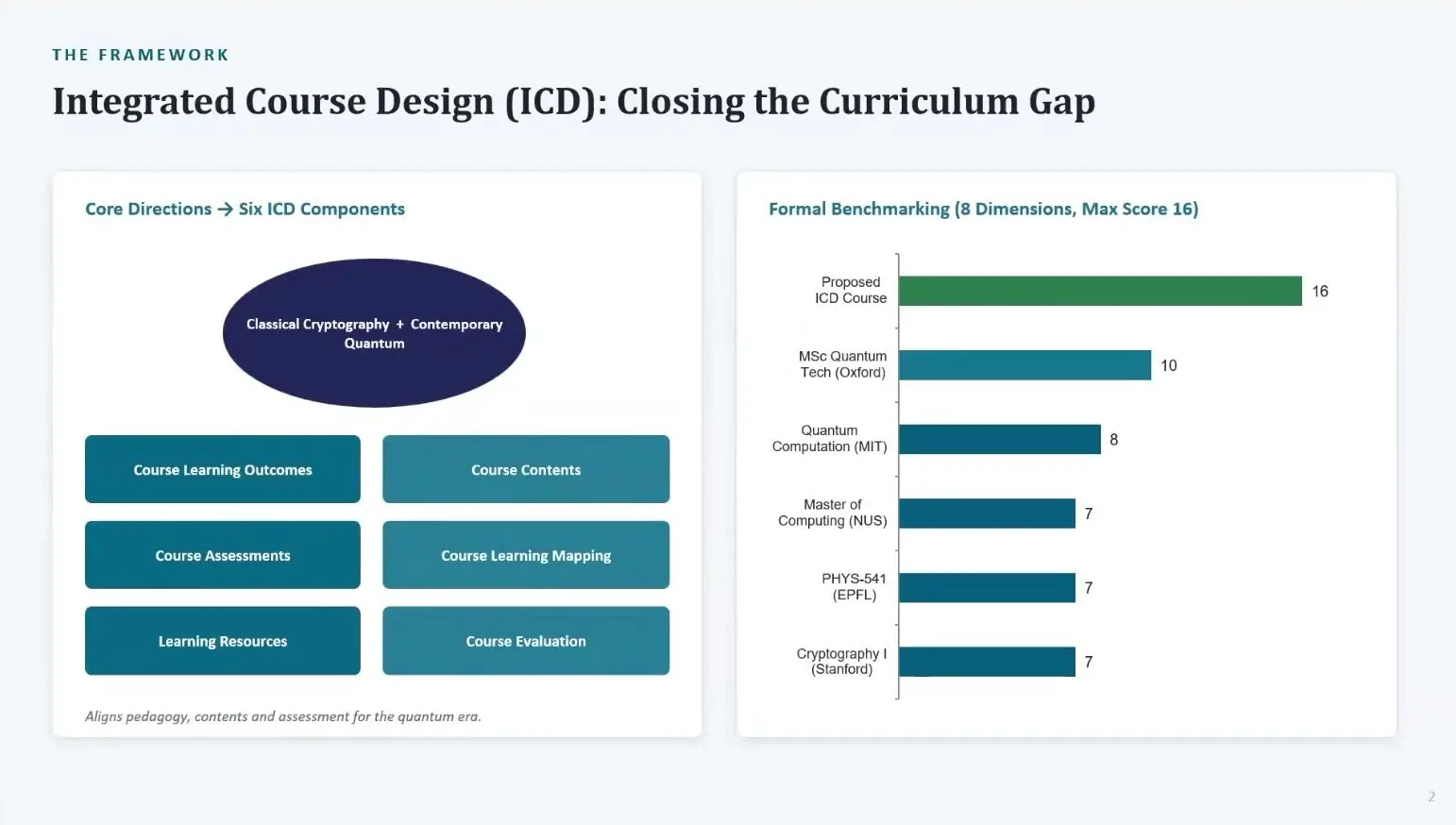
Their chart scored the plan 16 on its own eight-part rubric, against lower scores for courses at Oxford, EPFL, NUS and Stanford. Adeel said the score grades the proposal against its own sheet. The course has not run.
Do students still need circuits first
Circuits are the standard first language of quantum computing, much as logic gates once were for classical machines, and most first courses still start with them before they move on to anything else. A two-day tutorial taught them from scratch. A workshop session then asked whether they should still come first.
A two-day introduction to quantum computing
Scott Pakin of Los Alamos and Eleanor Rieffel ran a tutorial for beginners in four sittings of 90 minutes each, two on each of its two days. Day one covered the basics and the circuit model. Day two moved on to simple algorithms, other kinds of machine and optimisation.
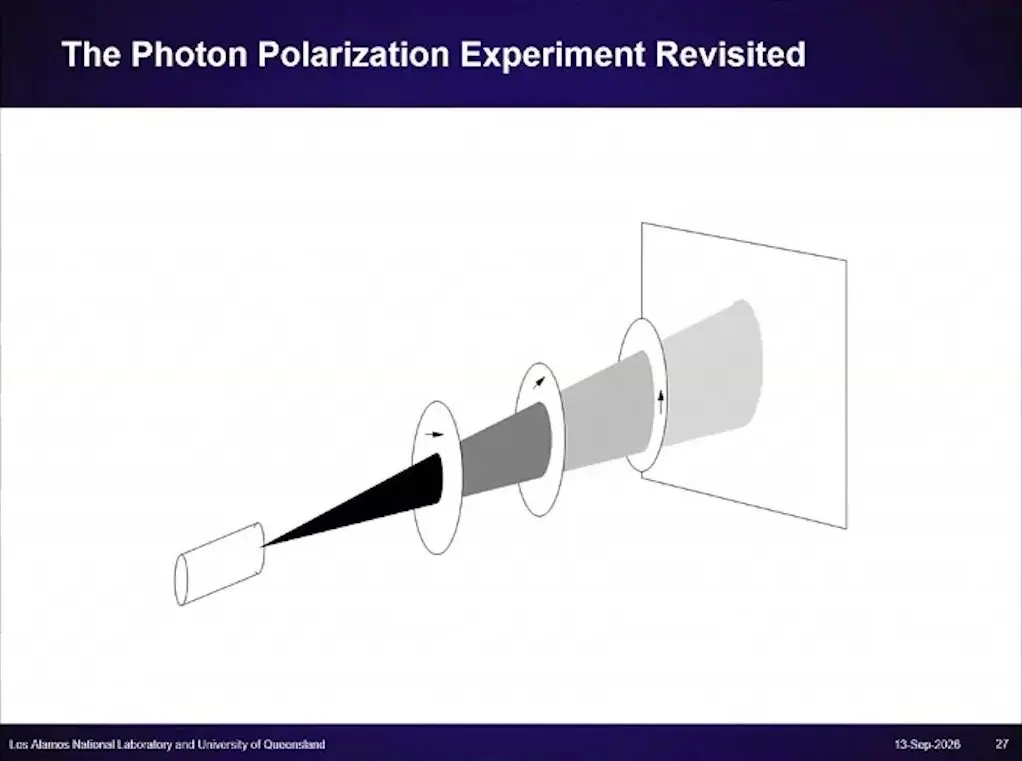
Rieffel traced the field to Feynman and Manin in the early 1980s. Quantum advantage, on that account, is proven only for simulation and a handful of algorithms, and Rieffel, who worked on the famous supremacy run by Google, NASA and Oak Ridge, said its random output is of no use in itself. In a show of hands, nearly the whole room agreed. The room then met qubits through polarising filters, where a filter set at 45 degrees between two crossed ones lets light through again.
Pakin taught the afternoon alone, at a slower pace. Pakin covered the circuit model, where qubits run as lines through time and every gate must be reversible, then built examples in the browser simulator Quirk. Moving one Hadamard gate past a controlled NOT changed the result from certain to an even spread over four outcomes. Two people solved the next puzzle before any hint.
NC State’s engineers think in logic diagrams
Gregory Byrd of NC State teaches quantum programming to a class split between engineering and computer science, using a textbook that was written for programmers and not for physicists. Circuits look like logic diagrams to their engineers. Byrd said circuits will not scale to big programs.
A short trial of one higher-level tool, Classiq, went poorly because their students had only just learned Qiskit and had to switch so soon to a second way of writing the same programs. Byrd liked how it treats a register as a number. PennyLane, another toolkit, confuses them by numbering qubits the other way round.
The panel keeps gates, with a way up
Olivia Di Matteo of UBC chaired the panel. With Di Matteo were Byrd, Valtteri Lahtinen of Quanscient, Matic Petrič of Fraunhofer and Damian Rovara of TUM. Rovara said gates are like a code library that people use every day without looking inside. Petrič has even taught Shor’s method for breaking codes to high school students in Ljubljana, using a higher-level language called Qrisp that keeps most of the gates out of view.
An audience member said circuits hide what a program is for. Lahtinen said the starting point is fluid dynamics, meeting the gates halfway, while Byrd said circuits show newcomers that qubits are a fixed resource. In the end the panel mostly kept gates for teaching. It wanted higher levels with a way back down.
Summer schools, summits and hackathons
Short, intense events are how many students first commit to the field. Six talks reported on them, from a summer school with 17 years of records to new events in Africa and Latin America that drew hundreds of applicants in a single year.
Waterloo’s summer school has 17 years of alumni
Michael Grabowecky of Waterloo’s Institute for Quantum Computing presented the record of USEQIP. It is a two-week school. About 30 students rotate in groups of 10 through labs on magnetic resonance, superconducting circuits, key exchange with light, a dust trap and the clean room, and each one leaves with a wafer cut in that room.
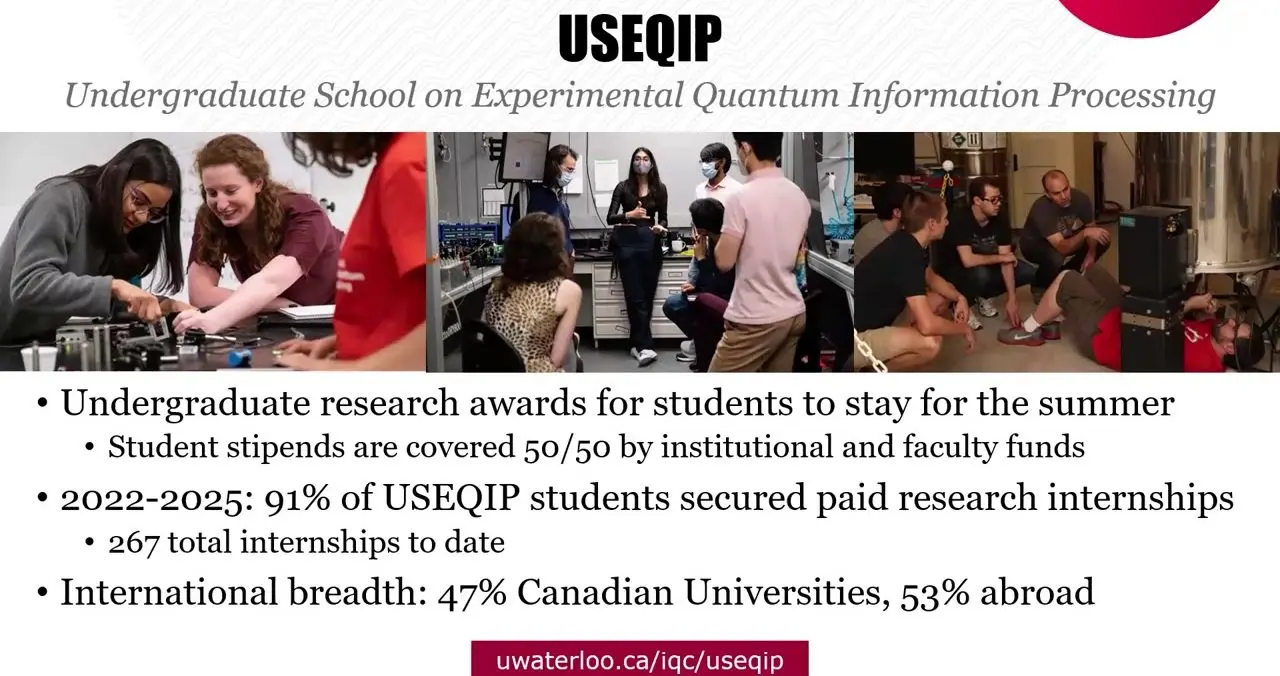
A 2025 survey of former students found 55 percent working in quantum information science and 27 percent in neighbouring work. Roughly 70 percent said the school had shaped their path a great deal. Only four of 36 said it had little or no effect, and all four came from 2021, the year the labs could not run in person at all.
Rice runs a summit built around students
David Román-García of Rice University presented QS3, a student research summit held at Rice on 23 and 24 March 2026. It drew 62 people from 21 institutions. Half the timetable went to student talks, meals and breaks, student presenters paid no fee, and five of the 18 who applied for awards were funded.
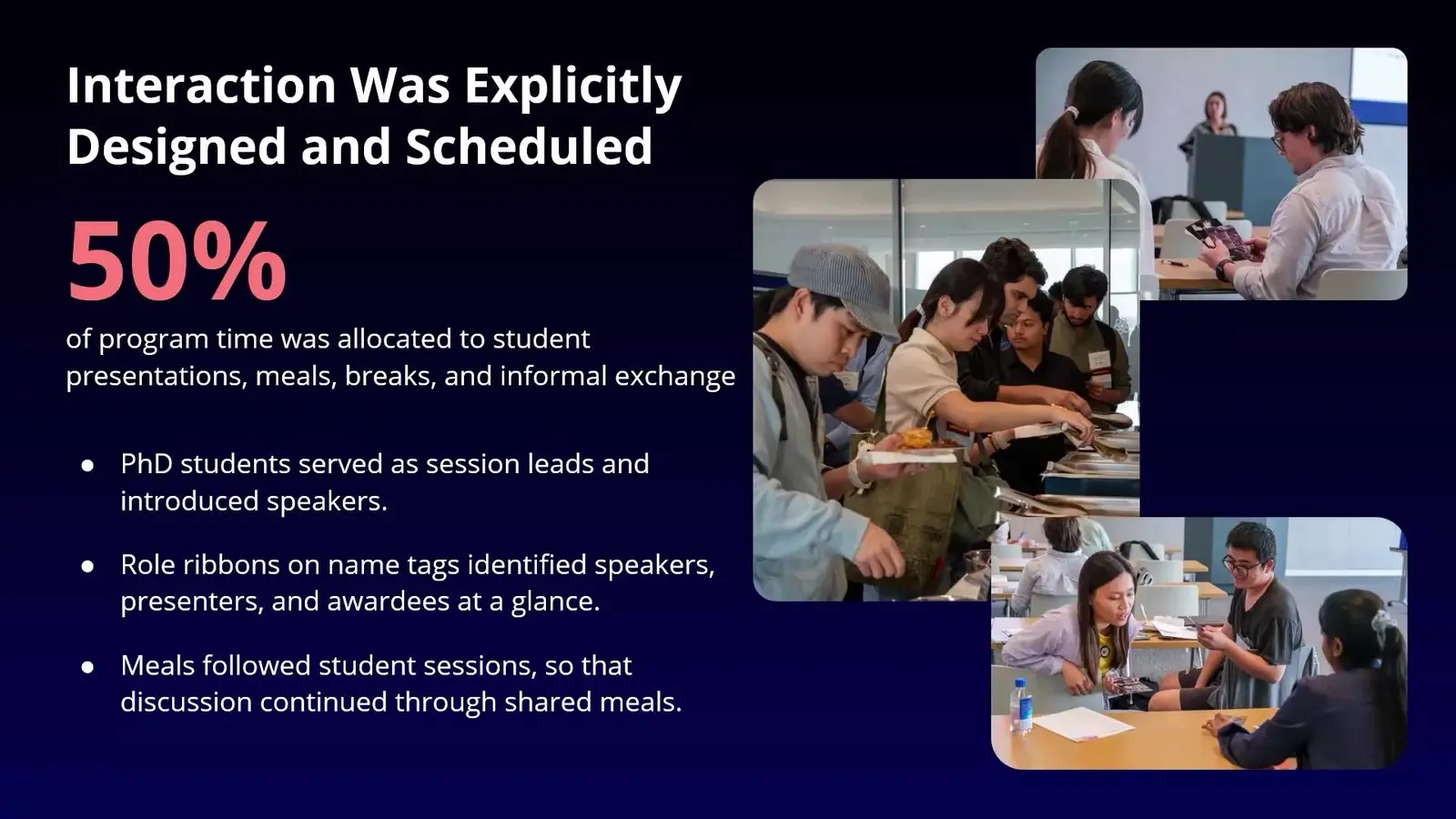
There were 18 posters and 11 short talks. Eight voluntary replies gave 87.5 percent a top mark, a pile the speakers declined to treat as a measurement of anything.
Baylor swaps the exam for a conference paper
Nischal Binod Gautam of Baylor University presented an engineering course on quantum mechanics, written up with Enrique Blair. The final project is a paper sent to a real conference, and the course counts the conference’s own reviews as its peer review, and one of the papers was accepted at this meeting. Quizzes and the exam were dropped.
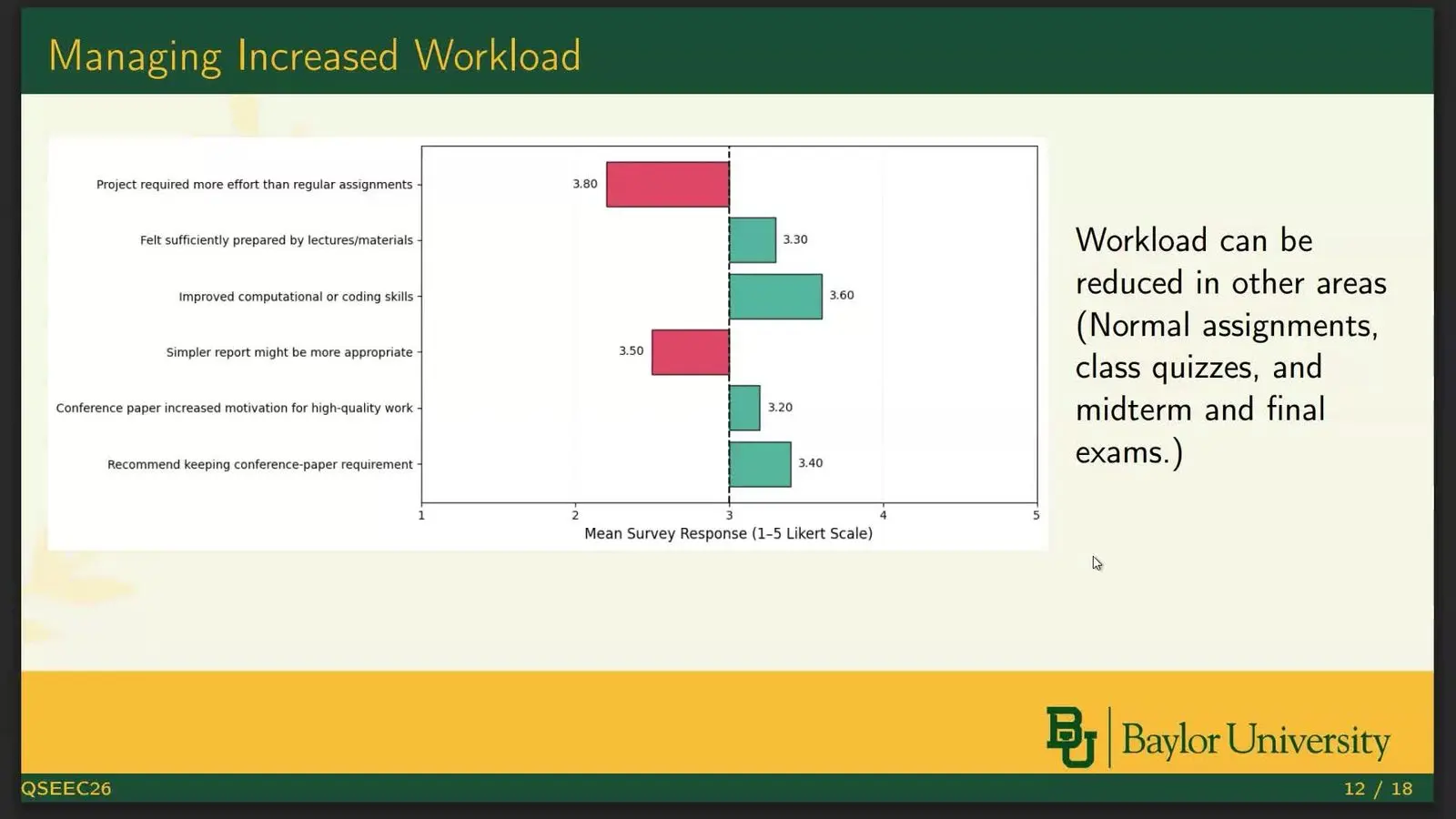
Ten students answered a five-point survey. Every score sat near neutral. Gautam listed the limits openly, with no comparison group, only self-report and no tests at all, and asked for more checkpoints during the term to come.
Africa wants the quantum year to leave something behind
Lorraine Majiri of Sherbrooke presented for the Africa Quantum Consortium. Majiri used the 2015 International Year of Light as a yardstick for what a themed year leaves behind. The 2025 quantum year brought wide first contact, Majiri said, while student groups that run without pay and a shortage of posted professors leave only a thin path for anyone who wants to go further.

One challenge drew 270 people from 26 countries in 43 teams. Yet the trail thins where jobs should begin. Cloud access to machines helps only where power, a device and a link all hold, so Majiri asked for local ownership from the start and pay for local teachers.
A hackathon for Latin America
Latin America got its own hackathon. Rafael Sotelo and Laura Gatti ran it from Montevideo, for a region with about 8 percent of the world’s people and few quantum courses. The event took place in Montevideo in October 2025, nobody needed any training to apply, and a free course run before it signed off 157 people as ready to take part.
Almost 400 applicants from 86 universities in 21 countries were cut to 80. They worked in eight teams on UN goals such as clean water. There was no test before and after and no follow-up on careers, though the group has since helped new hackathons get started in both Brazil and Mexico.
The Open Quantum Institute’s hackathons draw about a third women
Audrey Himmer of the Open Quantum Institute, which is hosted by CERN, said women made up about 30 to 32 percent of the institute’s hackathon participants. That is short of half, and in line with women in science and engineering. The strongest ratios came from Ghana and Pakistan, and Himmer read that as a sign that a wider mix of regions can shift other exclusions too. The institute has about 10 host countries in 2026.
Cloud access to quantum computers was already hard in Vietnam and Pakistan, and Himmer tied that to laws in the United States and elsewhere that limit what can be sold abroad. For undergraduates a simulator often suffices. The host country picks the language, and one host chose Spanish.
Free material on the web is not enough, Himmer said. Travel and lodging still need paying for, a need Himmer called last-mile delivery, and the pilot closes at the end of 2026.
Building the quantum workforce
Four talks went beyond a single classroom to the system around it. One came from a university that bought its own quantum machine, one from a firm that wants engineers trained in tiers, and two mapped the programmes that feed the field.
Florida Atlantic buys a machine and asks firms to hire locally
Robert Loredo runs quantum technologies at Florida Atlantic University after 21 years at IBM. Loredo said they had turned down four funded projects for lack of staff. The workforce they sketched runs from the electricians and plumbers who keep the buildings working up to the researchers, and they said there is no single ladder to a doctorate.
Loredo cited a 2023 McKinsey count of three open jobs for each ready person. The university bought a D-Wave annealer for its campus because, Loredo said, machines of that kind already do real work, so students can practise on the same tools they will meet in a job. Firms should hire nearby graduates, Loredo said.
A four-tier course for engineers
Arun Govindankutty of Nanoacademic wants to train engineers in four tiers. Their course runs from the physical effect up to computing, hardware and public use, and each idea comes back in a spiral at a higher level. The workbook grew from five chapters to 17.
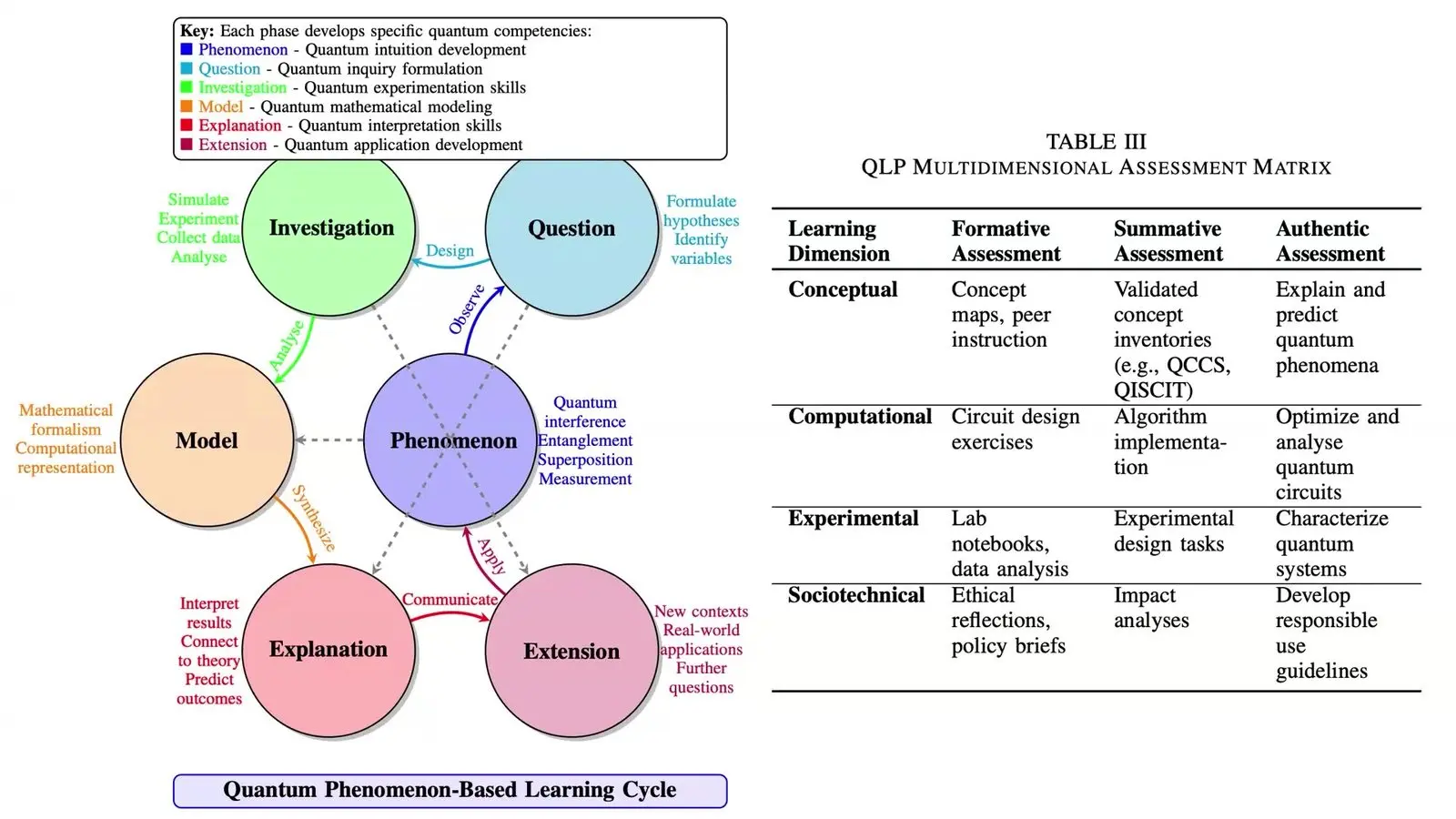
Govindankutty called the package a proposal, drawn from what Govindankutty personally found hard to learn as an electrical engineer coming new to quantum computing. A first class is due this spring at North Dakota State. No student has taken the course yet.
A global review finds the break after high school
Sara Ayman Metwalli wrote a review of quantum teaching around the world with Aryan Iliat, Steven Thomas, Suresh Nair, Zizwe Chase and Russell Ceballos, while working at the University of Illinois Chicago. The main break, Metwalli argued, is the step from high school into a first degree. Games and stories give way there to formal theory.
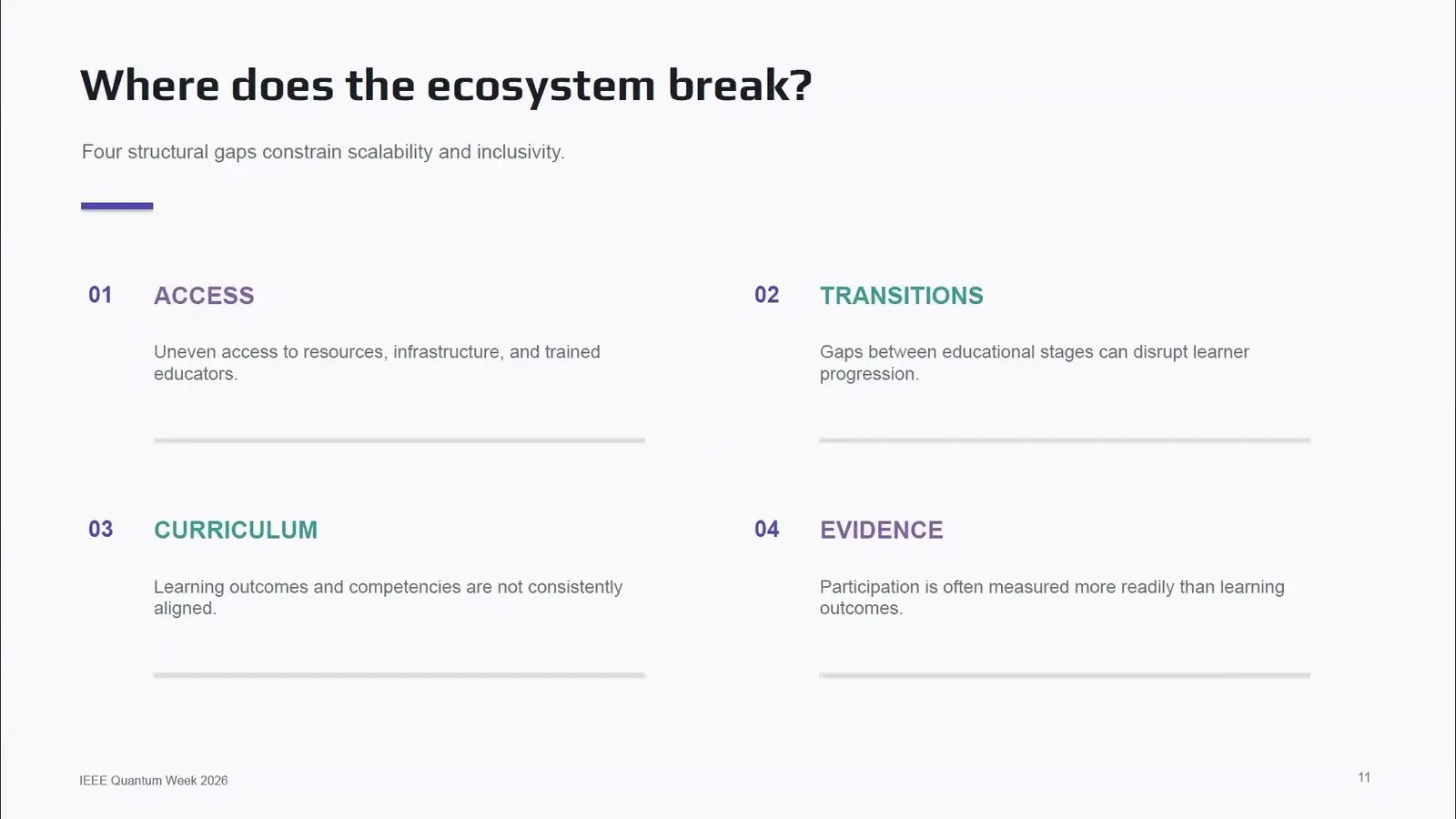
The review names four gaps, in access, transitions, curriculum and evidence. On evidence it found that programmes count who takes part more readily than what they learn. A pipeline drawn as school, then university, then work is too straight, Metwalli said, because people also arrive from industry and from study on their own.
A new department is hard to open. So Metwalli would teach the subject inside the ones that already exist, such as chemistry and security.
California State counts 2,900 students in changed courses
Justin Perron of California State University San Marcos followed up a three-year scheme that trained staff at the CSU’s teaching campuses, with co-authors from Sandia, CSU Chico, Growth Sector and the CSU’s central office. It aimed there because, at the start, 90 percent of US schools with such courses were research universities. Each summer brought two three-day workshops, on hardware in 2023, quantum machine learning in 2024 and sensing in 2025.
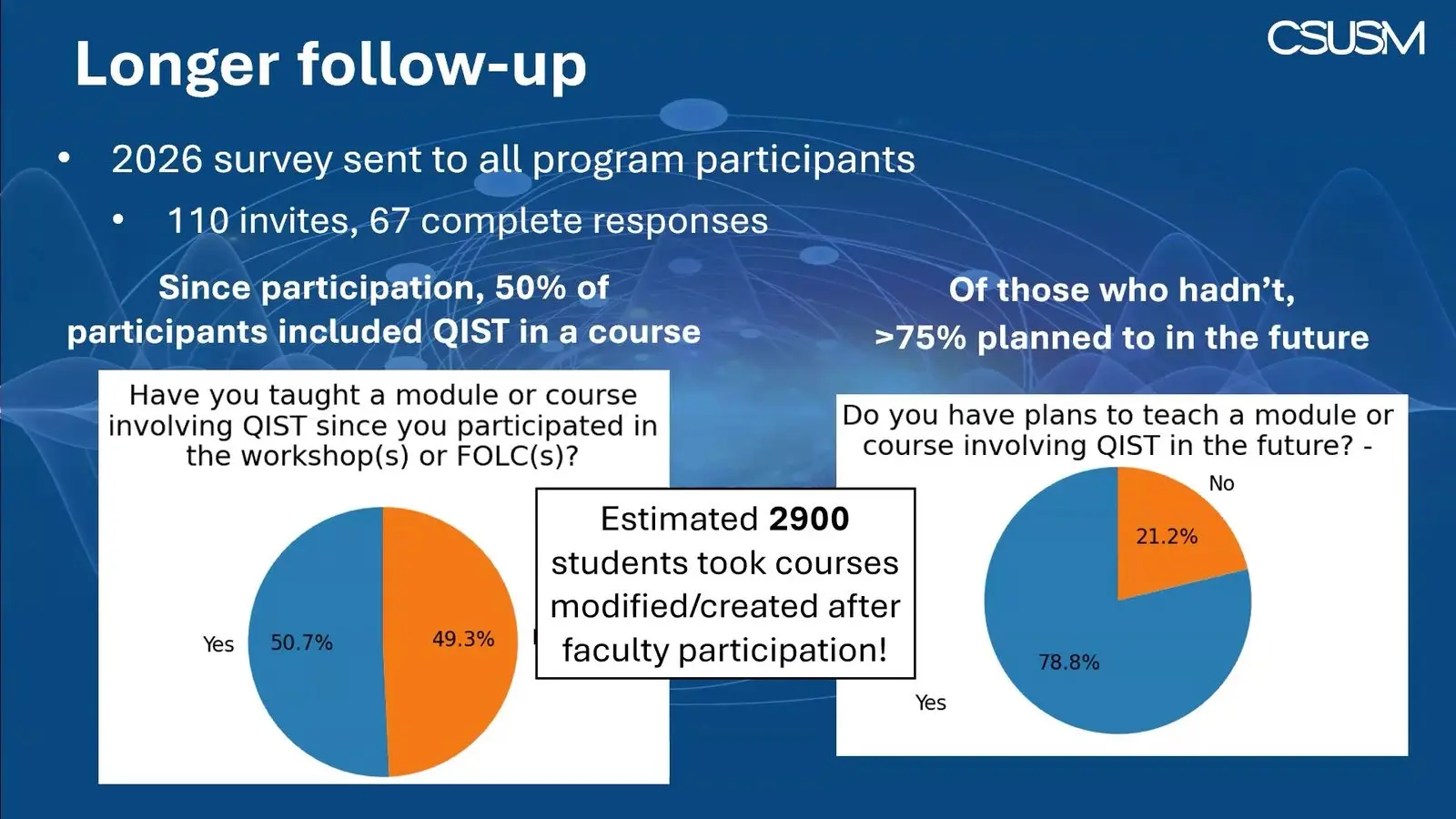
Small groups of about eight staff and two guides also met virtually about every two weeks, and each member was paid a small sum. The survey drew 67 replies. About half of those who replied had put the material into a course, and the class sizes they reported add up to 2,900 students.
Faculty in the small groups were twice as likely to teach the material as those who only came to a workshop. Perron flagged the sampling, and said it is still open whether the teaching worked.
What employers say they need
Three panels asked industry and universities what the new jobs will look like and who should train for them. Most agreed that the jobs will be broader than physics.
A US and Canadian panel finds demand outrunning seats
Danna Bailey of the Chattanooga Quantum Collaborative said a 12-week course for people who keep their day jobs had planned for 10 places. It drew 80 applicants and took 17. The panel opened on forecasts of 250,000 quantum computing jobs around the world by 2030, with job posts outnumbering ready candidates three to one in 2025.
Emily Easton of the Chicago Quantum Exchange said the gap employers feel is in experienced people, often with five or six years of research behind them. Each student in the exchange’s scheme gets two mentors. One comes from a university and one from a firm, and over five years the scheme placed roughly 75 to 80 percent of about 200 students in jobs outside academia.
Christian Sarra-Bournet said Sherbrooke’s Institut quantique has 45 professors and about 250 graduate students and postdocs. Sherbrooke makes its students take internships in industry. Most will leave. Eight in ten graduate students will go on to jobs outside the university, Sarra-Bournet said, and Ben Lau of Xanadu put the number of schools that teach with PennyLane at more than 150.
Most new quantum jobs will not say quantum
Gwen Leifer of Lockheed Martin said hardware job postings ask more and more for a mechanical, thermal or systems engineer with no quantum in the title. The panel agreed most new roles will look like that. Kortney Rolston-Duce of Quantinuum, moderating, recalled joining Honeywell Quantum Solutions in 2020 at under 100 people. Quantinuum now has more than 800 staff.

Daniel Nino of Xanadu named business development as the hardest gap. Sarah Chehade said WISER has about 54 research fellows, about 30 percent of them hired by partner firms, and Kimberly McGuire said C2QA at Brookhaven has only just begun tracking its students. Lockheed’s own tracking so far is one spreadsheet, Leifer said.
Leifer warned against promising jobs to anyone who earns a quantum certificate. Firms trust just one IT badge, Easton said, citing a report. It is from CompTIA. Nino said a quantum engineering degree makes the same unspoken promise. People who hold older degrees, in engineering physics or in electrical or mechanical engineering, are already well trained for the work that firms need done, Nino said.
1QBit’s Kaye calls domain-expert training premature
Phillip Kaye of 1QBit argued that training domain experts to apply quantum computing at industrial scale puts the cart before the horse. Only Shor’s algorithm and HHL, Kaye said, are known with confidence to give exponential speed-ups. Kaye spared sensing from the charge. The panel left the point unsettled.
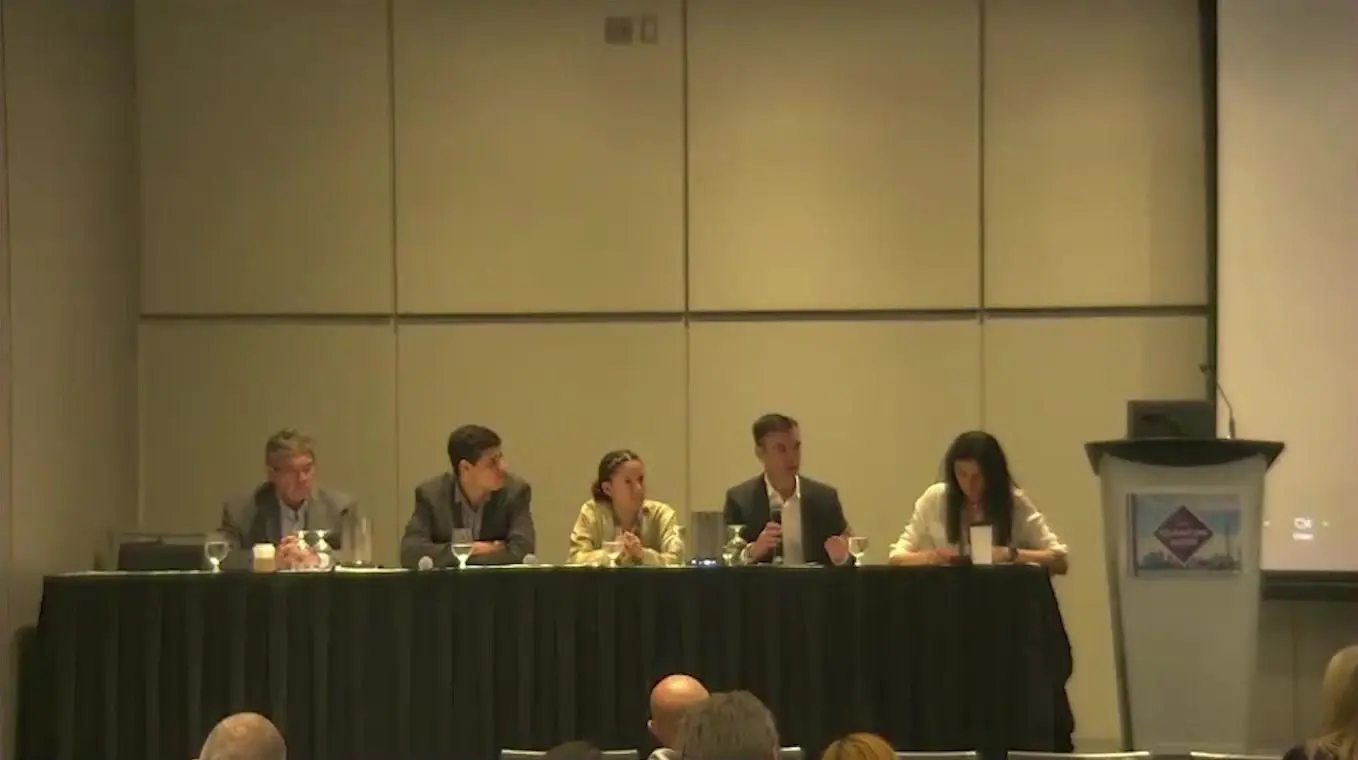
Hausi Müller of the University of Victoria wanted the government to pay seed money for small quantum teams inside firms in mining, forestry and other trades. Three others agreed. They were Kathrin Spendier of Quantinuum, Audrey Himmer and Amevi Acakpovi. Müller has run a 45-hour boot camp in quantum software at least five times, and found that mathematicians gained the most from it.
Acakpovi, of Accra Technical University, set out three layers. First comes a basic grasp of quantum for every engineering and computing student, then expert courses, then hands-on work on cloud machines with firms. May Siksik of Innovation Network Canada chaired. Kaye said about half of 1QBit’s staff began as interns paid by Mitacs, and that people who can invent new algorithms are the hardest to hire.
What it means for funders and teachers
For a funder or a head of department, the useful money now goes to the second contact. That means a test before and after every new kit, a comparison class wherever one can be found, and salaries for the local teachers who keep a programme alive once its founder leaves. Majiri and Akesson both asked for this.
For a teacher, the cheap route into hardware is real. The Waterloo kits cost about 200 dollars each and the syrup gate under 100 Canadian dollars. The Quorum-1 needs 460 dollars of parts, which its team put at about a tenth of the cheapest commercial teaching NMR, and the Q-12 list holds 161 free activities that any teacher can use. For an employer, Loredo’s advice was to hire nearby graduates before they move away. One hiring panel added that most new roles will be engineering jobs with no quantum in the title. More on what employers face is in our guide to getting ready for quantum computing.
Lefebvre’s syrup turns the light almost as promised. What it does to a student’s understanding has yet to be measured.
Frequently asked questions
What is quantum education?
Quantum education teaches the ideas and skills behind quantum technology, from school lessons on light and chance to university courses in programming quantum computers. It also covers training for technicians, engineers and managers. At QCE26 it ran from maple syrup gates to a calibration class on a real superconducting chip.
Can you teach quantum computing without advanced maths?
Several QCE26 speakers tried. Sherbrooke’s syrup gates, hand-held model qubits and a drag-and-drop tool called BOQS all aim to teach the core ideas without linear algebra. Their makers have yet to publish strong evidence of what students learn from them.
How much does a hands-on quantum teaching kit cost?
The kits shown at QCE26 ran from under 100 Canadian dollars for Sherbrooke’s syrup gates to about 200 dollars for Waterloo’s key-exchange kits. The University of Illinois Chicago team showed a magnetic resonance spectrometer with 460 dollars of parts, against 6,325 to 7,025 dollars for a commercial teaching unit.
Is there a shortage of quantum workers?
Robert Loredo of Florida Atlantic University cited a 2023 McKinsey count of three open jobs for each ready person. Loredo also said the university had turned down four funded projects for lack of staff. The workforce Loredo described runs from electricians and plumbers up to researchers.
Where are school quantum programmes in the US?
In Laura Akesson’s map of programmes outside the school day, 71 percent of student programmes sat within 20 miles of a top research university. Low-income areas held 15 student programmes, a count Akesson called small.
What happened at IEEE Quantum Week 2026?
IEEE Quantum Week 2026, also called QCE26, ran from 13 to 18 September at the Metro Toronto Convention Centre. This guide covers 39 of its talks on quantum education and the workforce. Most came from the education track, with speakers from Waterloo, Sherbrooke, George Mason, NVIDIA, PsiQuantum and about two dozen other schools and firms.
This guide is based on 39 talks, tutorials and panels at IEEE Quantum Week 2026 (QCE26), held at the Metro Toronto Convention Centre from 13 to 18 September 2026, and on the published conference programme. Names follow the programme. Affiliations and titles not listed there are as speakers gave them. Results are stated as each speaker presented them, and most rest on single classes, surveys or designs not yet taught. Company claims are the companies’ own.
- Qubit hardware and scaling roadmaps
- Photonics and quantum sensing
- Control electronics, calibration and readout
- Quantum error correction and decoders
- Fault-tolerant compilation and magic states
- Modular and distributed quantum computing
- Quantum computers in supercomputing centres
- Compilers, circuit synthesis and languages
- AI and language models for quantum software
- Testing and reproducible quantum experiments
- Benchmarks, error mitigation and quantum advantage
- Quantum state preparation, oracles and arithmetic
- Quantum optimisation, QAOA and annealing
- Quantum machine learning
- Chemistry, materials and life sciences
- Differential equations and fluid dynamics
- Power grids and energy
- Quantum finance
- Logistics, climate, databases and games
- Quantum networks and key distribution
- Quantum security and post-quantum cryptography
- Policy, standards and the quantum business

See today’s quantum computing news on Quantum Zeitgeist for the latest breakthroughs in qubits, hardware, algorithms, and industry deals.