

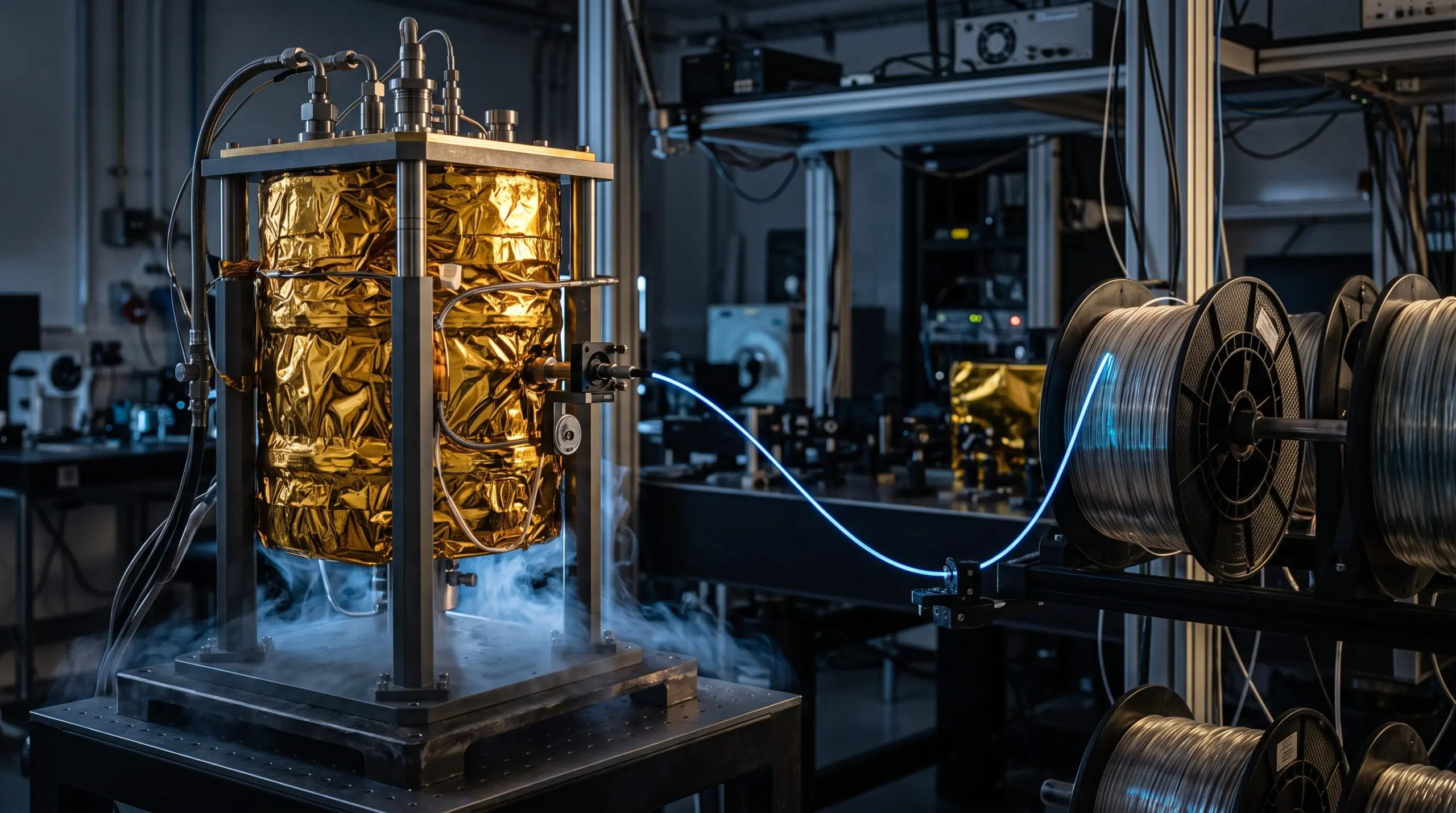
This guide follows 67 networking talks at IEEE Quantum Week 2026 in Toronto. Most of them built networks in software, and a few went out to measure what sun, wind and traffic do to real fibre.
On the afternoon of Thursday 17 September, Thomas Gerrits of NIST showed what sunshine does to quantum networks. Their team’s link runs on fibre hung from poles on the way to the University of Maryland. As the cable warmed in the sun it grew a little longer, and the timing gap between the two ends rose to 180 trillionths of a second in a field where photons must meet within tens of them. Left alone, the link lost its entanglement within hours.
A quantum network moves fragile quantum states from place to place. Most use single photons, sent down glass fibre or through the open air. The oldest use is quantum key distribution, or QKD, put forward by Charles Bennett and Gilles Brassard in 1984. Two people build a shared secret key from photons, and anyone who looks at the photons on the way leaves a trace. Fibre swallows light, losing about half of it every 15 km. A quantum state also cannot be copied and boosted the way a phone signal can, so the planned fix is the quantum repeater, which shares entanglement over short hops and joins them up.
This guide follows 67 talks on the subject from IEEE Quantum Week 2026, known as QCE26. Read together, they suggest the field’s next real step depends on taking its models out into the weather, and that faster simulators and early standards will add little until more real links test them. That is an argument about where to spend money, and plenty of people in Toronto would dispute it.
The best case against it is strong, and its builders made it well. Hardware is scarce and dear, while a simulator lets a team try out a network of hundreds of nodes that nobody could afford to build. A whole Monday workshop was given over to such tools. Angela Sara Cacciapuoti of the University of Naples Federico II put their own tool, Q2NS, at about 80 thousandths of a second for a chain of 256 nodes, where an older one took more than an hour. On that reading, software is how a young field moves fast and cheaply.
The weak spot showed when the tools were set side by side. Joaquin Chung of Argonne described two simulators that agreed on the quality of a link and disagreed on its speed, because each wrote the same protocol’s messages in its own way. Amar Abane of NIST said real physics had to go into the tool sooner than planned. Some simulated results also cut against the field’s usual advice. Anoosha Fayyaz of Pittsburgh found that cleaning up noisy pairs, a step called purification, helped in only 14.1 percent of runs once stored pairs were allowed to fade.
The field tests told a harder story. Gerrits kept their Maryland link usable about 93 percent of the time. Gerrits managed it only by fixing the link each time its quality slipped, and by sending a timing pulse down a second fibre, a shortcut Gerrits called a little like cheating. Laura D’Avossa of Naples watched timing drift for eight hours on a city loop, and Cara Alexander of Aliro said a loop in Albuquerque falls apart in high wind. Aliro’s model of that loop said 120 secure bits a second, and the real link gave 126. In orbit the weather is radiation, and Thomas Jennewein of Waterloo said detectors flown outside the space station took damage that still does not match the models.
Yet the pressure that decides the field may come from the market. At Monday’s panel on selling these networks, Farzam Toudeh-Fallah of Ciena put the reach of commercial key distribution at about 100 km, a short hop for a firm whose normal fibre runs for thousands. Mary Burkey passed on a US government view that post-quantum codes are cheaper for now. Standards bodies, meanwhile, are already drafting rules for entanglement networks that barely exist. A field whose key numbers still come from a few cables needs more cables, and more days of weather on them, before it needs more rules.
What it is. Quantum networks move quantum states between places, mostly as single photons in fibre. Their first use is quantum key distribution, which builds shared keys that reveal any eavesdropper.
What QCE26 showed. Most of the 67 talks modelled networks in simulators or emulators. A few field tests around Washington DC, Naples and Albuquerque measured what weather and traffic do to real fibre, and Berkeley ran a trapped-ion link over installed fibre.
The best field result. NIST kept entanglement usable on about 60 km of fibre hung from poles for about 93 percent of the time. It did so by fixing the link each time its quality slipped, and with a timing shortcut Gerrits called a little like cheating.
The warning. Two simulators can agree on a link’s quality and disagree on its speed. The speed claims for new simulators were measured by the tools’ own builders.
Quantum networks on real fibre
Seven talks dealt with real fibre and the kit that runs on it. One of them, from Fraunhofer, worked in a simulator built from a real key system’s numbers.
Berkeley sends a photon across town from a trapped ion
Two members of the QUANT-NET team from Lawrence Berkeley National Laboratory and UC Berkeley presented the project, a five-year effort shared with Caltech and Innsbruck. The programme lists ten authors, from You-Wei Cheah to Inder Monga. The team argued that lab work still runs on one-off scripts. A link that has to work again tomorrow needs control code that can be reused, so in QUANT-NET a central server plans the network and each node runs open-source control software.
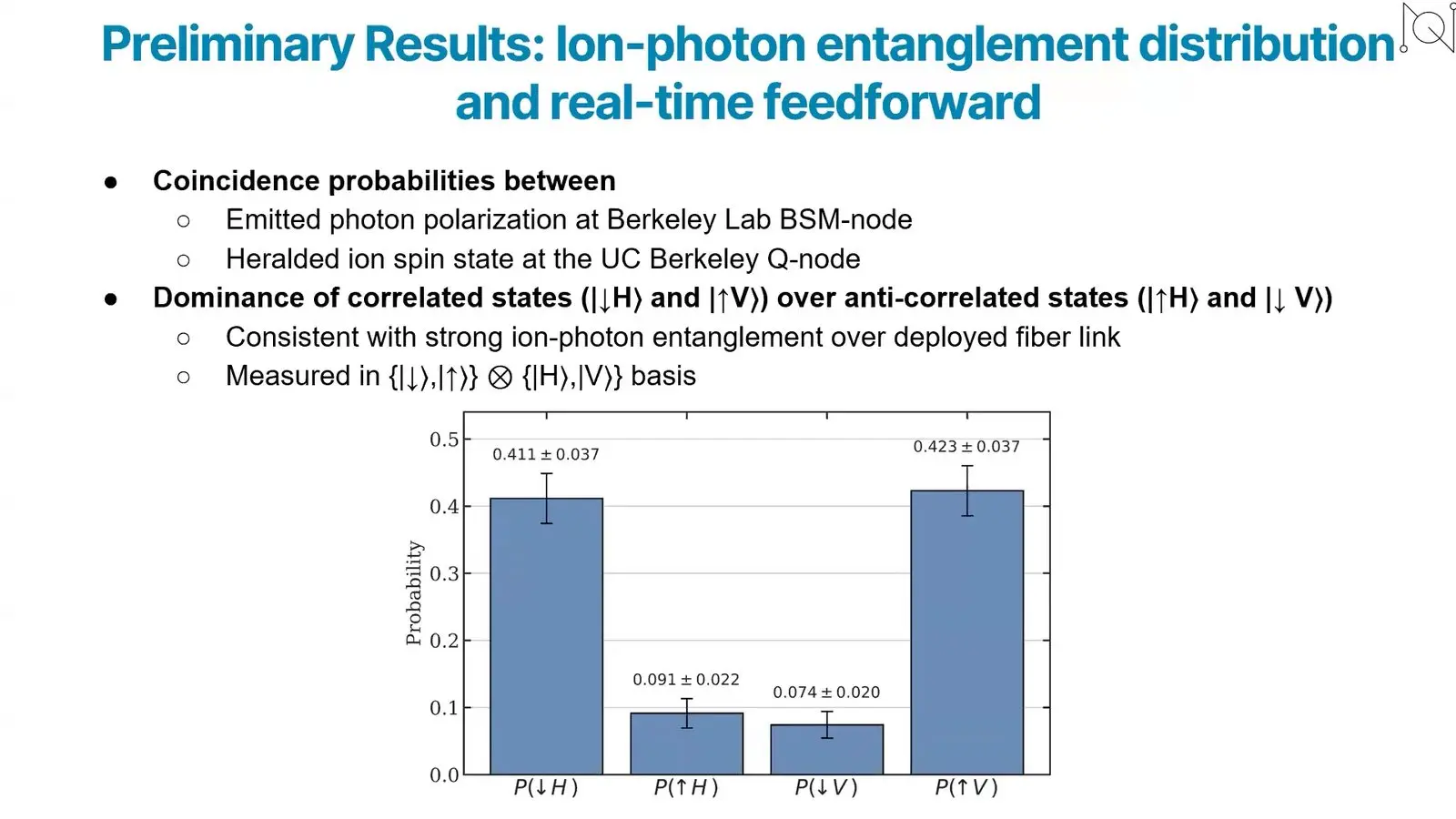
A calcium ion at UC Berkeley gives off a photon that travels down fibre already in the ground to a node at Berkeley Lab. That node reads it and sends back a signal. Matched results came out near 0.41 and 0.42 and crossed ones below 0.1, which the team called an early result. A second speaker said the run checks the link between ion and photon only, and that the two nodes do not yet share one clock.
Naples tracks eight hours of drift on a city loop
Laura D’Avossa of the University of Naples Federico II gave this paper with Angela Sara Cacciapuoti and Marcello Caleffi. It won a best-paper award in the QNET track. Joining two networks needs photons from two sources to arrive in step. On a campus test bed D’Avossa sent light round a 7 km loop of fibre that has lain in the ground for about ten years and shares its sleeve with the university’s own data.
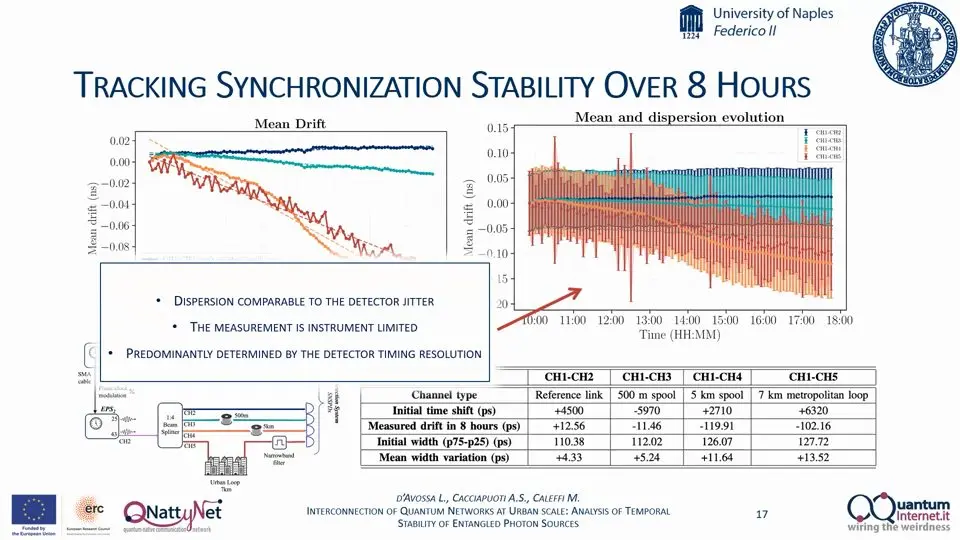
Even with no quantum signal, that loop counted more than 10,000 stray clicks a second. One spike came from campus internet traffic. Over eight hours the timing drifted by about 100 trillionths of a second at most. D’Avossa called it a first step, since both sources stood in one room and the clock they shared never had to cross the 3 km between the two campuses.
Washington DC links six government labs
Sergey Polyakov of NIST chaired the hands-on part of NIST’s network workshop on Thursday. Polyakov began with DC-QNet. It joins six US government labs, NASA and the Naval Research Laboratory among them, in a star around the University of Maryland. The links run over about 60 km of fibre, and each lab brings kit such as atomic clocks, photon counters or quantum memories.
Government bodies make good early buyers, Polyakov said. They can carry extra risk. Polyakov counted the loophole-free Bell tests of 2015 as the first use of a quantum network, since they needed two far-apart labs to share entangled light. NIST is building a network controller, and kit that can check a path quickly. Shared fibre of 10 km is probably fine. A link that also carries normal data should stay under 100 km.
NIST keeps entanglement alive on fibre hung from poles
Thomas Gerrits of NIST said quantum links need a billion times less noise than normal ones. Timing is just as hard. Ten trillionths of a second is about 2 mm of fibre, so in the lab their team used a timing system called White Rabbit, which held two nodes within 5 trillionths of a second for a day. On the fibre to Maryland, which hangs in the open like about a quarter of US fibre in their account, the gap reached 180 as the cable warmed.

Polarisation, the direction in which the light shakes, also drifts fast on that cable by day. Kit from Qunnect fixed the channel each time quality dropped below 98 percent. With that help the Bell test score, a check that only real entanglement can pass by going above 2, averaged 2.41, and the link was usable about 93 percent of the time. Without it the score fell below 2 within hours. Gerrits said most loss sits in the last mile. The link also sends a laser pulse down a second fibre so that the two nodes need no true shared clock, which Gerrits called a little like cheating.
Sharing fibre with ordinary traffic
Ivan Burenkov of NIST said one normal data channel, arriving at about a millionth of a watt, limits a quantum link in the same fibre to about 100 km. Cut that power ten million to a hundred million times and the reach only triples. Their group’s receiver works at about one photon per bit, and the same reading keeps the link steady.
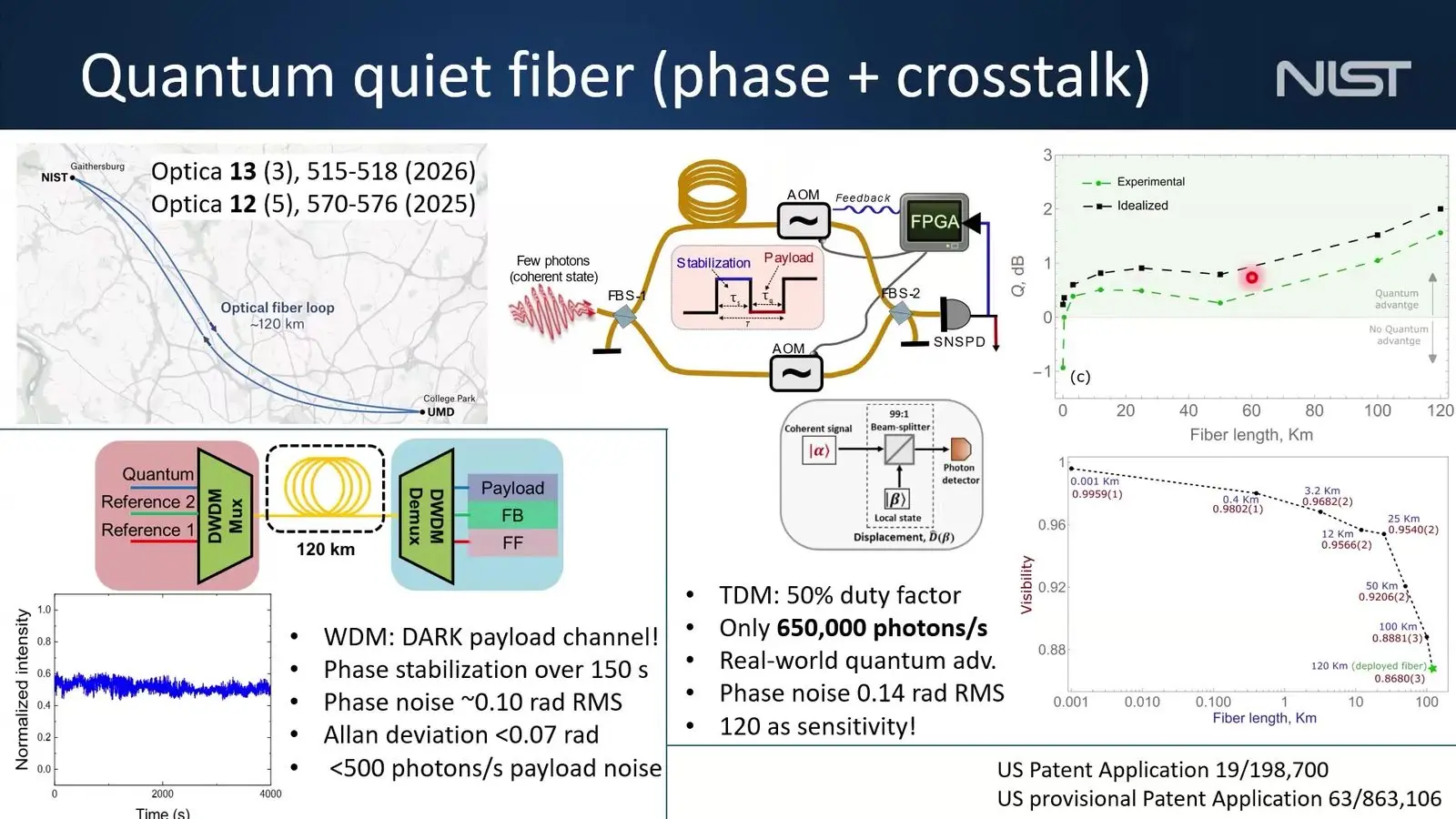
One scheme spends half its time on that steadying. It showed a quantum gain over the 120 km loop between NIST and Maryland. Another keeps the quantum channel dark and steadies it with guide channels on either side, which Burenkov said adds under 500 stray photons a second, though Burenkov warned that such strays spoil the joining step that long links rely on.
Aliro’s model meets the field in Albuquerque
Cara Alexander, vice president of product at Aliro Technologies, laid out a loop of simulate, copy, test and deploy. Aliro’s software runs a key scheme built on entangled pairs. A recorded stream of light events can be played into real nodes as if the detectors were there. On a 50 km loop in Albuquerque, partly hung from poles, between Qunnect kit and Sandia National Laboratories, the model said 120 secure bits a second. The link gave 126.
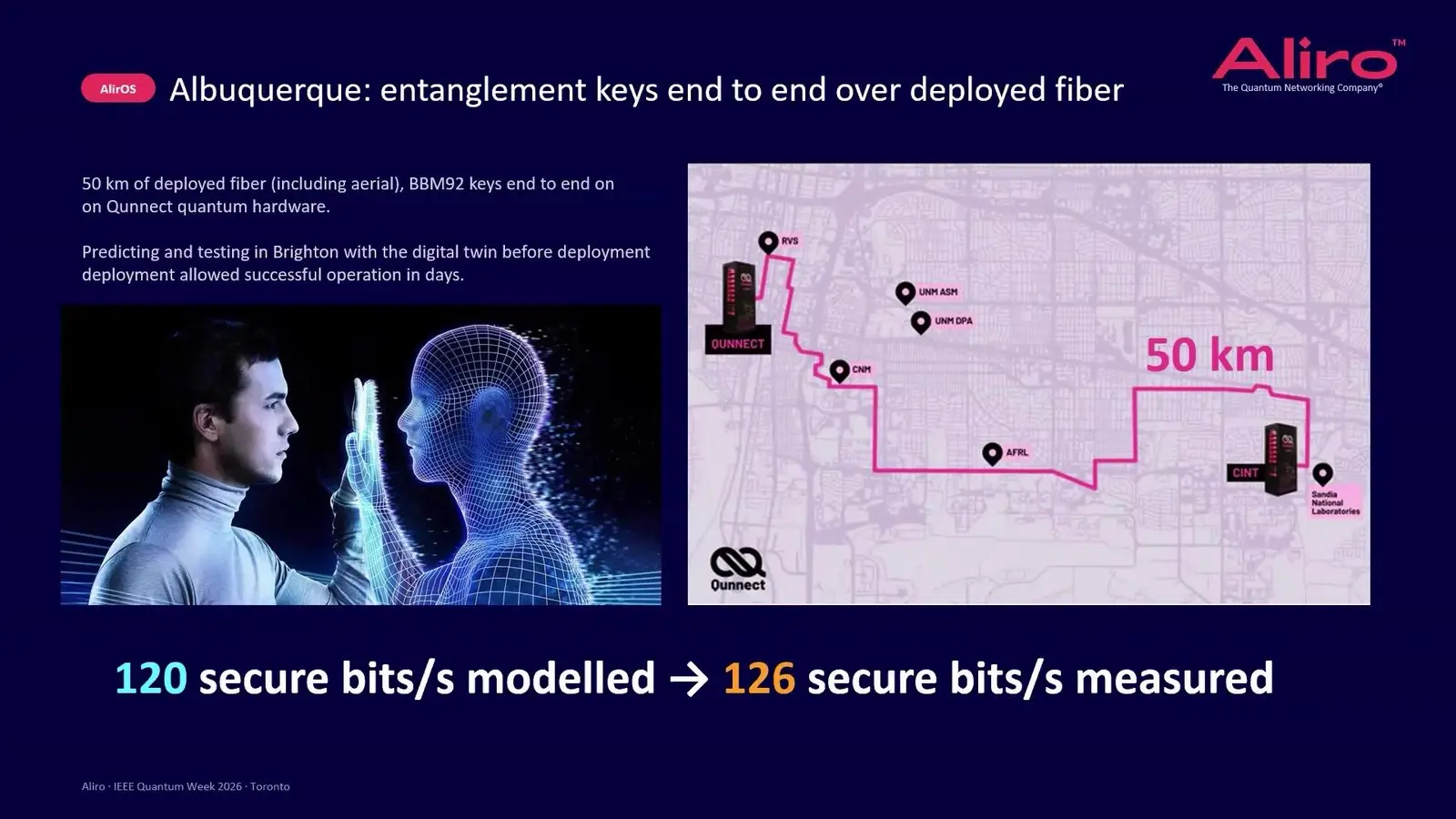
The same fibre falls apart in high wind, Alexander said. On still days it reaches 175 bits a second. Alexander also announced Obsignia, a unit that fits in a standard rack and feeds fresh keys to the encryption boxes a network already uses, and Alexander asked the field for shared file formats.
Fraunhofer ranks ways to undo fibre twist
Fabian Klingmann of the Fraunhofer Institute for Photonic Microsystems presented with eight co-authors, from Joscha Hanel to Fei Ding. Fibre twists the light that carries each key bit. Klingmann said tuning the fix had changed their institute’s first key system more than the group expected, and with no fair comparison to hand Klingmann built a simulator of fibre twist, drift and detector noise to rank the options.
Klingmann tried plain search methods, a program that learns by trial and reward, and a method that works out the fibre from nine readings. Each reads errors from bits thrown away anyway. High drift suits the learner. The ranking has not yet been checked on the real system whose numbers fed the simulator.
When to purify, distil and swap
A quantum repeater shares entanglement over short hops, stores it and joins the hops by a step called swapping. Purification, also called distillation, spends two noisy pairs to make one better pair. Four talks asked when that trade pays. Three more weighed codes that shrink when pairs arrive late, one key shared among four users, and how two kinds of repeater compare. Three more tuned memory, waiting and codes.
Caltech says distil as late as you can afford
Siddharth Chander, an undergraduate at Caltech, gave this paper with Xinan Chen of the University of Illinois and Allen Zang of the University of Chicago. A node can hold a pair only so long. The model has pairs of quality 0.9 that arrive at random and fade while they wait, and each plan is scored by quality times the chance of success, set to zero below about 0.811.
On one hop with short storage, throwing away the older pair won. With long storage, cleaning up at the deadline led. Across two hops every plan scored zero at short and middling storage times, because the swap itself pushed quality under the line, so their advice was to distil as late as you can afford. Their model assumes every swap works.
Würzburg finds a direct link should never distil
Marcel Kokorsch, a doctoral student at the University of Würzburg, presented with Guido Dietl. A fixed floor on quality is the wrong goal for key networks, Kokorsch argued, because it can rule out perfect pairs that happen to arrive a little more slowly than the rest. Their own score multiplies the rate left after cleaning by the secret bits each pair can give.
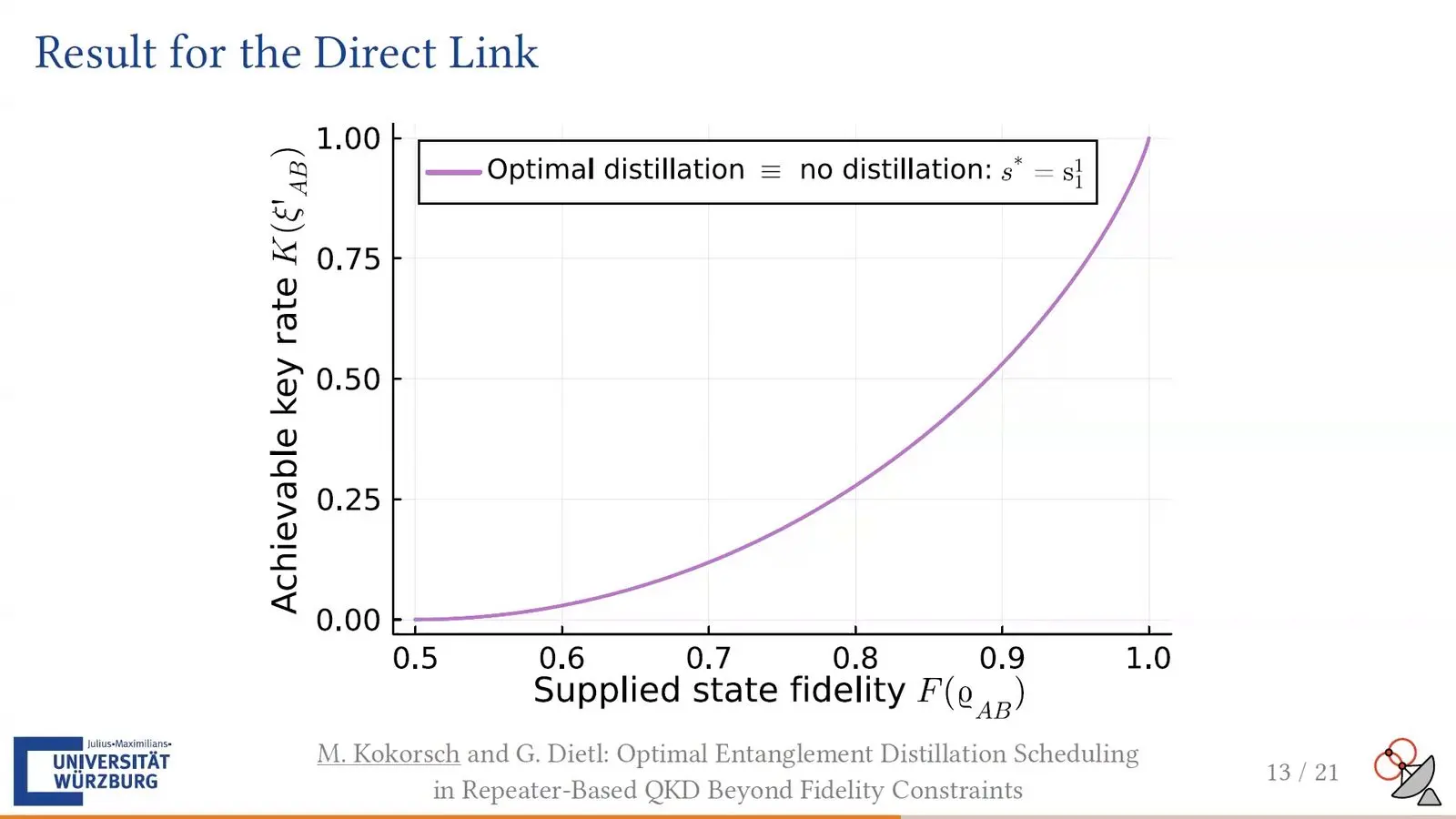
On a direct link the best plan never cleaned up at all. Two pairs become one, and a success chance below one never pays back the lost rate. With one repeater, any cleaning came before the swap. At 63 repeaters the picture broke into many bands, since each swap adds noise, and the result holds only for one simple kind of noise.
Pittsburgh finds cleaning rarely helps once pairs fade
Anoosha Fayyaz, a doctoral student at the University of Pittsburgh, gave this paper with Prashant Krishnamurthy, Kaushik Seshadreesan, David Tipper and Amy Babay. Old schemes assume both pairs are just as good. In practice they differ. In a real repeater the first pair has faded by the time the second one comes, so Fayyaz counted a gain only when the result beat the better of the two.
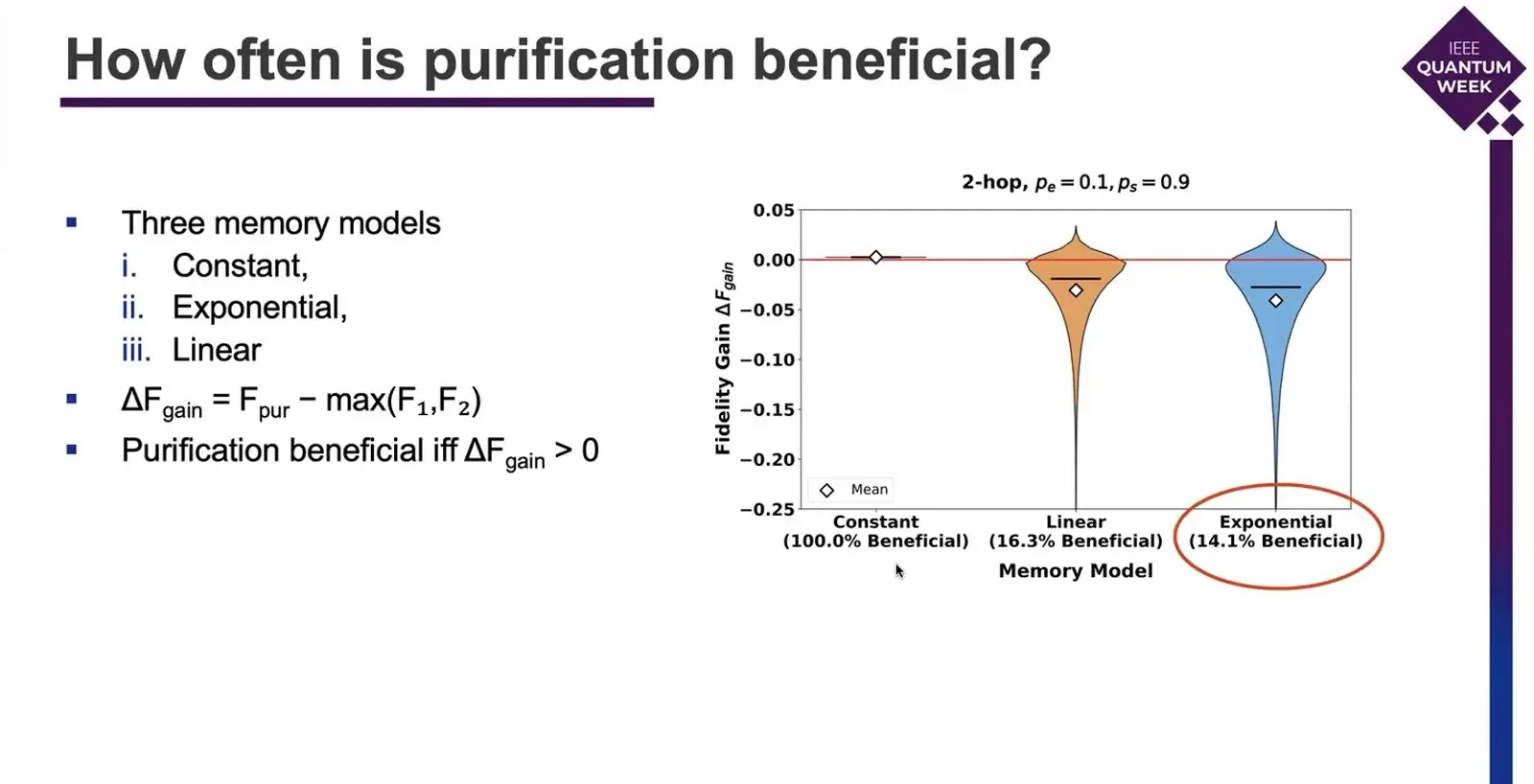
With perfect storage, cleaning gained every time. With storage that fades over time it gained in only 14 to 16 percent of runs. Their plan cleans only within a narrow band and drops pairs that cannot succeed, which Fayyaz said delivered faster than the other plans Fayyaz tried. Fayyaz noted that a lab cannot read each pair’s quality directly.
Pittsburgh keeps quality flat in a quantum data centre
Kaushik Seshadreesan, an assistant professor at the University of Pittsburgh, presented a second paper from the same group, with their PhD student Mohadeseh Azari listed first. Seshadreesan pictures a rack of quantum chips that act as one machine. Each hop makes a link worse. So their rule asks that a pair cleaned up across several hops be as good as a pair on a direct link.
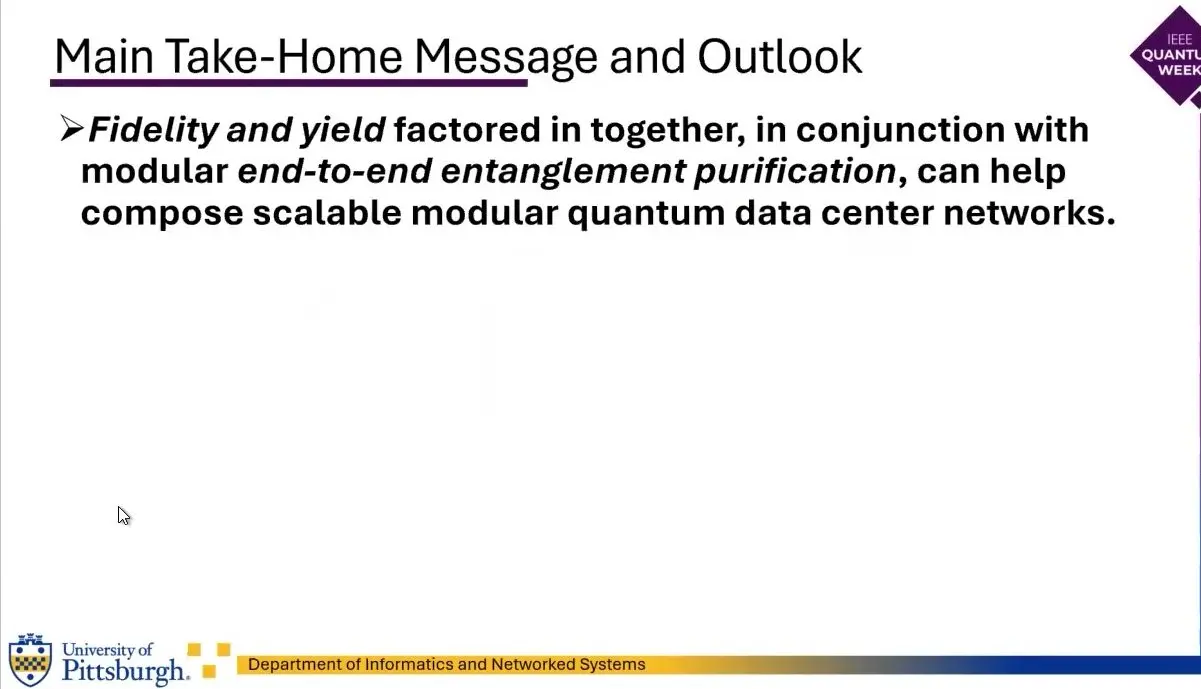
Seshadreesan wired the chips in a layout borrowed from data centres. A bigger module then asks less of the raw pairs, and giving one module to one job beat sharing links between jobs, at least in a model that assumes every swap works and nothing fades in store. The US Department of Energy paid for the work.
Aalborg trims a code when time runs short
Mahmoud Saad Abouamer, a postdoc at Aalborg University, presented with Jakob Kaltoft Søndergaard and Petar Popovski. Spreading one qubit across several entangled pairs fixes more errors. It also means a longer wait while the pairs age in store, and past some point the wait does more harm than the code does good.
Their answer is one code that can shrink, from 17 qubits to 13 and then to 8. With even noise, coding helped when time was short and a bare qubit won when time was loose, while noise that mostly flips the phase favoured the 13-qubit version over the full 17. A node, Abouamer said, should step down to a shorter code when it cannot afford to wait.
Berlin shares one key among four users
Janka Memmen of Technische Universität Berlin presented ReQuSim, a free Python tool for repeaters written by co-author Julius Wallnöfer. Their case is a hub in the middle that takes pairs from four users and merges them into one state that all four share, so that they can build a common key at once. This is called conference key agreement.
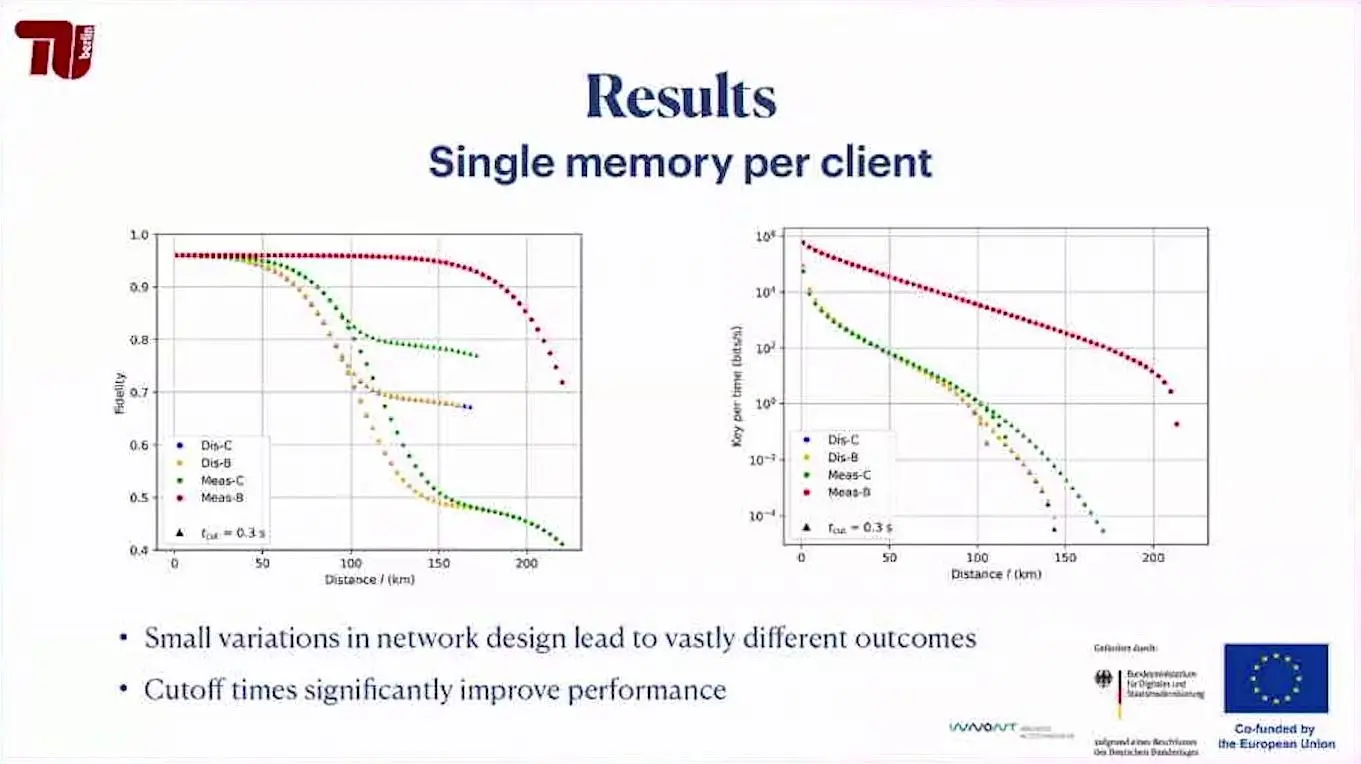
Each user had one store that held a state for about a second. When users measured at once with their own sources, quality stayed near 0.95 out to about 150 km, and key still flowed past 200 km while the other set-ups failed sooner. Memmen said that best case is the hardest to build. Five stores per user did better than five separate runs.
Two repeater families in a classroom simulator
Charu Jain of the Energy Sciences Network and Chuen Hei Chan, a PhD student at Virginia Tech, ran the Friday afternoon tutorial. Jain modelled repeaters built on trapped ions in a layer Jain called QNpack, and found quality fell with each repeater Jain added. Eight repeaters was the most the tool could hold.

Chan modelled repeaters made only of light, in which a tiny emitter throws out a web of linked photons whose spare branches stand in for retries. With no loss, more branches raised the rate. With real fibre loss it fell from several thousand a second to under 1,000. Jain said ten-shot classroom runs were too thin for firm claims.
Hannover moves memories to the side that is short
Karim Elsayed of Leibniz University Hannover gave this paper with Amr Rizk. A repeater builds a pair with the node on each side and then joins the two by a swap. Each try works only by chance. So one side often holds spare pairs that fade while they wait for partners, and the gap grows when one link is much longer than the other.
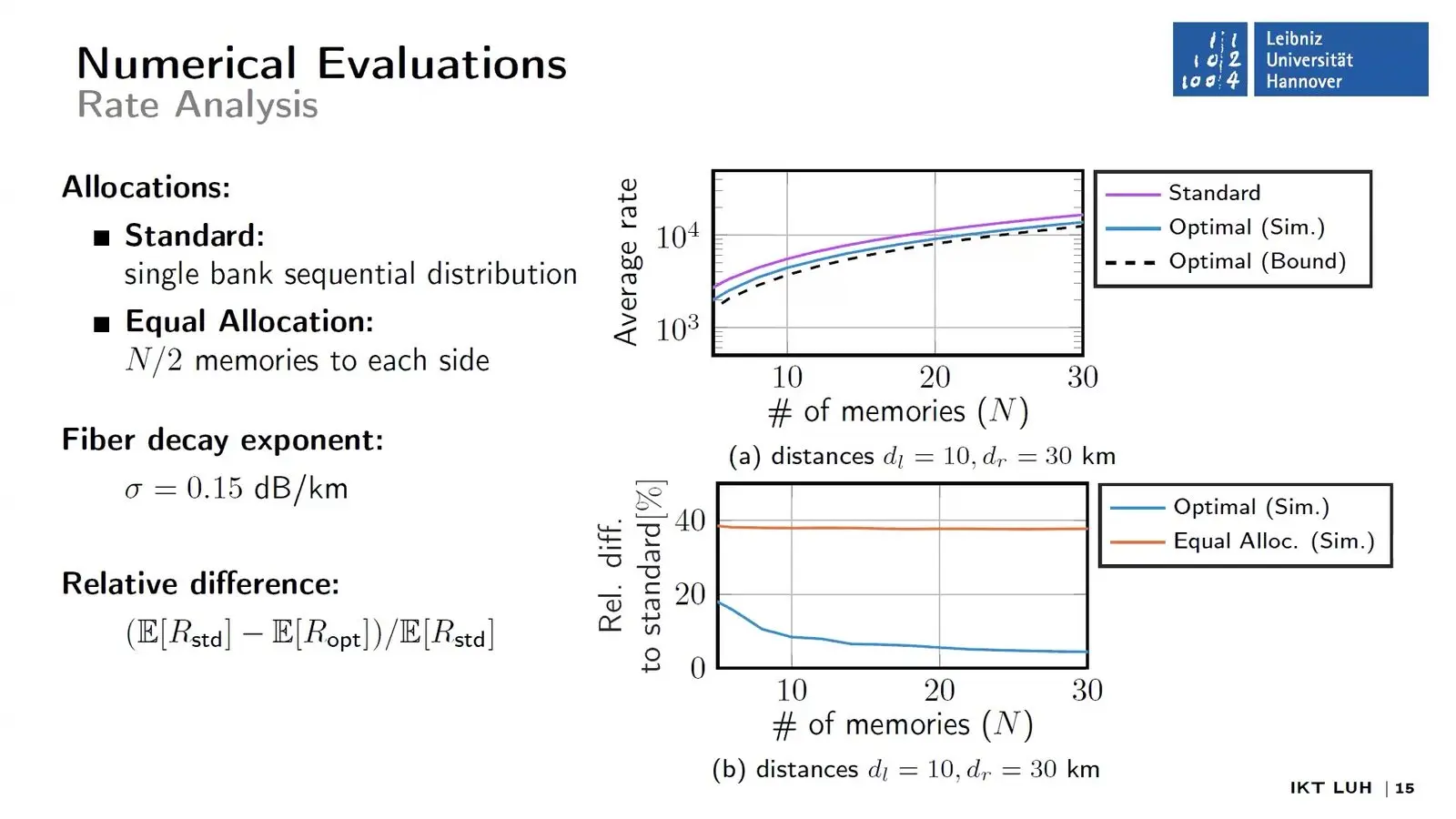
Elsayed’s rule hands the memories out again every round. It balances the new pairs expected on each side and tops up the side that is short. With links of 10 and 30 km, an even split lost about 40 percent of the rate, while the best rule lost under 20 percent, and less still as memories were added. Quality was much higher too. The rule works one node at a time along a chain, Elsayed said, with no proof that it is best for the chain as a whole.
NIST caps how long a pair may wait
Abdella Battou of NIST presented work with Van Sy Mai, Abderrahim Amlou, Richard La and Cory Nunn. A pair that waits longer for a partner is less likely to be thrown away. It is also older and worse. Their model gives each link its own noise, lets stored pairs fade, allows for imperfect swaps and slow messages, and turns a target for end-to-end quality into a limit on how long each link may hold its pair.
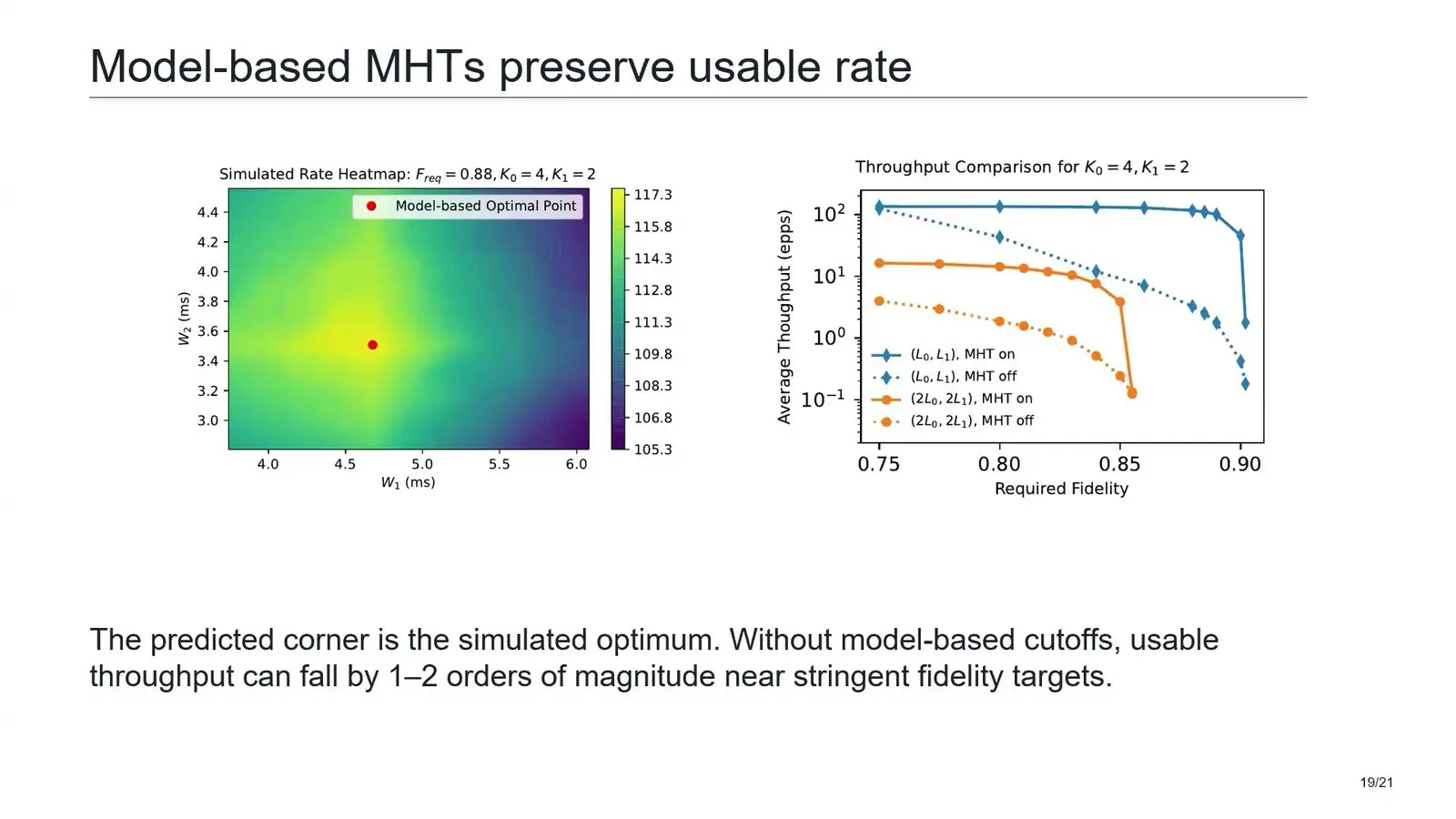
The team proved that the best limit for each link is the longest one the target allows. In SeQUeNCe runs these limits kept the rate near 100 pairs a second as the target rose, while holding pairs with no limit fell by one to two orders of magnitude. With six memories on links of different quality, the best split put four on one side and two on the other. How cleaning fits a limit set in time, Battou said, is the next step.
Chicago’s coded repeaters cut errors to second order in simulation
Sagar Patange of the University of Chicago, who did the work at Argonne, presented with six co-authors, from Caitao Zhan to Rajkumar Kettimuthu. Their repeater follows a 2009 plan by co-author Liang Jiang. Each link carries a pair spread over seven qubits in the Steane code, and the errors at each swap are fixed with an ordinary classical code.
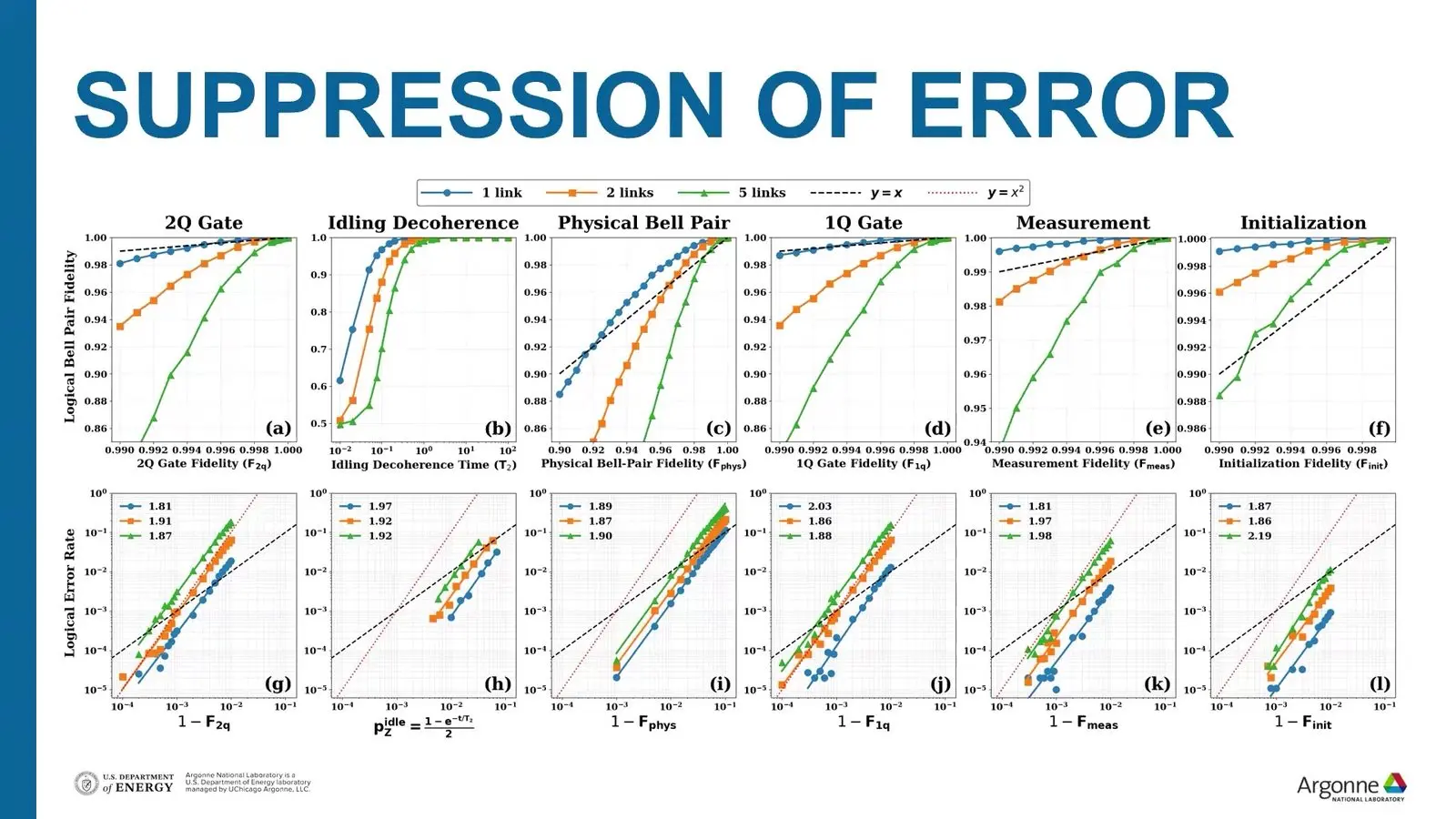
Thousands of qubits will not fit in a full quantum description. So Patange moved SeQUeNCe onto Stim, a fast tool that handles only the simplest kind of noise, and mapped each real error onto that kind. Across six sources of noise, the error left after coding fell with the square of the raw error, with fitted slopes of about 1.8 to 2.2. More links cut the wait. They also lowered quality, and on a single link quality began to fall beyond about 120 km. Patange said that spreading a computer across a network would probably need full error correction.
Simulators and emulators run ahead of the hardware
Hardware is scarce, so most of this field’s work happens in software. Fourteen talks showed simulators, which estimate how a network behaves, and emulators, which copy its data in real time so that real controllers can drive them.
Quantum Savory gets a browser front end
Leonardo Bacciottini of UMass Amherst launched Quantum Savory Studio live on the Monday, a point-and-click face on Quantum Savory, a simulator written in the Julia language. The claim was that it runs up to a hundred times faster than Python and is just as easy to write. The live demonstration then built a link. On a map of Massachusetts, nodes in Amherst and Cambridge were joined and the link’s quality plotted.
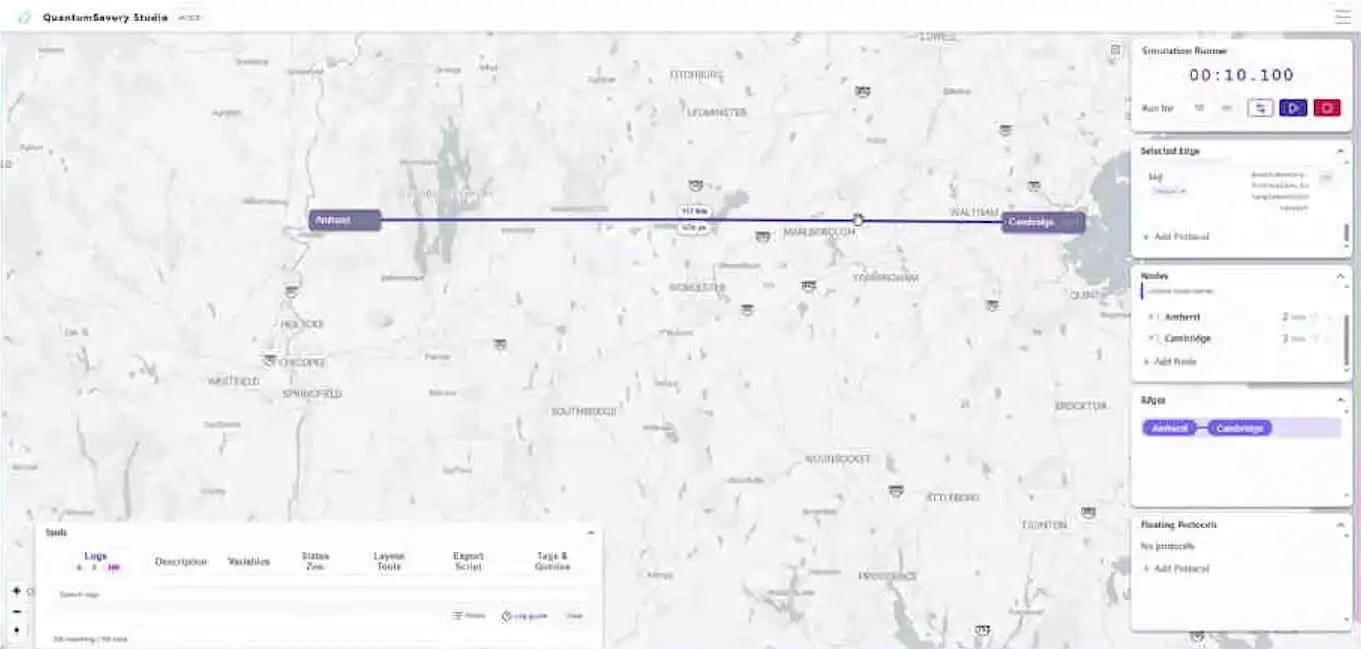
Rodney Van Meter of Keio University asked how anyone would build a big network without dragging nodes by hand. Bacciottini pointed to the code version, or to a server that lets an AI agent draw the network from a file. Van Meter called that terrifying.
SeQUeNCe reaches version 1.2
Joaquin Chung and Robert Hayek of Argonne National Laboratory presented SeQUeNCe. It steps from one event to the next and models links down to single photons. Chung said it won an R&D 100 award this year, and Hayek listed what is new, including a standard cleaning step, delays that follow link length and a faster way to handle simple states.
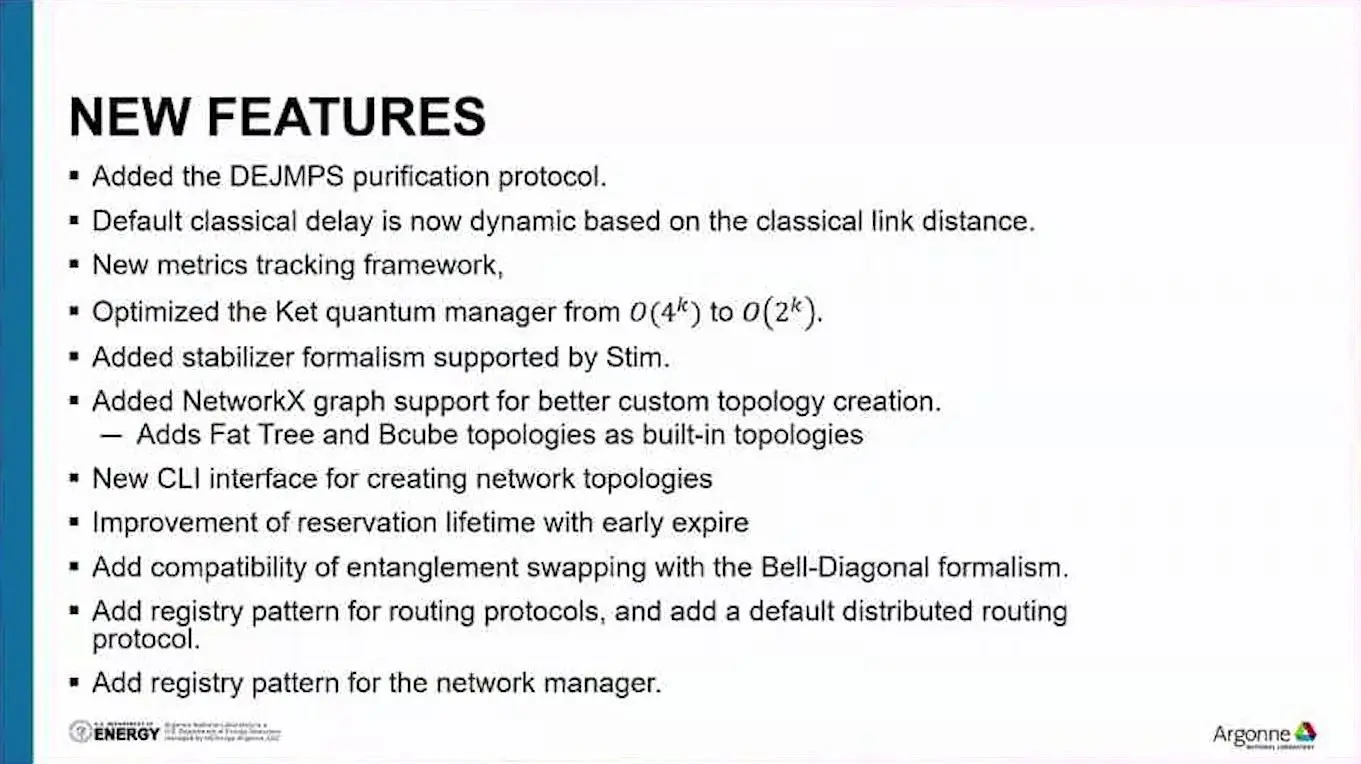
Data-centre layouts are now built in. Two nodes can stop making pairs early once they reach a target, and users can plug in their own routing, with OSPF, a standard internet routing method, now on offer.
Argonne’s tutorial shows a weak detector costs most of the pairs
Joaquin Chung of Argonne opened the two-part Sunday tutorial on SeQUeNCe with Alexander Kolar of the University of Chicago and Argonne, Robert Hayek and Caitao Zhan. Version 1.2 had come out the day before. Experiments are still small, Chung said, and a model can ask what a better detector or memory would buy.
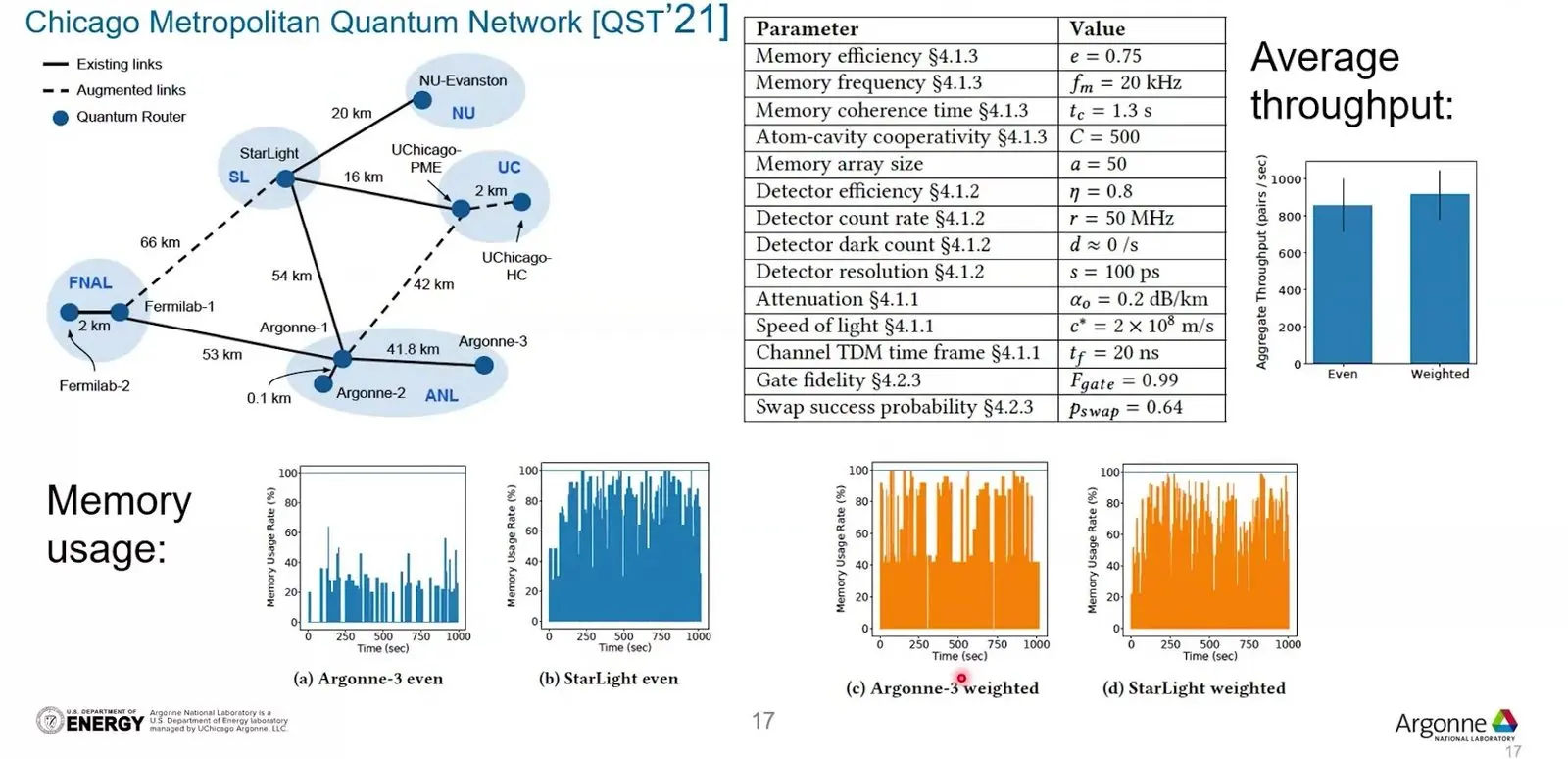
Kolar ran the first notebook. Two routers about 5 km apart delivered 105 pairs at 70.8 a second. On a star of five nodes, cutting the detector’s efficiency from 0.9 to 0.5 left just 3 pairs, while a faster memory barely moved the count, which Kolar put down to the classical messages setting the pace. Chung added that a tree that mixed two kinds of qubit showed no gain with today’s kit.
In the afternoon the room turned to teleportation. Zhan said that a better memory halves the wait. Raising its efficiency from 0.5 to 1 cut the mean teleport time from 20.5 to 10.8 thousandths of a second, since the step keeps failing until both memories catch the photon. Hayek then showed a new registry that picks protocols by name inside one run, and two routers 1 km apart using the Barrett-Kok protocol made 424 pairs a second.
MQNS trades photons for speed
Amar Abane of NIST built MQNS to compare whole network designs fast. A small change to a schedule should not take hours to test. So the tool swaps photon-by-photon detail for one event per attempt at a link, and on networks of up to 512 nodes SeQUeNCe climbed to about 6,000 seconds while MQNS stayed at a few hundred.
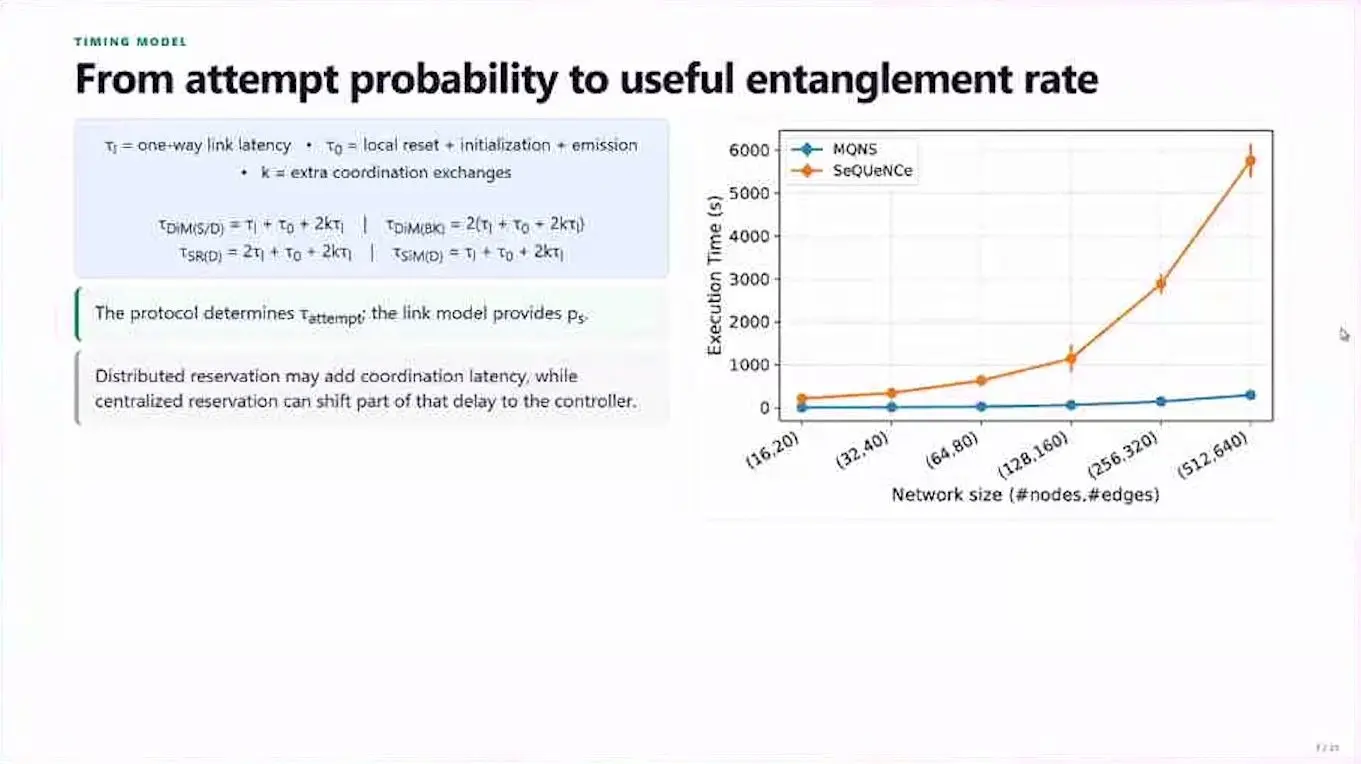
Abane said that shows the gain from leaving detail out. It does not rank quality. Their lessons were about bookkeeping, and the first was that a node must never learn what happened somewhere else before the message telling it so has had time to arrive.
Q2NS builds on a classical simulator
Angela Sara Cacciapuoti of the University of Naples Federico II presented Q2NS, out since March. The hard part, Cacciapuoti argued, is how quantum and normal traffic mix. So Q2NS is built on top of ns-3, a simulator of normal networks that has been in use for years, and it runs both kinds of event on one shared clock.
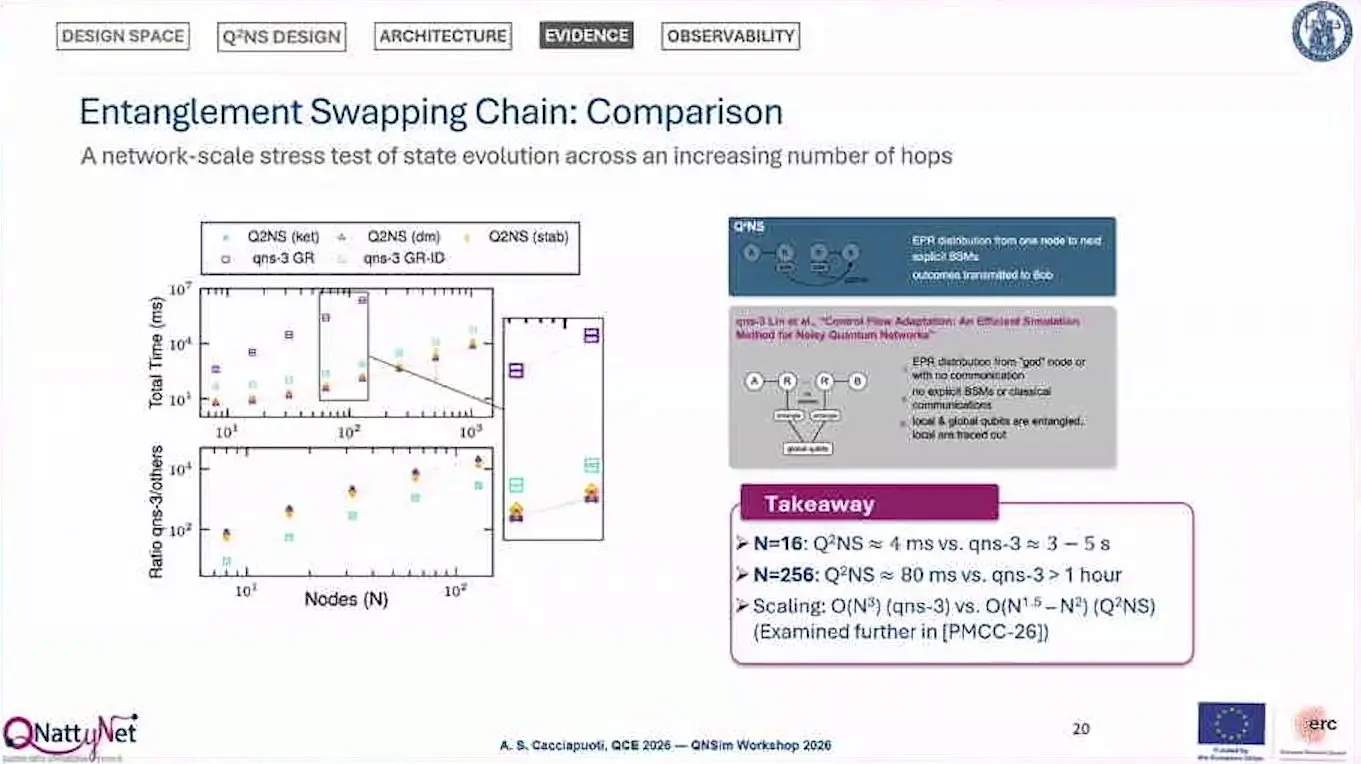
On a chain of 256 nodes Cacciapuoti put Q2NS at about 80 thousandths of a second. An older tool took more than an hour. A test with internet traffic added showed links losing quality faster with distance, and as with the other speed claims that morning, the faster tool’s own builders ran the comparison.
NIST adds fibre physics to SeQUeNCe
Abane also gave a Sunday paper on work Abane said their students had done, with co-authors from NIST and Université Grenoble Alpes. Simulators often boil a link down to a few numbers. Abane argued that heat, twist and bending change how a fibre turns the light, and that normal traffic in the same glass adds stray photons.
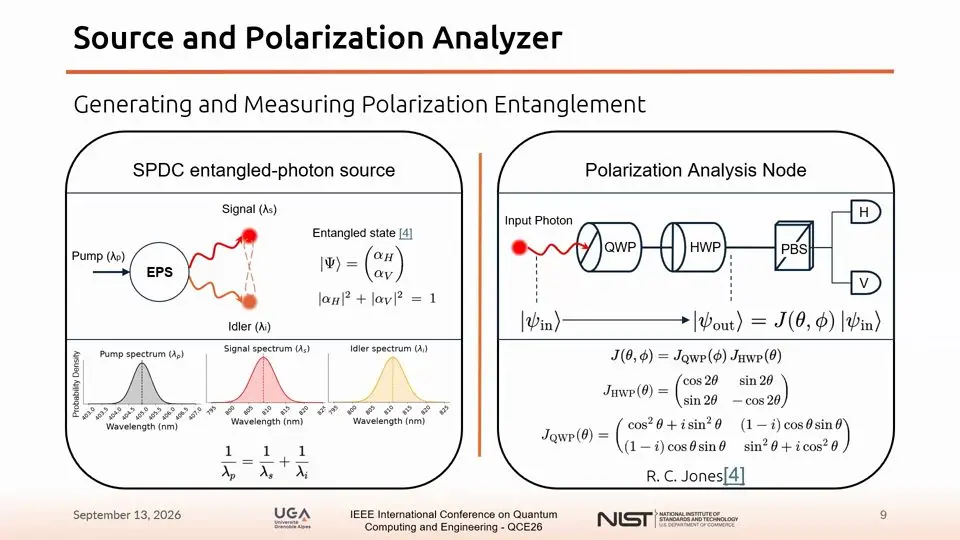
The team added a pair source, a fibre model built from short pieces and a light analyser to SeQUeNCe. They checked each part on its own. The joining step needed in the middle of long links is not yet checked, and Abane showed no network result that changed when the new parts were switched on.
Argonne learns which neighbours to favour
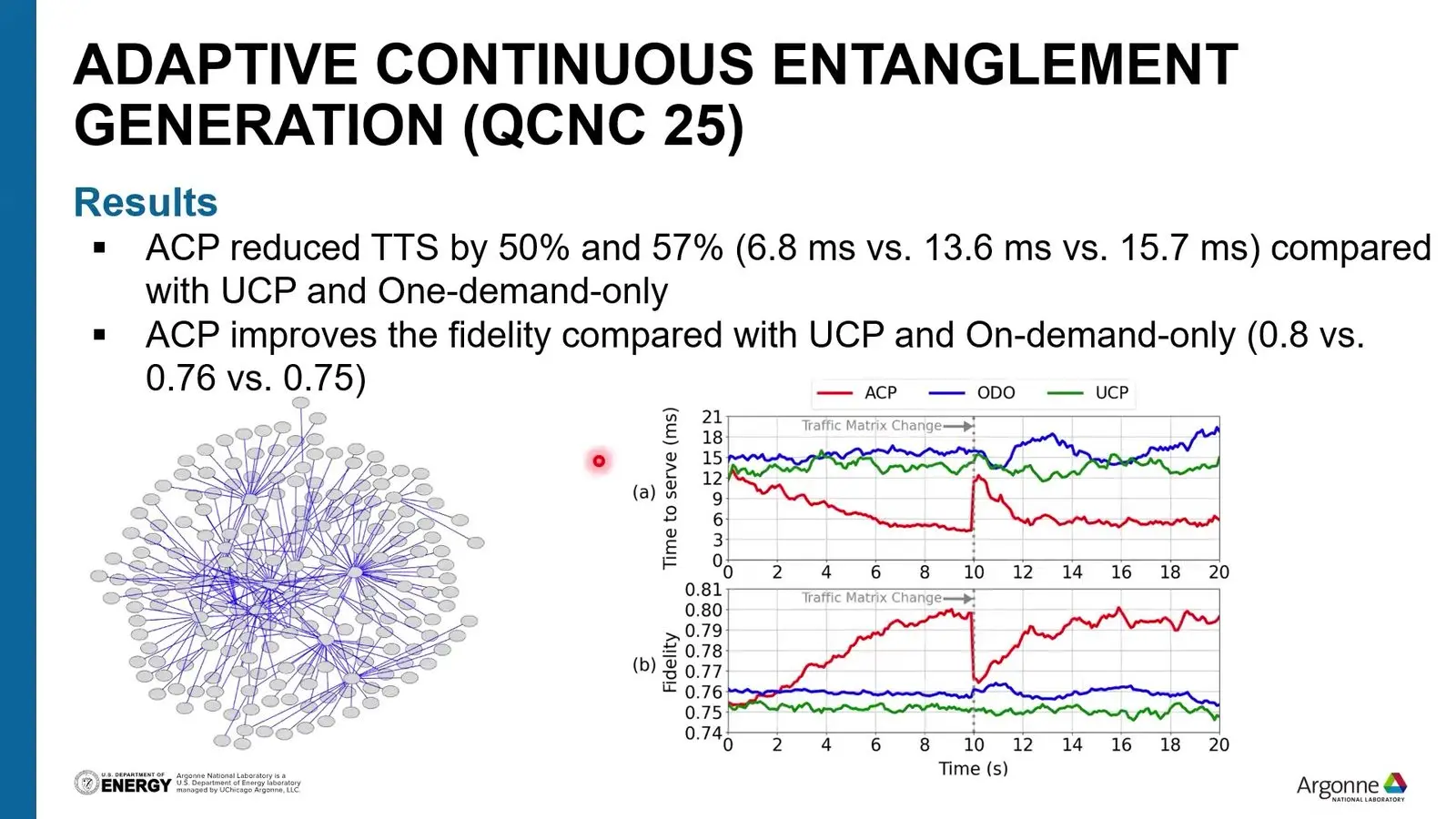
Chung came back on Thursday with three new studies. In one, nodes made pairs in the background before requests arrived and learned which neighbours to favour. On a 200-node network that cut the wait for a request to 6.8 thousandths of a second, about half what plain background making took.
A second study modelled a link between a superconducting qubit and an ytterbium atom. Adding noise in the parts that change the photons’ colour made the link look faster, and Chung explained that stray photons were being counted as if they were real successes. Chung asked everyone who uses a simulator to publish the code.
Delft proposes one score for a whole network
Samuel Oslovich of TU Delft and QuTech presented with Stephanie Wehner and Claudio Cicconetti of the National Research Council in Pisa. Oslovich wants one score for a whole network, run as a sealed box. A program goes in. Out come a success rate and a run time, two numbers that Oslovich said tests of single links never reach.
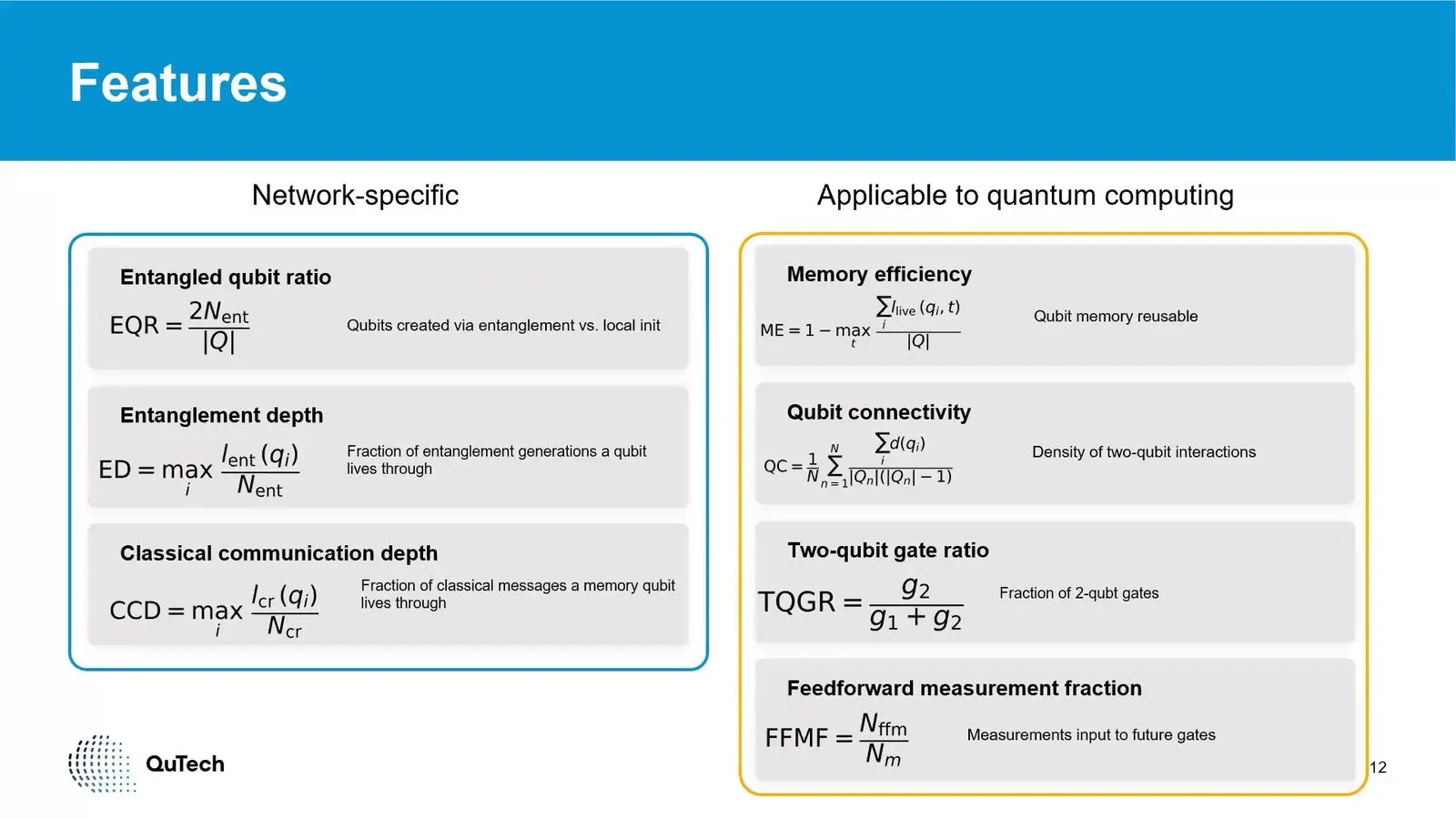
In simulation on two nodes, the setting that made pairs about ten times faster won the overall score, while the cleaner setting still won on quality. Oslovich said the results come from simulation only. Asked by Van Meter whether a simulated program could move to real hardware, Oslovich said it would have to be rewritten.
A tutorial on what simulation costs
Michal van Hooft, a simulation engineer at QuTech, taught NetSquid from a live notebook in the Friday morning tutorial. Ezra Kissel of the Energy Sciences Network opened it. NetSquid jumps from one event to the next, so empty time costs nothing, and the real limit, van Hooft said, is how many qubits share one entangled state, since a full description strains at 10 to 12 of them.
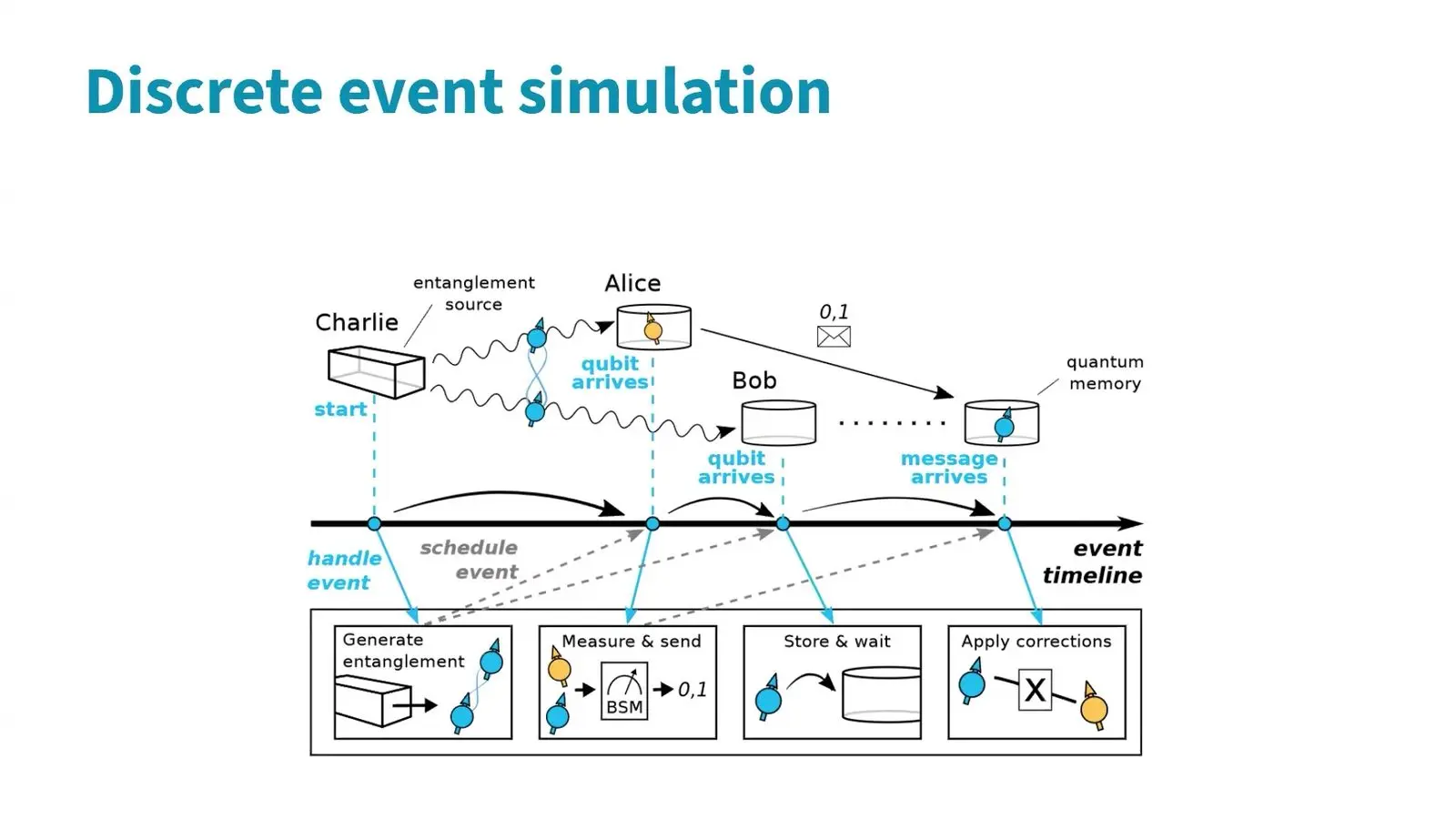
Van Hooft built the session from the ground up. A qubit was first stored as a density matrix, then sent down a channel with a 20 percent chance of noise. In their example a fibre of length zero still lost 20 percent of its photons, before 0.25 decibels per kilometre were added. Separate pairs, Van Hooft said, can run into the millions so long as they are never merged into one state, and about five people were in the room to work through it.
Emulating New York’s fibre in real time
Dan Kilper of Trinity College Dublin opened the talks on emulators. Their tool lets real controllers drive a copy of a network that carries about 100 colours of light across New York City, with its physics checked against a standard industry tool. Their Irish key links show rates swinging on fibre hung outdoors, which forces operators to leave wide margins.
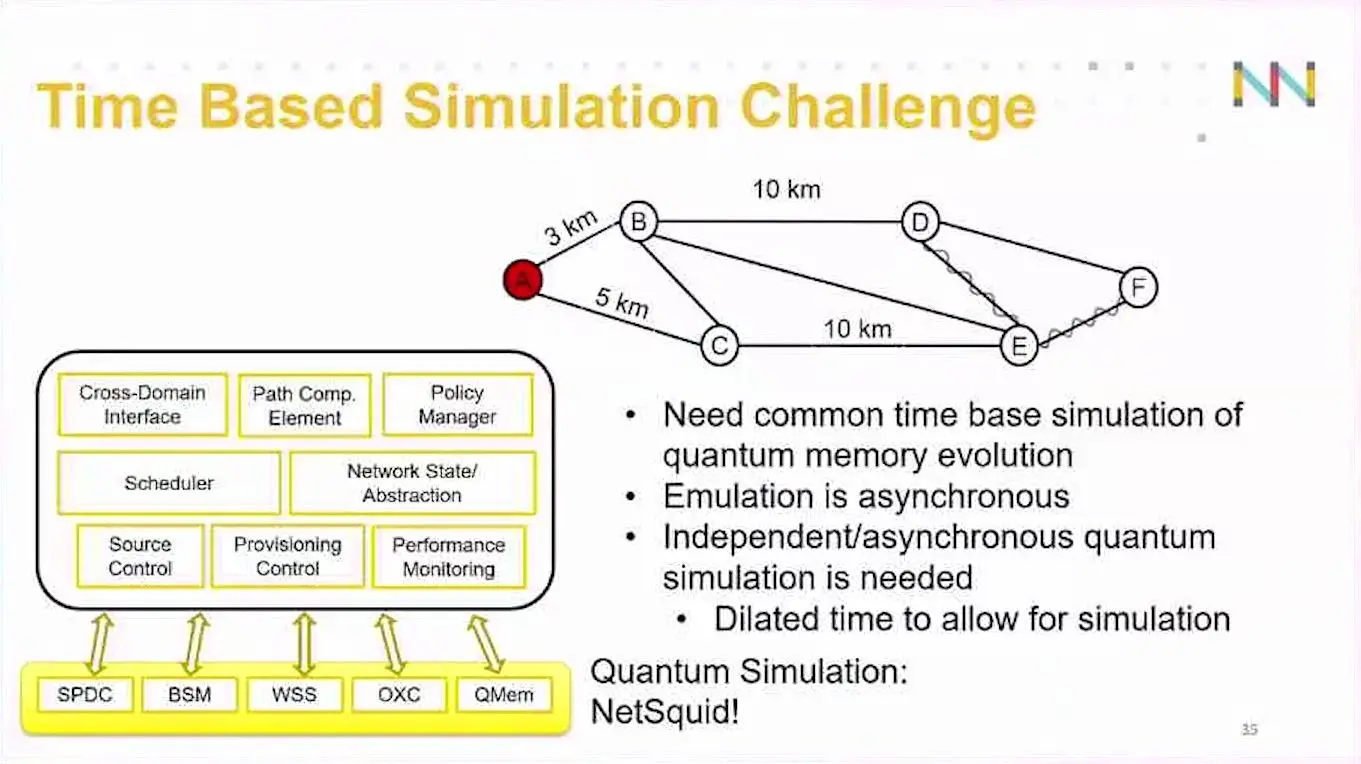
Time is where the quantum version breaks, Kilper said. Their tool assumes every device settles before its input changes, while a quantum store fades all the time and needs a shared clock. Kilper named stray light from normal traffic and from control pulses as the main threat to quantum channels in shared fibre.
Aliro emulates key data for a satellite fleet
Brian Doolittle, who leads simulation at Aliro Technologies, drew the line between the two kinds of tool. A simulator estimates what a system will do, Doolittle said, while an emulator copies its data as it happens, so real software can be tested against it as if the hardware were there. Boeing was the first customer. In one emulated satellite pass the sifted key rate peaked at 467 bits a second.

Over 12 hours it ran more than 200 sessions at once. Doolittle said the method works only for jobs such as key networks, where the quantum state stays the same over time. The work is not yet published.
Quditto copies key networks for Telefónica
Blanca Lopez of IMDEA Networks and Diego Lopez of Telefónica shared this talk. Key networks have passed 100 nodes and 12,000 km, Blanca Lopez said, yet they still do not work as a service, because the boxes are closed and devices running different protocols cannot share a key. Quditto puts node software on laptops or virtual machines.
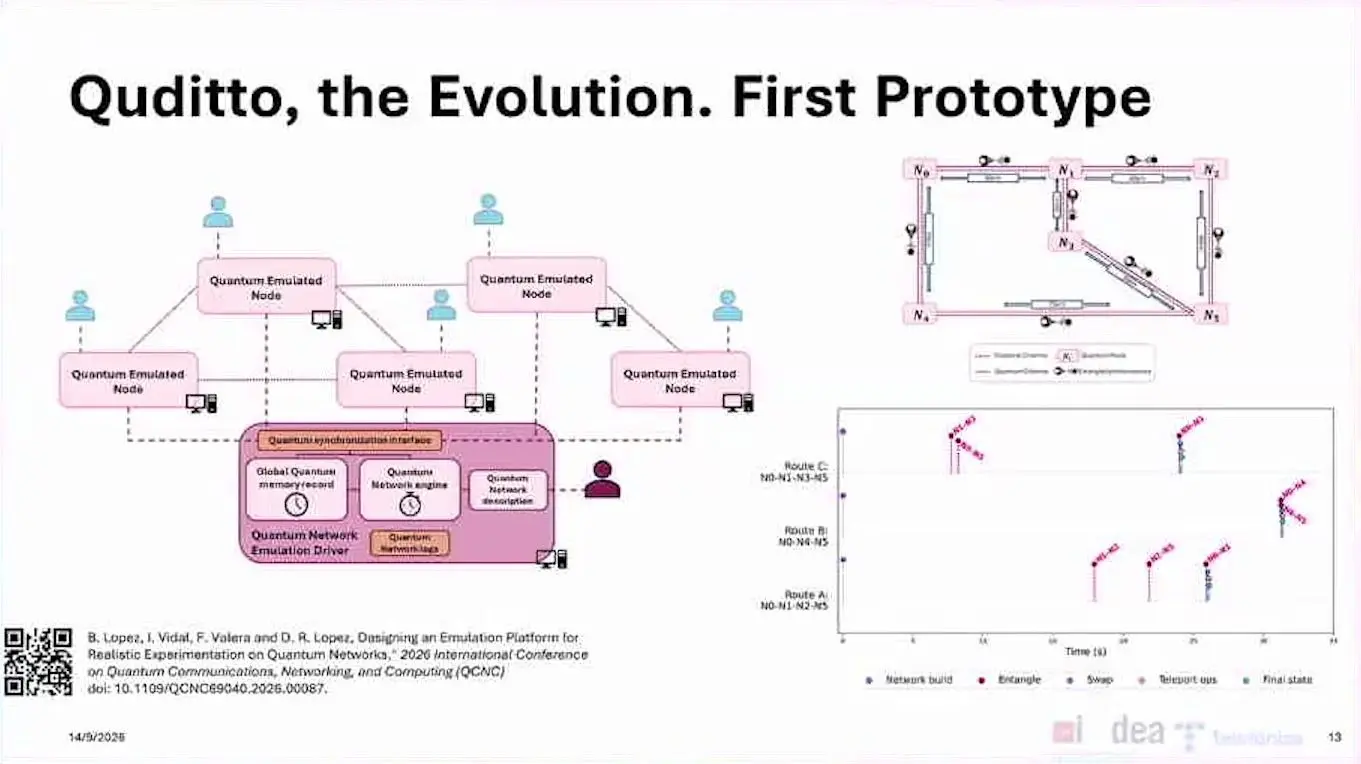
Diego Lopez said Madrid’s quantum network is the largest built only on commercial fibre links. A European project that began in July will use these copied networks to check early on whether kit from different makers works together, and it will feed what it finds to ETSI, which sets standards for Europe.
Two panels ask when a model can be trusted
On the Monday, Van Meter chaired a panel of the day’s speakers, and Kilper said ideas mostly flow from the lab to the simulator. Van Meter gave Doolittle credit for a neat line, that emulation is simulation that cares about the clock on the wall.
On the Thursday, IQM’s head of North American business asked Bacciottini, Alexander and Chung when a simulation is good enough to build from. Chung answered from their own tests. Chung had checked SeQUeNCe against a second tool, and the two gave the same link quality and very different rates, which Chung traced to how each wrote the same messages.
Routing and planning the network
Once a network exists, someone must pick its paths and place its kit. Fourteen talks did that work, mostly on paper or in simulation.
UMass maps the trade between rate and quality
Bacciottini came back on Thursday, with Don Towsley and Gayane Vardoyan, to a routing problem. Each link can trade speed for quality. It might spend three noisy pairs to make one better one. Normal routing gives each link a cost and runs a classic shortest-path method, and Bacciottini wanted the same for a goal such as key rate, which depends on speed and quality together.
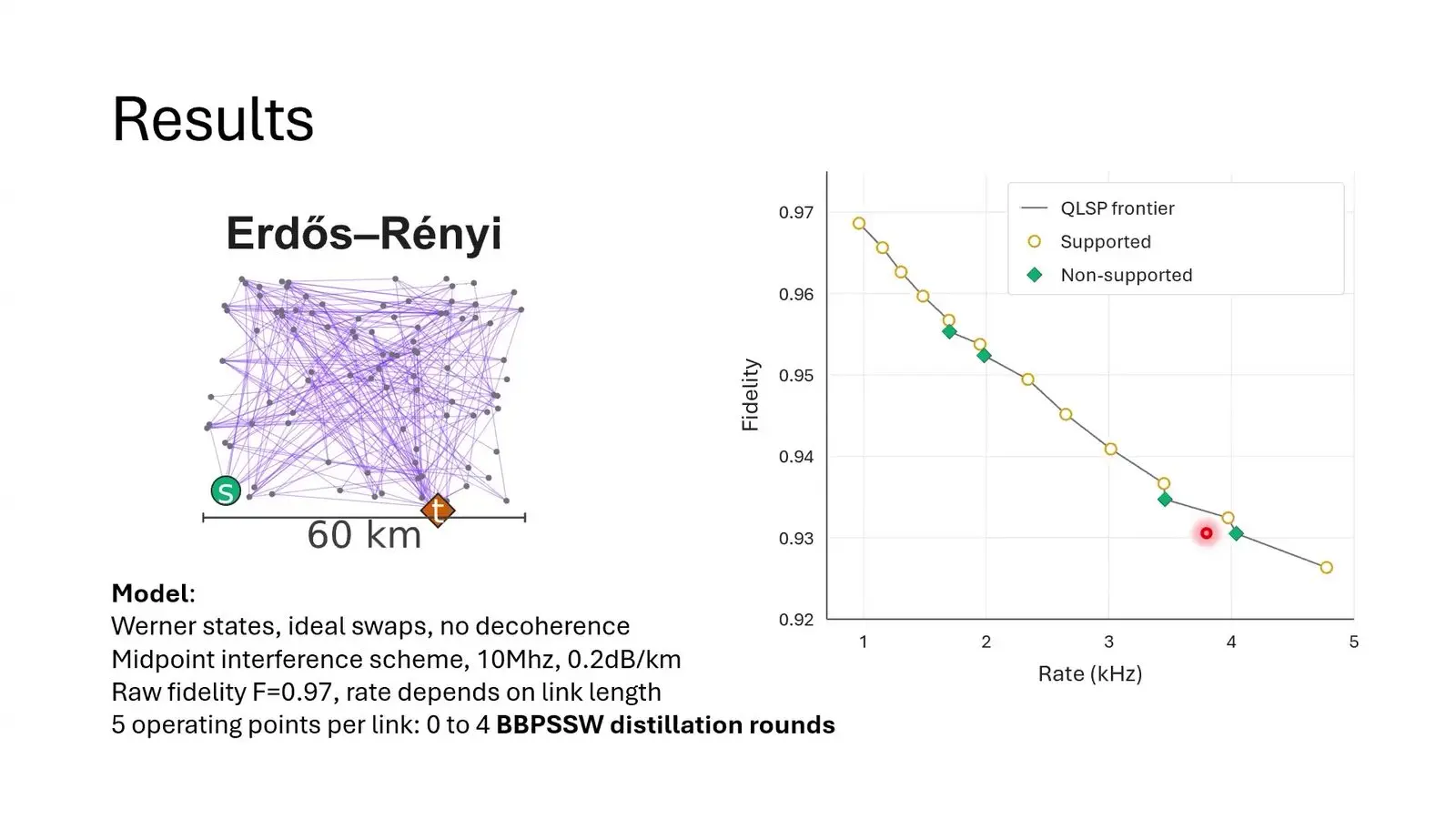
Their method sorts quality into bins and copies each node once per bin. One run then gives the best rate for every quality that can be reached. On a 60 km test network the best trade-offs ran from about 0.97 at a thousand pairs a second to about 0.93 near five thousand. Simpler methods, Bacciottini said, miss points.
Kennesaw keeps spare paths for fragile demands
Dillon Horton, a PhD student at Kennesaw State University, presented with Hien Hoang, Ethan Hunt, Dheeraj Tukkugudam, Tu Nguyen and Kun Suo. Links and swaps can fail. One path per pair of users is rarely enough, so one of their schedulers serves first the demands with the fewest separate routes.
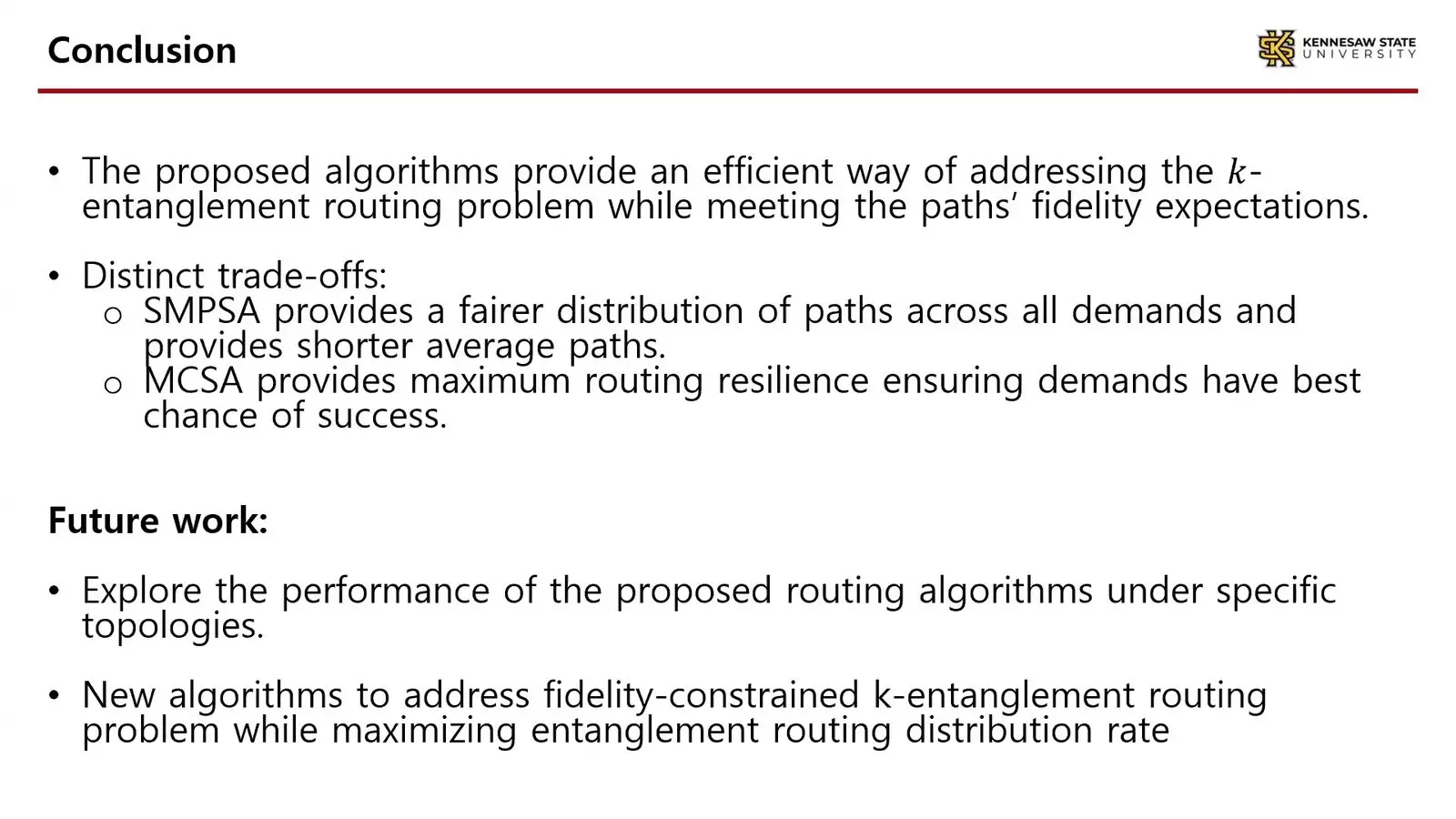
On networks of 50 to 250 nodes, that scheduler kept the most spare paths at the cost of slightly longer routes. Horton agreed that their quality figure leaves out time spent waiting in store and losses at each swap, so the figure is a best case.
Salerno treats an empty key store as an attack
Maria Caterina D’Aloia of the University of Salerno presented with Christian Esposito. Their subject was nodes that run out of key. Heavy use can drain a node’s store, so a route that works now is no good a moment later, and their method deals with that by putting the nodes into groups. A forecast trained at many sites then picks which ones may carry the next message.

On networks of 64 to 256 nodes, D’Aloia said their method stayed close to a perfect router and still recovered under attack, while plain shortest-path routing stopped. A fresh check at each step catches a wrong forecast nine times in ten, D’Aloia said. The rest can still let an attack land.
Waterloo cuts the trusted relays in a key network
Mehdi Bolourian of the University of Waterloo presented this paper, whose ten other authors run from Tianqu Luo to Massimo Tornatore. A trusted relay sees the key it passes on. A newer design sends both users’ light to a hub that reports a result without ever learning the key, though loss and fibre runs of uneven length can still force trusted relays back in.
Their planner prices trusted relays so high that no cheaper build can buy one more. In a six-node example the old pattern needed three, and the new plan needed just one. As demand rose in tests on real city layouts, compact Tokyo never needed a trusted relay at all, while Madrid and a stretched 50-node layout needed them much sooner.
Doha flies a drone between two ground stations
Anjum Ashraaf of Hamad Bin Khalifa University presented with Syed Shah Mir, Mohamed Abdallah, Ala Al-Fuqaha, Aiman Erbad and Mounir Hamdi. Their setting is a place with no fibre. After a disaster, say, a drone can hover between two ground stations and run a key scheme in which the middle node never holds the key, so the worst an untrusted drone can do is refuse to link.
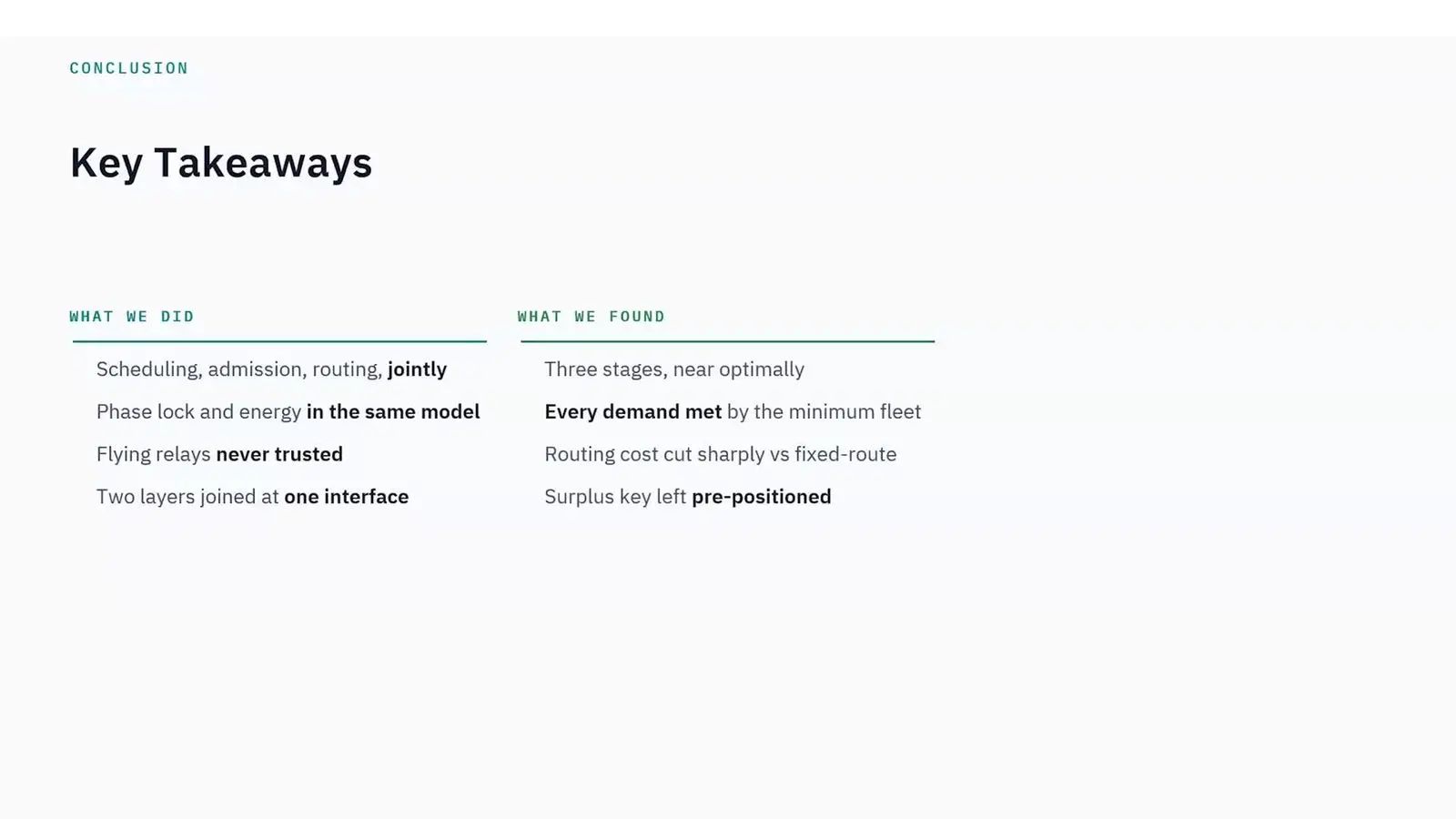
In one plan three drones met every demand within their energy budget. Ashraaf said keeping the light in step on a moving drone is still unsolved, and was not sure that any drone flying today could lift the telescopes the scheme needs.
BellKAT writes network protocols as algebra
Anita Buckley of USI Lugano presented BellKAT, with co-authors including Robert Rand, at Thursday’s workshop on spreading work across machines. Each step names the pairs it needs. Steps can run in order, side by side or by rank, and a second version, PBKAT, adds the odds that each step works, so the whole protocol can be scored.
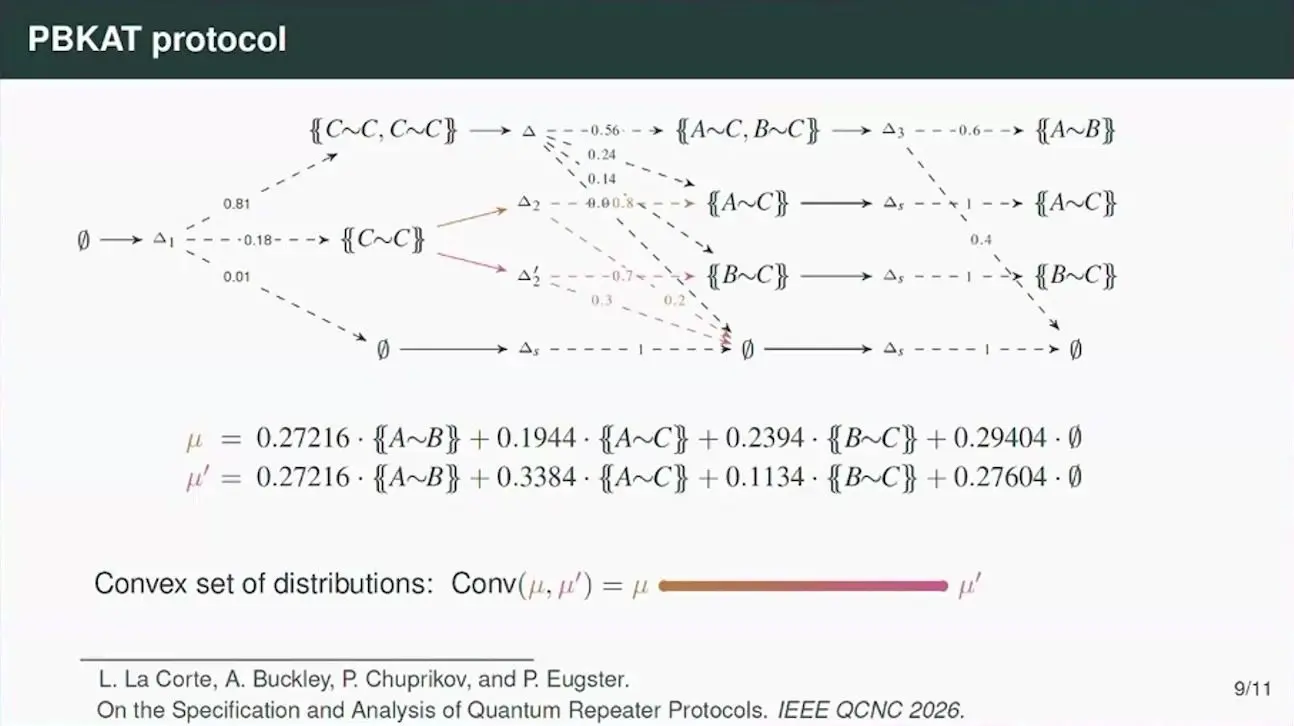
In their three-node example, two different schedules both gave an end-to-end pair with odds of 0.27216. Exact sums stop scaling once quality is tracked as well, Buckley said, so the group adds a time cost to each step and works out the chance of a link at each tick of the clock instead.
Naples runs 23 devices from four vendors for 35.5 hours unattended
Angela Sara Cacciapuoti came back on Tuesday with a case against the layered stack that runs the classical internet. Entanglement changes with every local step, in its quality, in the time it has left and in who owns it, so each layer and node that touches a pair needs the same view of it. Keeping those views in step costs messages. A stale view can treat a faded pair as good.
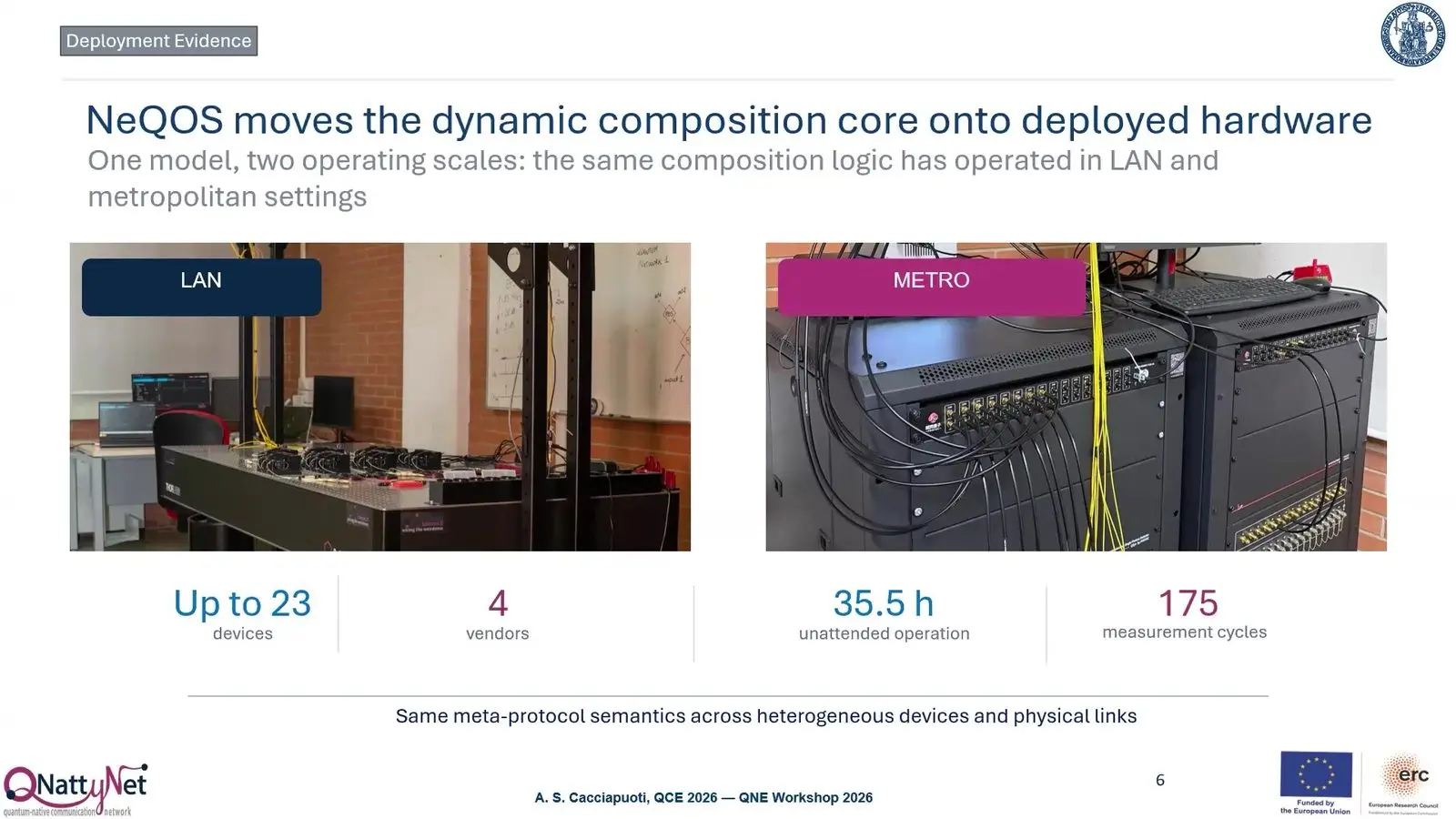
The group’s answer builds each protocol at run time from small parts, steered by each node’s state and by facts that travel with the path. It ran first in Q2NS, on more than 10,000 simulated nodes. Software called NeQOS then moved the same logic onto Italy’s national quantum internet test bed, where it ran up to 23 devices from four vendors for 35.5 hours unattended, over 175 measurement cycles. Nobody had to recalibrate anything during the run, Cacciapuoti said.
NIST routes entangled light on a signal blind to phase
Abdella Battou of NIST described the test bed’s campus fabric of optical switches at Gaithersburg, which is linked to DC-QNet. Its control software, Multiverse, routes each pair as two arms, one per photon. It ranks paths by loss, by how much the fibre smears each pulse, and by the coincidence-to-accidental ratio, or CAR, which counts true photon pairs against chance ones.

CAR cannot see phase drift or twisted polarisation, a gap Battou’s team flags itself. Battou called that a low risk for now. The test bed has no memories or repeaters yet, and loss is the main error. The risk grows once swapping arrives, so the plan is a standard noise figure for quantum links, like the bit error rate quoted for classical service.
Innsbruck tells only the nodes on a job about its pairs
Alexander Pirker of the University of Innsbruck and Quantum Network Design GmbH spoke in the same session. An application states a goal, such as a Bell pair between two far nodes, and Pirker’s control plane builds a workflow for it from small tasks. Pirker calls that a saga, after a term from software design. Tracking every resource across a big network is slow, so resources that exist only for one saga are known only to the nodes along it.

For bigger networks Pirker splits the map into segments, each with its own manager. Stand-in resources cover the parts that other segments handle, found by a tree across segments or by passing the job to a default gateway, as internet routing does. Studies of how both methods scale are under way.
Innsbruck finds a grid beats a star under one controller
Pirker returned on Wednesday with a paper by six authors, among them Robert Hayek, Alexander Kolar and Joaquin Chung of Argonne. In SeQUeNCe, a central controller built each job from small tasks. The team tried four layouts, a grid, a caveman graph of tight clusters joined by few links, two clusters joined by one link, and a star, all with links 10 km long. Each request asked for 100 Bell pairs at one of three priorities.
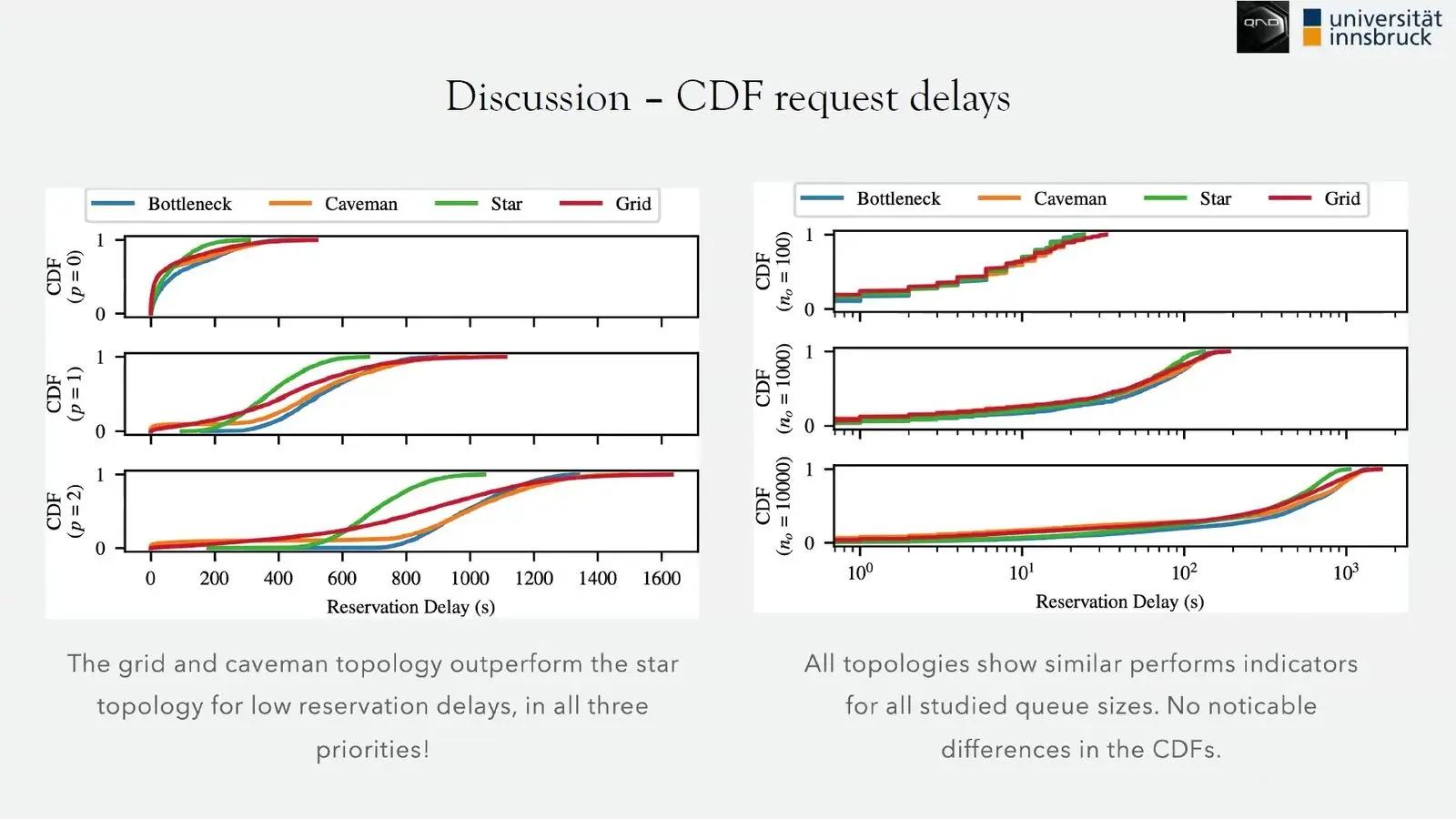
To Pirker’s own surprise, the grid and caveman layouts served short-delay requests better than the star. The gap widened at lower priorities. The size of the queue, from 100 to 10,000, made little difference, and quality fell with each hop, as expected with no cleaning. Pirker granted that it is hard to compare layouts with different path lengths fairly.
Keio shares Bell-state analysers with no central controller
Yifeng Shen of Keio University presented with five co-authors, among them Rodney Van Meter and Shota Nagayama. A Bell-state analyser does the swap that joins two pairs. It is costly. So optical switches let many end nodes share a few, though each request needs two paths to ports on the same analyser. In Shen’s protocol each node floods its links to its neighbours and builds a table of the analyser ports it can reach and what each costs.
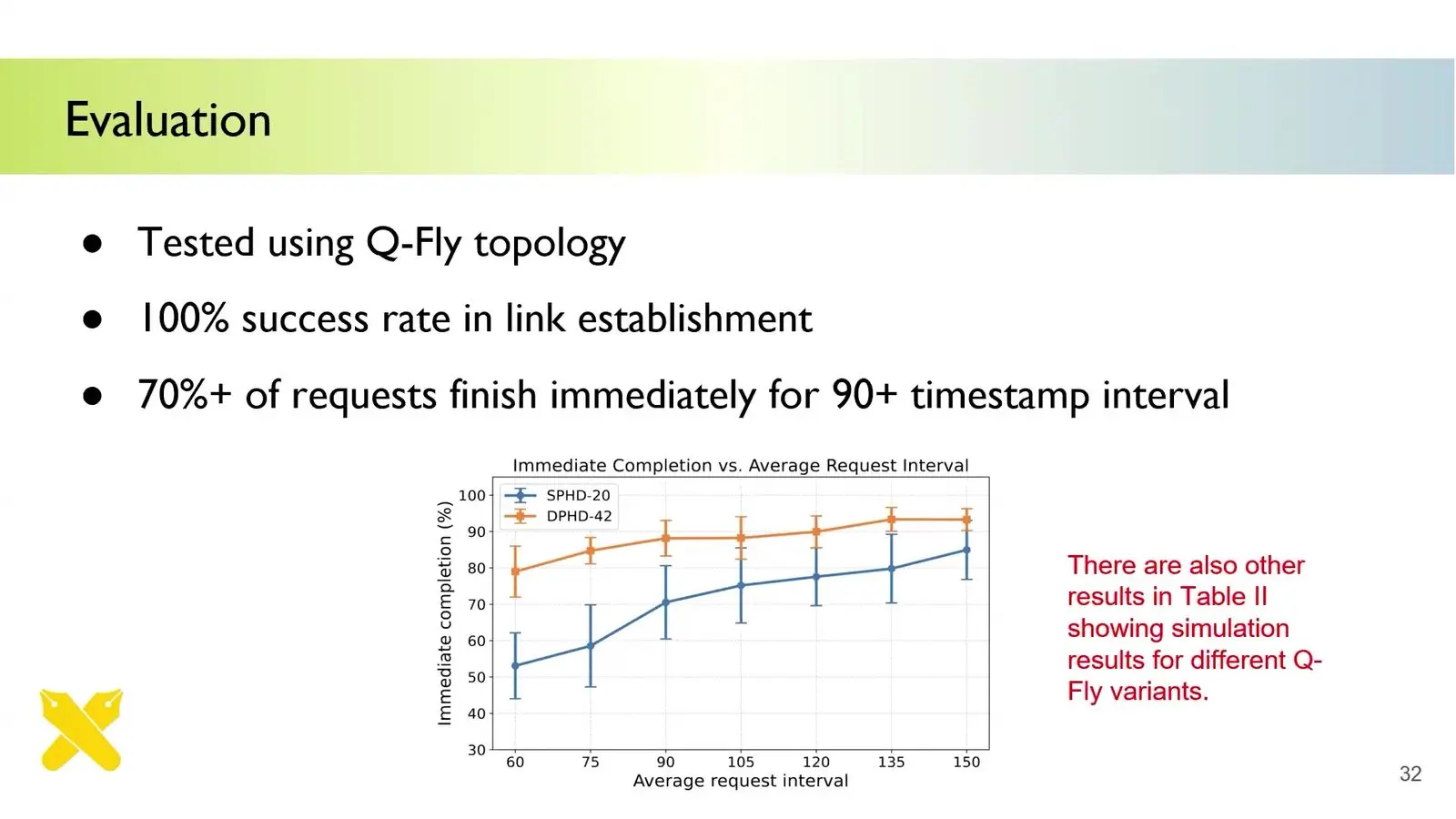
Two nodes that want a pair merge their tables, and the lead node picks the cheapest analyser. A reservation then passes from switch to switch, and a busy switch turns it down at once, all in nine messages. In simulations of QFly, the layout the group is building at its Moonshot test bed in Shin-Kawasaki, every request was set up, and once requests came 90 or more steps apart over 70 percent went through with no delay. No livelock showed up in long runs.
QuTech saves 42 minutes on a four-link trapped-ion request
Jake Smith of QuTech in Delft presented with four co-authors, among them Stephanie Wehner. Today’s nodes make entanglement only on request. Under QNodeOS, an operating system for quantum network nodes, the network hands out blocks of time that repeat. Between blocks a node needs a gap to run its own gates and reset, because the device that makes entanglement must also use it.

Smith’s team schedules gaps shorter than that minimum. When a pair turns up late in a block, the node just skips the next one. In a model with trapped-ion figures from a published city link, that cut the service time of one four-link request by 7.6 percent, about 42 minutes, and of two requests sharing the network by 30 percent. The gain is largest at low rates, Smith said, which suits near-term kit. Buffers like those in internet routers are years away.
Panel splits on when to make entanglement
Wenji Wu of ESnet chaired a panel of Cacciapuoti, Battou, Pirker and a researcher who works on error correction at IonQ, and the sharpest split was over when to make the pairs. Cacciapuoti would make them ahead of time if the hardware allows. Pirker expected a mix. The IonQ researcher wanted them made as fast as the memories permit.
The IonQ researcher said nobody has yet run more than a simple two-qubit program across two machines, and for now would judge a link by its rate at a given quality. Battou wanted boxes on each link that report its figures, as classical links do. Asked from the floor whether the field should pick one shared problem, the panel named two, spreading a computer across machines and sharing entanglement.
Tennessee Tech plans grid key upgrades from the last year back
Muhammad Ismail of Tennessee Tech University presented work led by former PhD student Mariam Gado. Grid control networks link a control centre with its substations. Attacks on them hit the real world, as in Ukraine in 2015, when about 250,000 people lost power. Full key distribution would need every node to send and measure quantum states. The team used a lighter scheme instead, semi-quantum key distribution, in which one end is fully quantum and the other only reflects states or measures in one basis.

Their planner picks where to put the fully quantum servers, how bright each source is and which links get new fibre, so that each year’s rising demand is met at least cost and nothing is undone later. A genetic algorithm solves the fourth year first and seeds each earlier year with that answer. On IEEE 14-bus and 39-bus test grids this cut weighted cost by 50 to 75 percent against planning one year at a time. The yearly key rates, Ismail said, are only illustrative.
Satellites, telescopes and new uses for photons
Fibre loses light as it goes, so some groups looked up to satellites. Others asked what quantum tools can do for networks long before a quantum internet exists.
Montréal cleans up entanglement sent from a satellite
Lia Suci Waliani, a PhD student at the École de technologie supérieure in Montréal, presented with Georges Kaddoum, Mahdi Chehimi and Shahan Hawatian. Waliani puts the source of entanglement on a satellite. It sends one beam of light to each of two ground stations, and the trip down strips away some of the entanglement.
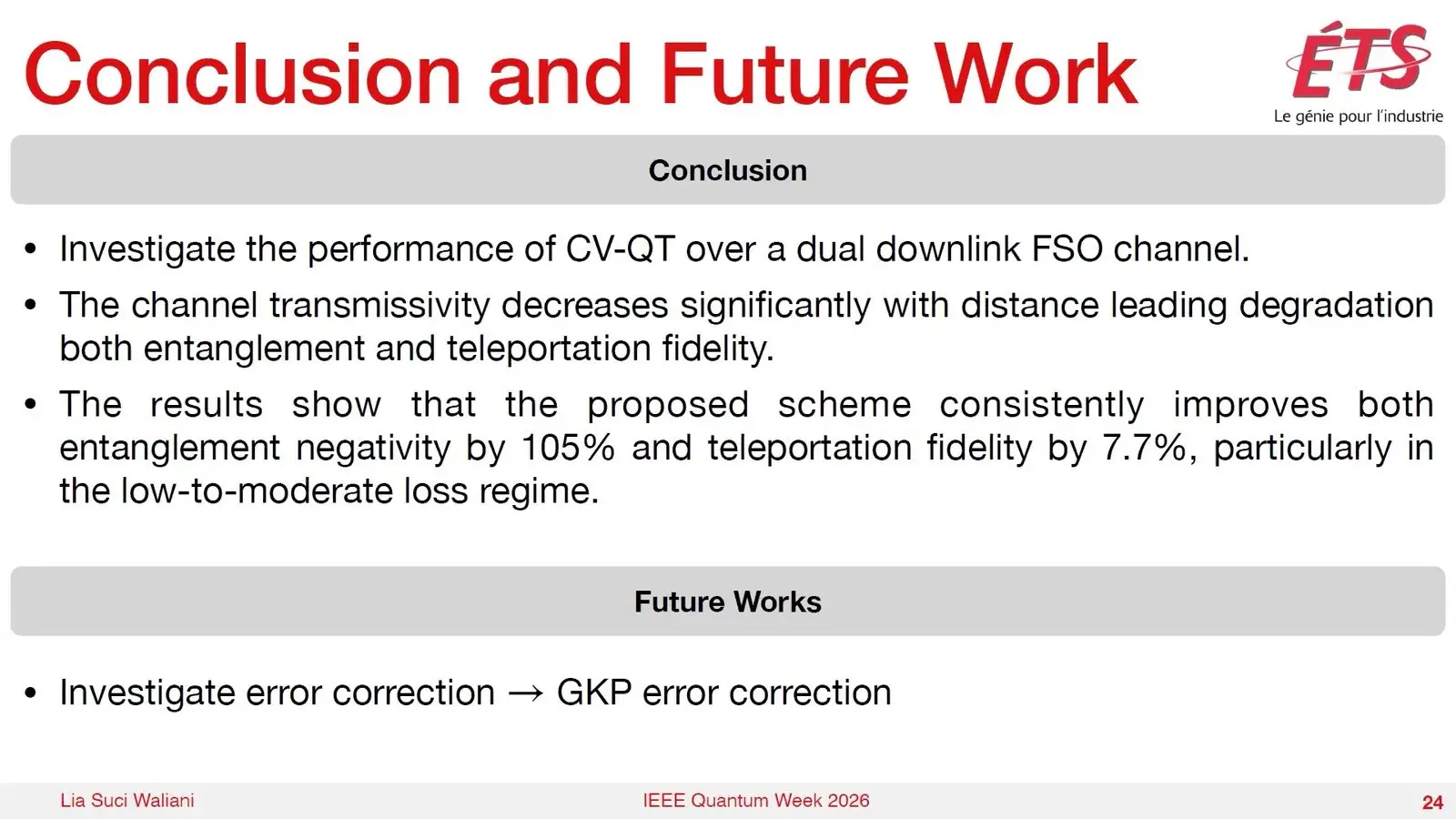
Waliani cleans up only the worse of the two beams. Treating both would multiply the failures. In simulation the gain was 7.7 percent in quality at moderate loss and was clearest at about 1,000 km, while near 2,000 km the link was lost altogether.
Houston splits satellite planning with an annealer
Zhu Han and Lei Fan of the University of Houston led the Monday morning tutorial on mixed satellite and ground networks, with a third colleague. Fan split planning problems so that a D-Wave annealer, a quantum machine for picking the best of many options, takes only the hard yes-or-no part. A normal solver takes the rest. On a case that assigned users to ground stations and satellites, the mix reached the same answer as the normal method.
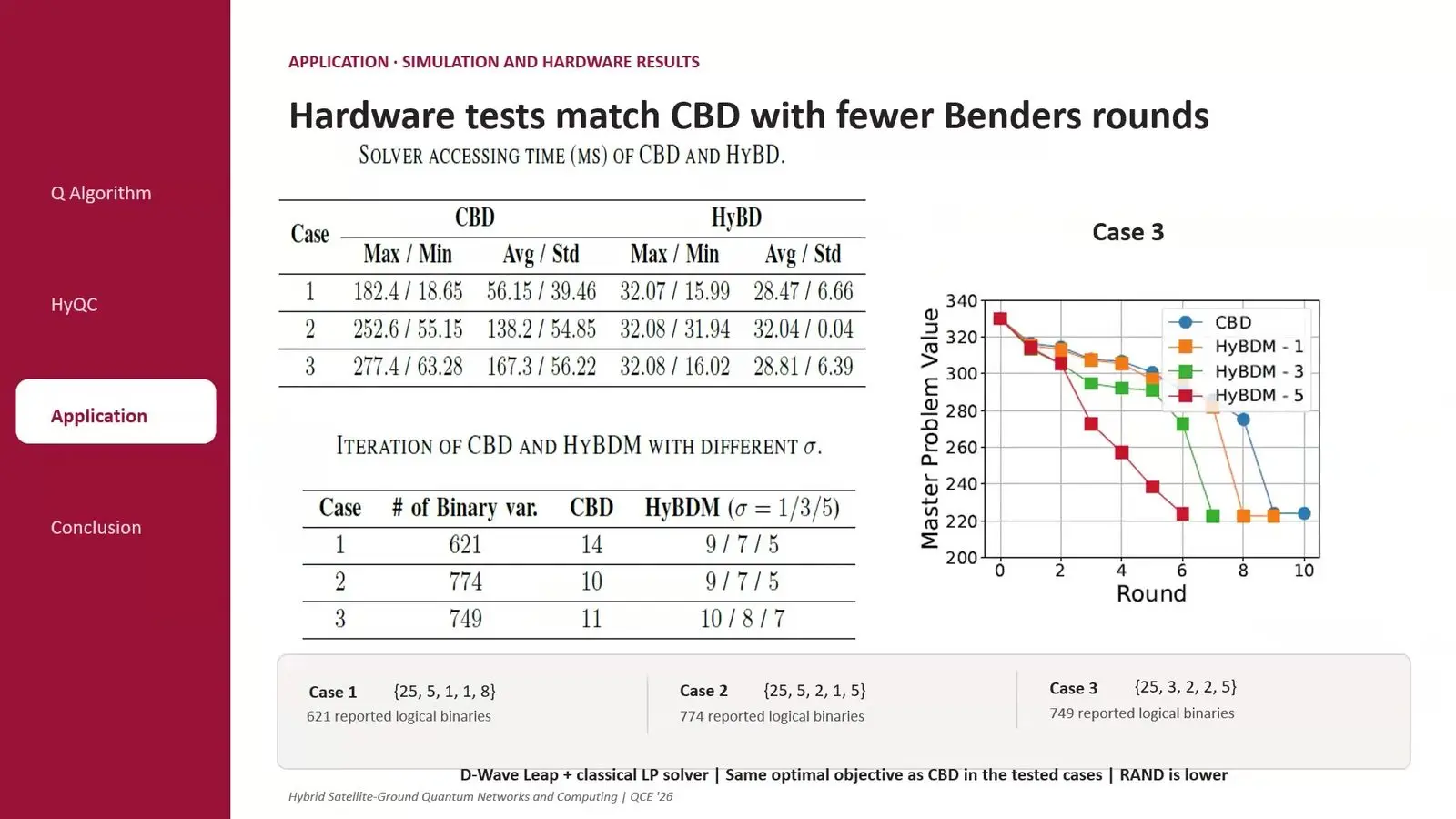
The third presenter handed out entangled pairs from satellites to ground stations. Solved in one piece, even a modest case with 12 satellites and 5 ground stations already needed 4,549 qubits on the annealer, and no larger case could be run at all. Split up, each part stayed small enough to solve.
Routing three-way entanglement from orbit
The afternoon half drew on papers from groups in San Antonio, Houston and at Temple University. In a model with 150 satellites and 17 ground stations, serving more requests for states shared by three users cut the total traffic the network could carry, because those states use up the same parts. A questioner said that losing one photon breaks such a state. The presenter agreed.
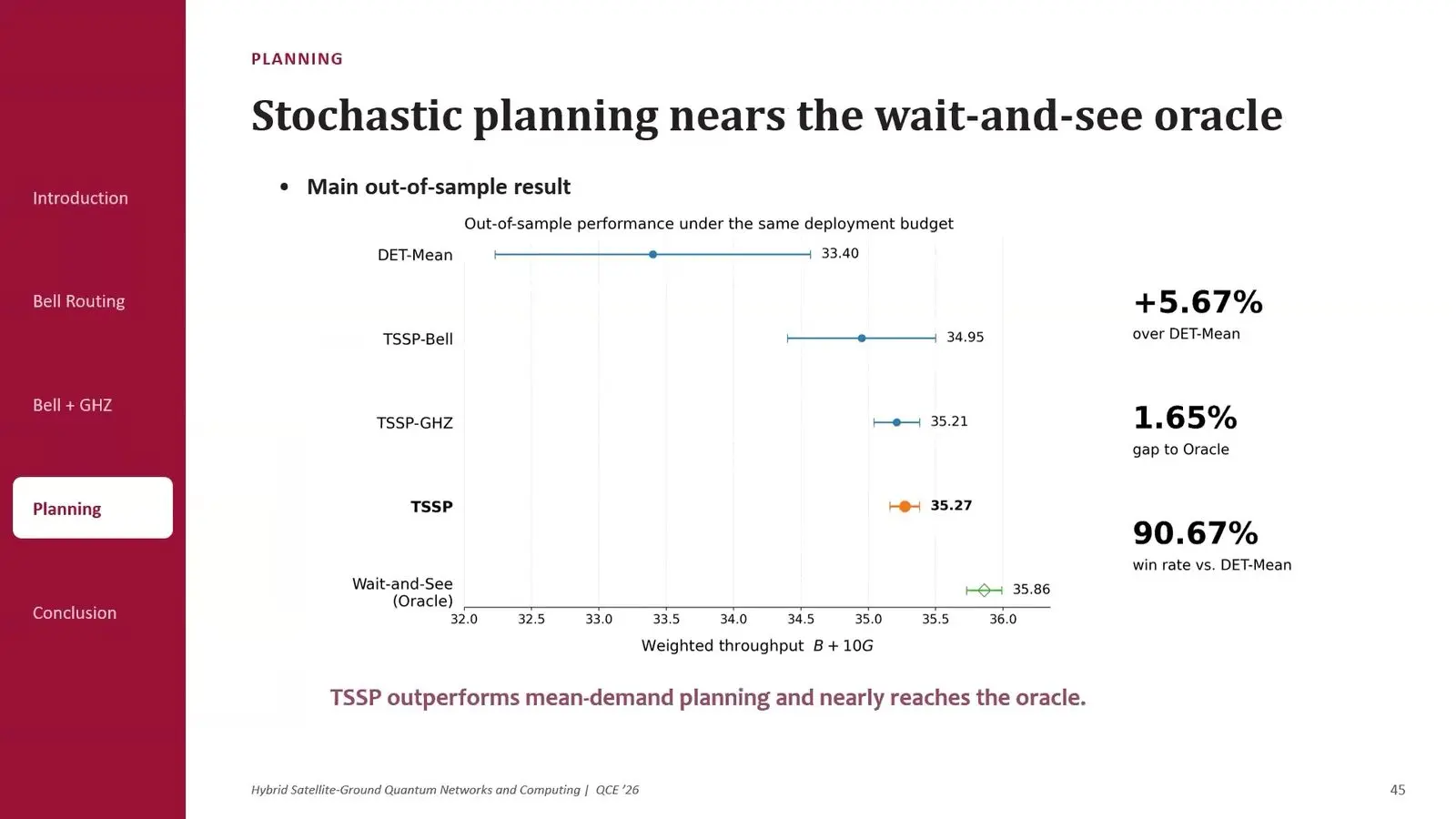
A two-stage plan, tested on 100 demand patterns it had never seen, came within 1.65 percent of a planner that knew the future. A second presenter covered how to spread one circuit across linked chips, and named the short life of qubits as the hardest open problem. Gates were assumed perfect.
Embry-Riddle budgets keys for missions near the Moon
Rahi Shah, a master’s student at Embry-Riddle Aeronautical University, presented the work, with their advisor Di Wu as co-author. A craft between Earth and Moon can make more key than it spends on average and still run out. The risk lies in the gaps between contacts with the ground. The craft keeps using key all the time, whether or not a ground station is in view, and the threat Shah named is harvest now, decrypt later, in which data is stored today to be read once codes break.
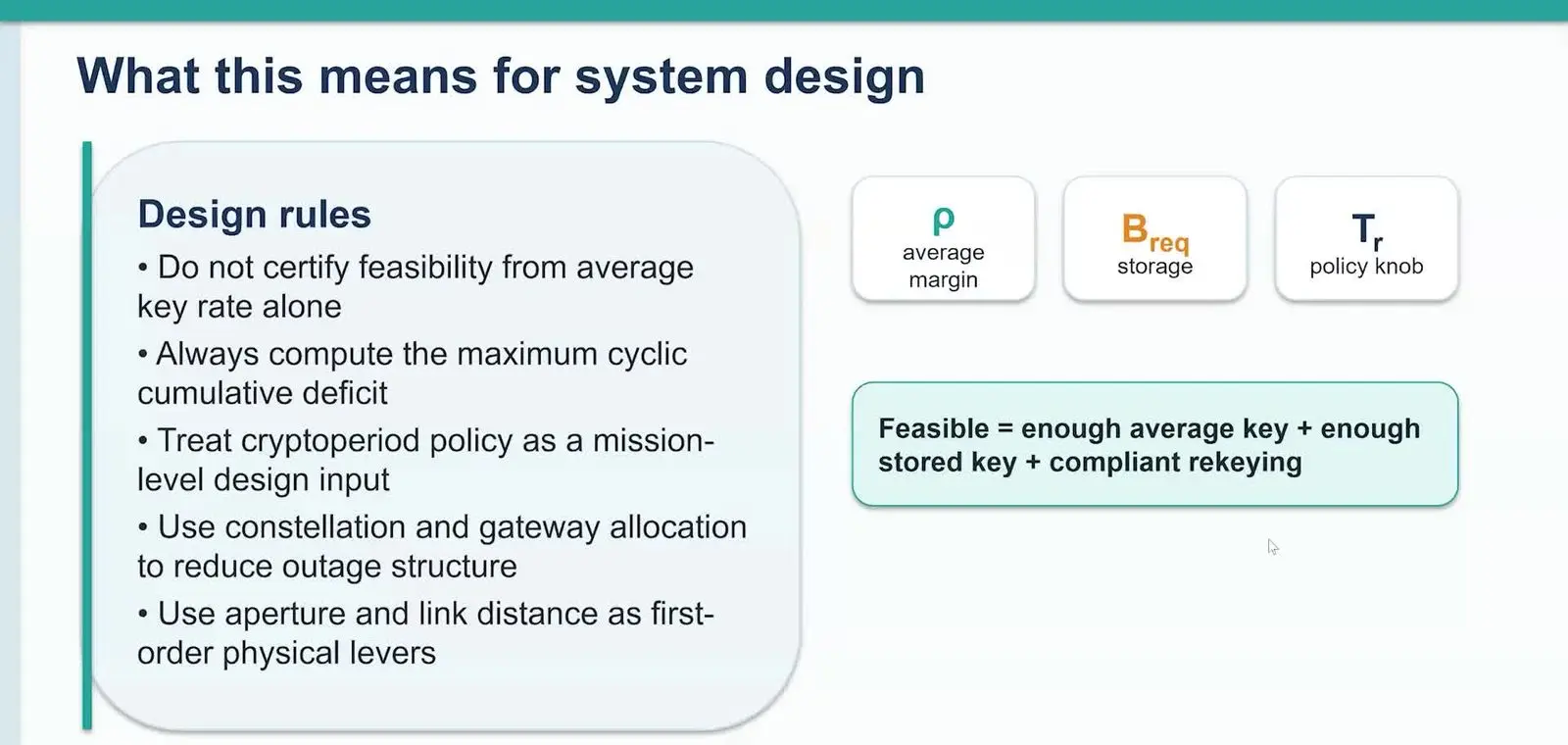
For a fleet of 16 craft the average looked fine, but the key store needed about 10,701 bits and anything smaller ran out. Refreshing a standard AES key, Shah noted, does not grow with the data, while a one-time pad does.
Detectors in orbit took radiation damage the models do not match
Thomas Jennewein of the University of Waterloo and Simon Fraser University leads QEYSSat, Canada’s quantum satellite mission. On Tuesday’s panel about networks in space, Jennewein said detectors flown outside the space station went from about 10 dark counts a second to tens of thousands after a little radiation. That payload, SEAQUE, is led from Illinois with Boeing as a partner. After almost a year in orbit the damage still does not match the models. QEYSSat itself, a 100 kg craft due to launch next year, is a science test, Jennewein said.
Rudolph Magyar of Boeing chaired Nick Mondrik of IonQ, Rodney Van Meter, Mehdi Namazi of Qunnect and Alireza Shabani of Nanofiber QT. Namazi would prove city links of about 100 km first. A fleet built round one part, Namazi warned, could be beaten by a better part in two years. Mondrik added that in orbit a team flies what it launched. Shabani put a first downlink of entangled light at about 10 million dollars, and said the US government has held back because post-quantum codes are the rival path.
Van Meter was once doubtful enough to study shipping entangled qubits by container ship. Now Van Meter takes that back. A satellite in low orbit passes over for about six minutes once a day, and a study Van Meter had seen suggests a link from geostationary orbit may be in reach.
Romania proposes bouncing entangled light off a mirror in orbit
Florin Constantin of the Institute of Space Science in Romania proposed EQuAntOR, a mission idea sent to the European Space Agency with partners in Bucharest. The satellite would let go of a mirror that sends light straight back, and bounce entangled photons off it as it drifts away. That tests whether entanglement lasts as the gap grows. A second source would serve key distribution with ground stations and with lower satellites.
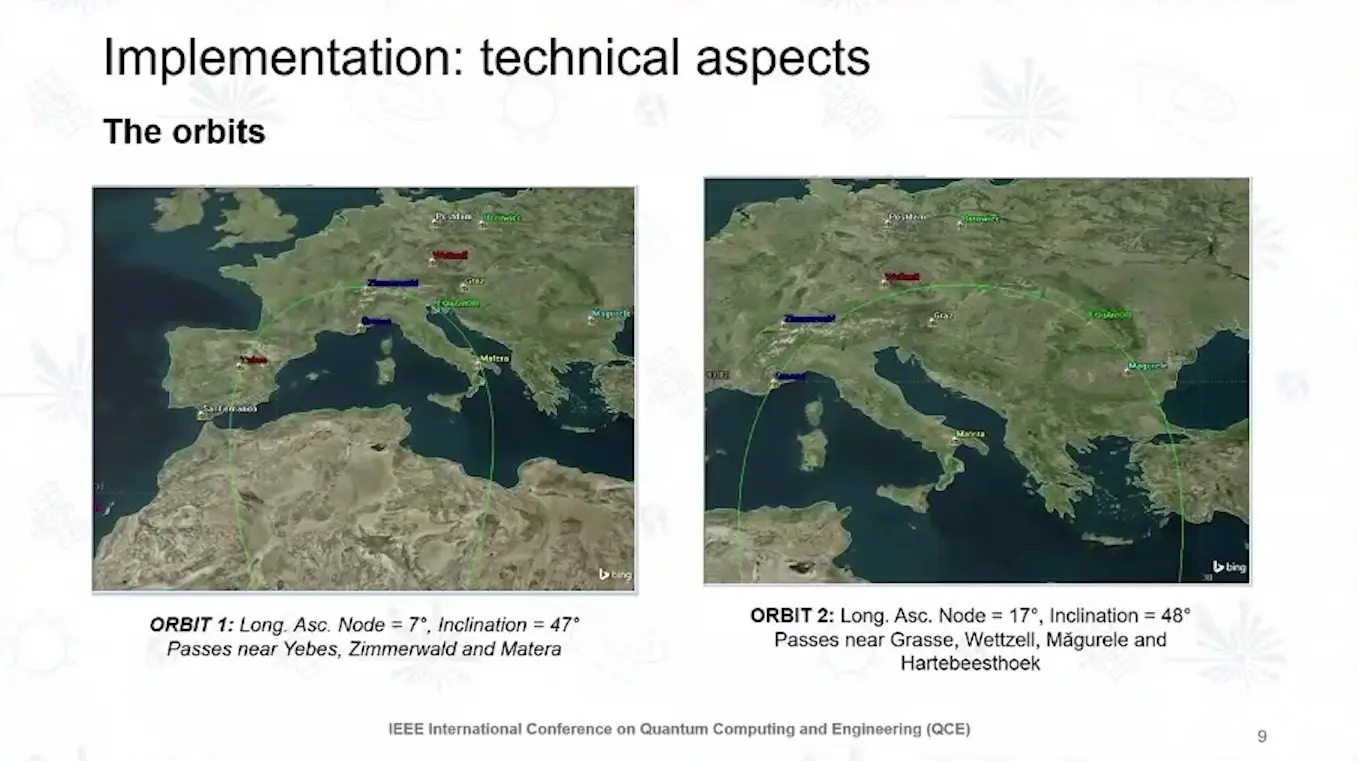
The craft would sit in an inclined geosynchronous orbit, whose figure-of-eight track passes nearly over several ground stations, so Constantin hopes for links of about 35,000 km with only a short path through air. The source, the mirror and the size of the craft are all still open. Asked how far the test should reach, Constantin named cislunar range, about 400,000 km.
Munich wants quantum receivers for classical links
Janis Nötzel of the Technical University of Munich asked how normal links can gain from quantum tools before any quantum internet exists. Nötzel set the old limit on how much data light can carry beside the higher ceiling that quantum physics allows, and the gap grows without end as the light gets very faint.
That favours quiet links that use little power. Their examples ran from links under water to factory floors and a beacon on a satellite, where Nötzel worked out that about 20 bits a second could tell a million satellites apart in one second.
Maryland says low-loss links leave most room for quantum receivers
Saikat Guha of the University of Maryland, College Park, who directs the NSF Center for Quantum Networks, argued that links with little loss leave the most room to gain. No scheme can send more than a set number of entangled pairs per mode, one slot of light in the fibre, and that ceiling climbs without limit as loss falls. One qubit per mode can never get near it. With Liang Jiang and Prajit Dhara, Guha’s team showed that packing several qubits into one mode, as a grid-shaped state of light called a GKP qudit, comes within a constant gap of the ceiling.
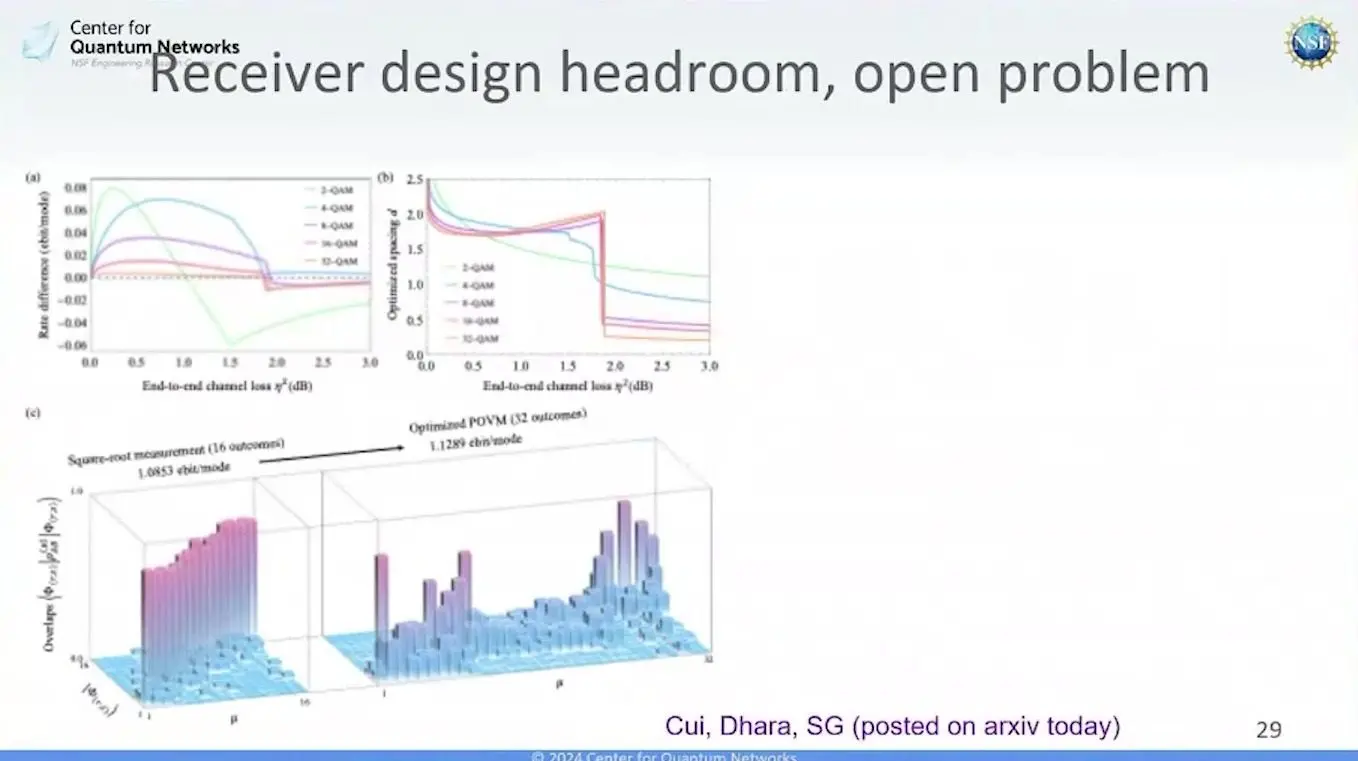
GKP states are hard to make, so the newest work uses plain laser pulses set out in a grid of phases and strengths instead. Nobody yet knows the best measurement to make midway. A tuned measurement with 32 outcomes gave 1.1289 entangled bits per mode against 1.0853 for the textbook one. With about one decibel of total loss, Guha estimated that GKP schemes could beat standard ones by ten times or more, and laser-pulse schemes by about five.
LG sends messages straight over a quantum channel
Byungkyu Ahn of LG Electronics showed a way to send the message itself over a quantum channel, with no key shared first. It is called quantum secure direct communication. Their team packs several bits into each photon by when it is sent. A coil of fibre then turns each pattern into its own arrival time, using a trick known as the temporal Talbot effect. One detector does the work.
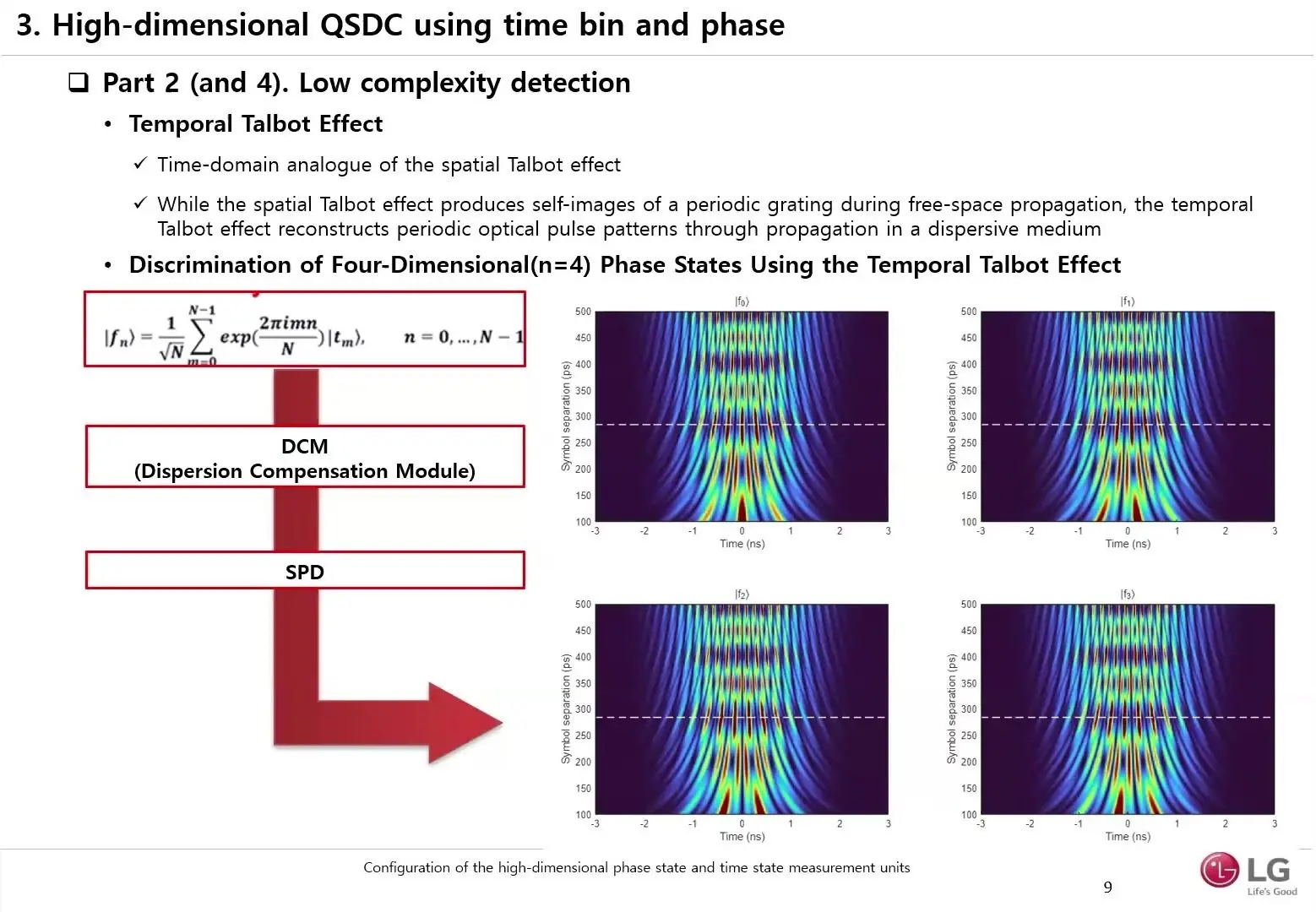
Ahn said the scheme carries more secret data than the standard method over the same distance. LG is building it with Korea Telecom and KAIST, and plans a test on Korean commercial fibre by 2027, with a version that needs no quantum memory on its plans for 2028.
Dresden links three telescopes through quantum memory
Nikhitha Nunavath of TU Dresden presented work by Vignesh Raman, Riccardo Bassoli and Frank Fitzek. Astronomers add up the phases around a triangle of telescopes. That sum cancels each one’s own errors. The team asked whether to read each link at once, or to hold all three in quantum memory and join them in one go.
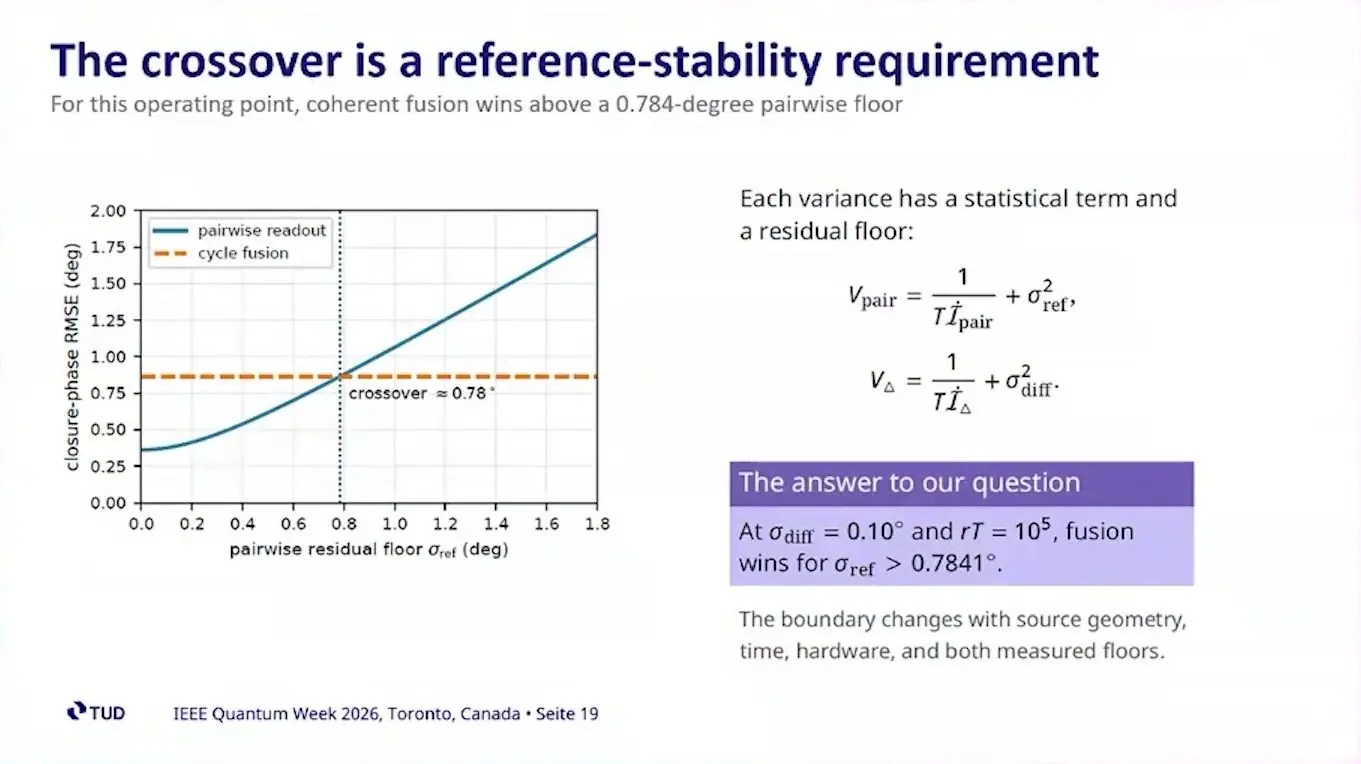
Combining them accepts only a quarter of attempts. So even perfect memory gave it no gain in speed, and in their toy case it won only once the error left over in the simpler method passed about 0.78 degrees, a line that moves with the hardware. Nunavath wants to test both on one clock.
Infleqtion would check 100 petabytes with 122 qubits
Pranav Gokhale, a co-founder of Infleqtion and its chief technology officer, presented Supercheq, which checks that two far copies of a file match without sending the file. A hash is short. Yet two files can, in rare cases, share one. For 100 petabytes the best classical check needs 193 gigabytes, and the lean version of Supercheq needs 122 qubits.
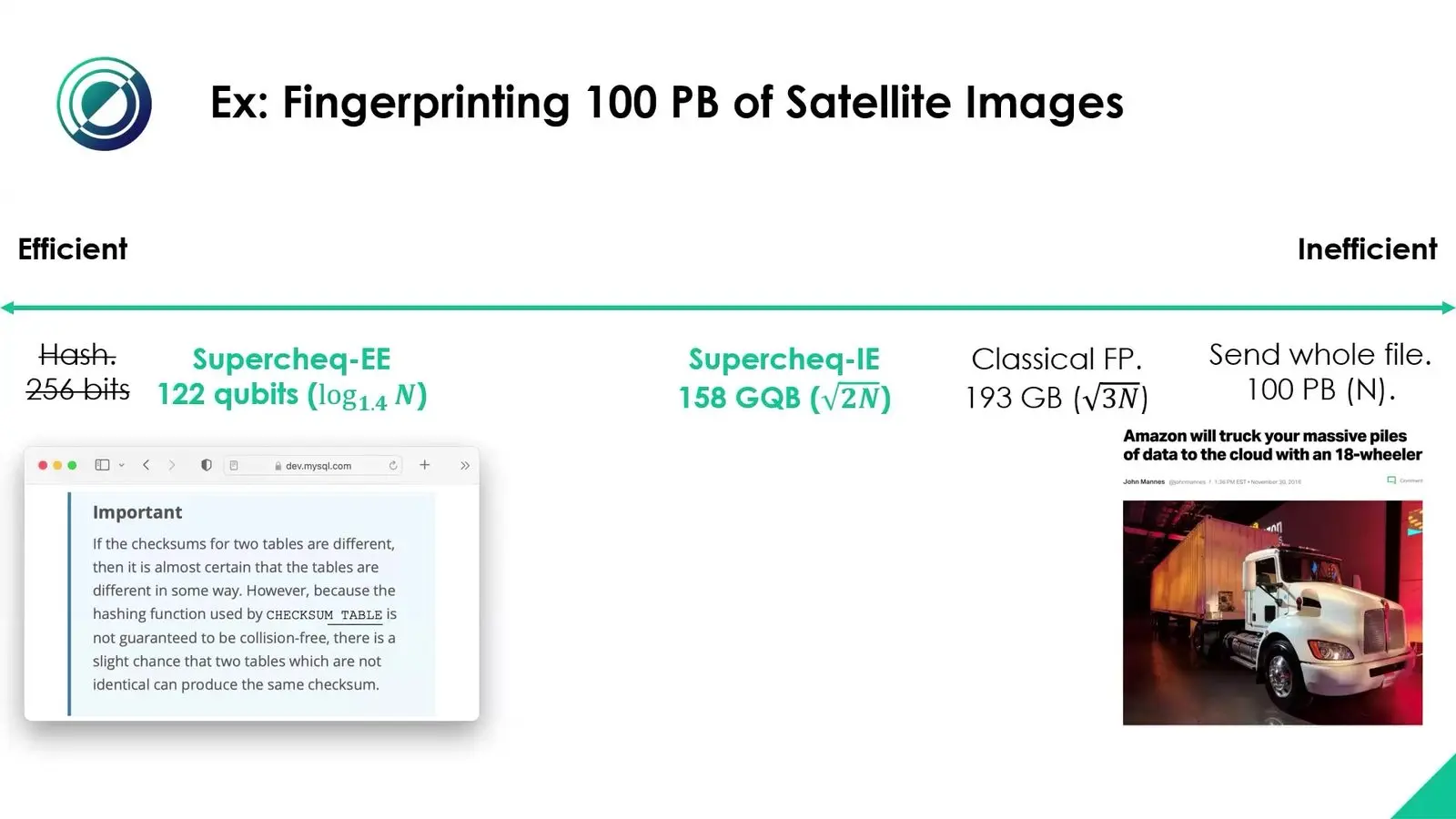
A second version writes the file’s bits into the links of a graph state, a set of qubits tied together by gates, so a file of N bits needs about the square root of N qubits. A third party then runs a swap test to see whether the two states match. Changing the file costs just one more gate. Gokhale said the scheme needs machines and links that do not yet exist.
The market and the standards
Five talks asked who will pay for quantum networks, and who writes their rules. Their answers came from sellers, funders and standards bodies more than from the lab.
Industry panel puts commercial key distribution at about 100 km
Alireza Shabani opened the Monday panel on how to sell quantum networks, and Julian Martinez-Rincon of MIT’s Lincoln Lab put the questions. Seven guests took part. They came from IonQ, Ciena, Nanofiber QT, Toshiba Europe and the US energy department, and Mary Burkey joined them. Two of them spoke just for themselves.
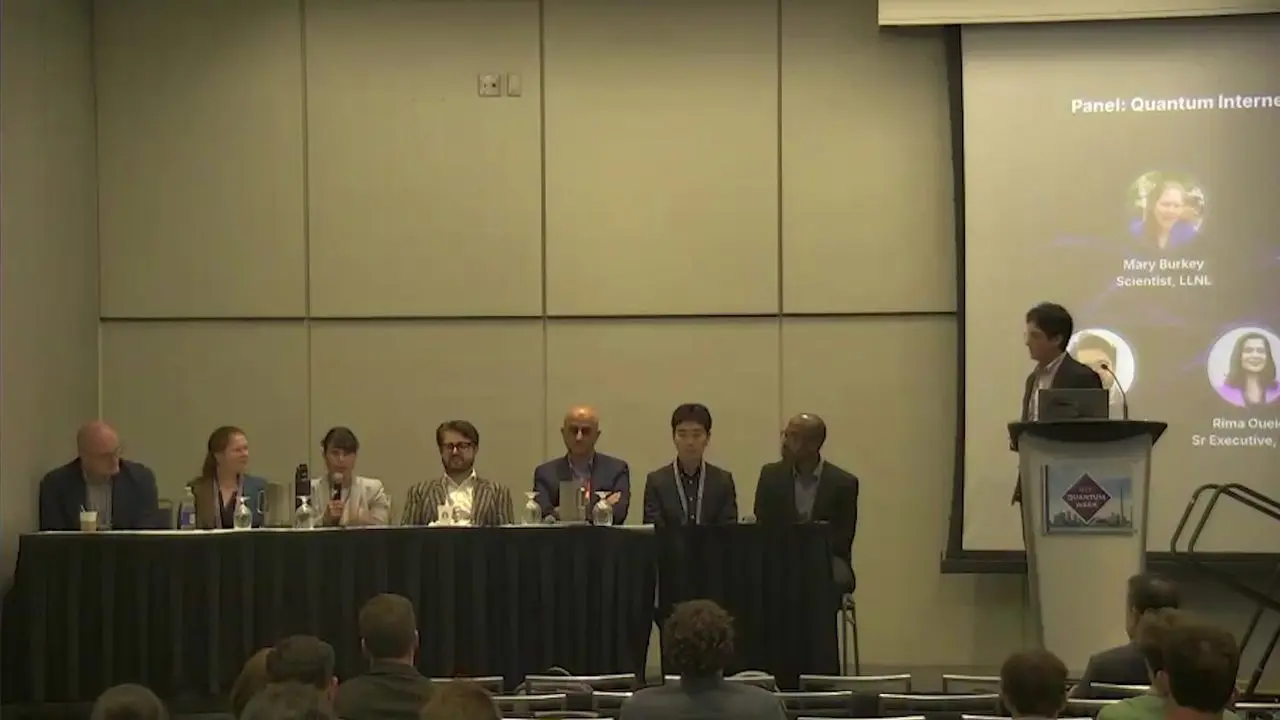
Farzam Toudeh-Fallah of Ciena said key networks sold today reach about 100 km. Ciena’s own fibre runs for thousands. Akihisa Goban of Nanofiber QT put today’s rate at hundreds to thousands of linked pairs a second. Goban wants a million. Mary Burkey passed on the view of the NSA, the US code-breaking agency, that quantum keys cost a lot and are open to side-channel attacks, while post-quantum codes are cheaper now.
Taofiq Paraiso of Toshiba Europe described EuroQCI, a plan that required all 27 EU countries to start a key network. Toshiba now has paid trials in London and Paris, where banks see the case.
Naples argues the physics should shape the design
Cacciapuoti argued on Thursday that key networks and entanglement networks are at different stages. Set rules for entanglement networks too early and the field may freeze an idea that is still changing. Cacciapuoti asked designers to start from what the physics fixes, such as entanglement being used up once it is read, and to track each pair from birth to use.

Cacciapuoti listed four properties that the physics fixes. Entanglement is non-local, it is used up when read, its quality and ownership must stay visible to the network, and it builds its own map of neighbours that can differ from the cabling. From these came a proposal to give each node a quantum address beside its normal one, with a routing table for entanglement next to the normal table. The group is testing these ideas in Q2NS and on test beds.
A roadmap ranks key distribution alone near market
Timothy Burt of L3Harris summed up a new roadmap of uses for quantum networks. It is version 2.0 of the Quantum Networking Applications Roadmap, finished with the Quantum Economic Development Consortium in 2026, and it scores each use against measures such as quality, rate and distance. The scores came from experts. Few replied, Burt said.
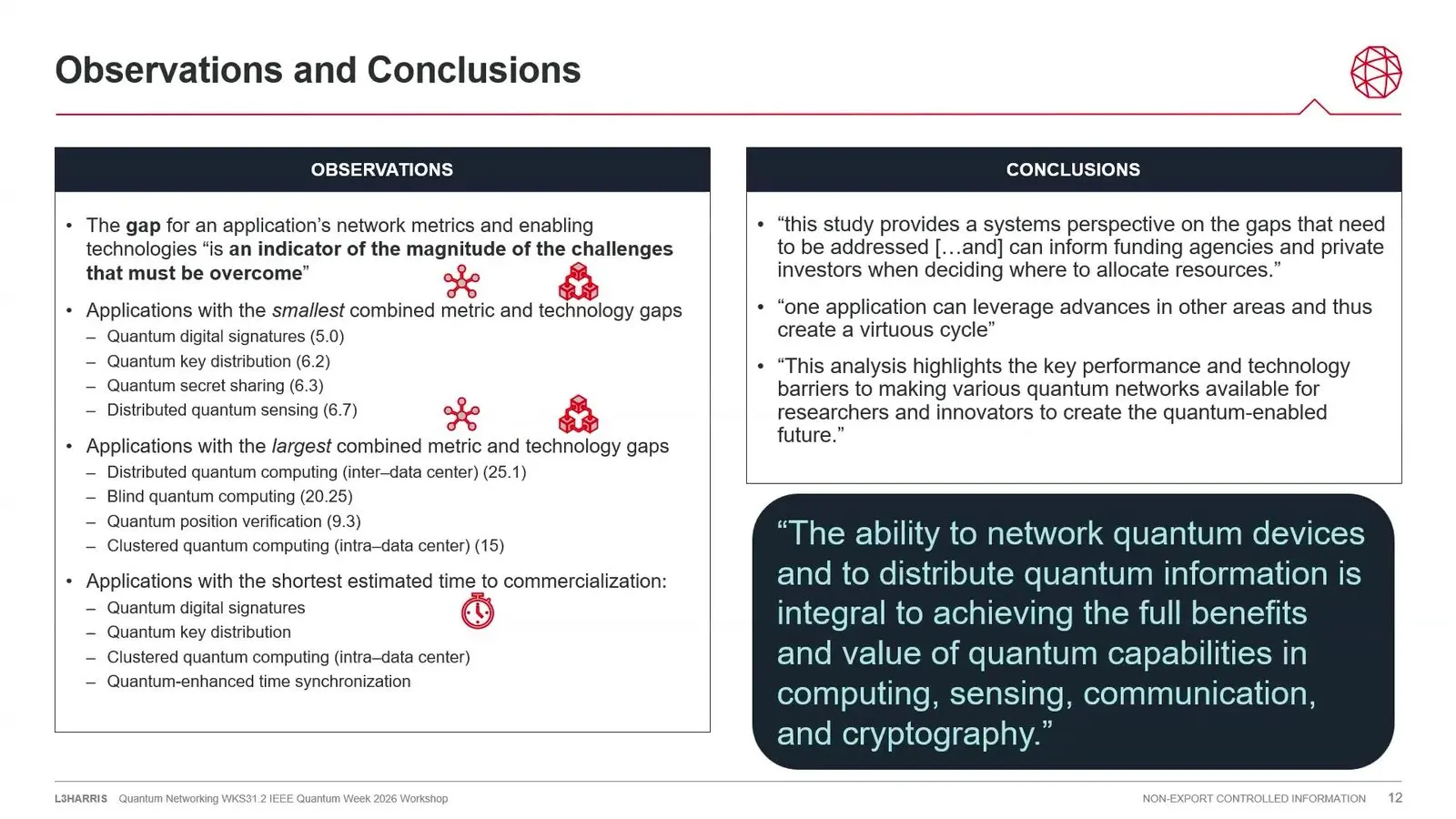
Key distribution stood alone near market, under five years away. Computing spread across data centres was the furthest off, and Burt warned that the sensing score was muddled, since some of those asked pictured huge sensor systems and others pictured caps worn on the head in hospital.
Korea counts 55 ITU-T recommendations
Taesang Choi of Korea University said ITU-T, the telecom arm of the UN’s ITU, began work on key networks in 2019 and has issued 55 standards since. ISO and IEC set up a joint committee in 2024, mostly on sensors. For entanglement networks, ITU-T has begun its first formal draft, a layered model called Y.QN-LM.
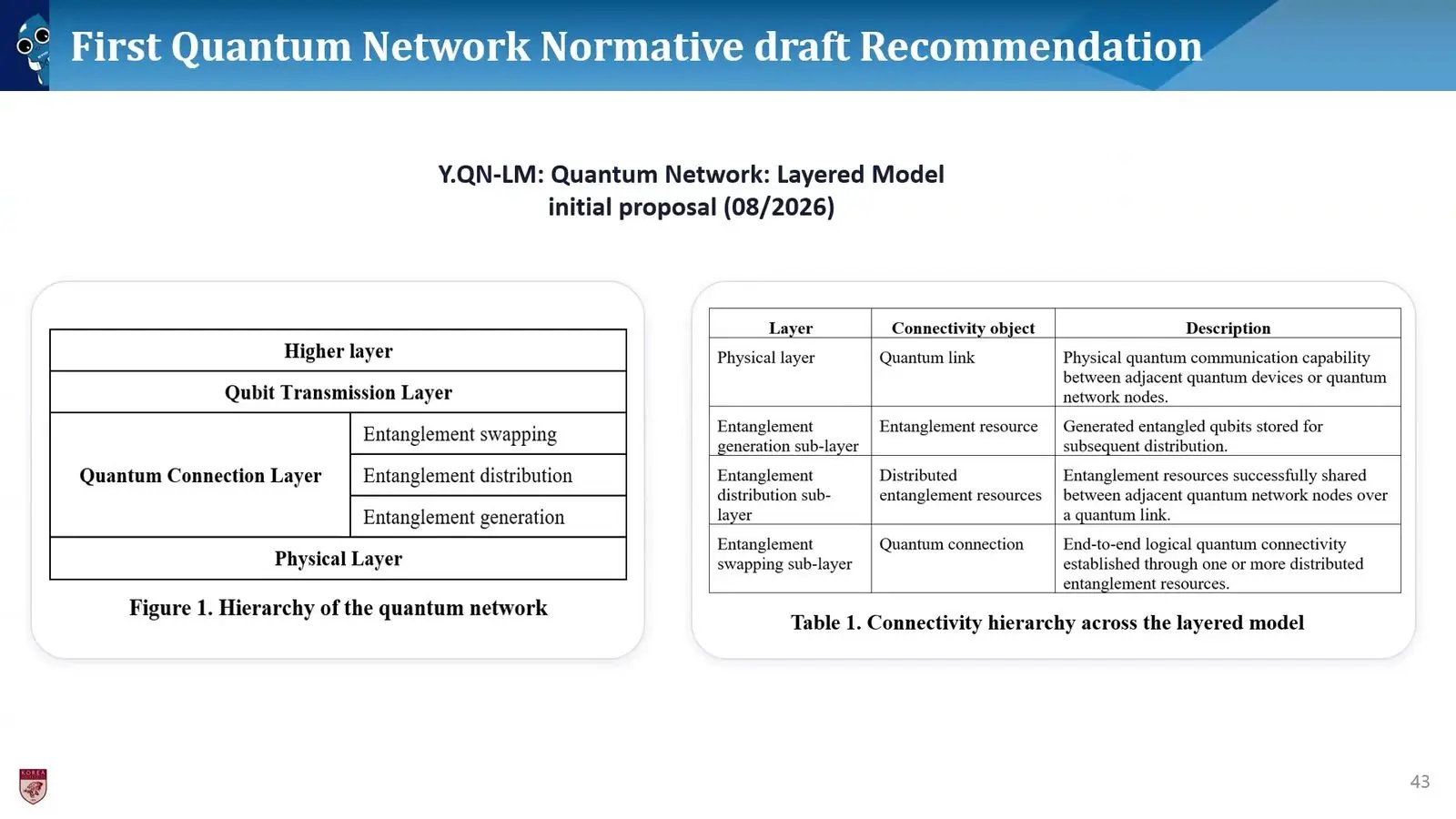
The model has three layers, with the physical kit at the bottom, a middle layer that makes, shares and swaps entanglement, and a top layer that moves qubits. Choi closed on four questions the bodies must settle, and the first is words. ITU-T says quantum network. ISO says quantum communications, and the internet research group says quantum internet. ETSI’s key group, Choi added, has 13 published papers, most of them on how devices connect.
Panel asks whether standards are too early
On the closing panel, Cacciapuoti said the field can agree now on words, on measures such as link quality and on test cases. Design and protocols are too early, Cacciapuoti said. Choi said ITU-T is driven mainly by telecom firms, so researchers should join and fix the draft if it is wrong, and one listener worried that rules were being written for things that do not yet exist.
Cacciapuoti added that the most common key schemes use no entanglement at all, so a model built from key networks may not carry over. Choi pointed to 6G work, where technical reports run for three to four years before formal standards begin, and would start with one small quantum network and leave links to older networks for later.
Measuring and certifying a link
A network has to know what its links are doing before it can trust them. Four talks measured or certified links, three of them in models or simulation and one from a test bed’s data.
UMass puts the noise from shared traffic on 15 km of fibre at about a third
Xuchuang Wang, Joseph Chapman, Matheus Guedes de Andrade, Yu-Zhen Janice Chen, Joseph Lukens, Gayane Vardoyan and Don Towsley wrote this paper, which won a best-paper award in the QNET track. A doctoral student from the UMass Amherst group presented it. The goal is one strand of fibre doing both jobs. Their model splits what a link does to quantum light into loss, survival and noise that scrambles the state, measured with traffic off, then with traffic going the same way, then the opposite way.
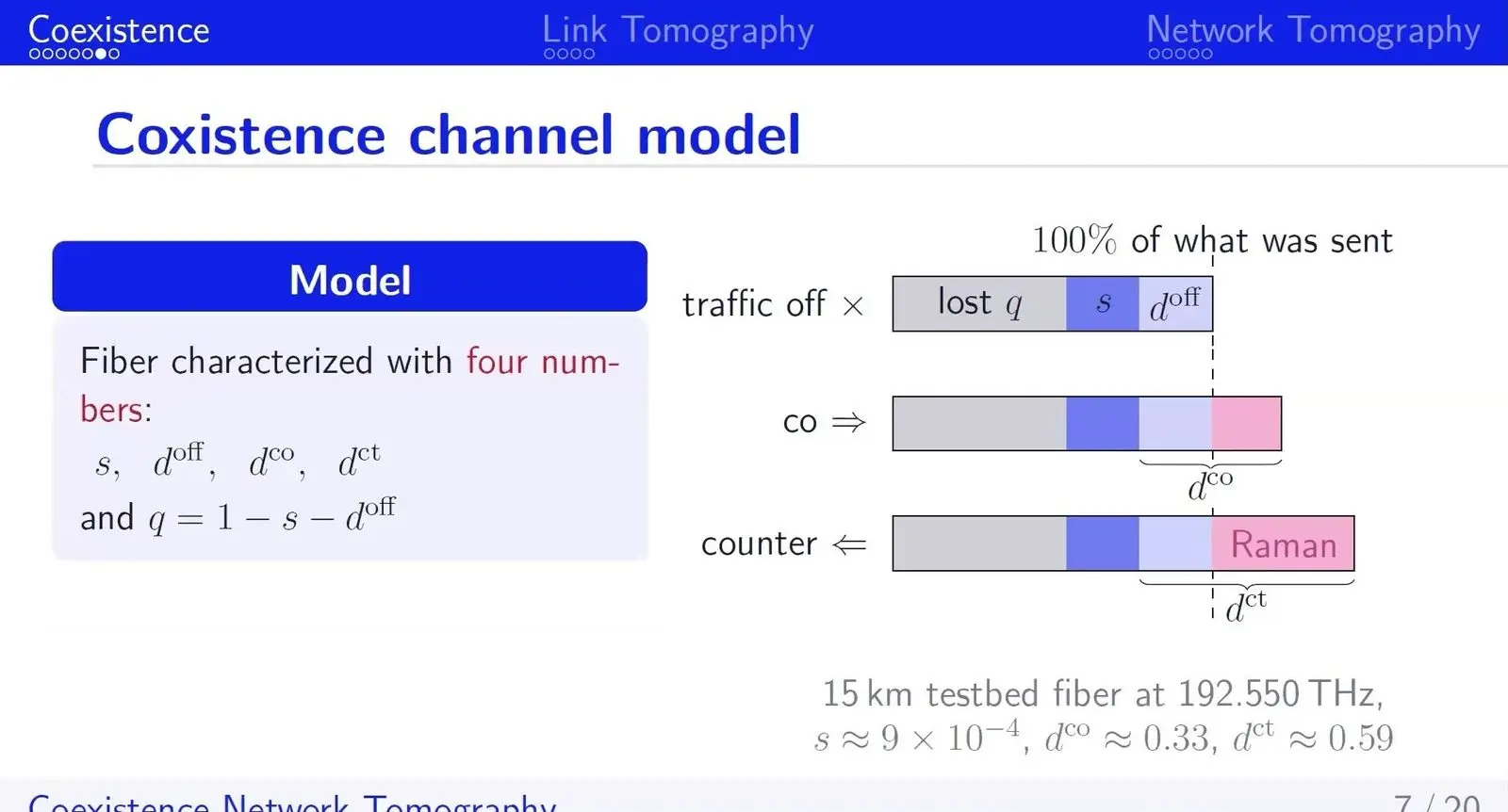
The numbers came from a published test bed at Oak Ridge National Laboratory, with fibres of 0.5, 5 and 15 km. On the 15 km fibre the surviving fraction was about 9 in 10,000, and traffic in the same direction added a scrambling term of about 0.33, against about 0.59 for traffic going the other way. Each setting used 125,000 photons. For a star of fibres the team built the whole picture by simulation from those measured links.
UMass offers quantum probes for link loss and leaves the gain open
Yufei Zheng, Zihao Gong, Saikat Guha and Don Towsley asked whether quantum probes can estimate how much light every link in a network lets through, and a doctoral student from the same UMass Amherst group presented the paper. Today’s method is slow. It relies on solvers whose run time grows with the cube of the number of links. The new probes target large sets of links whose information does not overlap, a choice the presenter called a heuristic.
Asked how large the quantum gain is, the presenter said its scaling is not yet known. The maths behind the estimate also assumes perfect measurements, so the paper offers a quantum route to the estimate and leaves its size for later work.
Stony Brook’s Bell test lets no bad batch through in simulation
Xuan Du Trinh of Stony Brook University presented with five co-authors from Stony Brook and Brookhaven National Laboratory. The CHSH test compares how two parties’ results line up. No unentangled pair can score above 2. Trinh’s check spends some pairs in each batch on the test, and the rest are kept for use only if the whole batch passes it.
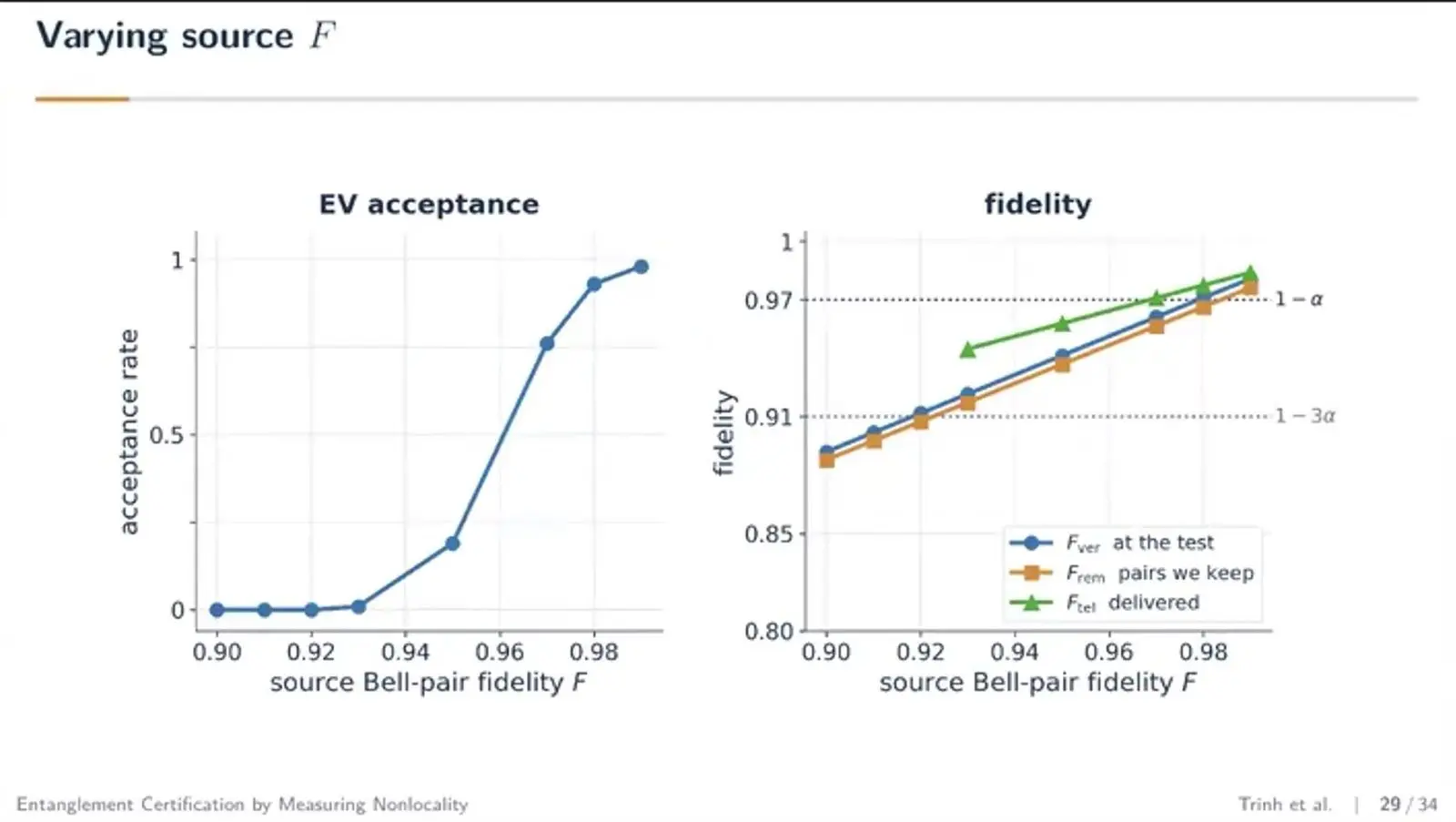
The model, built in SeQUeNCe, gives Alice a source of entangled photons and a memory, joined to Bob’s memory by a fibre that loses and scrambles photons. Across 500 low-quality batches the check wrongly accepted none. As source quality rose from 0.90 to 0.99, the share of batches accepted climbed from zero to near one. The results come from simulation only.
Dresden shows one link report can hide whether a circuit will run
Sakineh Ghaderi of TU Dresden presented with Vignesh Raman, Riccardo Bassoli and Frank Fitzek. A link usually reports two figures. Those are how often it makes pairs and how good they are after one set storage time, and Ghaderi asked whether they can prove that a circuit spread across nodes will work. In their model two links report the same rate and the same quality, 0.8125, yet one memory holds for 400 millionths of a second and the other for 40.
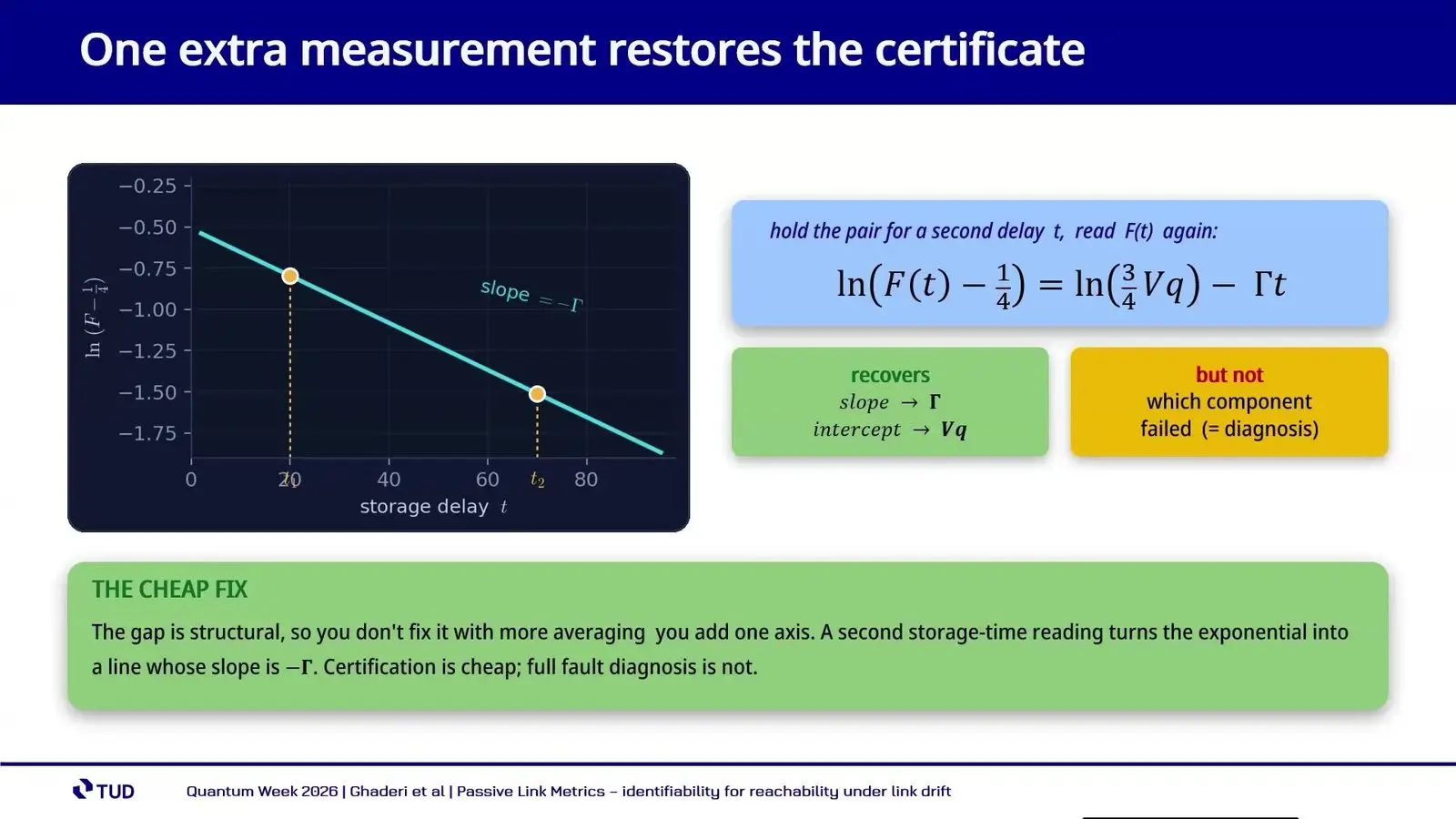
The margins came out at 0.057 and minus 0.113, so the same report calls one link usable and the other not. The fix is one more reading. Hold the pair for a second delay, and the slope between the two readings gives the rate at which the memory fades. That still does not say which part failed, and the whole argument is a model with no measured data.
Key distribution protocols, proofs and software
Key distribution is the one use the roadmap put near market. Four talks worked on its protocols, its security proofs and the software that runs it.
Padua’s hypercube walk drives the eavesdropper’s overlap towards zero
David Polzoni of the University of Padua presented with Tommaso Bianchi and Mauro Conti. In their scheme Alice sends either a plain state or a quantum walk, a quantum version of a random walk over a graph. Bob either measures or runs the walk backwards. Security rests on how much the results in the two bases overlap, and a smaller overlap leaves an eavesdropper less to guess.
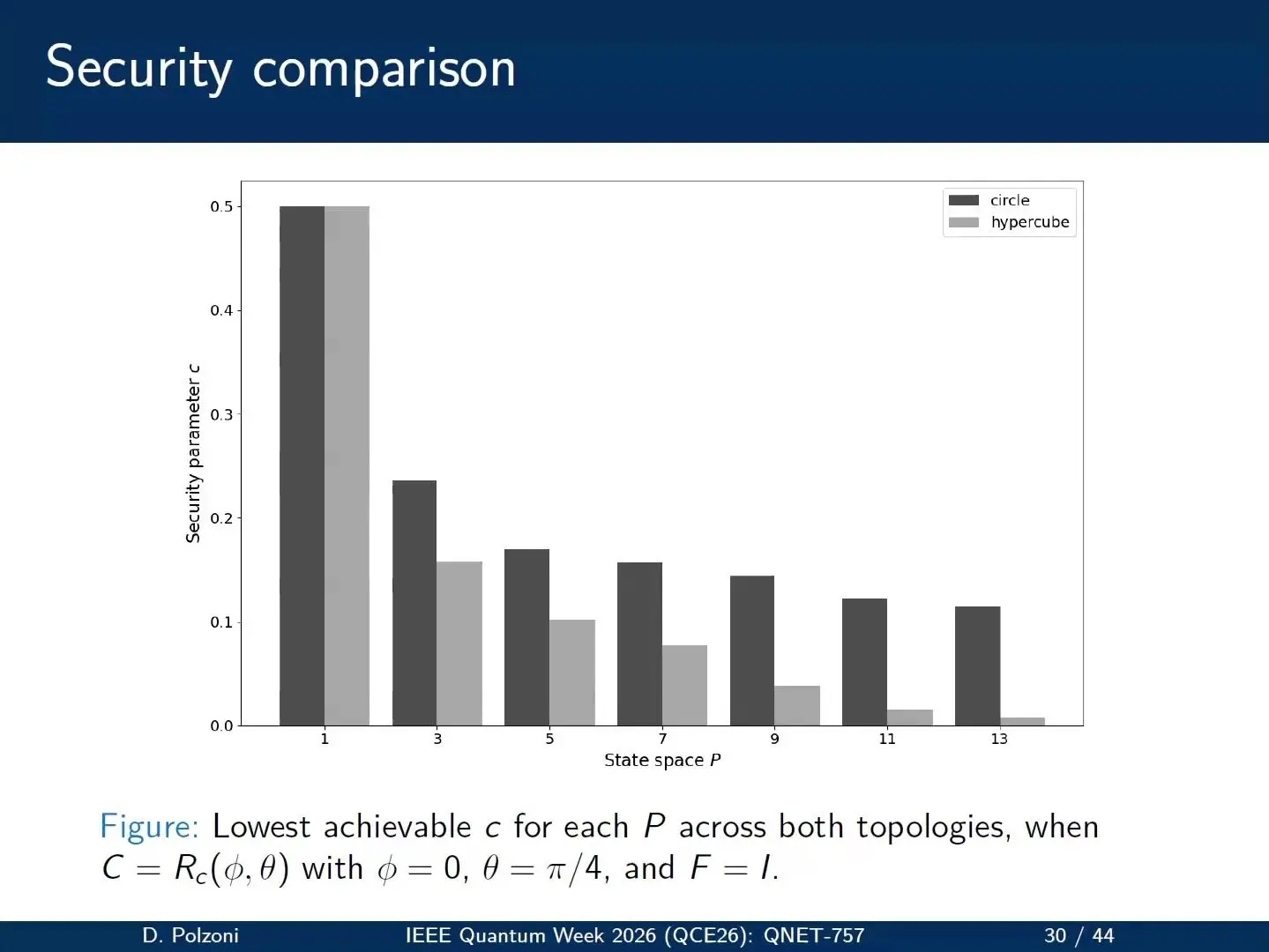
Earlier work walked a circle. Walking a hypercube instead drove the overlap almost to zero by a state space of 13, while the circle’s stayed above 0.1, and under two kinds of noise the tuned hypercube coped best. The study is a Qiskit Aer simulation with no finite-size corrections. Asked what hardware could run it, Polzoni named no source.
Connecticut proves extended B92 secure with finite keys
Walter Krawec of the University of Connecticut proved that the extended B92 protocol stays safe with a finite number of signals, against the most general attacks, for sources that send one qubit at a time. Plain B92 sends two states. An eavesdropper can beat it by measuring as Bob does and dropping every photon that gives no clear answer. So a 2010 version adds two test states and never says which basis was used.
Krawec let the attacker prepare any state of known size, with links between rounds and no assumption of a simpler attack. The overlap term in the key length came out at exactly one, and the limit for long keys matches the known rate. Loss is the easy part, Krawec said. The hard step is a proof for sources that sometimes send more than one photon, and Krawec asked the room for ideas.
Dalhousie finds signing every message cuts throughput from 15,741 to 246
Saul Hafting of Dalhousie University wrote this paper as a second-year student on a first work term, with Darshana Upadhyay, Sagarika Ghosh and Srinivas Sampalli. Hafting found three holes in plain BB84 code. Its random seed is not truly random. Its classical channel is open, and nothing renews a session that looks unwell.
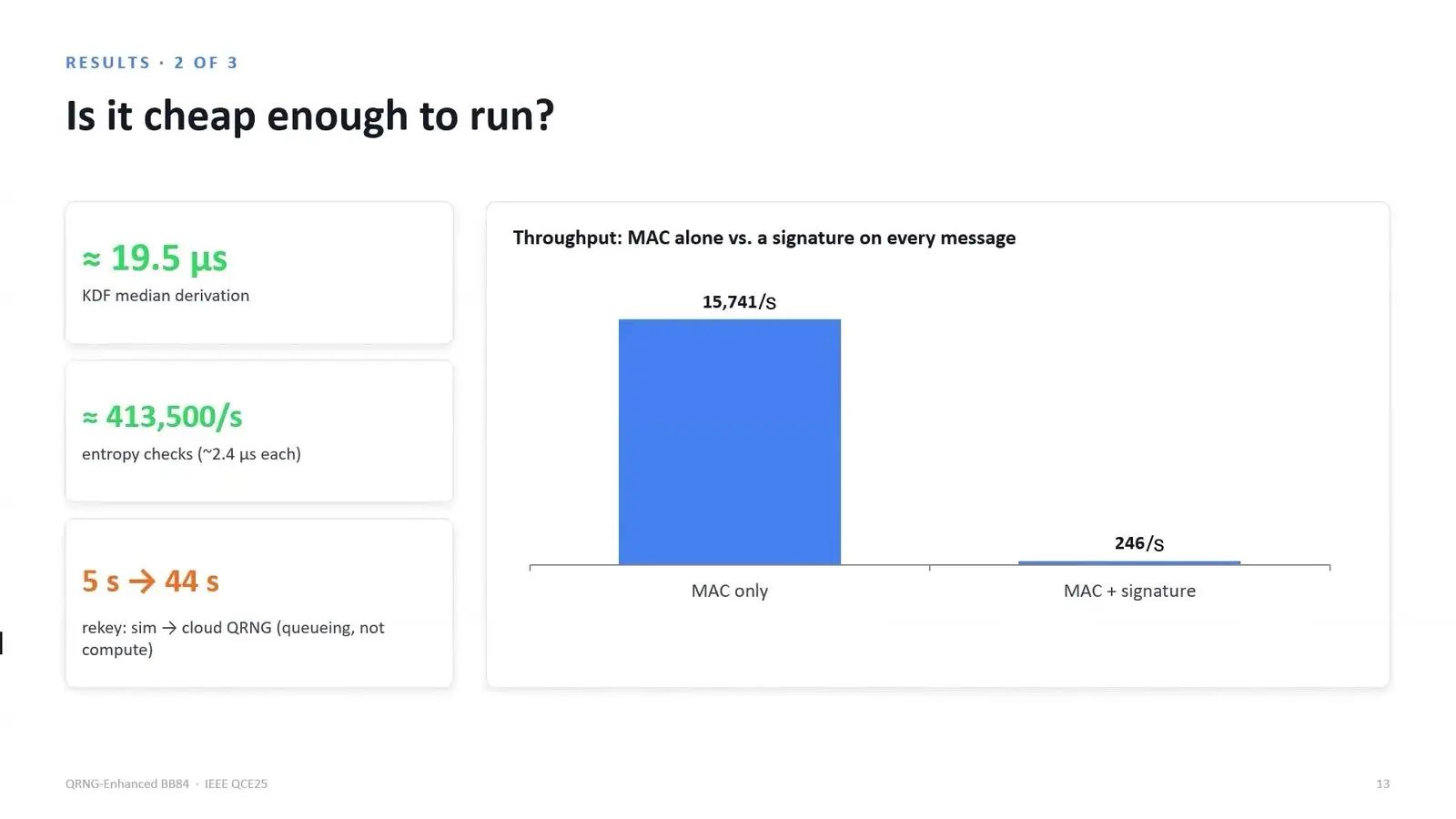
The random bits came from a one-qubit circuit run on an IBM quantum chip, and those bits passed all 16 of NIST’s tests of chance, where an ordinary computer’s sample passed 2. A post-quantum signature called Dilithium3 signs the opening handshake once, and a message code called KMAC256 guards every later message. With the code alone the software handled 15,741 messages a second. Signing every message dropped that to 246. Asked how a chip’s output becomes proven randomness, Hafting offered no check beyond those tests.
NVIDIA runs key post-processing on a network card
Joseph Meyer of NVIDIA and Eindhoven University of Technology presented with Juan Jose Vegas Olmos and Idelfonso Tafur Monroy. Raw bits from key distribution must be sifted, checked, fixed and squeezed. Only then do they make a secret key. Meyer ran all of that on one Arm core of a BlueField-3 DPU, a network card with its own small computer, so the keys never leave the card.
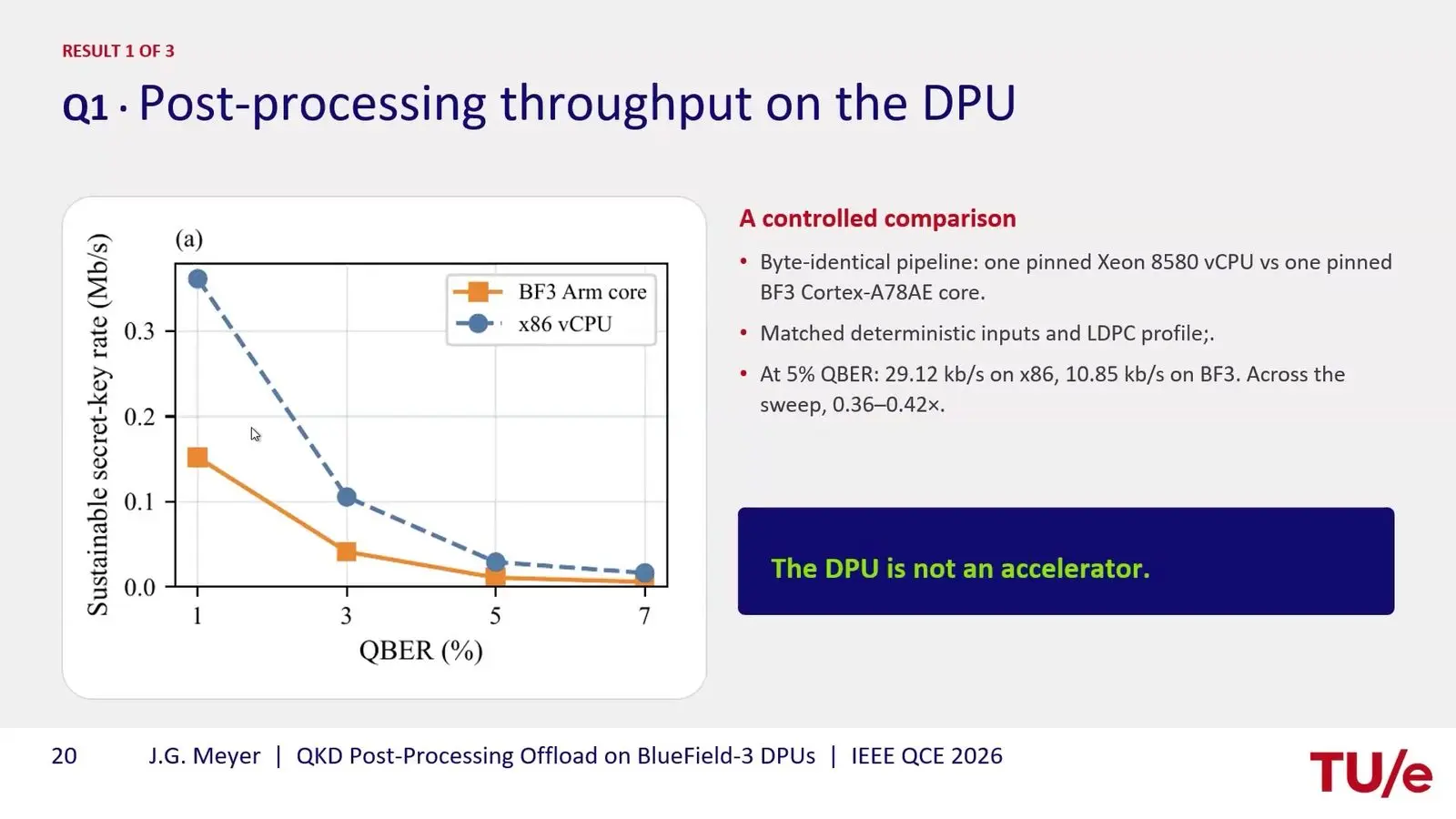
Error correction took about 97 percent of the time. At 5 percent error the card made 10.85 kilobits of secret key a second, against 29.12 on a Xeon core, and Meyer stressed that the DPU is no accelerator. That is still about 4,000 times what it takes to rekey encrypted data-centre traffic every minute. The quantum link itself was simulated.
What it means for network buyers and funders
For an operator or a funder, the order of spending follows from Toronto. Money belongs first in field links and in shared tests that make simulators agree on speed as well as quality, and only then in a faster simulator or a fuller standard. Any vendor with a modelled result should be asked how it compares with real fibre. Aliro’s Albuquerque loop, where a model was set against a working cable, is the test to copy.
Quantum key distribution is worth buying where it fits. Its reach is about 100 km and longer links still lean on trusted relays, so a buyer should weigh it against post-quantum codes, which run on normal computers and need no new fibre. For the firms selling into this market, see our guide to quantum networking companies.
Every simulator in Toronto ran in still air. The quantum networks that matter will hang outside like Gerrits’s cable, in the sun and the wind.
Frequently asked questions
What is a quantum network?
A quantum network moves quantum states, usually single photons, between distant places through fibre or open air. Its first use is quantum key distribution, which lets two parties build a shared secret and spot any eavesdropper. Later uses could join quantum computers into larger machines or link sensors and telescopes.
How far can quantum key distribution reach?
At QCE26 Farzam Toudeh-Fallah of Ciena put commercial quantum key distribution at about 100 km. Fibre loses light steadily, and quantum states cannot be copied and boosted, so longer networks today use trusted relay stations. Satellites and quantum repeaters are the planned routes to longer reach.
What is a quantum repeater?
A quantum repeater shares entanglement over short hops, stores it and joins the hops into one long link. It may also clean up pairs, spending two noisy pairs to make one better pair. Several QCE26 modelling papers found that this cleaning pays only in narrow conditions, especially once stored pairs fade.
Are quantum networks working outside the lab?
Some are, with constant care. At QCE26 NIST reported entanglement usable about 93 percent of the time on about 60 km of fibre around Washington DC. Aliro measured 126 secure bits a second on a 50 km loop in Albuquerque, close to its model, and both links swung with the sun or the wind.
Is quantum key distribution better than post-quantum cryptography?
They solve the same problem in different ways. Quantum key distribution needs special hardware and fibre and has limited reach, while post-quantum cryptography runs on ordinary computers. A panellist at QCE26 passed on the US National Security Agency’s view that post-quantum codes are the cheaper choice for now.
What happened at IEEE Quantum Week 2026?
IEEE Quantum Week 2026, also called QCE26, ran from 13 to 18 September at the Metro Toronto Convention Centre. This guide covers 67 of its networking talks, on field links, repeaters, simulators, routing, satellites and standards. Most of them modelled networks that do not yet exist at scale.
This guide is based on 67 talks, tutorials, workshop sessions and panels at IEEE Quantum Week 2026 (QCE26), held at the Metro Toronto Convention Centre from 13 to 18 September 2026, and on the published conference programme. Names follow the programme where it lists them. Workshop speakers, affiliations and titles not listed there are as speakers gave them. Results are stated as each speaker presented them, and most come from simulation or emulation. Company claims are the companies’ own.
- Qubit hardware and scaling roadmaps
- Photonics and quantum sensing
- Control electronics, calibration and readout
- Quantum error correction and decoders
- Fault-tolerant compilation and magic states
- Modular and distributed quantum computing
- Quantum computers in supercomputing centres
- Compilers, circuit synthesis and languages
- AI and language models for quantum software
- Testing and reproducible quantum experiments
- Benchmarks, error mitigation and quantum advantage
- Quantum state preparation, oracles and arithmetic
- Quantum optimisation, QAOA and annealing
- Quantum machine learning
- Chemistry, materials and life sciences
- Differential equations and fluid dynamics
- Power grids and energy
- Quantum finance
- Logistics, climate, databases and games
- Quantum security and post-quantum cryptography
- Quantum education and workforce
- Policy, standards and the quantum business

See today’s quantum computing news on Quantum Zeitgeist for the latest breakthroughs in qubits, hardware, algorithms, and industry deals.