This guide follows 33 quantum chemistry and life-science talks at IEEE Quantum Week 2026 in Toronto. In most of them the quantum share of the problem was small, and getting smaller.
On the Monday morning of IEEE Quantum Week 2026, Alán Aspuru-Guzik of NVIDIA and the University of Toronto opened a simulation workshop by framing quantum chemistry as a race. On one side stood today’s quantum machines. On the other stood the classical ones, which keep getting better at it. Aspuru-Guzik co-wrote the 2014 paper that gave quantum chemistry VQE, the method much of today’s chip-based chemistry builds on. Yet in Toronto the same scientist showed an AI model that does the work of a top classical method. It handled a chain of 100 carbon atoms in two minutes.
Quantum chemistry is the oldest promise of quantum computing. Molecules are held together by electrons that obey quantum rules. To track them all exactly, an ordinary computer needs twice the memory for each new slot an electron can sit in. In the early 1980s Richard Feynman proposed modelling one quantum system with another. Classical chemistry has not stood still since. Cheap methods handle most everyday molecules. Coupled cluster, the method chemists trust for accurate energies, works well while the electrons behave in an orderly way. Both struggle where electrons are tightly bound up with each other, as when a bond is pulled apart or a metal atom sits at the heart of a catalyst.
Such a region is a knot in an otherwise orderly rope, and the knot is where quantum computers are expected to help first. Read together, the 33 talks followed here support a case that is easy to state and hard to welcome. Chemistry is still the best first use for a quantum computer. But the quantum share of each problem has shrunk to a narrow knot, and at QCE26 the classical side was untying it faster than the quantum side could grow.
The strongest case against that view came from Tom Beck of Oak Ridge National Laboratory. Beck’s team, from seven national laboratories, four universities and industry, used IBM hardware to correct the energy of salt clusters for fusion reactors. Beck called these the first results on real quantum hardware for a fusion material. Beck expects a crossover at 100 to 200 electrons. On that view the knot is real and grows with the size of the problem, and a hybrid design that splits the work is how quantum hardware earns its place. Aleksander Wennersteen of Pasqal went further, saying Pasqal’s atoms followed a real magnet past the point where classical methods lost track, though the target was a model of magnetic spins rather than a molecule’s electrons.
Yet the same results show how much rides on the classical part. Artur Izmaylov’s method needed up to 2,800 times fewer shots than a standard rival on stretched nitrogen, and it turned into a threefold loss once the classical part carried little of the answer. Beck’s tritium binding was off by up to 100 kilocalories per mole, an error Beck traced to the classical step missing almost a third of the electron effects. Kunal Sharma’s IBM runs matched DMRG, a classical method for chain-like systems, without beating it. At IBM’s own tutorial, Thaddeus Pellegrini said the classical split moved a glycine answer more than the choice of solver did.
The user in the room asked for something else. On the Sunday afternoon Vikram Mulligan of the Flatiron Institute, who designs peptide drugs, said the group uses quantum computers and does quantum chemistry, but has not yet put the two together. Mulligan wants fast, rough energies over many shapes. That moves the question from one exact answer to speed across thousands of shapes, a race the quantum chip has not yet entered.
What it is. Quantum chemistry on quantum computers aims to model the electrons that hold molecules together. Today it pairs a strong classical method with a small quantum step aimed at the hardest part.
What changed at QCE26. Hardware runs reached 117 qubits on IBM chips, 61 on an IonQ machine and 256 atoms on Pasqal’s analogue machines. Classical and AI methods moved faster still, shrinking the part left for the quantum step.
The best hardware result. Oak Ridge used IBM hardware to correct energies for a fusion-reactor salt. Conformations came within about 10 kilocalories per mole of exact, while the tritium binding was off by up to 100.
The warning. Most speakers framed their quantum step as a match for classical methods, short of a win. Lolur said a laptop still solves their 16-qubit case, and others conceded that DMRG or Rosetta still handles theirs.
Hybrid methods that keep the quantum part small
Most of the week’s chemistry talks gave the chip one narrow job and left the rest to a classical computer. Three talks and IBM’s two-part tutorial set out how far that split can go, and where it breaks.
Toronto trades one deep circuit for several shallow ones
Artur Izmaylov of the University of Toronto Scarborough opened the chemistry workshop. The main flaw of VQE, Izmaylov said, is depth, since gate errors that nobody fixes pile up faster than the answer gets better. The fix swaps one deep circuit for a few shallow ones, and a small sum on an ordinary computer then mixes them. Shallow circuits pick up fewer errors.

The method keeps the part of the answer a classical computer can handle, and adds quantum circuits only for what that part misses. For nitrogen pulled apart from 1.1 to 1.8 angstrom, where the classical part carried more than 99 percent of the answer, it needed 1,300 to 2,800 times fewer shots than the standard ADAPT-VQE method. At 3.0 angstrom, where it carried little, it needed about three times more. Izmaylov called that the limit of a classical split.
Central Florida tests what moves a sample-based answer
Ahatesham Bhuiyan’s team at the University of Central Florida tested a method called sample-based quantum diagonalisation. A chip draws bit strings. A normal computer then solves the small grid of numbers they define. The team ran three small molecules at 24 to 32 qubits on IBM’s ibm_fez to see which of their choices, from the layout of the qubits to the number of shots, change the answer.
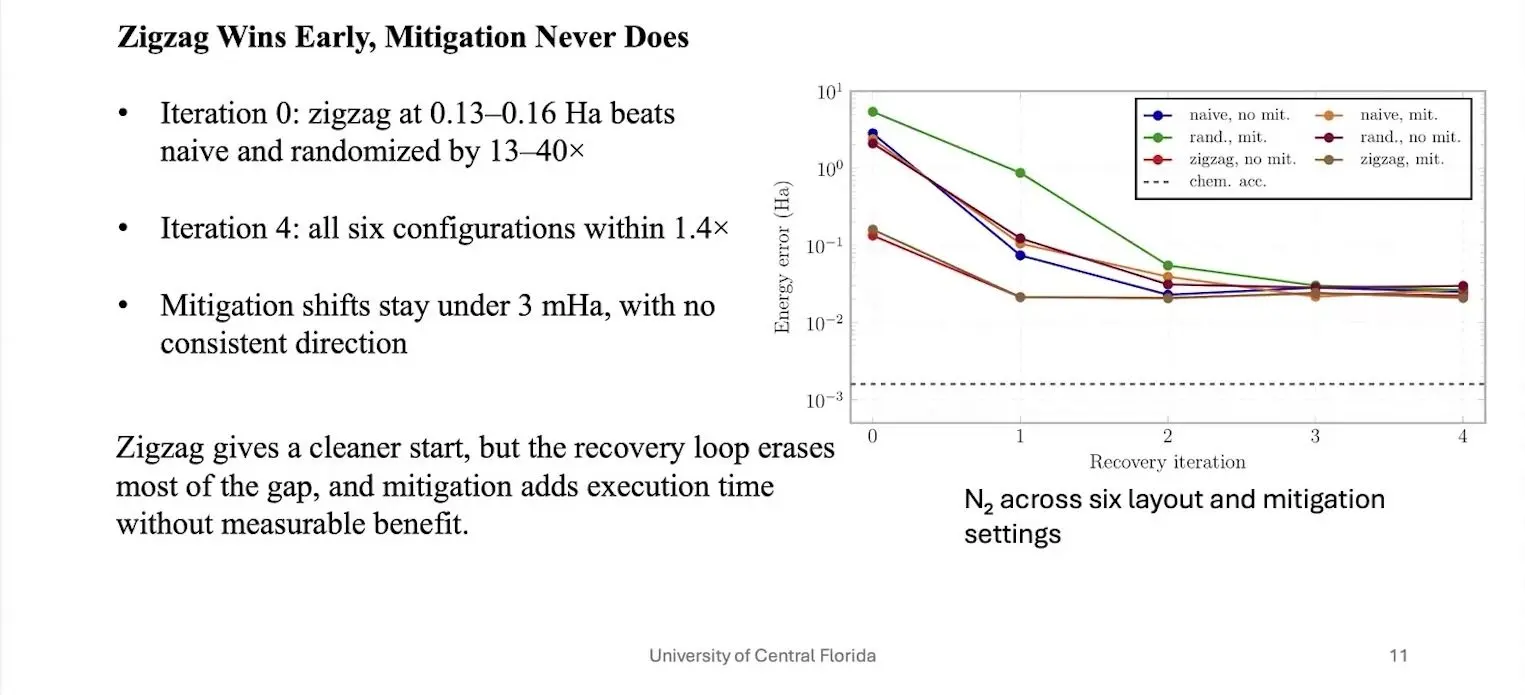
A careful layout of qubits on the chip started 13 to 40 times more accurate than a careless one, yet after four rounds of repair all six setups ended within a factor of 1.4. Budgets of 1,000 and 10,000 shots did best. Bhuiyan listed one machine and one run per setting as limits.
IBM matches a classical benchmark on an iron-sulphur cluster
Kunal Sharma of IBM Research showed results from IBM chips that matched DMRG, a strong classical method, on an iron-sulphur cluster at 50 to 80 qubits. IBM’s Heron chips run circuits about 100 to 150 gates deep. That is too shallow for the textbook quantum method, so the method samples bit strings and solves for the energy in the space they span.
The chip also matched a 40-qubit model that was built to fool a classical shortcut, though DMRG still solved it, and Sharma said the case was made for the test. Forty-five spin models ran at 115 qubits close to DMRG.
IBM’s tutorial repairs noisy bit strings before the classical solve
Kevin Sung of IBM, who built the ffsim simulator, taught sample-based quantum diagonalisation in the first half of a two-part tutorial. A chip samples bit strings, the molecule’s energy formula is cut down to the space they span, and an ordinary computer solves that small problem. Noise is the snag. Gate and readout errors give strings with the wrong number of electrons, and in one recent run Sung saw more than 90 percent of strings fail that test.
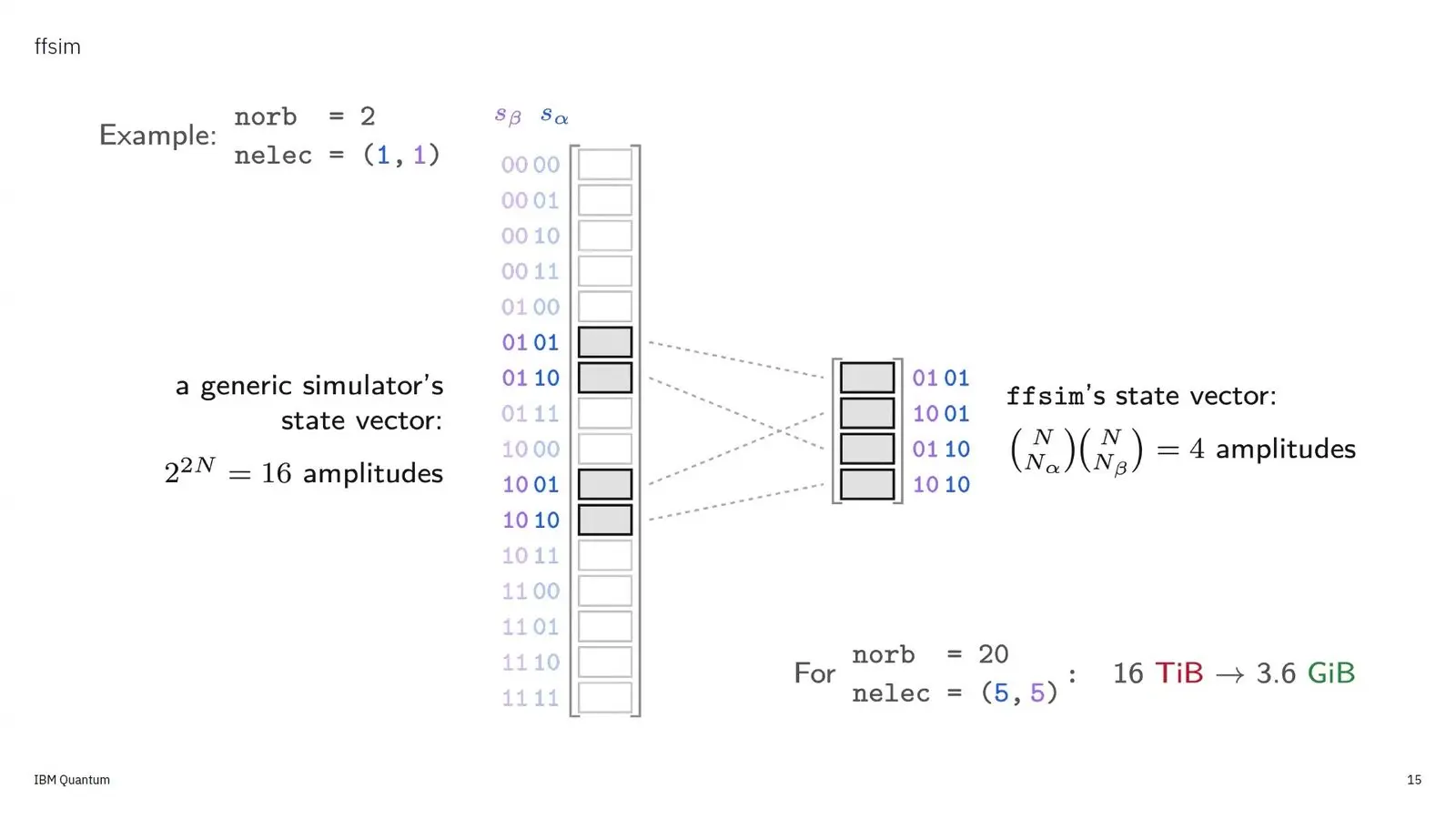
The fix flips bits with odds tied to how full each orbital looks, solves each batch on a normal computer and feeds the new guesses into the next round until they settle. Sung said the classical solve is usually the bottleneck. The ffsim simulator keeps only states with the right electron count, so a 40-qubit, 20-orbital state needs 3.6 gibibytes where a generic one needs 16 tebibytes. In IBM’s nitrogen notebook a 16-qubit case ran cleanly, while a 52-qubit case converged poorly on a notebook sized for a laptop.
IBM splits a 12,635-atom enzyme into fragments
Thaddeus Pellegrini of IBM gave the second half of the tutorial over to fragments. Each piece of a molecule is built from local orbitals plus a bath that stands in for its links to the rest, then sent on by size and difficulty. Small pieces go to exact solvers and middling ones to coupled cluster. Only the large, tangled ones, such as those near a metal atom, go to the quantum chip.
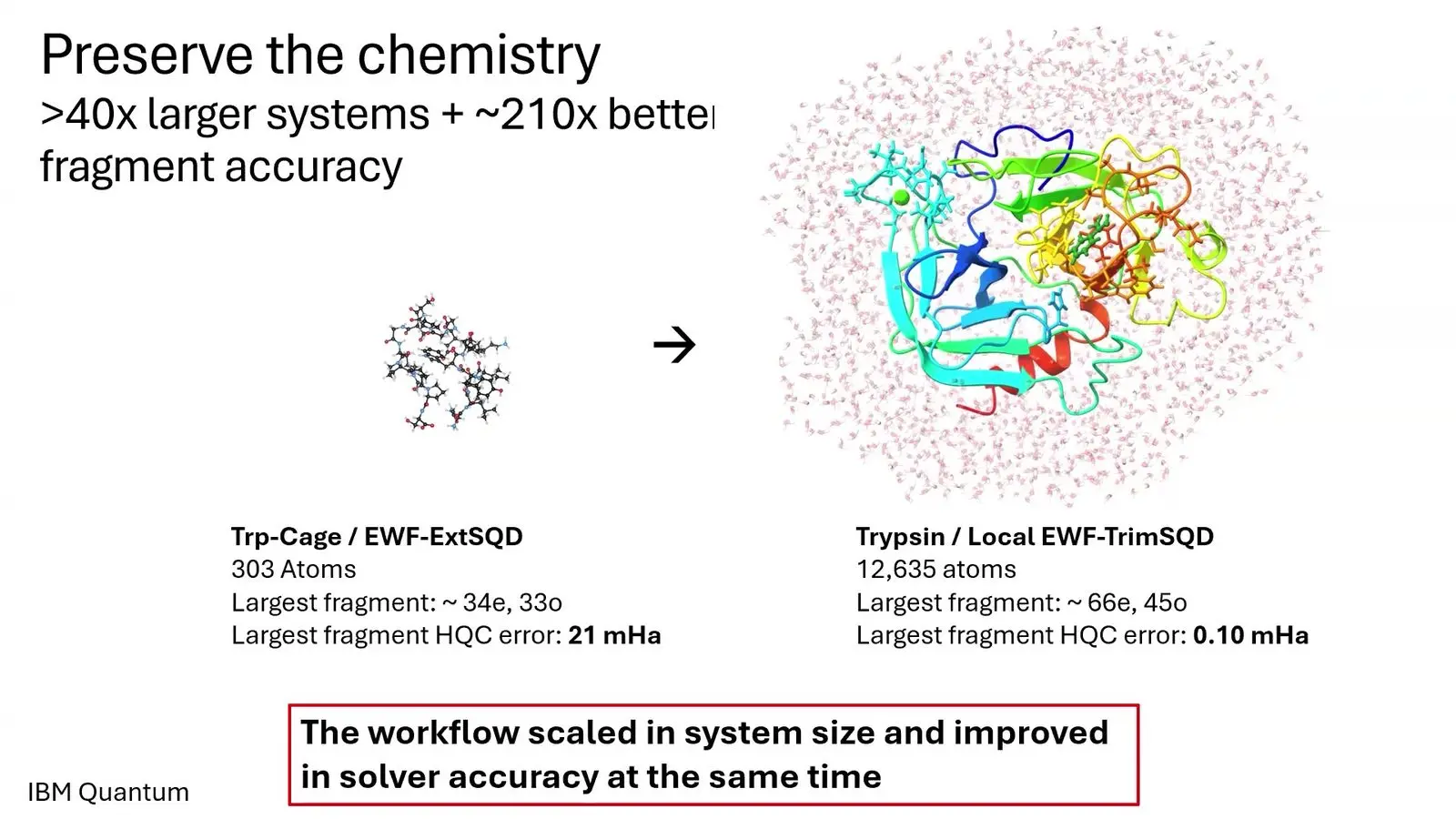
That route took IBM from a mini-protein of 303 atoms to trypsin, an enzyme of 12,635. The largest fragment’s error fell from 21 to 0.10 millihartree. The scaled-up work, with the Cleveland Clinic, RIKEN and the University of Tokyo, used 9,200 circuits of up to 94 qubits on two Heron r2 chips, plus the Fugaku and Miyabi-G supercomputers. Pellegrini called it a finalist for the ACM Gordon Bell Prize.
Glycine made the point. Coupled cluster everywhere landed 55.03 millihartree from the full reference, and a screened sample-based run landed 25.22. The embedding moved the result more than the choice of solver, Pellegrini said, and read the Oak Ridge salt study the same way. A layer written in Rust, called QRMI, lets a Slurm scheduler hand out quantum processors as it does GPUs.
Materials, batteries and fusion
The knot is tightest in materials built around metal atoms, where the electrons around each metal atom are tightly bound to each other and classical methods lose accuracy. Four talks took quantum methods there. They covered fusion fuel, batteries, carbon capture and a magnet.
Oak Ridge corrects fusion-salt energies on IBM hardware
Tom Beck of Oak Ridge National Laboratory began with what Beck called a polemic. The field, Beck said, has leaned too far towards technology and away from physical science. Beck’s plan splits the work, so that a big computer samples the chemistry, a quantum computer fixes the energy of each snapshot and the averages fix the final answer.
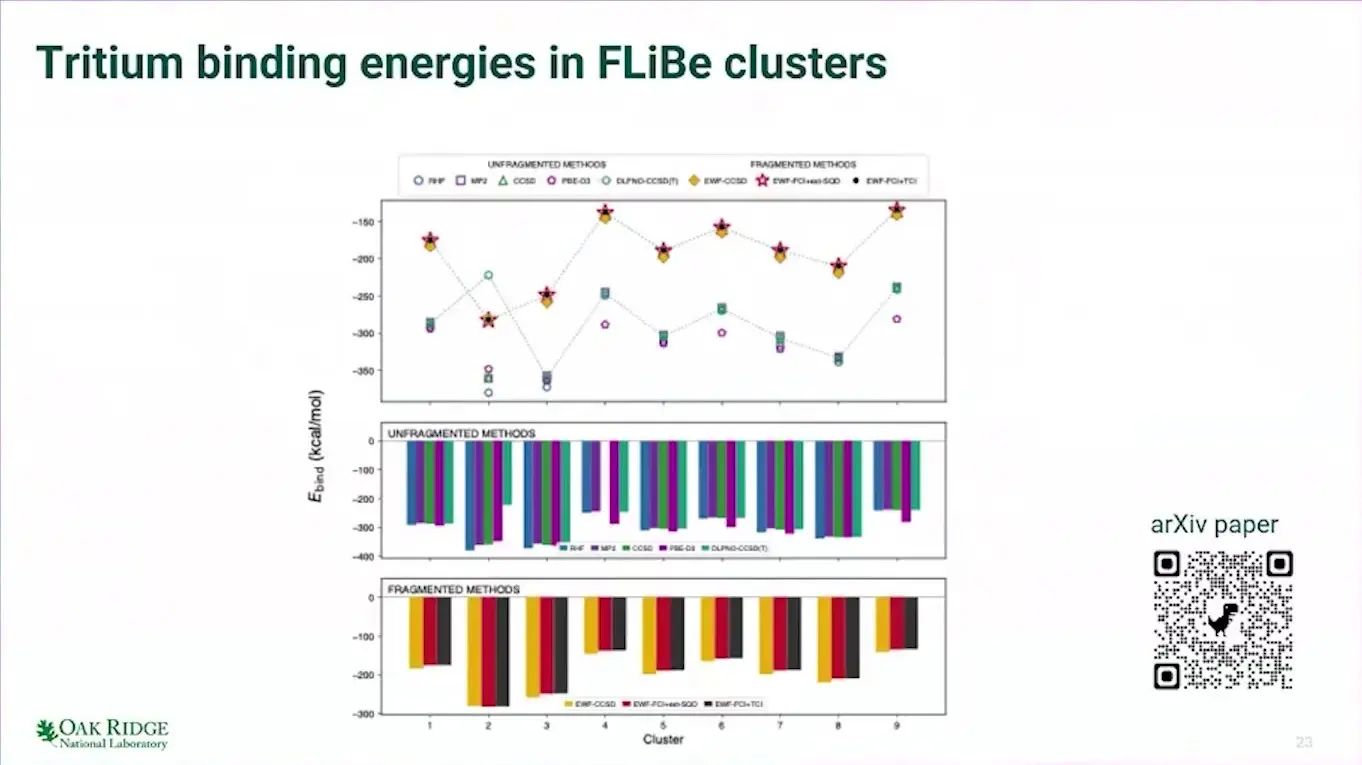
The test case was tritium, a fusion fuel. A reactor making one gigawatt needs about 450 grams a day, bred in a blanket of molten salt. On clusters of the salt FLiBe, run on IBM hardware with Mario Motta of IBM leading the quantum sampling, shape energies came within about 10 kilocalories per mole of exact. Tritium binding was off by up to 100, which Beck traced to the classical step missing almost a third of the electron effects. Beck said a new way of picking fragments cut the errors from 30 or 40 kilocalories per mole to about one, without showing the plot.
IQM targets a lithium-air battery
Sona Najafi, quantum solution manager at IQM, said about 10 IQM machines are now out in the field. One of them is at Oak Ridge. The example, studied by an IQM colleague in collaboration with Volkswagen, was a lithium-air battery, which theory says could hold about five times the energy of a normal one, though strong electron effects make the usual shortcuts miss its chemistry.
The chip only makes a first guess at the state. A classical sampling method called quantum Monte Carlo does the rest, and Najafi said this cuts the power in the cost formula from 5.5 to 4.5, so that at 100 orbitals the work runs about 248 times faster. Eight hydrogen atoms took 16 qubits and reached chemical accuracy. The lithium case is planned as a 40-qubit run.
Capgemini saves the quantum step for three metal atoms
Phalgun Lolur of Capgemini presented work led by Tom Montgomery and Adrian Varela-Alvarez on cages built from metal joints and carbon links, known as metal-organic frameworks, that can trap carbon dioxide. One frame can hold thousands of atoms. Yet the bond that matters sits in one small spot, so the team splits the frame into three tiers.

The bulk runs at a cheap level in seconds, a middle shell uses density functional theory and about three metal centres get the most accurate method, with the quantum processor kept for the smallest cluster. Today’s machines reach a depth of a few hundred gates, Lolur said, while the chemistry Capgemini wants needs tens of thousands. A variational demo has run. Lolur said the lab will use a classical method if it does the job.
Pasqal’s atoms follow a real magnet past classical reach
Aleksander Wennersteen, technical lead for quantum-centric HPC at Pasqal, used a different kind of machine. The atoms ran no gates. They were set out to obey the same kind of rules as a real magnet, TmMgGaO4, and then left to run, and the team checked what they did against tests on the magnet at the MagLab at Los Alamos.
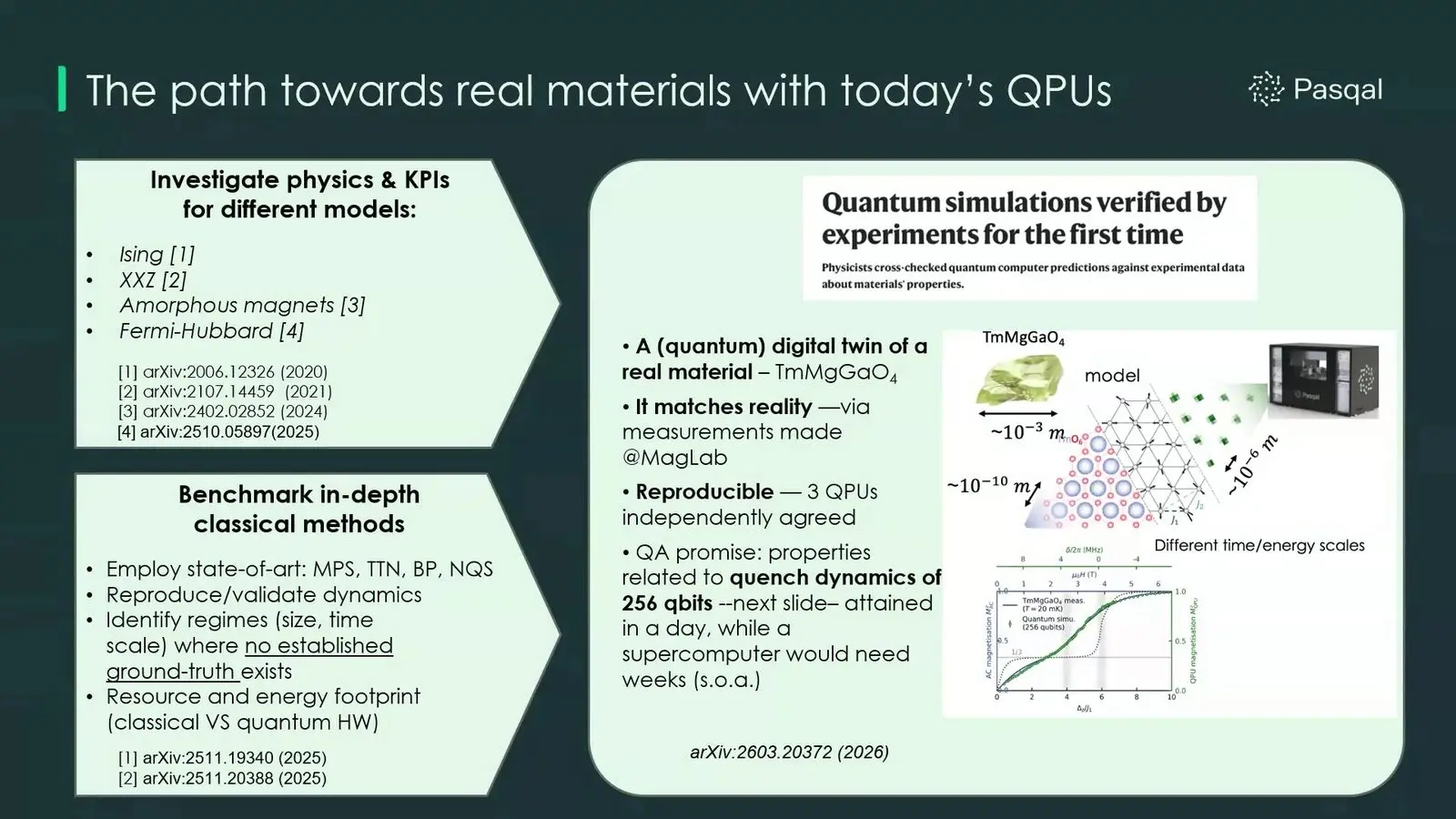
Wennersteen said classical methods could not follow the magnet’s quench dynamics, its response to a sudden change, past 225 qubits, while the atoms ran 256-qubit dynamics in a day. Pasqal claimed a supercomputer would need weeks. Runs on five machines in three countries agreed, which Wennersteen called a pleasant surprise. Before that the team spent years on classical emulation, pushing ground states to about 900 qubits on NVIDIA B200 GPUs.
Cheaper circuits and mappings
Before a molecule reaches a chip, its electrons must be rewritten in qubit terms, and the circuit must be kept short. Five talks worked on that bill.
Oxford learns a cheaper way to write electrons as qubits
Sergii Strelchuk of the University of Oxford worked with Thilo Müller of Oxford and Patrick McClure of the US Naval Postgraduate School. Their topic was cost. Each way of writing electrons as qubits gets the physics right, Strelchuk said, so the only real choice is cost, and on the sums shown, useful chemistry needs about 1,000 logical qubits and 100 million gates.
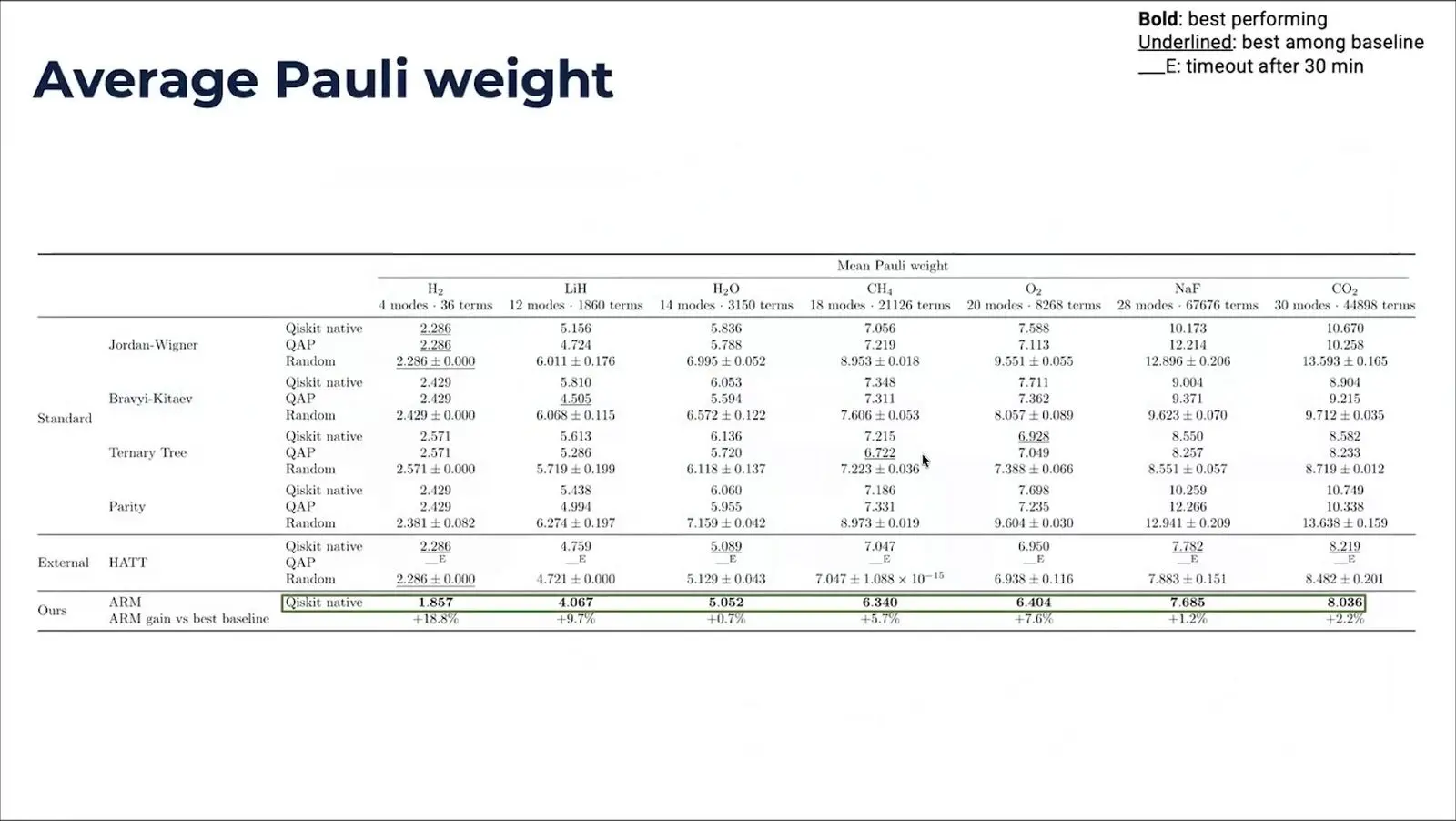
The method starts from a standard mapping and adds a layer of CNOT gates, each switched on or off by an optimiser running on graphics cards. Against the best tuned rivals, the average cost of each energy term fell 18.8 percent for hydrogen, 9.7 for lithium hydride and only 0.7 for water. Strelchuk prefers extra qubits to rough mappings with unknown error.
Venturus trims qubits before the search starts
Erico Souza Teixeira of Venturus, with Instituto QUANTA and the Federal University of Pernambuco, cuts the problem down before the search starts. Some facts never change. The count of electrons is one, so the search can sit in a smaller space, and a common way of writing electrons as qubits, called Bravyi-Kitaev, parks those facts on qubits that can then be dropped. That saves qubits.
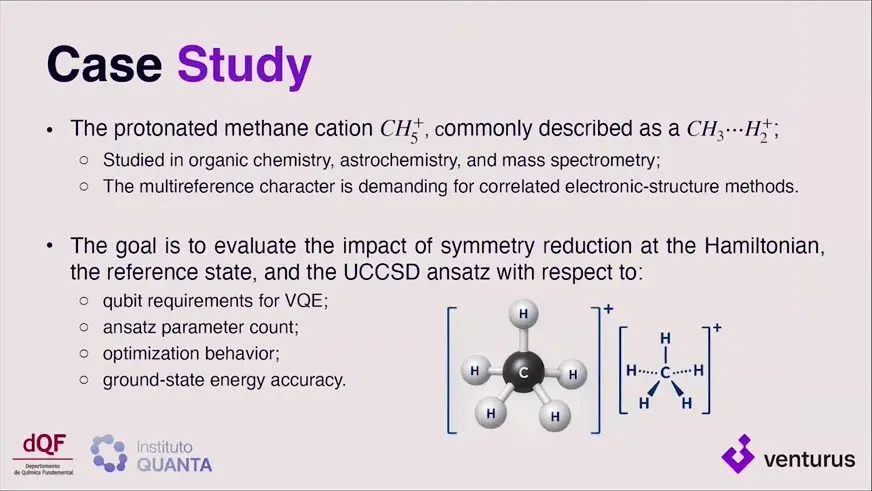
On protonated methane the cuts dropped up to five qubits and halved the count of Pauli strings, from about 800 to about 400. Every mapping reached chemical accuracy from the usual start. The Bravyi-Kitaev runs were the fastest.
Fraunhofer predicts orbital rotations with a graph network
Abhishek Dubey of Fraunhofer IIS works with a compact circuit that pairs electrons, which for four hydrogen atoms needs just three settings and nine CNOT gates where common chemistry circuits need about ten times more. Turning the orbitals first makes it shorter still. That step must be redone for every shape, so the group trained a graph neural network to predict it.
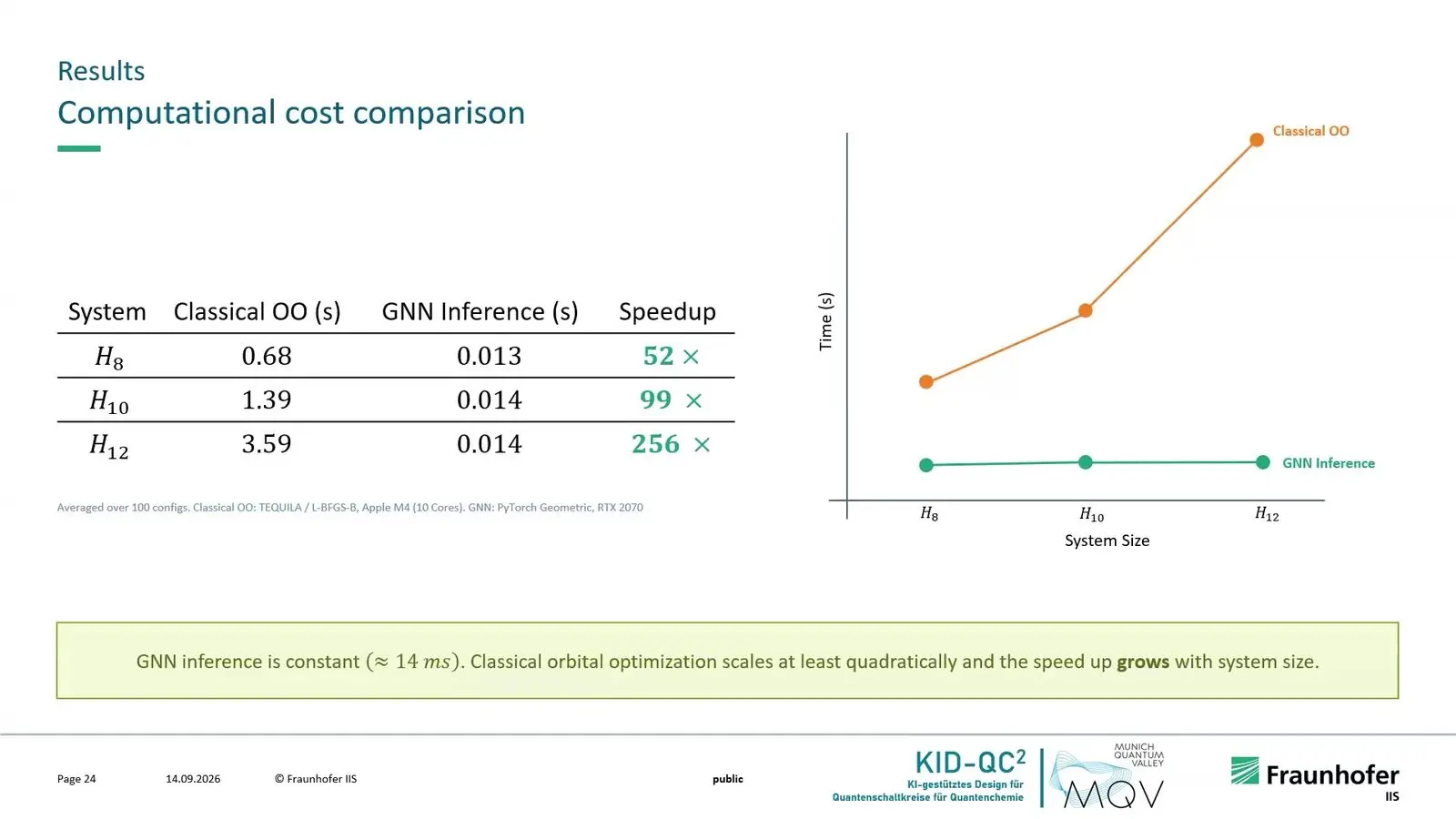
The network learned from about 140,000 shapes each of four- and six-atom hydrogen systems and was then tested on eight- to twelve-atom systems it had never seen. Each guess took about 14 milliseconds at every size, which is 52 to 256 times faster than the classical route, though errors grew as the systems got larger. Dubey said it has only been tried on hydrogen.
Lin and colleagues slim a generative eigensolver
A twelve-author team, from Yu-Cheng Lin to Nan-Yow Chen, slimmed down the generative quantum eigensolver. That method builds a chemistry circuit one piece at a time and picks each new piece the way a text model picks the next word in a sentence. The team swapped one block of its model for a smaller one.
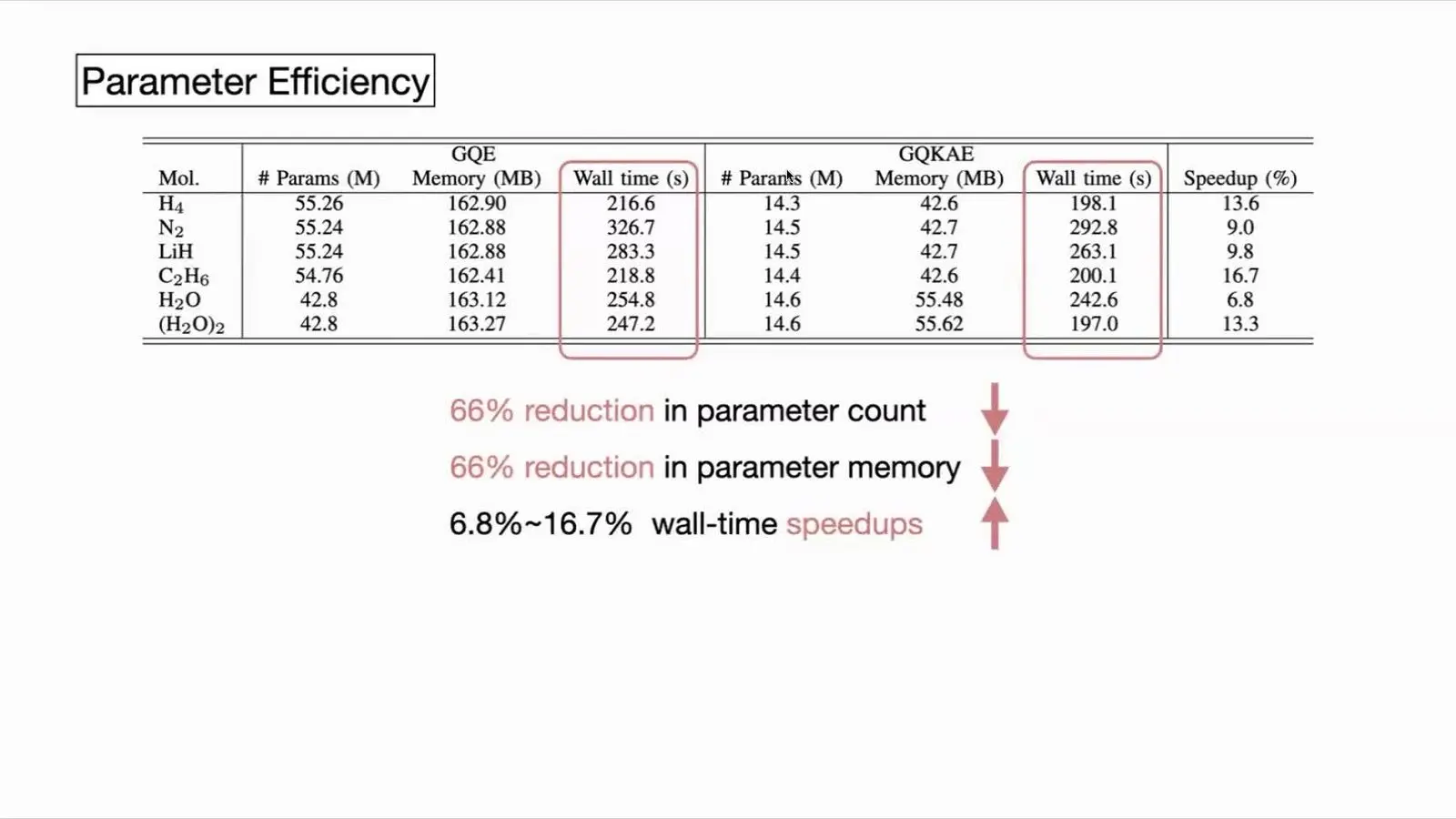
Settings and memory each fell by about 66 percent, with the settings for four hydrogen atoms dropping from 55.26 million to 14.3 million, and simulated runs finished 6.8 to 16.7 percent sooner. For water the circuits stayed near 740 two-qubit gates. None have run on a real device yet.
qBraid shows a small basis set misses before any qubit runs
James Brown, a research scientist at qBraid, took the first half of qBraid’s tutorial, after Kenny Heitritter toured a platform that reaches about 24 devices. Brown began with the error that comes before any chip. In the small STO-3G basis, which builds each orbital from three simple functions, hydrogen misses the energy of a large basis by about 0.04 hartree. The target is one thousandth of a hartree. Brown warned that STO-3G results in quantum papers are toy systems.

Each orbital holds a spin-up and a spin-down electron, so four functions need eight qubits, and a basis good enough for chemistry on oxygen needs about 120. Three standard mappings all gave the exact hydrogen energy. A Bell circuit on an IQM machine gave nine wrong outcomes in 1,000 shots, which Brown put down to hardware noise. Phase estimation could give exact energies, Brown said, but only with circuits far longer than today’s machines allow.
qBraid’s tutorial shows what design and noise each cost
The second half of qBraid’s tutorial, listed under Tarini Shekhar Hardikar and James Brown, worked through notebooks on the hydrogen molecule, the simplest test case in chemistry. A circuit shaped by the chemistry beat a plain one with more knobs. Checking each step against the molecule’s symmetry cut one circuit from 965 layers deep to 527, and its rounds of tuning from about 45 to 25.

Adding noise based on a QuEra device, with error rates of 0.3 to 0.5 percent per operation, made the result much worse. Almost every number came from a simulator with no noise. The session then turned to Q-Cliff, a circuit builder made with SandboxAQ, which reached very high accuracy on a 12-qubit problem with 631 terms in its energy formula.
Classical methods keep moving
Every quantum claim in chemistry is measured against a classical line, and that line moved during the week. Three talks showed how fast.
MoLe learns coupled cluster from orbitals
Aspuru-Guzik took aim at coupled cluster, the method chemists trust for most small molecules. Its best common form slows with the seventh power of a molecule’s size. MoLe takes the orbitals from a cheap first run and feeds them to an AI model that guesses the coupled-cluster answer, and since it gives back the full wavefunction, it gives forces too.
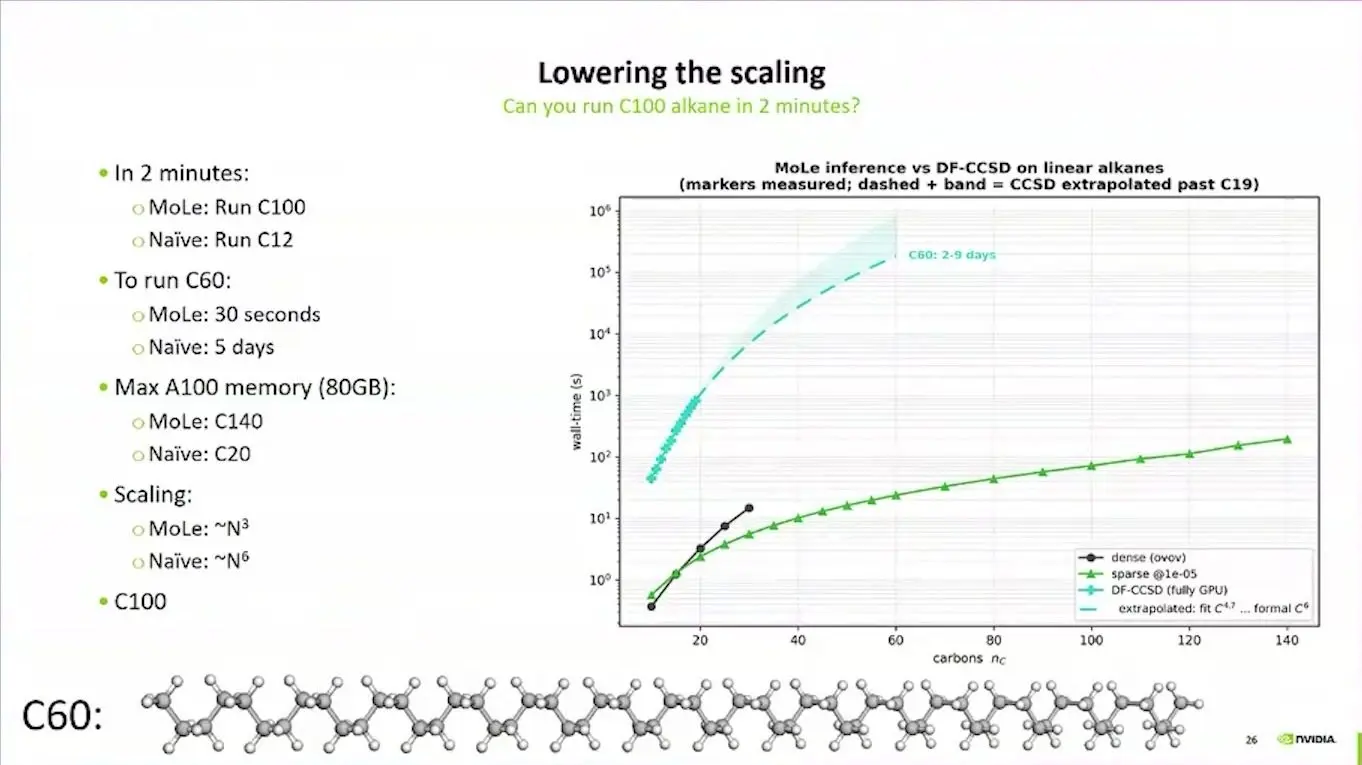
Trained on only 100 small molecules, MoLe was off by 0.66 kcal/mol on a standard test set, where a leading AI rival trained on the same data was off by 19.15. A chain of 60 carbon atoms took 30 seconds against an estimated five days. Asked if a quantum computer could feed it training data, Aspuru-Guzik said yes, and that MoLe would then become the quantum machine’s own rival.
Capgemini finds where tensor-network emulators run out
Phalgun Lolur presented a Capgemini study, done with GSK, by Marek Kowalik and Ellen Michael. A tensor network copies a quantum chip on a normal one by squeezing the state into a chain of small linked blocks, and the team asked how far that can go on molecules before the chain fills up.
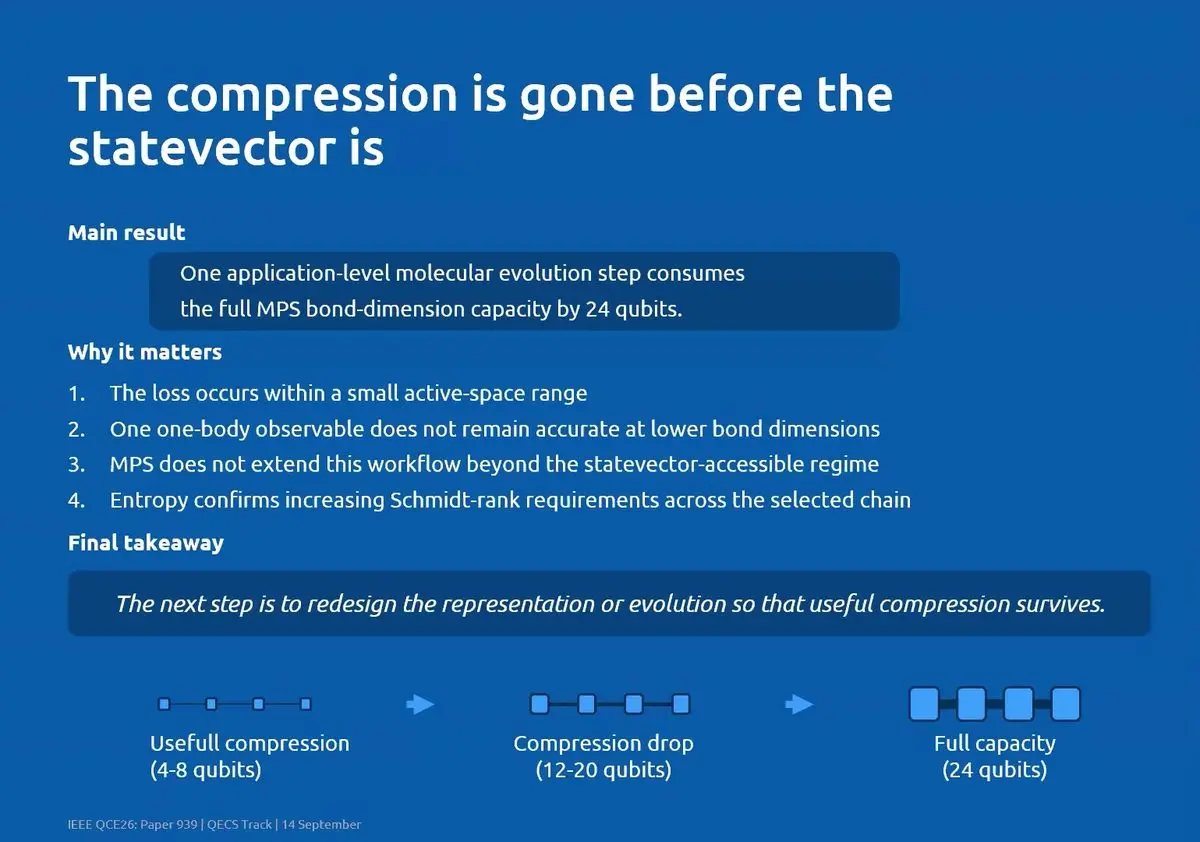
Useful compression held to about 16 qubits, Lolur said, and at 24 qubits the links in the chain were full. So the method stopped between 20 and 24 qubits. Lolur credited Fermioniq for the emulator.
Calgary audits the claims and finds the baselines weak
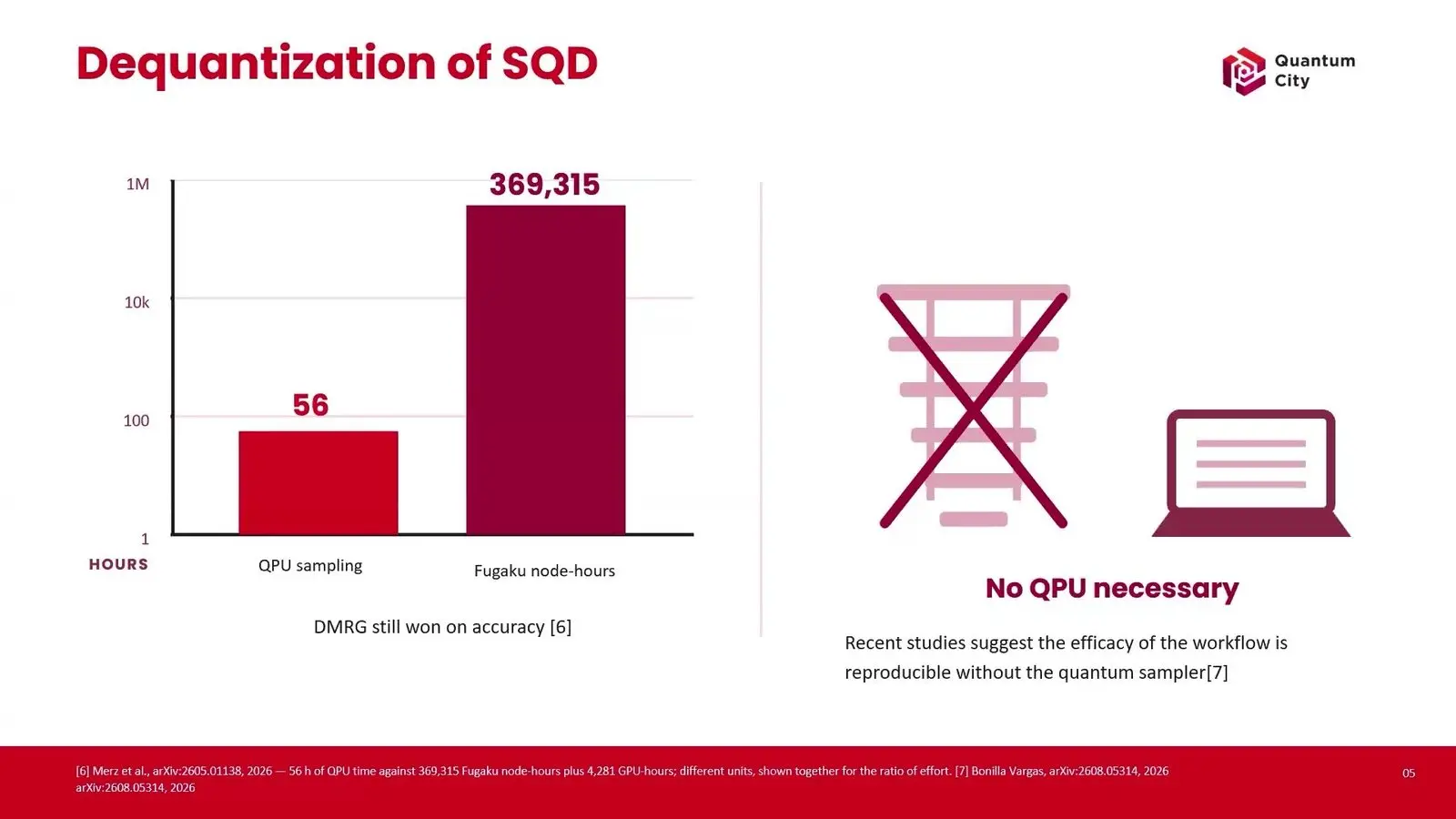
Sumner Alperin-Lea of Quantum City at the University of Calgary checked the claims made for quantum work on drugs and proteins against the rivals they beat. In one recent sample-based study, 56 hours of chip time sat beside 369,315 node-hours on the Fugaku supercomputer. DMRG still won on both accuracy and total compute. The units differ, Alperin-Lea noted. A second paper found the workflow works as well with no quantum sampler at all, and no author of these papers claims an edge.
Peptide folding drew the same scrutiny. A 13-qubit win came over a DMRG cut down to bond dimension 2, and a 123-qubit win over the CPLEX solver came against a three-hour laptop cutoff, with full CPLEX at parity in the same paper. The largest case Alperin-Lea described was 18 residues on 145 qubits, where the drug semaglutide has 31. Metal centres, protein interfaces and GPCR receptors remain open gaps, Alperin-Lea said.
Drugs, proteins and life sciences
Life sciences stretched the theme from drug reactivity to protein folding and cancer genes. Eight talks showed what the field’s users ask for, and what the chips could give them.
Flatiron’s peptide designer wants speed over precision
Vikram Mulligan, co-head of the Biomolecular Design Group at the Flatiron Institute, designs peptides. These are short, stiff chains of amino acids. Seven blockers designed this way for NDM-1, an enzyme that helps germs resist drugs, all worked, and the folding energy from the computer even ranked how well they worked. For a ring-shaped peptide that the usual model gets badly wrong, a cheap quantum method run piece by piece got within 0.663 angstrom of the true shape.
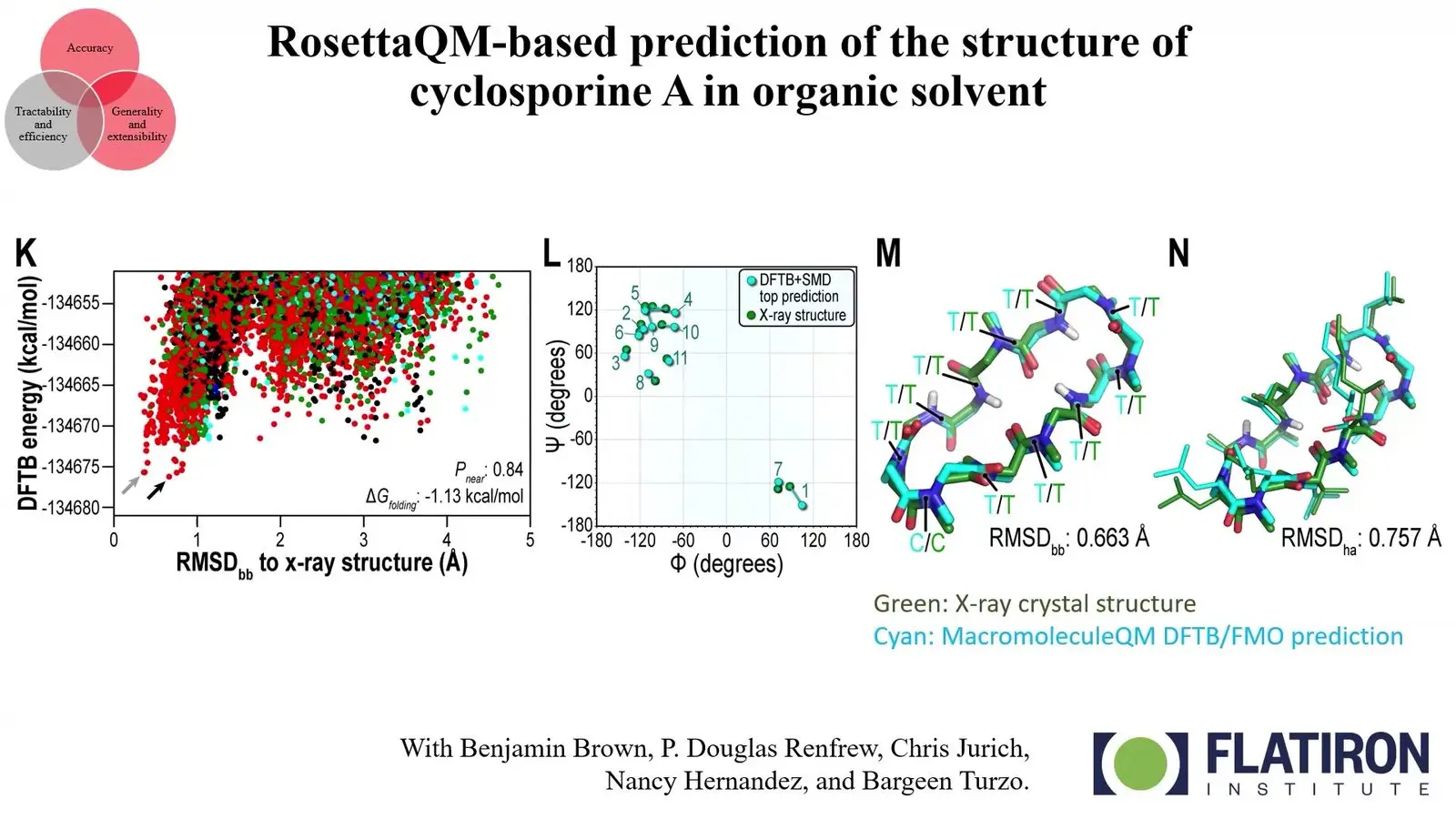
Mulligan most wants help with choosing how each side chain sits at every position, a hard search done today with a million random trial steps. For that, speed beats precision. Fast, rough energies over many shapes matter more than one exact energy, Mulligan told the room, and a quantum computer would help if it brought the accuracy of density functional theory down to seconds.
British Columbia takes side-chain design to an annealer
Tristan Zaborniak, a postdoc in maths at the University of British Columbia, took Mulligan’s side-chain problem to a D-Wave annealer. An annealer needs yes-or-no choices. The usual way spends one qubit on each choice, while Zaborniak’s way uses only enough qubits to count the choices, so eight of them fit in three qubits.
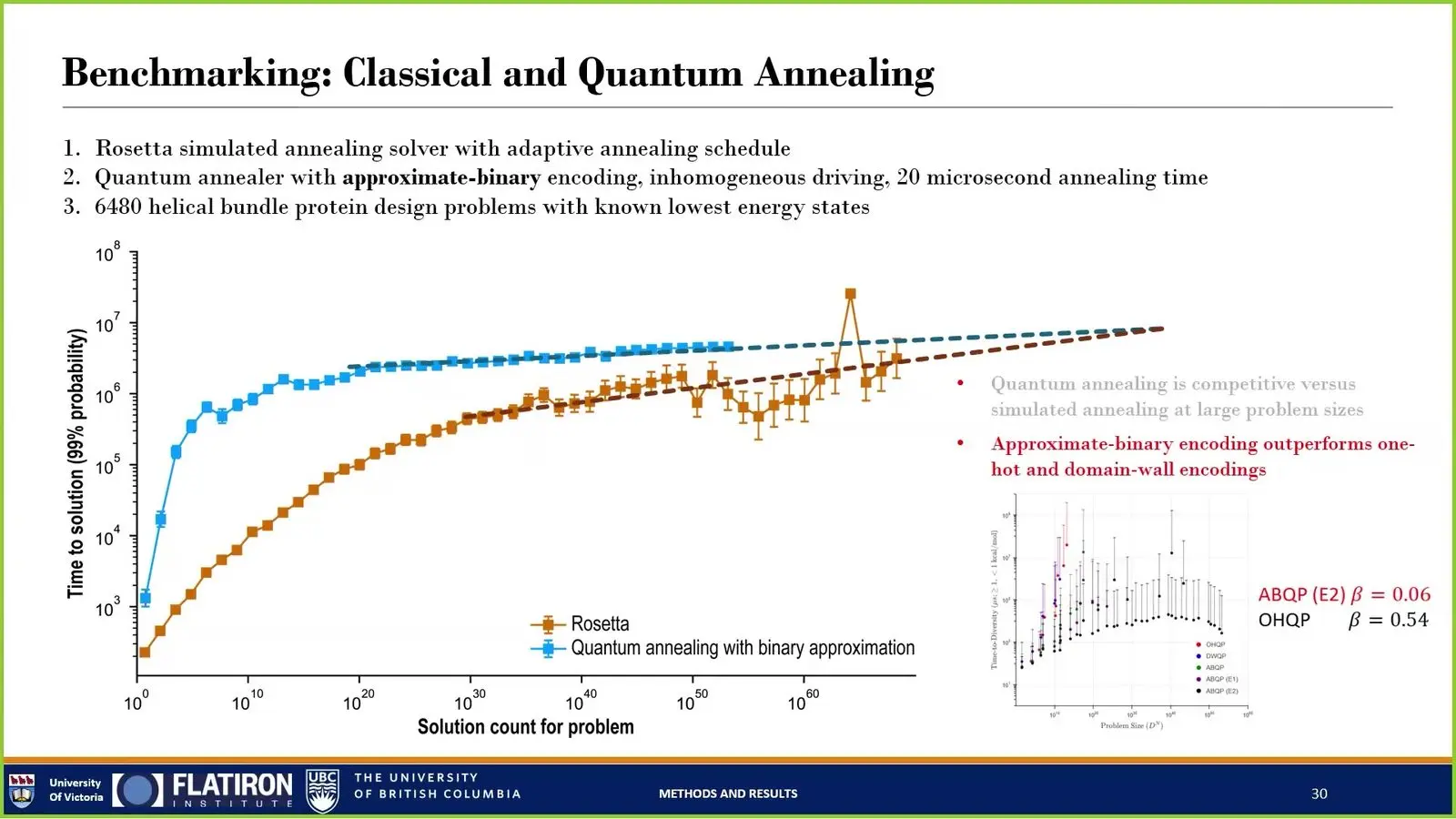
On 6,480 test problems with known answers, the annealer was slower than Rosetta’s classical search in absolute time across the range. Zaborniak said its scaling might be better. No gate-based tests have run yet.
Kipu Quantum and IonQ fold proteins on a 64-qubit machine
Alejandro Gomez Cadavid of Kipu Quantum presented a paper, written with the IonQ team, that won a best-paper award in the QECS track. Each amino acid is a bead on a grid. Some qubits record each turn of the chain and others mark which distant beads touch, so seven chains of 14 to 16 amino acids used 53 to 61 qubits on an IonQ machine with 64 fully linked qubits.
The quantum samples beat random draws at finding which beads touch, and in four cases they hit the lowest energy their cost function allows, while the 61-qubit runs suffered more from noise. A final repair of the chain’s shape overwrote the contact qubits and erased that gain. Someone from the Flatiron Institute asked about the handedness of proteins, which the model left out. See our story on IonQ’s awards at IEEE Quantum Week.
Capgemini and GSK run drug reactivity on IBM Heron
Phalgun Lolur of Capgemini presented work with IBM Quantum, Haiqu and GSK, and credited Marek Kowalik, Vedangi Pathak and Vladyslav Los with the experiments. The aim was a drug score. The team let a small piece of a GSK drug evolve in time on the chip, which leaves a fingerprint that a classical model then turns into a score for how readily the drug reacts with its target.
On IBM’s Heron chip the circuit rose past 100,000 gates on 16 qubits with routing. Cutting weak terms cut depth 15.5 times. Haiqu split the rest into short blocks. A direct Heron run fell into noise, while the blocked version stayed within Lolur’s error bound out to 100 time units, and Lolur noted that the 16-qubit case solves on a laptop in seconds.
Infleqtion picks cancer genes and senses breath
Teague Tomesh, manager of quantum applications at Infleqtion, described work with Chicago and MIT on picking 5 or 10 genes out of 100 or 1,000 that sort a tumour by tissue. Gurobi, a leading classical solver, stops proving an answer is best past about 100 variables. A recursive form of QAOA, run at 20 qubits on IBM’s Boston machine, fixed one choice at a time from its samples.
After four rounds, an annealing step found a lowest-energy answer that it had missed in 100 tries on the full problem, which Tomesh called an older result. A second project simulates an atom-based sensor that reads breath for signs of head and neck cancer. No quantum advantage was claimed.
Yale models molecules that lose energy
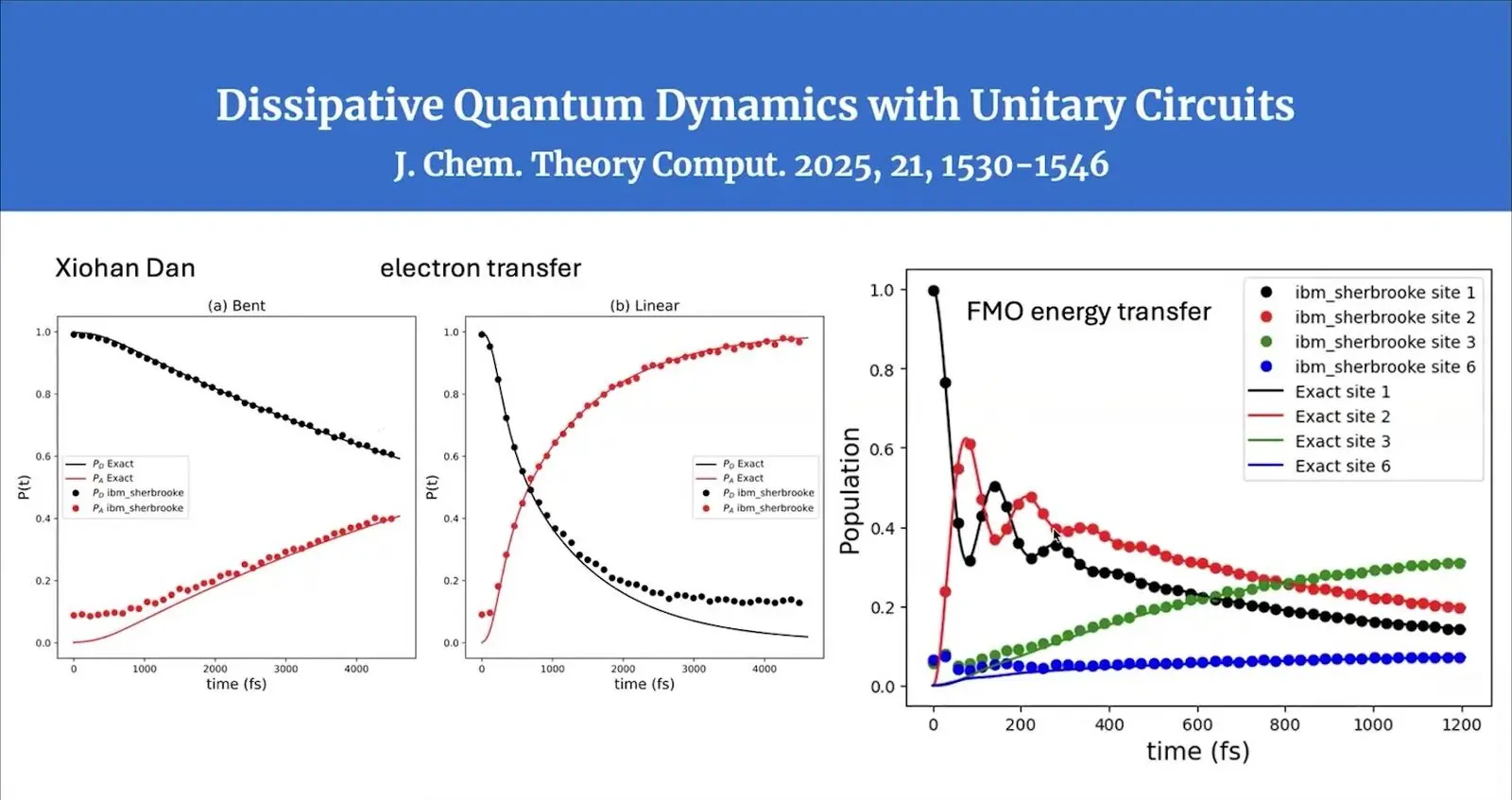
Victor Batista of Yale University showed three lines of work. The first lets a molecule lose energy to the world around it, which a plain quantum circuit cannot do, by adding one spare qubit. Runs on an IBM chip followed energy through a protein that gathers light for just over a trillionth of a second, and tracked it fairly well, Batista said, because the circuits stay short.
A second line stores drug-like molecules in the microwave light of 3D superconducting cavities and predicts how each one splits between oil and water, with an R-squared score of 0.73. A third puts a quantum step inside an AI model. Asked what that adds, Batista said the gain comes only when that one step slows the whole job.
CCRM calls the quantum computer a specialised accelerator
Rob Quirk, vice president of tech sourcing and venture development at the Centre for Commercialization of Regenerative Medicine (CCRM) in Toronto, spoke for the buyers. CCRM works on cell and gene therapy. Quirk put a CAR T dose at about 350,000 to 450,000 dollars and the 2024 market at 8 billion dollars. The first projects at CCRM’s 2025 spin-off, Deep Tech Biolab, were a couple of months from starting after six months on use cases.
Quirk ran through the warnings in a Deloitte report on the life sciences from August 2025. Loading classical data can eat any speed-up, tuned circuits can go flat and stop learning, and any claimed edge has to beat a strong classical rival. Quirk called the machine a specialised accelerator inside a hybrid solver. It is not a faster computer. Quirk had been told two to three years, with no consensus.
Cleveland Clinic folds a protein on IBM hardware as a feasibility test
Daniel Blankenberg of the Cleveland Clinic, whose group is about five years into quantum work with IBM, compared ways to put a protein on a grid. One grid did far better. A face-centred cubic lattice fitted a helix of paxillin to an RMSD of 0.98 angstrom, against 1.75 on a tetrahedral one. RMSD is the average distance between matching atoms in a model and the known structure. Blankenberg stressed that such fits test the grid and say nothing about prediction.
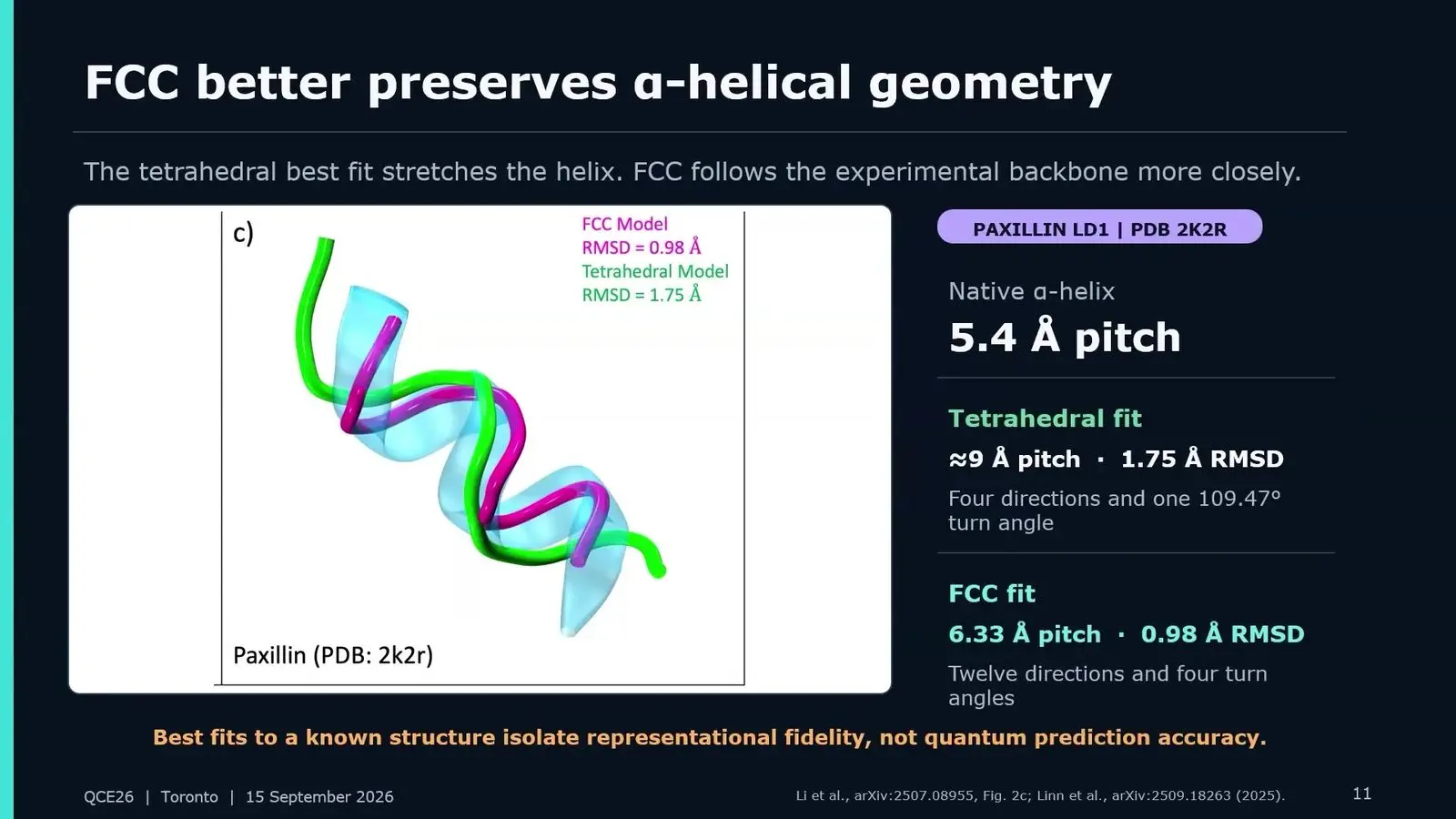
The group has since moved from the grid to the twist angles along the chain, with a code whose qubit count grows only with the logarithm of the number of angles. So the 44 angles of a small protein called chignolin fit in 6 qubits. The strain moves to circuit depth. On IBM’s Cleveland machine the best structure came within 1.758 angstrom, and 88 of 300 jobs fell under 2 angstrom. The run was warm-started from simulation, and the team called it a feasibility result with no claim of quantum advantage.
Generative design, mRNA and genomes
Five talks set quantum samplers and solvers on drugs, vaccines and genomes. In each of them the chip came up with ideas or searched for an answer, and the tools that judged how good those answers were stayed classical.
A quantum-seeded generator finds five KRAS binders in 12 compounds
Alán Aspuru-Guzik of the University of Toronto, NVIDIA and the Vector Institute went after KRAS G12D, a cancer protein. It is hard to drug as it is so small, and by Aspuru-Guzik’s count KRAS drives 80 to 90 percent of cancers of the pancreas. A small quantum circuit, a Born machine, feeds bits to a classical network that writes molecules. Then Insilico Medicine’s tools score them. The lead was Mohammad Ghazi Vakili.
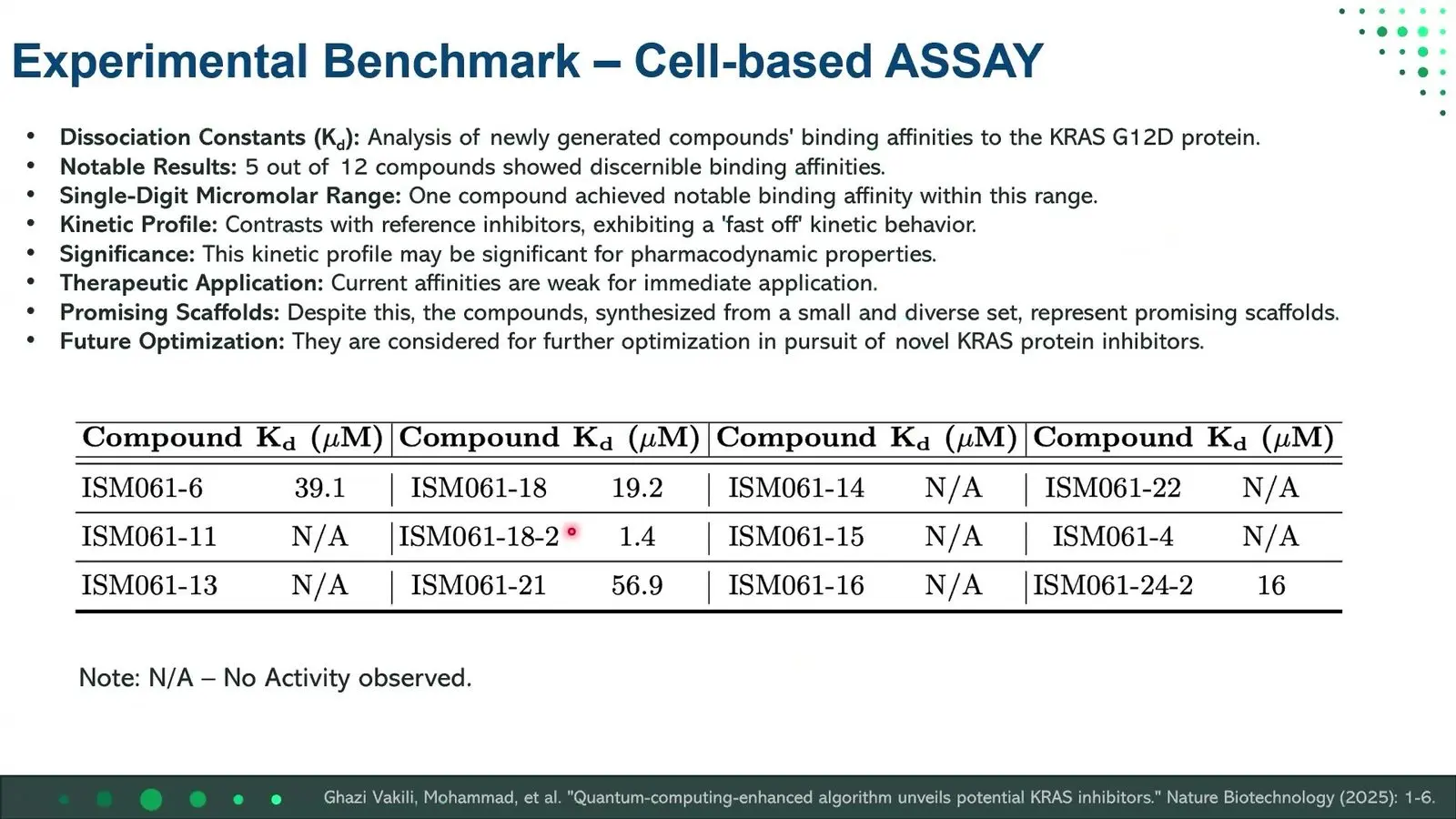
Five of 12 synthesised compounds bound in an assay, the tightest at 1.4 micromolar, an affinity the team called too weak for immediate use. With the quantum part switched off, 52 percent of molecules passed the filters, and the rate rose when an IBM machine supplied 16 qubits. Aspuru-Guzik would not call that trend statistical without more qubits. The value of a micromolar binder here, Aspuru-Guzik said, is that it came first.
Yale samples codons for mRNA vaccines with a quantum circuit
Victor Batista of Yale University, in a second talk, turned a quantum sampler on mRNA design. Most amino acids can be spelt with more than one codon. So the COVID-19 spike protein alone has about 10 to the 632 possible mRNA strands. The method, QEVO, draws bit strings from a tuned circuit, turns each one into a design, scores it on a normal computer and feeds the score back to tune the circuit again. Batista showed well-folded designs for a small protein and then one of about 600 residues.
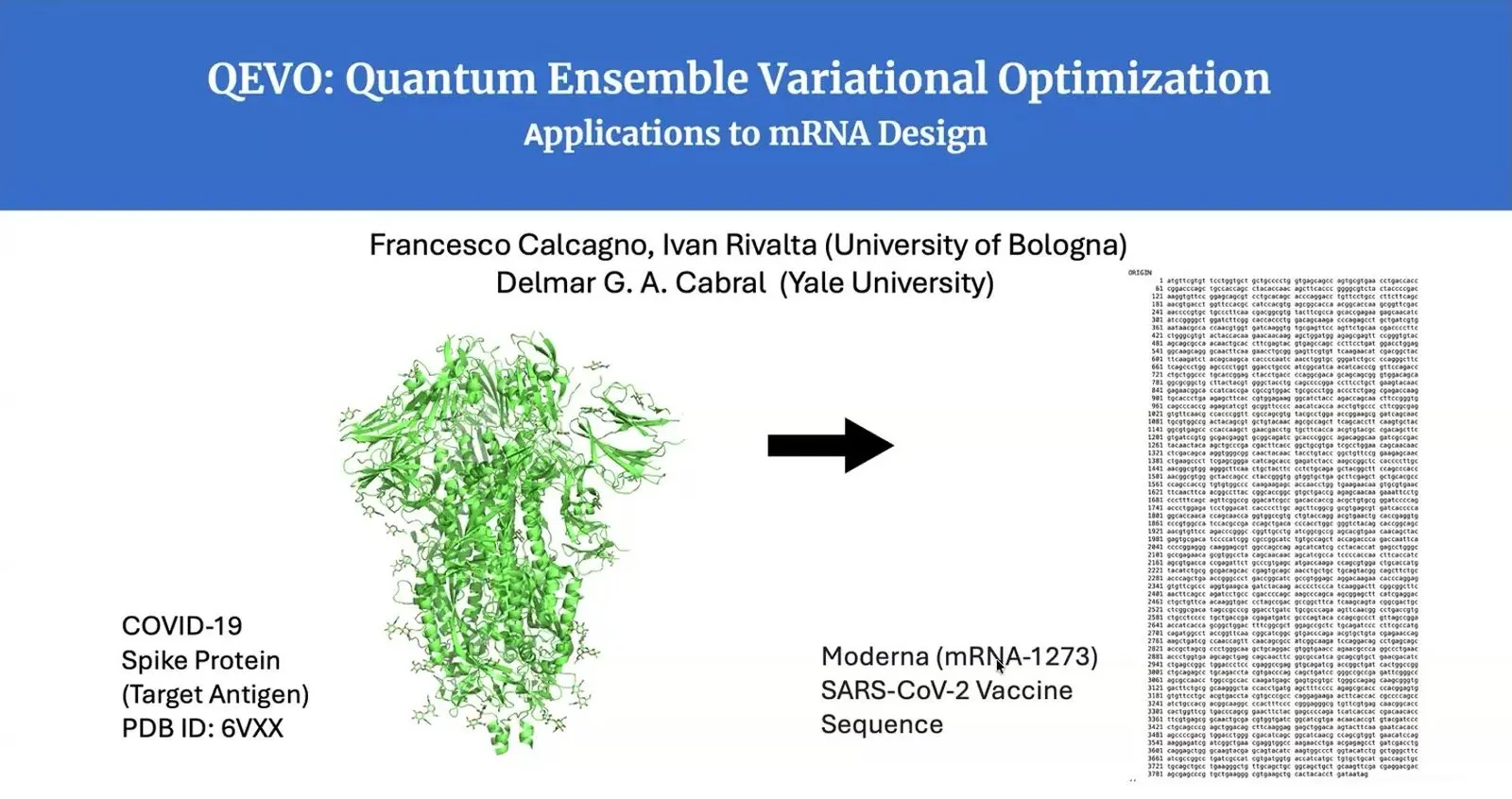
The same loop docked drugs against a receptor called JAK2. An earlier model learned to squeeze protein sequences into a simple shape and then rebuild them. Sequences drawn from it and folded with AlphaFold put two kinds of residue side by side to hold a zinc ion, Batista said. All the scoring was classical.
IBM and Moderna pack mRNA folding into 23 qubits
Triet Friedhoff of IBM Quantum gave a paper written with Mihir Metkar, Wade Davis, Vaibhaw Kumar and Alexey Galda, in work with Moderna. Folding affects how stable a vaccine is. Written as yes-or-no choices, a strand of 100 bases gives about 700 of them, tied by more than 172,000 rules that link pairs. A trick called Pauli correlation encoding stores each choice in how a pair of qubits line up, so 23 qubits are enough.

The circuit gives back smooth values, not yes or no. So the team built a decoder that fixes one choice at a time and strikes out clashes as it goes. On an IBM Heron chip, three strands of about 100 bases landed 0, 5.9 and 18.0 percent from the best answer found by the classical solver CPLEX. Someone in the room said that without knots in the fold, which the model leaves out, classical methods solve the problem fast. Friedhoff said adding them would need more variables than today’s chips hold.
Oxford assembles genomes with an iterative QAOA on 56 qubits
Sergii Strelchuk of the University of Oxford reported three years of quantum genomics with the Wellcome Sanger Institute, funded by a Wellcome Leap grant. The target is the pangenome, a graph that replaces one reference genome with the variants seen across many people. Assembly means finding a path through that graph. An iterative QAOA solved such problems on up to 80 qubits in simulation and 56 on hardware, with one layer and five rounds.
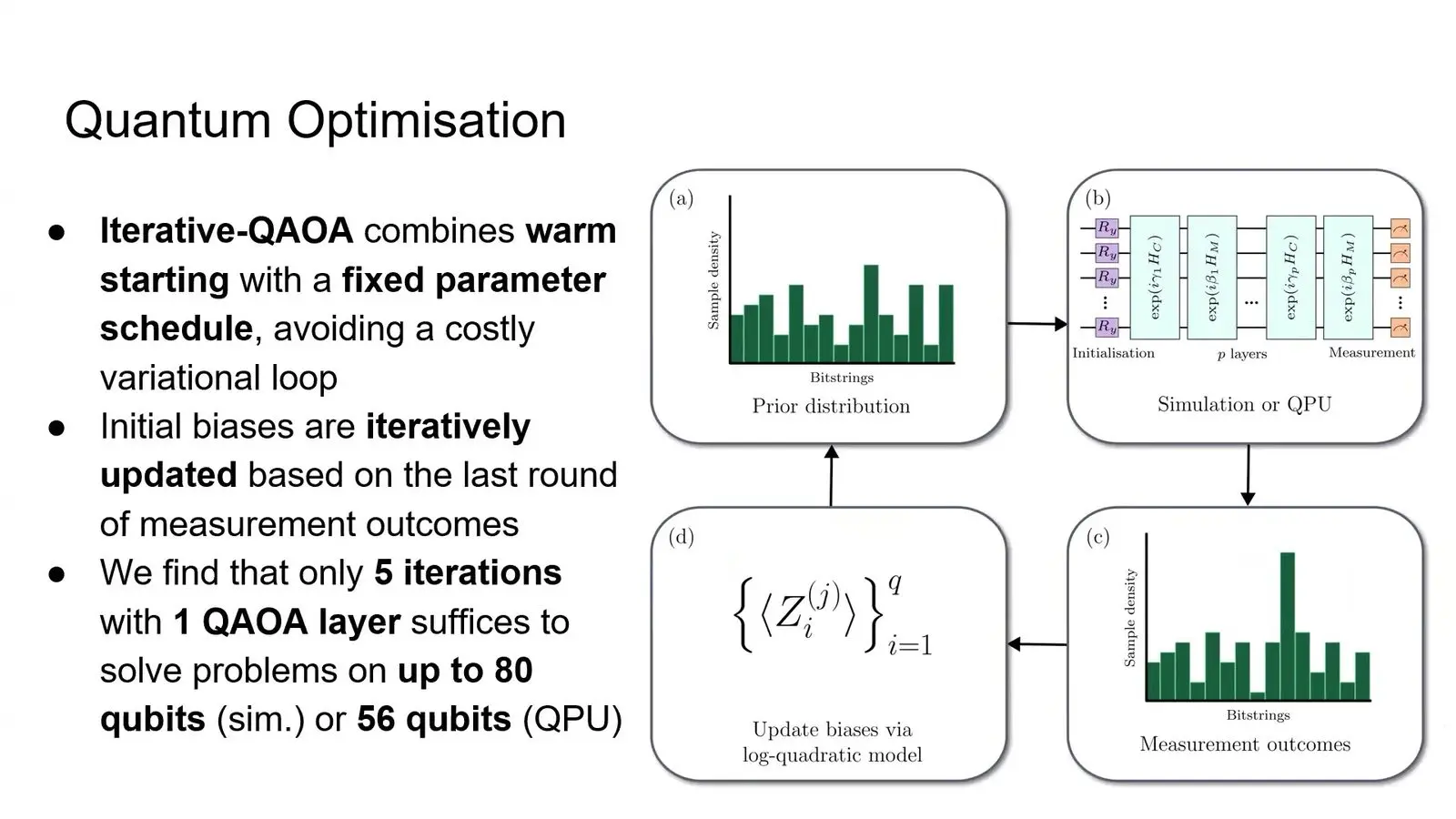
A first version needed n squared qubits and beat Sanger’s tools until Sanger improved its own software, while a higher-order form needs only about n log n. On SARS-CoV-2 samples a lossless compression shrank one graph from 550 to 84 vertices, one per qubit. Strelchuk expects only Grover-style gains for lining up many sequences at once. With the grant finished, the work continues in a company.
GenomeArc picks glioblastoma marker genes with QAOA
Mohammed Uddin Dafil, a geneticist and chief executive of GenomeArc in Toronto, works on glioblastoma. It is the most aggressive brain tumour. Its cells mix with healthy ones and switch between states, and 15 percent or more of them run two programmes at once. Dafil treats the choice of a marker gene panel as a yes-or-no problem with one qubit per gene, and QAOA solves it with a mixer that keeps the panel size fixed.
On simulated data with known answers the panels scored about 0.83 for recovery, and on real T cells the method split naive and memory cells more cleanly than classical clustering, Dafil said. A marker found this way was hit with an antisense molecule, which cut it by about 50 percent in treated neurons. No case was shown that a classical method could not reach.
Phase estimation and fault-tolerant chemistry
The textbook route to exact energies is quantum phase estimation, which needs machines that correct their own errors. Four talks worked on that route, from its cost to its error bounds.
Riverlane and Quantum Motion show why exact chemistry needs fault tolerance
Jonny Davidson of Riverlane opened a tutorial by showing how fast exact chemistry outgrows a normal computer. Fourteen electrons in fourteen orbitals can sit in 11,778,624 ways. Fifty in fifty reach 1.6 times 10 to the 28. A quantum computer would hold that in 100 qubits. The work comes from QUICHE, a UK and German project that links a chemistry package called ORCA to estimates of what a quantum run would need.
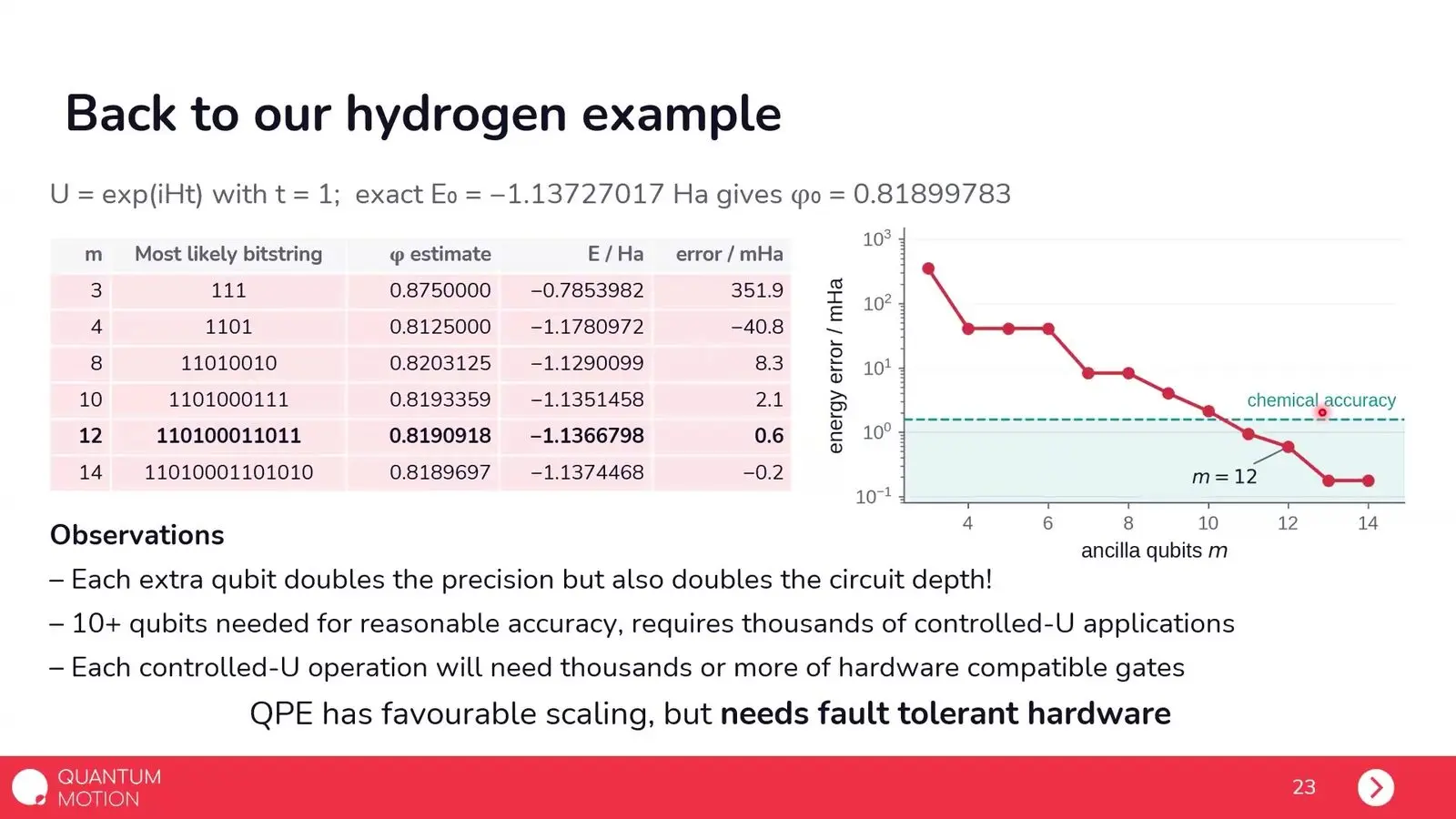
Thomas Bromley of Quantum Motion then worked phase estimation on hydrogen. Three ancilla qubits, which read out the energy, left an error of 351.9 millihartree, eight left 8.3 and twelve left 0.6. Each extra qubit doubles the precision. It also doubles the depth. Ten or more need thousands of controlled steps, each costing thousands of gates, Bromley said, so the method needs fault-tolerant hardware.
TotalEnergies tightens the Trotter bill for phase estimation
Jérémie Messud of TotalEnergies, writing with Wassil Sennane of QUANTSOC, wants phase estimation to screen materials for carbon capture. The method cuts a molecule’s motion through time into short slices called Trotter steps. Too few slices skew the answer. Most bounds on that error look at the motion as a whole, while chemists care about the energy and the state, so Messud worked out bounds on those two things directly.
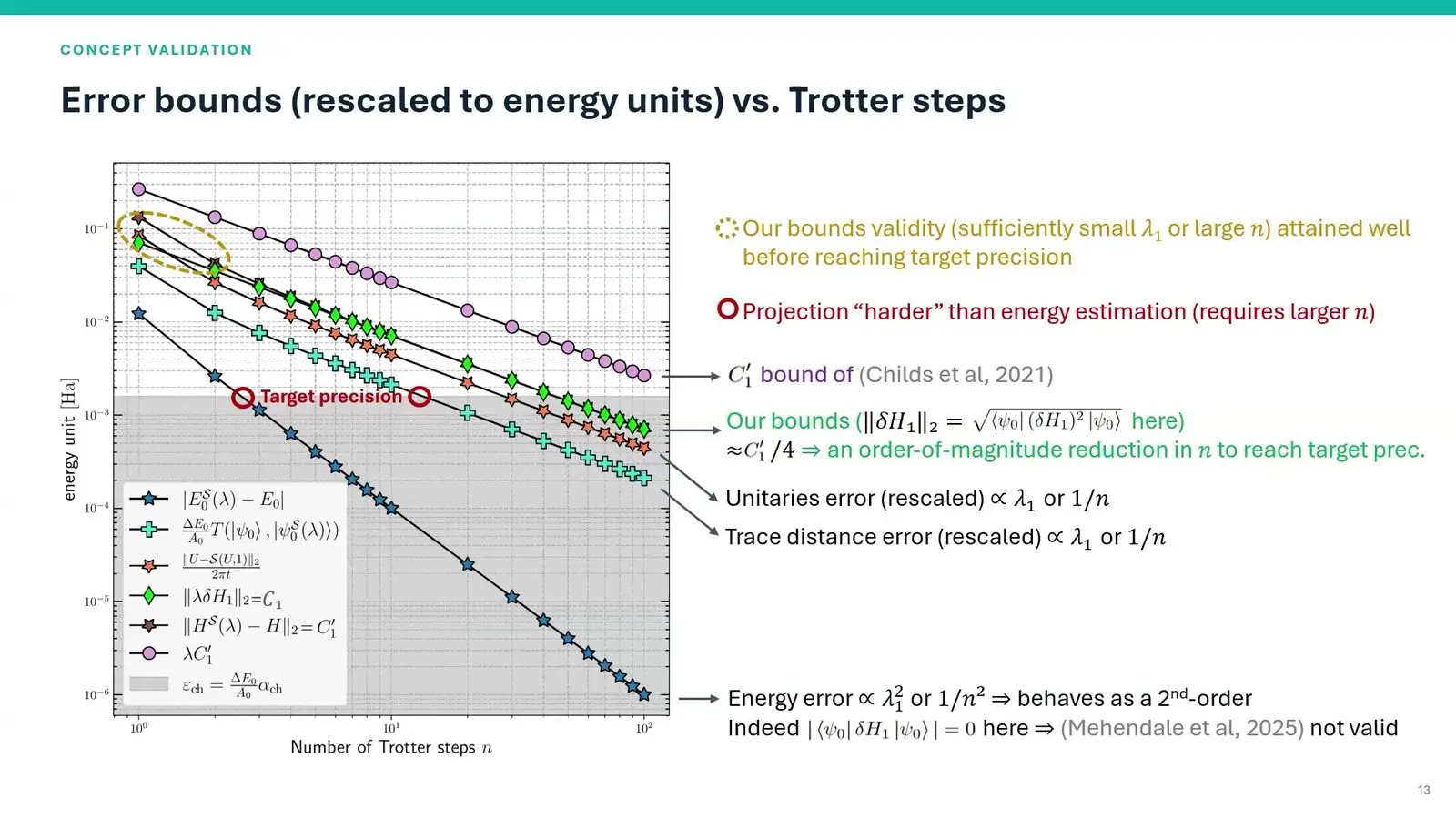
For hydrogen the new bounds sit about four times below an earlier bound from Childs and colleagues, which means about an order of magnitude fewer steps to reach chemical accuracy. Projecting out the state needed more than ten times as many steps as estimating its energy. The test system is small, so how the savings scale remains open.
Microsoft’s chemistry kit finds the savings in classical steps
David Williams-Young, who leads software for Microsoft’s quantum applications team, said much of the road to fault-tolerant chemistry runs through classical steps. Microsoft’s kit for chemistry chains boxes that can be swapped, from the shape of a molecule and its orbitals to the choice of which electrons matter and how the start state is loaded. The quantum computer sits in it as a helper, much as a GPU does. For stretched nitrogen, a tool that picks the key orbitals cut eight to four.
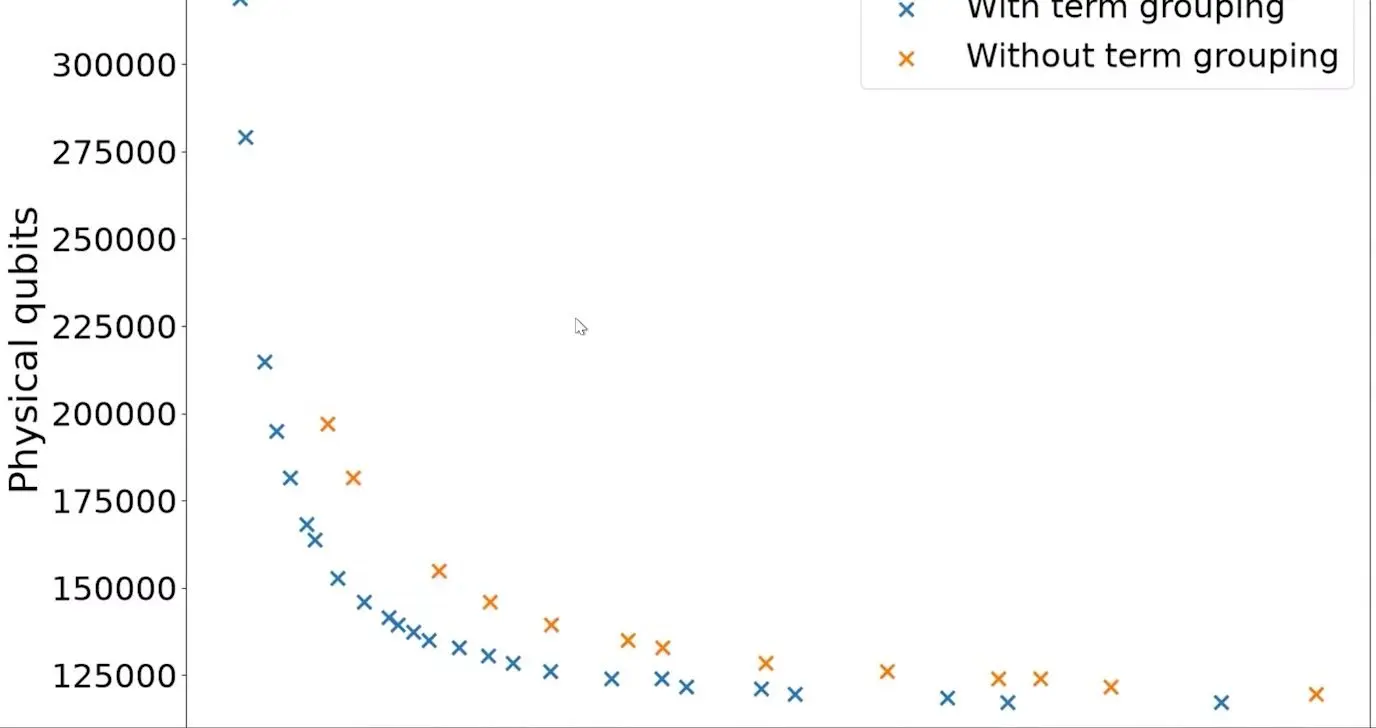
That left an 8-qubit problem with 161 terms. A six-bit phase estimation then landed on the right energy. Built one way, with extra qubits for a lookup table, it cost about 10 times more than with Trotter steps at this size, and Williams-Young asked where the two cross over. A cost estimate for a simple magnet model on Microsoft’s public Majorana hardware model put one option at 117,196 physical qubits.
Munich trains an agent to design a hydrogen chain’s energy gap
Salvatore Zammuto of the Technical University of Munich, writing with Martin Schulz, ran chemistry in reverse. An agent that learns by trial sets the bond lengths of a chain of six hydrogen atoms. Phase estimation then returns the gap between the chain’s two lowest energies, and the agent keeps changing the bonds until it hits the gap it was asked for. The search is hard. Zammuto said it is QMA-hard, a class of problems thought to be hard even for quantum computers.
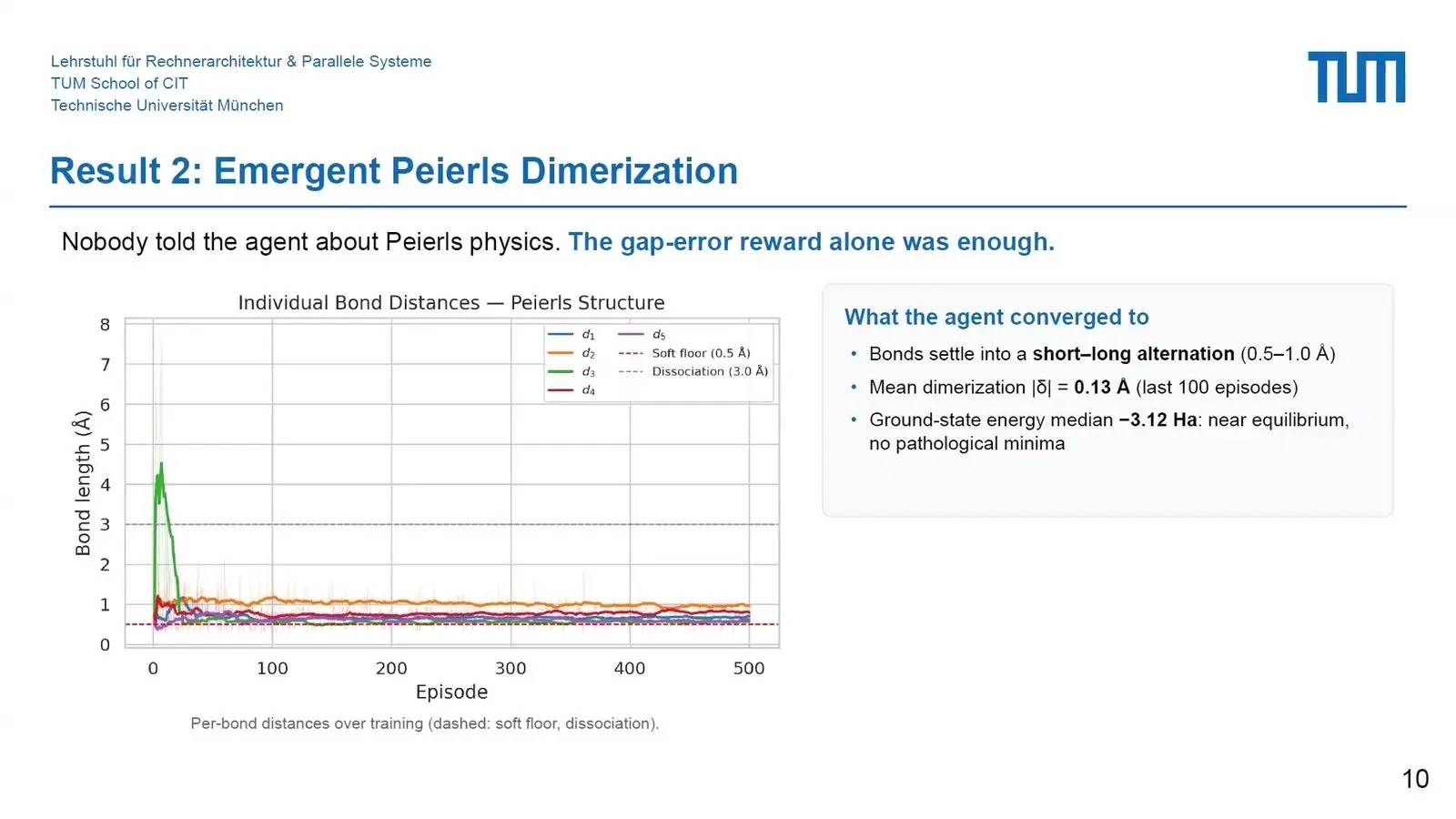
At a target of 0.5 hartree, 477 of 500 episodes succeeded, and the agent found Peierls dimerisation, the short and long bonds that alternate in real chains of atoms, without being told any physics. At 0.7 hartree it stalled. More than 99 percent of the time went on the phase estimation step, at about 3.9 seconds for each exact 12-qubit call. Zammuto would send the easy shapes to tensor networks on GPUs and keep quantum chips for the hard ones.
What it means for quantum chemistry buyers
A materials or drug team should test any quantum chemistry offer against the moving classical line, including MoLe, DMRG and fragment methods, before it buys hardware time. Quantum teams should pick problems where the knot cannot be shrunk, such as metal centres and bonds pulled apart. They should also say how much the classical part did.
See our report on IBM’s new toolbox for molecules. Most gate-based chip results in this guide were small or cut down, and Lolur’s 16-qubit drug case, which ran past 100,000 gates on Heron, still solves on a laptop in seconds. The quantum computer’s job is the knot, and classical advances keep shrinking it. Aspuru-Guzik’s race is still on, and the classical machines are ahead.
Frequently asked questions
What is quantum chemistry on a quantum computer?
It means using qubits to model the electrons that hold a molecule together. Exact classical methods need memory that grows exponentially with molecule size, while a quantum computer could in principle track the electrons directly. Today’s work pairs a classical method with a small quantum step for the hardest part.
What is the variational quantum eigensolver?
The variational quantum eigensolver, or VQE, is a hybrid method for finding a molecule’s lowest energy. The chip prepares a trial state, and a classical optimiser adjusts it to lower the energy. Each energy estimate needs many repeated runs called shots, and Artur Izmaylov named circuit depth as its main weakness, since gate errors pile up as circuits grow.
Can quantum computers beat classical chemistry methods yet?
Not on the evidence at IEEE Quantum Week 2026. IBM’s hardware matched DMRG on an iron-sulphur cluster without beating it, and Phalgun Lolur of Capgemini said their 16-qubit drug case still solves on a laptop in seconds. Meanwhile AI methods such as MoLe cut the cost of classical benchmarks sharply. Pasqal claimed its atoms followed a magnet past the reach of classical methods, a claim about a spin model rather than a molecule.
What is sample-based quantum diagonalisation?
Sample-based quantum diagonalisation uses a quantum chip to sample bit strings and a classical computer to solve the small matrix they span. It suits today’s chips because the circuits can stay shallow. Oak Ridge, IBM and the University of Central Florida all used it at QCE26.
Which molecules are quantum computers expected to help with first?
Talks pointed to molecules where electrons are tightly bound up with each other. Examples include metal centres in catalysts, bonds pulled apart and battery reactions. In these regions classical methods lose accuracy, and that is where a quantum step could add the most.
What happened at IEEE Quantum Week 2026?
IEEE Quantum Week 2026, also called QCE26, ran from 13 to 18 September at the Metro Toronto Convention Centre. This guide covers 33 of its talks on quantum chemistry, materials and life sciences. Most paired a strong classical method with a small quantum step.
This guide is based on 33 talks, workshop sessions and tutorials at IEEE Quantum Week 2026 (QCE26), held at the Metro Toronto Convention Centre from 13 to 18 September 2026, and on the published conference programme. Names follow the programme where it lists them. Affiliations and titles not listed there are as speakers gave them. Results are stated as each speaker presented them, and most come from simulation or small hardware runs. Company claims are the companies’ own.
- Qubit hardware and scaling roadmaps
- Photonics and quantum sensing
- Control electronics, calibration and readout
- Quantum error correction and decoders
- Fault-tolerant compilation and magic states
- Modular and distributed quantum computing
- Quantum computers in supercomputing centres
- Compilers, circuit synthesis and languages
- AI and language models for quantum software
- Testing and reproducible quantum experiments
- Benchmarks, error mitigation and quantum advantage
- Quantum state preparation, oracles and arithmetic
- Quantum optimisation, QAOA and annealing
- Quantum machine learning
- Differential equations and fluid dynamics
- Power grids and energy
- Quantum finance
- Logistics, climate, databases and games
- Quantum networks and key distribution
- Quantum security and post-quantum cryptography
- Quantum education and workforce
- Policy, standards and the quantum business



See today’s quantum computing news on Quantum Zeitgeist for the latest breakthroughs in qubits, hardware, algorithms, and industry deals.