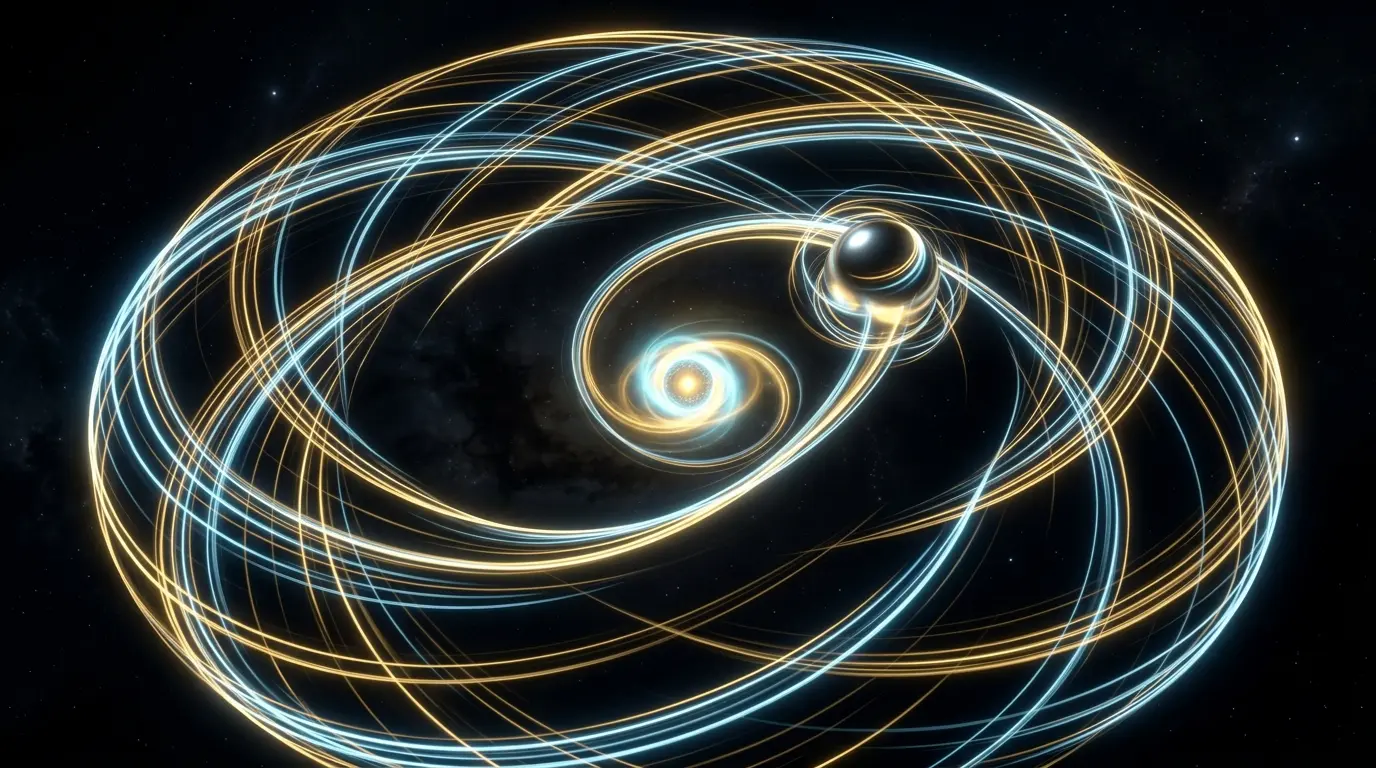
Mean-field states, commonly used as starting points for calculations in physics and chemistry, now offer a resource for quantum information processing due to new understandings about their entanglement content. Arrangements of N fermions on a lattice can carry up to a specific amount of ‘orbital entanglement’, determined by the system’s size and number of particles; this value represents the maximum possible level achievable with any fermionic arrangement when enough particles are present. Recent findings reveal that even simple descriptions of electrons, those routinely used in materials science and chemistry, harbor surprising potential for creating ‘orbital entanglement’, a key component of quantum computers.
Arrangements of particles hold a specific maximum amount of this entanglement determined by system size; sufficient particles guarantee achieving this limit. The Ludwig-Maximilians-Universität Munich team discovered that these same simple electron descriptions routinely used in materials science possess surprising potential for quantum computing. They proved arrangements of particles, described using ‘Slater determinants’ akin to listing all possible hands of cards, can carry up to a specific amount of ‘orbital entanglement’.
This measures how strongly linked quantum particles are, quantifying how well they “know” each other’s state instantly, regardless of distance. The maximum achievable level is determined by the system’s size and number of particles, with enough present guaranteeing this limit.
Orbital Rotations Maximise Entanglement via Majorization Relations
Careful manipulation of ‘orbital rotations’, transformations applied to individual electrons without altering their fundamental interactions, served as the key technique in this investigation. These rotations effectively reshuffle how entanglement is distributed amongst quantum orbitals; while often used to simplify complex systems by concentrating correlations into fewer orbitals, they were deliberately deployed here to maximise entanglement as a resource. Using mathematical rules known as ‘majorization relations’, researchers could compare and order different arrangements of properties representing the system’s energy levels, akin to sorting numbers with specific constraints on their sum.
Slater determinants, descriptions of multiple fermions, were investigated on lattices comprising dA plus dB sites equaling a total of *d* sites. The focus was maximising orbital entanglement rather than minimising computational complexity, a typical goal in many-body physics and chemistry. These systems can carry up to mindA, dB, N, d-N ebits, units of quantum information. This approach allows for simplification because free states are readily prepared through mathematical relationships known as ‘majorization relations’.
Slater Determinants Exhibit Maximal Orbital Entanglement in Free Fermionic Systems
Previously focused on reducing correlation to simplify quantum systems, Slater determinants of N fermions now achieve up to mindA, dB, N, d-N ebits of orbital entanglement, a measure of how strongly linked quantum particles are. This represents a leap from prior limitations where maximising this connection was elusive. Even non-interacting fermion arrangements can rival any fermionic state when sufficient particles and holes exist within the system; previously achieving maximal entanglement required complex particle interactions or specific states.
Researchers at Ludwig-Maximilians-Universität Munich also derived closed-form solutions for total orbital correlation in free fermionic states across various lattice configurations, transforming standard calculations into potential resources for future quantum computers. The team successfully calculated these correlations for all partitions of lattices with five or fewer sites using new relationships governing Hermitian matrices. However, while promising, these calculations currently focus on idealized systems and do not yet account for practical limitations like noise inherent in real quantum hardware, a key consideration as this work moves toward implementation.
Strong Orbital Entanglement Offers Promise for Quantum Computation
Basic arrangements of electrons routinely used as starting points for complex calculations can be harnessed for quantum information processing by maximising their inherent ‘orbital entanglement. Establishing closed-form solutions detailing total orbital correlation now makes standard physics and chemistry calculations viable resources for future technologies; however translating this theoretical potential into practical devices remains challenging due to the difficulty maintaining high levels of connection between quantum particles when interactions mirroring real materials are introduced. This raises an important question. How do we preserve and control this delicate resource in more realistic scenarios? Ludwig-Maximilians-Universität München scientists have revealed that Slater determinants, despite lacking particle interactions, can achieve maximal levels of entanglement given enough particles, previously requiring complex electron behaviour or specific state configurations. The finding opens questions about preserving this fragile resource as material imperfections arise, a key challenge for realising these systems in actual hardware.
Researchers demonstrated that even simple arrangements of electrons, Slater determinants on lattices, can possess substantial orbital entanglement, up to the maximum possible for fermionic states when sufficient particles are present. This is notable because mean-field states, commonly used as initial approximations in physics and chemistry calculations, now appear capable of serving as resources for quantum information processing. They derived closed-form solutions detailing total orbital correlation for partitions of up to five sites using new majorization relations. These results suggest standard computational methods may be adaptable for use with future quantum technologies.
👉 More information
🗞 Maximal Orbital Entanglement from Non-Interacting Fermions
✍️ Damiano Aliverti-Piuri (Ludwig-Maximilians-Universität München); Julia Liebert (Princeton University); Christian Schilling (University of Geneva)
🧠 ArXiv: https://arxiv.org/abs/2610.32974


See today’s quantum computing news on Quantum Zeitgeist for the latest breakthroughs in qubits, hardware, algorithms, and industry deals.