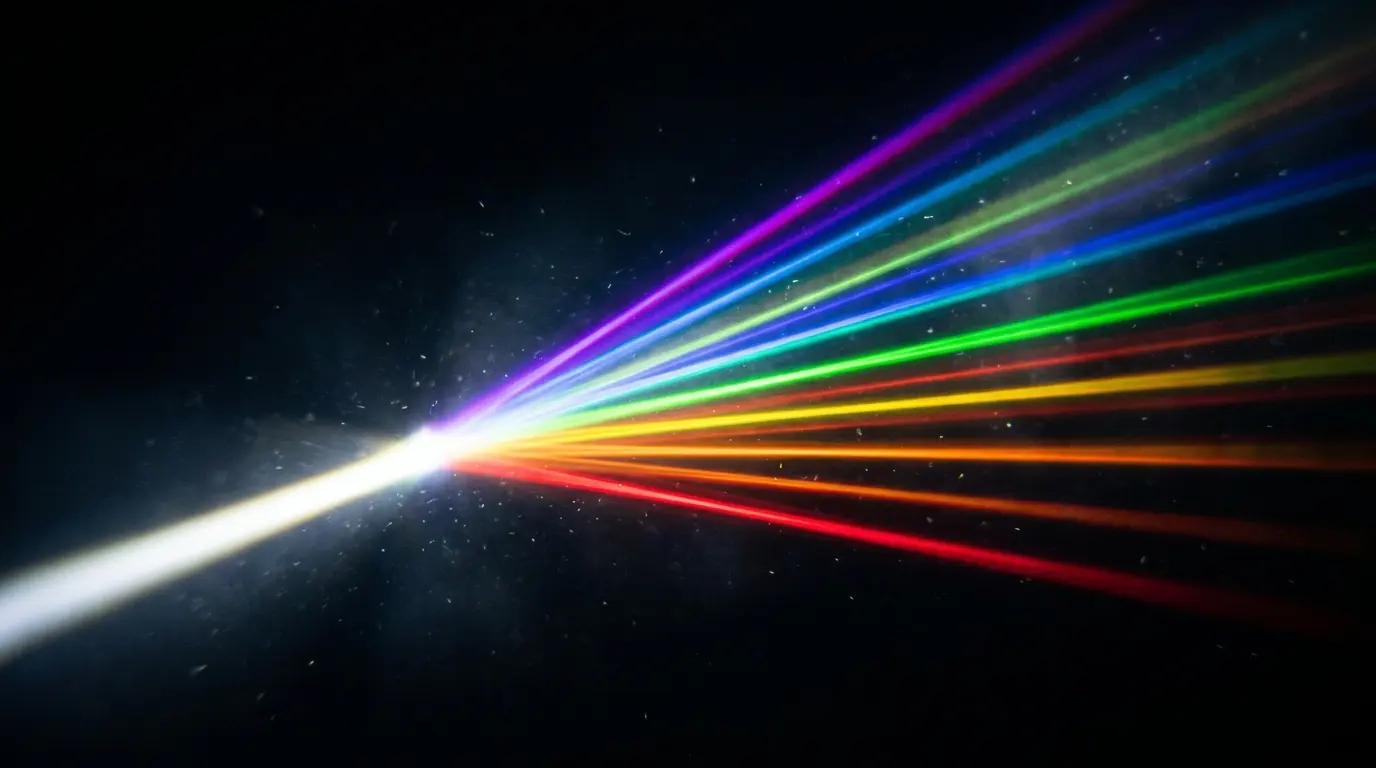
Jiabao Peng, Richard Bernecker and Stephan Fritzsche of the Friedrich-Schiller-Universität Jena and the Helmholtz-Institut Jena have developed a new analytical method to calculate the full Laguerre-Gaussian spectrum of entangled photons generated through spontaneous parametric down-conversion. The researchers analytically solve the four-dimensional transverse spatial integral, previously requiring intensive computation, without approximating the phase-matching function.
Their approach reduces the description of source geometry to just two parameters for specific photon conditions, enabling computationally efficient evaluation at high mode orders and addressing a key limitation in previous work. The results provide a new tool for characterizing and engineering high-dimensional spatial entanglement.
Laguerre-Gaussian Spectrum Calculation for Entangled Biphotons
Calculating the full Laguerre-Gaussian (LG) spectrum for entangled biphotons, critical for advancing high-dimensional quantum information processing, now bypasses computationally intensive multidimensional integrations through a new generating-function approach. The team’s formulation efficiently addresses a key obstacle in characterizing and engineering spatial entanglement generated by spontaneous parametric down-conversion (SPDC). The new technique streamlines calculations by reducing the problem to coefficient extraction and a single longitudinal integral, allowing for rapid determination of amplitudes for any pump, signal and idler LG indices.
This is achieved through a compact description using dimensionless parameters that define the source geometry. The approach allows for numerically stable evaluations, a significant improvement over methods that struggle with high-mode orders. The researchers outline their mathematical formulation and assess its computational performance in their work, noting that the method can be applied to a broad range of SPDC scenarios.
A comparison of OAM spectra obtained by projection onto the lowest radial order and by radially insensitive detection illustrates the approach’s capabilities. The study also investigates how source parameters can be tuned to approach maximally entangled states, an important step in building robust quantum communication networks. “There, radial-mode completeness removes the explicit infinite sums, although the resulting expression still involves a four-dimensional transverse integral,” the authors write, highlighting the complexity they have overcome.
SPDC and High-Dimensional Quantum Information Processing
This analytical approach directly evaluates coincidence amplitudes, offering a significant advantage over methods prone to numerical instability. This simplification contrasts with prior modeling methods requiring more complex representations of spatial characteristics. The study reveals how adjustments to the source geometry influence the degree of entanglement achievable in the generated biphoton states.
Their approach builds upon the completeness relation for radial modes, allowing for an exact integral representation without individually resolving amplitudes for every radial order. Extending this framework to broadband SPDC, the authors suggest, could further refine the model by incorporating the effects of pump bandwidth, material dispersion, and spectral filtering on the full LG spectrum.
Analytical Approach to the Four-Dimensional Transverse Integral
The ability to accurately model the spectrum of entangled photons has received a boost through a new analytical approach that bypasses computationally intensive methods. This advancement addresses a key limitation in prior work, particularly when dealing with high-mode orders essential for advanced quantum information processing. The core of this method lies in its ability to fully describe the source geometry using a limited number of dimensionless parameters.
For wave-vector-degenerate photons exhibiting equal waists, this simplification reduces to just two parameters, a significant reduction in complexity compared to earlier modeling techniques. This streamlined description allows for numerically stable calculations, even at high mode orders where previous methods struggled with accuracy and computational demands. The team’s approach avoids simplifying the phase-matching function, preserving the integrity of the model in complex scenarios like thick crystals or strong focusing conditions.
Central to the technique is the analytical performance of the transverse Gaussian integration, detailed in an appendix to their work. This allows for efficient evaluation of the coincidence amplitudes, which determine the probability of detecting entangled photon pairs. The researchers express the transverse integral as a function of several parameters, denoted as Q⊥(t;η,μ), and a normalization factor, Δ(t;η), with explicit forms provided in supporting material.
The approach uses a shorthand notation, ≡ G_(sgn(ℓ_j))(q,;η_j,μ_j), to simplify the mathematical representation of the process. By carefully manipulating these terms and extracting the OAM indices, the researchers achieve a computationally efficient and accurate model for predicting the behavior of entangled photons. This advancement promises to accelerate progress in areas reliant on high-dimensional spatial entanglement, such as secure quantum communication and advanced quantum sensing.
Dimensionless Parameters Defining SPDC Source Geometry
The geometry of sources generating entangled photons can now be fully described using just four dimensionless parameters, a reduction in complexity that facilitates more accurate modeling of spatial entanglement. These parameters, waist ratios, a pump focusing parameter, and a signal-to-idler wave-number ratio, define the source geometry and yield identical normalized coincidence amplitudes for sources sharing the same values. This analytical approach, detailed in recent work, moves beyond the limitations of previous treatments restricted to thin-crystal regimes or requiring nested finite sums and special functions for full LG spectrum calculations.
The method allows for the determination of amplitudes for arbitrary pump, signal and idler Laguerre-Gaussian (LG) indices within a compact description. The resulting dependence on a variable denoted ‘t’ takes a quadratic form, enabling the calculation of key angles defining the system’s behavior.
This analytical solution circumvents the need for computationally intensive approximations previously required to model the full LG spectrum, particularly in scenarios beyond the thin-crystal limit. Comparisons of OAM spectra reveal the impact of these dimensionless parameters on the distribution of orbital angular momentum.
Specifically, the study examines projections onto the lowest radial order alongside a radially insensitive OAM spectrum, normalizing results to highlight relative weights within a central interval. “Under wave-vector conservation, the longitudinal kernel G(t) depends on the source geometry only through these four independent dimensionless parameters,” the researchers write, emphasizing the streamlined nature of their approach.
Limitations of Approximations in Existing LG Spectrum Models
To illustrate their approach, the researchers compare OAM spectra obtained by projection onto the lowest radial order and by radially insensitive detection, and investigate how high-dimensional maximal entanglement can be approached by tuning source parameters. The study’s results show that for fixed pump indices, the complete set of probabilities is referred to as the LG spectrum. The researchers found that the angular Schmidt spectrum is a radially insensitive quantity of this form.
OAM Spectra Comparison: Radial Order vs. Insensitive Detection
Comparing orbital angular momentum (OAM) spectra reveals distinct outcomes depending on how radial modes are handled, with projections onto the lowest radial order differing significantly from radially insensitive detection methods. The research team analytically compared these two approaches, demonstrating how tuning source parameters can approach high-dimensional maximal entanglement in spontaneous parametric down-conversion (SPDC).
This analytical comparison allows for a detailed examination of spectral profiles and their impact on fidelity for various measurement schemes. This projection, often implemented with spatial light modulators and single-mode fibers, provides a simplified measurement but may not fully represent the complete spectrum.
The fraction associated with this = = 0 projection, denoted , exhibits strong variation, indicating a dependence of radial composition on the specific OAM indices involved. the work details a convergent evaluation of the infinite sum over and for radially insensitive OAM detection, offering a method to shape Laguerre-Gaussian spectra and improve fidelities with maximal entanglement states (MES) under different radial detection schemes. Increasing a parameter denoted as γ enhances the relative probabilities of OAM modes with large absolute indices, while increasing φ suppresses them. The treatment of radial modes, the researchers found, fundamentally determines the detailed spectral profile, and achieving high-dimensional MES generation requires both high fidelity within the target OAM subspace and substantial occupation of that subspace.
Phase-Matching Function Impact on Biphoton State Fidelity
The analytical calculation of biphoton spectra, important for engineering high-dimensional quantum states, has long been hampered by computational demands. This method allows for numerically stable evaluation at high mode orders, addressing an important obstacle in previous works. The complexity of describing source geometry has also been substantially reduced; the authors demonstrated that only two dimensionless parameters are sufficient to fully characterize wave-vector-degenerate photons with equal waists.
Numerical Stability of Full LG Spectrum Evaluation at High Modes
The analytical solution of a four-dimensional integral, previously a major computational hurdle in modeling entangled photon behavior, is now achievable through a generating-function approach developed by Peng, Bernecker, and Fritzsche. This method circumvents the need for approximations to the phase-matching function, a common limitation in earlier treatments of Laguerre-Gaussian (LG) spectra. The team’s work directly evaluates the transverse integrals defining coincidence amplitudes, enabling a more accurate depiction of the spatial biphoton state generated by spontaneous parametric down-conversion.
This reduction in complexity stems from a focus on parameters governing the source, allowing for a more concise representation of the system. Previously, direct evaluation of these amplitudes could become numerically unstable when working with high-mode orders, hindering progress in high-dimensional quantum information processing. The new approach addresses this obstacle by enabling computationally efficient and numerically stable evaluation at these previously inaccessible modes.
This advancement is important for engineering high-dimensional maximal entanglement, as it allows for precise control over the spectral profile of the generated photons. The ability to accurately model the full LG spectrum also impacts detection strategies, allowing for more feasible evaluation of their effectiveness.
👉 More information
🗞 Efficient calculation of the full Laguerre-Gaussian spectrum of entangled biphotons
✍️ Jiabao Peng, Richard Bernecker and Stephan Fritzsche (Theoretisch-Physikalisches Institut, Friedrich-Schiller-Universität Jena, Max-Wien-Platz 1, Jena, Germany)
🧠 ArXiv: https://arxiv.org/abs/2611.26251v1

See today’s quantum computing news on Quantum Zeitgeist for the latest breakthroughs in qubits, hardware, algorithms, and industry deals.