


This guide follows 17 talks and panels on quantum computing in finance from IEEE Quantum Week 2026 in Toronto, plus one tutorial sitting. The hardware came close to its baselines on small books, and the one saving in production ran on ordinary computers.
On Thursday 17 September, in Room 701A of the Metro Toronto Convention Centre, two kinds of progress in quantum computing in finance were reported a few hours apart. They pointed in different directions. In the morning Ruslan Shaydulin of JPMorganChase described a portfolio problem run on qubits protected by error correction, and the chair, Mekena McGrew of Deloitte, said it was the first year the workshop had seen such runs. In the afternoon Valeria Zaffaroni of Intesa Sanpaolo described a program that decides when about 900 of the bank’s cash machines get refilled. Over a year it cut the cost of that cash by 12.7 percent. It used no quantum computer at all.
Banks are an early customer for quantum computing because they already run some of the heaviest routine computing outside science. Every night they price contracts whose value depends on thousands of possible futures, and they rebalance portfolios, score loans and plan where cash must go. Most of this work is approximate. A small gain on very large sums is worth a lot, which is why quantum computing in finance draws so much attention from banks that would otherwise wait.
Read together, the two talks settle where the money is. Quantum ideas are paying banks before quantum machines do. On small problems the hardware came close to classical or unprotected baselines and went no further, while the saving that reached production borrowed the maths of quantum computing and ran on the bank’s own servers. It lives beside the cash machines it schedules.
The best case against that view came from Shaydulin, and it deserves a fair hearing. Shaydulin’s team spent two years stripping out every unprotected part of a circuit, then ran a 12-asset portfolio on 12 logical qubits made from 97 physical ones on Quantinuum hardware. It took 1,132 two-qubit gates. The protected run did almost exactly as well as the bare one. Answering questions, Shaydulin said portfolio tracking problems turn hard for classical computers at a few hundred variables.
IBM added weight to that case. Andres Ruiz traced a full curve of risk against return for a 100-asset book on 100 qubits, and their chip kept 99.54 percent or more of the classical reference on the risk curves. Paul Griffin of Singapore Management University gave part of a factor portfolio to a photonic machine, which produced calmer books without the highest return. None of these runs showed a clear win over classical methods. On the Wednesday Maryam Haghighi of the Bank of Canada went further, describing a sandbox in which a quantum optimiser beat a heavily tuned classical one on a month of real settlement data, though a long way from operations. Dirac-3’s steadier books came with no theory behind them and gave way to Gurobi on a smaller data set.
Machine learning gave the most careful numbers. A team from American Express blended features from up to 101 IBM qubits into a credit default model and gained 9 to 41 basis points, hundredths of a percent, which the team itself said matched the error bars. Vanio Markov of Wells Fargo and Dimitrios Athanasakos of HSBC argued for quantum models shaped to the data. Markov’s models ran on a laptop.
Yet the money question was settled by patience, which is a matter of how banks behave more than of physics. Intesa Sanpaolo did not wait for a better chip. On the Tuesday the same bank tilted a real trading book in a classical solver, having no quantum machine for that project. It tested its scheduler on 276 cash machines from December 2023, ran it beside a control group, and only then widened it to about 900 machines in its outsourced fleet. Banks adopt any new method that way, and the tool that passed the test needed no hardware the bank did not already own.
What it is. Banks hope quantum computers will price risk faster, pick better portfolios and spot patterns in credit and market data. At QCE26 the hardware runs were small and came close to their baselines.
The milestone. JPMorganChase ran a 12-asset portfolio problem on 12 error-corrected qubits made from 97 physical ones. It scored 0.131 against 0.136 for the unprotected run.
The saving. Intesa Sanpaolo’s quantum-inspired scheduler cut the cost of cash in about 900 ATMs by 12.7 percent over a year. It runs on ordinary computers.
The warning. Blending quantum features from up to 101 IBM qubits into a credit model gained 9 to 41 basis points, which its authors said matched the error bars. No hardware run showed a clear win over classical methods.
Quantum computing in finance meets logical qubits
A logical qubit is one reliable qubit built from several error-prone physical ones, and it is the unit that a useful quantum computer will one day be counted in. Two talks and a panel on the Thursday morning asked what quantum computing in finance gains from them. The speakers offered a promise, with no saving attached yet.
JPMorganChase runs a portfolio on 97 physical qubits
Ruslan Shaydulin works in Global Technology Applied Research at JPMorganChase. The bank has funded quantum research since 2017. Shaydulin ran a portfolio problem with QAOA, a quantum search method, on Quantinuum hardware, using the Steane code, which stores one logical qubit in seven physical ones. Earlier runs with this code all used some part that was not protected, Shaydulin said, and removing those parts took two years.
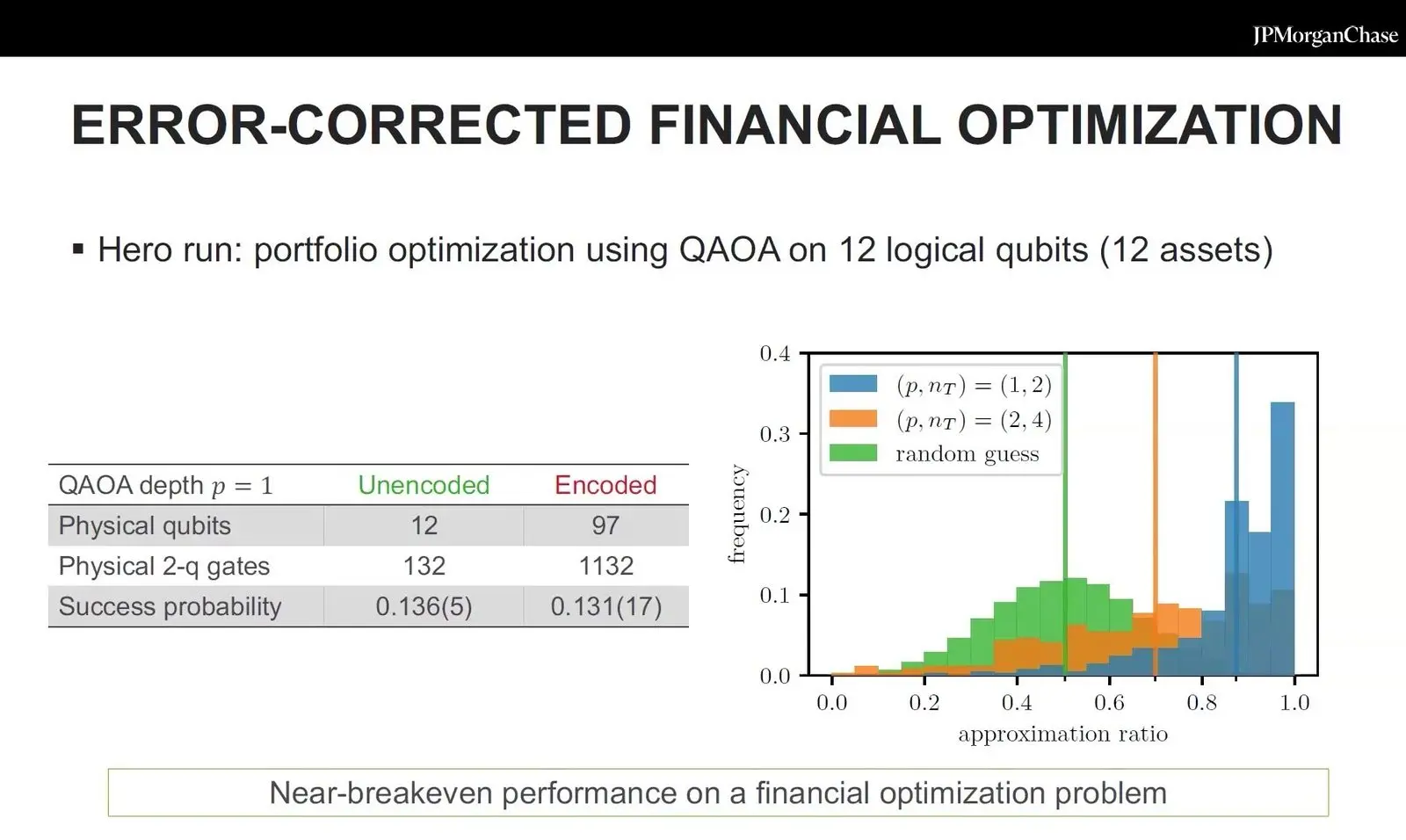
The team built new circuits for magic states. These are the special inputs needed for the T gate, a step that error-corrected machines find costly. Teleporting each qubit onto a fresh helper qubit gave the lowest error in emulation, 1.87 in 1,000 per cycle, which Shaydulin credited to turning leakage into an ordinary error the code can fix. On a smaller test with eight logical qubits, protection raised the gate count from 49 to 735 while success rose from 0.102 to 0.108.
The main run put 12 assets on 12 logical qubits, which took 97 physical qubits and 1,132 two-qubit gates. Its success rate was 0.131, against 0.136 for the bare version with only 132 gates and 0.1821 for a perfect machine with no noise at all. At two layers the rate fell to 0.034. Even so, the approximation ratio, a score of how close the answers came to the best one, still beat random guessing. For more, see our report on the bank’s work with Quantinuum.
Infleqtion trains circuits on ordinary chips
Pranav Gokhale is chief technology officer and co-founder of Infleqtion. Gokhale treats most financial optimisation as a QUBO, a score over yes-or-no choices. Gokhale set four tests for a quantum model of one, which are that it should be hard to simulate on a classical computer, cheap to train, rich enough to fit the problem and reliable when run. The last test is their case for logical qubits. Their candidate is the IQP circuit, a layer of Hadamard gates on each side of a block of phase rotations.

Such circuits can be trained entirely on CPUs or GPUs, Gokhale said, much as AI separates the chips that train a model from those that run it. On an anonymised client problem, Infleqtion’s trained circuit reached 96.9 percent of the best answer. On a second problem it beat QAOA with one and two layers.
Infleqtion has started on the hardware but has not yet run the model on it. On the Sqale neutral-atom machine, Infleqtion packed ten small code blocks, each holding three logical qubits, into 80 atoms, and each block prepared its starting state with over 90 percent success after strict filtering of bad shots. The full logical IQP run has not been done.
The morning panel argues about shortcuts
Mekena McGrew of Deloitte chaired a panel of Shaydulin, Gokhale and Stefanos Kourtis of the Université de Sherbrooke. Kourtis had stepped in at a day’s notice with a talk on learning with neutral atoms, and said plainly that Kourtis knows nothing about finance. The panel asked about throwing away bad shots. Shaydulin said the bank’s runs throw away shots only when the making of a magic state fails.
The panel split on what counts as protection. Shaydulin argued that detecting errors is easier than correcting them, but that a method which throws away bad shots cannot work at scale. Gokhale said IQP training heads for good answers with no promise of the best one, and both Gokhale and Kourtis stressed designing codes together with the hardware they run on. McGrew closed by calling this the first year the workshop had seen work on logical qubits.
Bigger portfolios on today’s chips
Four talks pushed portfolios and trades onto the noisy chips that exist now, or onto other kinds of machine, and IBM’s run reached far larger sizes than the logical-qubit runs could manage. Each paid for that reach with classical help. Ordinary computers trained, checked or finished the quantum step every time.
IBM traces a 100-asset risk curve on 100 qubits
Andres Ruiz of IBM Quantum and IBM Research presented work with Soumyadip Ghosh and Stefan Woerner. Their problem was choosing a portfolio under a cap on CVaR, the average loss in the worst outcomes. Writing that cap into the circuit directly needs extra qubits and messy penalty terms. So Ruiz computes the whole set of best trade-offs between return and variance on the chip, then applies the cap on a classical computer, and one curve answers every risk budget.
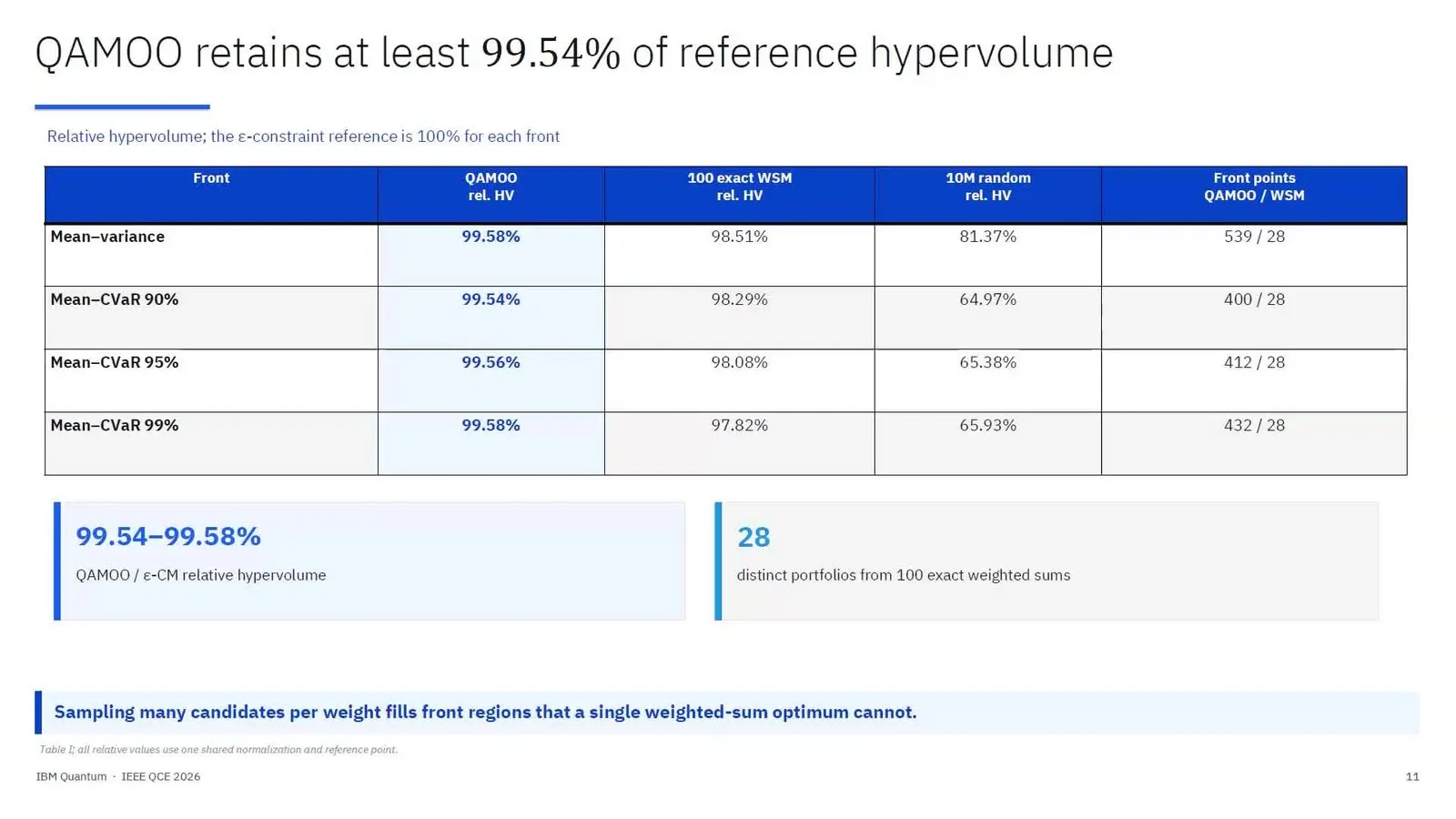
The test book held 100 assets on 100 qubits of the IBM Boston machine. QAOA at depth three needed 2,376 two-qubit gates, with 100 different weightings of risk against return and 100,000 shots for each one, and the circuit settings were trained on a classical computer by a method called Pauli propagation.
The chip’s scores were high. Measured by the share of the reference curve’s area it covered, the chip kept 99.58 percent on the return-and-variance curve and at least 99.54 percent on the CVaR curves. Exact weighted sums landed near 98 percent and 10 million random portfolios near 81 percent. The classical training behind those scores took 2,692 CPU hours.
Delaware keeps a budget rule inside the circuit
Jose Falla of the University of Delaware presented work with their adviser, Ilya Safro, on picking exactly four assets from a book of twelve. Only 495 of the 4,096 possible choices hold four assets. A standard QAOA mixer, the step that shuffles between candidates, therefore spends most of its effort on choices that break the rule.
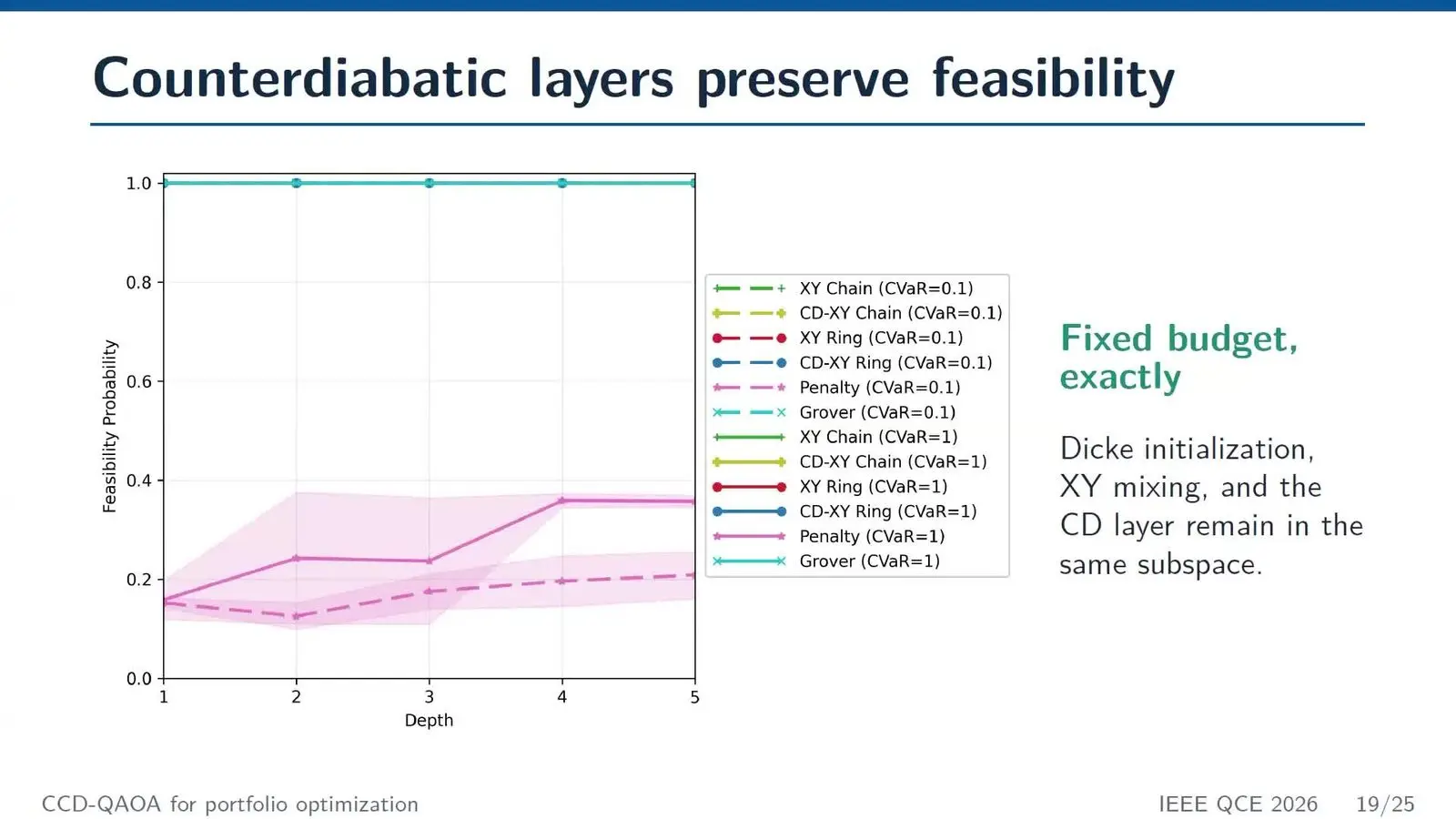
Falla used an XY mixer, which keeps the number of assets fixed. Falla started from a Dicke state, an even blend of every legal choice, and added extra three-qubit steps that help the circuit follow the best answer. Those steps also keep the count fixed. A mixer that relied on a penalty leaked outside the budget, while their layers stayed fully inside it.
In Falla’s runs the new mixer beat the plain XY mixer at every depth Falla tried, whether it was trained on the best tenth of the samples or on all of them. The price is more gates and more training time. Falla listed sparser steps, warm starts and fixed schedules as ideas still to test.
TCS Research finds simulator settings fail on a real chip
Rahul Rana of TCS Research in India won a best-paper award in the QAPP track for work with two co-authors on currency arbitrage. That means a loop of trades that ends with more money than it began with. Six currencies and loops of three make a 24-qubit problem, and a trick called Pauli correlation encoding, which stores yes-or-no choices in links between a few qubits, cut that to five.
Training ran on a simulator with rates from OANDA. Then the trained settings were copied onto a 156-qubit IBM chip, and in ten runs they found no workable loop at all. A short retrain on the chip itself fixed that. A larger case on 98 physical qubits was still in progress and fell short of ten good runs out of ten.
A photonic machine steadies a factor portfolio
Paul Griffin teaches at Singapore Management University. Griffin spent more than 15 years in banking and tech before that, and on the Sunday morning Griffin presented work with Nirvik Sahoo and Chyng Wen Tee. Fund managers often pick shares by traits such as momentum, quality and calm prices, and they rebalance every month. In this system a learning agent proposes how much weight each trait gets, and a QUBO, a score over yes-or-no choices, then steadies the book.
Two machines solved the QUBO. Gurobi, a classical solver, handled one copy, and Dirac-3 from Quantum Computing Inc handled the other. It writes the data onto modes of light and lets the higher-energy states leak away as the light goes round a loop. The data held 153 traits of company shares in 13 groups.
On the broad data the plain learner made the most money. Dirac-3 led on the risk-adjusted ratios, with the lowest volatility and turnover, while on a smaller set of traits Gurobi did better. Griffin had no theorem for the split and said the photonic machine returns many good answers, so the single best fit need not be the one to keep.
Quantum machine learning in banking
The Thursday afternoon session turned to learning, as did several earlier talks. Six talks and two panels gave the most cautious numbers of the week, and nearly every speaker said so.
Wells Fargo models the order book as a quantum channel
Vanio Markov of Wells Fargo presented work with Charlee Stefanski, Vladimir Rastunkov and David Novak. Markov argued that fast markets behave like quantum systems, because no trader sees the whole state, every trade moves the price it measures, and the order of events changes the outcome. Their data were limit order books for Apple, NVIDIA and Intel. These are the queues of buy, sell and cancel orders.
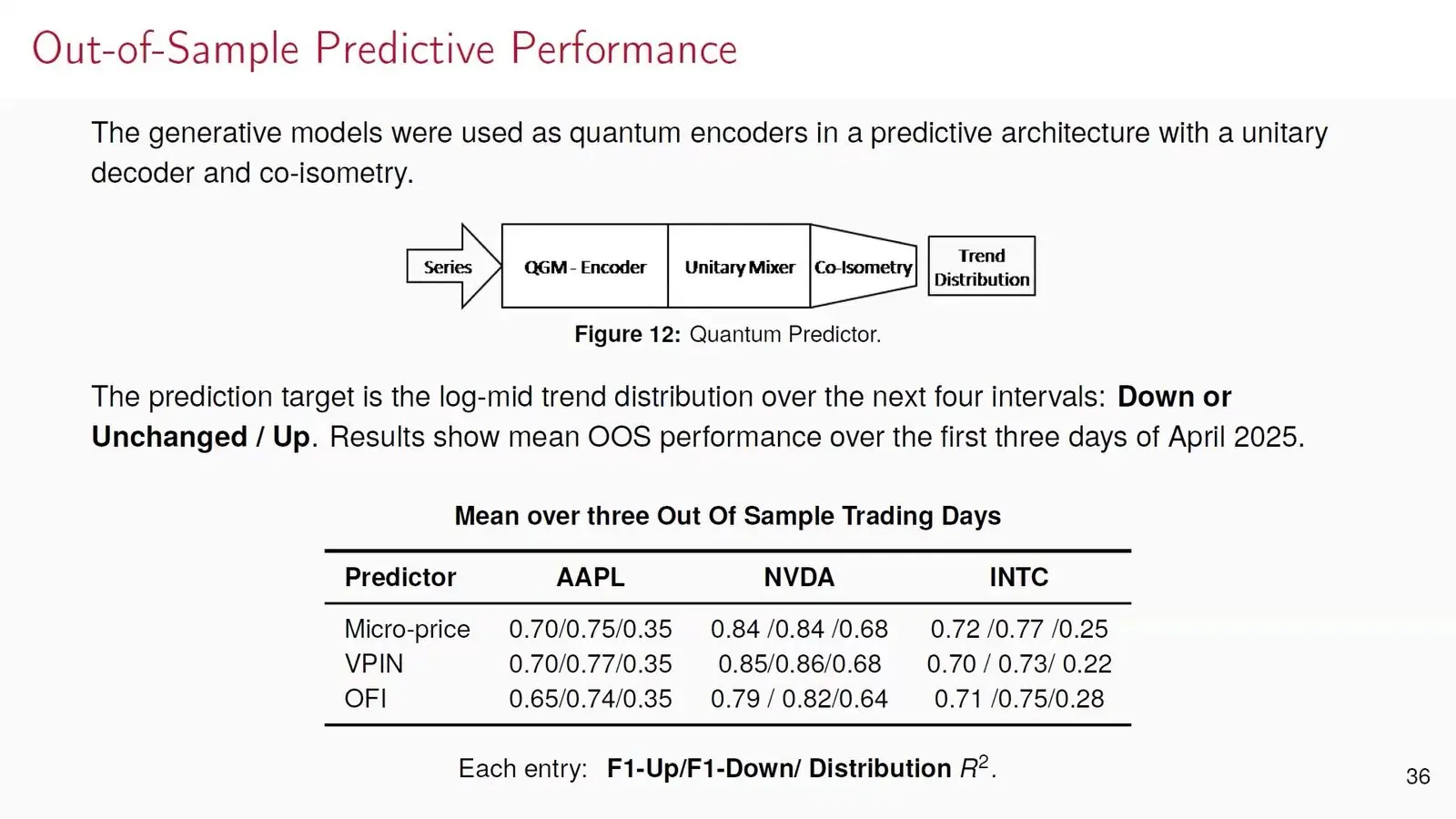
Markov said a classical linear model of these series needs more than 1,000 states. A quantum one needs far fewer. After about three years of work, Markov claimed it needs roughly the square root of that, about 30 dimensions or five qubits. Their model maps one quantum state of the market to the next, and the readout adapts so that the whole history picks how the next step is measured.
As a forecast of whether the mid price trends up or down over the next 400 events, the model scored 0.84 on NVIDIA on the F1 scale. Apple and Intel came in near 0.7. Markov stressed these are four-qubit models trained on a laptop.
HSBC asks how much memory a forecast needs
Dimitrios Athanasakos of HSBC in Singapore gave the next talk, on work with colleagues at the bank and at Nanyang Technological University. Most work on quantum computing in finance asks how fast an answer comes. This talk asked how much memory a forecast needs, when a hidden source sends bits through noise and an observer keeps a running guess about what it last sent.
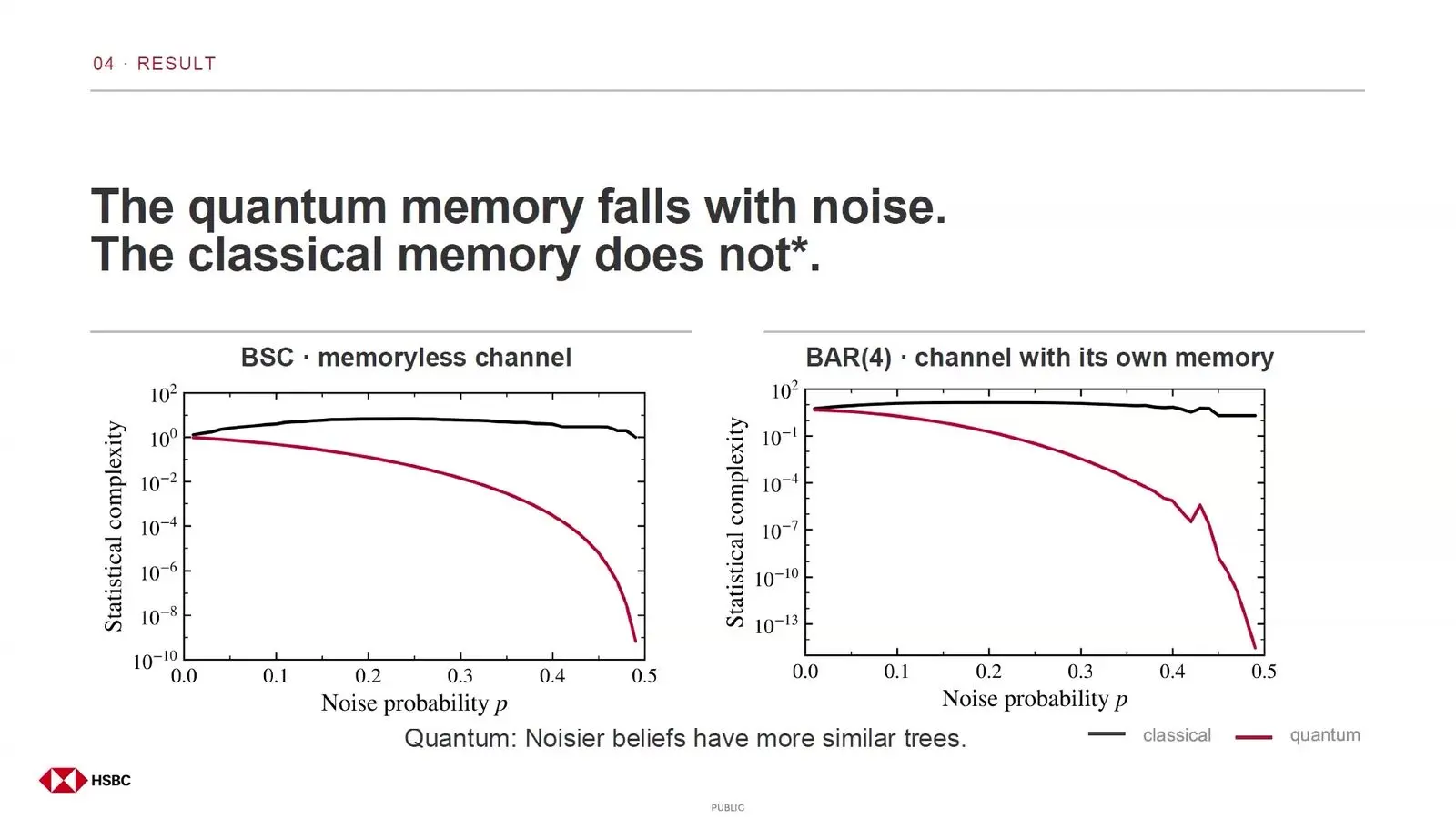
A classical store must keep beliefs of 0.64 and 0.65 apart, even though they predict almost the same future. Their quantum encoding writes each belief as a state whose overlap with the others reflects how alike their futures are, so near-identical beliefs share most of their space. On two noisy test channels, quantum memory fell by many orders of magnitude as the noise rose towards a coin toss. Classical memory stayed roughly flat. Athanasakos said there is no strict proof of the gap yet.
NYU Abu Dhabi passes fraud models along a blockchain
Nouhaila Innan of the Center for Quantum and Topological Systems at NYU Abu Dhabi presented QuantumChain. Innan put UK payment fraud losses at 1.28 billion pounds in 2025, while fraud makes up under 1 percent of all payments, which makes it both costly and rare, and so hard for any model to learn. Each bank keeps its own data.
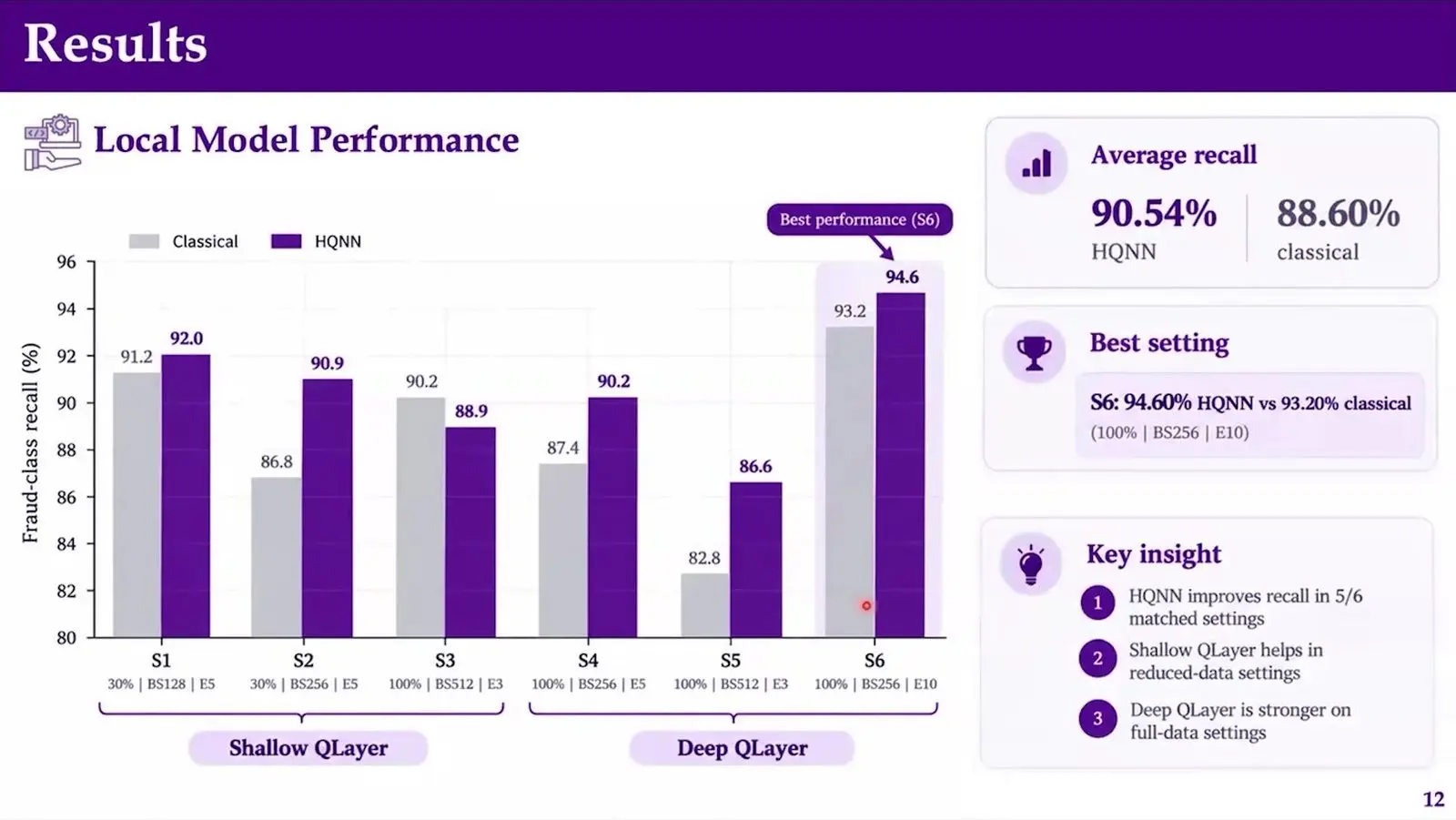
Each bank trains a hybrid quantum and classical model on its own data and locks the update. A hash of each update goes on a private blockchain so that any tampering shows, and the update then travels over a simulated quantum key link to a server that weights each bank by how reliable it has been. On the PaySim data with 10 clients, on a noisy simulator, fraud recall averaged 90.54 percent against 88.60 for a matched classical model. Innan noted that stronger classical models exist.
Carnegie Mellon’s ring count flags 2008 and misses 2020
Arul Rhik Mazumder of Carnegie Mellon University, writing with Shreyan Ronit Mazumder, turned daily S&P 500 returns into clouds of points and counted the rings in each cloud. The ring count rose before the 2008 crash. The known quantum way to count rings needs deep circuits, so Mazumder used a shallow tunable circuit in their place.
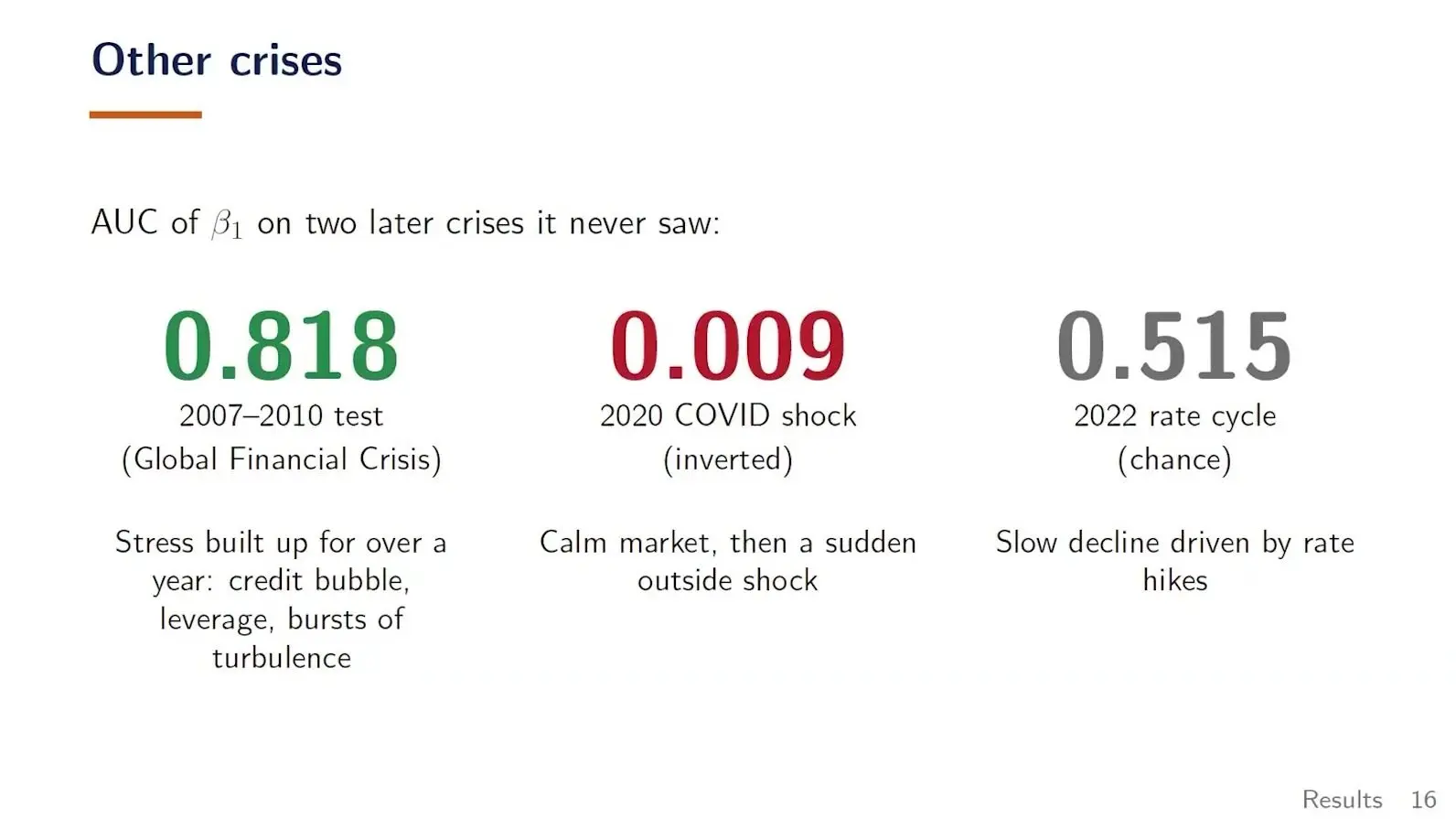
As a crash signal the ring count scored an AUC of 0.818 on 2007 to 2010, against 0.652 for volatility. That is a clear lead. On the sudden 2020 COVID shock it scored 0.009, a signal pointing the wrong way, and on the 2022 rate cycle it scored 0.515, which is chance. Mazumder tied the 2008 success to the slow build-up of stress before that crash.
American Express runs credit features on three IBM chips
Andras Ferenczi, an engineer at American Express, first showed the credit work on the Tuesday. It was run with a team from IBM. At 101 qubits and 174 features the circuit needed 870 two-qubit gates, with the same layout on IBM’s Brisbane, Torino and Marrakesh machines, and the only error handling was a fix for readout errors called TREX.
On balanced samples every chip came in just under the classical model, with Brisbane at 87.7 against 88.7 and Torino at 88.9 against 89.8. Quantum features led in one column only. That was an 81-qubit simulation, at 89.1 against 88.4. In a later test on unbalanced data, the quantum model on its own was the weakest of all.
American Express tests quantum features for credit risk
A team from American Express, working with IBM, found that quantum features nudge a credit default model up by no more than its error bars. Tree models such as XGBoost already do this job well. Even so, a few basis points of ranking matter on a large book, and the data came from a public contest that American Express sponsored in 2022, with about 459,000 customers.
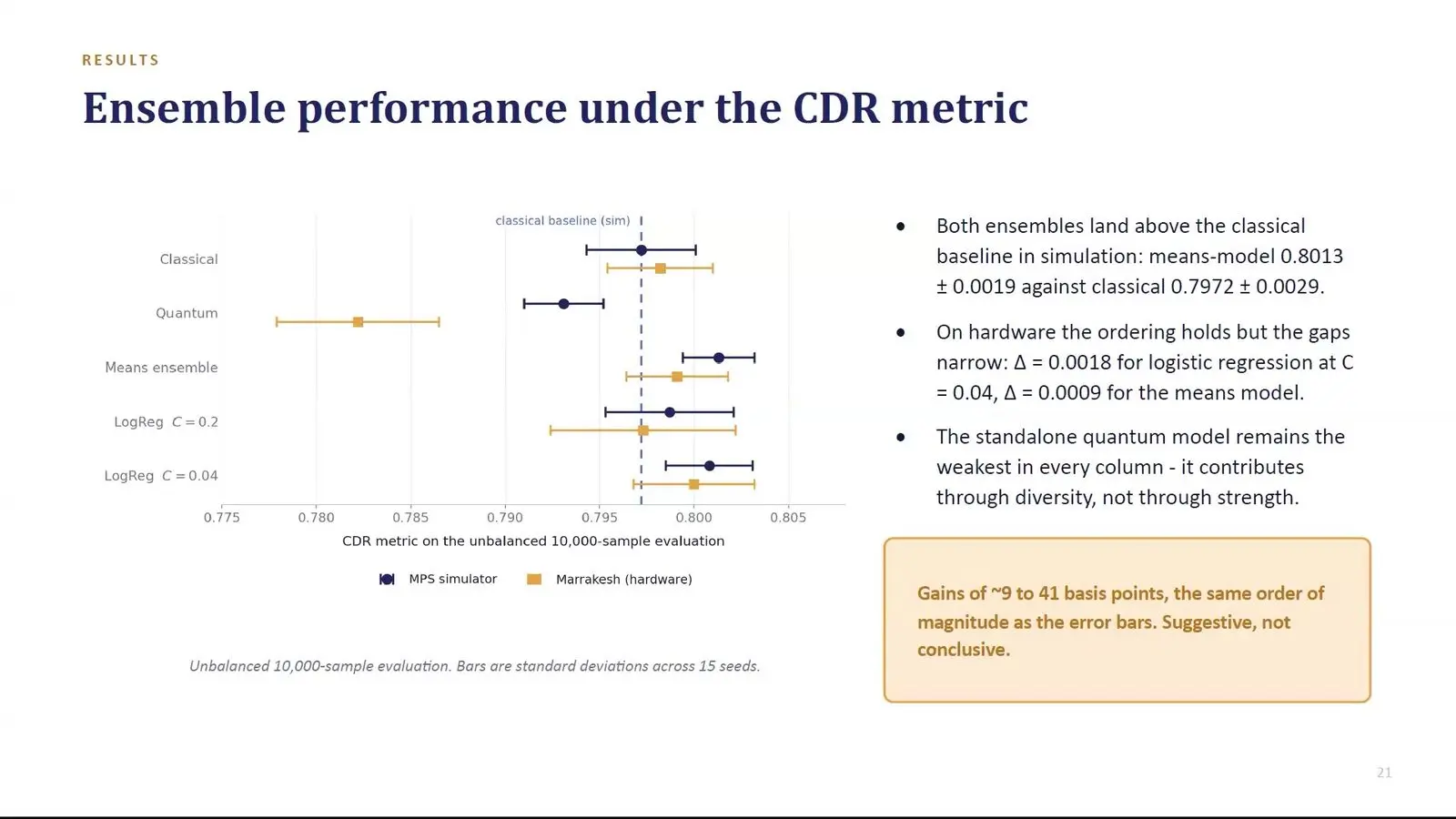
Each customer’s features were loaded into a chain of two-qubit links, and each qubit was then measured three ways, one circuit run per customer. The results went into XGBoost. On 101 qubits and 174 features, IBM’s Marrakesh machine scored 88.8 percent on test data against 89.6 for the classical model alone. The hardware landed within one to one and a half points of simulation.
The two models disagreed on many customers. So the team blended them, and in simulation the blend scored 0.8013 against 0.7972 for the classical model alone, though on the Marrakesh hardware the gap narrowed to just 0.0009. The team called its gains of 9 to 41 basis points suggestive. It claimed no quantum advantage.
The afternoon panel looks for where learning could pay
McGrew chaired again. Markov, Athanasakos and the American Express speaker made up the panel. Asked what 9 to 41 basis points mean, the speaker from American Express said that on a large book they can add up to millions in lost business. The same speaker named fraud and default detection, call-centre scheduling, foreign exchange and routing as places where learning on error-corrected machines might one day pay.
Athanasakos saw firmer ground in optimisation. Athanasakos called machine learning a science of trial and error, which today’s small machines cannot yet test. Markov went further and said that even a perfect computer could not win by brute force against the money already spent on deep learning, so the best bet is models built around problems that look like quantum ones.
A bank panel puts quantum-safe migration ahead of quantum computing
Erin Li of CIBC chaired a Wednesday panel of five, drawn from CIBC, a central bank, a hub run by the BIS, a quantum nonprofit and a quantum firm. Its firmest view was about locks. Moving banks to quantum-safe cryptography works only if the whole network moves, since one slow bank keeps the old locks alive for all the rest of them.

On computing the panel was more guarded. Stepan Fomichev of Xanadu said real advantage needs error correction and about a billion gates. Maryam Haghighi of the Bank of Canada described a sandbox in which a quantum optimiser did much better than a heavily tuned classical one on a month of real payment data. It was one month, Haghighi stressed, and a long way from use. In the final poll 65 percent of those who answered expected quantum computing to be useful in narrow places within ten years.
Pricing and production
Three talks sat at opposite ends of the subject, one at the start of the week in a Monday tutorial and two from Intesa Sanpaolo. One priced an option on a five-qubit circuit. The others ran a real trading book and about 900 cash machines on ordinary computers.
Classiq prices an option on eight price points
Tomer Itelson of Classiq Technologies led the afternoon half of a Monday tutorial, which the programme shared with Stefano Mensa of NVIDIA, and after some drills in Classiq’s Qmod language the room priced a European call option. That is the right to buy an asset at a fixed price on a set date. Its value is the average payoff over a model of future prices. Monte Carlo prices it by sampling.

The quantum route is amplitude estimation. It builds a circuit where one qubit reads 1 with a probability equal to the expected payoff, and the iterative version narrows an interval on that probability round by round. In principle it needs far fewer samples than Monte Carlo. Three qubits held eight price points, and a lookup table applied the payoff only when the price sat at or above the strike.
The circuit came out five qubits wide. A run on Classiq’s own sampler gave a payoff estimate of 0.17380, with an interval from 0.17174 to 0.17585, while the CUDA-Q version of the same exercise ended in an error and no comparison with a classical price was shown. The room treated it as a lesson in method, with no claim of speed.
Intesa Sanpaolo tilts a real trading book towards return
Francesca Cibrario of Intesa Sanpaolo presented the work with Davide Veronelli. It came from the bank, its innovation centre and Fondazione LINKS. The classic Markowitz method weighs the return a book should make against how much that return swings, so a manager has to trade one for the other. Tilting adds one dial. Its sign and size push the same score towards return or towards risk.
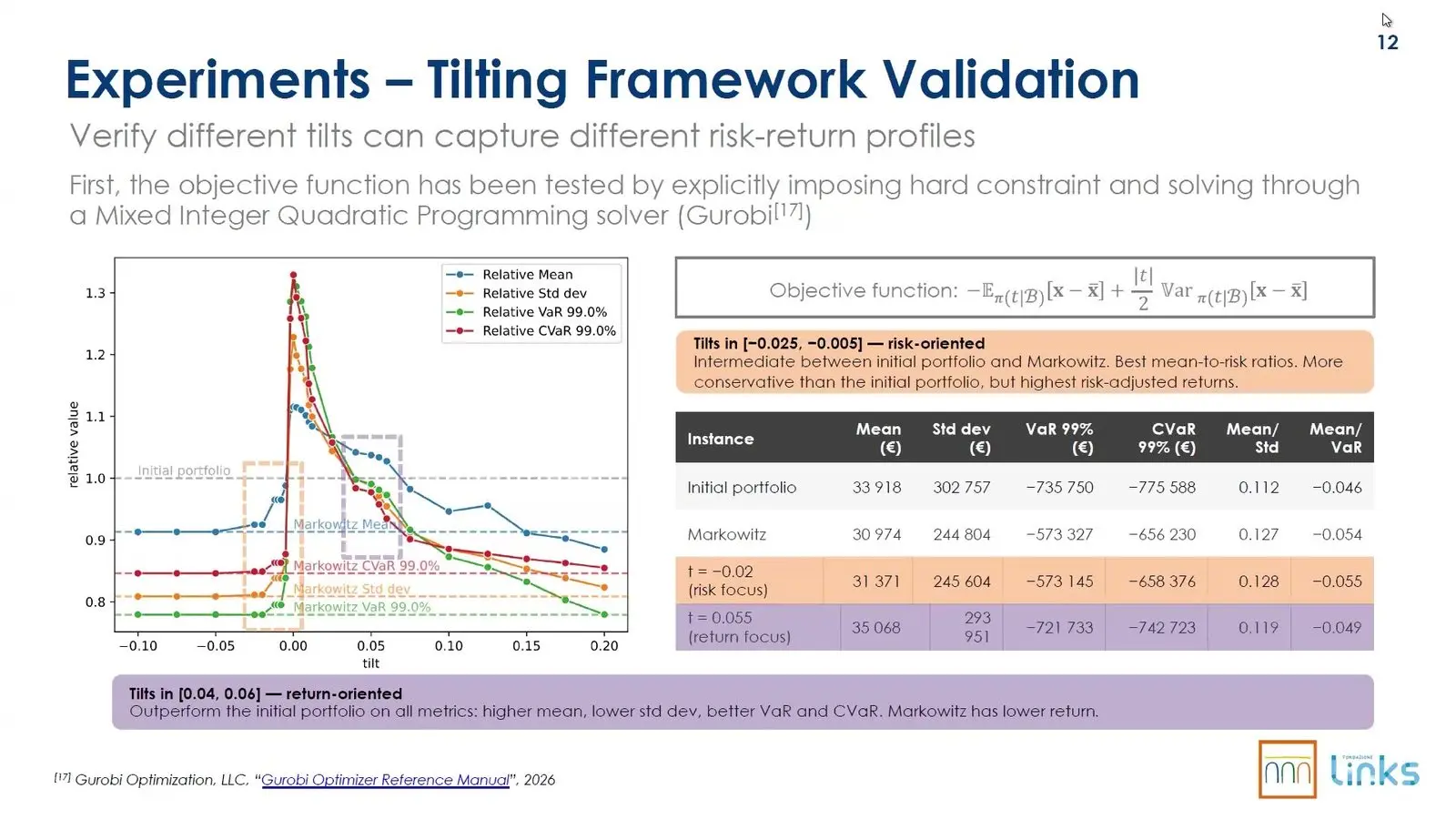
The test was a real book from 28 September 2018 of 127 instruments, among them stocks, futures and options. The team had no quantum machine for this project, so Gurobi, a classical solver, did the work. A tilt towards return gave a mean of 35,068 euros against 33,918 for the bank’s starting book and 30,974 for Markowitz, with less spread and better value at risk than the starting book.
Intesa Sanpaolo cuts the cost of ATM cash by 12.7 percent
Valeria Zaffaroni of Intesa Sanpaolo presented the one finance result in production. It is a quantum-inspired ATM scheduler that runs without any quantum chip. A refill ticket opens when an ATM falls below the bank’s cash threshold, and a crew then empties and refills it. Each day the cost is written as a QUBO, with a fixed fee per visit, a loading charge set by the machine’s size and a charge on cash left idle.
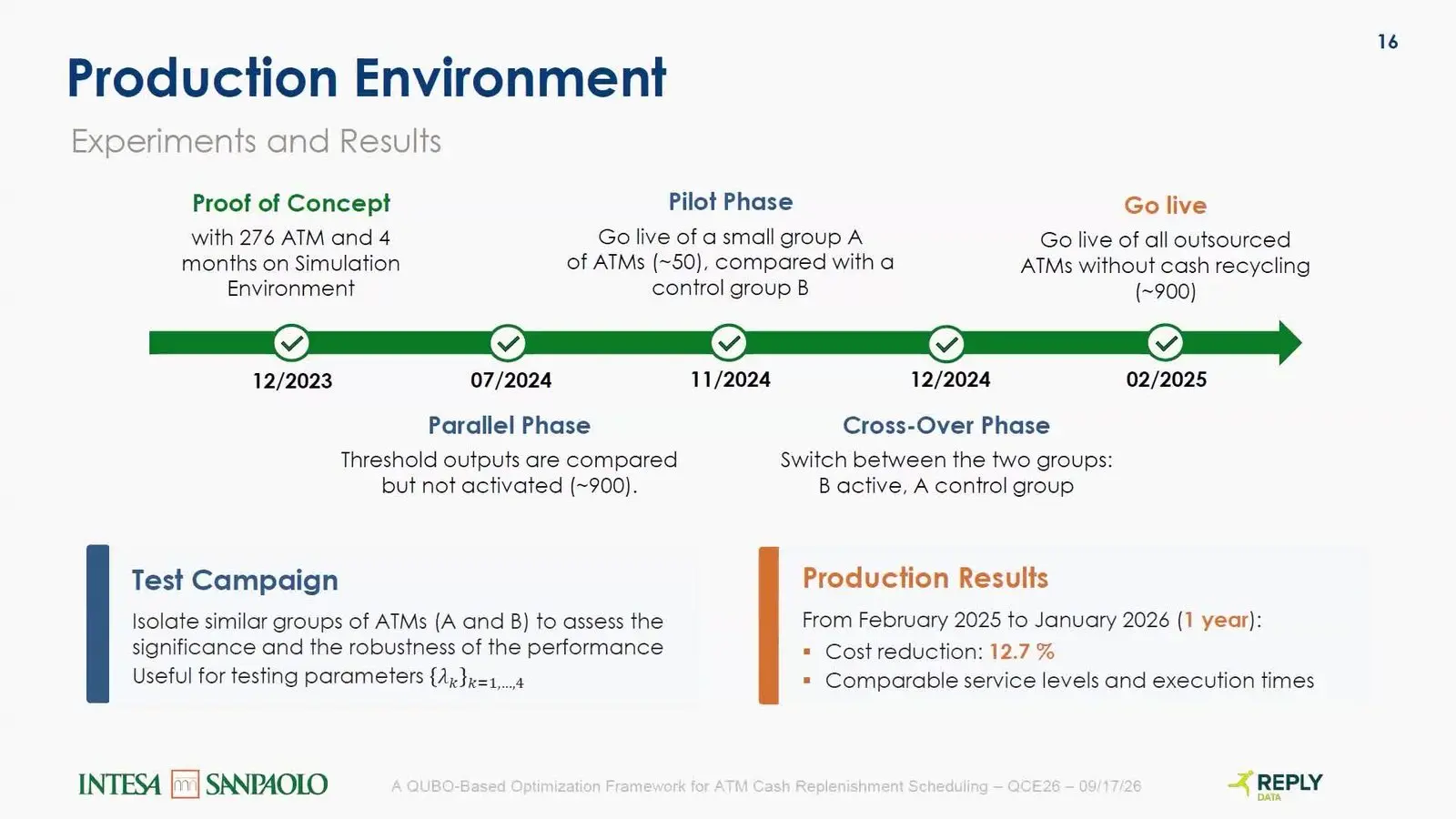
The rollout was slow and careful. It began in December 2023 with a four-month trial on 276 ATMs, and about 50 machines went live in July 2024 beside a control group. From November 2024 it covered all outsourced ATMs without cash recycling, about 900 of them, and the year of results runs from February 2025.
From February 2025 to January 2026 the cost of cash fell 12.7 percent, with service levels and run times about the same. Next come about 800 ATMs that recycle cash, comparisons with other rule-of-thumb methods and small trials on real quantum hardware, which would be the first time a quantum chip touched the system at all. No such comparison was shown yet.
What it means for banks and asset managers
A bank deciding what to fund has a clear order of work. Quantum-inspired solvers can be tried now against the system a bank already runs, with a control group beside them as Intesa Sanpaolo used, and judged on the money they save. A buyer should also ask to see them set against ordinary rule-of-thumb methods before signing.
The logical-qubit runs from JPMorganChase and the 100-qubit risk curve from IBM are engineering milestones. They show no financial benefit yet, and the credit gains match their error bars, so talk of a quantum advantage in finance should wait for a protected run that beats a classical solver on a real book. Shaydulin’s few hundred variables are the place to watch. Until then, the quantum money in finance sits inside a cash machine.
Frequently asked questions
What is quantum computing in finance?
Quantum computing in finance means using quantum algorithms, or classical programs inspired by them, on banking problems such as pricing, risk, portfolio choice, credit scoring and logistics. The main hopes are faster Monte Carlo pricing through amplitude estimation, better portfolio search through QAOA and annealing, and new patterns from quantum machine learning.
Has quantum computing beaten classical methods in finance?
Not clearly, on the evidence at QCE26. Hardware runs from JPMorganChase, IBM and others came close to classical or unprotected baselines on small problems, and a Bank of Canada panellist described one sandbox win on a month of settlement data. Blending quantum features from up to 101 IBM qubits into a credit model gained 9 to 41 basis points, which its authors said matched the error bars, and they claimed no quantum advantage.
What did JPMorganChase show on logical qubits?
JPMorganChase ran a 12-asset portfolio problem with QAOA on 12 logical qubits made from 97 physical qubits on Quantinuum hardware. Every part of the circuit was protected against errors. The protected run succeeded with probability 0.131, against 0.136 for the unprotected version.
Can quantum machine learning predict credit default?
An American Express team tested quantum features from up to 101 qubits on IBM hardware with an XGBoost model on about 459,000 customers. The quantum model alone scored slightly below the classical one, and a blend of the two gained 9 to 41 basis points. The team called the gains suggestive because they matched the error bars.
What is quantum-inspired optimisation?
Quantum-inspired optimisation borrows the maths of quantum algorithms, such as writing a problem as a QUBO, and solves it on ordinary computers. Intesa Sanpaolo’s ATM scheduler works this way. It cut the cost of cash in about 900 machines by 12.7 percent over a year.
What happened at IEEE Quantum Week 2026?
IEEE Quantum Week 2026, also called QCE26, ran from 13 to 18 September at the Metro Toronto Convention Centre. Most of its finance work came together in a three-session workshop on Thursday 17 September. This guide covers 17 of its finance talks and panels and one tutorial sitting.
This guide is based on 17 talks and panels and one tutorial sitting at IEEE Quantum Week 2026 (QCE26), held at the Metro Toronto Convention Centre from 13 to 18 September 2026, and on the published conference programme. Names follow the programme where it lists them, and affiliations and titles not listed there are as speakers gave them. Results are stated as each speaker presented them, and many come from emulation, simulation or small test problems. Company claims are the companies’ own.
- Qubit hardware and scaling roadmaps
- Photonics and quantum sensing
- Control electronics, calibration and readout
- Quantum error correction and decoders
- Fault-tolerant compilation and magic states
- Modular and distributed quantum computing
- Quantum computers in supercomputing centres
- Compilers, circuit synthesis and languages
- AI and language models for quantum software
- Testing and reproducible quantum experiments
- Benchmarks, error mitigation and quantum advantage
- Quantum state preparation, oracles and arithmetic
- Quantum optimisation, QAOA and annealing
- Quantum machine learning
- Chemistry, materials and life sciences
- Differential equations and fluid dynamics
- Power grids and energy
- Logistics, climate, databases and games
- Quantum networks and key distribution
- Quantum security and post-quantum cryptography
- Quantum education and workforce
- Policy, standards and the quantum business




See today’s quantum computing news on Quantum Zeitgeist for the latest breakthroughs in qubits, hardware, algorithms, and industry deals.