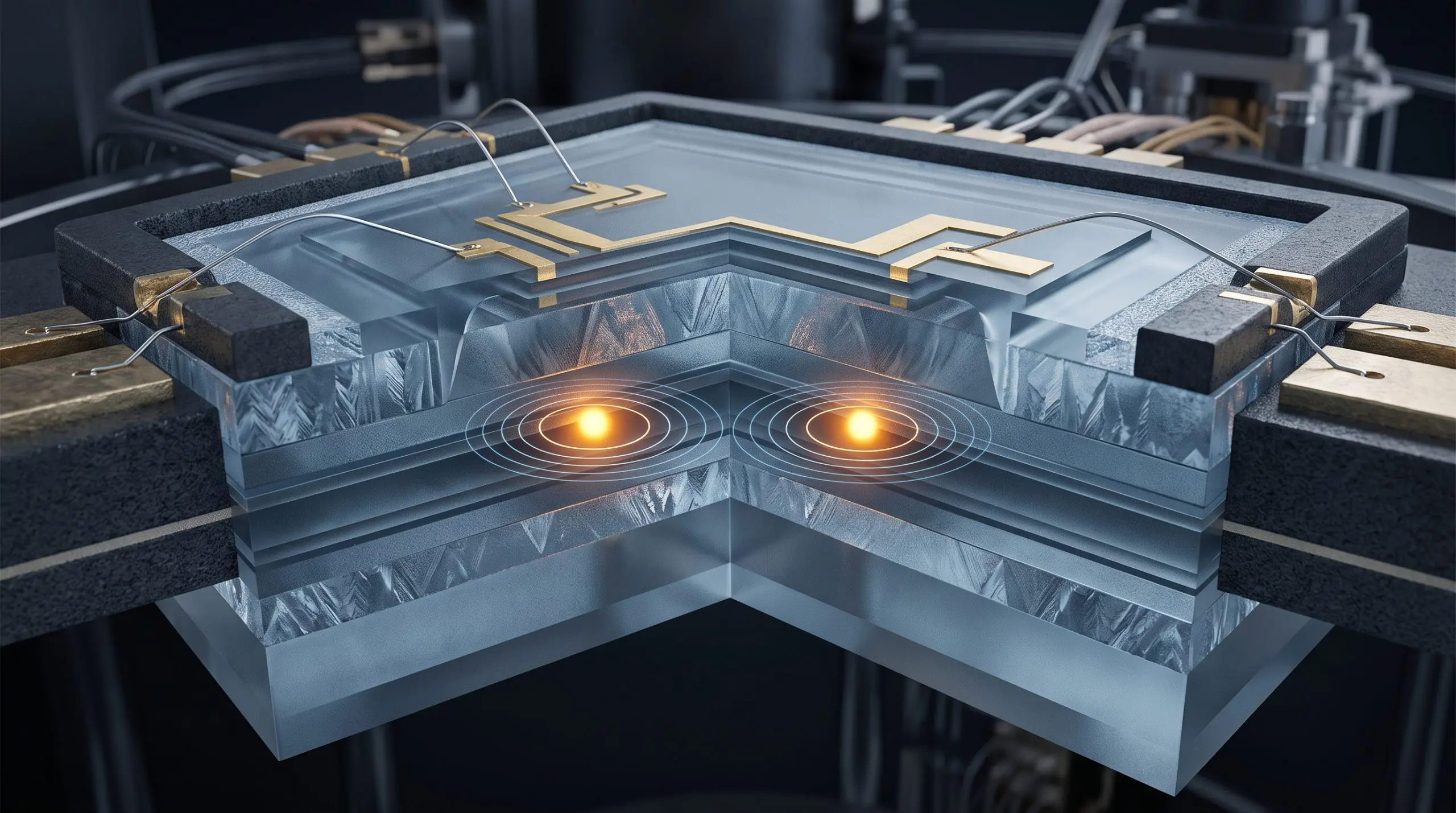
Researchers at National Taiwan University have developed a new stochastic model to more accurately predict decoherence in spin qubits within silicon-germanium quantum dots. The work uses a 1/f spectrum to characterize quantum noise correlation, offering a more precise approach than previous random coherence models.
By employing gate set tomography, the team attributed specific error generators to incoherence error, resolving a longstanding issue where large coherent noise strengths were previously overestimated to explain observed decoherence times. This refined understanding allows for gate optimization, demonstrating a substantial reduction in errors from non-Markovian charge noise and a more robust control pulse.
Si/SiGe Quantum-Dot Spin Qubits and Stochastic Charge Noise
Electric dipole spin resonance, a common technique for controlling spin qubits in Si/SiGe quantum dots, is directly impacted by fluctuating electric fields at the qubit interface. Researchers at National Taiwan University have proposed a spin-phonon model to characterize how these fluctuations contribute to decoherence, a major obstacle to building stable quantum computers. This model accounts for the non-Markovian effect of charge noise, a phenomenon where past noise influences current qubit behavior, and offers a more detailed understanding than previous random coherence models.
This 1/f noise, prevalent in solid-state qubit systems including superconducting qubits, originates from electric field fluctuations surrounding the qubit itself. The researchers specifically note that even with thicker SiGe layers designed to isolate qubits from oxide layers, charge noise remains a significant factor in the decoherence of spin qubits formed near the Si/SiGe interface, as charge density fluctuations contribute to the noise.
The work addresses a critical need for detailed descriptions of non-Markovian noise and the development of control methods to suppress it. Gate set tomography was employed to analyze error generators, leading to the attribution of specific errors to incoherence rather than previously overestimated coherent noise strength.
This distinction is important because it avoids artificially inflating the perceived strength of coherent noise to match experimentally observed decoherence times, which in turn provides a more accurate assessment of gate fidelity. The researchers found that δ(t) = + + /ℏ contains all frequency detuning parameters, contributing to a decrease in decoherence time and gate infidelity, where is a manually tunable frequency detuning, is the classical realization of 1/f noise. is the effective magnetic field of hyperfine interaction.
Further analysis demonstrated that an optimized control pulse, designed to mitigate the effects of incoherent non-Markovian 1/f charge noise, substantially reduces error contributions. This optimized pulse also exhibits greater robustness against coherent noise compared to a standard Gaussian pulse, as revealed through filter function analysis within a CPMG protocol.
The team’s findings suggest that the optimized pulse is significantly more effective at maintaining qubit coherence in the presence of noise. While single-qubit gate fidelities have already exceeded 99.9% and two-qubit gate fidelities have reached 99.8% in these systems, this work represents a step toward even higher fidelities and more stable quantum computations.
1/f Charge Noise Spectrum Impacts Spin Qubit Decoherence
A spin-phonon model, derived from electric dipole spin resonance, characterizes decoherence in spin qubits embedded within silicon-germanium quantum dots, offering a more detailed understanding of noise than previous approaches. This model directly links classical charge noise to quantum noise via the spin-phonon coupling constant, , a connection that helps accurately simulate qubit behavior. The work demonstrates that this coupling contributes significantly to decoherence, as observed in master equation construction and simulations using parameters from a real device.
The model’s Hamiltonian incorporates a second-order interaction, detailing how charge noise influences the spin-phonon coupling within the Si/SiGe heterostructure, a structure where electron confinement is typical. The team’s analysis, detailed in an appendix, outlines the derivation of this Hamiltonian and its impact on qubit performance. Simulation results, including Ramsey experiments and the CPMG protocol, reveal a consistent feature of decoherence linked to the 1/f spectrum, confirming the model’s predictive power.
The 1/f charge noise is recognized as a primary factor limiting the decoherence time of spin qubits in Si-based quantum dots, and this work provides a framework for addressing its impact. “The spin-phonon coupling will also contribute to some of the decoherence,” the researchers state, highlighting the importance of this interaction in understanding qubit limitations. This understanding is critical for developing strategies to mitigate noise and extend qubit coherence times, a vital step toward realizing stable quantum computation.
Spin-Phonon Model Characterizes Decoherence in Si/SiGe Dots
This model directly links charge noise to spin-phonon coupling through a second-order interaction, a connection detailed in the paper’s appendix, and offers a refinement over models that solely consider coherent noise. The work introduces a Hamiltonian incorporating this interaction, detailing how charge fluctuations impact the spin qubit’s behavior. This is not merely a theoretical exercise. Simulations validate the noise model against a real qubit device, demonstrating its ability to accurately reflect observed decoherence.
The researchers formulate the decoherence noise model by considering the electron’s position and spin operators, which are correlated within the Si/SiGe heterostructure. The team’s analysis reveals that the frequency detuning parameter, δ(t) = + + /ℏ, contributes to decreased decoherence times and gate infidelity.
Even with thicker SiGe layers intended to isolate spin qubits from interfacial charge noise, the proximity of quantum dots to the Si/SiGe interface means charge fluctuations continue to affect qubit performance. “Although some of the devices use a thicker SiGe layer to let the spin qubits of the quantum dots go far away from the oxide layer that contacts the metal gate, because the quantum dots are formed and located near the interface of Si/SiGe, there is still some charge-noise effect observed, especially in the decoherence of the spin qubits,” the authors state, emphasizing the persistent influence of interfacial charge noise. The model’s ability to accurately capture these effects is important for improving the performance of decoherence simulations and gate set tomography analysis.
By addressing the error generators identified through these methods, the research attributes specific incoherence errors, avoiding the overestimation of coherent noise strength previously used to explain observed decoherence times. This refined understanding allows for more accurate assessments of gate fidelity and enables optimized control pulses designed to minimize the impact of non-Markovian 1/f charge noise.
Incoherence Errors from 1/f Noise Underestimated in Prior Studies
Gate set tomography reveals that previously attributed decoherence may stem from mischaracterization of noise, rather than inherent limitations of the qubit itself. Analyses of error generators demonstrate that incoherence errors have been underestimated in simulations of spin qubits within silicon-germanium heterostructures. Earlier studies relying solely on coherent noise models to predict decoherence decay in Ramsey and Carr-Purcell-Meiboom-Gill protocols showed deviations from experimental results, suggesting an incomplete picture of error distribution.
The research team’s investigation links specific error generators identified through GST to the proposed non-Markovian noise model, pinpointing sources of noise and their directionality. Detailed analysis of these error channels is available in Appendix B of the published work. Gate optimization, informed by the refined noise model, yielded substantial improvements in gate fidelity. The team employed the Krotov method to optimize single-qubit gate operation, achieving a reduction in gate infidelity of approximately one order of magnitude.
This optimization focused on addressing incoherent errors, a strategy that differs from traditional approaches centered on minimizing gate operation time. “In our quantum noise model, we attribute a portion of the error to the incoherent error that occurs when operating the quantum gate,” the researchers write. The ability to accurately account for environmental influences, such as 1/f noise, is critical for reducing non-Markovian errors. The model’s integration with pulse engineering provides a pathway to enhance average gate fidelity while simultaneously minimizing incoherence.
This is particularly important for the development of two-qubit gates, like CZ gates, where identifying error mechanisms and developing effective noise models are essential before pulse optimization can begin. Pinpointing relevant noise sources, characterizing their spectra and suppressing their effects on quantum gate operations are key steps toward achieving fault-tolerant quantum computers.
Optimized Control Pulses Reduce Non-Markovian Noise Effects
Gate set tomography revealed that attributing specific error generators to incoherence errors avoids a common misstep in decoherence analysis, overestimating the strength of coherent noise. This refined approach, detailed in a recent publication, allows for more accurate modeling of decoherence times in Si/SiGe quantum dot spin qubits and, importantly, a more realistic assessment of gate fidelities. Previous studies often relied on larger coherent noise strengths to match experimental results, inadvertently underestimating the true performance potential of these qubits.
The team’s work extends beyond simply refining the noise model; they also demonstrate a practical method for mitigating its effects. Using the Krotov optimal control method, researchers designed optimized control pulses that substantially reduce the contribution of incoherent, non-Markovian 1/f charge noise. This optimization strategy focuses on minimizing the impact of noise with a 1/f spectrum, a characteristic correlation found in the quantum noise affecting these devices.
The resulting pulses exhibit a distinct waveform compared to traditional Gaussian pulses, indicating successful navigation away from local minima in the optimization process. The normalized filter spectrum derived from the control matrix demonstrates the extent to which charge noise is removed during gate operation. A comparative analysis shows the optimized pulse consistently outperforms a Gaussian pulse in reducing noise across a range of frequencies, even down to Hz, corresponding to the maximum number of π(Y) gates implemented in the CPMG sequence.
This suggests the optimized pulse is not only effective against quantum noise but also exhibits greater robustness against classical dephasing noise sharing a similar 1/f spectrum. The master equation approach, employed in an extended Liouville space, yielded gate fidelities closer to experimental values than previous methods.
This improvement stems from accurately describing the non-Markovian error through time convolution of the master equation, even while using a time-local approximation. The inverse of the frequency, representing the waiting time, is important for spectrum fitting and accurately characterizing the noise. Both classical and quantum incoherent noise can be effectively reduced by addressing their respective strengths in the frequency spectrum through careful analysis. Increasing the number of π pulses statistically reduces noise and coupling, a finding supported by the observed behavior of the optimized pulse in the CPMG protocol.
Oscillations within the optimized pulse shape are attributed to the ability of the operator to reduce the error accumulation rate, functioning similarly to dynamical decoupling techniques. The researchers state, emphasizing the broad applicability of their approach. This work provides a pathway toward enhancing average gate fidelity while simultaneously improving the resilience of quantum computations against environmental noise.
Microscopic Noise Model Validated via Ramsey and CPMG Simulations
Gate set tomography revealed a connection between error generators and incoherent noise, resolving discrepancies seen in prior decoherence simulations. This new work addresses this gap by introducing a stochastic model that accounts for non-Markovian 1/f noise, a common source of decoherence in these systems. The team’s approach centers on a quantum noise model that incorporates non-Markovian 1/f charge noise, derived from the spin-phonon coupling and described within a master equation framework.
Simulations of Ramsey and Carr-Purcell-Meiboom-Gill (CPMG) experiments, using parameters mirroring those of a realistic device, demonstrate the model’s ability to predict decoherence behavior. “Our noise model with the inclusion of quantum noise is compatible with other coherent noise models, which also address 1/f charge noise,” the paper states. By accurately characterizing the non-Markovian effects, the model provides a more realistic assessment of qubit performance.
The researchers demonstrated that the model yields gate fidelities closer to experimental values, validating its predictive power. This spectrum, extracted from CPMG sequences, aligns with theoretical predictions, further supporting the model’s accuracy. The team employed a Krotov optimization method, incorporating the non-Markovian noise correlation function into an extended Liouville space within the master equation approach. This allowed for a more precise simulation of qubit dynamics and a more accurate prediction of decoherence. The results confirm the model’s compatibility with existing coherent noise models while offering a more comprehensive understanding of the underlying noise mechanisms.
👉 More information
🗞 Effect of stochastic charge noise in Si/Si-Ge quantum dot spin qubits
✍️ Wei-En Chiu, Chia-Hsien Huang, Yi-Hsien Wu and Hsi-Sheng Goan
🧠 DOI: http://link.aps.org/doi/10.1103/c2c3-tdbs


See today’s quantum computing news on Quantum Zeitgeist for the latest breakthroughs in qubits, hardware, algorithms, and industry deals.