This guide follows 15 talks on quantum photonics and sensing at IEEE Quantum Week 2026 in Toronto. Most of them treated photons and measurements as a budget to be spent with care.
On the afternoon of Wednesday 16 September, in Room 718A of the Metro Toronto Convention Centre, Saikat Guha gave the closing panel of a signal-processing workshop a rule that sums up quantum photonics. Noise added at the detector can never be taken out afterwards, Guha said, so any quantum gain has to be won by working on the light before it is counted. A detector destroys the photon it registers. Each photon is therefore a coin that can be spent only once, and the only question is what it buys.
Light is still the natural carrier of quantum information. A single photon barely touches its surroundings, so it can keep a quantum state intact through air, fibre or a chip at room temperature. The same aloofness makes photons hard to steer, and every mirror and splice loses a little light. Sensing turns that fragility into a strength. A quantum system that is easily disturbed makes a very fine probe, and the best-known example is the nitrogen vacancy in diamond, a flaw whose glow changes with the magnetic field around it.
Taken together, the 15 talks followed here suggest that the cheapest gains in quantum photonics now come from spending the photon budget well. Several papers learned the same thing from fewer measurements, fewer instruments or fewer training rounds, and most of them did it in simulation or on a bench. The devices that make and catch photons moved more slowly. Thrift is running ahead of the hardware.
The strongest case against that reading came on Thursday afternoon. Nicolas Maring said Quandela’s published design for a photonic machine tolerates only six or seven percent total photon loss, which leaves software little room to cover for a bad splice. Ryota Kitagawa of Fujitsu showed how hard the hardware side is, since each tile of the team’s diamond chip needs exactly one good defect, and chance decides the strain each one feels. On this view the device sets the ceiling, and clever counting can only work beneath it.
Yet the same panel suggested that the size of the budget is itself a design choice. Ilai Schwartz said NVision’s molecules keep their data in nuclear spins and simply retry a failed light link, so the design can lose 70 percent of its photons and carry on. The two firms were spending the same scarce coin in opposite ways. Quandela guards every photon, while NVision makes photons cheap to lose.
That moves the argument from optics to accounting. The right design depends on what a lost photon costs the rest of the machine, which is a question of engineering and price as much as physics. Nikhitha Nunavath of TU Dresden showed a receiver that made the right call most of the time from sensor estimates that rarely got every detail right. The papers in this theme kept finding ways to need fewer measurements, and in quantum photonics a saved measurement is a saved photon.
What it is. Quantum photonics uses single photons to carry, process and measure quantum information. Quantum sensing uses fragile quantum states, such as the spin of a diamond defect, to measure fields and signals very finely.
What QCE26 showed. Several talks cut the measurements a task needs, from rebuilding a full diamond sensor curve out of 15 tones to tomography that needs about eight times fewer counts.
The hardware picture. Quandela said its quantum dots emit a photon 80 percent of the times they are triggered. Fujitsu screened 29 diamond nodes on its waveguide chips and showed entangling them is still ahead.
The caution. Many of the largest gains came from simulation, or from claims made on a panel. Several of the sensing methods have yet to meet a device.
Measuring light with fewer resources
Three Sunday talks went after the cost of measuring light. Each found a way to learn the same thing with fewer instruments, fewer counts or a cheaper camera.
One programmable gate replaces a rack of instruments
Mitchell Thornton, a professor at Southern Methodist University in Dallas, presented work with Hiva Shahoei, Cooper Shapard, R. Mason Tuller and Duncan MacFarlane. Their subject is the qudit. That is a quantum unit with more than two levels, and here it is a single photon whose levels are different colours of light, so it can hold more than a plain qubit. To read such a photon in a new way, a lab usually needs a new tool. Thornton sets one gate in front of a fixed detector and just reprograms it.
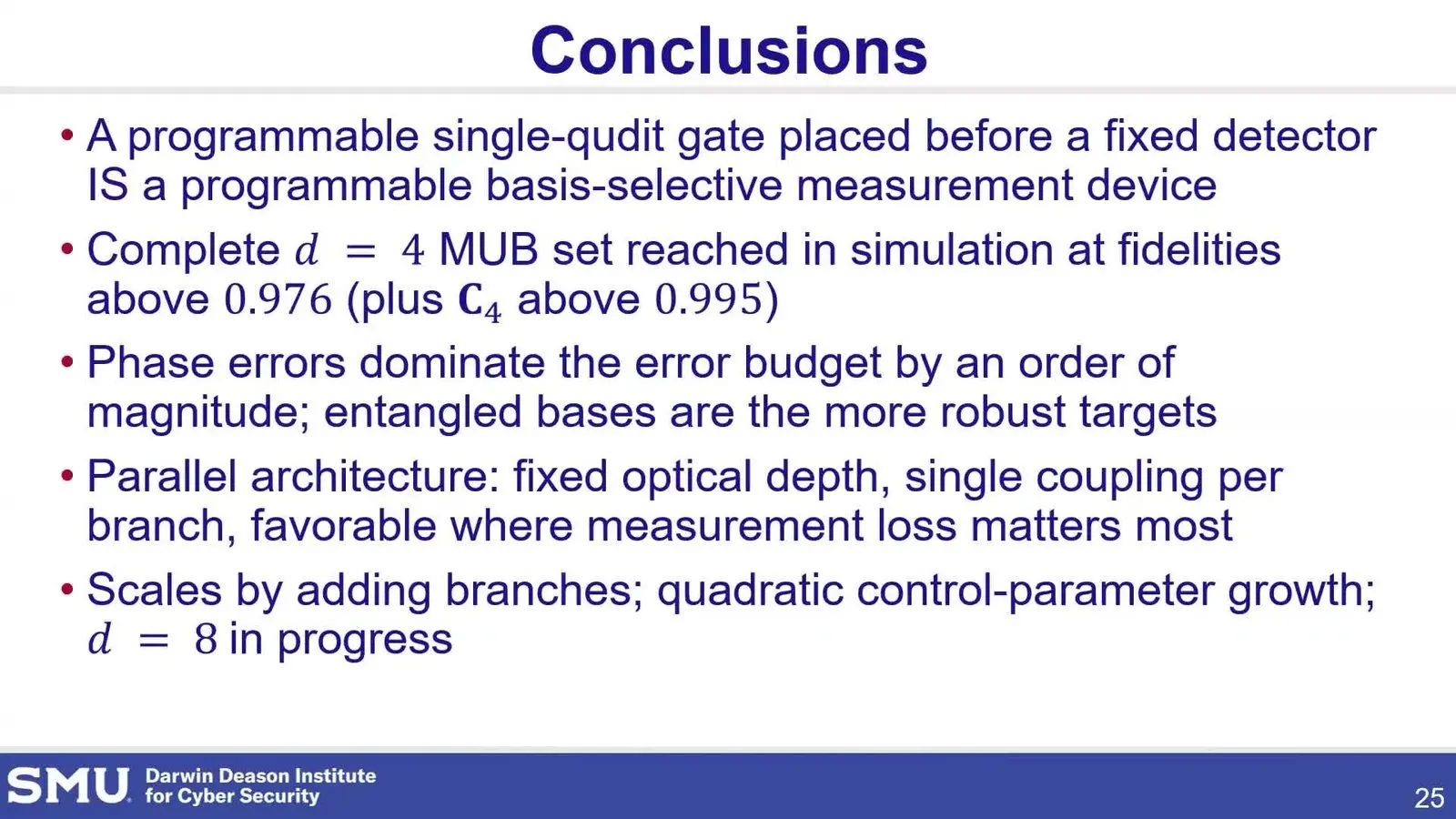
The gate is built from light modulators on side-by-side paths. For four levels it needs 104 radio settings, which a search finds once and then stores. Across about 100,000 trials in simulation, with noise near 2 percent, every setting cleared a fidelity of 0.98, a close match between the programmed gate and the target. No chip has run it yet. A layout is under way at the LIGENTEC foundry.
Georgia Tech rebuilds states from eight times fewer counts
Anuvab Sen, a PhD student at the Georgia Institute of Technology, presented work with their adviser Saibal Mukhopadhyay. Tomography is the job of working out an unknown quantum state from many measurements. In a sensor, the state has already been mixed with noise by the time it is read, so a plain fit keeps every part of the signal, noise and all. A common fix keeps only the strongest part. That throws away real signal.
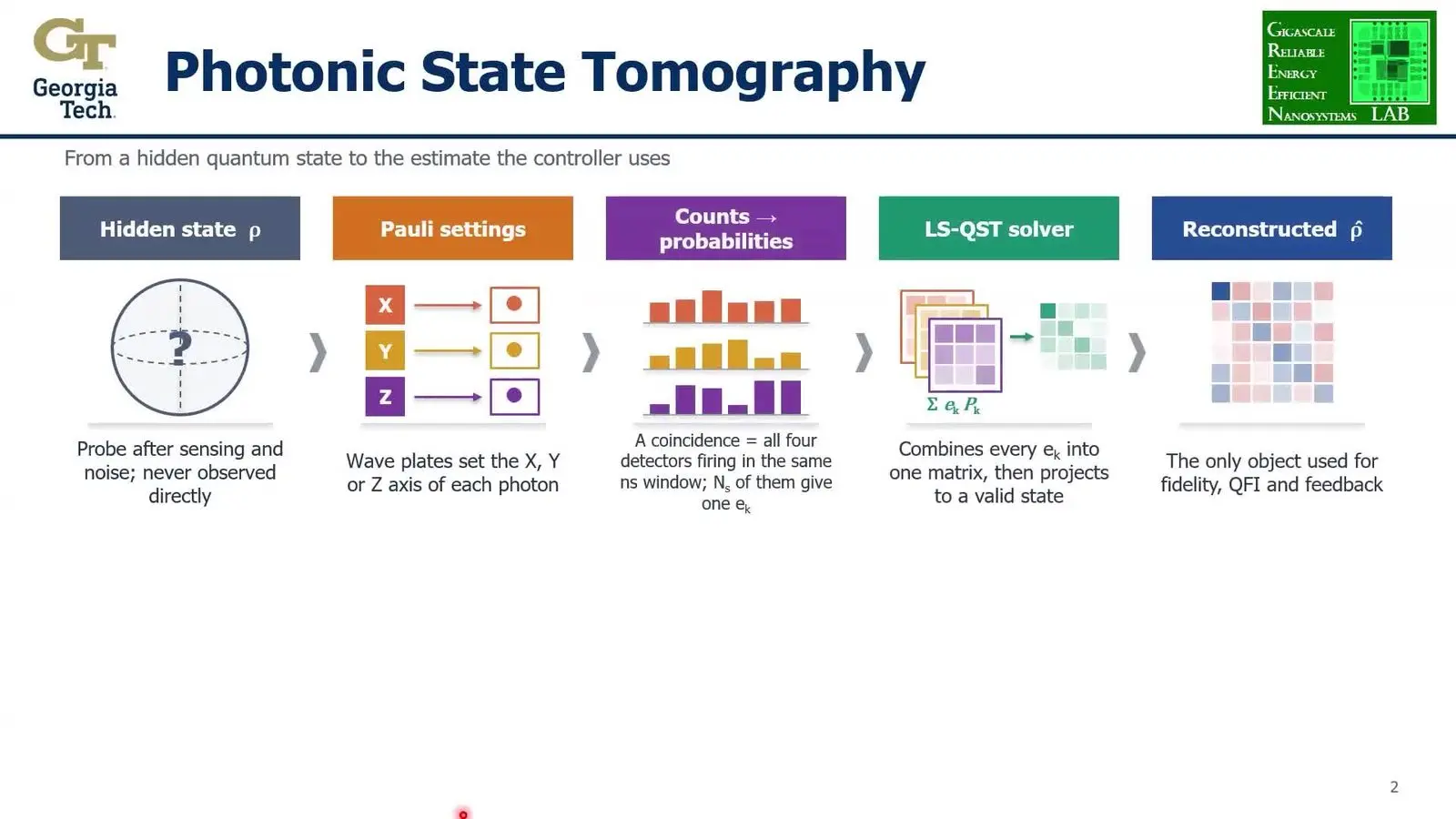
Sen’s method keeps every part that rises above a noise floor, so the data decide how much to keep. Sen said cited baselines take about 40 hours on one photonic chip, and their cutoff brings that to about two hours with about eight times fewer counts. Their tests added depolarising noise of 20 percent or more. The cleanup takes a median 0.16 milliseconds on one processor core. A live sensor and a test on a custom chip remain open.
KAIST teaches a camera to count two photons
Nur Duwi Fat Fitri, a PhD candidate at KAIST, presented work with Suseong Lim, Jin-Woo Kim, Heonoh Kim and June-Koo Kevin Rhee. Their experiment images a classic effect. When two identical photons meet at a beam splitter they leave together, so the rate at which both detectors click at once dips, and an object placed in one arm can then be read without harm. Their camera gathers light well. It cannot tell one photon in a pixel from two.
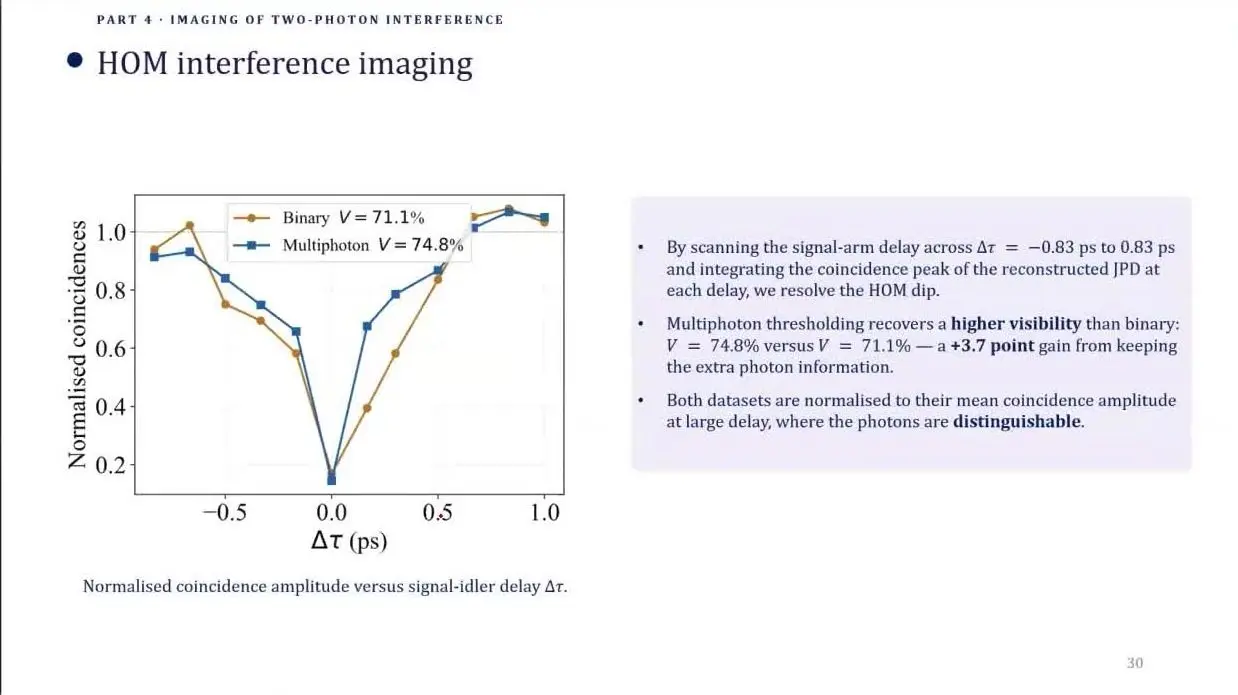
Bayesian thresholds now sort each pixel into zero to four counts. The dip reached 74.8 percent with these thresholds, against 71.1 percent for a plain cut that only asks whether a pixel saw any light at all. The gain is real but small. The gain model behind it was built for this particular setup.
Quantum photonics chips and emitters
The next five quantum photonics talks moved from measurement to the devices that make and steer light. One measured a chip at room temperature, one screened defects in diamond, one modelled tiny antennas, and two cut the cost of making photon webs or of modelling them.
Rotonium’s warm chip runs a learning task
Marco Venere, a PhD candidate at Politecnico di Milano, presented for that group, for Inveriant and for Rotonium, the firm that builds the chip. The chip, RP000, runs at room temperature at the telecom wavelength of 1,550 nanometres on a silicon circuit made on a standard chip line. It packs three or four qubits into different properties of a single photon. Venere wanted to show a reason to use it.
On the chip, a quantum classifier scored 97.7 percent on a satellite image data set, against 99.3 for a noiseless model of the same thing. Venere said RP000 had a smaller output error and a higher score than a 20-qubit superconducting chip Venere compared it with. A hybrid design that scored 76 percent, where a classical network of the same size scored 31, has only been simulated. Venere aims for 100 qubits by 2030.
Fujitsu screens tin defects node by node
Ryota Kitagawa of Fujitsu presented a paper that won a best-paper award in the photonics track. Kitagawa had 19 co-authors at Fujitsu, the University of Tokyo and QuTech in Delft. The goal is a processor built from tiles of diamond spin qubits linked by light, and Kitagawa chose the tin vacancy, a tin atom sitting in the diamond lattice, because its light has a narrow line. Each tile needs one good defect.
The team bonds diamond to alumina guides for light, then thins it from about 500 micrometres down to 200 nanometres. Each node is checked from above before the guide is etched, and across 29 nodes the screen kept only the centres that put strong light into the guide. Strain high enough for a microwave drive showed up in 59 percent of the chips. Linking the nodes is harder. Kitagawa said entanglement between them is still to come.
New Mexico models antennas for single emitters
Viktoriia Babicheva of the University of New Mexico presented a paper with Julien Werzowa and Li Liu. Their subject is the nanoantenna, a tiny particle that gathers light and steers it to or from a single emitter, such as one atom or one defect in a crystal. Metal particles hold light tightly but lose much of it as heat. Particles made of semiconductor lose less.

Babicheva turned to layered crystals such as tungsten diselenide, whose response to light differs in and out of the plane of the layers, and quoted a boost of up to 40 in how fast an emitter gives off light. In a model of one emitter beside an antenna, energy passed back and forth before loss damped it. Babicheva said a 7 by 7 array already gives a sharp shared peak.
North Carolina State builds graph states from small motifs
Jianqing Liu of North Carolina State University presented work with Tingxiang Ji, Hansika Weerasena and Demitry Farfurnik. A graph state is a web of linked photons whose links follow a chosen graph, and it is the raw material for photonic machines that compute by measuring. The team fuses small motifs. It does not build the target graph whole, and among graphs that simple local steps make equal, it picks the one with fewest links.
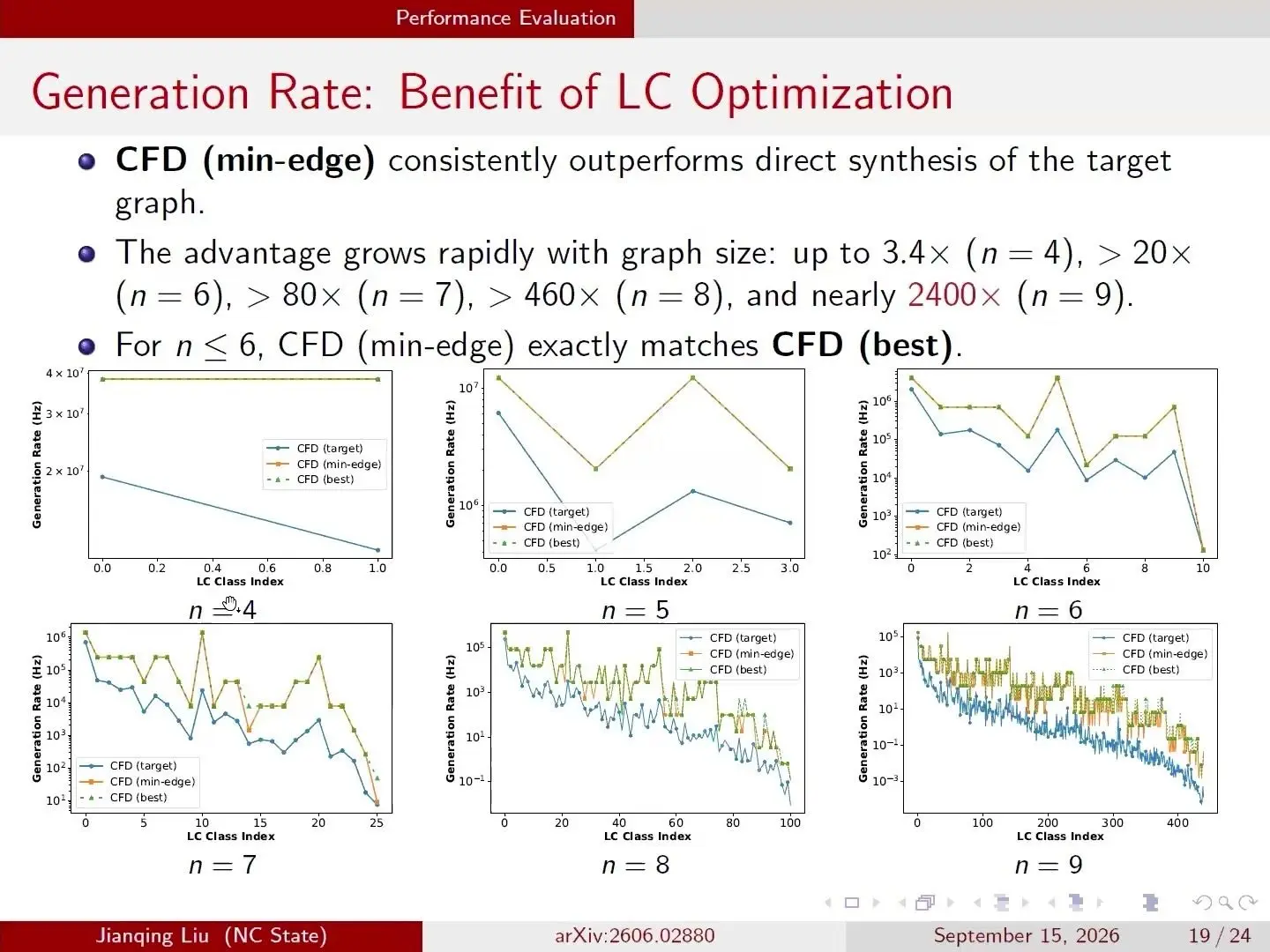
The rates came from a model of a quantum-dot source. On graphs of 4 to 9 qubits, the gain over direct building rose from 3.4 times at 4 qubits to nearly 2,400 times at 9. Up to 6 qubits the fewest-links choice matched the best possible one, and fusion needed 80.0 to 84.6 percent fewer resources than a rival method built from pairs of linked photons.
Tokyo shrinks a two-photon simulation 16-fold
Romain Piron of the National Institute of Informatics in Tokyo, with Akihito Soeda, works on waveguide QED, where light in a narrow channel meets an atom. A computer can track only a finite window of colours. A badly placed window has to be wide, and that multiplies the cost.

Before calibration, three test curves sat up to 10.58 percent off the reference. They did not settle even with a very wide window. Centring the window well brought the errors down to between 0.68 and 4.21 percent, and the curves settled at a quarter of that width, which the team called a 16-fold cut in the size of the simulation.
Sensors that measure less and learn more
Five talks worked on quantum sensing itself, where the photon budget becomes a budget of shots and tones. All five aimed to get a reading, or a decision, with fewer shots, fewer tones or a better model.
Fraunhofer rebuilds a diamond sensor curve from 15 tones
Tobias Schmalzried of Fraunhofer and the University of Stuttgart presented work with Jens Wizl, Valentyna Afanasenko, Diego Kuderna Melgar and Ingmar Kallfass. A diamond sensor is read by sweeping a microwave tone across a band and watching the defect’s red glow dim at the point where it is in tune. A full sweep takes many points. It also needs a costly tunable source.
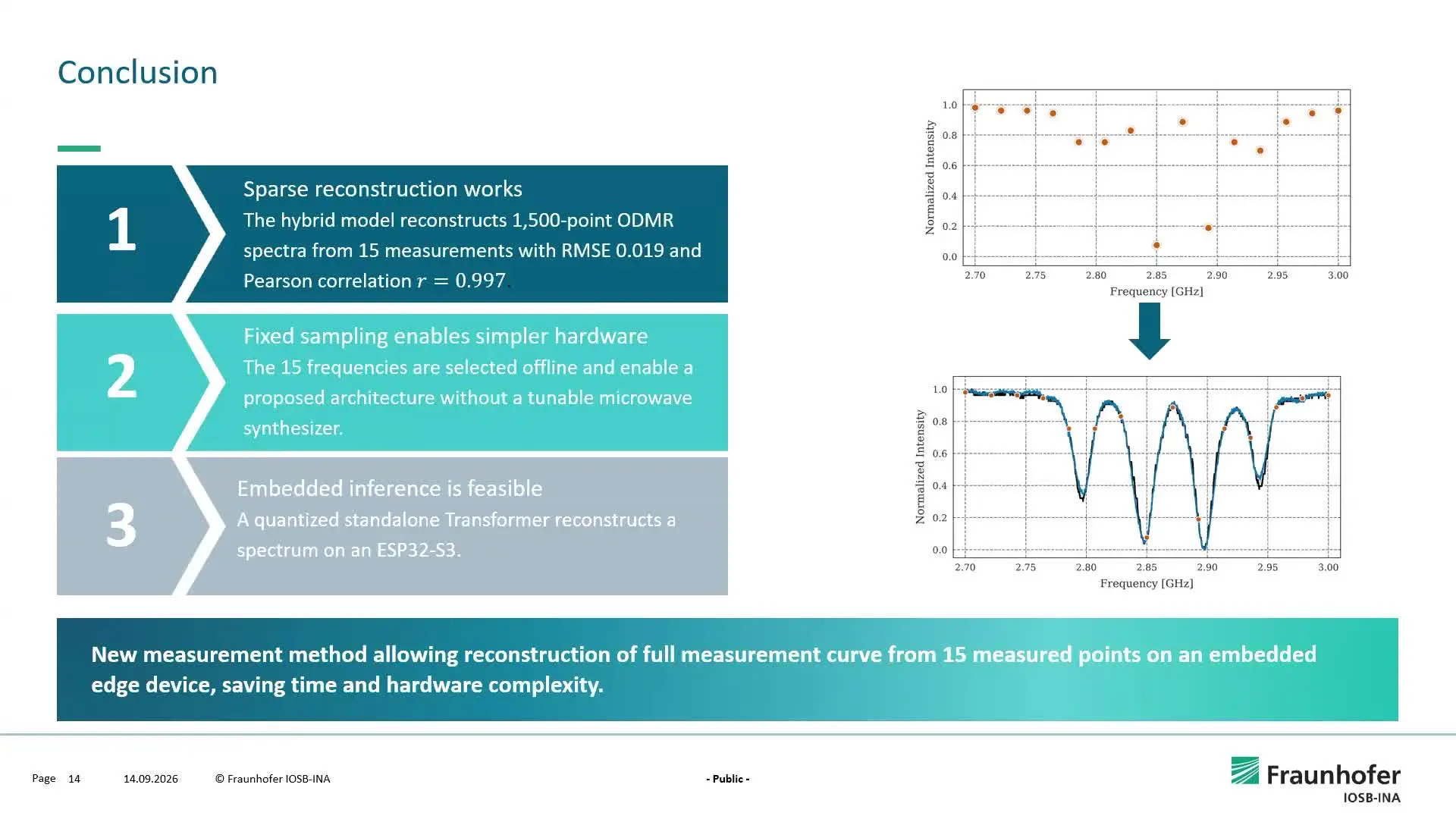
Their hybrid model rebuilds a full curve of 1,500 points from only 15 measured tones, with a correlation of 0.997. The 15 tones are chosen once for each sensor and then fixed, so a future sensor could drop its tunable microwave source. A small network already runs on a low-cost board. That matters for a portable sensor, because the costly tunable microwave source is the part such a sensor would most like to leave behind on the bench.
New Hampshire checks sensor models against the bench
Gabrielle Friedly of the University of New Hampshire presented work with Qiaoyan Yu. Friedly called diamond sensing hard to break into. The kit costs a lot, few labs have it and computer models often fail to match what the bench shows, so Q-STEP runs three standard sensing routines first as Qiskit circuits and then as sweeps in lab software. Friedly said the two agreed within 10 percent at the base level under identical settings, with noise scaled from a quarter to four times that level.

One routine, which uses four extra pulses to cancel noise, kept its signal 70.77 percent longer at low noise but lost 49.33 percent at twice the base level. Friedly called the results early. A questioner suggested adding more kinds of noise to the model.
Cleveland State trains an agent to pick each sensing shot
Temitope Adeniyi, a PhD candidate at Cleveland State University, presented work with Stefan Andrei. In quantum sensing a qubit picks up an unknown phase, and each shot returns only a noisy yes or no, so every wasted shot spends time the qubit does not have. Adeniyi treats the choice of the next shot as a decision. A small trained network makes it.
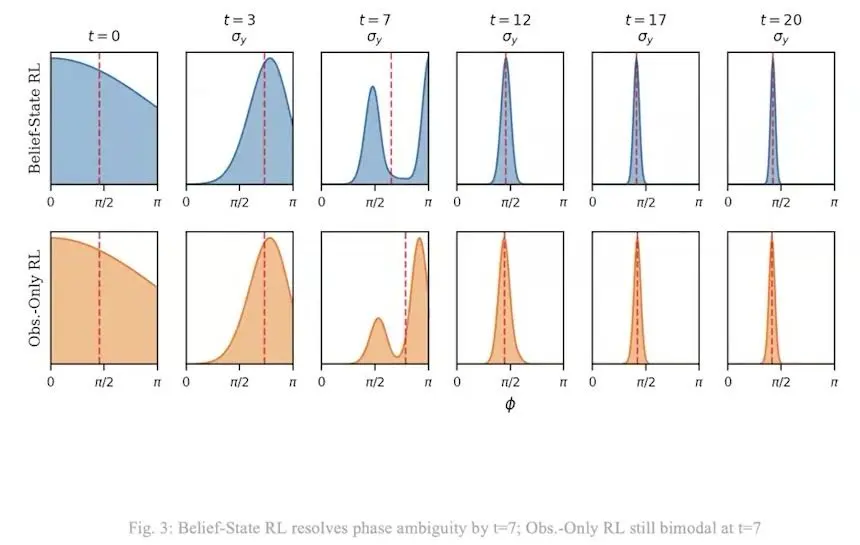
In simulation the agent reached an error of 0.072 radians within about 2,000 training rounds, against 0.093 radians after 8,000 for an agent fed raw counts. Adeniyi claimed 23 percent lower error than the agent fed raw counts. Adeniyi also said it was as accurate as a standard sampling method and about 100,000 times faster to run. There are no hardware runs yet.
North Carolina State turns a signal into a yes or no
Aishwarya Majumdar of North Carolina State University presented a paper that won a best-paper award in the QTEM track, written with Yuan Liu. The question is whether an unknown signal value lies inside a chosen range, a yes or no answer Majumdar tied to decoding, sorting and sensing. The setup pairs a qubit with an oscillator, such as an ion’s shared motion. Most hardware already has one.
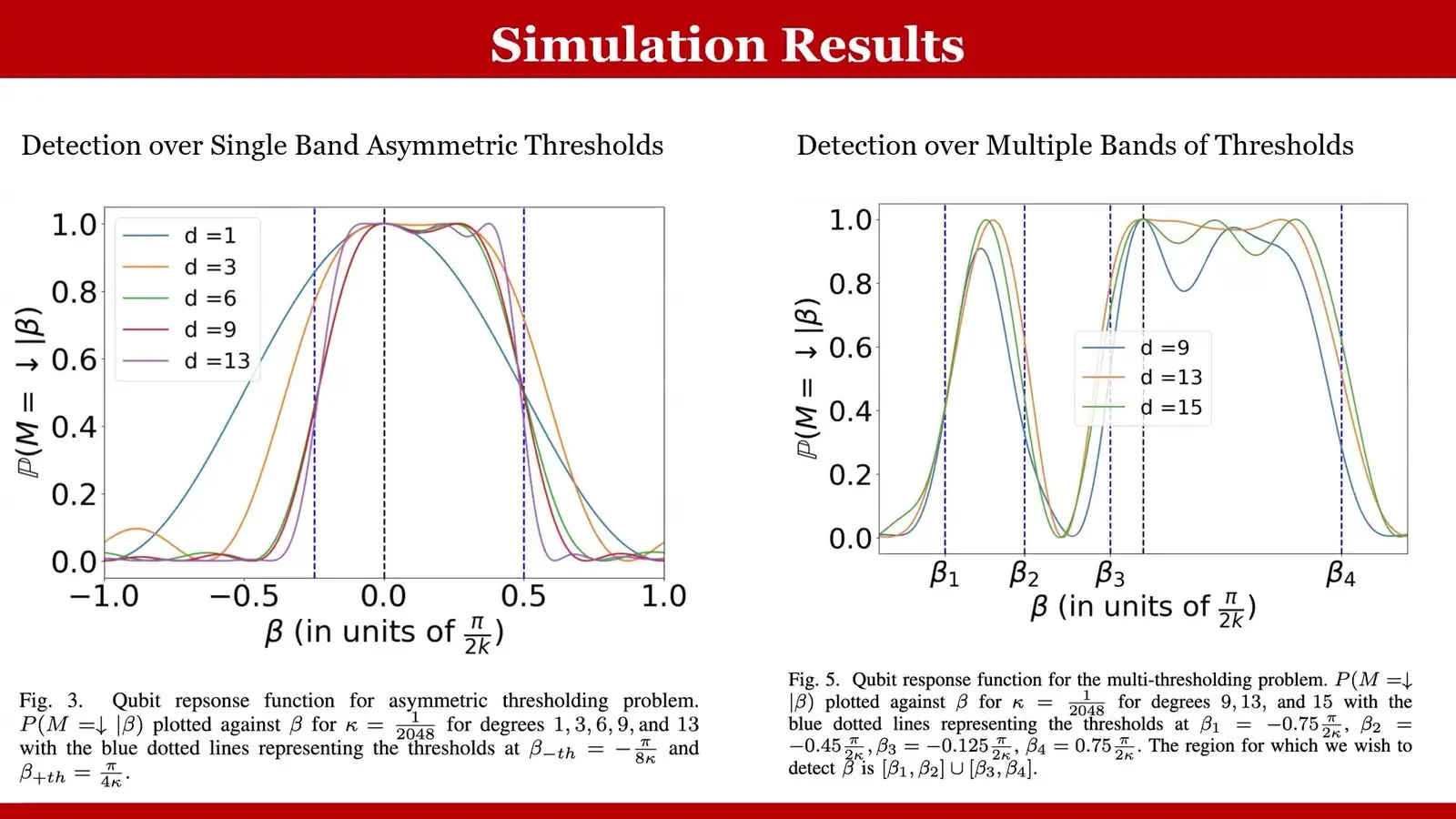
A recipe called quantum signal processing turns the qubit and pushes the oscillator in turn, and the last qubit reading gives the answer. In simulation a sequence of degree 13 gave a clean yes or no for one range set off to one side, and degree 15 handled two ranges at once. No device run was shown.
TU Dresden sends only what the receiver needs
Nikhitha Nunavath of TU Dresden, with Riccardo Bassoli and Frank Fitzek, works on links that carry only what the task at the far end needs. A four-qubit model stood in for a sensor. The sender worked out chosen properties from that sensor and then sent them on to the receiver over a noisy radio link.
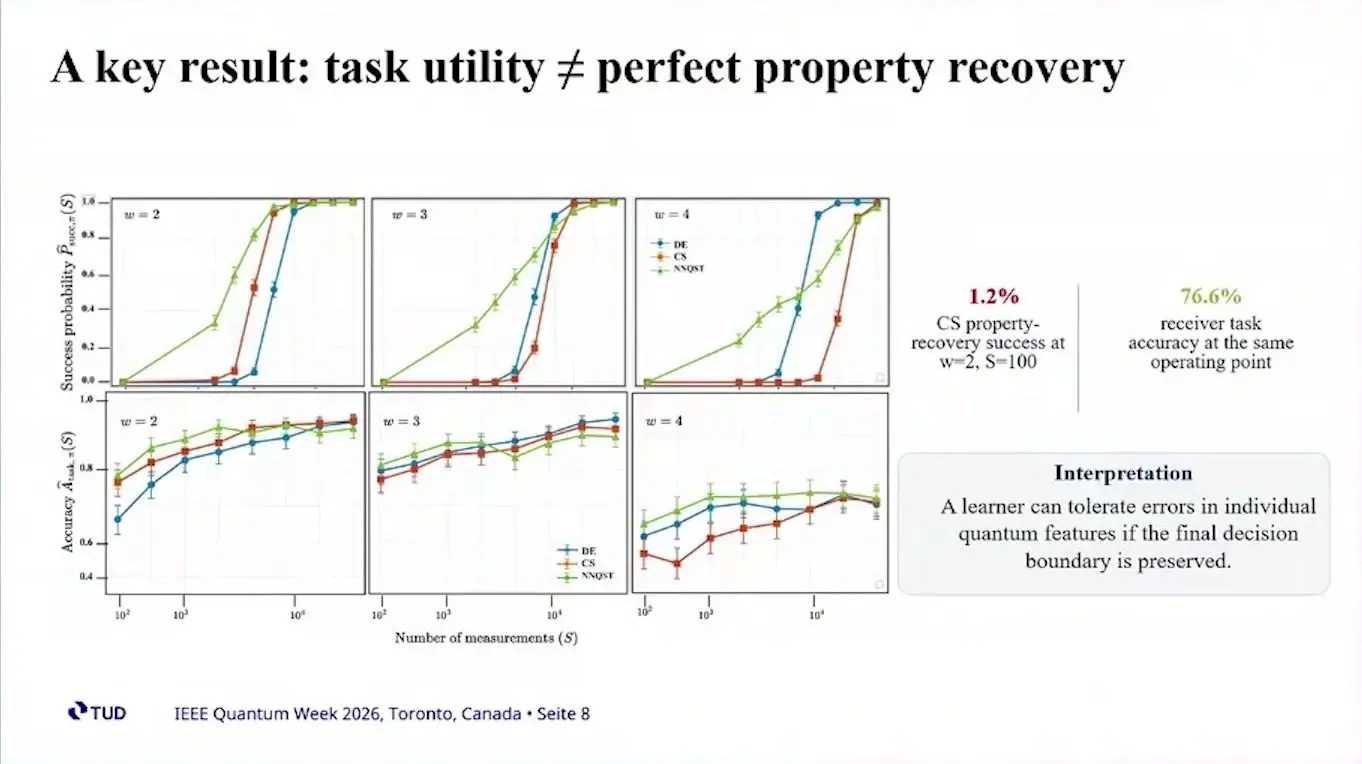
Classical shadows are a cheap way to guess many properties from random measurements. With them, at 100 measurements, every target property came out right only 1.2 percent of the time. Yet the receiver made the right call 76.6 percent of the time, which is the whole point of sending a receiver only what its task needs. A second test was smaller. Nunavath called it a limited result.
The panels on light
Two panels set the papers in context. One asked which classical ideas carry over to quantum signals, and the other asked how spin qubits linked by light will scale.
Guha says the gain comes before the detector
Saikat Guha, who described their Center for Quantum Networks, sat with Quntao Zhuang of the University of Southern California and Jianqing Liu of North Carolina State. Guha opened with their Green Machine. It swaps each part of a classical decoder for a beam splitter, so the light does the decoding before any photon is counted. Guha said that beats any receiver that reads one symbol at a time.

The panel then turned to where the classical toolkit fails. A quantum signal cannot be copied, and the moderator drew the consequence that the feedback filters used in radio have no direct quantum version. Liu said even the ratio of signal to noise is hard to define for single photons. One questioner said a quantum camera 100 times slower than a normal one loses to plain averaging. Guha replied that at the limit of what a lens can resolve, a normal camera cannot tell which digit it sees, while light worked on before it is counted can.
Quandela and NVision spend the loss budget in opposite ways
Marko Loncar of Harvard chaired Thursday’s panel on spin qubits linked by light. With them were Jonathan Reiner of Quantum Machines, Ilai Schwartz of NVision Quantum Technologies and Nicolas Maring of Quandela. Maring said Quandela moved from a design made only of light to one in which each quantum dot also holds an electron spin, which can store a link to other dots. Its dots now emit a photon 80 percent of the times they are fired. Two separate dots have interfered with above 90 percent fidelity.
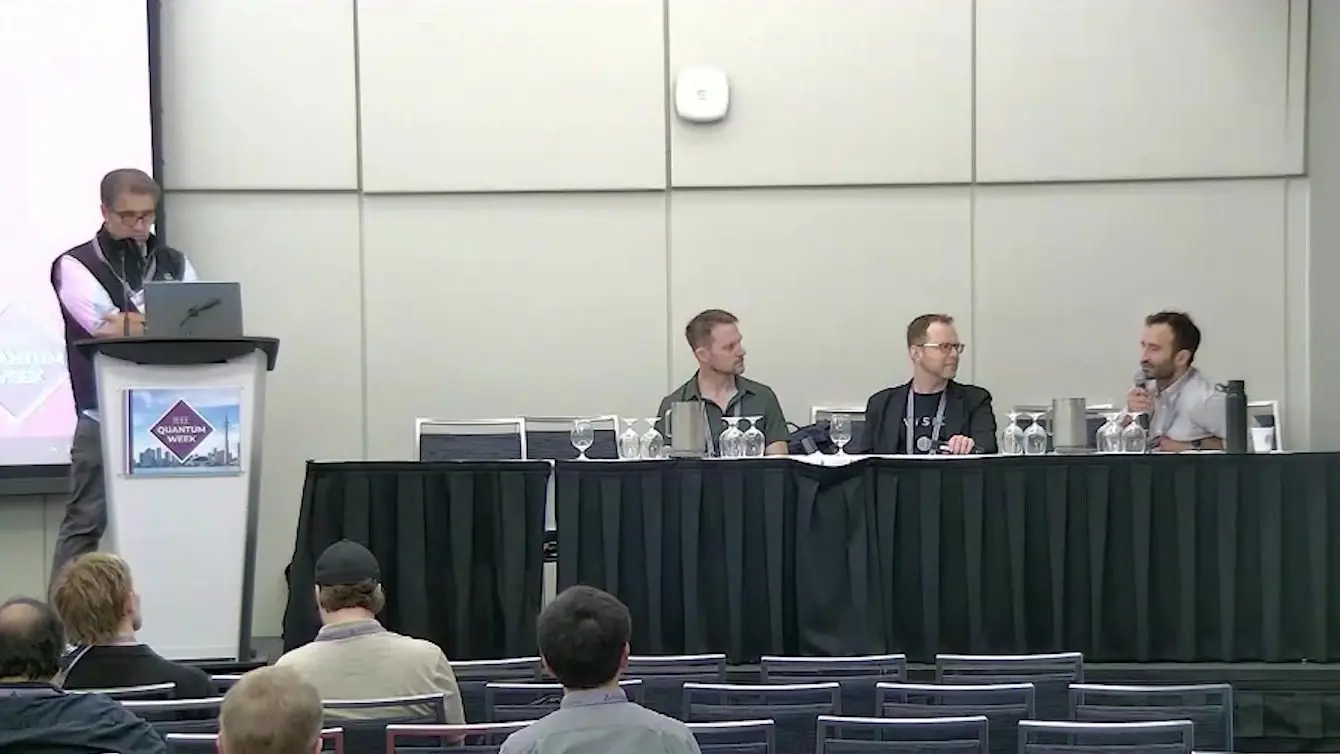
Schwartz said NVision’s molecules keep their quantum state for about 10 milliseconds. Since a failed light link is simply tried again, Schwartz said, the design can lose 70 percent of its photons. NVision has yet to show the molecules on a chip. Reiner said such systems need fast and slow microwave drives, optical switches and detectors all on one clock, far more than a superconducting chip, and called for shared plug and cable standards.
What it means for sensor and photonics buyers
The useful question about any quantum photonics or sensing design is how it spends its photons and what a lost one costs. Buyers should ask for the loss budget. Then they should ask whether the headline number came from a device or from a simulation, since the firmest results here were small and measured, such as Fitri’s camera dip and Kitagawa’s screen of 29 nodes.
The largest gains came from simulation or from the panel floor. Majumdar’s decision scheme, Adeniyi’s agent and Friedly’s models have yet to meet a device, and our explainers on how photonic quantum computers work and what quantum sensing is set out how far the field still has to go.
Guha’s rule is a fair test. A gain has to be made before the detector, because nothing done afterwards can win back what the detector lost, and every design in this guide will be judged by that arithmetic. Each photon is still a coin spent only once.
Frequently asked questions
What is quantum photonics?
Quantum photonics uses single particles of light to carry and process quantum information. Photons keep their quantum state well at room temperature and travel easily through fibre and chips. Their weakness is loss, since every mirror, splice and waveguide absorbs a little light.
What is quantum sensing?
Quantum sensing uses fragile quantum states as very fine probes of magnetic fields, signals and other quantities. A common example is the nitrogen vacancy in diamond, a defect whose red glow dims at a microwave frequency set by the field around it. At QCE26 several talks cut the number of measurements such sensors need.
Why is photon loss such a problem?
A lost photon takes its information with it, and detectors destroy the photons they count. At QCE26 Quandela said its published design tolerates only six or seven percent total loss. NVision said retrying failed links lets its molecule design tolerate 70 percent loss, though it has yet to show the molecules on a chip.
What is a qudit?
A qudit is a quantum unit with more than two levels, where a qubit has two. A single photon can act as a qudit if its levels are different colours, paths or time slots. At QCE26 Mitchell Thornton of Southern Methodist University showed in simulation how one programmable gate can measure such photons in many different ways.
Are photonic quantum computers better than superconducting ones?
Neither approach has won. Photonic chips run warm and suit telecom fibre, while superconducting chips are more mature but need deep cooling. At QCE26 Rotonium’s speaker claimed its room-temperature chip beat a 20-qubit superconducting chip on one learning task, which is a single comparison and the company’s own.
What happened at IEEE Quantum Week 2026?
IEEE Quantum Week 2026, also called QCE26, ran from 13 to 18 September at the Metro Toronto Convention Centre. This guide covers 15 of its talks on photonics and sensing, from Sunday papers on measurement to two panels on signal processing and spin qubits linked by light.
This guide is based on 15 talks and panels at IEEE Quantum Week 2026 (QCE26), held at the Metro Toronto Convention Centre from 13 to 18 September 2026, and on the published conference programme. Names follow the programme. Affiliations and titles not listed there are as speakers gave them. Results are stated as each speaker presented them, and many are simulations. Company claims, including those made on panels, are the companies’ own.
- Qubit hardware and scaling roadmaps
- Control electronics, calibration and readout
- Quantum error correction and decoders
- Fault-tolerant compilation and magic states
- Modular and distributed quantum computing
- Quantum computers in supercomputing centres
- Compilers, circuit synthesis and languages
- AI and language models for quantum software
- Testing and reproducible quantum experiments
- Benchmarks, error mitigation and quantum advantage
- Quantum state preparation, oracles and arithmetic
- Quantum optimisation, QAOA and annealing
- Quantum machine learning
- Chemistry, materials and life sciences
- Differential equations and fluid dynamics
- Power grids and energy
- Quantum finance
- Logistics, climate, databases and games
- Quantum networks and key distribution
- Quantum security and post-quantum cryptography
- Quantum education and workforce
- Policy, standards and the quantum business



See today’s quantum computing news on Quantum Zeitgeist for the latest breakthroughs in qubits, hardware, algorithms, and industry deals.