

This guide follows 29 talks at IEEE Quantum Week 2026 in Toronto on how to put quantum computers in big computer centres. Most were about the software that links the two, and few were about the cable between them.
On the first morning of the conference, Sunday 13 September, Robert Wille of the Technical University of Munich opened a tutorial on quantum HPC integration in Room 718B with a confession. The first three or four months of writing down a shared software stack for Munich’s quantum machines, Wille said, had produced nothing at all. Physicists and computer scientists had used the same words to mean different things, and the two camps had clashed over them. Over five days that small admission came to describe much of the week.
Quantum HPC integration is the work of fitting quantum computers into supercomputing centres. No serious plan has a quantum computer working alone. Every useful method so far splits the job, with the quantum chip doing the one step it may do better and normal computers doing the rest. The chip is an add-on that a bigger machine calls on, much as supercomputers already call on graphics chips. Centres share their computers through a batch scheduler, most often the free tool Slurm, and a quantum machine fits that model badly.
A quantum computer is one device shared by many users. It stops for calibration, the regular retuning its qubits need, and every maker ships its own software. The 29 talks followed here suggest that, for everything short of live error correction, joining a quantum computer to a supercomputer is now a problem of shared words far more than of short wires. Wille’s lost months were the first sign of it.
The strongest case against that view came from the people building error-corrected machines. Ophelia Crawford of Riverlane put a superconducting decoding round near one microsecond, and Krysta Svore of NVIDIA described a GPU host tied to the quantum controller by NVQLink. Svore said the link has shown delays under 3 microseconds. For error correction, distance is physics. A slow decoder makes the machine give wrong answers. Burns Healy of Quantum Sky added a reason that has nothing to do with physics. US defence data rules attach to any circuit built from controlled data, and may rule out a cloud machine.
Everything short of error correction told a different story. Dimitar Trenev of Amazon Braket modelled the first published run of a chemistry method that samples on the chip and solves on classical nodes. Even over a slow link, talk between the two took about 0.01 percent of the run. Aleksander Wennersteen of Pasqal asked for a link that is tight in logic but need not be short. Philipp Seitz of Quantinuum was happy to have the Fugaku supercomputer in Kobe and the quantum device in Tokyo, because their jobs run on a clock of hours.
Most of the real work therefore went into vocabulary. The Munich group showed QDMI, an interface that tells a software stack what each device can do. Wennersteen presented QRMI, a thin interface built with IBM so that schedulers can treat a quantum chip as a resource. Douglas Jacobsen of NVIDIA said Slurm itself will stay unaware of the chip, and the working answer in several talks was a Slurm licence, a token a job must hold before it can reach the device.
Yet the hardest words to agree were never technical. Patrick Hopf of the Technical University of Munich pointed out that a licence rations only the local cluster, since other cloud customers share the same device. Barr von Oehsen of the Pittsburgh Supercomputing Center said a core hour has no line for the window just after calibration that some users want. Travis Humble of Oak Ridge told a Tuesday panel that old data-centre rules on keeping a record of who used a machine, and for how long, had been harder than the engineering. Blake Johnson of IBM got a closed-loop chemistry run only by booking a full day on a quantum system and on Fugaku at once. Behind every scheduler plug-in sits the question of who gets a turn.
What it is. Quantum HPC integration joins a quantum computer to a supercomputer so that each does the part of a job it does best. The quantum chip acts as an accelerator, called by a larger classical machine.
What changed at QCE26. Shared interfaces such as QDMI and QRMI, and Slurm licences, became the working way to plug a quantum chip into a centre. QRMI is now backed by 21 organisations.
Where distance matters. Live error correction needs the classical decoder close to the qubits, inside about a microsecond on superconducting chips. For today’s chemistry runs, a model by Dimitar Trenev of Amazon Braket put communication at about 0.01 percent of the run.
The open question. Who gets the machine, and when, is still unsolved. A licence rations only one cluster, and core hours do not price the window after calibration.
Quantum HPC integration starts with shared interfaces
Before a scheduler, a compiler or a monitoring tool can treat one maker’s chip like another’s, the industry has to agree what its words mean. Seven talks, most of them hands-on tutorials, showed the interfaces that are trying to set those words.
Munich builds one stack for many machines
Robert Wille, Martin Schulz and Lukas Burgholzer of the Technical University of Munich opened the week with the Munich Quantum Software Stack, a free layer that carries a user’s program to several kinds of quantum machine in one centre. Wille said the Munich Quantum Valley has three to four hundred researchers. Its machines include ion traps from AQT, an atom machine from planqc and several IQM chips at the Leibniz Supercomputing Centre. Its Munich Quantum Toolkit lists more than 4.2 million downloads.
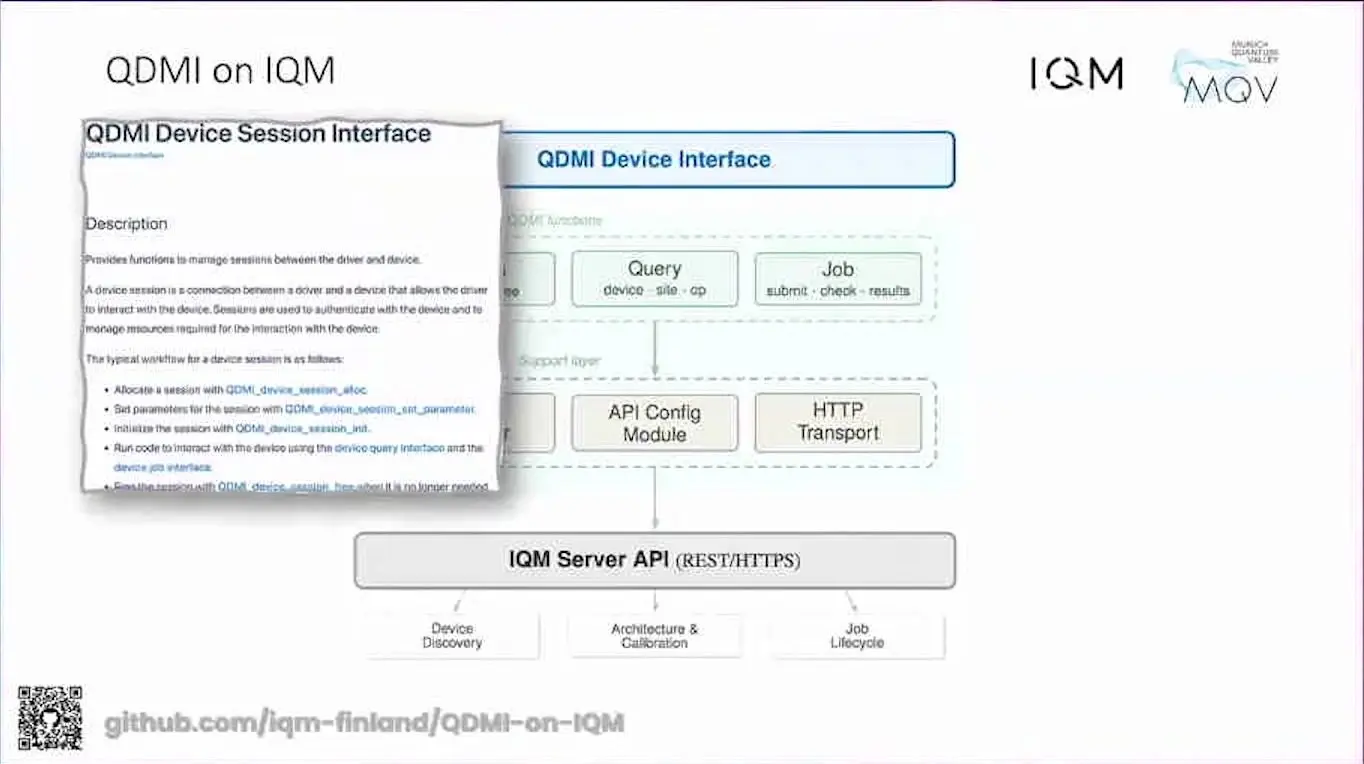
Schulz set out a design that borrows heavily from classical computing. It uses the LLVM compiler framework, a C library modelled on how supercomputer codes call graphics chips, and markers that flag a block of code as a quantum kernel. Schulz proposed three levels of scheduling, from the centre down to the device. Schulz said the prediction methods behind it are still a research problem.
Burgholzer closed with QDMI, the Quantum Device Management Interface. It tells the stack what devices exist, what each can do, how to submit a job and what the latest calibration says. On IQM machines it wraps the vendor’s server, and Python bindings make the device look like an ordinary Qiskit backend. Burgholzer called QDMI free and heading towards a standard.
Switching devices by changing one name
In the afternoon, Burgholzer drove IQM’s Garnet machine through Amazon Braket with QDMI. Switching meant changing one name. Real quantum chips still accept little beyond their native gates, Burgholzer said, and every QDMI device so far is custom work. The demo also showed mqt-cc, a compiler in which a pass that cancels repeated Hadamard gates takes about 10 lines.
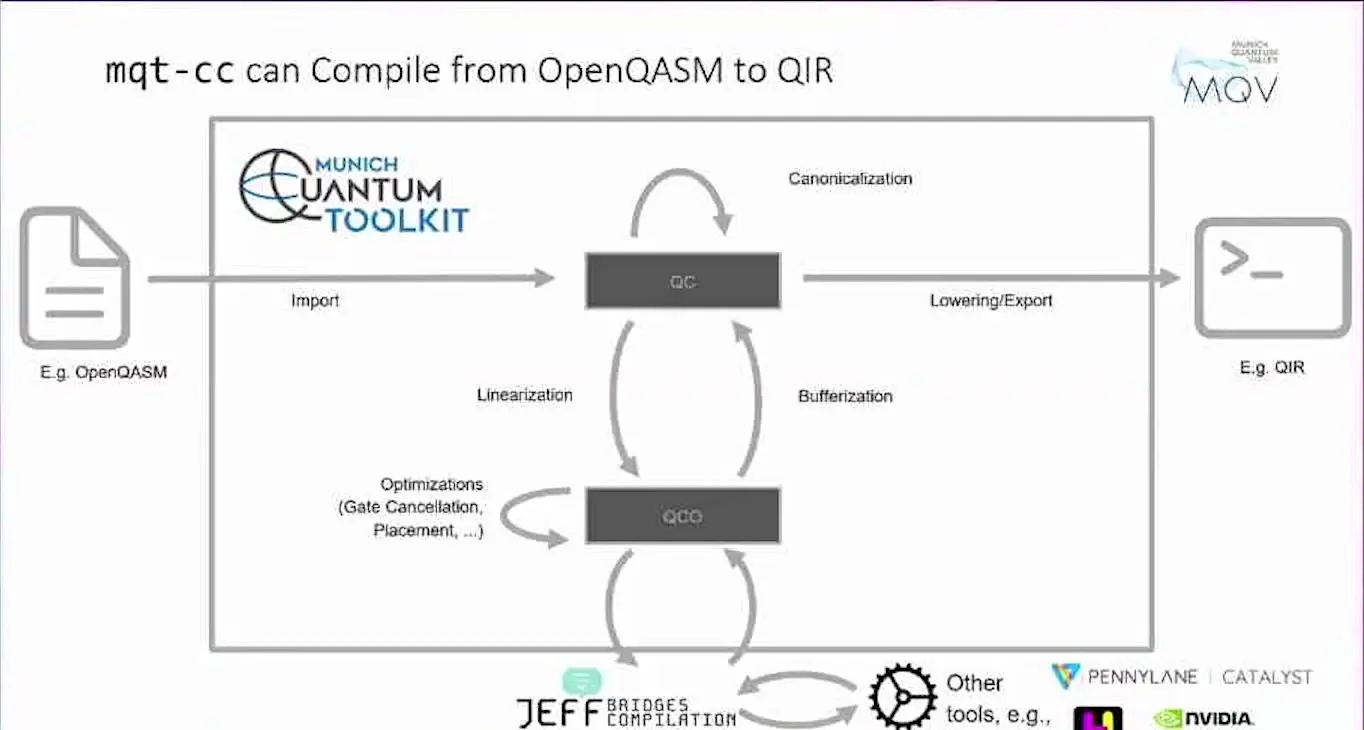
Jorge Echavarria of MQV presented a C++ framework that lets the stack’s parts pass tasks to each other in one process or across many. Echavarria described a shared network built on QDMI. It lists IQM, Peak Quantum, AQT and planqc as commercial providers, the Leibniz centre and CESGA in Spain as public ones, and ties to the EuroHPC Federation Platform. Echavarria said collaborators had found the stack about three seconds slower than their own setup, a gap Echavarria traced to a delay in fetching jobs from its queue.
openQSE grows to about 34 members in a year
Amir Shehata of Oak Ridge National Laboratory said openQSE, a group trying to agree the software layers from an application down to a quantum device, has grown from two members to about 34 in a year. Oak Ridge and IonQ founded it. About 17 members have published an architecture paper together.
Its working groups cover software and system design, compilers, the sharing of quantum machines, and the electronics that control them. On a closing panel, Shehata asked what networking and classical computing a quantum advantage would need before it could be put to use in a real centre with real users. Oak Ridge has its own test case. Its IQM system and its supercomputer sit about a block apart.
Classiq and NVIDIA compile the loop and the circuit together
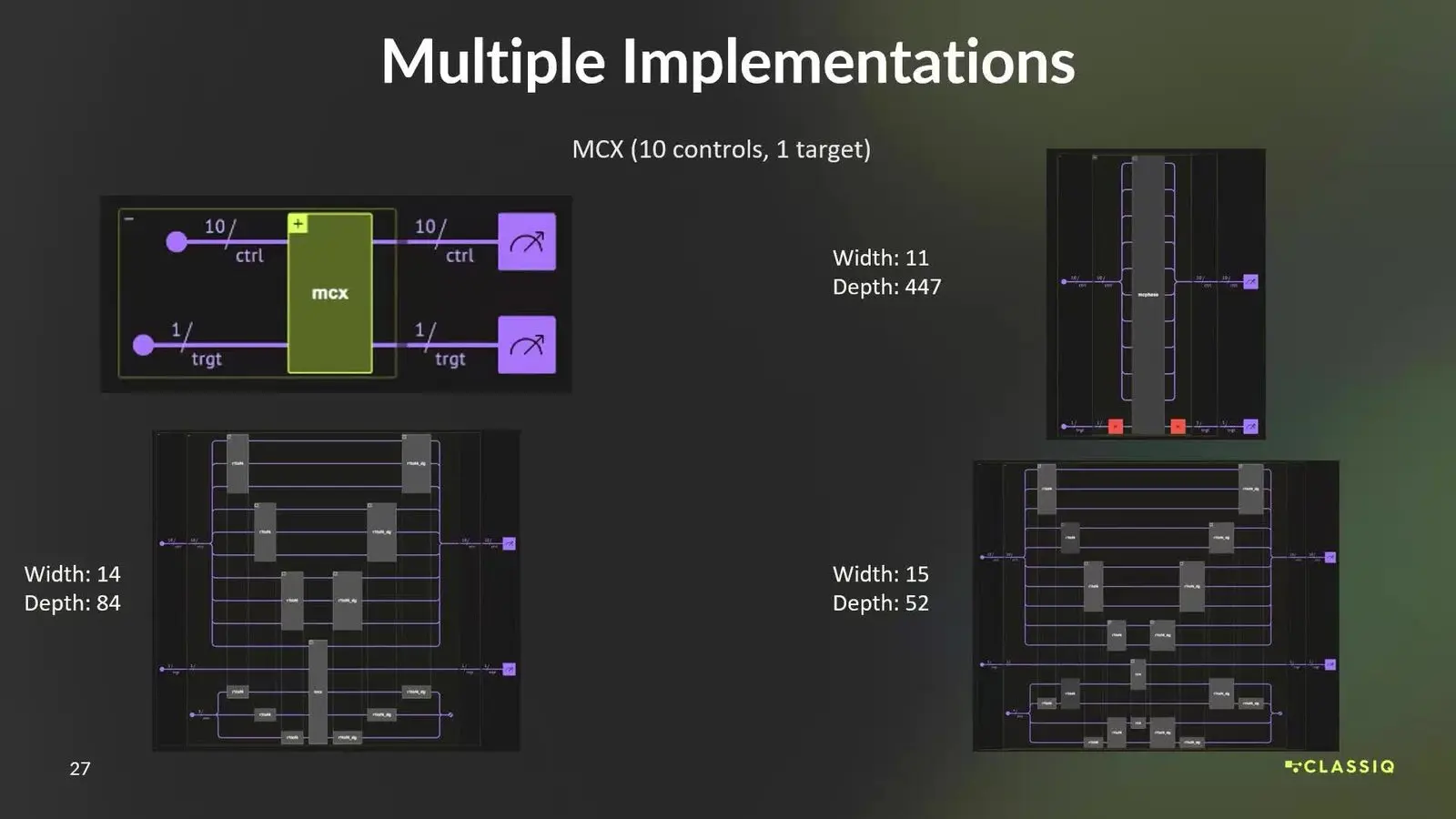
Tomer Itelson of Classiq Technologies showed one line of code turning into three very different circuits, depending on how many spare qubits the compiler was allowed. The language, Qmod, describes a program at a high level and leaves the gates to a synthesiser. Their example was a gate with ten controls. Built with 11 qubits it reached depth 447, with 14 qubits depth 84, and with 15 qubits depth 52.
Stefano Mensa of NVIDIA took the second half. Mensa said the company does not make qubits and works on the computing around them. CUDA-Q, its open platform, compiles a kernel onto a CPU, a GPU or a quantum processor, chosen by one line. Mensa said compiling the optimiser loop and the circuit together removes the gap a hybrid program crosses on each round, and that a real-time call over NVQLink should answer within tens of microseconds or less.
Every attendee builds a Slurm cluster on AWS
Sebastian Stern of Amazon Web Services had every attendee deploy a Slurm cluster in a temporary AWS account. It had a classical queue that grows on demand and a quantum queue with access to Amazon Braket, so the room could see how the two halves of a hybrid job get their turns. Burgholzer pleaded for a standard. One plug-in per machine per front end will not last, Burgholzer said, and each vendor should build to one.
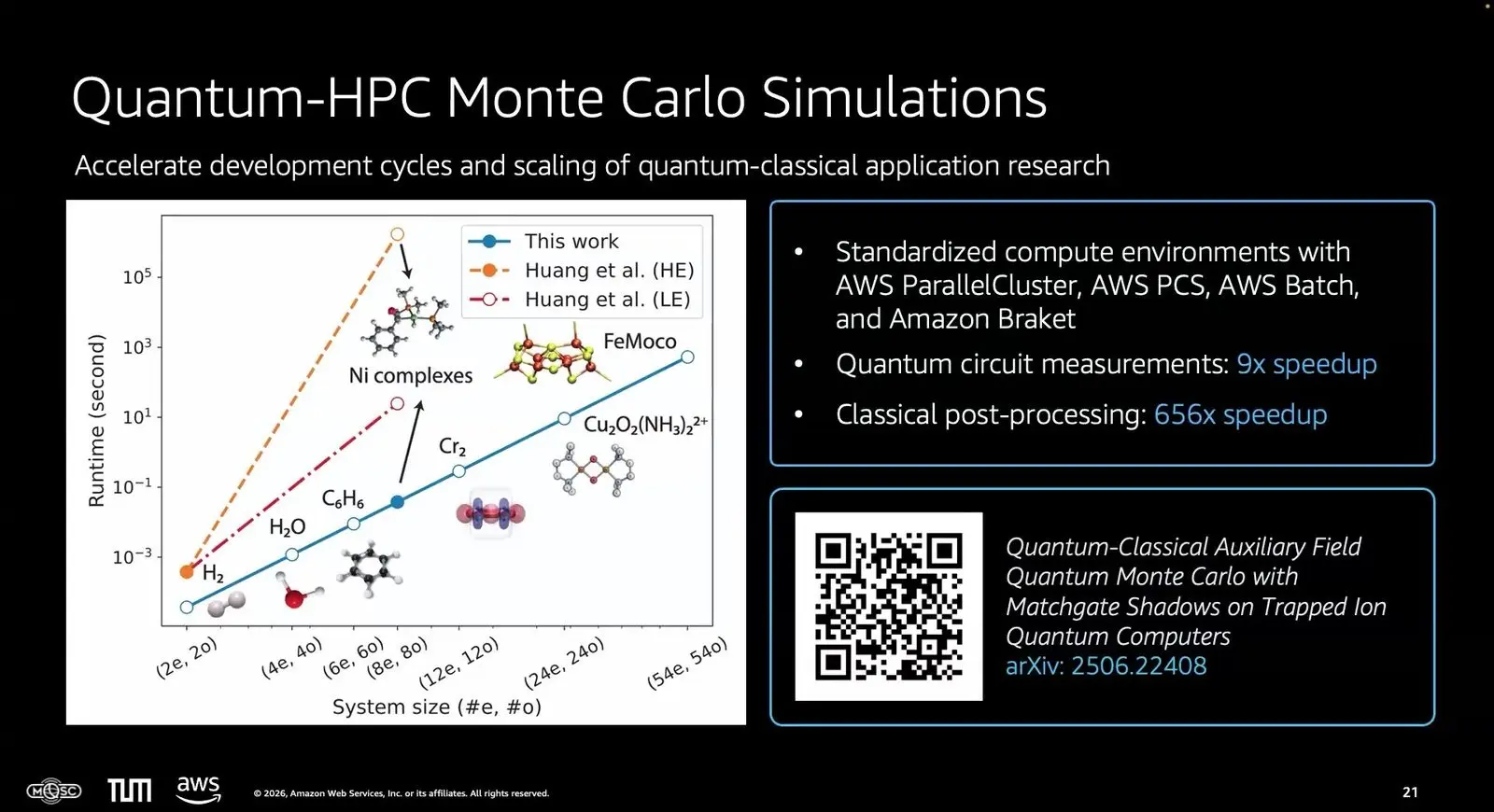
The use case was a chemistry method in which many random walkers drift towards a molecule’s lowest energy, and a better starting guess lowers the bias. Stern based it on an AWS project with AstraZeneca, IonQ and NVIDIA that used more than 60,000 circuits of 24 qubits on IonQ’s Forte and 320 NVIDIA H200 GPUs. The quantum machine is used once, to take a compact snapshot of a state from random measurements. That snapshot then serves every walker at every step.
A Slurm licence for each quantum device
After lunch, Patrick Hopf of the Technical University of Munich took the stack apart. A Slurm plug-in writes a device catalogue into each job, the Munich library reads it, and a QDMI library turns the calls into AWS requests. Each backend is a Slurm licence. One added line gave a licence for IQM’s Garnet, and a test circuit there returned 46 counts of 00 and 47 of 11 from 100 shots.
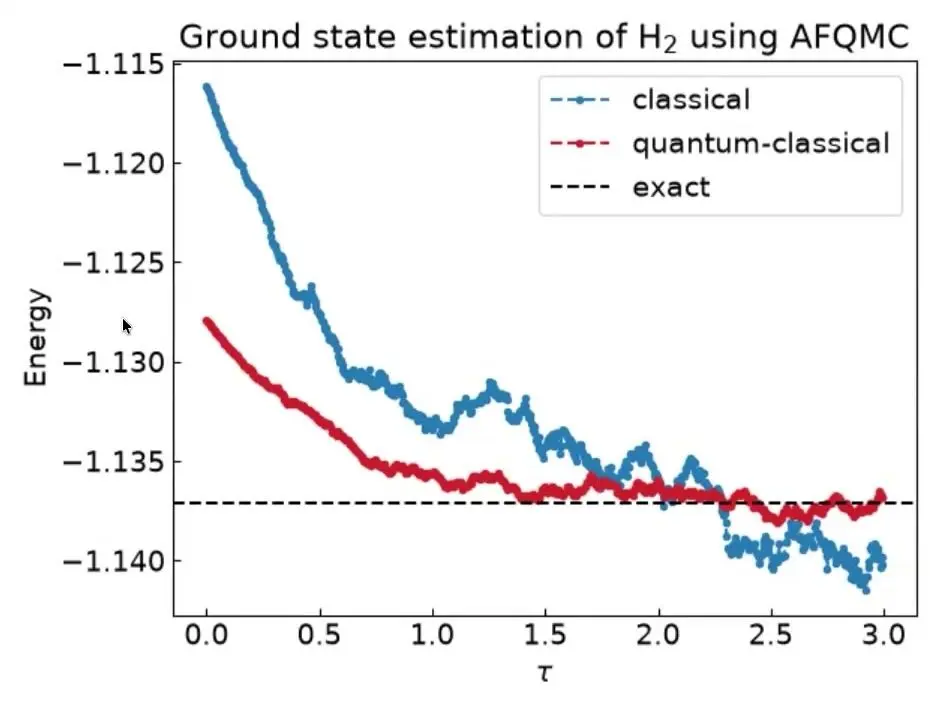
Hopf noted that the licence only rations the local cluster, since other Braket customers share the same device. The last lab ran the same chemistry with no quantum computer at all. It took 300 seconds. The quantum-assisted version, which took its snapshots from Braket’s SV1 simulator, needed about 45 minutes of post-processing. It started closer to the exact energy and was steadier, and Stern framed today’s trade as less bias in return for more computing.
openQSE’s runtime group builds a virtual Slurm cluster
Amir Shehata of Oak Ridge returned on the Wednesday to show what openQSE’s members have built so far. The work is shared with Travis Humble and Tom Beck. Members meet each week in five working groups, which cover workflows and system design, control electronics, a compiler aimed at fault tolerance, a common interface to quantum machines, and the runtimes that start and stop jobs.
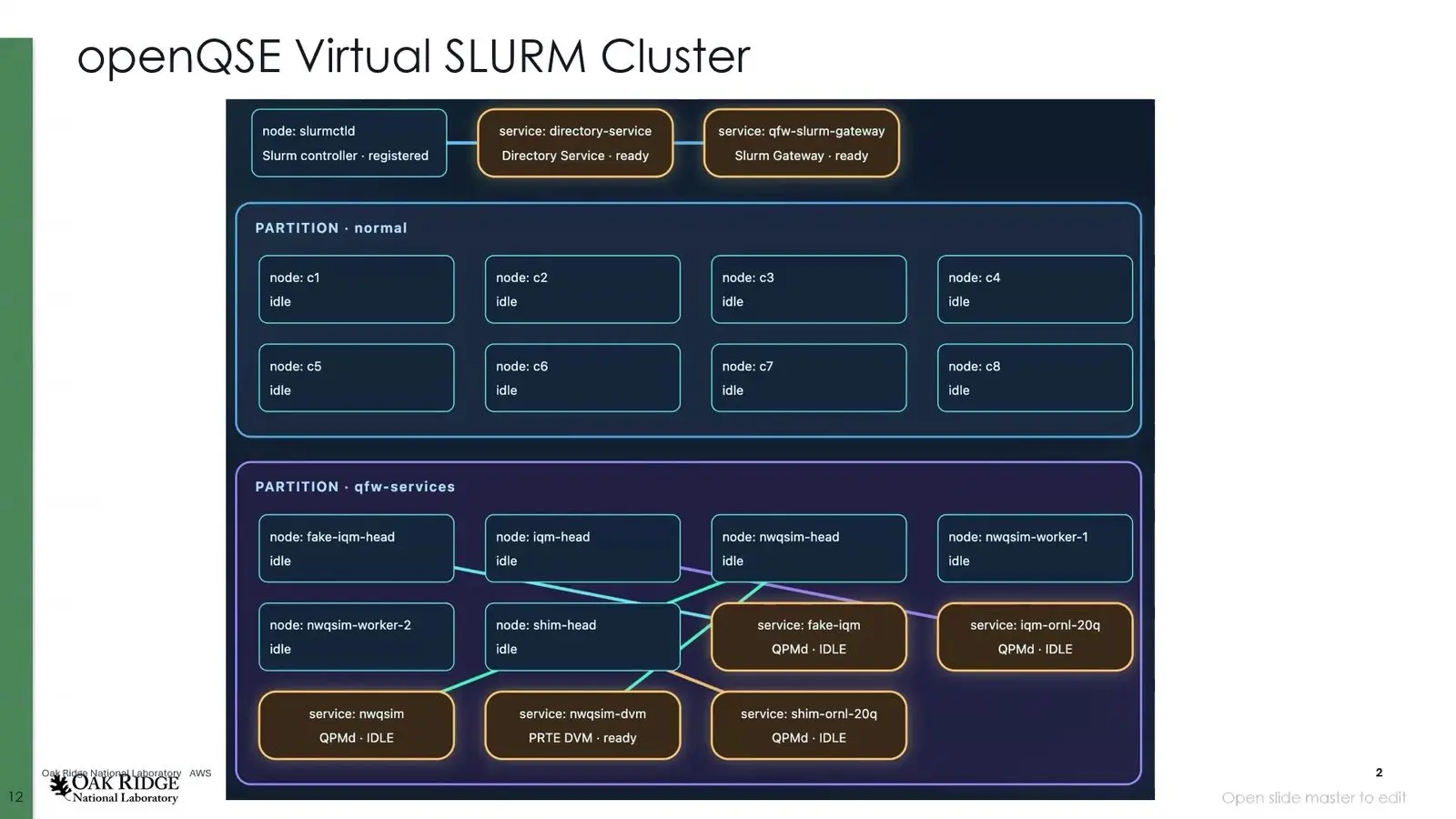
The interface group compares QRMI with QDMI. It wants one interface with several versions underneath, as MPI, the standard for passing messages between supercomputer nodes, already has. In the runtime group’s virtual Slurm cluster, jobs find and reserve a real IQM system, a fake IQM and the NWQ-Sim simulator. Anyone can run it on a laptop.
Schedulers, licences and reservations
A supercomputer’s scheduler decides which job runs where and when. Five talks on how that should work for a quantum chip came from quantum hardware makers Pasqal, Quantinuum and Alice & Bob and from graphics chip makers NVIDIA and AMD.
Pasqal’s QRMI plugs a QPU into five schedulers
Aleksander Wennersteen, who leads quantum HPC work at Pasqal, argued that joining a quantum chip to a supercomputer is mainly a software problem. The hardware needs some give from the host site, such as a separate room for the lasers that hold Pasqal’s atoms in place. In their phrase the link should be tight in logic. The machines need not be close.

Most of the talk covered QRMI, the Quantum Resource Management Interface, built with IBM and now backed by 21 groups. It is a thin library of about seven functions for finding, booking and running a quantum chip. With it, Slurm, PBS, IBM LSF, Flux and the Open Cluster Scheduler can all treat the chip as a resource. Scheduler makers told the team they were not yet really scheduling, so the team added a load sensor and licences that change as the machine does, which Wennersteen called far more painful than expected.
As a vendor, Wennersteen said, an on-site setup has never felt as smooth as the cloud. Pasqal is testing time slices with a priority queue, so that small test jobs can fill the gaps between big ones while a large job waits its turn on the machine. Warden, its middleware, is open source.
NVIDIA says Slurm will stay blind to the chip
Douglas Jacobsen of NVIDIA said Slurm, the scheduler that picks where and when each job runs, will stay unaware of the quantum chip. Sites today ship a licence and a plug-in. A generic resource is a poor fit, Jacobsen said, because it dies with its node and takes the chip with it.

The November release adds resources that can cover five nodes or a whole cluster. A maintenance hook can take the chip offline during recalibration, and a start hook fetches the access token when the job begins, so a two-week wait does not need a two-week token. Their proposed campaign runs three jobs. Compilation asks for the chip at a count of zero, enough to read calibration without any right to run, then comes execution, and then analysis on many nodes.
AMD wants decoders that never relaunch
Muhammad Osama of AMD Research argued that a quantum decoder may need to borrow a trick from graphics chips. It would stay resident and keep checking for work, so it never has to relaunch. Osama split the stack into a workflow that names the campaign, a scheduler that says how long a user may hold the machines and a device runtime that starts once the program is compiled.

Osama drew a sharp line between two clocks. A reservation covers minutes or hours and fails by making the user wait, while a device context lives in microseconds and fails with an instant error. A resident GPU kernel can spend 99 percent of its time waiting for the next task. Osama could not yet see how to express two tenants sharing one quantum chip.
Quantinuum’s slow clock lets Fugaku and the chip sit apart
Philipp Seitz of Quantinuum’s hybrid team took the slow clock. There a chemistry pipeline runs for minutes, hours or weeks, so Fugaku can sit in Kobe while the quantum device sits in Tokyo. Their Tierkreis tool is a graph of tasks with data on the edges, and it reaches the job systems on Fugaku and elsewhere so that old C++ or Fortran codes run unchanged.
Seitz said a site usually has one quantum processor, or two if lucky. Seitz does not want the supercomputer idle while it waits on the quantum chip, and does not want the chip held up through a long classical run either. Asked about a common format for workflows, Seitz said a big settings file is little better than a batch script.
Alice & Bob runs a quantum machine as a Linux program
Kevin Kissell of Alice & Bob argued that a cat-qubit machine should run as an ordinary compiled program on a Linux cluster and fit in a couple of rows of kit. Kissell introduced the firm as a Paris start-up founded in 2020. It has more than 250 staff and has raised 180 million euros. Its cat qubits store information in a resonator so that one kind of error, the bit flip, fades away fast as photons are added.
Kissell said supercomputer users distrust Python. They prefer compiled C++ and Fortran that scale from a small test run to full use on thousands of nodes with exactly the same file. Their hybrid program file stretches the Linux format to hold quantum parts. Kissell put IBM and Google years ahead here.
How tight the coupling must be
A quantum job runs on three clocks. Error correction runs in microseconds, hybrid loops take milliseconds to seconds a round, and large chemistry runs go on for hours. Six talks asked which of those clocks forces the classical hardware to sit beside the chip, and which lets it sit further away.
Amazon’s model puts communication at 0.01 percent
Dimitar Trenev, an applied scientist at Amazon Braket, argued that talk of tight coupling mixes two levels, and Trenev built a model to pull them apart, in a paper with co-authors at AWS, NVIDIA, Berkeley Lab and elsewhere. For most programs, delay only costs time while the quantum chip waits. Error correction is the exception, because there a missed deadline makes the answer wrong.
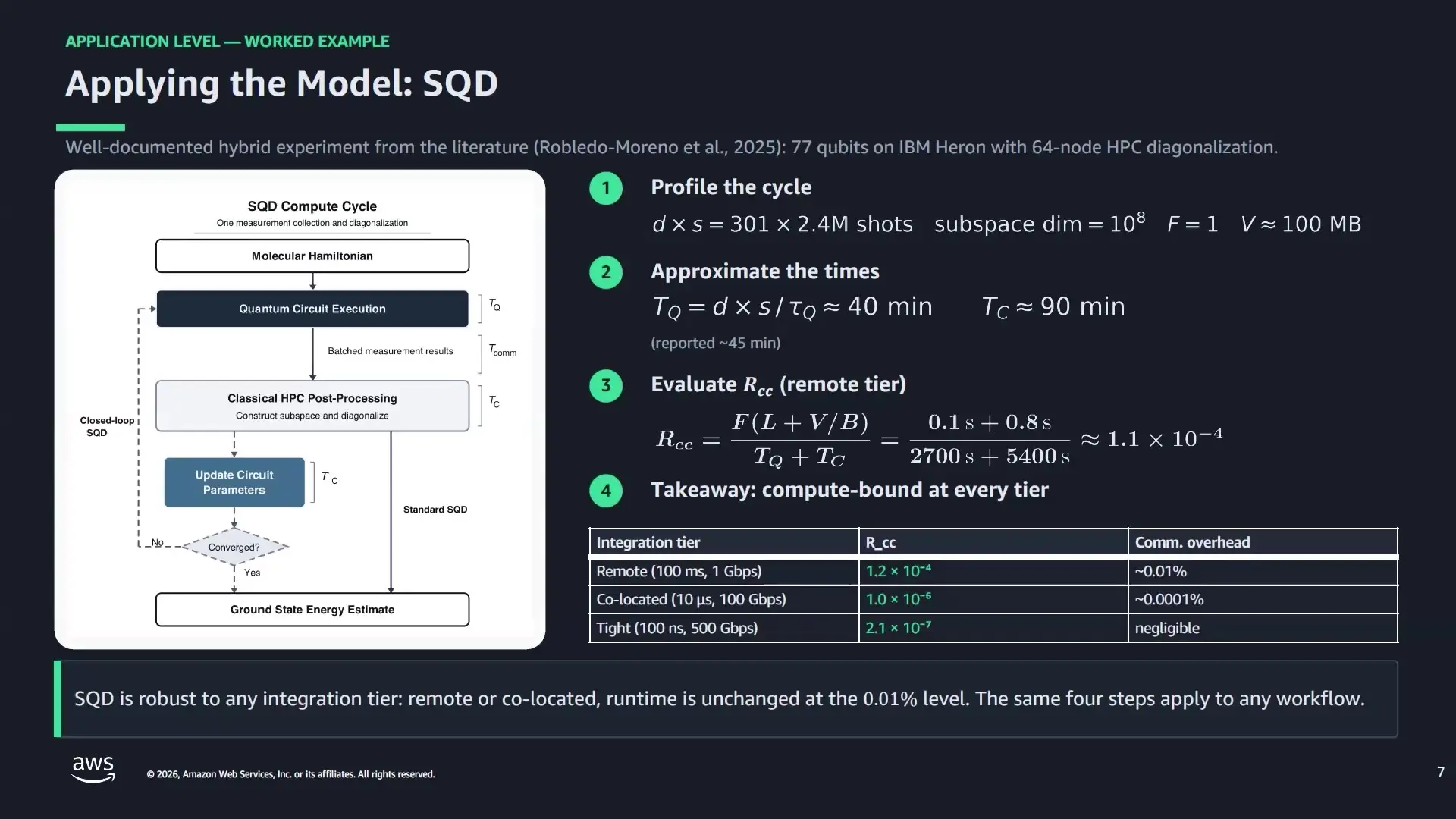
Trenev tested the model on the first published run of the sampling method, which used 77 qubits on IBM Heron and 64 classical nodes. It estimated about 40 minutes of quantum time against roughly 45 reported. Over a slow link of 100 milliseconds, talking took about 0.01 percent of the run. Breaking a 2048-bit RSA key is another matter, and the team showed that doubling the reaction time from 10 to 20 microseconds raised run time from 8.1 to 16.1 hours for one layout.
Their grid of workflows left one corner empty. The team found nothing today that needs both many supercomputer nodes and very short delays. Trenev expects error-correction decoding to run on special chips beside the qubits, and said these were their own views and not an Amazon position.
A panel on wires, watts and decoders
A nine-person panel chaired by Aaron Lott of HPE spent most of its time on the cost of wiring and the speed of decoders. Roman Caudillo of QoLab said a fridge has about two watts of cooling at 4 kelvin. So cold control chips stop near 100 qubits. At about 20 milliwatts a channel there is no more room, and Caudillo said wires, filters and amplifiers are more than 80 percent of today’s cost, which packing them together could cut by 10 to 100 times.
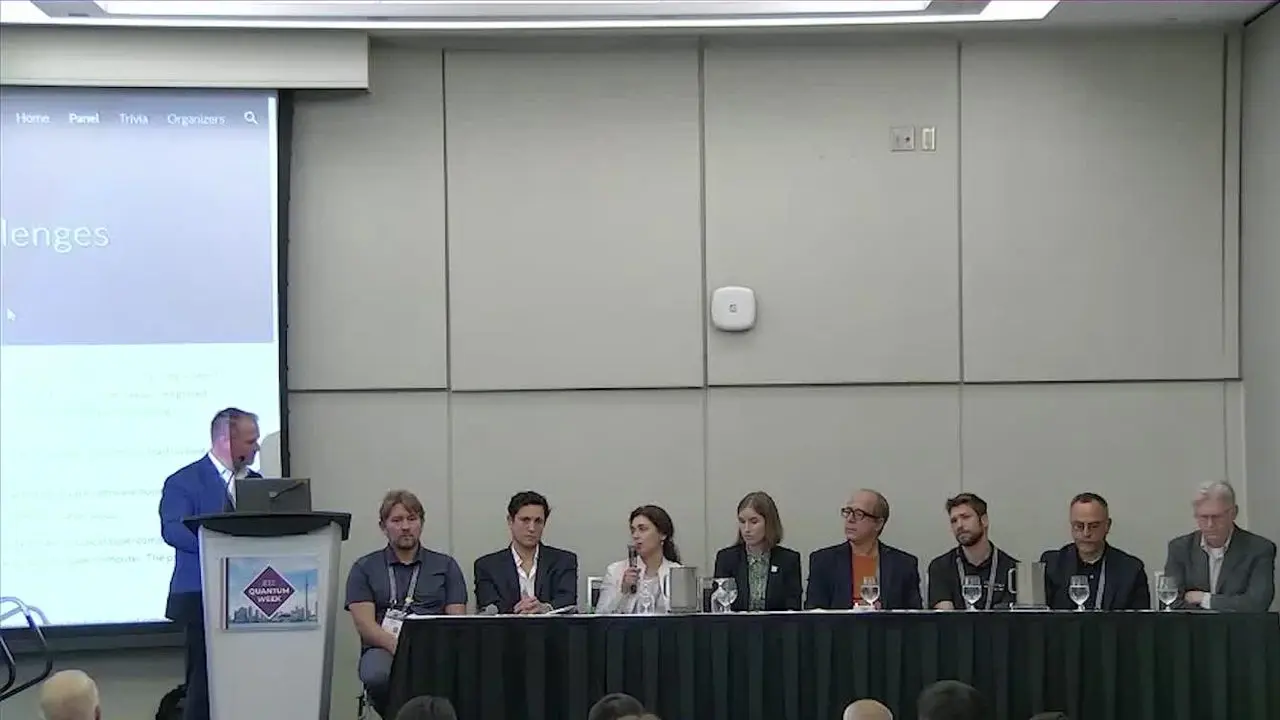
Ophelia Crawford of Riverlane named the decoder as the costly classical job. Crawford put the round near one microsecond. Sahar Daraeizadeh of Intel said a surface code at millions of qubits would push at least 500 gigabits a second up the stack. A large job, Daraeizadeh said, takes a few hours with a one-microsecond round and about 200 days with a millisecond one, and Daraeizadeh wants a chip at 4 kelvin to squeeze the data stream first. Barr von Oehsen said most of Pittsburgh’s regular users never look at the hardware.
Xanadu’s Backline sits under PennyLane
Joshua Izaac of Xanadu said light-based machines still need FPGAs, GPUs and CPUs beside the lasers, each on its own clock. A first decoding round takes between a nanosecond and a microsecond. A backup round for missed errors takes one to 100 microseconds, and later work moves out to the supercomputer, where time is cheap but far away from the qubits.
Backline, Xanadu’s control layer, sits under its PennyLane software. One fix-up routine can then run on many devices. A controller drives the quantum hardware while a second chip runs the decoder, and on AMD kit Izaac gave the hop to the main chip as about 2.4 microseconds and to the graphics chip as about 4.5. We wrote about the Xanadu and AMD Backline link when it came out.
NVIDIA’s keynote decodes Helios in real time
Krysta Svore, vice president of applied research for quantum computing at NVIDIA, announced CUDA-Q Logical in the Wednesday keynote. It is an open compiler that takes a program down through a chosen error-correcting code and a layout to the control of the device. Run on the Gidney and Ekerå design for breaking 2048-bit RSA, its first test gave about 5.05 hours and 19,252,128 physical qubits. That matched the published model to seven figures.
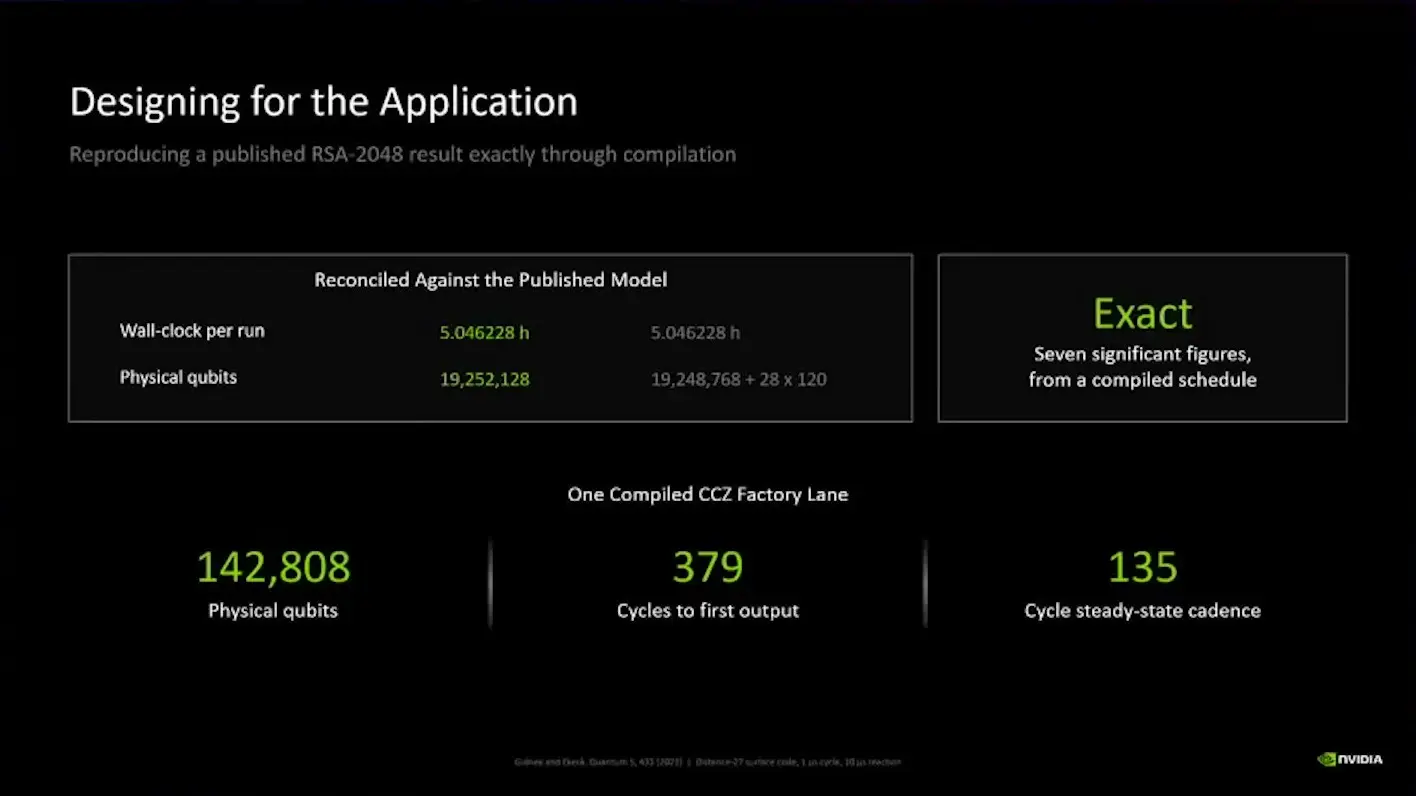
Their design adds a host built on graphics chips between the quantum controller and the supercomputer. It runs decoding, retuning and control over NVQLink, which Svore said has shown delays under 3 microseconds. Svore also reported a result on real hardware. On Quantinuum’s Helios, Svore said, live decoding on graphics chips cut the logical error rate of an eight-qubit test from 4.95 percent to 0.925 percent, with a typical decode of 67 microseconds in a budget of 2,000.
NVQLink’s round trip measures 3.84 microseconds
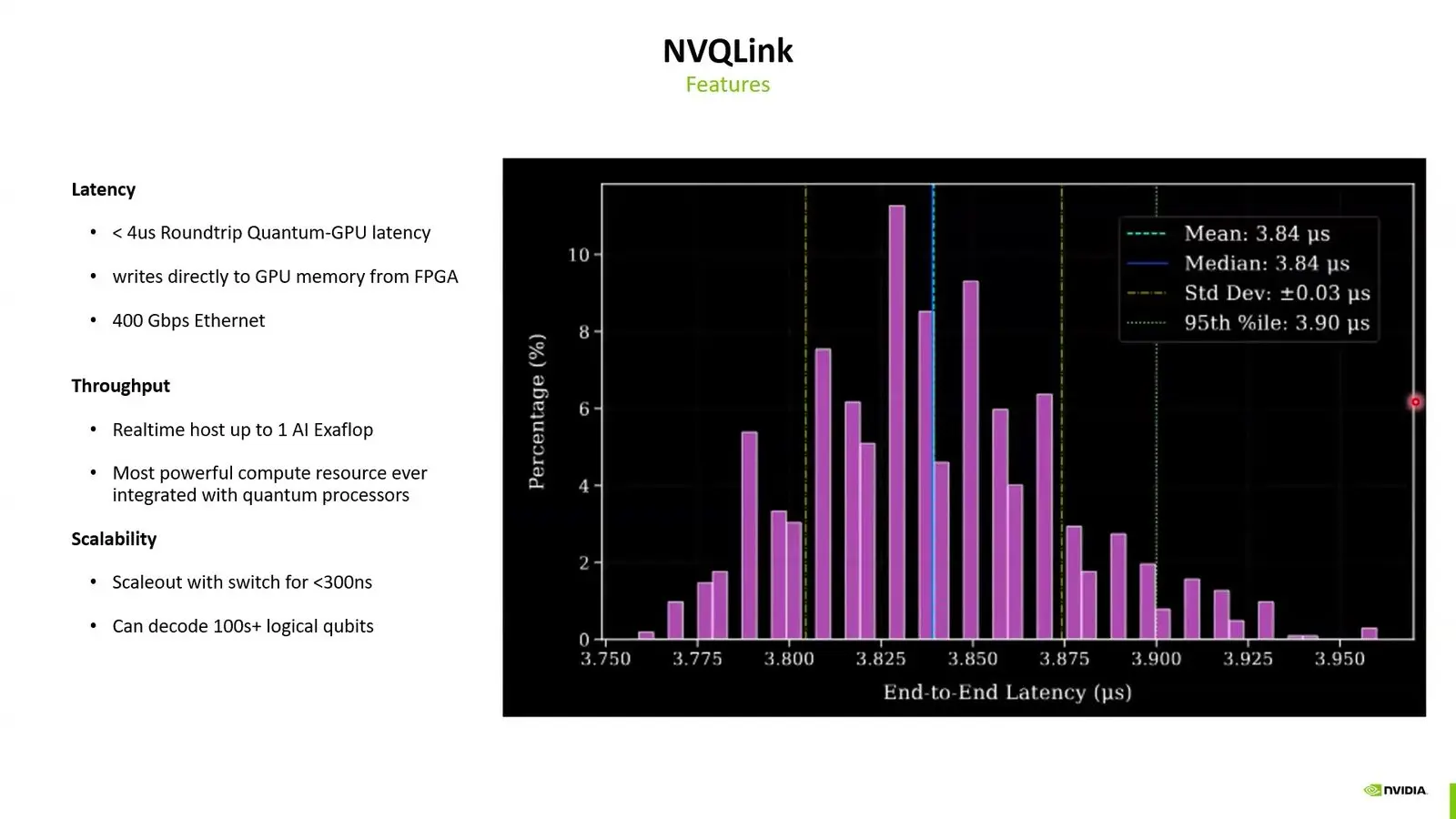
Yuri Alexeev of NVIDIA gave a measured round trip of 3.84 microseconds, on average, for NVQLink. That is the firm’s link between quantum control kit and graphics chips. It writes from the controller’s FPGA, a chip that can be rewired for each task, straight into GPU memory over a 400 gigabit network, and 95 percent of trips took 3.90 microseconds or less.
Alexeev showed a colleague’s diagram of the logical machine. It starts at the chip. Pulse processors form the controller, which feeds a host of CPUs and GPUs that runs decoding and live calibration in one closed loop. Only that loop needs the tightest link, Alexeev said, and the link on to the supercomputer can be an ordinary one.
Dell servers meet the 4-microsecond target
Robert Lee of Dell Technologies tested whether Dell’s servers can meet NVIDIA’s NVQLink target. That target is a round trip under 4 microseconds. Lee linked a GPU server through a network card and a 100 gigabit cable to an FPGA standing in for the control box, and used RDMA, a way of moving data that skips the main processor.
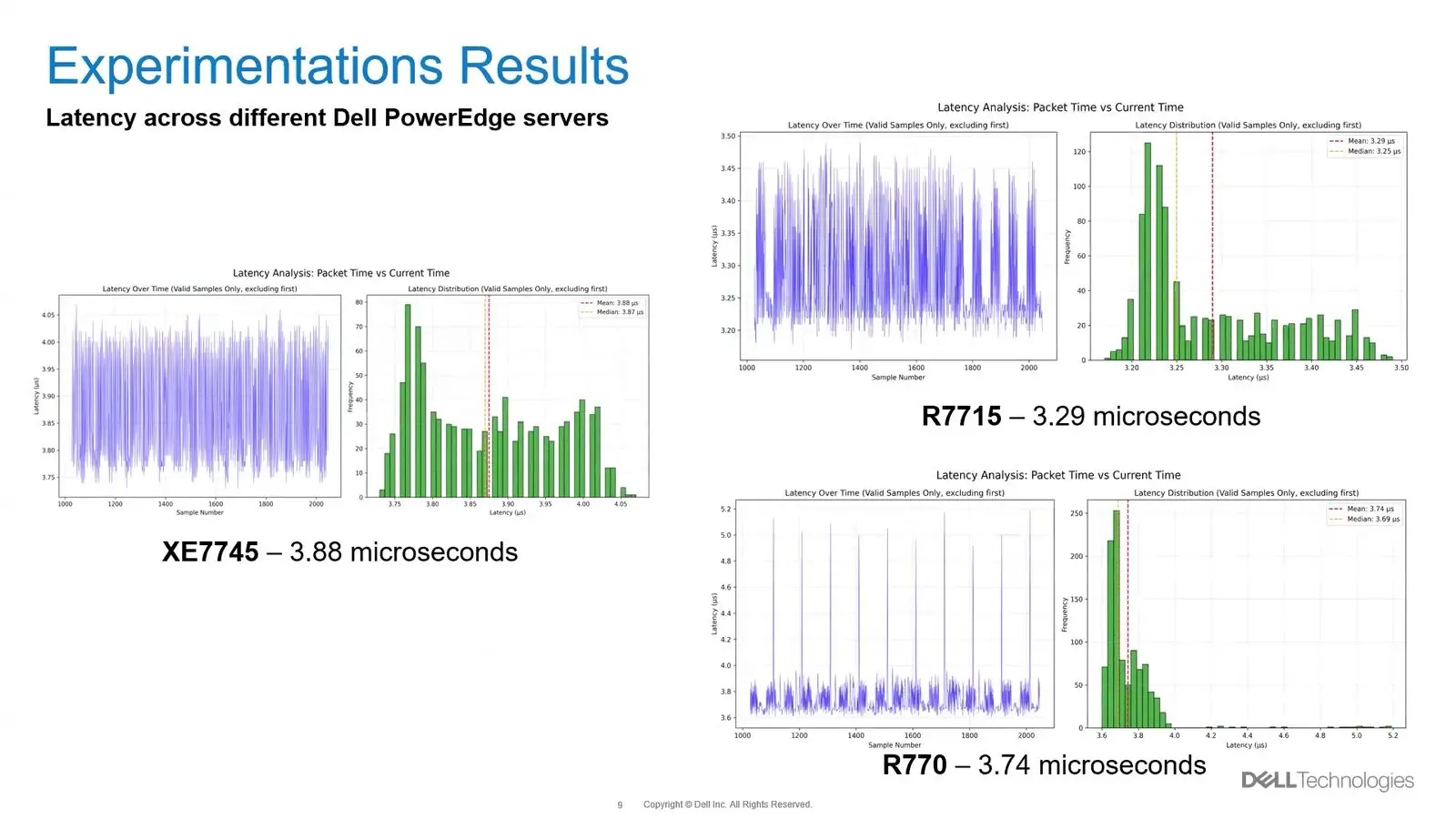
Every server met the target. The R7715 averaged 3.29 microseconds, the R770 3.74 and the XE7745 3.88, and Lee credited a newer CUDA-Q release with the biggest gain. No quantum controller was in the loop. The figures measure the classical half of the link.
Centres and their users
A supercomputing centre is a set of people as much as machines. Eight talks from Oak Ridge, NERSC, HPE, Argonne, Poznan and Barcelona described how centres are preparing their users and sharing scarce machines.
Oak Ridge builds test beds for trust
Travis Humble of Oak Ridge National Laboratory argued that test beds build users, trust and repeatable results. Access to hardware is only part of it. Oak Ridge’s user programme began about 10 years ago with cloud access to IBM, IQM, Quantinuum, IonQ and others, and its first machine on site is a Quantum Brilliance rack of three small diamond chips that work at room temperature.
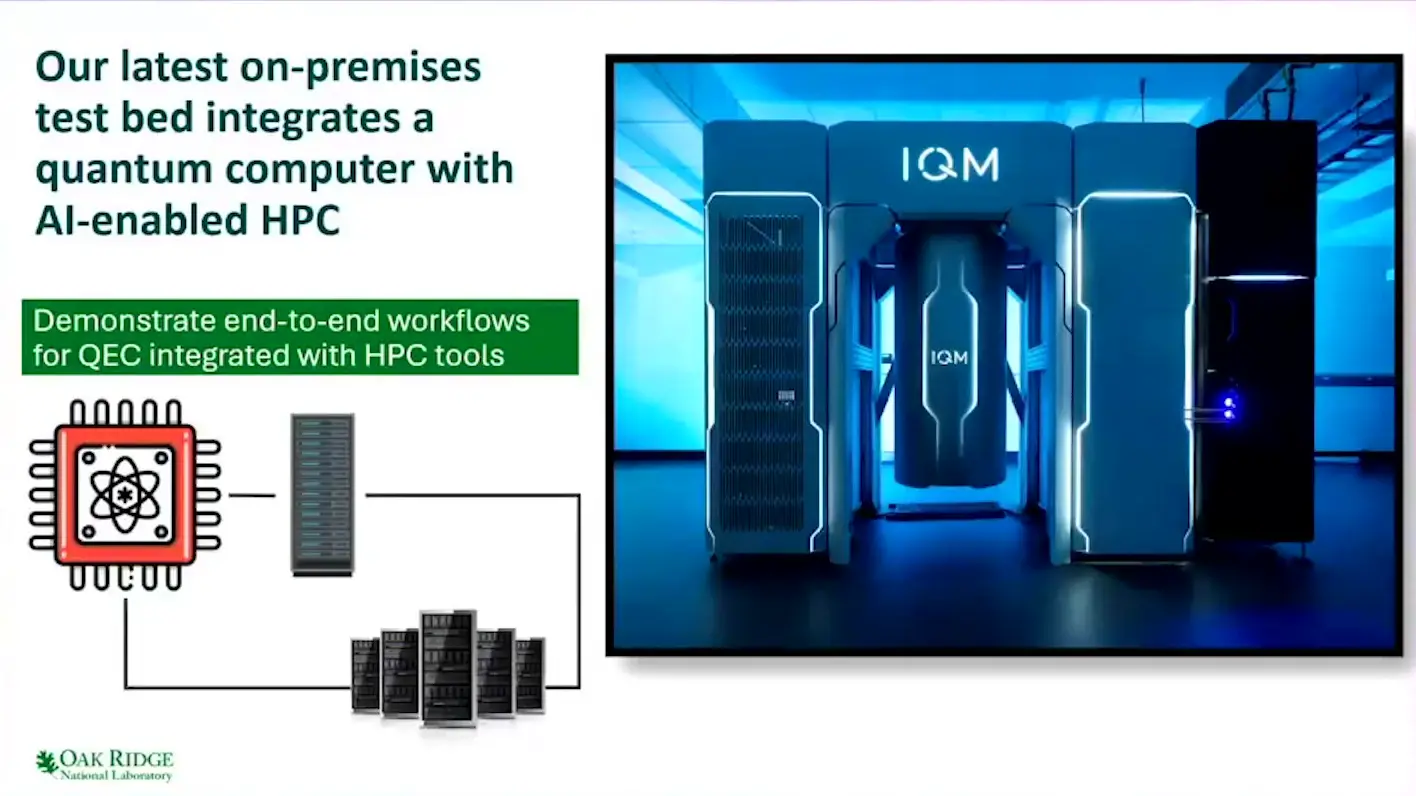
The newest machine, put in this summer, is a 20-qubit IQM Radiance about a quarter mile from the supercomputers, linked to a Riverlane Deltaflow 2 decoder and to Lux, an AMD-based AI system still being set up. Humble said this first version is not yet built for short delays. The interfaces are still open. Humble pointed to openQSE to agree them.
NERSC readies 12,000 users
Katie Klymko, the quantum advisor at NERSC, Berkeley Lab’s centre, described a site that serves about 12,000 open-science users on its Perlmutter machine and plans to add quantum in the early 2030s. Sharing is part of the case for buying. Costly machines may be worth owning together so neither sits idle, a reason Trenev’s model leaves out.
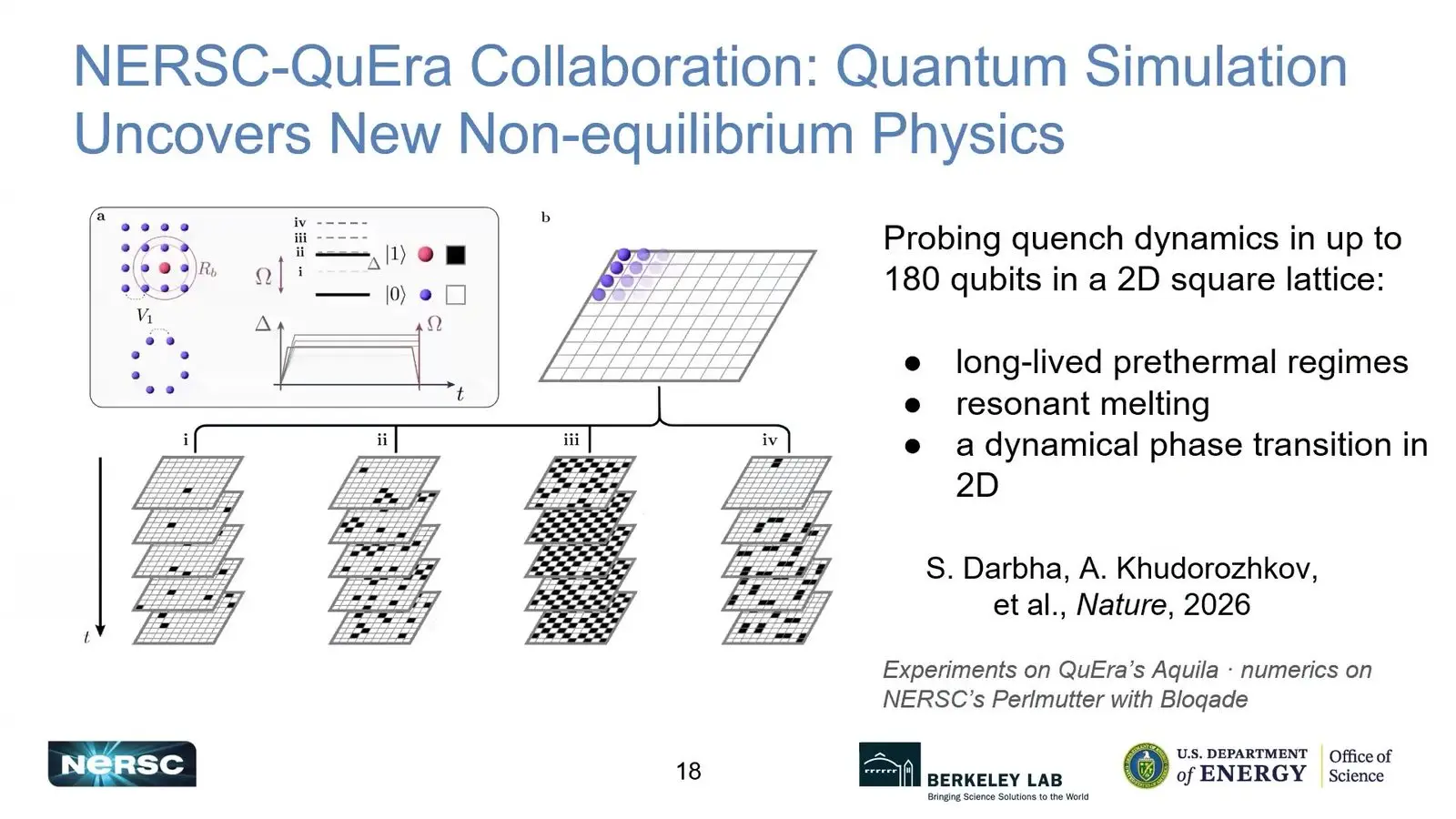
A call for time on QuEra machines drew 20 bids. Four teams won time on the analogue Aquila system and two on Gemini, a 260-qubit digital machine at AIST in Japan. On Aquila, tests with up to 180 qubits found long-lived states that hold off heating and a sudden change of phase, in a paper Klymko said Nature has accepted. One study estimates that decoding large problems may need up to a petaflop of classical power.
NERSC’s QUEST scheme and a 2028 target
On the Thursday, Klymko opened HPE’s workshop on quantum supercomputing with the pressure from above. A Department of Energy request asks vendors whether 200 logical qubits, about 100,000 steps and an error rate near one in 100 million could be ready around 2028. Klymko called that ambitious. NERSC’s access scheme is now called QUEST, with QuEra access since October 2024 and IBM access since January 2025.
On QuEra’s Gemini, a Berkeley Lab and QuEra team is working out which forces between atoms the hardware really makes. Later circuits can then be shallower. With IBM, methods that measure on the chip and solve small matrices on normal computers are being tried on Nighthawk chips. Klymko also described HamLib, a set of ready-made problems, as a fair way to compare machines on the same task.
HPE argues for a horizontal stack
Masoud Mohseni, who runs HPE Quantum, said the best use is to simulate quantum systems. Work on classical data is overrated, Mohseni said, since loading the data with no quantum memory wipes out any gain the chip might have offered in the first place. Mohseni put the quantum share of national-lab work at 30 to 50 percent.
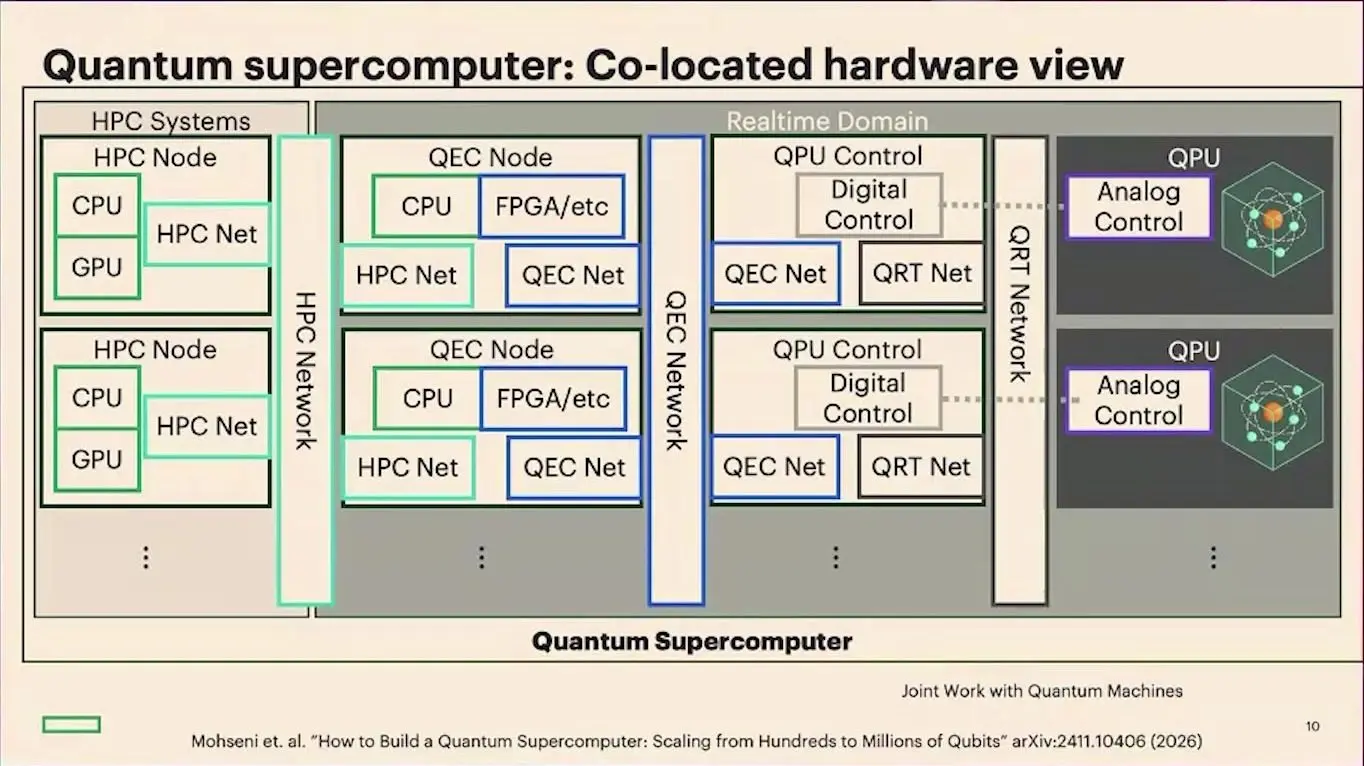
Their design, drawn with Quantum Machines, splits the system into the quantum chip, digital control outside the fridge and decoding nodes, joined by a fast network at about 100 nanoseconds. HPE’s Quantum Scaling Alliance now has more than ten vendors. Mohseni likes this flat model better than the tall stacks of big firms, since the chip trade grew that way. Mohseni also described TangleLab, a 5 million dollar test bed at the Pittsburgh centre built around a nine-qubit Rigetti chip, which expects to take on teams in summer 2027.
Humble’s keynote treats the chip as a lab instrument
Travis Humble, director of the Quantum Science Center at Oak Ridge, framed a quantum computer in their Thursday keynote as a lab tool. It should match a measurement the lab already makes. Their example was potassium copper fluoride, a crystal whose spins form chains, run on an IBM machine by IBM, Purdue and Oak Ridge and set beside measurements the lab had already made. A 50-qubit run, the measured neutron spectrum and a classical model each showed the same bright patch at low energy.
Humble said the Frontier supercomputer stays and its successor only doubles the speed, so a quantum chip has to join the people, codes and data already there. The user programme has served more than 500 users. Humble also cited Dario Gil, the Department of Energy’s Under Secretary for Science. Gil told Oak Ridge that by 2028 the department will field a first generation of fault-tolerant computers able to do science.
Argonne calls 2028 a demonstration
Laura Schulz, who leads quantum work at the Argonne Leadership Computing Facility, wants a user site that runs quantum machines beside supercomputing and AI. No such site has been set up yet, Schulz said. A Department of Energy plan sets fault-tolerant systems for 2028. They would have logical qubits in the low hundreds.
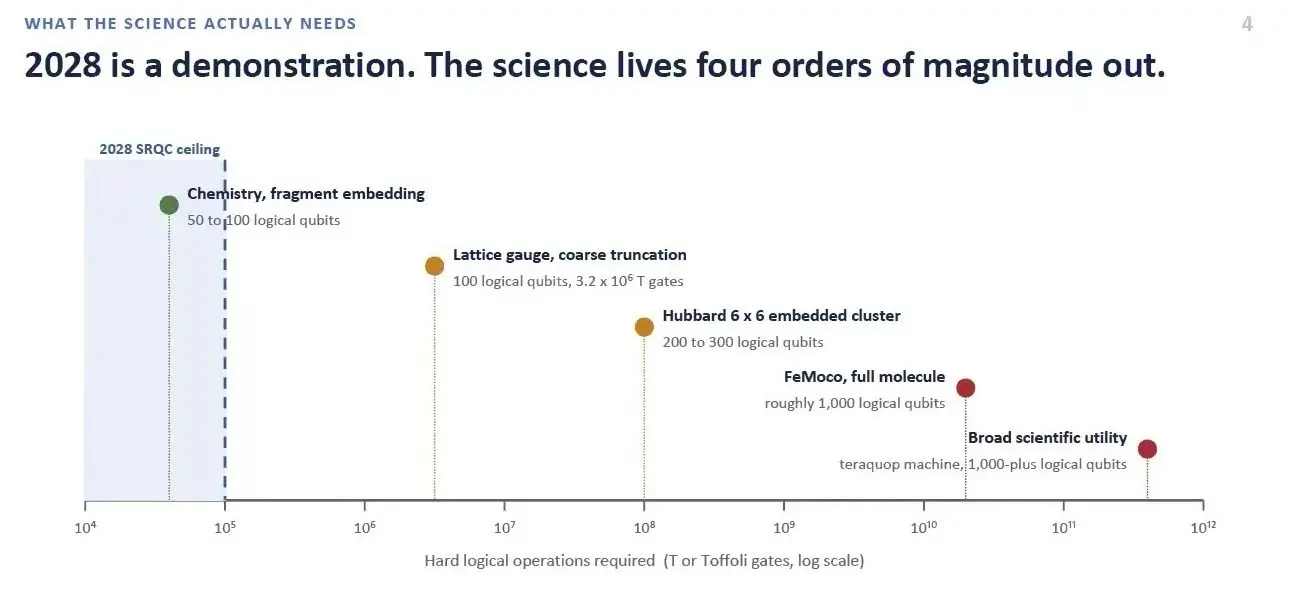
Schulz called that a demonstration. Counted in T gates, the costly steps of an error-corrected machine, the 2028 ceiling covers a chemistry fragment at 50 to 100 logical qubits. A full FeMoco molecule, the metal core of the enzyme that fixes nitrogen, needs roughly 1,000. Schulz asked for benchmarks of what a user gets once a job has crossed the whole site, in place of good-day figures from the machine alone.
Europe puts ten quantum machines in supercomputing centres
Konrad Wojciechowski of the Poznan Supercomputing and Networking Center said about ten quantum computers are going into Europe’s big computer centres. The joint body EuroHPC runs the plan. All the machines are built by firms in Europe. Poznan’s own, PIAST-Q, holds more than 20 trapped ions. It has served about 20 projects since July, and the centre also runs two photonic machines from ORCA, each with eight modes, the paths that carry its light.
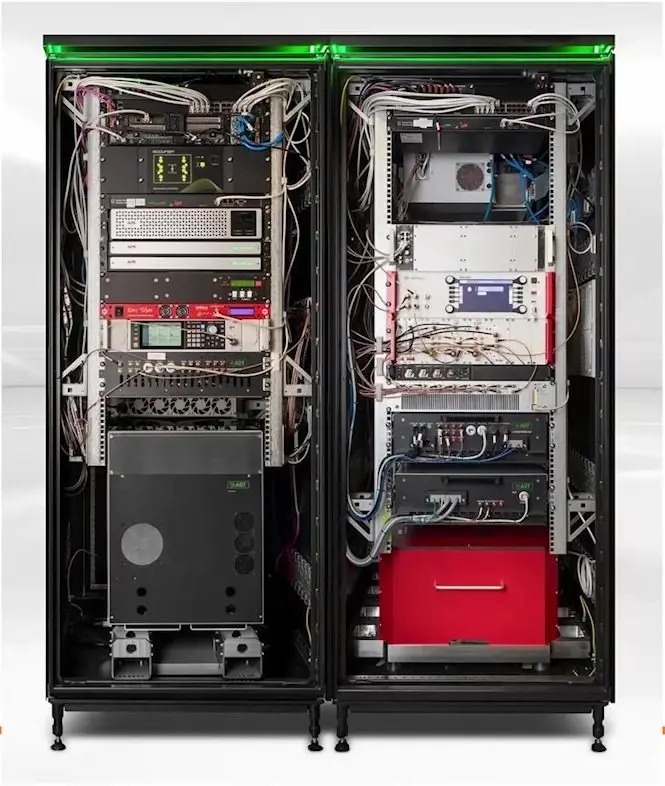
Hybrid tests are hard to compare, Wojciechowski said. Each centre joins its machine to its supercomputer in its own way.
Barcelona cuts circuits on MareNostrum 5
Mar Tejedor of the Barcelona Supercomputing Center had a room of newcomers cutting circuits on its MareNostrum 5 machine in one session. Javier Conejero helped in the room. The team had booked about 40 nodes. The big machine shares one file store with MareNostrum Ona, the centre’s quantum computer, so data can pass from one to the other through the same disks.
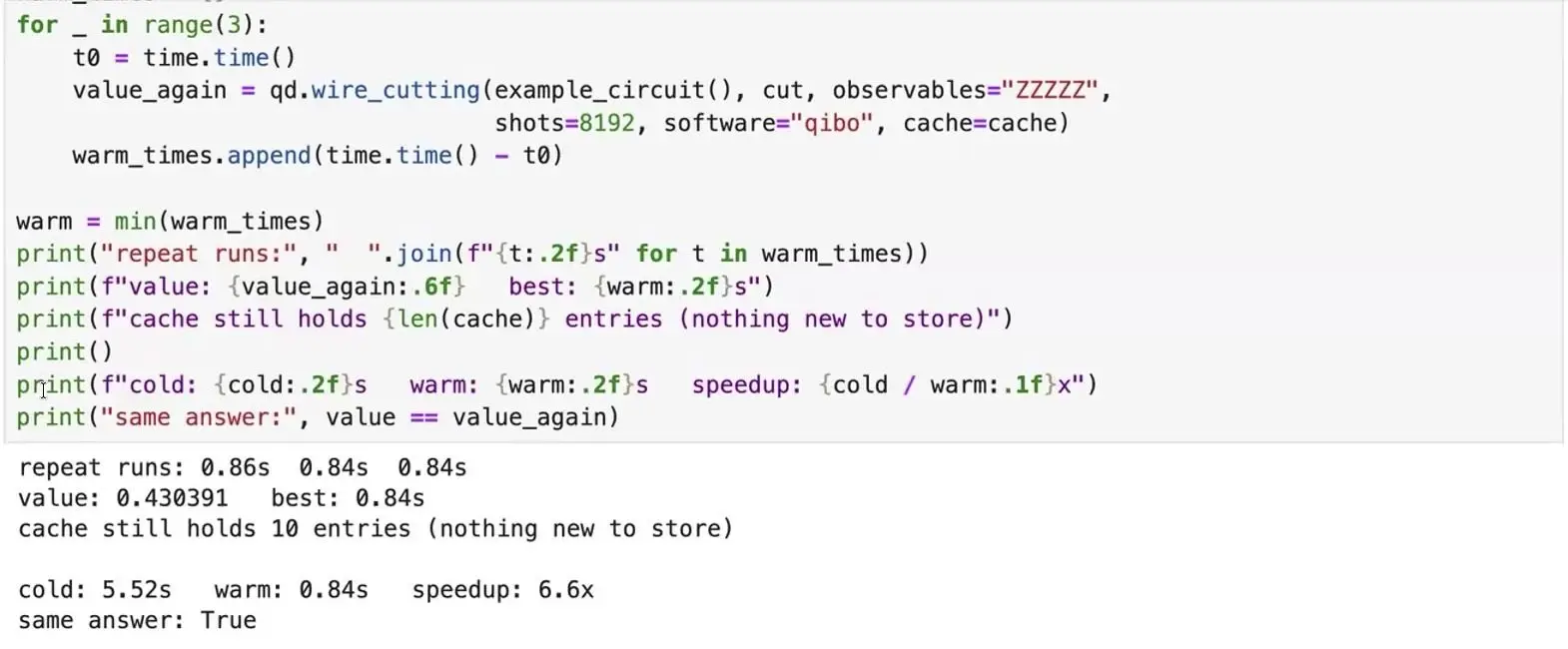
The tool, Qdislib, cuts a circuit too big for a device into pieces that run on their own. Classical nodes then stitch the results back together. A four-qubit hydrogen circuit split into two-qubit halves, about 500 small circuits run side by side across the cores of one node, and a cache that spots repeats answered in 0.84 seconds against 5.52 from cold. Tejedor said caching on quantum hardware had saved 38 percent of device time.
Hybrid chemistry runs in practice
The workloads that justify all this plumbing today are mostly chemistry runs that split work between a quantum chip and many classical nodes. Two talks followed real runs from end to end.
IBM and Osaka watch where the time goes
Yuto Morohashi of the University of Osaka and IBM Research Tokyo set out to show where the time and money go in a hybrid run. Morohashi worked with five co-authors from IBM Research Tokyo and the University of Tokyo. Results drift as the chip is retuned. Full runs also cost so much that only a few can be made, which makes each one hard to explain after the fact.

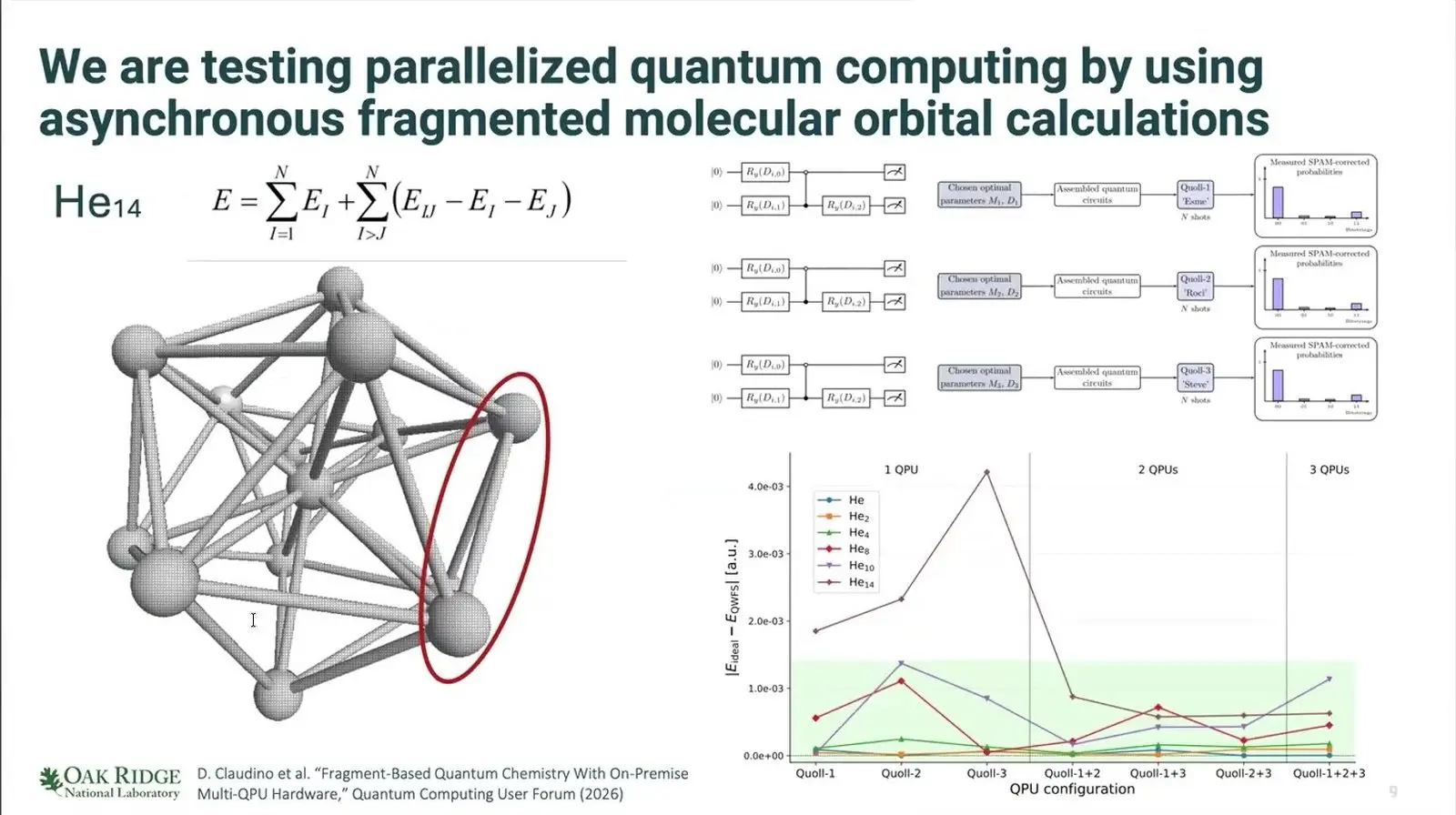
Their test was a RIKEN chemistry run on IBM’s ibm_kingston chip and 64 nodes of the Miyabi-C supercomputer, with 80 quantum runs of 72 qubits each. It used about 20 percent of the quantum quota and 8 percent of the supercomputer tokens. Two runs with the same seeds ended at slightly different energies. Morohashi said their metrics do not cut cost. They only let the team estimate that about five runs at this scale fit in the same budget.
IBM books a whole day on Fugaku
Blake Johnson, a distinguished engineer at IBM, argued that a shared calendar matters more than a shared room. Four chemistry runs showed why. Johnson spoke on behalf of Seetharami Seelam, and the first run, an open loop on iron-sulphur clusters, used about 15 minutes of quantum time and 16,000 node hours on Fugaku at RIKEN.
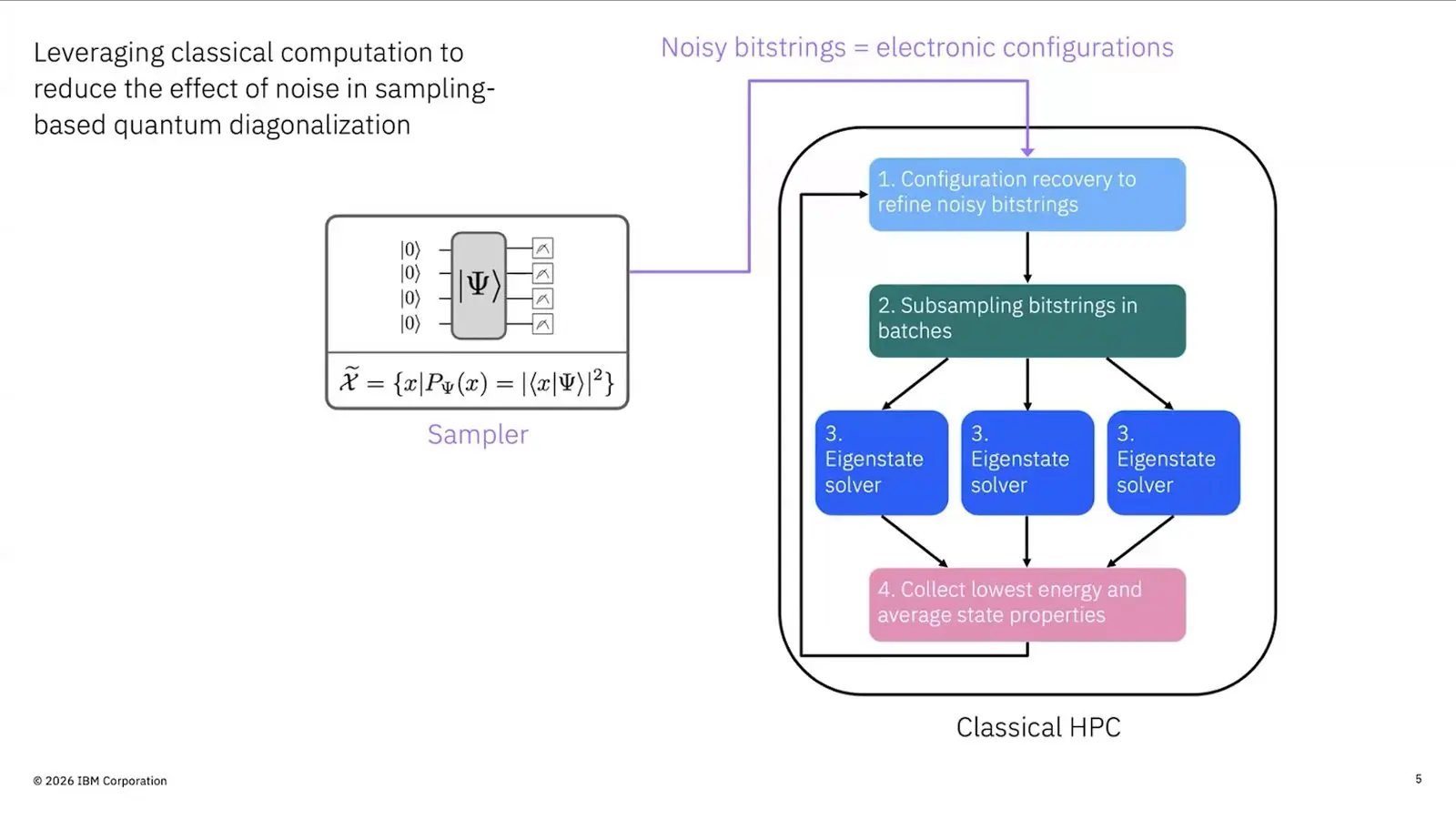
Closing the loop, so the guess updates when a lower energy comes back, meant booking a full day on the quantum system and on Fugaku at once, and one stretch used all 150,000 nodes. Johnson said ordinary queues would have stretched it over weeks or months. A protein run with the Cleveland Clinic and RIKEN fell from three months to just over two days after moving onto a GPU machine. Johnson said cutting a molecule into fragments lets a chip of 60 to 100 qubits do science now.
Rooms, rules and recovery times
A quantum machine in a data centre is a delicate guest. Three sessions on the Tuesday and Wednesday asked what the room, the rules and the racks must look like before it can be treated as one more accelerator.
A cooling fault can cost days
Vassilios Pantazopoulos of NVIDIA described the NVIDIA Accelerated Quantum Center, being built in the Boston area as a blueprint for a machine that joins quantum chips and GPUs. Pantazopoulos said NVIDIA has no plan to build its own quantum chip. Most of the talk was about the room around the machine.
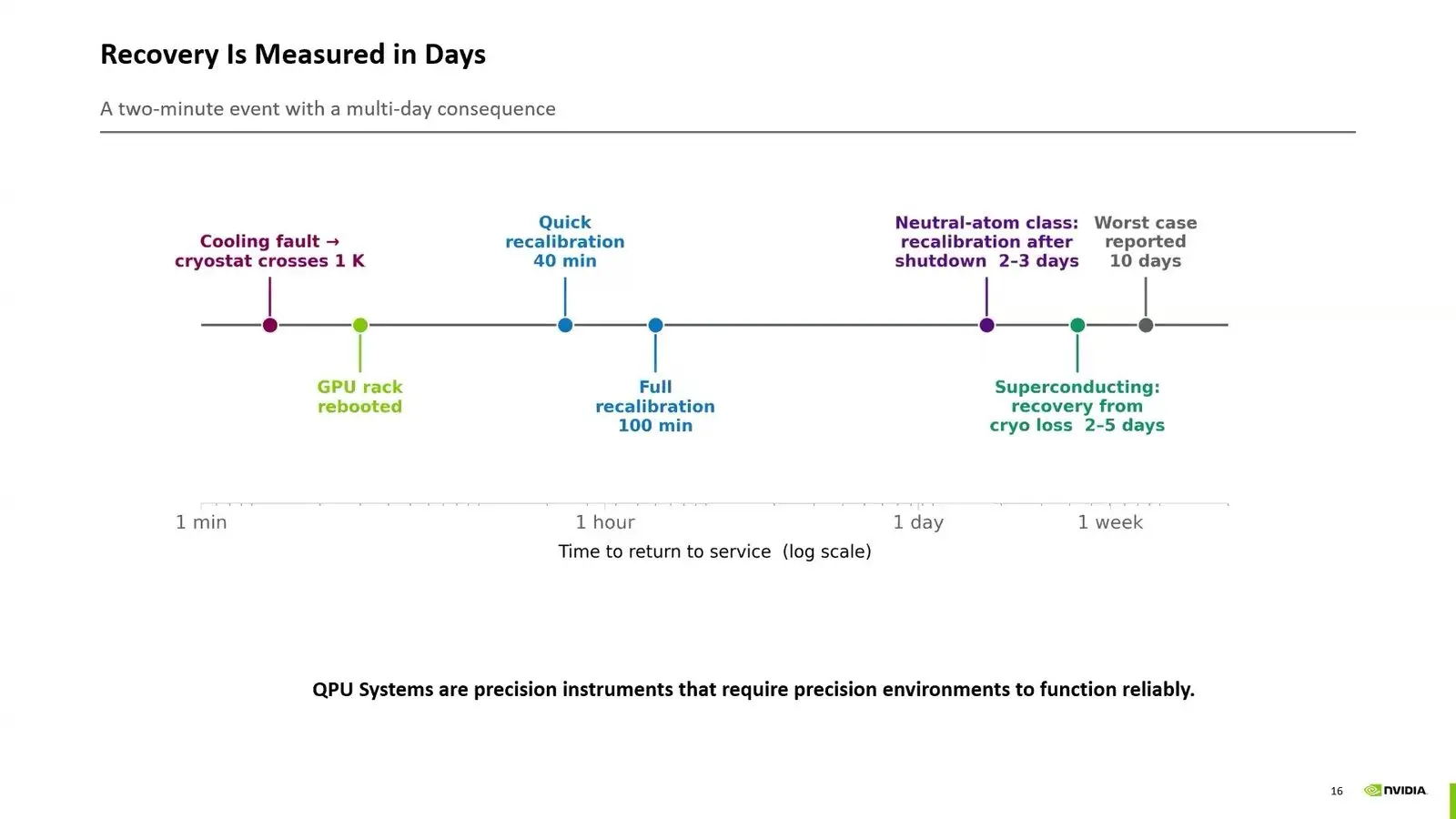
A cooling fault that pushes the fridge above 1 kelvin starts the clock. A quick recalibration takes 40 minutes and a full one 100 minutes. A neutral-atom machine needs 2 to 3 days to recalibrate after a shutdown, a superconducting one 2 to 5 days after a loss of its cooling liquid, and the worst case reported was 10 days.
Policy, more than physics, slowed integration
Travis Humble of Oak Ridge told a Tuesday panel that the technical work had been far smaller than expected. The hard part was old data-centre rules. Humble’s example was keeping a record of who used a system and for how long, which quantum machines built for the lab were never made to do. Joshua Moles of Snoquera and Amir Shehata ran the panel, with Smriti Bajaj of Dell, Martin Schulz, Ryan Jones of Infleqtion and Neal Erickson of Quantinuum.
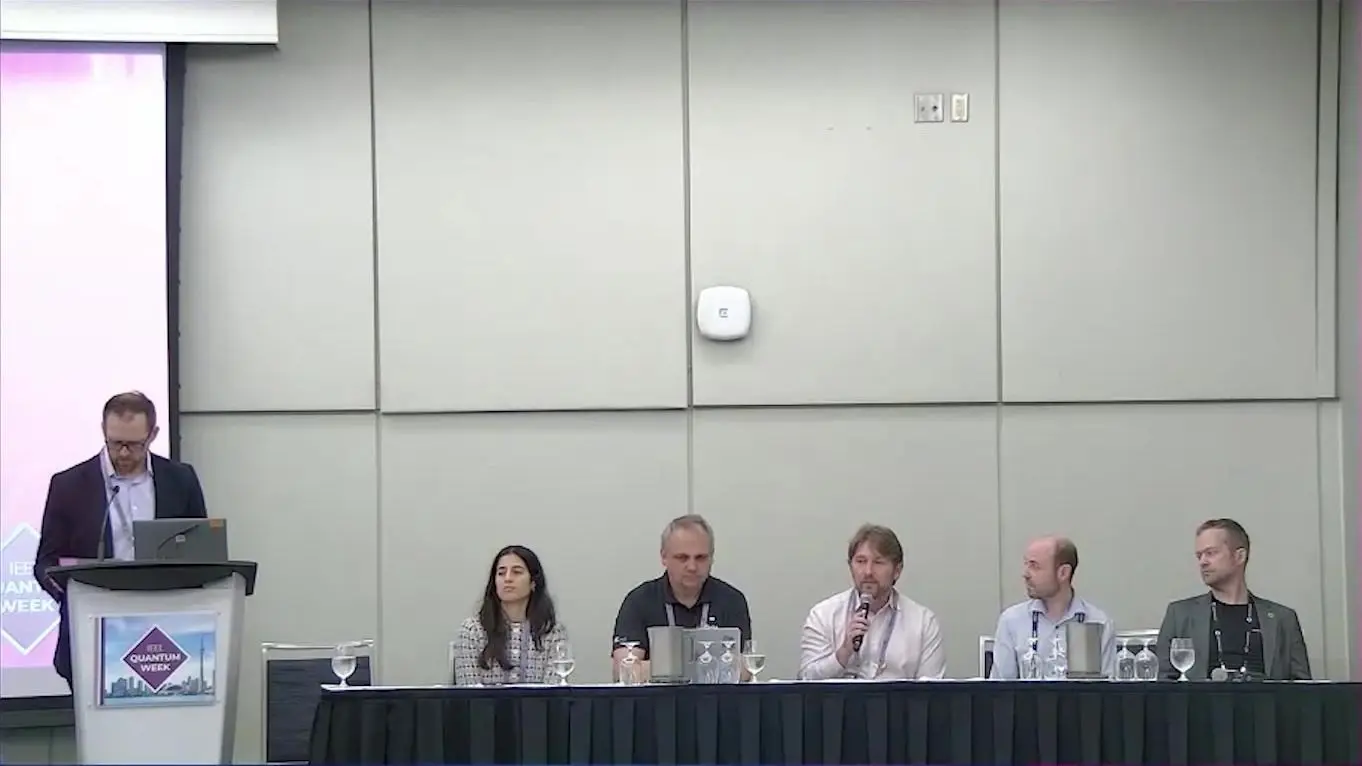
Humble noted estimates of one fault-tolerant result per month. Schulz doubted that quantum runs could last a month. Big classical jobs survive that long only by saving their state from time to time so they can restart, and a quantum state cannot be copied. On power, Schulz set 20 megawatts for a supercomputer against about 25 kilowatts for a quantum fridge.
Panellists want Slurm integration within a year
Jay Guilmart of Q-CTRL asked four panellists how a quantum computer becomes one more accelerator beside CPUs and GPUs. Two named simpler Slurm integration as the fix needed within a year. They were Smriti Bajaj of Dell and Andres Paz Sampedro of NVIDIA. Bajaj said Dell had measured NVQLink round trips under 4 microseconds on its own servers, and put about 99 percent of each hybrid workload on the classical side.

Burns Healy of Quantum Sky said US government use needs the whole system cleared for security. Paz Sampedro expects a few quantum computers shared by thousands of nodes. That makes the quantum machine the bottleneck. The chief executive of Anyon Computing put perhaps 1,000 to 4,000 qubits in one fridge, so growth will mean clusters of linked machines that share entanglement over cold links.
What it means for supercomputing centres
For a centre weighing a quantum purchase, the talks suggest an order of work. Buy machines that speak a common interface such as QDMI or QRMI, budget for calibration windows and for training users, and treat link speed as a question for the day error correction runs live. Svore’s Helios result was the only real-time decoding on hardware in these talks. The chemistry gains rest on single case studies.
The second question is who gets a turn. A Slurm licence rations one cluster, a core hour does not price the hour after calibration, and IBM’s closed-loop run needed a full day booked on two machines at once. Beyond Toronto, Israel has a new centre for quantum and supercomputing, and we covered how Classiq links quantum code to Israel’s new HPC-quantum center.
Two years into their joint project, Wille’s physicists and computer scientists still used some words differently. Each centre that buys a quantum machine now faces the same months of argument over words.
Frequently asked questions
What is quantum HPC integration?
Quantum HPC integration joins a quantum computer to a supercomputer so that each does the part of a job it does best. The quantum chip works as an accelerator that the larger classical machine calls on, as supercomputers already call on graphics chips. At QCE26 most of the work was on shared interfaces, schedulers and queues.
Does a quantum computer need to sit next to a supercomputer?
For live error correction, yes, because a decoder must answer within about a microsecond on superconducting chips. For today’s hybrid chemistry runs, a model by Dimitar Trenev of Amazon Braket put communication at about 0.01 percent of the run even over a distant link. Philipp Seitz of Quantinuum said slow chemistry pipelines let Fugaku sit in Kobe while the quantum device sits in Tokyo.
How do supercomputers schedule quantum computers?
Many centres use Slurm, and sites today often treat the quantum chip as a licence, a token a job must hold before it can reach the device. Pasqal and IBM built QRMI so that Slurm, PBS, IBM LSF, Flux and the Open Cluster Scheduler can treat a quantum chip as a resource. NVIDIA said Slurm itself will stay unaware of the chip.
What is QDMI?
QDMI, the Quantum Device Management Interface, comes from the Munich Quantum Valley. It tells a software stack what quantum devices exist, what each can do, how to submit a job and what the latest calibration says. At QCE26 it was shown driving IQM’s Garnet machine through Amazon Braket.
What is quantum-centric supercomputing?
Quantum-centric supercomputing is IBM’s name for runs that split work between a quantum processor and classical nodes. A common example is sample-based quantum diagonalisation, where the quantum chip supplies samples and the supercomputer solves a smaller version of the problem. At QCE26 IBM described a closed-loop run in which one stretch used all 150,000 nodes of Fugaku.
What happened at IEEE Quantum Week 2026?
IEEE Quantum Week 2026, also called QCE26, ran from 13 to 18 September at the Metro Toronto Convention Centre. This guide covers 29 of its talks on putting quantum computers inside supercomputing centres. Most dealt with interfaces, scheduling and how to share a scarce machine among many users.
This guide is based on 29 talks, tutorials, keynotes and panels at IEEE Quantum Week 2026 (QCE26), held at the Metro Toronto Convention Centre from 13 to 18 September 2026, and on the published conference programme. Names follow the programme. Affiliations and titles not listed there are as speakers gave them. Results are stated as each speaker presented them, and most are tutorials, models or single case studies. Company claims are the companies’ own.
- Qubit hardware and scaling roadmaps
- Photonics and quantum sensing
- Control electronics, calibration and readout
- Quantum error correction and decoders
- Fault-tolerant compilation and magic states
- Modular and distributed quantum computing
- Compilers, circuit synthesis and languages
- AI and language models for quantum software
- Testing and reproducible quantum experiments
- Benchmarks, error mitigation and quantum advantage
- Quantum state preparation, oracles and arithmetic
- Quantum optimisation, QAOA and annealing
- Quantum machine learning
- Chemistry, materials and life sciences
- Differential equations and fluid dynamics
- Power grids and energy
- Quantum finance
- Logistics, climate, databases and games
- Quantum networks and key distribution
- Quantum security and post-quantum cryptography
- Quantum education and workforce
- Policy, standards and the quantum business



See today’s quantum computing news on Quantum Zeitgeist for the latest breakthroughs in qubits, hardware, algorithms, and industry deals.