This guide follows 14 talks on quantum computing for power grids from IEEE Quantum Week 2026 in Toronto, most of them given on one Thursday. Nearly every result came from classical simulation, and the real quantum runs stayed small.
On the morning of Thursday 17 September, in Room 716A of the Metro Toronto Convention Centre, Hal Finkel of the US Department of Energy opened a web page that went live as Finkel spoke. It launched a competition worth up to $215 million for quantum computers that correct their own errors. The grid engineers who followed Finkel to the front of the room asked a smaller and older question about quantum computing for power grids. They wanted to know whether any quantum method helps keep the lights on, and who gets to decide when one does.
Keeping the lights on is a running exercise in mathematics. A grid must match supply and demand every second. So its operators solve a stack of hard problems, starting a day ahead, when they choose which plants to switch on in a job called unit commitment. Every few minutes they share the load among running plants at least cost, which is economic dispatch. Optimal power flow adds the physics of the wires so that no line overheats. Quantum methods promise help with all of them, because many of the choices are yes or no and the number of combinations explodes as a grid grows.
The talks in Toronto answered the second question plainly. A classical solver decides, and it will go on deciding for years. The forms of quantum computing for power grids most likely to help a utility this decade are ordinary programs that borrow a quantum idea. The machines they are named after remain a bet on the future. Almost every team that reported a result kept a classical solver at the end to accept or fix the quantum answer, and that solver judged nearly everything said that week.
The best case against that view came from Pacific Northwest National Laboratory. Yousu Chen, its chief electrical engineer, reported real gains from quantum Hamiltonian descent, a 2023 algorithm in which a spread-out wave rolls across the whole range of answers and tunnels between valleys. It cut the cost of running a five-unit thermal plant by 3.97 percent against the GAMS solver. On one islanding job its binary step ran about seven times faster than Gurobi, a common commercial solver. Chen also saw a gain on a D-Wave machine, before access to it ran out.
Chen was careful about what those numbers meant. Every run was on a classical simulator, and Chen said classical solvers stay stronger on large smooth problems. Meng Yue of Brookhaven National Laboratory used a quantum-inspired sampler on two graphics cards and called it a candidate generator, nothing more. The runs on real quantum chips were small. Yuqi Jiang of Penn State placed grid sensors with QAOA on an IBM machine for grids of up to 30 buses, the nodes where lines and loads meet. A classical repair step fixed the many placements that left parts of the grid blind.
Harsha Nagarajan of Los Alamos National Laboratory brought the bluntest verdict. On public test grids of up to 78,000 buses, the matrices a quantum linear solver must handle grew harder faster than the grids grew, the team found. The promised speedup fizzled on real data. For unit commitment, a D-Wave annealer chose only which units run, and the dispatch stayed classical.
Yet the ruling that mattered most was about money, and it came after lunch. Finkel’s prize aims at error-corrected hardware, and only $2.5 million of it is money for 2026. Rima Kasia Oueid of the Department of Energy said the planned grid sensor demonstrations of the GridQ programme had lost their funding. On the closing panel Amal Khabou of Hydro-Quebec said four people cover quantum in a research centre of about 500, and Khabou placed computing on a live grid a decade away. Sensing came second on Khabou’s list, and sensing was the work that had just lost its money.
What it is. Grid operators solve hard scheduling and power-flow problems every day, and quantum methods promise better or faster answers. At QCE26 almost all of them were tried in classical simulation.
The best result. PNNL reported that simulated quantum Hamiltonian descent cut a five-unit plant’s dispatch cost by 3.97 percent against GAMS. Every run was on an ordinary computer.
The hardware. Real quantum runs on grids used IBM and D-Wave machines, at 30 buses or fewer. A classical step checked or repaired each answer.
The warning. On grids of up to 78,000 buses, a Los Alamos study reported that a quantum linear solver loses its promised speedup for DC optimal power flow. Any useful gain will come from small, well-chosen pieces of the problem.
Quantum Hamiltonian descent on ordinary computers
Three talks used one young algorithm, and none of them needed a quantum processor. Quantum Hamiltonian descent pictures a wave spread over the whole range of answers, which then settles into the lowest valley and can tunnel through the ridges that trap an ordinary search. For now it runs as a simulation on standard chips and graphics cards, so in these talks the classical machine was both the worker and the judge.
PNNL reports outage time cut by up to 12.4 percent
Yousu Chen is chief electrical engineer at Pacific Northwest National Laboratory. Chen gave the keynote of the power systems workshop in Room 701B, which Hongyu Wu of Kansas State University chaired, and Chen said from the start that no quantum chip was involved. The descent method runs on a normal computer chip. A version for yes-or-no choices runs on a graphics card.
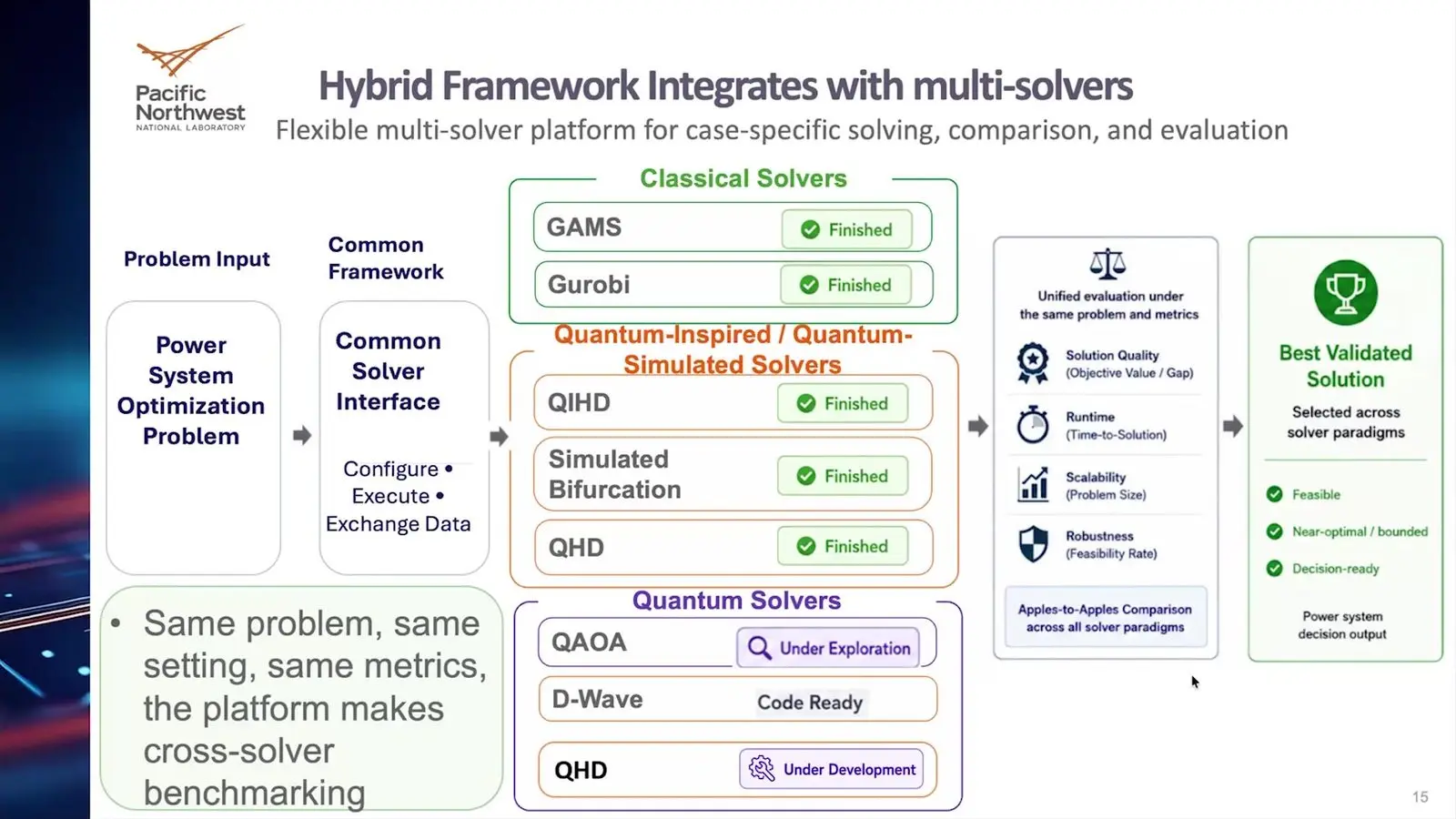
Their first job placed protection devices on feeders. These are the local lines of a grid, here with about 100 to 400 buses each, and the choice of where to put each device is a pure yes-or-no problem. Against the GAMS solver, the average time each customer spent without power fell by up to 12.4 percent. Outages fell by almost 20 percent.
The second job was islanding. A fault is cut off on purpose, so that each island of the grid balances its own supply and load. On the 118-bus test grid with five islands, the binary part of the problem ran about seven times faster than Gurobi, with the rest held classical. Chen said that speedup covered the binary step only, and that the lab has not shown classical solvers failing in general.
A cheaper split of one plant’s output
That afternoon, in Room 716A, Chen gave a paper written with Mingze Li of PNNL and Lei Fan of the University of Houston. A grid operator sends a power plant one total output. The plant must then split it among units that each have their own cost curve, and ripples in those curves trap local solvers in troughs that are not the cheapest answer.

The team folded the power balance into the cost as a penalty. They then let the descent spread over every unit’s full range. Against GAMS, a subgradient method and one more solver, descent gave the lowest workable cost for plants of three, four and five units, and for five units it cost $8,206.52 against $8,545.95 for GAMS. That is the 3.97 percent cut.
The method is not yet fast enough for a control room. Fan said the small cases take about two minutes, while a plant gets a new order about every five minutes and has roughly one minute to answer it. A finer grid of 96 points brought the four-unit cost down from $8,360.41 to $8,180.44. Every run so far used a classical simulator. The team is talking to one vendor about hardware.
Brookhaven calls its sampler a candidate generator
Meng Yue of Brookhaven National Laboratory gave the next paper. Yue spoke for lead author Zhongqi Zhao and co-authors Ding Lin, Tianqiao Zhao, Xiao Chen, Mert Korkali and Jianhui Wang. Their target was AC optimal power flow, which picks generator outputs and voltages at least cost while it obeys the physics of alternating current. Those equations make the search bumpy.
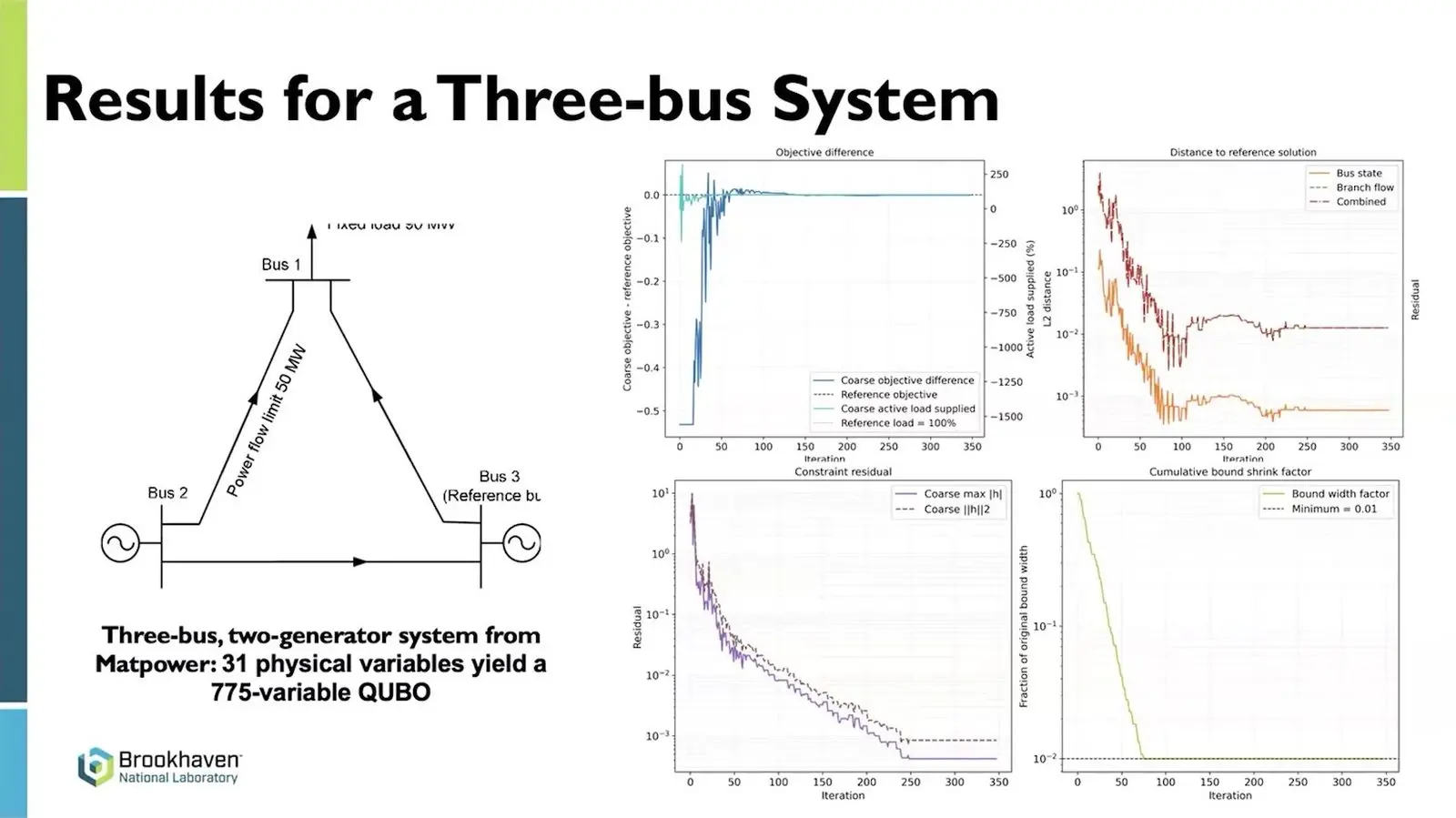
Most quantum-style solvers take only simple terms, so the team had to reshape the physics first. They cut each variable into 25 steps and handed the result to simulated bifurcation, a classical sampler that ran on two graphics cards. Good candidates were then checked against the full physics. On a three-bus test, 31 variables became 775 yes-or-no ones, and the cost came within about one part in 10,000 of a classical answer.
Yue made modest claims for the method. Yue called it a candidate generator, said it would not replace existing solvers, and said a 30-bus run took days on two older graphics cards. A questioner from TotalEnergies noted that the reshaped problem is easy for classical solvers. Yue replied that the gain comes from testing many candidates against the full physics.
Unit commitment and power flow on quantum machines
Two talks in the last session in Room 701B asked what a quantum machine itself could add to grid planning, beyond the ideas that classical programs had already borrowed from it. Los Alamos argued against a famous speedup, and Delaware squeezed a large schedule onto a handful of qubits. A Wednesday talk in the same room tested hybrid QAOA on generator scheduling. All three kept the quantum part small and left the final dispatch to classical code.
Los Alamos finds the linear-solver speedup fizzles
Harsha Nagarajan is a staff scientist at Los Alamos National Laboratory. Nagarajan presented work done mainly by a postdoc on their team, and asked whether HHL, a quantum algorithm for sets of linear equations, could speed up DC optimal power flow. That is the simple grid model that operators run in real time. On paper HHL grows only with the logarithm of the number of buses, but it also grows with a number that measures how hard the problem is.
That hardness measure grew faster than the grids did. On the public PGLib test grids, up to 78,000 buses, Nagarajan’s fit had it growing as the bus count to the power 1.81. Nagarajan stressed that this is an empirical fit, without proof. Once the cost of loading data and reading out every bus is added, Nagarajan said, the route offers no useful speedup on real networks.
For unit commitment Nagarajan split the problem so that a D-Wave Advantage annealer chose which units run and classical solvers set their output. Rounding the cut coefficients to integers shrank it from 60 to 83 qubits to just 16 to 21. On one area of the IEEE RTS-96 grid, with 24 buses over six hours, about 81 percent of about 100 samples came within 5 percent of the best answer from Gurobi, and about 24 percent landed on it.
Delaware packs 312 choices into 15 qubits
Kien Nguyen is a doctoral student at the University of Delaware, advised by Ilya Safro, and worked with Xiaoyuan Liu of Fujitsu on the same scheduling problem that Nagarajan had split in two. Three units over ten hours would normally need 30 qubits. That is one for each on-or-off choice. Pauli correlation encoding stores each choice as a pattern shared between qubits instead, so that example fits in five.
The rest of the loop is classical. Once the circuit sets which units run, an ordinary program sets how much power each one makes, in a two-stage loop much like the one Nagarajan used with their annealer. A large case of 26 units over 12 hours, with 312 yes-or-no choices, ran on 15 qubits. On smaller systems the worst gap was about 7 percent.
The large case did not fully work. One run met every rule and finished about 13 percent from the best answer, while the other runs still broke rules. All of it was noiseless simulation, and Nguyen called the project unfinished, with noise as the next test and no other encoding yet to compare it against.
Hybrid QAOA for generator scheduling ties with random guessing
A study in the QuACO workshop on Wednesday found that a hybrid QAOA method for scheduling generators did no better than random guessing. That held at every size tested. The job, known as AC optimal power flow unit commitment, decides which generators to switch on and how to set their voltages and outputs, so it mixes on-off choices with smooth ones. Sizes ran up to 13 generators, and the team said no quantum approach had been tried on the problem before.
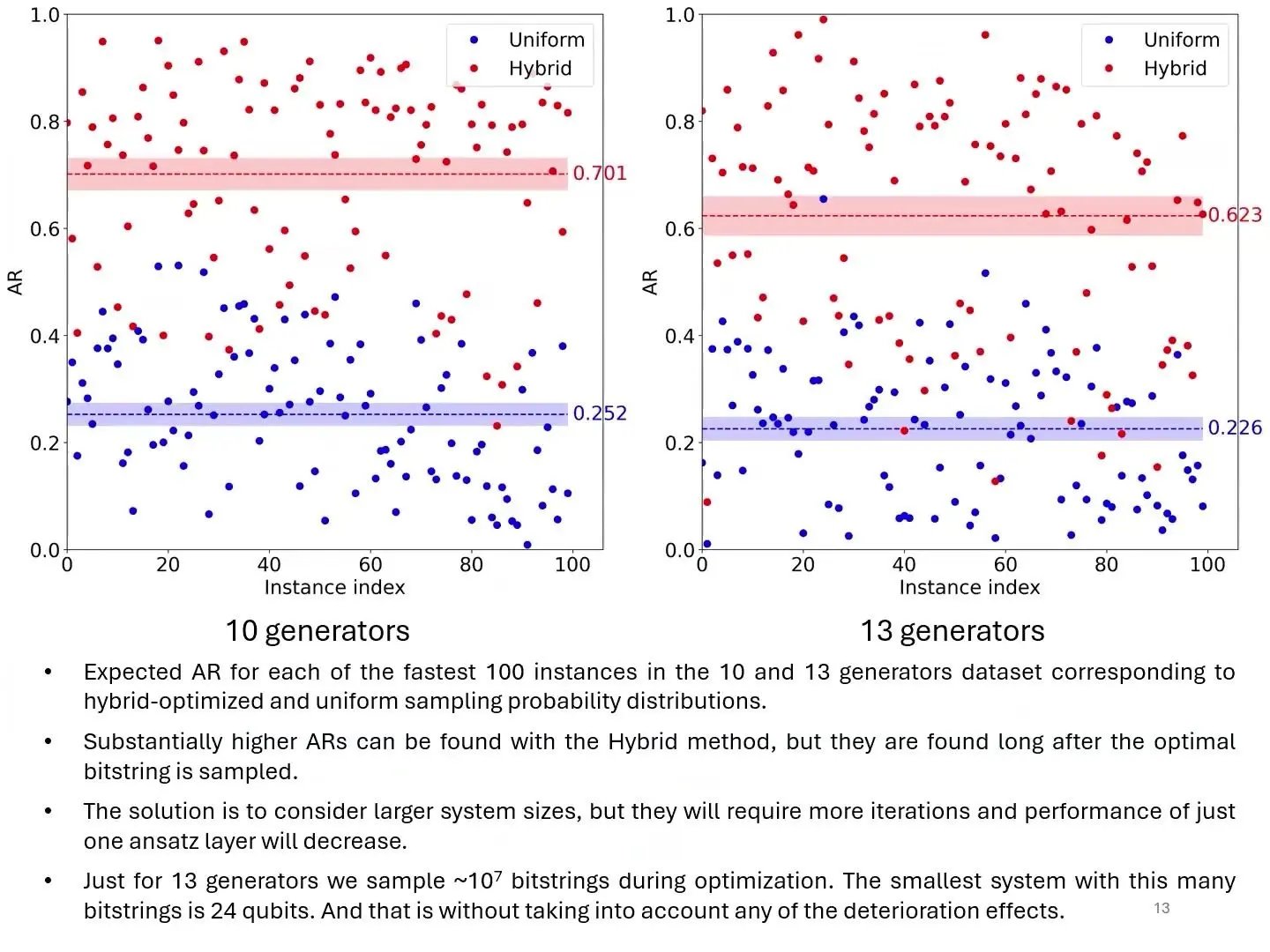
Only the on-off choices went on qubits, one per generator, and a classical optimiser set the continuous values for each sampled bit string. The trained circuits did give better spreads than chance. They averaged an approximation ratio of 0.701 against 0.252 at 10 generators. But at 13 generators training drew about 10 million bit strings, more than the whole search space, so random sampling found the best answer first. The team put the size where the method might compete above 30 qubits.
QAOA and annealers on grid security and safety
Three papers in Room 716A applied quantum search to the safety of the grid and the plants that feed it, from failed lines to nuclear fault trees to the placing of sensors. In each, a classical step checked, repaired or completed the quantum search. Every quantum run stayed small enough for an ordinary computer to check.
Penn State ranks the worst line outages
Joseph Lange is a graduate student in electrical engineering at Penn State. Lange wrote this paper with Yan Li of Penn State and with Haosen Guo, Xi Wang, Waqas Rehman, Andrey Bernstein and Xiaoyuan Fan of Eaton Research Labs. Utilities already check that the grid survives the loss of any one part. Lange argued that attacks and the load from data centres mean several losses at once now need checking, and those cases multiply fast.
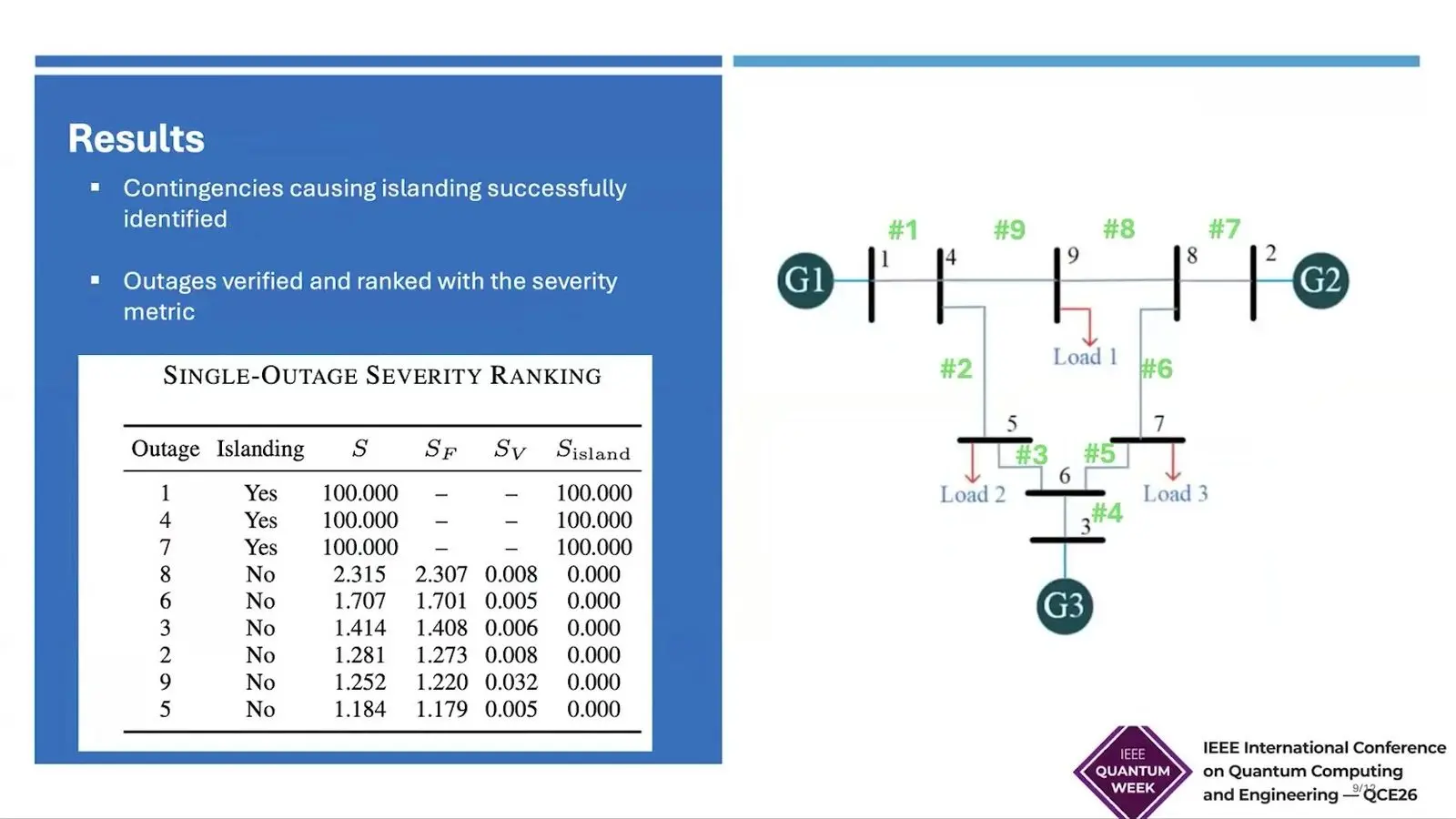
Lange used QAOA, the quantum approximate optimisation algorithm, with each line as one qubit set to 1 when the line is out. A severity score added overloads and voltage swings. Any outage that cut off part of the grid got a heavy penalty, and the test was the IEEE 9-bus grid, so nine qubits and one layer in an ideal simulation, with only single outages tested.
The result was clear on that small grid. Lines 1, 4 and 7 each cut off part of the grid, and between them they took roughly 90 percent of the shots. Lange said the rankings matched a classical check. The chair noted that a real grid has tens of thousands of single-outage cases, and Lange suggested splitting large problems into smaller ones.
EDF hunts the weak points of nuclear fault trees
Rola Saidi is a doctoral student at EDF R&D. Saidi presented work with Samuel Deleplanque, Stefan Creemers, Luis Fernando Perez Armas, Mohamed Hibti and Belhassen Zouari. A fault tree traces a system failure back through logic gates to the failures of single parts, and a minimal cut set is the smallest group of failed parts that brings the whole system down. Real trees run to tens of thousands of nodes.
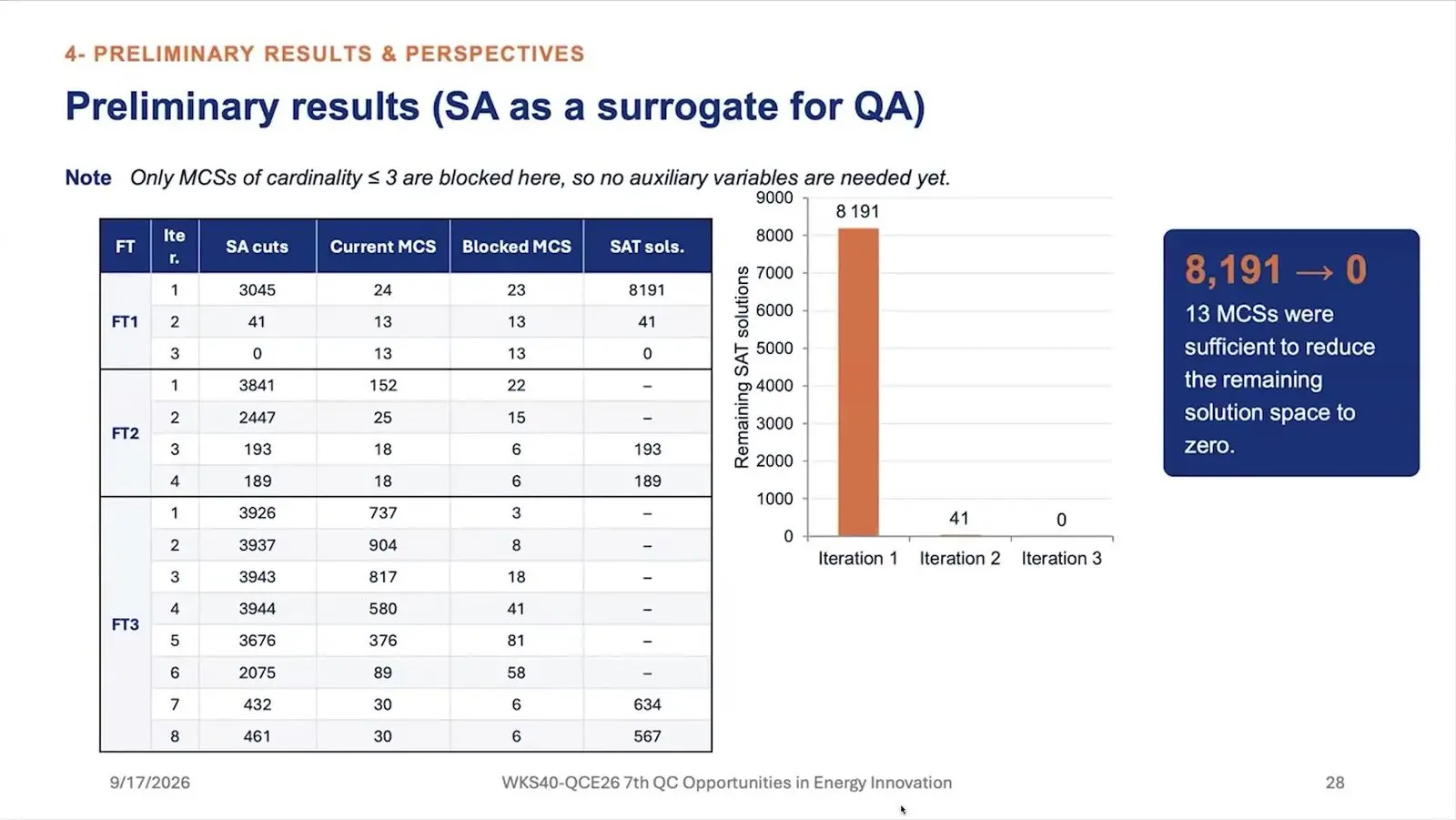
Saidi said no annealer approach to this problem had been published before. Their team turned trees of 4 to 1,773 nodes from real systems into yes-or-no problems three ways, and a new encoding that reuses helper variables needed the fewest qubits. One run could not find every cut set, because of a cap of 4,000 shots. So Saidi ran the search in cycles, blocking each set found until a classical solver confirmed nothing was left.
The cycling method worked in a test run. With simulated annealing standing in for the quantum machine, one tree went from 8,191 solutions to 41 and then to none, with only 13 cut sets blocked. So far only sets of three or fewer parts can be blocked, and Saidi listed fuller runs on D-Wave hardware and a comparison with classical tools as next steps.
A classical repair makes QAOA’s sensor plans usable
Yuqi Jiang of Penn State gave the last paper of the session. It was written with Zhiding Liang, Yan Li, Qiang Guan and G K Venayagamoorthy. Phasor measurement units are sensors that time-stamp voltage and current, so that operators can work out the state of nearby buses, and a good placement keeps the whole grid in view even after any single line trips. Each bus is one qubit, set to 1 if it gets a sensor.
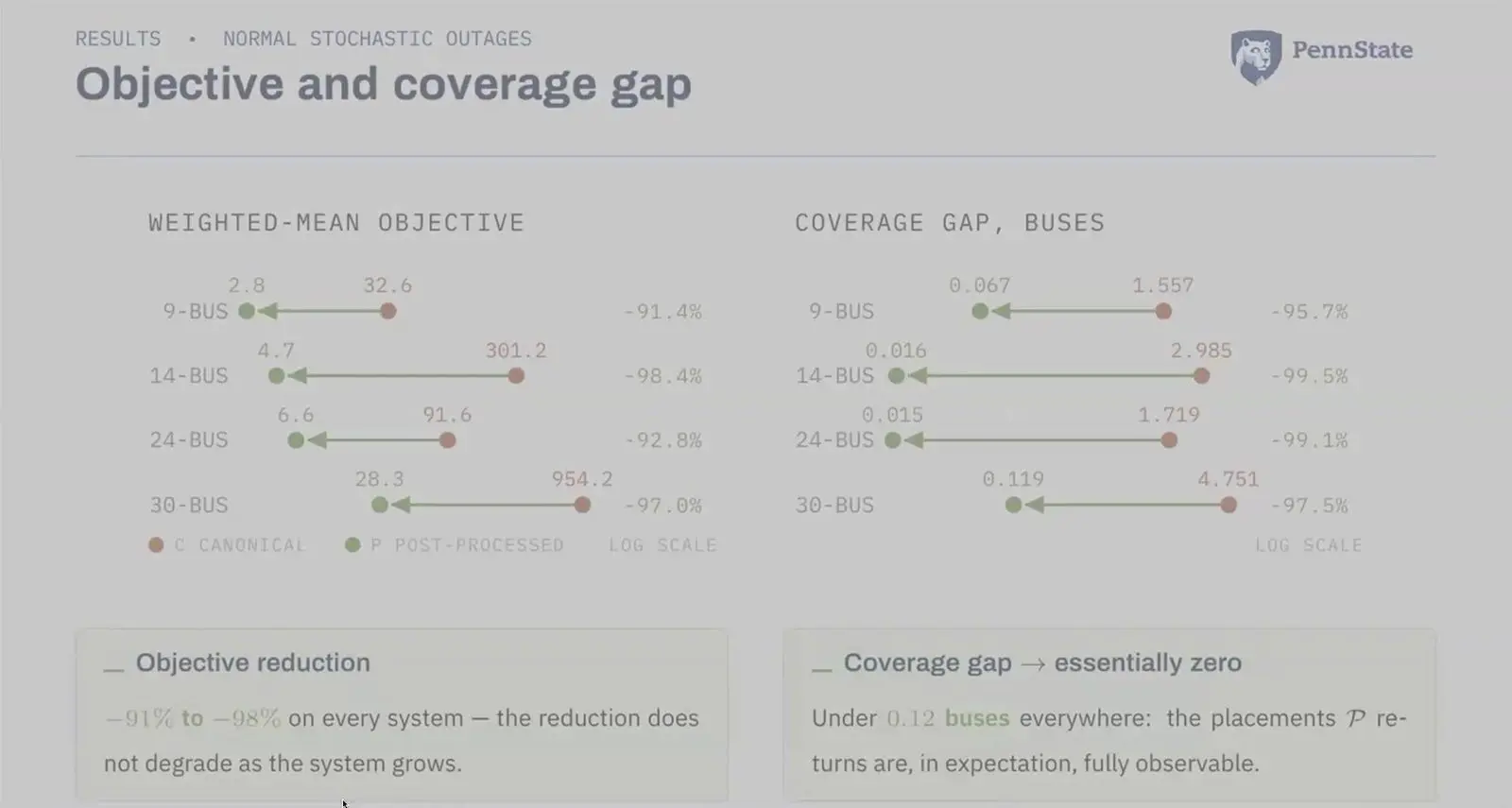
QAOA alone did badly. Many of its placements left parts of the grid blind, so a classical step flipped one bit at a time to repair them and fed the result into the next round. On IBM’s ibm_pittsburgh machine, with grids of 9, 14, 24 and 30 buses, repair cut the weighted objective by 91 to 98 percent. On the 14-bus grid the smallest working placement fell from five sensors to four.
Repaired runs also returned all 200 workable placements on every grid, which plain QAOA did not match even when it was given twice as many shots. Jiang said the group now handles grids above 100 buses, with the classical repair step still in the loop.
From the laboratory to the control room
Two sessions that afternoon turned from algorithms to money and timing. They explain why the grid day held so much simulation and so little hardware, and why the people closest to the wires ranked computing last.
The Department of Energy makes the case for timing
Rima Kasia Oueid is a senior commercialisation executive at the US Department of Energy, and Oueid set a hard test for any use case. It must beat the next best classical option. The gain can come in speed, accuracy, reach or power. Oueid called McKinsey’s market estimate of 2 trillion dollars a floor, since it left out energy and the grid, and priced a day without GPS at about 1 billion dollars on 2019 figures.

Timing was Oueid’s flagship case. GPS can be faked or jammed, Oueid said, and clocks that keep time without it would serve substations and the sensors that watch the grid. Oueid suggested sensors could also fingerprint devices, so that a hijacked thermostat or battery is flagged before trouble spreads. Oueid named Duke, ComEd and EPB in Chattanooga as utilities already working with quantum technology.
GridQ has a test bed and too little money to run it. GridQ, which Oueid called the first applied programme Oueid knew of at the department, joins Oak Ridge, Los Alamos, Argonne and the National Laboratory of the Rockies in a sandbox that firms can plug into. Its sensor demonstrations lost their funding, so a lab can host a firm but cannot pay it. Oueid said error-corrected hardware and artificial intelligence crowd out uses that would help now.
A utility puts computing a decade away
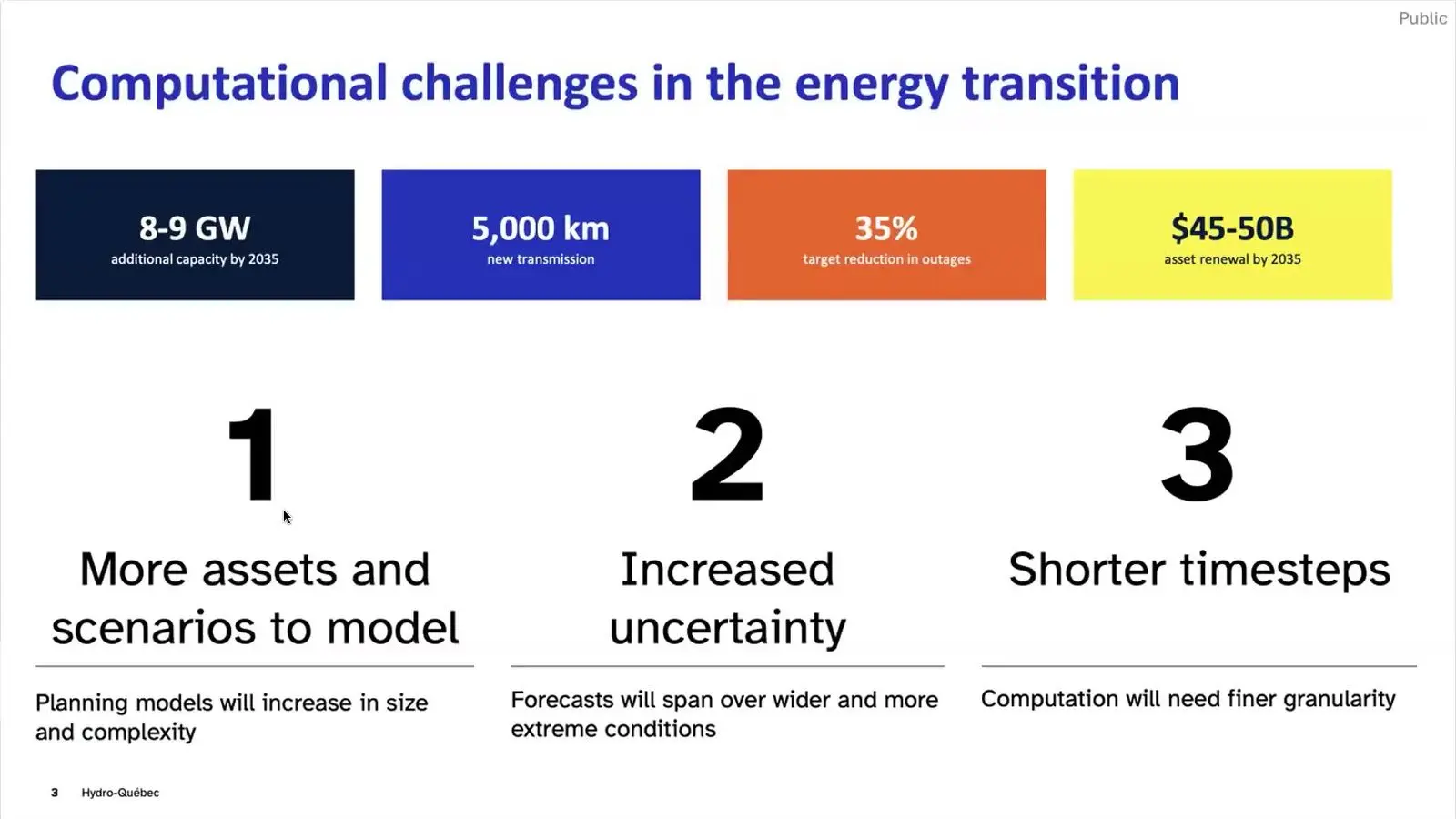
Wesley Jones of the National Laboratory of the Rockies chaired the closing panel. Amal Khabou of Hydro-Quebec spoke first. Khabou said four people cover quantum in a research centre of about 500, while their firm expects 8 to 9 more gigawatts of load by 2035 and checks each new method against an older one that its engineers already trust. The others on the panel were Rima Oueid, Phil Smith of Argonne, Matija Zesko of PsiQuantum and Travis Humble of Oak Ridge.
Zesko spoke for the hardware side. Zesko led a technology monitor in 2022 and 2023. Chemistry and differential equations stayed on their list because the gain is larger. Search and machine learning came off it, and Zesko asked of each job whether a quantum step is truly the slow part. Humble described an entanglement test on utility fibre in Chattanooga, where the fibre hangs from poles and the wind swings it, adding noise that a lab never sees.
Smith gave money and distance. Q-NEXT, the centre Smith works with, began in late 2020 on 115 million dollars and now runs a 300 kilometre link to Fermilab. Asked when any of this reaches daily utility work, Khabou put security first, sensing next and computing on a live grid a decade away. Oueid added, speaking personally, that devices for secure links can already be bought.
Power portfolios, energy communities and base stations
Three Tuesday papers took quantum methods off the main grid. They went to a book of power deals, a local energy community in Italy and the batteries behind solar-powered 5G masts, and more of this work touched hardware. A classical solver still set the bar.
TISI fits 10,296 power choices onto 14 qubits
Takuya Yoshioka of TISI Inc., in the TIS INTEC Group, fitted an electric-power portfolio of 10,296 on-off choices onto 14 qubits, and runs on a device landed on the simulated error curve. The paper is by Yoshioka, Keita Sasada, Riku Usuki and Keisuke Fujii. Each resource in the book is on or off. The cost punishes a miss against the target power and adds a risk term, so a plain encoding would spend one qubit on each resource.
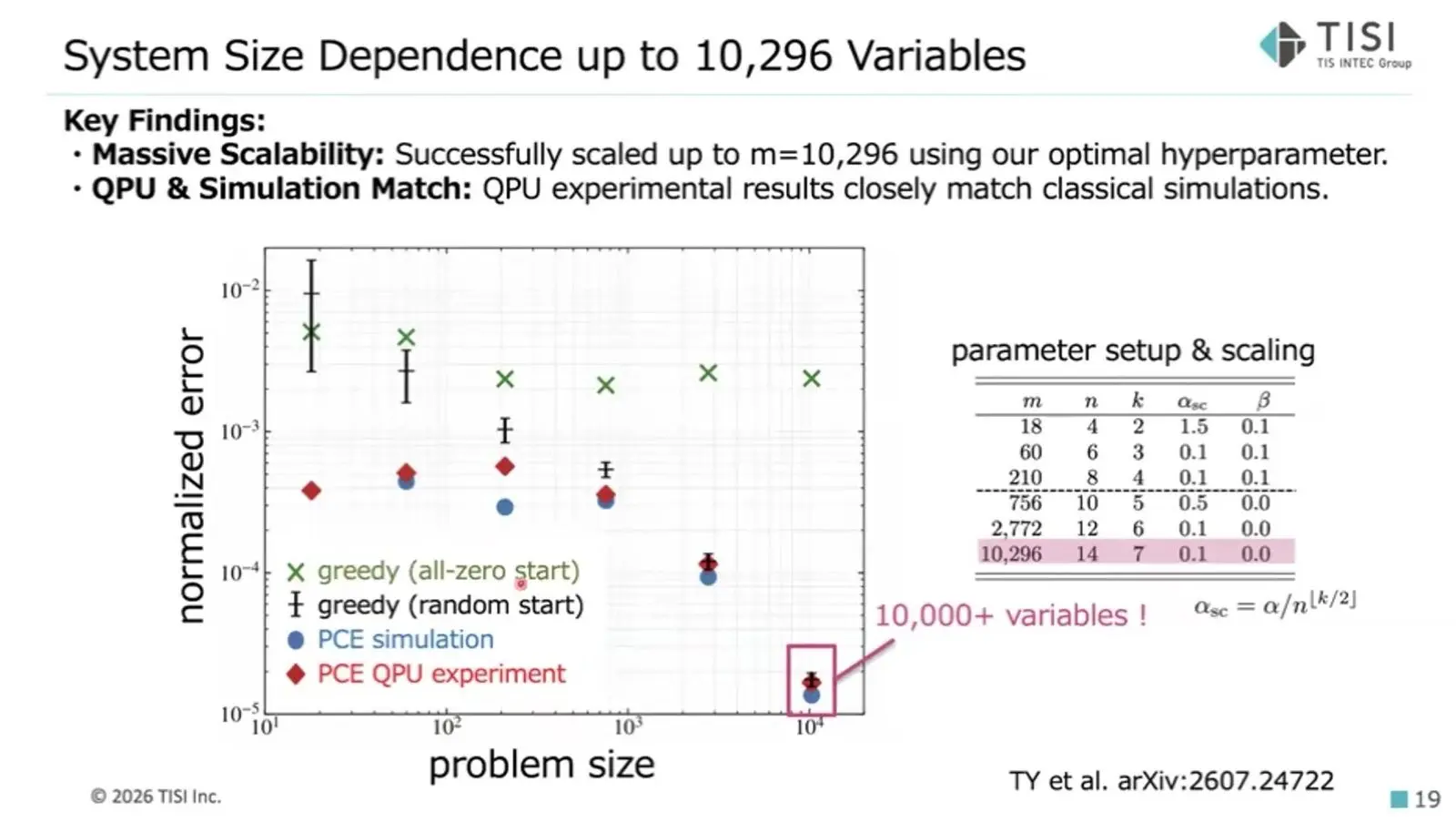
Pauli correlation encoding stores each choice as a pattern shared among a few qubits. Kien Nguyen of Delaware applied the same idea to unit commitment on Thursday. Yoshioka’s scaling ran from 18 variables on 4 qubits to 10,296 on 14, and both simulated and device points fell below the greedy baselines, which means lower error. On a 24-hour book of 756 resources the schedule landed close to Gurobi. It was trained on a simulator first.
CRS4 builds energy communities from 12-qubit blocks
Giuliana Siddi Moreau of CRS4 chose the members of a renewable energy community in blocks of about 12 qubits. With a balanced split, that reached the best mixed-integer answer at 60 members in simulation. One QAOA run over the whole problem grew worse with size. Six co-authors joined the work. In Italy such members keep their own meters on the public grid, and the state pays for power made and used in the same interval.
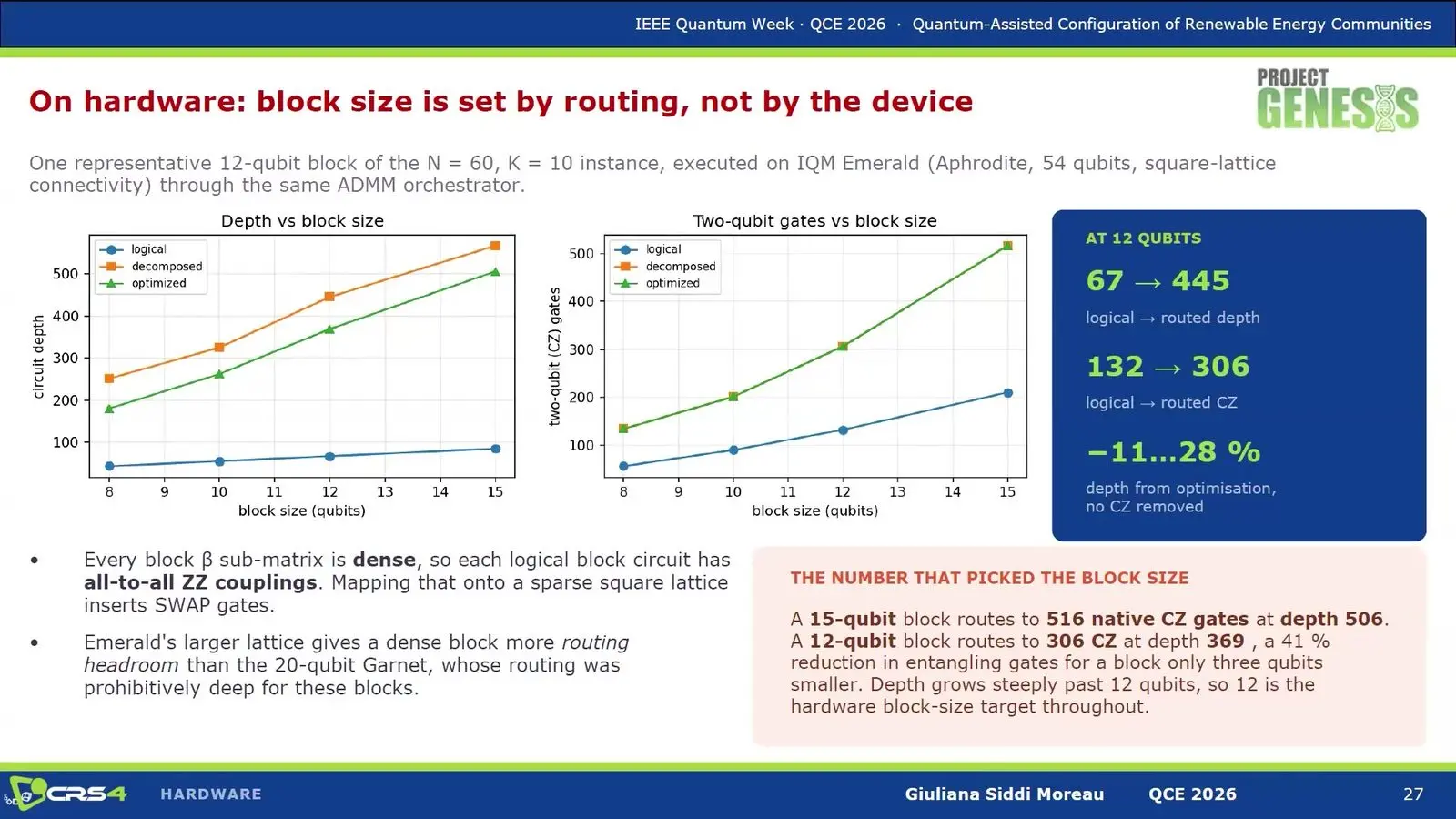
On an uneven split, the quantum version came about 12 percent short of the optimum and the classical split about 5 percent short. Routing set the cap on block size. On IQM Emerald, a 54-qubit square lattice, one 12-qubit block grew from depth 67 to 445 with 306 two-qubit gates, and a 15-qubit block needed 516. Every block ran on a simulator except one, trained on Emerald at one QAOA layer and 8,000 shots.
KDDI makes every base-station schedule feasible with no tuning
Chihiro Dogo of KDDI Research rewrote a day-ahead energy plan for 5G base stations that run on solar power, so that every answer works on every solver tested. No one has to tune penalty weights. Kazuhiro Saito of KDDI Research and two Waseda University authors, Masashi Tawada and Nozomu Togawa, wrote it with Dogo. A plan has 48 half-hour slots with three yes-or-no choices each. The usual form adds penalty terms to keep the battery’s charge in range. The weights take a long time to tune.
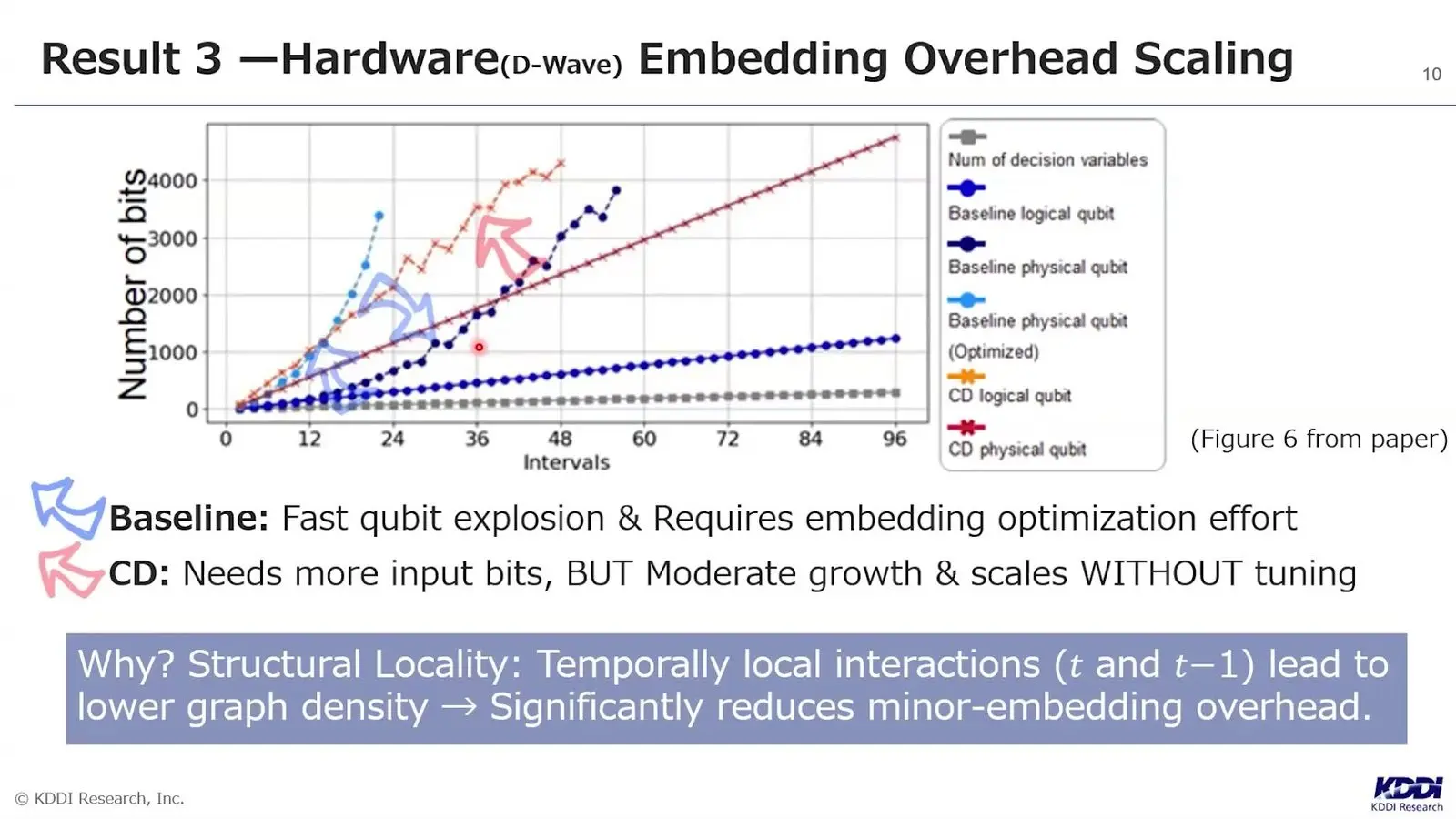
The fix encodes the battery’s charge level directly, with three bits per slot for eight levels, so every answer stays in range by design. On real solar data from Tochigi and Japanese market prices, the untuned penalty model was feasible only 3.7 percent of the time on a GPU solver, and tuning took up to 300 hours. The new form was 100 percent feasible on D-Wave Advantage, simulated annealing, the GPU solver and the exact solver SCIP. It also fit on the D-Wave chip where the penalty model failed past 56 slots.
What it means for utilities using quantum computing for power grids
Invest in the judge first. The quantum-inspired solvers shown in Toronto run on ordinary processors and graphics cards. A utility curious about quantum computing for power grids can ask labs and vendors to test them against GAMS and Gurobi on its own cases, with no quantum hardware at all. KDDI’s base-station work shows the cheapest gain may come from rewriting the problem, since its new form was feasible on every solver it tried. It should ask for the test cases to be published too, since Chen said the lab’s cases are not public yet.
Quantum hardware is a longer bet for a utility. Grid runs on hardware stayed at 30 buses or fewer and gave no sign of beating a classical solver on a grid of real size. A Wednesday study found hybrid QAOA for generator scheduling no better than random sampling up to 13 generators. Nagarajan’s study suggests the textbook speedup for DC power flow may never come on real networks, so a buyer should ask which small piece of a job the quantum step will take, and what checks its answer. For the money behind the hardware, see our report on the Department of Energy’s $215 million competition.
Khabou’s order of priorities fits what Toronto showed about quantum computing for power grids. Secure links and sensing come first. Computing on a live grid waits a decade if Khabou is right, and in the meantime Hydro-Quebec will keep checking each new method against one its engineers already trust. Until then a classical solver rules on every quantum answer.
Frequently asked questions
What is quantum computing for power grids?
Quantum computing for power grids means using quantum algorithms, or classical programs inspired by them, on the scheduling and power-flow problems that grid operators solve every day. These include unit commitment, economic dispatch, optimal power flow and checks on what happens when lines fail. Many of the choices are yes or no, so the number of possible plans grows very fast with grid size.
Can quantum computers solve optimal power flow faster?
Not on present evidence. At QCE26 Harsha Nagarajan of Los Alamos reported that, for DC optimal power flow on public test grids of up to 78,000 buses, the matrices a quantum linear solver must handle get harder faster than the grids grow. That growth, plus the cost of loading and reading data, wipes out the promised speedup on their empirical fit.
What is quantum Hamiltonian descent?
Quantum Hamiltonian descent is a 2023 optimisation algorithm that treats the search as a quantum wave spreading over the whole range of answers and settling into the lowest valley. At QCE26 Pacific Northwest National Laboratory reported using it to cut a plant’s dispatch cost by 3.97 percent against the GAMS solver. All of those runs used a classical simulator.
Is any utility using quantum technology today?
A Department of Energy speaker at QCE26 named Duke, ComEd and EPB in Chattanooga as utilities working with quantum technology. Amal Khabou of Hydro-Quebec put security first, sensing next and computing on a live grid a decade away. Secure-link devices can already be bought, according to one panellist speaking personally.
Did any grid work at QCE26 use real quantum hardware?
Yes, at small sizes. Penn State placed grid sensors with QAOA on an IBM machine for grids of up to 30 buses, and Los Alamos reported a 24-bus unit commitment case run on a D-Wave annealer. In both cases a classical step checked or completed the answer.
What happened at IEEE Quantum Week 2026?
IEEE Quantum Week 2026, also called QCE26, ran from 13 to 18 September at the Metro Toronto Convention Centre. Most of its energy work came together on Thursday 17 September in two workshops, with more talks on Tuesday and Wednesday. This guide covers 14 of those talks, papers and panels.
This guide is based on 14 talks, papers, briefings and a panel from three workshops and two paper sessions at IEEE Quantum Week 2026 (QCE26), held at the Metro Toronto Convention Centre from 13 to 18 September 2026, and on the published conference programme. Names, affiliations and titles are as speakers gave them. Results are stated as each speaker presented them, and most come from classical simulation or small test grids. Company and agency claims are their own.
- Qubit hardware and scaling roadmaps
- Photonics and quantum sensing
- Control electronics, calibration and readout
- Quantum error correction and decoders
- Fault-tolerant compilation and magic states
- Modular and distributed quantum computing
- Quantum computers in supercomputing centres
- Compilers, circuit synthesis and languages
- AI and language models for quantum software
- Testing and reproducible quantum experiments
- Benchmarks, error mitigation and quantum advantage
- Quantum state preparation, oracles and arithmetic
- Quantum optimisation, QAOA and annealing
- Quantum machine learning
- Chemistry, materials and life sciences
- Differential equations and fluid dynamics
- Quantum finance
- Logistics, climate, databases and games
- Quantum networks and key distribution
- Quantum security and post-quantum cryptography
- Quantum education and workforce
- Policy, standards and the quantum business


See today’s quantum computing news on Quantum Zeitgeist for the latest breakthroughs in qubits, hardware, algorithms, and industry deals.