This guide follows 69 quantum machine learning talks at IEEE Quantum Week 2026 in Toronto. The ones that mattered most were about keeping score fairly.
On the first morning of IEEE Quantum Week 2026, in Room 803A, a master’s student from Yonsei University watched a perfect record in quantum machine learning turn into a losing one. Hyong Keun Park had built quantum features to spot faults in a simulated chemical plant. Under loose rules, which keep the best test result and let each method tune for as long as it likes, Park’s quantum versions beat a classical detector on all ten random trials. Then Park gave every method the same tuning budget and kept the fault labels out of the choice of model. Every quantum version fell behind.
Quantum machine learning asks whether a quantum computer can find patterns in data better than an ordinary one. The usual recipe turns each data point into a quantum state, lets a circuit act on it and then measures the result. A few dozen qubits span a space with billions of dimensions. The hope is that patterns tangled up in ordinary data come apart in that space. Early hopes rested on theory that promised huge speed-ups, and much of that faded when classical researchers found shortcuts of their own and others showed that loading big data into qubits can cost as much as the sum saves.
Read together, the 69 talks followed here suggest that the most useful thing the field made this year was a stricter scorekeeper, a way of judging quantum models that holds up. A win reported without one should be read as unproven. The claim is harsher than it sounds, because many of the week’s talks reported wins and some came from real chips with dozens of qubits.
The best case against it came from the strongest results. On Sunday afternoon Luke James Miller of the University of Missouri-Kansas City used 66 qubits of an IBM chip to tell apart pairs of graphs that a standard classical test cannot separate. On Thursday Oliver Knitter of IonQ took a best-paper award in the applications track for a language model with a small quantum head. In simulation, Takao Tomono of JAXA scored perfectly on ten kinds of quiet machine fault heard through one microphone. A reader looking for signs that the field is growing up will find them here.
Each of those speakers drew their own limits, though. Miller made no claim to beat the classical graph tools, and the signal faded once the circuits grew deep, while Knitter found that a noiseless simulation did better than the device itself. Tomono had six samples per class and one classical rival. Tomono said a different classical kernel might match the result. Kauã Barbosa found a quantum kernel level with a classical one on factory faults, and Rinka Miura said in the talk itself that a deeper and costlier circuit may be part of the win.
That habit of self-audit ran through the week’s quantum machine learning talks. Lakshikka Sithamparanathan of Cleveland State showed that one scaling knob decides whether a quantum kernel works at all, and claimed no advantage at all. James Pegg, Hubert Okadome Valencia and Ronin Wu gave a molecule-shaped circuit a classical twin with the same 64 settings, and the twin scored higher on one of two properties. Wolfgang Mauerer, Jonas Stein and Kristina Kirova each read circuits as sums of waves. That turns a black box into something a designer can reason about. Jadwiga Wilkens of Linz showed that noise on a real ion trap can look just like the entanglement some methods use as a training signal.
Yet the scorekeeper matters for money as much as for method. When a Sunday workshop polled 24 people on where quantum machine learning should aim, chemistry and materials came top and manufacturing got no votes, though several of the week’s talks were about factory faults. Soheil Mansouri of SiC Systems argued the reverse, that making drugs is a bigger prize than finding them. A Cascade Quantum research scientist called the bet on better scaling a poor one for a startup. It needs hardware that a startup cannot yet sell. Knitter’s own energy study found the quantum device used more energy than a graphics card that simulated it, at every width tested. A fair contest has to count the power and the hours as well as the accuracy.
What it is. Quantum machine learning feeds data into quantum circuits and trains them to classify, forecast or generate. Almost all of it still runs on classical simulators or on fewer than 20 qubits.
What changed at QCE26. The sharpest talks tested how to judge a quantum model. Under a strict protocol, a 10-of-10 winning record turned into a losing one.
The best hardware results. Miller told hard graph pairs apart on 66 IBM qubits. IonQ’s device runs cut a language model’s error by 15.7 percent against classical baselines.
The warning. Most gains were small, came from simulators and faced one or two classical rivals. Several speakers said a better classical method might match them.
Quantum kernels and the case for a fair contest
A quantum kernel uses the chip only to measure how alike two data points are, and then hands those scores to a classical method such as a support vector machine. It is the easiest kind of quantum model to test fairly. Nine talks and a panel used one.
Yonsei shows how a scoring rule creates a win
Hyong Keun Park of Yonsei University worked with Joonkyo Shim and Hyunsoo Yoon on the Tennessee Eastman process, a standard simulated chemical plant with 52 sensor readings and 24 kinds of fault. The six-qubit kernel came in three versions. One was wired like the plant, one at random and one with no entanglement. Four classical methods sat beside them, each tested on 10 random splits of the data.

Under loose rules, every quantum version beat the plain classical detector on all ten splits, by 0.002 on a score where 1 is perfect. Under strict rules all seven gaps turned negative. A classical control made the same flip, so the flip came from the rules. The one gain Park would defend came before any kernel, since keeping at least one input from each part of the plant lifted the score from 0.779 to 0.799.
Rio Grande finds a kernel level with classical
Kauã Barbosa, a student at the Federal University of Rio Grande in Brazil, tried a quantum kernel on a water-loop test rig with eight sensors and ten kinds of fault. Each model learned from normal data alone. A plant in use rarely logs its own breakdowns.
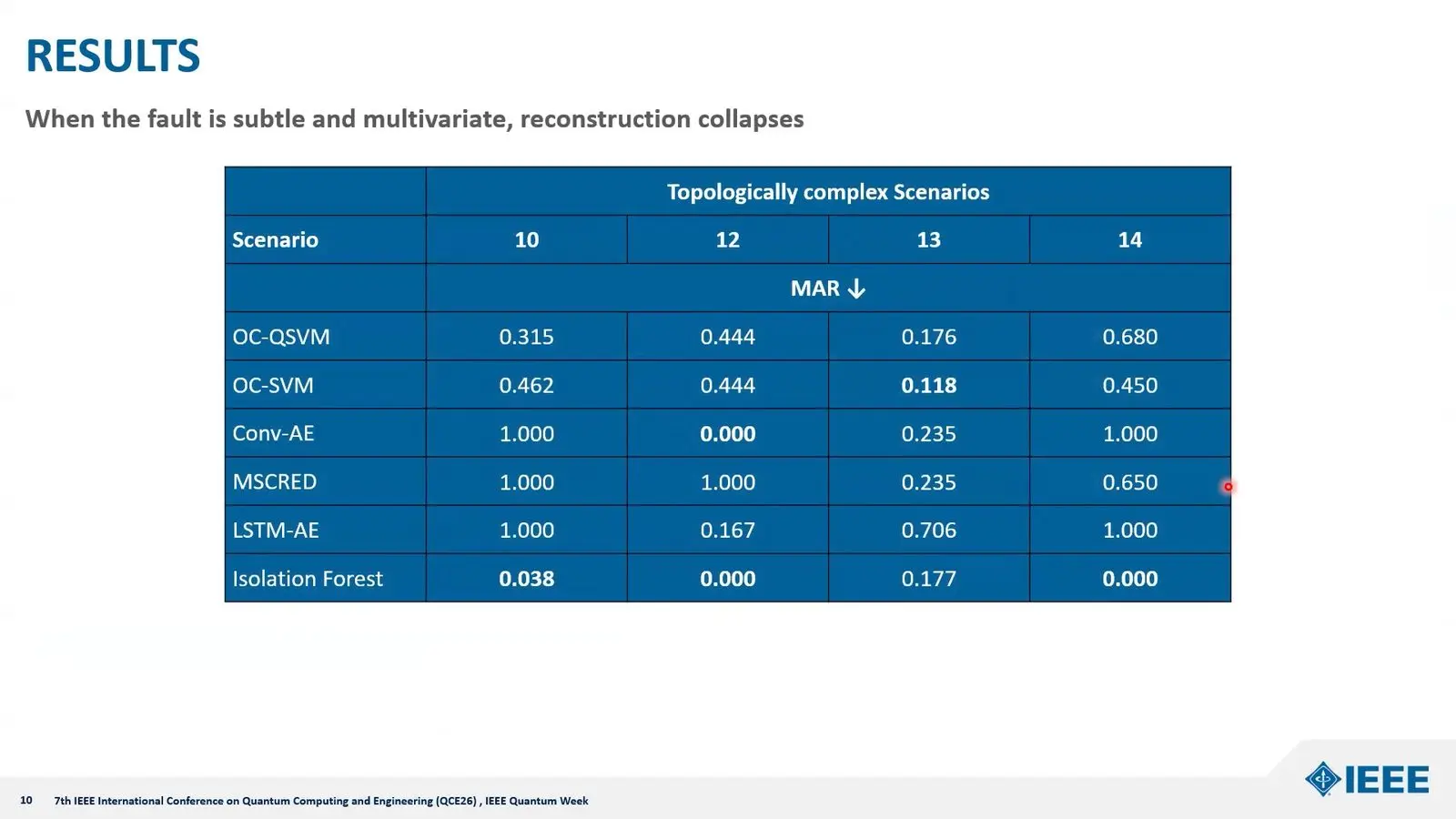
On average Barbosa claimed no win. The quantum kernel scored 0.629 on a standard F1 measure, against 0.670 for the classical kernel and 0.744 for a classical autoencoder. It did better on one slow drift that three other models missed, though a simple classical method caught that drift better still.
JAXA hears ten fault types through one microphone
Takao Tomono of JAXA, Japan’s space agency, worked with Kazuya Tsujimura of TOPPAN Holdings on a way to hear faults without touching the machine at all. Plants often bolt five or more sensors onto each machine. Tomono wants one microphone, listening for one bad machine among four good ones that all run at once.

Each sound clip became six numbers, so six qubits. A quantum kernel called QK25 fed a classifier that drew a boundary around normal sound, and in a classical simulator it scored a perfect 1.0 on all ten kinds of fault. A classical kernel fell to about 0.2 on some. Tomono listed the limits, with six samples per class, no repeat trials and one classical rival.
Cleveland State ties two camps of kernel papers together
Lakshikka Sithamparanathan, a doctoral student at Cleveland State University, set out to join two sets of papers that seem to clash. One set says quantum kernels fail on classical data as more qubits are added, while the other says that shrinking the input by a small number, the bandwidth, before it goes in brings the accuracy back. The question was whether both are one effect.
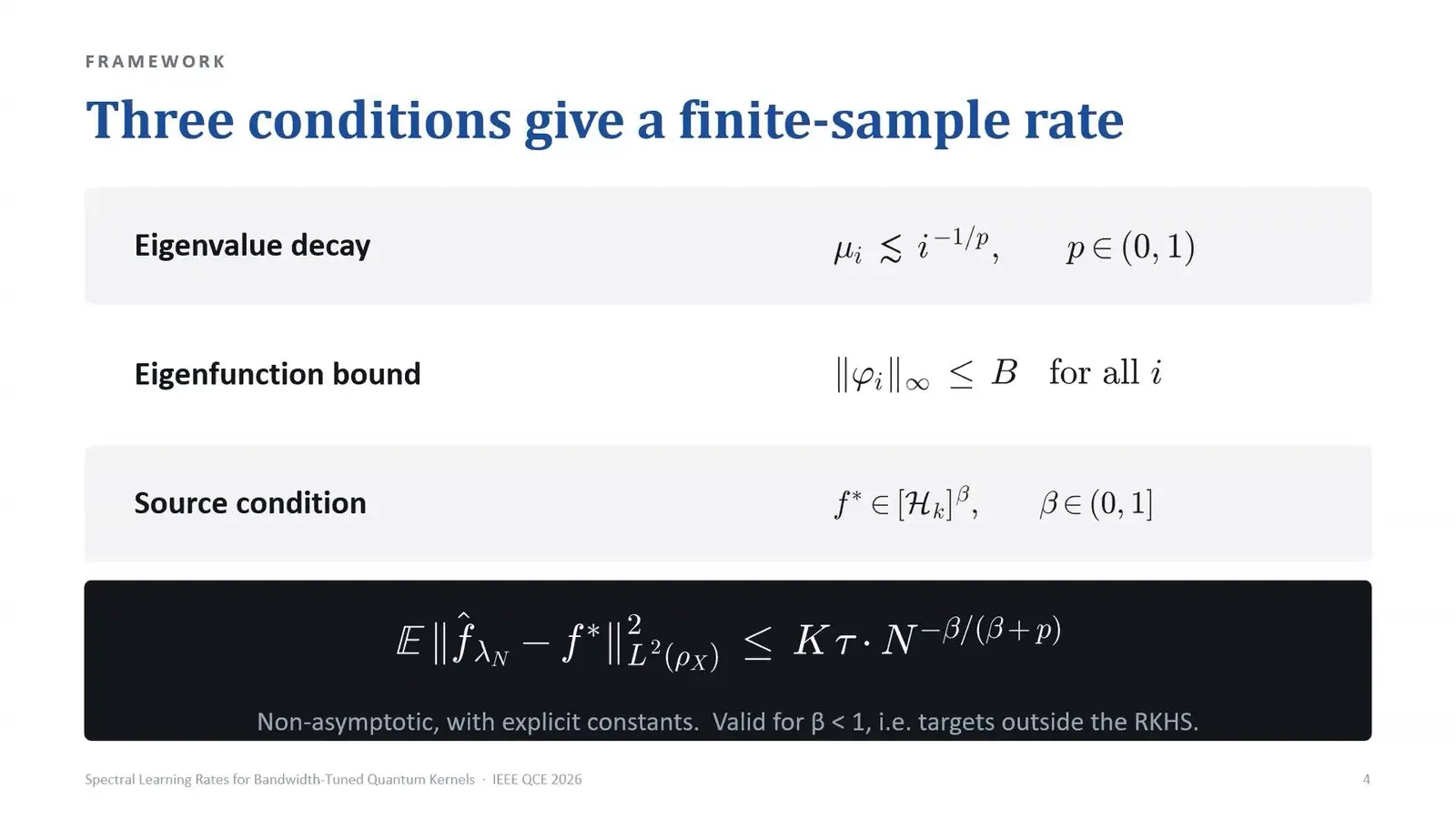
The answer carried a known classical result on learning rates over to quantum kernels, under three conditions written out in full. On one circuit, accuracy sat near 53 percent with the bandwidth left at 1 and rose above 90 percent once it was tuned. No advantage was claimed. Every kernel tested can run on an ordinary computer. Their penalty weight was picked on the test set, and the jump above 90 percent had not passed the screen their own diagnostic sets out.
Sherbrooke builds a kernel for analogue atom machines
Stefanos Kourtis of the Université de Sherbrooke filled a gap in a finance workshop after being asked over dinner the night before. RydKernel drives a row of neutral atoms with one global drive and no gates, and it aims at a known flaw of quantum kernels, where every score of likeness shrinks towards zero as qubits are added. Kourtis said that flaw had stalled quantum kernels.

Kourtis said the shrinking is proven absent in one limit and stays absent in simulations beyond it. On the Iris flower data set of 150 points, RydKernel came close to the classical kernels as the chain of atoms grew, and modelled noise made results worse without bringing the shrinking back. A run on real atoms is under way.
Kobe predicts molecule energies with a costlier kernel
Rinka Miura of Kobe City College of Technology worked with Masakazu Ishihata of NTT. Miura built a kernel from rough quantum states of two small molecules and used it to guess their energy at new shapes, which is how chemists find where a bond is stable. With enough data it hit chemical accuracy.
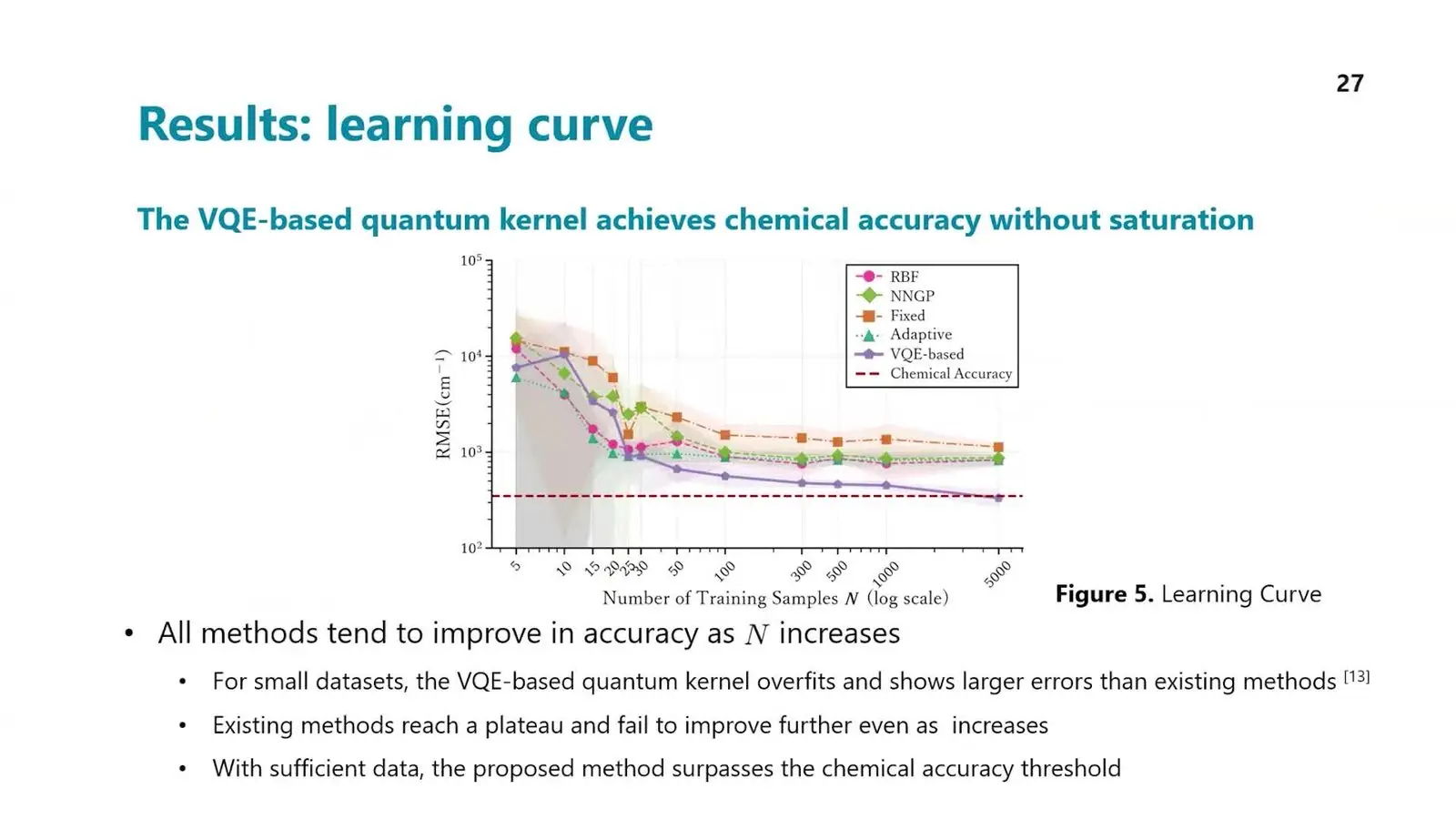
Miura conceded that the race was not quite fair. The circuit is deeper and costs more than the rival kernels, small training sets made it overfit and noise in one step wiped out the gain. A test with the same budget for every method is still to come.
Thales spots radio jamming with random quantum features
Alexis Vieloszynski of Thales cortAIx Labs in Montréal worked with Polytechnique Montréal on radio jamming, where a cheap transmitter can swamp a shared band. Each slice of signal became a picture. Jamming then shows up as an odd picture, and the quantum step was a random circuit that is never trained, run many times over to build a long list of features.
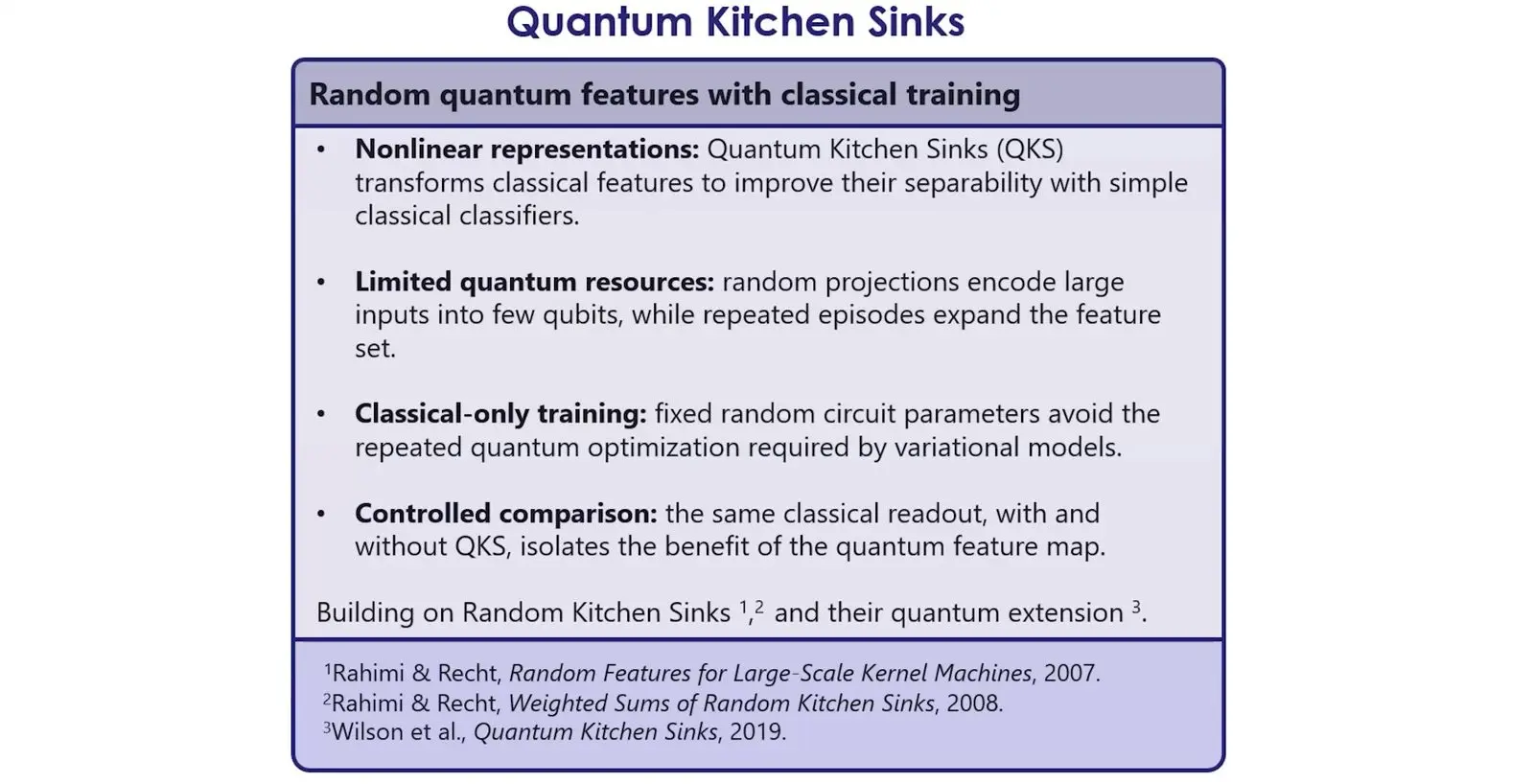
With a simple straight-line classifier on top, the quantum features did clearly better than the raw picture, but with a classifier that can already bend its boundary the gap shrank. A small run on an IBM machine came close. It landed within about a hundredth of the simulator.
Imperial and JIJ pick radar features with two-qubit kernels
A speaker from Imperial College London and JIJ presented work by Daniel Fadi Feghali and six co-authors on choosing which inputs a classifier should keep. Each feature, and each pair of features, got a small quantum kernel of at most two qubits that scored how much it told about the label. Picking the best subset is a yes-or-no search. So the team wrote it as a QUBO and solved it by simulated annealing.
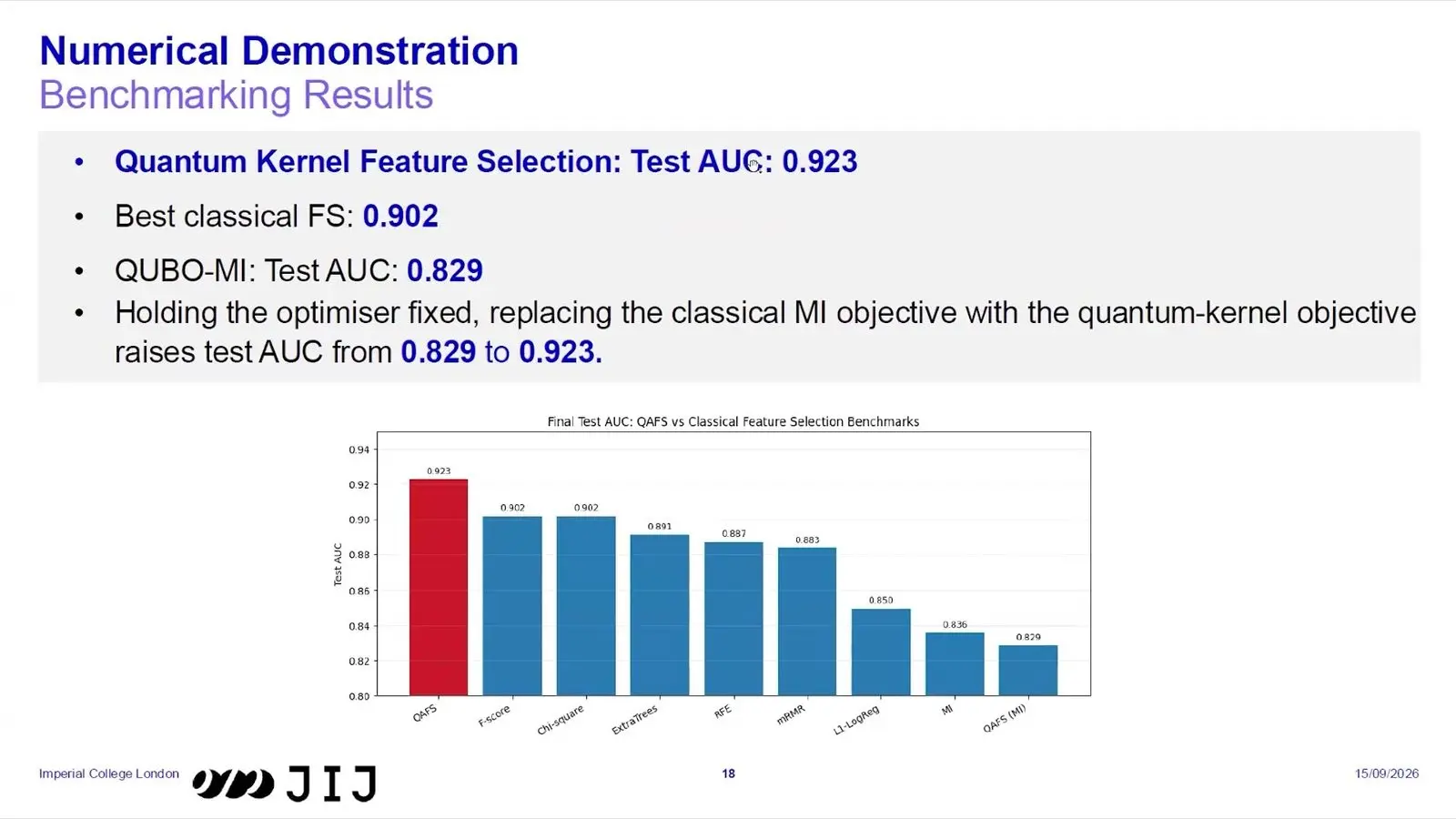
On the ionosphere radar set of 351 samples and 34 features, the method kept 15 and reached a test AUC of 0.923. The best classical picks tied at 0.902. The study used one data set, one family of feature maps and a noiseless simulator, and the team has left shot noise and real hardware for later work.
Taiwan’s tensor networks make quantum kernels cheap to simulate
Tai-Yue Li of Taiwan’s National Center for High-performance Computing taught a tutorial on how to run quantum kernels at scale. A kernel compares every pair of data points, so the work grows with the square of the data, and in a plain simulation it also doubles with each qubit you add. Li put 46 qubits at more than 512 terabytes.

Version 2 of cuTN-QSVM turns CUDA-Q kernels into tensor networks, which suit wide and shallow circuits, and it runs on one graphics card. Batching every pair of points into one sum cut the run time on one H200 by 526 times, so at 1,800 points the job took about 12 seconds. Asked whether that suits every data set, Li said it does. Each batched circuit compares just one pair of points.
The room votes on where the field should aim
Then an organiser polled the room. Kernel methods came first among 24 voters, then models that make new data, then tunable circuits, which sat higher than the organiser had thought they would. For uses, chemistry and materials took 11 votes, life sciences 4 and finance 3, and nobody voted for factories or for energy and climate.
A research scientist from Cascade Quantum, who came from classical machine learning, said papers that claim a gain from tunable circuits should be doubted. Another backed quantum linear algebra. That panellist warned that the cost of loading data in and reading answers out can wipe out a speed-up that has been proven on paper.
Quantum neural networks on real chips
A quantum neural network is a circuit with rotation angles that a classical optimiser tunes, much as the weights of an ordinary network are trained. Eleven talks took such models onto hardware or onto real data. Each one set out how far the result went.
Missouri separates graphs a classical test cannot
Luke James Miller of the University of Missouri-Kansas City, with Yugyung Lee, asked how much a shallow circuit that is never trained can say about a graph. The method is called QuIC. It turns each graph into a sorted list of output odds that does not depend on how the nodes are numbered, so two copies of one graph always look the same. With exact numbers, a simple model read off the triangle count almost perfectly.
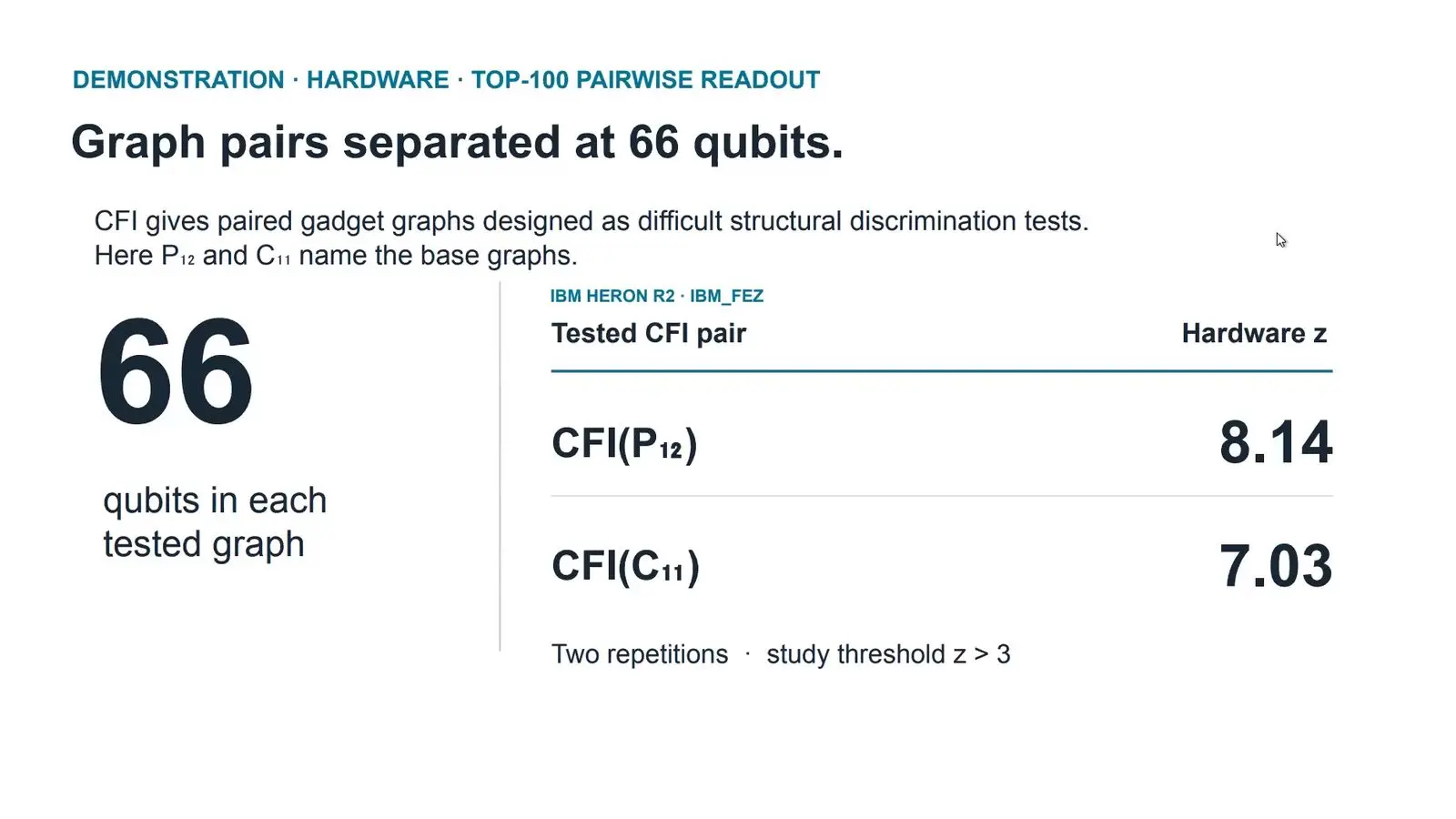
The hard test was pairs of graphs that a standard classical check cannot tell apart, and on IBM’s ibm_fez chip two such pairs at 66 qubits came apart clearly. Depth set the limit. The signal faded once circuits passed about 210 layers of two-qubit gates, and Miller made no claim to beat the classical graph tools nauty and Traces.
IonQ trains a network on the chip and fills hospital records
Martin Roetteler of IonQ presented work with Iordanis Kerenidis and three other co-authors. Training a model on a chip is slow, because the usual way to find each slope runs the circuit twice for every setting in it. Their design, Roetteler said, cuts the runs for each step from a number that grows with the square of the qubits to one that grows far more slowly.
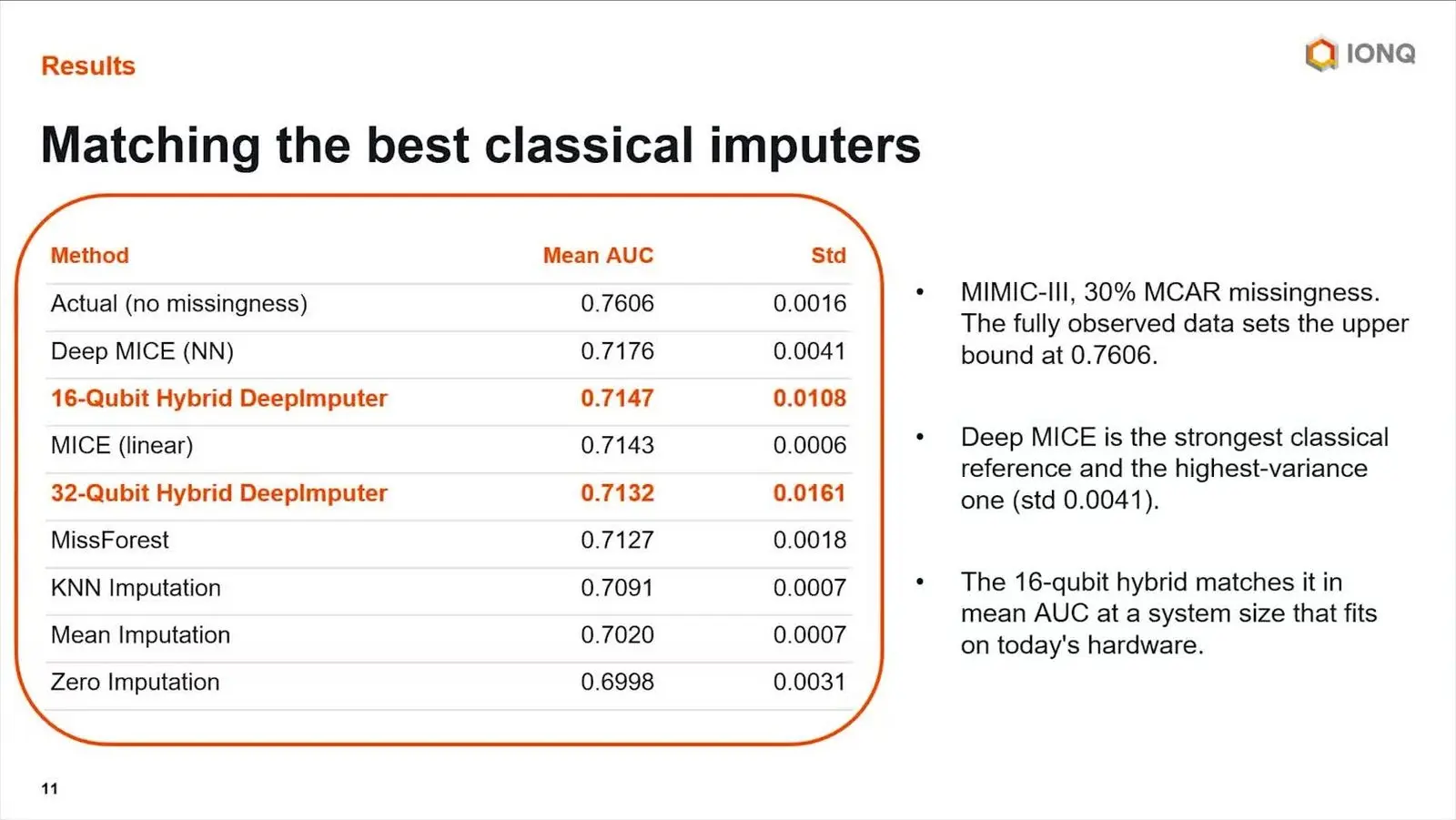
The test filled gaps in hospital intensive-care records with 30 percent of the values hidden, and a 16-qubit model scored 0.7147 against 0.7176 for Deep MICE, a classical method, which the team called a match. On the chip itself the gain was small. On IonQ’s Forte Enterprise machine the team trained only the last layer and gained 1 percent.
IonQ’s language model wins a best-paper award, and loses on energy
Oliver Knitter of IonQ won a best-paper award in the applications track. The team, ten authors in all, trained BERT, a language model, to sort film reviews as good or bad, with a small quantum circuit as the last layer. From 10 to 18 qubits, the device runs cut error by 15.7 percent against classical baselines once the team corrected for the hardware’s bias.

Knitter’s energy study was less kind to the device. A graphics card simulating the circuit used energy that grew exponentially with each added qubit, while the device’s energy grew only in a straight line. At every width tested the device still used more. Knitter put the crossing near 34 qubits for this hardware and this circuit.
Coimbra sorts blood cells without claiming a quantum win
Guilherme Cruz of the University of Coimbra presented Q-Blood, which sorts pictures of blood cells. Three models shared one classical image network. One added a ten-qubit circuit, one added a classical block of the same size and one added nothing at all, so any gain could be traced to the extra part.
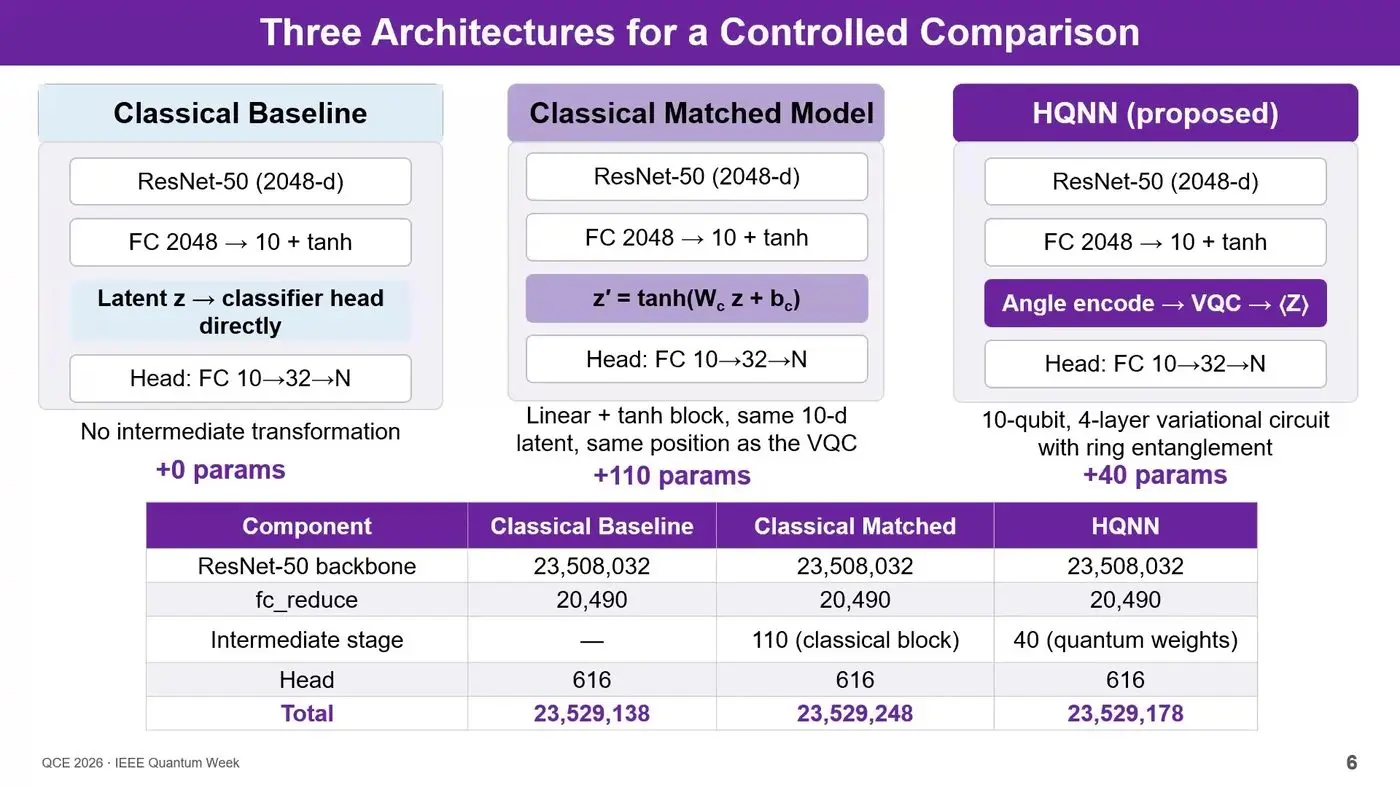
On four kinds of white blood cell, the quantum hybrid scored a macro F1 of 91.53 percent against 88.62 for the matched classical block, while on a set with eight kinds all three sat near 98.5. A check of 40 images on IBM’s ibm_fez scored 90 percent. Cruz would not call it a quantum win.
A Columbia student finds shot noise matters more than gate noise
A graduate student at Columbia tested how the way data is fed in and the depth of a circuit hold up under noise, across 315 small models. Noise rates came from a simulated IBM chip, scaled up to 16 times. The simplest way in, one rotation per qubit, needs no two-qubit gates.
Exact outputs barely moved under noise. Reading each model with only 64 shots moved results more than 20 times as much, because answers that sat near the decision line flipped from one side to the other. The simplest design won at shallow depths and cost about 2.5 points of accuracy.
Cascade Quantum trains a classifier one angle at a time
A Cascade Quantum researcher ran a live notebook on a breast-cancer data set of about 600 tumours. Each feature was squeezed into a few bits, and a test of how much each feature told about the label decided how many qubits it got. Each angle was then tuned in turn.
Four qubits got 100 percent of the training data right. Adding two more qubits to the trained circuit lowered the score on the training data but raised it on the test data, which is the score that matters in the end. The notebook is not public.
Cascade Quantum turns a classifier into an explainer
Sonika Johri of Cascade Quantum treated the trained circuit as the thing worth keeping. Run forward and then backward on many inputs at once, it shows which links in the data drove each call, and looped with a measurement in the middle it can also make new samples. Five genes out of a hundred told two cancer types apart.
A second study gave ChemBERTa, a language model for chemistry, a quantum head to predict whether a drug crosses into the brain. Johri said plainly that it found no quantum advantage.
UCL composes images and sentences that CLIP cannot
Mehrnoosh Sadrzadeh of University College London worked with three co-authors, Martha Lewis among them, on meaning built from parts. If you have seen a yellow cube and a red cylinder, you can picture a yellow cylinder. CLIP mostly cannot. Lewis had found as much in earlier work on this widely used model, which links words and pictures, and the team set out to do better with very small circuits.

The team built on DisCoCat, the model of meaning Sadrzadeh developed with Stephen Clark and Bob Coecke, in which a relation such as “is left of” becomes a small circuit with three qubits per word type. On combinations never seen in training, the circuits reached 72.32 percent with 426 settings. CLIP, with about 151.5 million, sat at 50 percent. Sadrzadeh granted that each circuit has a classical tensor-network twin, and training on hardware is still to come.
Missouri entangles image and text to find the right caption
Ali Shiri Sichani of the University of Missouri built QEMFN with Srikar Alla. It takes features from a frozen CLIP model, squeezes each into six numbers and loads them onto six image qubits and six text qubits that are then tied together by gates. Keeping CLIP frozen, Shiri Sichani said, saves time and power in training.

On recall at rank one, the share of searches whose top answer is right, QEMFN scored 68.9 against 64.8 for a classical model of the same size. A classical analogue of the circuit came close behind at 68.2. Removing only the entangling gates dropped QEMFN to 67.1, and hardware was used only to re-rank a short list of top answers, which saves machine time.
Query Machines watches a quantum transformer pay attention
A presenter from Query Machines in Delft showed work by Andrea Gasparini and Diego Iacopetta on a small quantum transformer of 12 qubits, three for each word, with no measurement until the very end. The aim was a model you can read. Attention showed up as mutual information between the word registers, which says how much one of them tells you about another.
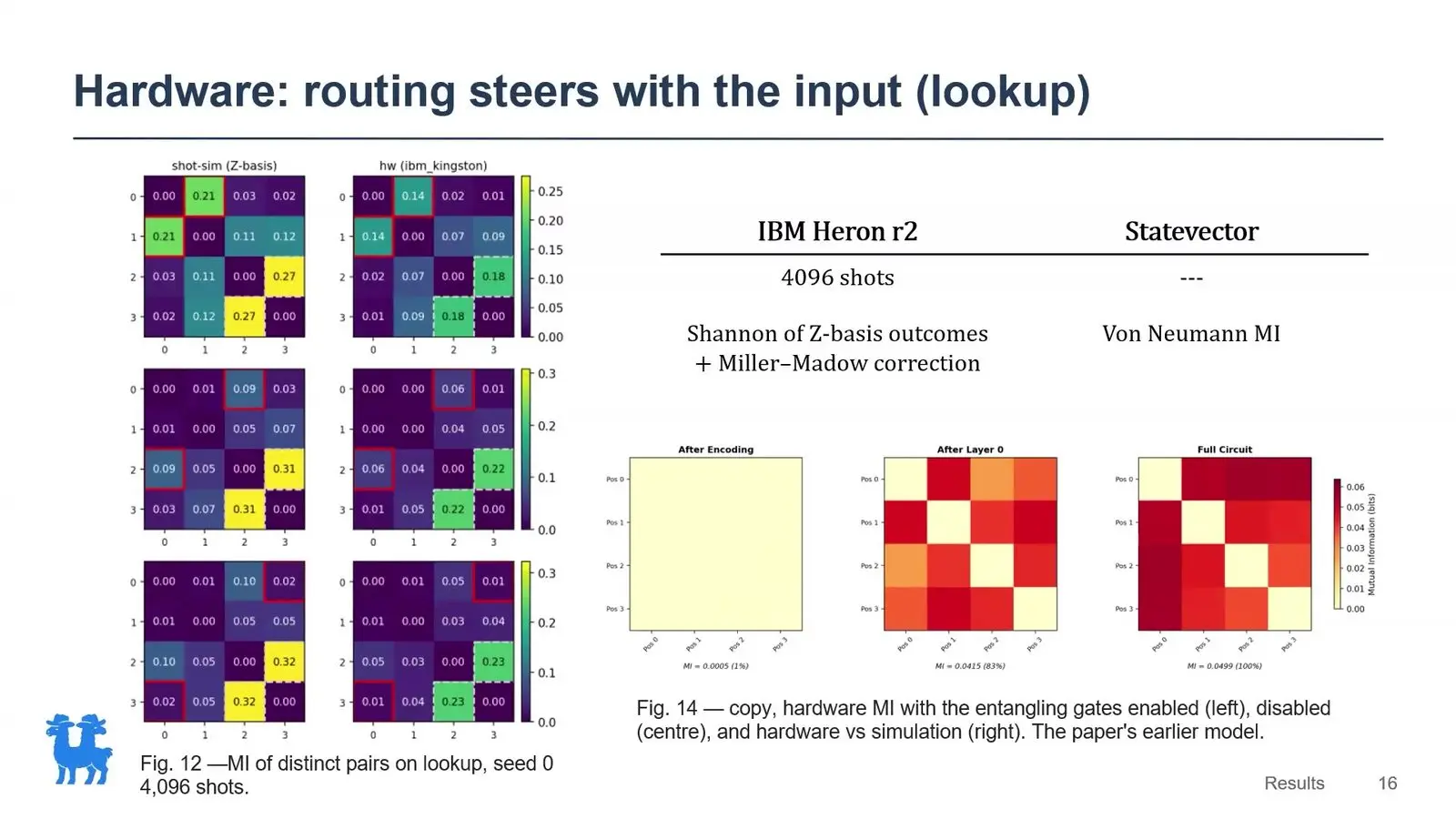
During training that measure rose for the pair the input pointed to and fell for the rest. Removing attention wiped out exact-match accuracy. On IBM’s ibm_kingston with 4,096 shots the measured value fell about tenfold, yet the same pattern appeared, and the team cautioned that the link to accuracy held clearly on one task only.
A quantum spiking network steers a simulated robot past obstacles
Nouhaila Innan of New York University Abu Dhabi presented Q-SpiRL with Muhammad Shafique and three others. A spiking network passes signals as timed pulses, as nerve cells do. The quantum versions add an eight-qubit circuit just before the output, and the robot picks one of five steering moves to reach a target past fixed and moving blocks.
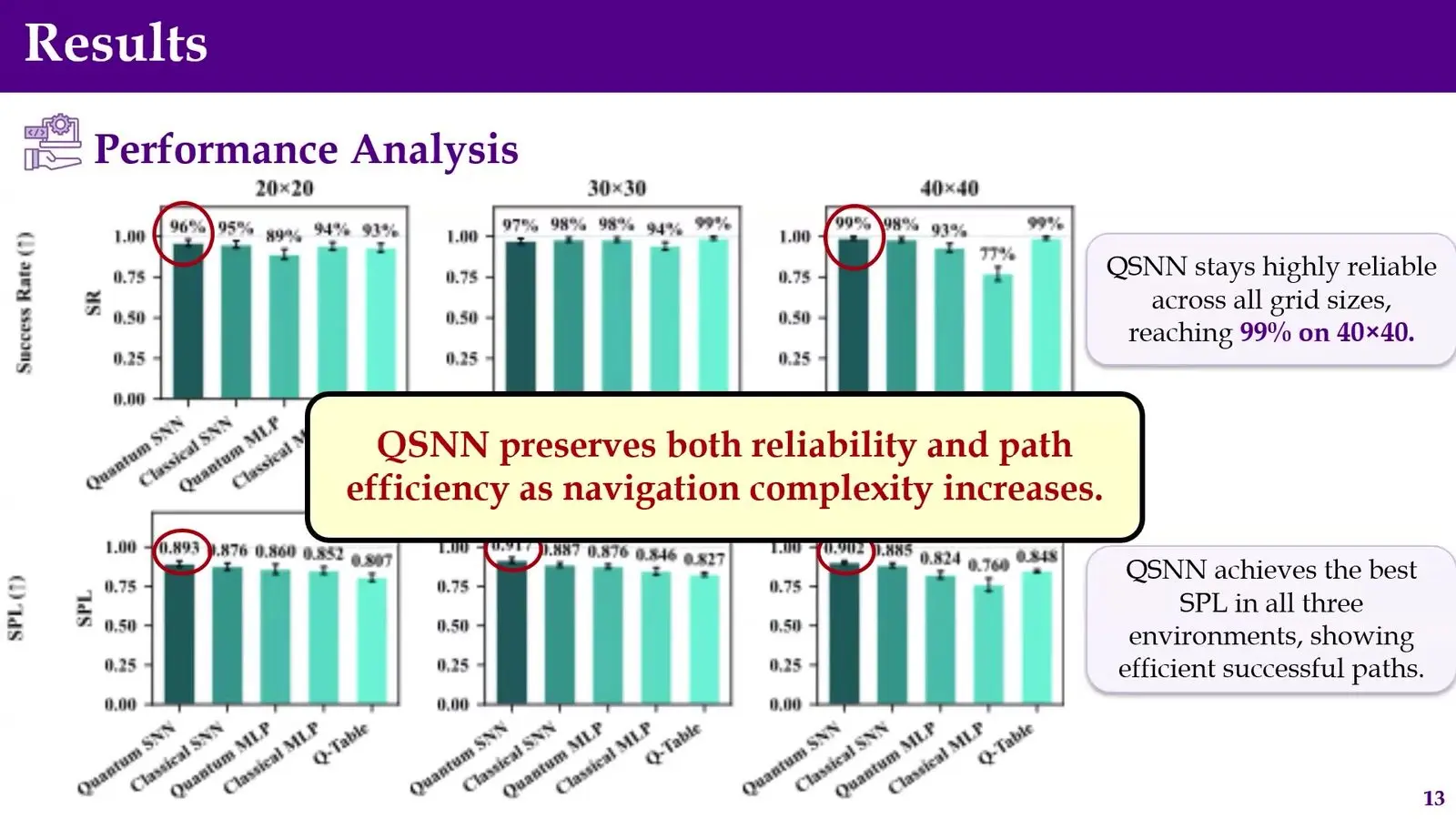
On grids of 20, 30 and 40 squares a side, the quantum spiking policy reached the goal in 96, 97 and 99 percent of episodes, with the best path efficiency each time. A plain lookup table also hit 99 percent on the largest grid, by longer routes. One episode on IBM’s Fez processor reached the goal with more needless turning. Innan said tests of what the quantum layer adds are still running.
Attacks, defences and certificates
If quantum models are ever put to work, someone will try to fool them. Six talks looked at attacks on quantum classifiers and at ways to prove that a model’s answers hold.
Florida blurs attacks by stopping state preparation early
Prabhat Mishra of the University of Florida gave three talks on Sunday. The first took on adversarial attacks, tiny changes to an image that a person cannot see but that flip the answer a classifier gives, and it left the trained model alone. The defence stops the step that loads the image into qubits early, so the loaded state blurs the attack more than the picture.
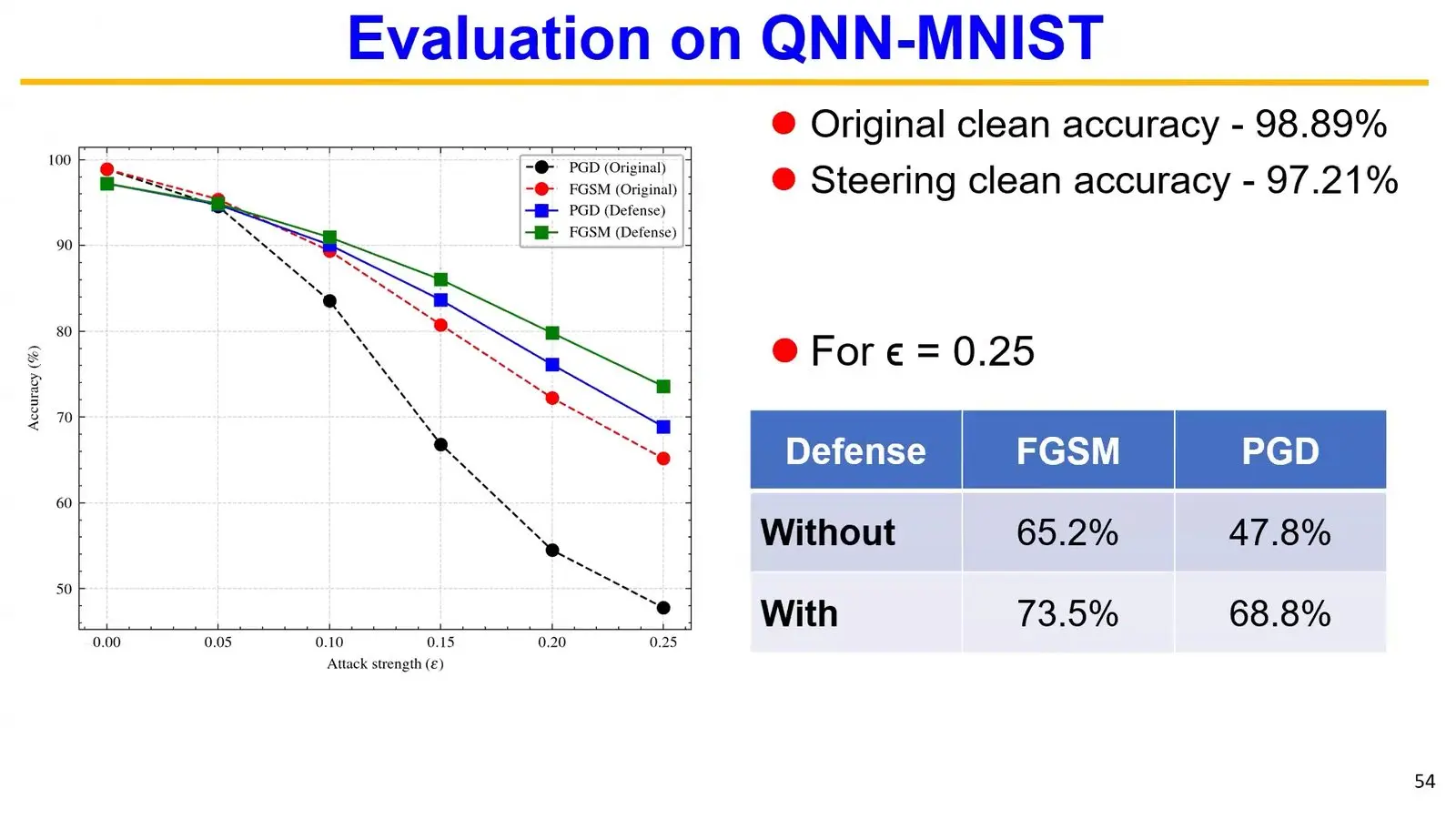
In one test, a model that sorts pictures of clothes lost 7.84 points on clean images and gained 40.19 points on attacked ones. Another model gained almost nothing. All the attack numbers came from a simulator.
Florida adds an autoencoder that can refuse to answer
Mishra’s second talk put a quantum autoencoder in front of the classifier. It squeezes the input into a few qubits and throws the rest away. Mishra’s bet is that this hurts a small attack more than the main signal, and a score of how sure the model is lets it refuse to label an image it doubts.
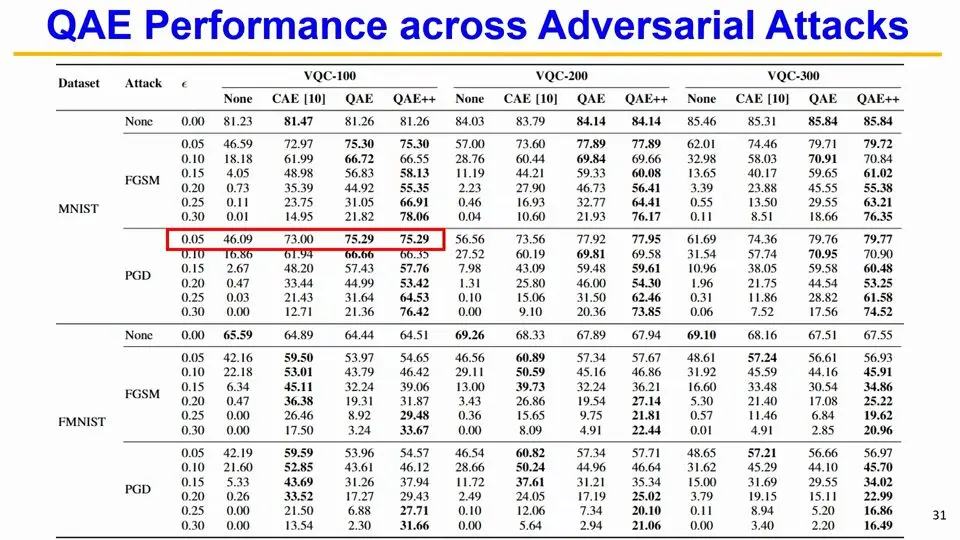
Runs on a simulator used two standard image sets. Mishra stated gains of up to 68 percent under attack. Refused images drop out of the count, so the table needs reading cell by cell before that figure is given to the defence.
Florida proves a floor under accuracy
The third talk asked for a floor under accuracy that a seller could promise, one that no input within a stated noise budget can push below. The classical method feeds each input in as a range and pushes that range through every layer. Quantum outputs only run from minus 1 to 1. So several steps had to be redone.
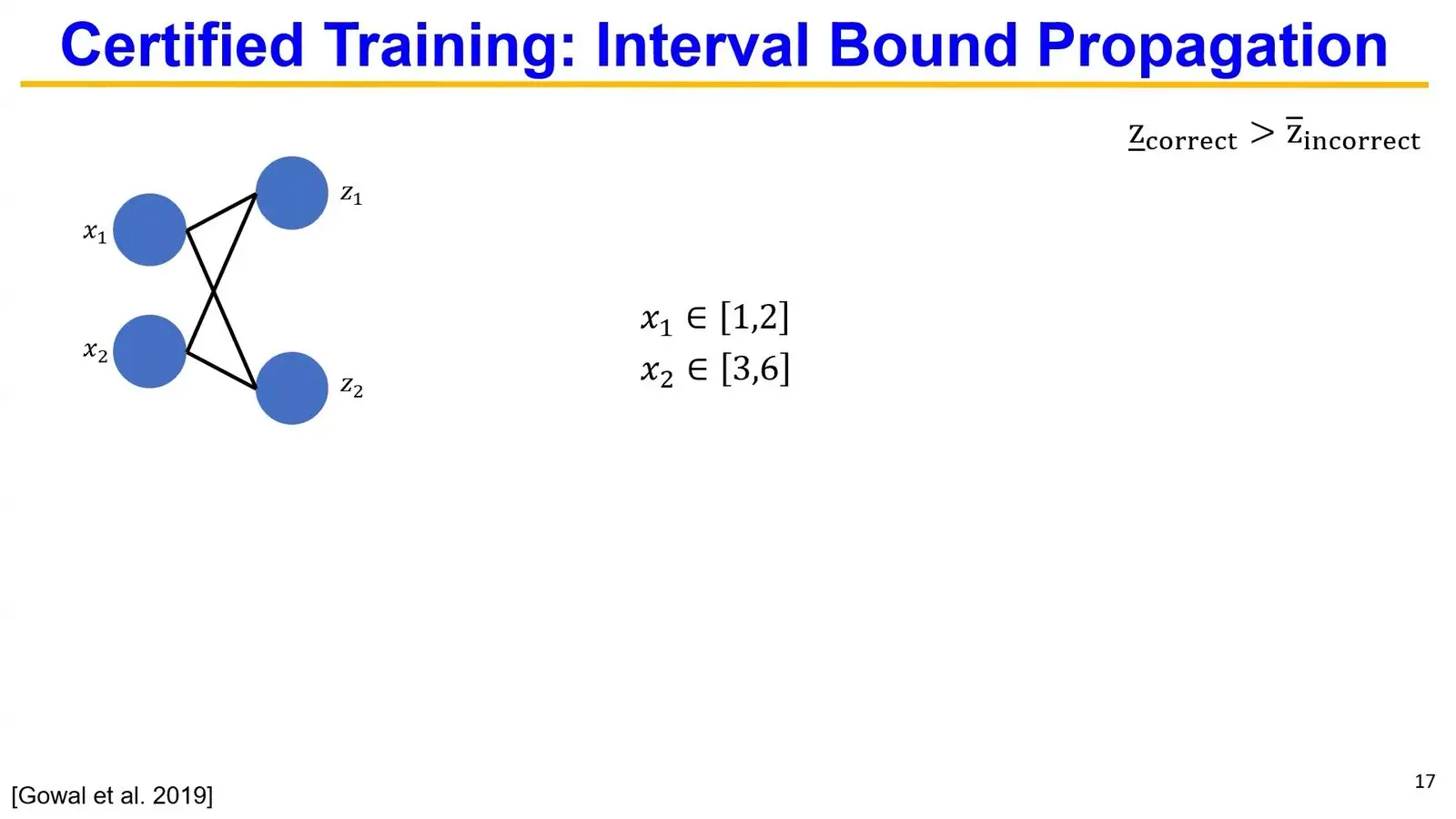
The proven floor sat above zero but well below test accuracy. It fell towards zero as qubit counts rose.
A backdoor that changes with every input
Junrui Zhang, Rui Ning and colleagues showed a backdoor attack, a hidden trigger planted during training that forces a chosen wrong answer. A fixed trigger copied from classical attacks fails on quantum networks. Their trigger changes with each image.
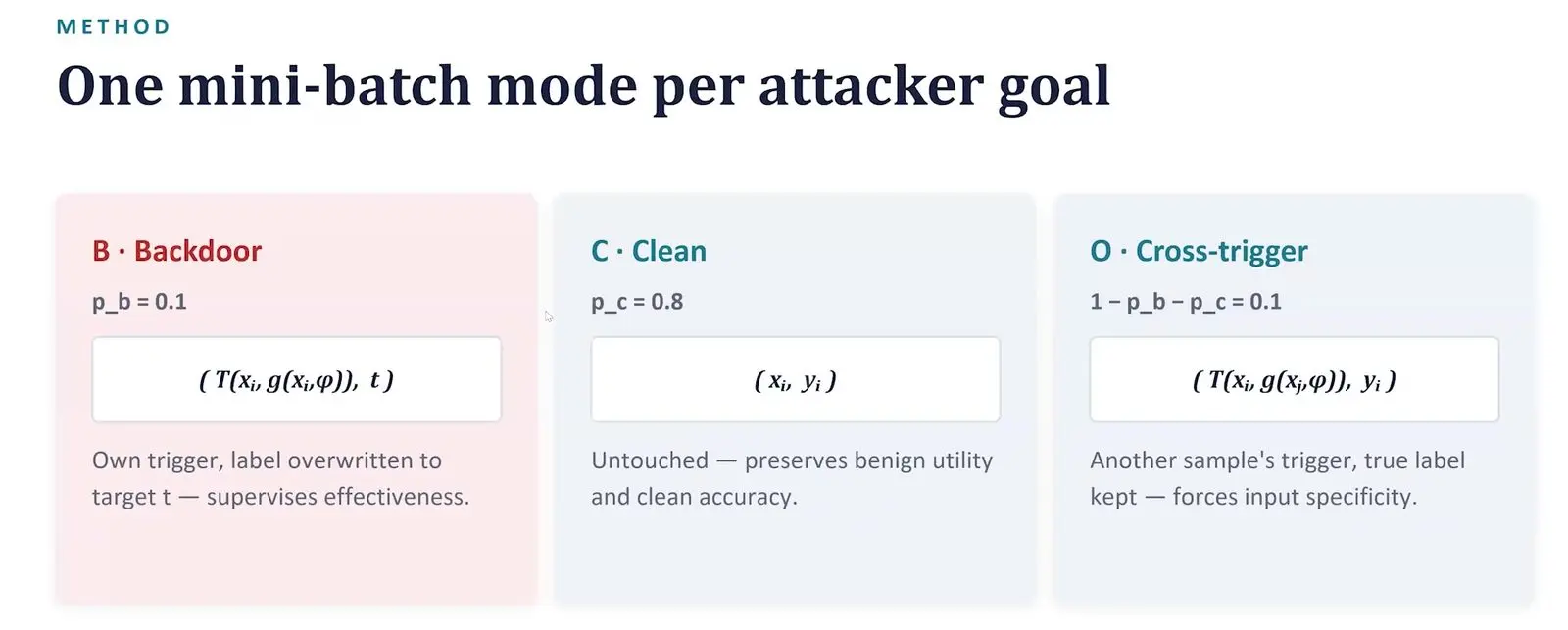
On two small image sets, normal accuracy stayed near 97 to 98 percent while the attack worked about 97 percent of the time. Fixed triggers did far worse, at about 3 and 8 percent. The attack also survived 20 rounds of extra training meant to wash it out, and the speaker noted that defences built to reverse-engineer one fixed trigger can still find older attacks of that kind.
Checking a whole hybrid pipeline
Flavjo Xhelollari, with Tao Li of the City University of Hong Kong and Juntao Chen of Fordham, built a checker for a whole pipeline, from the classical numbers going in, through the quantum step and back out. A pass counts as a proof. A fail means only that the bound was too loose.
The bounds sat well above the gaps measured in tests, by 40 to 66 times for shifted inputs and up to 1,524 times for shifted models. Checks on IBM hardware were thin so far.
Fordham counts the move to hardware inside the certificate
A speaker presented a paper by Flavjo Xhelollari and Juntao Chen of Fordham University and Tao Li of City University of Hong Kong. A certified radius is the largest nudge to an input that a model is proven to shrug off. The catch is that a proof worked out on a clean simulator is about a different machine from the noisy one that runs the job. So the team built that gap into the proof.
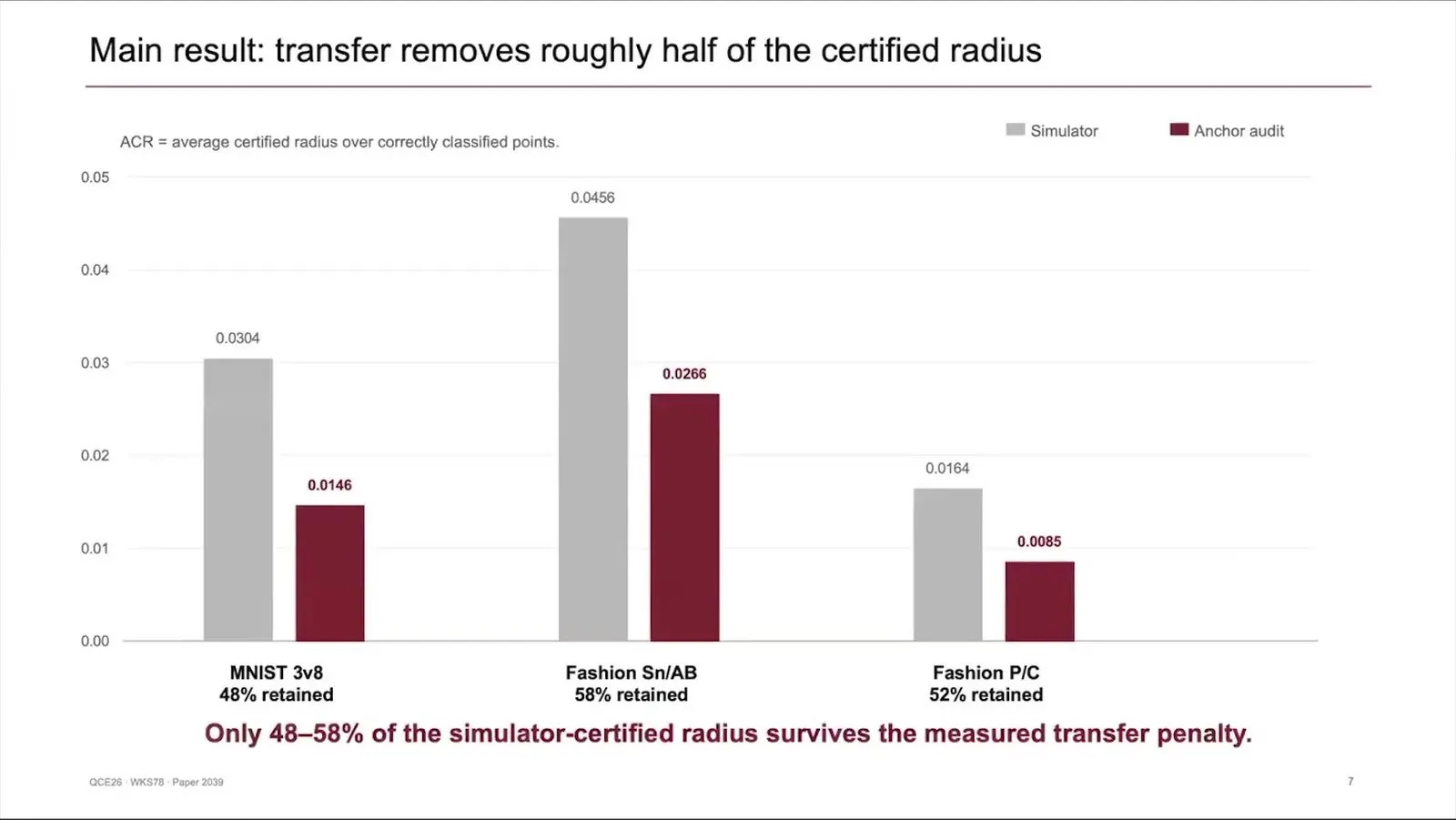
Only 48 to 58 percent of the simulator’s radius survived on three image tasks, with MNIST 3 against 8 falling from 0.0304 to 0.0146. A trial run on IBM’s ibm_kingston, at 512 shots, left a radius below 0.001. The slides called that too cautious to use.
Reading circuits as waves
Many quantum models can be read as sums of waves, and the way data is fed in decides which waves the model can make. Seven talks used that view, or ones close to it, to explain why some circuits train well and others stall.
Regensburg tunes the pulse under each gate
Wolfgang Mauerer of OTH Regensburg presented a paper that won a best-paper award in the machine learning track, standing in for first author Melvin Strobl of KIT. A circuit that mixes data loads with trainable layers makes a sum of sine waves. So the team went below the gate. It trained the shape of each control pulse as well as its angle.
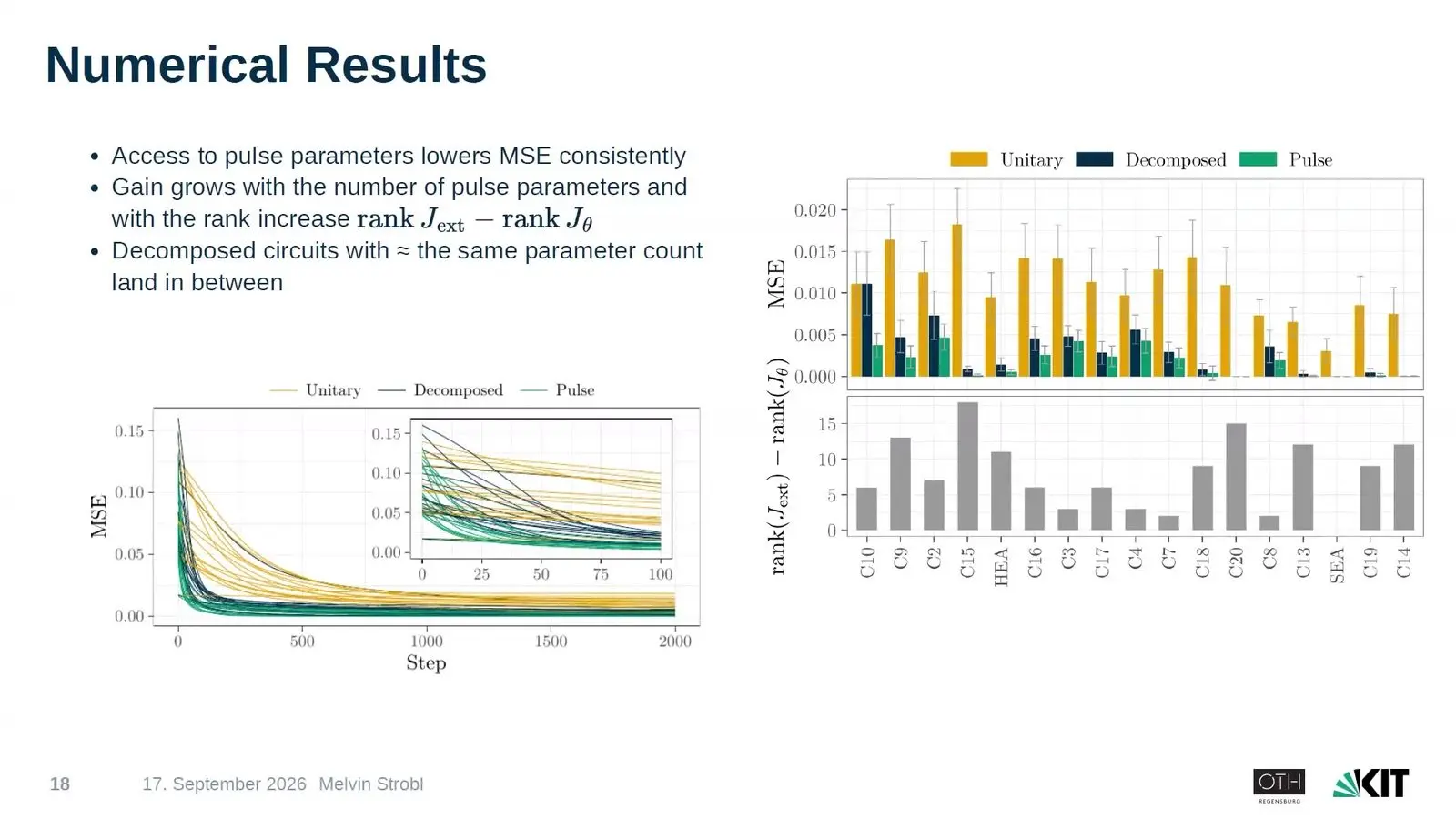
Mauerer argued that the extra settings give the optimiser more ways to move without changing which waves the model can make, so the contest against plain gates stays fair. In simulation, pulse training cut error on every layout tested. Mauerer noted that most hardware makers do not let users change their tuned pulses.
Munich finds the same frequency made too many ways
Jonas Stein of LMU Munich presented work led by Michael Poppel. Stein compared models that reload data on one qubit with models that spread it over several. The simplest code, loaded three times, gives 7 frequencies and makes the zero frequency 20 separate ways, while a ternary code gives 27 frequencies, none made more than 8 ways.
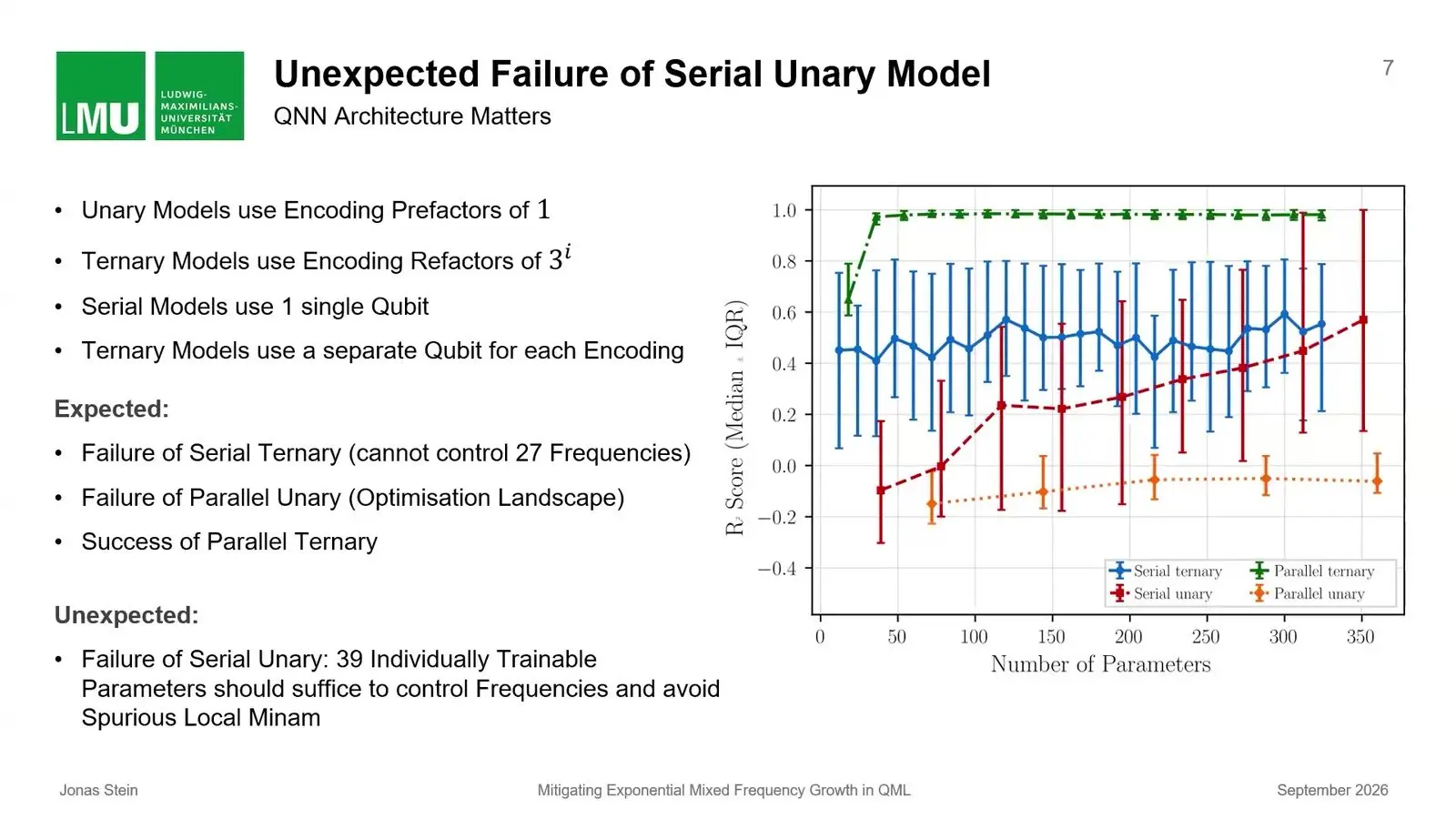
Stein said the waste forces many of the model’s settings to move in step with each other, which leaves less freedom to fit a hard target. On a target with 27 frequencies, the spread-out ternary model fit almost perfectly. The simple models lagged.
Linz borrows harmonic analysis to make extra training data
Kristina Kirova of Johannes Kepler University Linz presented Harmoniq. When people train a classical model, they make more data by shifting or turning the examples they have, and quantum learning has had no such kit. Harmoniq builds one out of shifts in time and in frequency.

In a test of cleaning noisy signals, a plain method lost one of three signal clusters at moderate noise. Harmoniq kept all three. Kirova called it an early result, not yet set against classical augmentation methods.
Regensburg measures the magic a generator spends
Tom Krüger of OTH Regensburg, with Wolfgang Mauerer, measured the “magic” that a family of circuits uses up as it learns. Magic is what makes a state hard to copy on a classical computer. Only the two-qubit gates spent more of it as training made progress, while the magic spent by the one-qubit layers stayed flat throughout. Krüger urged a rethink of those layers.
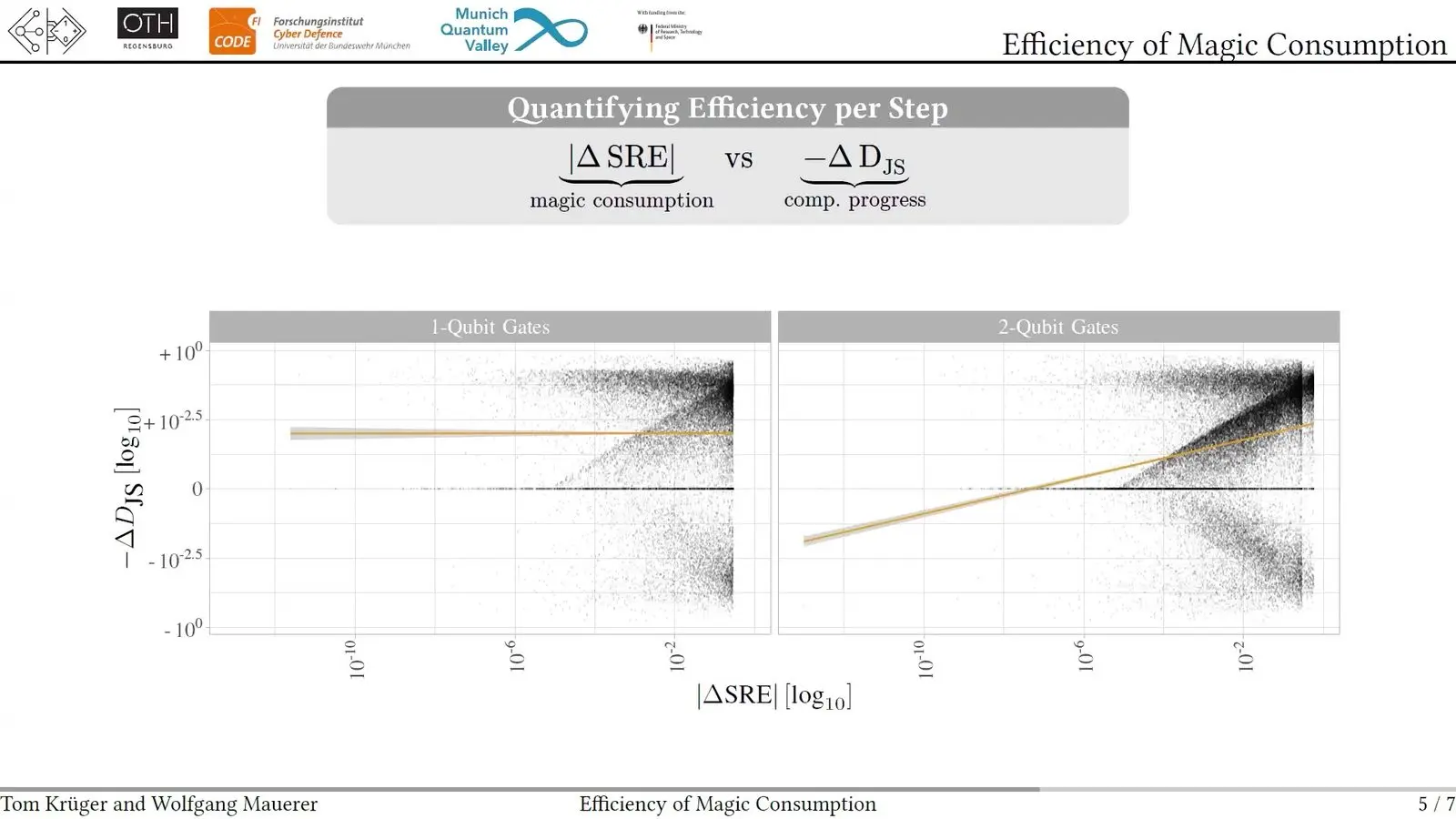
Trained states held far less magic than random ones. Whether that makes such circuits easy to copy on a classical machine is open, and Krüger guessed there is a floor.
Linz warns that noise can look like entanglement
Jadwiga Wilkens of Johannes Kepler University Linz spoke for Richard Kueng. A barren plateau is a flat stretch where the training signal of a circuit fades away, and a 2022 paper Kueng co-wrote ties it to heavy entanglement between the qubits. The method checks for that build-up with cheap random measurements and, when it sees too much, starts training again with a smaller step.
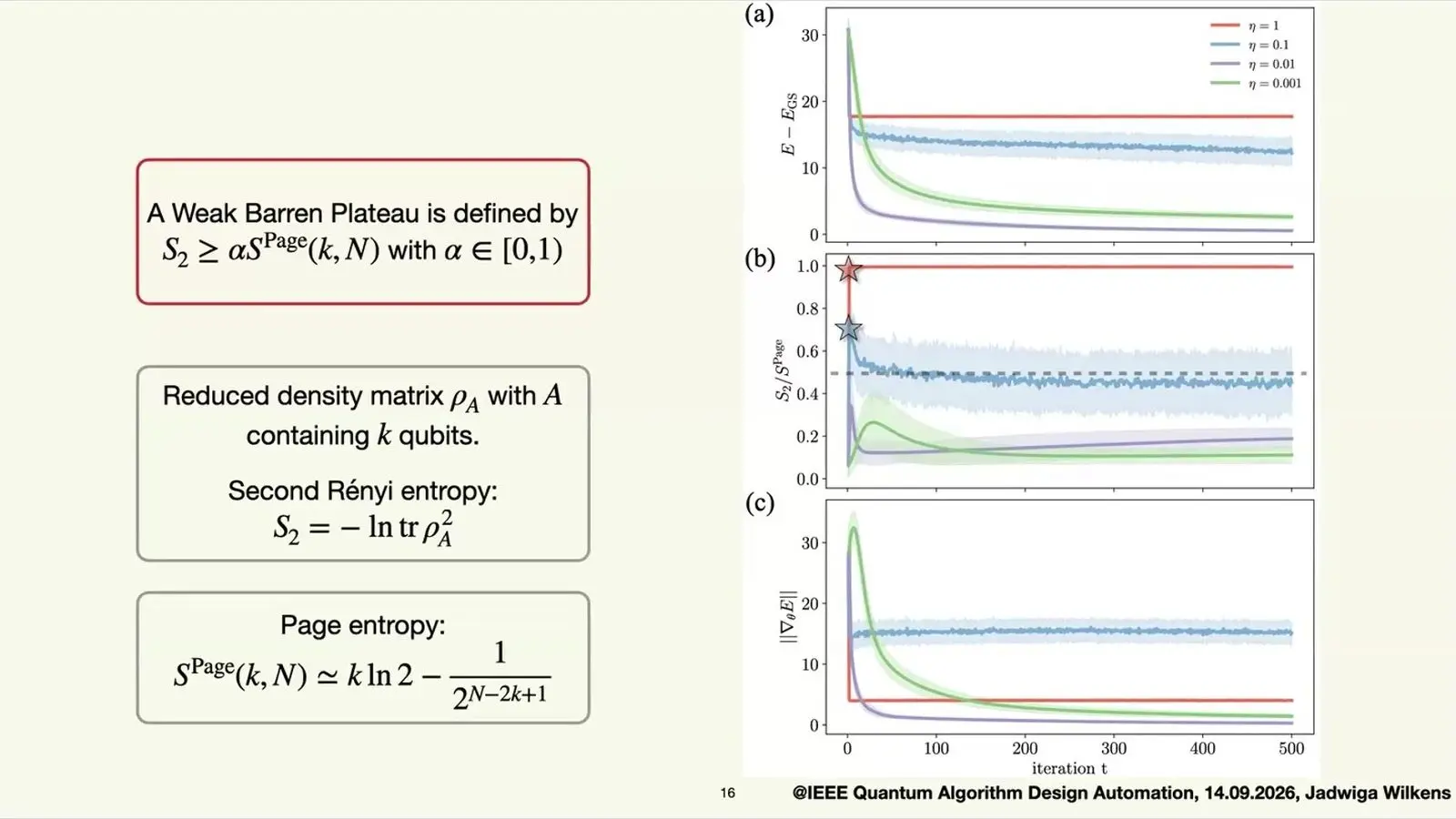
In simulation the warning worked. On a 12-ion AQT machine, though, the measured states looked more tangled than the ideal ones. Wilkens traced the gap to noise, which can mimic entanglement, and said telling the two apart is still open.
Munich teaches a circuit tic-tac-toe
Markus Baumann of LMU Munich, with Claudia Linnhoff-Popien and Jonas Stein, built the board’s symmetries into a nine-qubit classifier for tic-tac-toe. The game suits the test because the labels are exact and the symmetries are known.
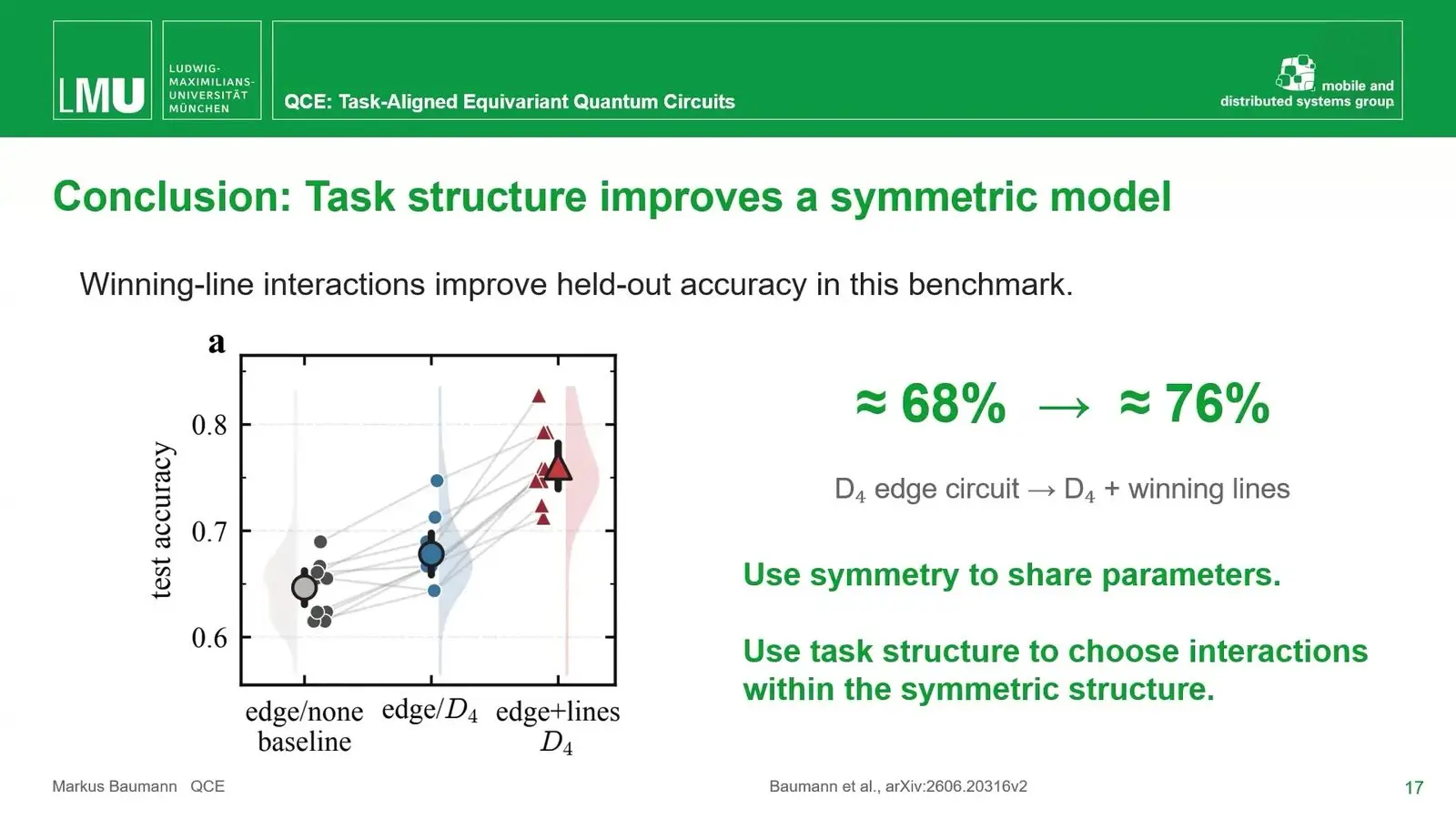
Symmetry alone got about 68 percent of the boards held back for testing right, from training sets of 30 to 600 boards. Adding gates along the winning lines lifted that to about 76 percent. Baumann noted two limits. Draws are over-represented in the data, and no other data set has been tried yet.
IonQ finds hidden parities and leaves the circuit behind
Sang Hyub Kim of IonQ presented work with Oliver Knitter, Martin Roetteler and four other co-authors. A parity label depends on whether an odd or even number of chosen bits are set. Parities are the waves of bit data, and simple statistics on the raw bits cannot see them. Kim’s method searches for the hidden parity with a quantum circuit during training and then hands the job to an ordinary classifier, so nothing quantum runs once the model is in use.

On three small tasks the method scored 100 percent, where logistic regression and support vector machines reached 70.1, 69.1 and 47.9. Kim granted the tasks were small enough to solve by brute force. On 20-bit inputs with a ninth-order parity, out of more than a million candidates, the quantum-guided search succeeded in 5 of 5 runs against 4 of 5 for two guided twins. Every comparison was simulated.
Generative models and the data that suits them
Generative models learn to make new samples that look like their training data. Six talks asked which data such models should learn, how to stop them simply copying it and how to learn a quantum state.
Quantinuum proposes a test for quantum-friendly data
Chen-Yu Liu of Quantinuum offered a score from 0 to 1 that shows how much a data set’s links look like the kind quantum circuits make. The work focused on IQP circuits, whose samples are thought to be hard to make classically, though they can be trained on an ordinary computer.

On samples from a D-Wave annealer, the score rose the longer the machine was left to anneal. Two sets of turbulence data scored high, and IQP models learned them from just 11 samples, while Liu said classical networks of up to 1.2 million settings needed about ten times as much data. Liu called this indirect evidence.
Munich generalises by matching parities
Markus Baumann of LMU Munich won a best-paper award in the QGDD track with Daniel Hein, Steffen Udluft, Tobias Rohe, Claudia Linnhoff-Popien and Jonas Stein. Their model learns how likely each 12-bit string is from 200 samples. Matching the counts it sees gives every unseen string zero chance.
Matching parities instead, which are sums of bits over chosen groups, lets the model spread some chance onto strings it never saw, and that is how it learns to generalise. The parity-trained model came out best in 190 of 200 test cases. Baumann called the chemistry example a toy.
Gandhinagar learns quantum states with a classical critic
Bhavin Makwana of Dhirubhai Ambani University tackled state learning. Writing down an unknown state of 10 qubits takes more than a million numbers, so a learned model that can make the state on demand is meant to stand in for that list. The team kept a quantum generator and moved the critic, which judges its output, onto classical numbers.
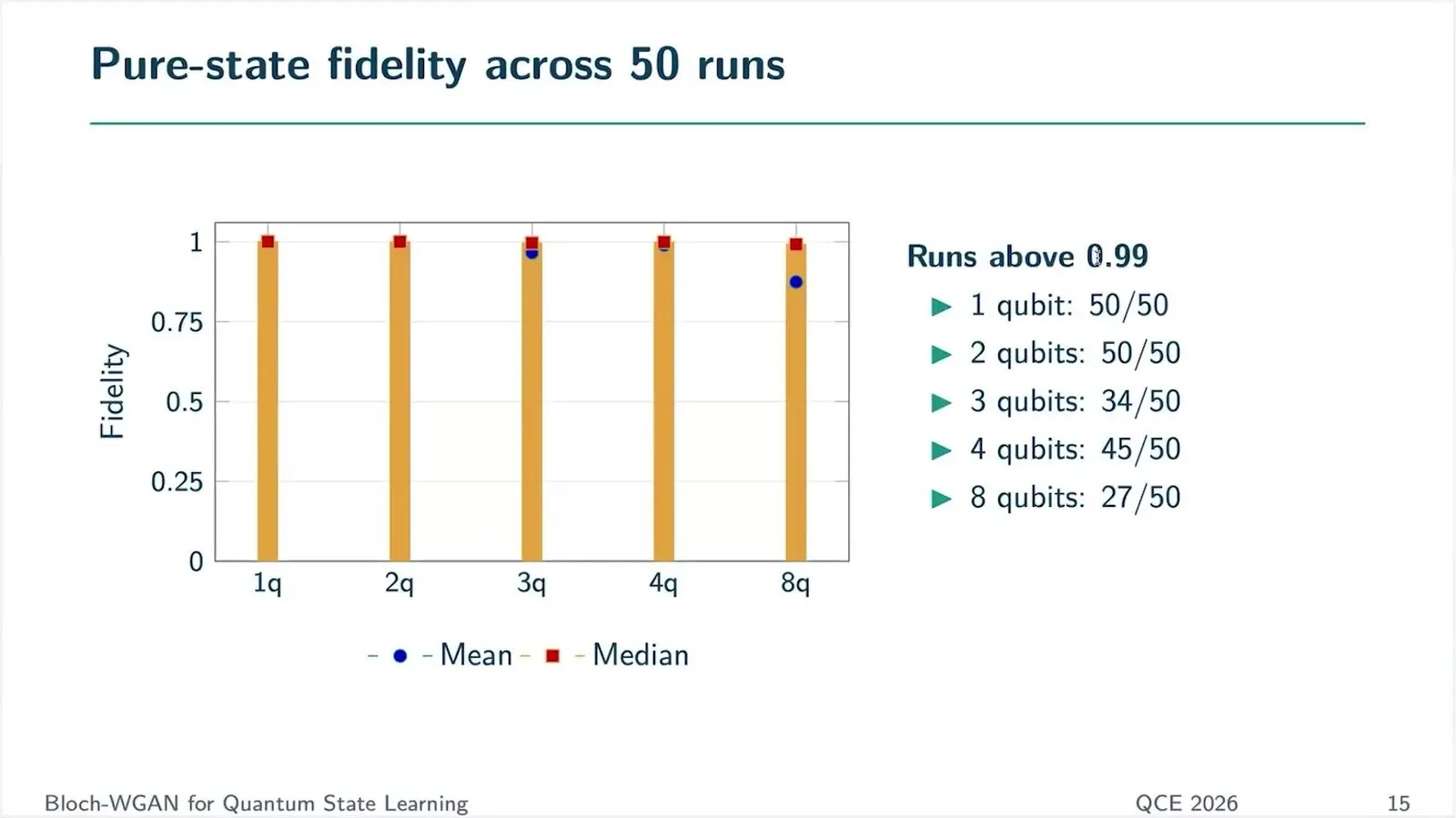
Every pure-state run passed 0.99 fidelity at one and two qubits. At eight qubits only 27 of 50 runs did. Makwana blamed a small circuit with only 31 settings and training signals that fade, and every result here came from a simulator with no noise in it.
IIT Madras estimates qutrit entropy from a fraction of the measurements
Sai Sakunthala Guddanti, who is studying for a joint doctorate at IIT Madras and Deakin University, worked with Anil Prabhakar and Ria Rushin Joseph on qutrits, quantum units with three levels in place of two. Entropy says how mixed a state is. A full read of five qutrits takes 243 kinds of measurement.
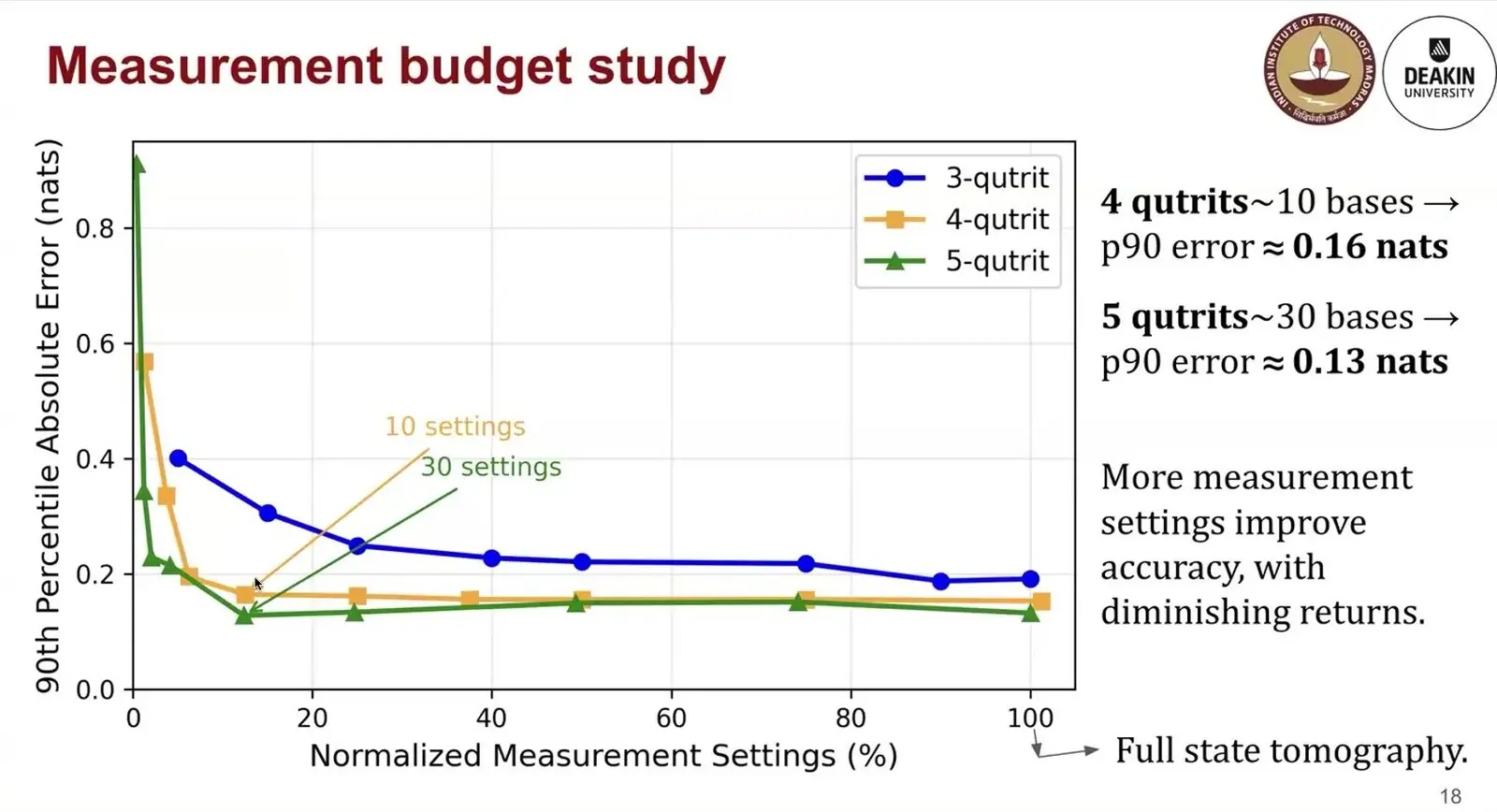
Guddanti used a tunable circuit for two or three qutrits and a classical neural network for more. On five qutrits the network got within 0.13 nats nine times in ten, from about 30 settings. Guddanti said that about one setting in eight was enough to get the error near 0.1, and that each extra setting after that helped a little less than the one before.
Taiwan tiles a generator to seed a hard search
Jen-Yu Chang of National Yang Ming Chiao Tung University worked with Alán Aspuru-Guzik’s group in Toronto. The task was a hard search for strings of plus and minus ones that overlap with shifted copies of themselves as little as possible, and the best classical solver needs good starting points. A small AI model picked quantum circuits to supply them.
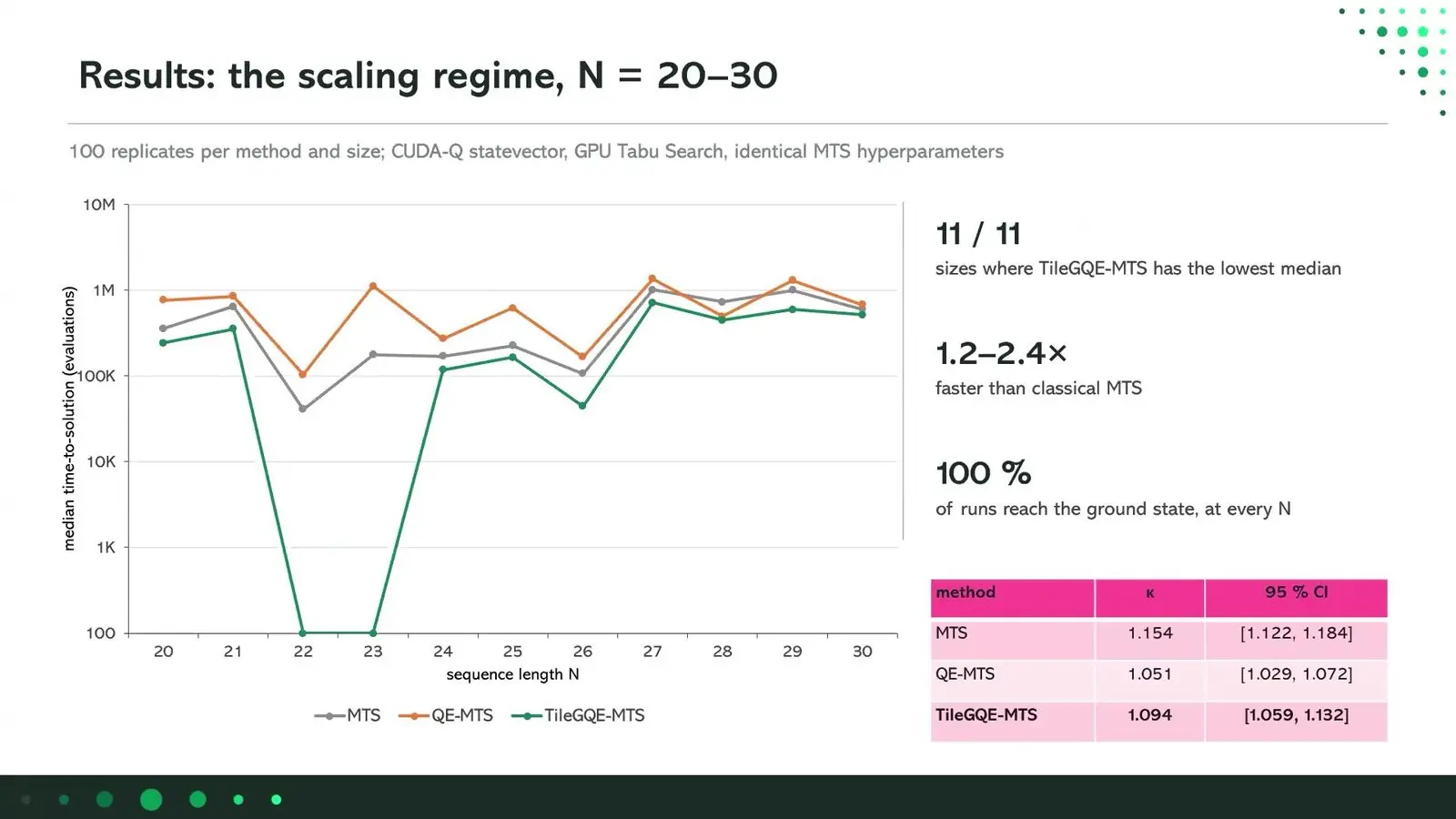
The team trained on short chains and copied the useful parts along longer ones. Across 100 runs per size in simulation, the tiled method had the fastest median time to a solution at all 11 lengths from 20 to 30, by 1.2 to 2.4 times. Chang accepted that the trick relies on a symmetry special to this problem.
SiC Systems argues the factory is the bigger prize
Soheil Mansouri, the founder of SiC Systems, told a drug-making workshop that the big prize for quantum computing in medicine lies in the plant. Mansouri put the trade at 500 billion to 1 trillion dollars by 2035. Finding drugs, by contrast, was a 20 to 30 million dollar problem. Mansouri also cited a count, made by Ensemble Biosystems from FDA files, that 74 percent of letters turning down cell and gene therapies name flaws in how they are made.
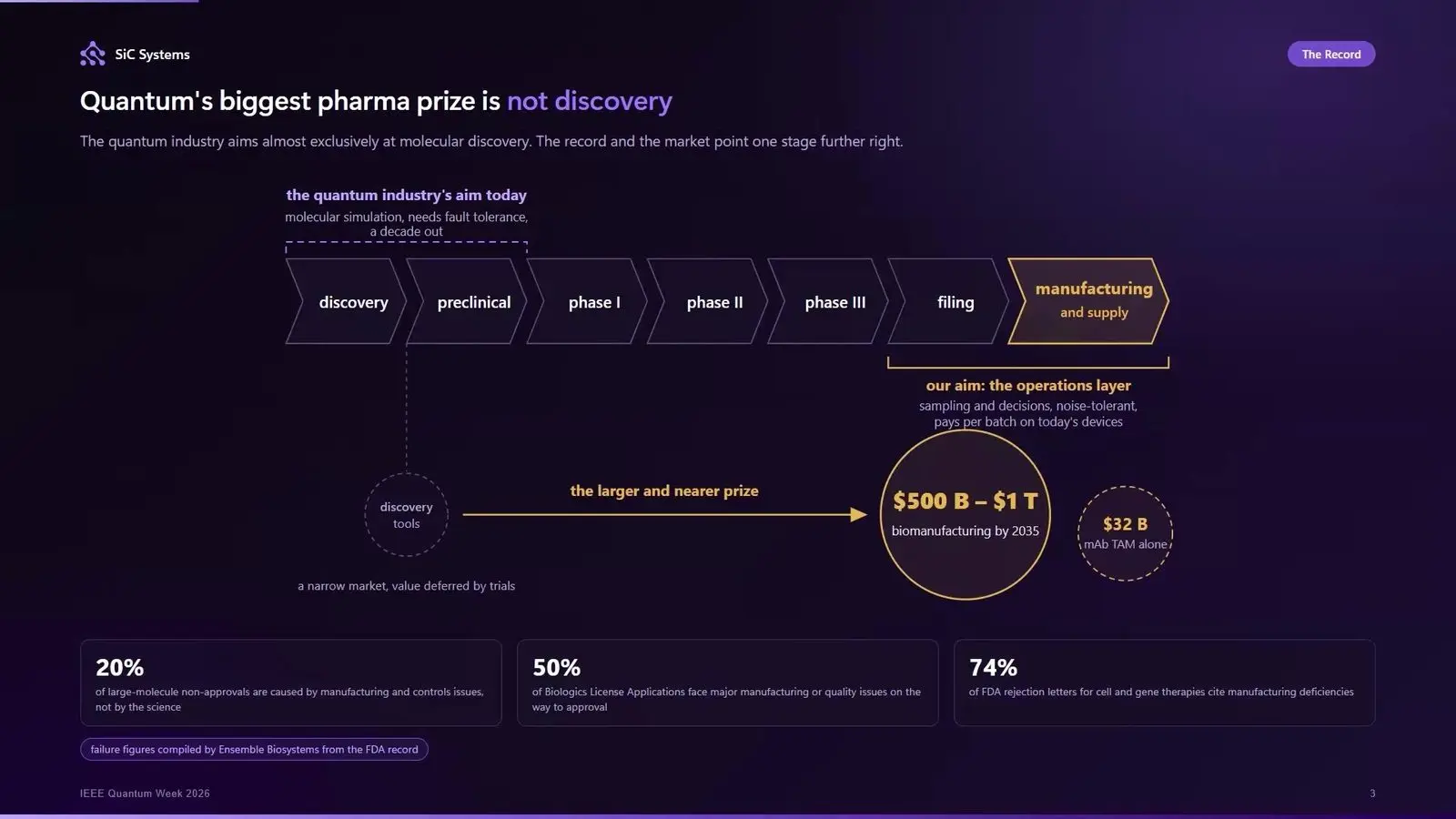
The firm spots faults with generative adversarial networks, pairs of networks that learn how a healthy plant behaves, fed with samples drawn from quantum sources. Mansouri said a simulator beat the hardware they tried. The scope card was frank. Eight photons in 16 modes can be simulated on a normal computer, each network trained in under five minutes on a laptop, and no claim was made to beat the best classical tools.
Time series, memory and forecasting
A forecast needs a memory of what came before. Seven talks built that memory into quantum or quantum-inspired models, and each one was trained on a normal computer.
A reservoir with a reusable operating band
Markus Baumann of LMU Munich gave the first paper at the fourth Quantum Machine Learning workshop. It was on reservoir computing, where a fixed system turns a stream of inputs into rich signals and only a simple readout on top of it is trained. Adding time to the system lets it remember earlier inputs.
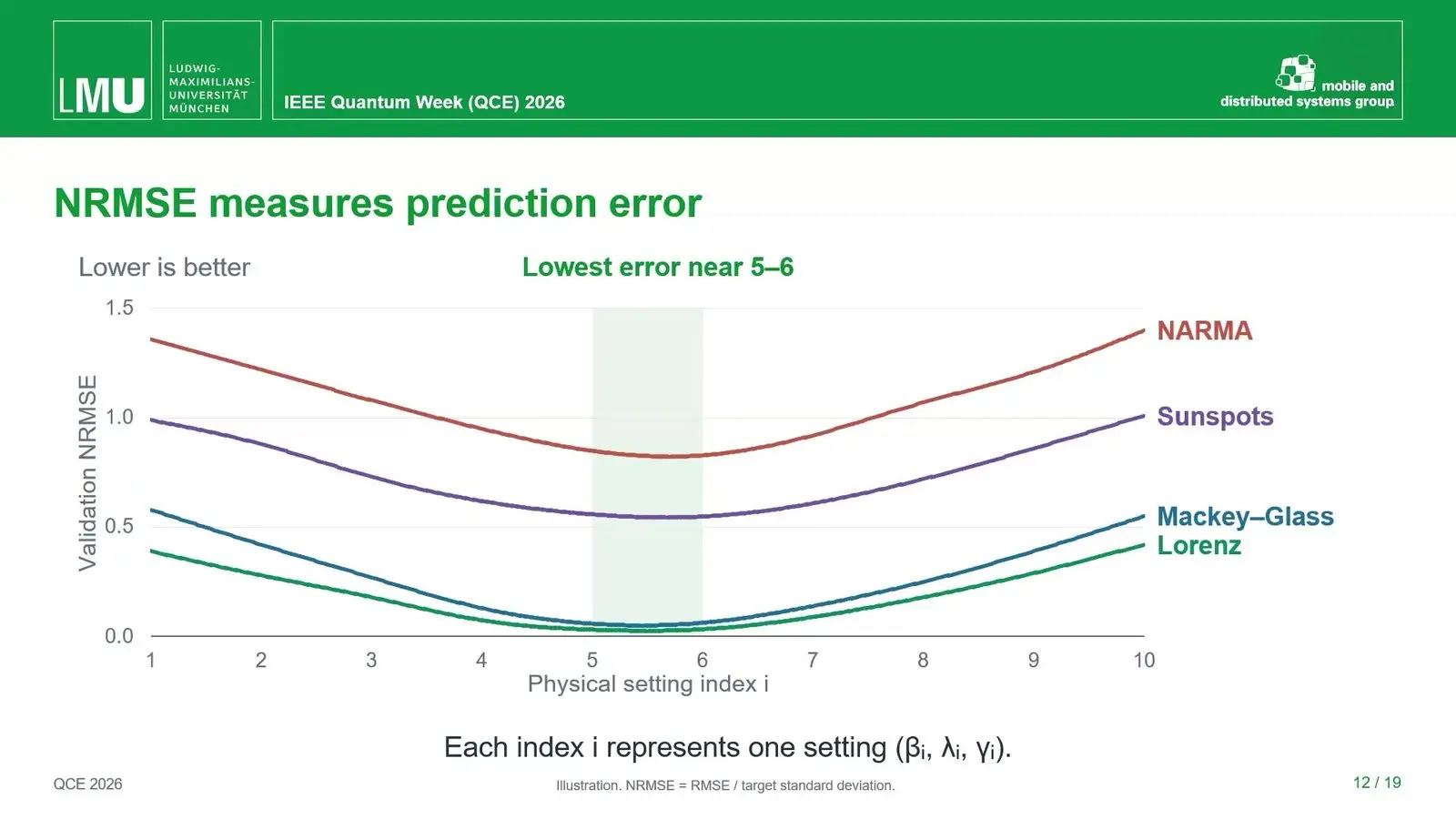
In simulation, on four standard time-series tasks, error bottomed out at the same setting. Baumann called this a band that a sweep can find again on a new task, and noted that a real chip would need to keep its memory alive.
Taiwan forecasts sunspots with a small quantum-inspired model
Kuo-Chung Peng of National Taiwan University presented a paper with 19 authors. In this design a classical network writes the angles of a circuit step by step, so the circuit only has to run once at the end instead of once at every step. Peng’s version adds a gate that blends old memory with each update.
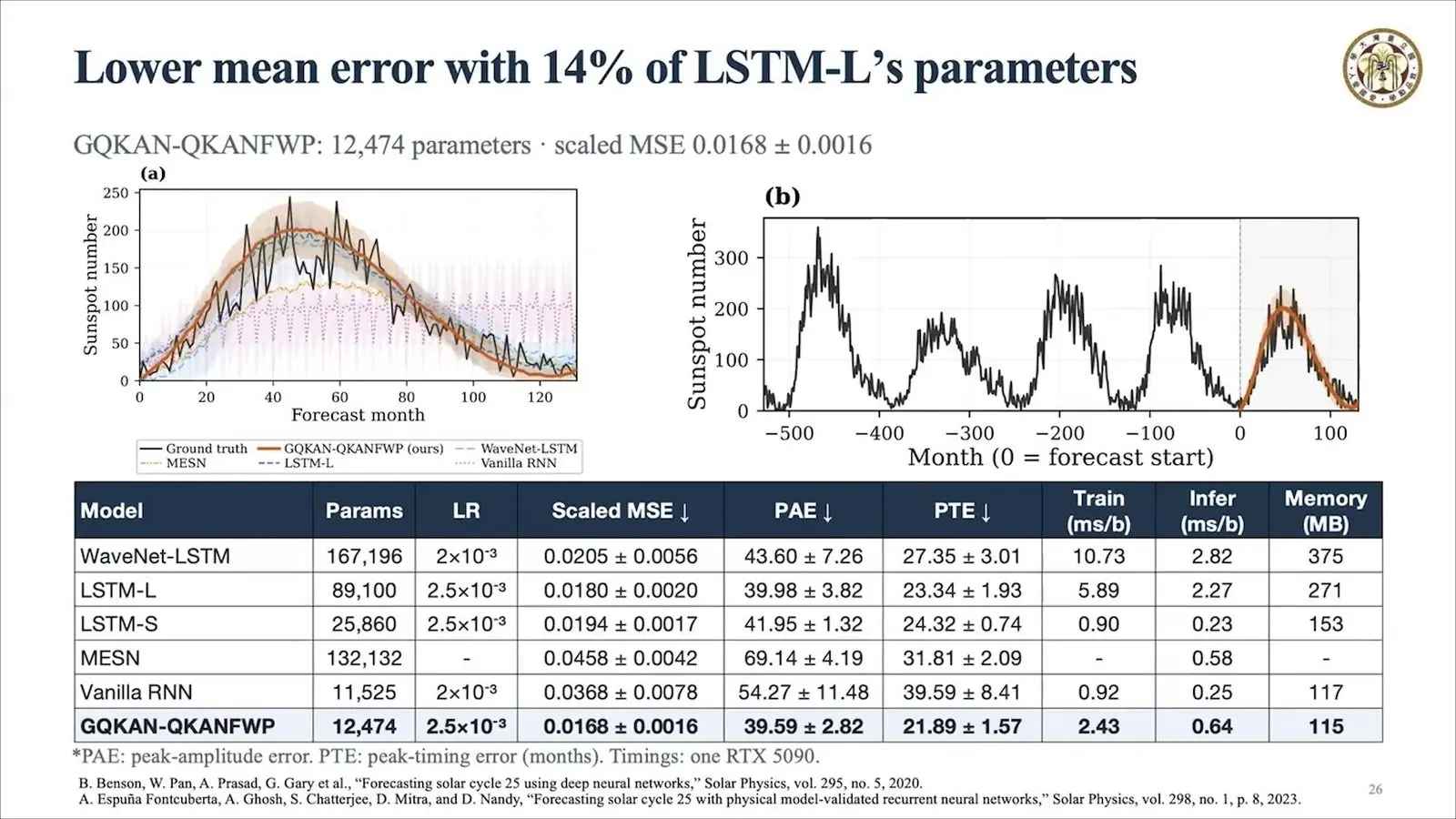
On monthly sunspot records going back to 1749, just 3,326 points in all, the model with 12,474 settings beat a classical forecaster with 89,100 and trained more than twice as fast. Inference on IonQ and IBM hardware matched simulation closely. All training ran on graphics cards.
Wells Fargo lets a model forget old updates
Samuel Yen-Chi Chen of Wells Fargo presented work with groups including Stevens Institute of Technology and Brookhaven National Laboratory. In the plain design every past update to the circuit counts the same, so an old update that has stopped helping can never be turned down. Chen’s version learns how much of each one to keep.

Across five time-series tasks, the original did well on short runs, while the new models trained faster and more smoothly on long ones. No hardware results were shown.
Wells Fargo teaches fast-weight programmers on a free GPU
Samuel Yen-Chi Chen of Wells Fargo opened a tutorial with the design behind several of the week’s forecasters. Quantum models that carry a hidden state from step to step are hard to scale and slow to simulate, Chen said, so here a trained classical network writes the circuit’s angles at each step. The memory lives in the angles.
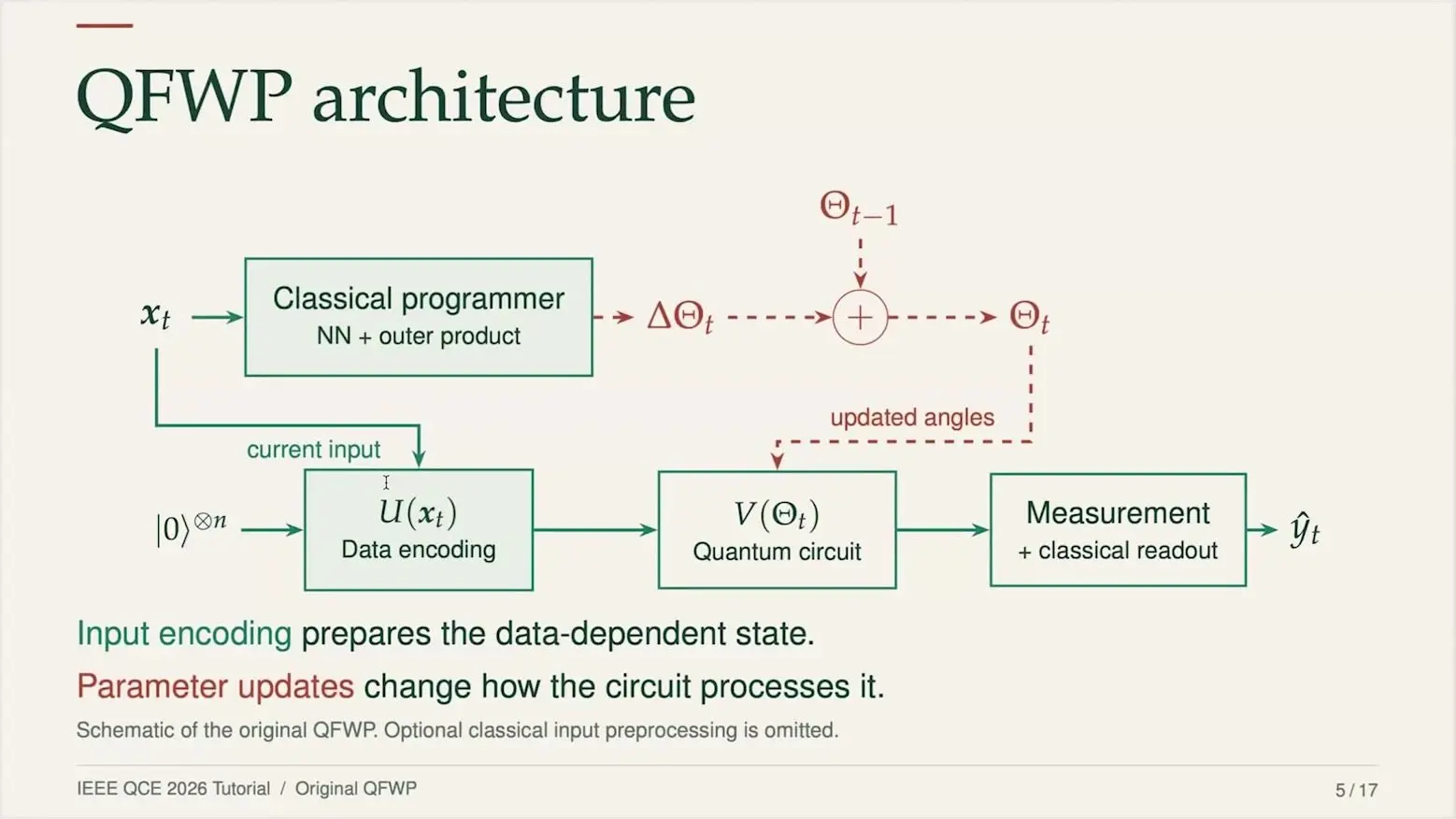
To keep the classical part small, the network puts out one short list for the layers and one for the qubits, and the product of the two gives the full update. The notebook built this in PennyLane on a damped oscillation. On a free T4 graphics card, simulation on the GPU was slower than on the CPU at 12 qubits, ahead at 16 and about ten times faster at 20.
Gandhinagar cleans up a fibre link
Bhavin Makwana returned with a quantum reservoir, a simulated light-based system with 8 modes. The task was to recover symbols sent down an optical fibre, where the light spreads out as it travels so that each symbol smears into the ones beside it. Simple readouts did no better than chance.
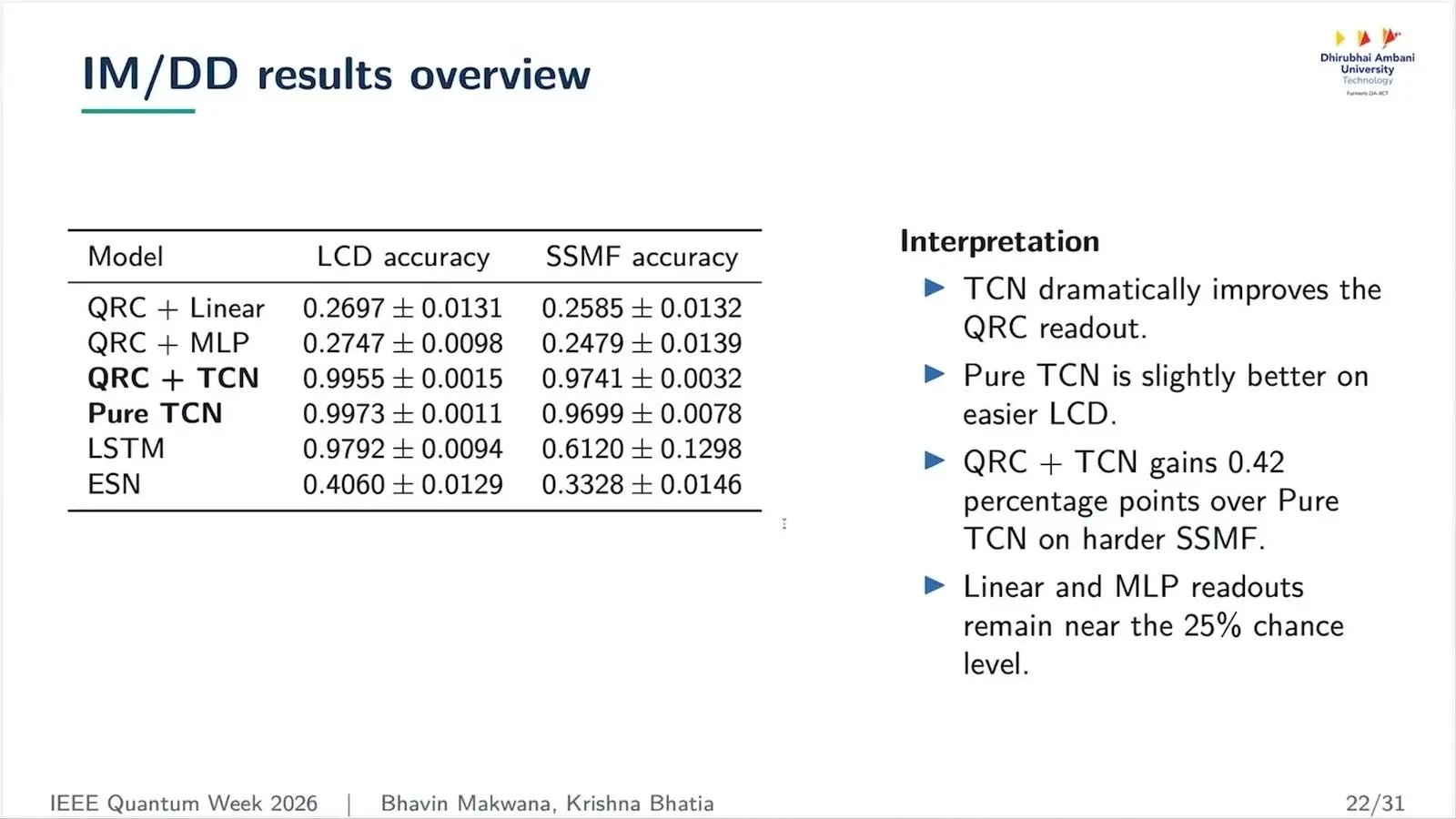
A stronger readout lifted it to 97.41 percent on standard fibre, 0.42 points ahead of the same network fed raw input. Makwana claimed no quantum advantage.
Toronto forecasts the city’s temperature
Mu-En Lee of the University of Toronto showed a forecaster made of quantum circuits whose angles are reset at each time step by a small classical network. It learned from two years of Toronto weather to predict each day’s high and low.
Over 20 seeds and three window lengths it made smaller errors than a plain classical forecaster, and Lee reported that the gap between training and test error shrank by about a quarter to a third. A questioner asked why a plain forecaster was the baseline at all.
Jülich sharpens weather maps with nine quantum steps
Amer Delilbasic presented work from Jülich, the University of Iceland and ESA on turning blurred weather maps into sharp ones, with grid cells shrunk from 31 km across to 3. Most of the network is classical. Only nine of its 256 steps go through quantum circuits.

The test on the 2021 season showed a small average gain that classical stand-ins did not match, though a different year of data did not keep that gain. With the declared noise of the IQM Spark machine at Jülich, results stayed close to the noiseless run. Measured device noise is the next test.
Data, federations and the pipeline around the model
The model is rarely the whole job. Eleven talks dealt with the data, the search for good settings and the network of machines around a model.
Knowledge graphs need data machinery first
Fanfan Lin of the ZJU-UIUC Institute presented a survey written with Wentao Huang. Lin asked the room not to read its title as a claim that quantum computers speed up knowledge graphs, the large stores of linked facts behind search engines. The survey asks what a graph needs before any quantum step can run on it.
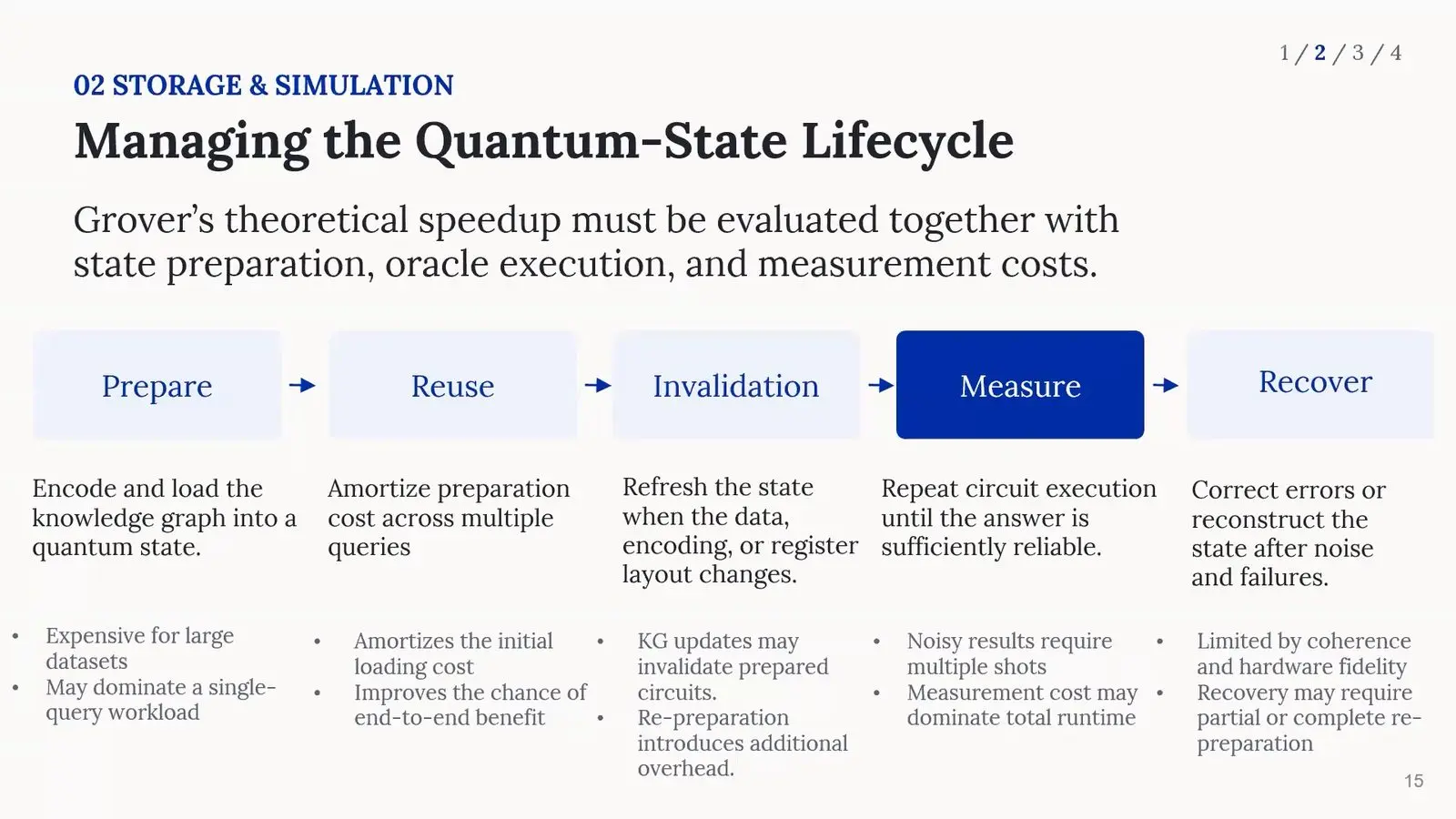
It names five bottlenecks, among them loading the data, which is costly and hard to spread across runs. Lin called live updates to a changing graph the hardest problem of all.
Texas A&M predicts missing links with a quantum walk
Priyank Dubey, a PhD student at Texas A&M University, presented QSearchNet, which guesses which missing links in a network will form. Think of friend suggestions. Local rules count shared friends and miss the long-range shape of the network, while global rules such as the Katz index give every path the same fixed fade with length.
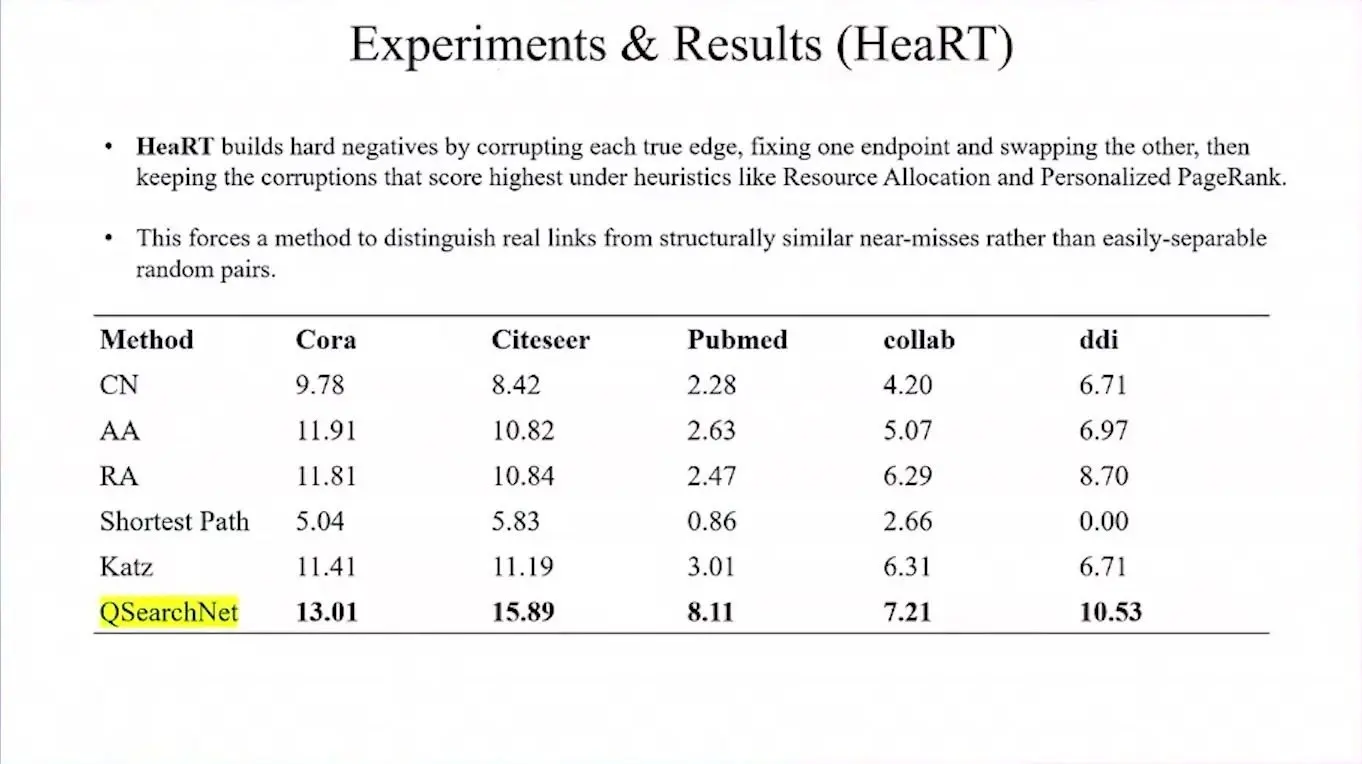
QSearchNet runs a quantum walk on log2 N qubits for a graph of N nodes. On HeaRT, a benchmark whose decoy links are built to look real, it beat five classical rules on all five data sets, scoring 8.11 on Pubmed against 3.01 for Katz. A questioner noted that classical link scoring already runs in polynomial time. Dubey agreed that the claim is about blending local and global structure.
Purdue borrows atom physics to thin out a training set
Zirui Zhang of Purdue University, with Pravin Mahendran, Kevin Zhang and David Bernal Neira, used the physics of atom arrays to shrink a training set while keeping the points that matter. Atoms that sit close cannot both be excited. So the excited atoms tend to be points that sit apart.
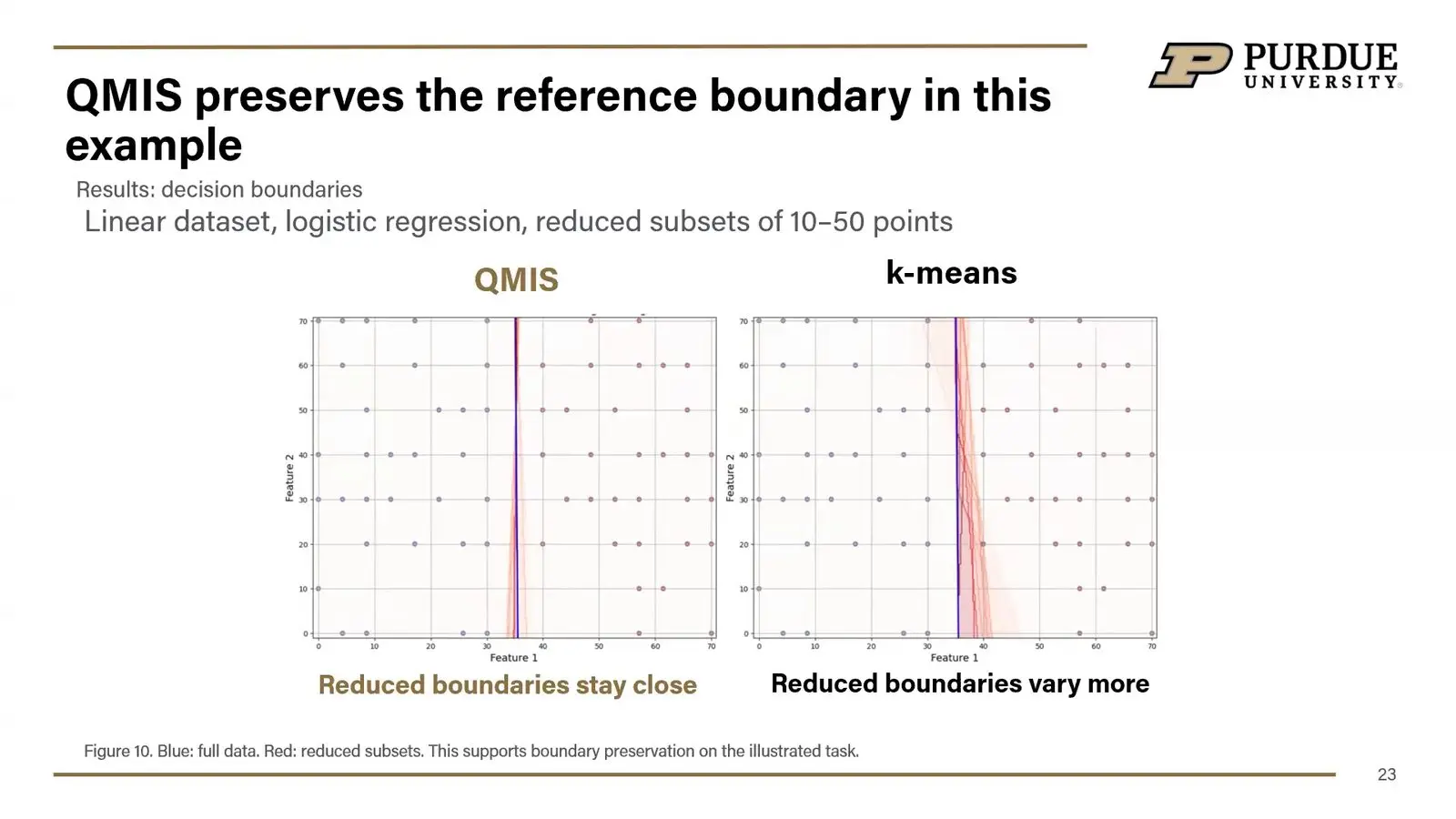
Against a standard classical method, the scores held up as fewer points were kept, with a small edge when only 10 to 20 percent were left. Zhang reported no speed-up and claimed no advantage, and the talk did not say whether the runs used a device or an emulator.
Algoma searches circuit settings with a memory
Shahroz Abbas of Algoma University, with Ajmery Sultana, built a tool that looks for the best settings of a quantum classifier and keeps a memory of what it has tried. The job was to spot break-ins on the network links of medical devices.
Three trials Abbas showed climbed from an F1 score of 0.8846 to 0.9805, with the best recipe using four qubits out of the ten the search could try. All tests ran on simulators.
Wells Fargo fuses quantum and classical models
Samuel Yen-Chi Chen of Wells Fargo presented work with colleagues at Fordham and St John’s. Keeping only the single best model leaves signal behind, Chen argued. The method picks a varied set from a pool of 29 models in four families, both quantum and classical, and then fuses their scores into one answer.
Fusion beat the best single model on every data set shown, such as lifting a heart-disease score from 0.9106 to 0.9444. The winning mixes all held both quantum and classical members.
Korea University lets a language model pick the quantum agent
Hyojun Ahn of Korea University built AQuA-Cache for short videos, where tastes shift fast and each refresh of a cache costs network time. Three small quantum agents, each a four-qubit circuit, were trained to weigh quality and cost in different ways, and every 100 time slots GPT-4o read a summary and chose which agent should run.
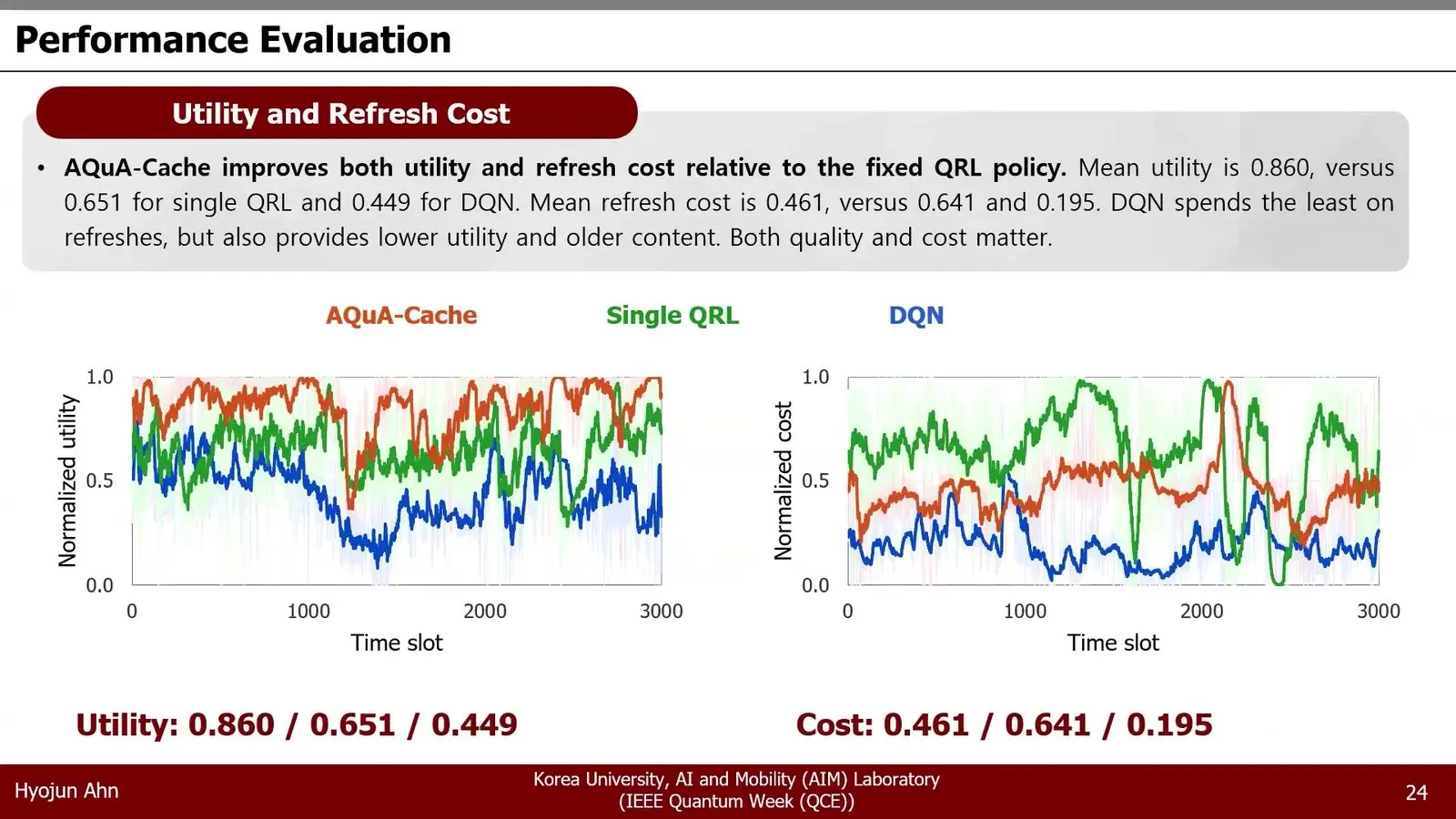
Over 3,000 simulated slots the mix scored a mean utility of 0.860. One balanced agent scored 0.651 and a classical deep Q-network scored 0.449, though the classical network spent least on refreshes by keeping older videos in the cache. Ahn said real traffic, a fair classical rival and tests on hardware must come before any claim.
NVIDIA shrinks GPT-2 with quantum-inspired activations
Jiun-Cheng Jiang of NVIDIA and National Taiwan University taught quantum-inspired Kolmogorov-Arnold networks, which learn the shape of the function on each link of a network. In QKAN each of those functions is a one-qubit circuit that reads the input several times. A layer of 32 inputs and 32 outputs, run on a batch of 1,024, makes about a million such circuits, so FlashQKAN packs them into tiles on a graphics card. The slides claimed it ran 100 times faster.
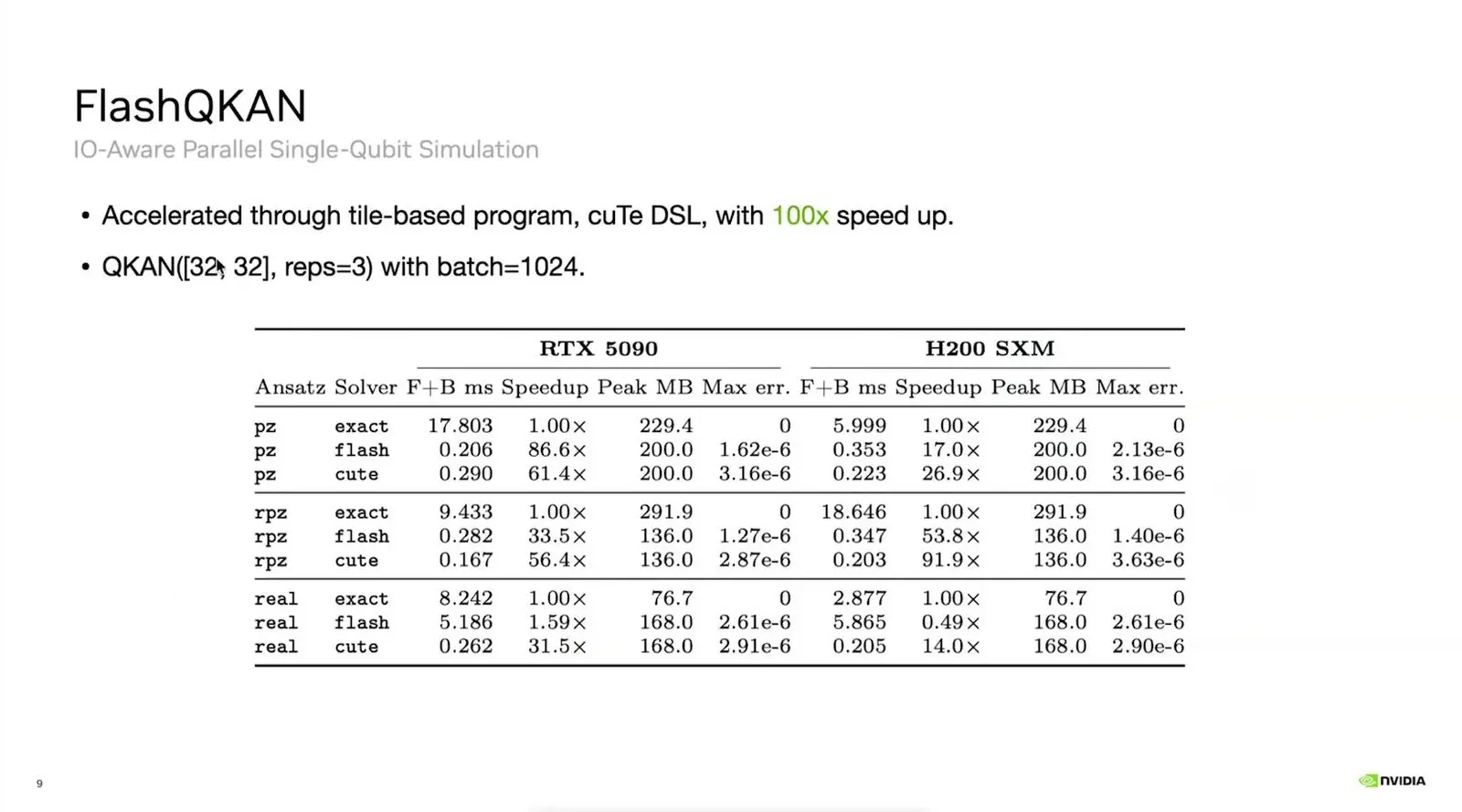
Swapping GPT-2’s feed-forward block for a QKAN layer shrank that block about 300 times, and the model trained 1.63 times faster. Everything ran on graphics cards.
Abu Dhabi weights noisy clients in federated learning
Walid El Maouaki of the eBRAIN Lab at New York University Abu Dhabi won a best-paper award in the machine learning track with Muhammad Shafique. In federated learning, each client keeps its data and sends only updates to a server that averages them. Quantum clients may run on hardware with very different noise.
Q-RAIL scores each client from its device data and its circuit, then weights its update. The largest gap was an accuracy of 0.877 against 0.777 for plain averaging, in simulations built from IBM noise data.
Marquette drops gradients from federated training
Fabrice Kameni of Marquette University did away with slopes, the usual guide for training, because finding each one costs two circuit runs for every setting. The loop adds shots only when results get better and steps back if accuracy falls.
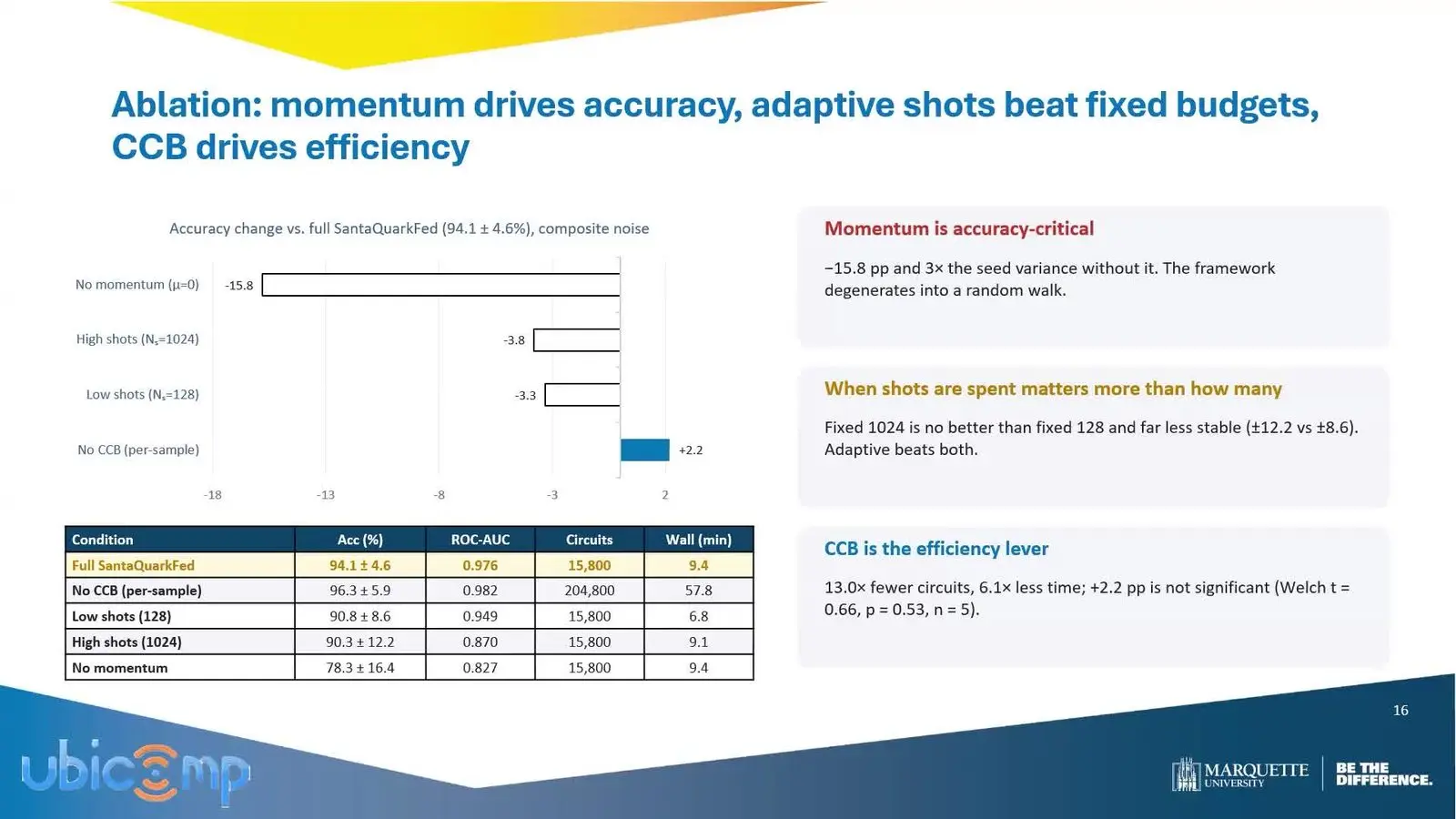
On a simple noiseless test with handwritten digits the method reached 98.6 percent, against 97.4 percent for a standard rival. Kameni agreed that the rival still used fewer circuits and less time.
Alabama turns shot noise into privacy
Dinh Nguyen, an assistant professor at the University of Alabama in Huntsville, said the scatter from a small number of shots could guard privacy when many sites train one quantum model. A common privacy method hides each record by adding a set amount of noise, tracked by a budget called epsilon. A circuit read out with few shots has that noise built in.
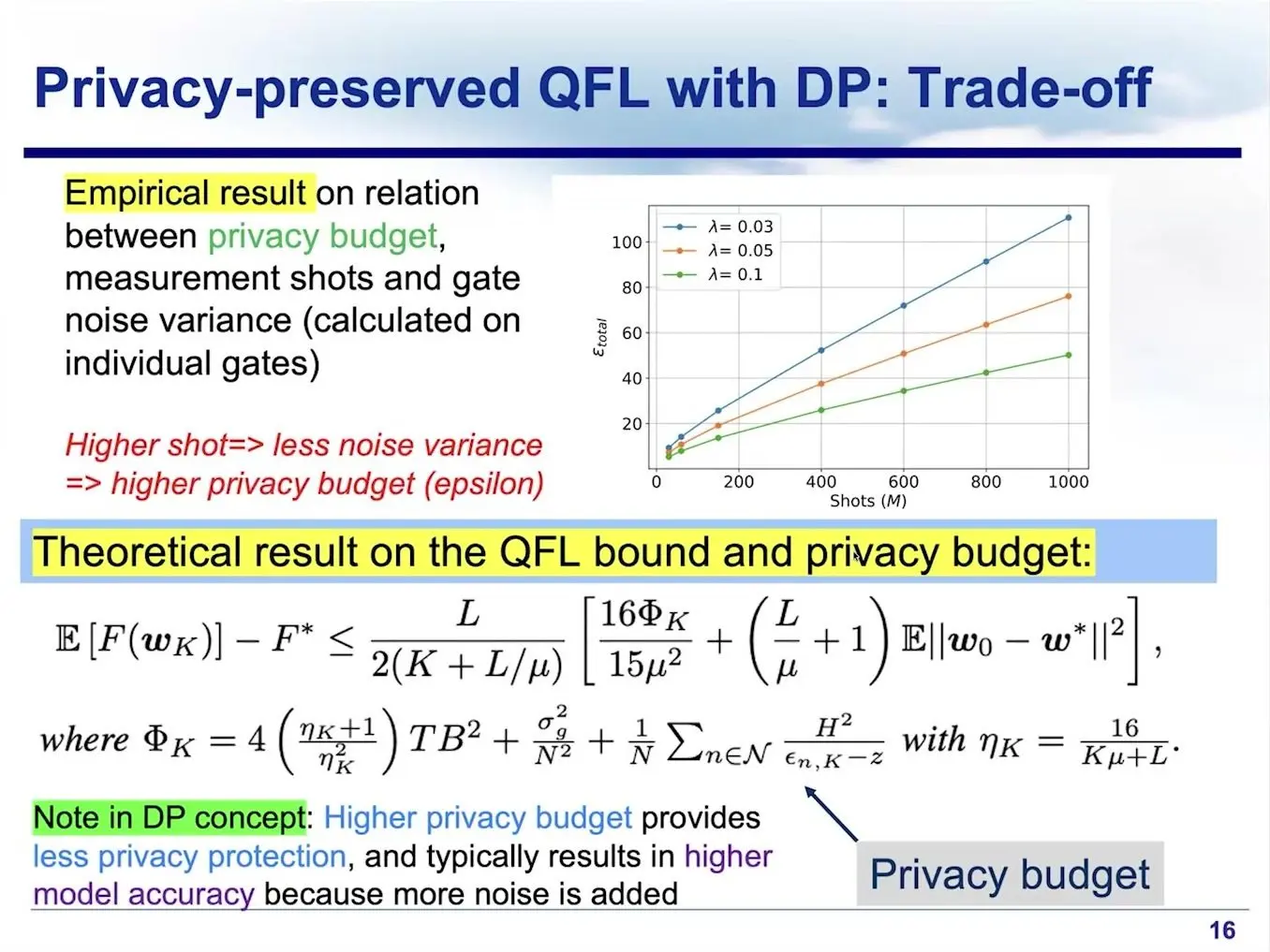
More shots mean less noise and a larger budget, so privacy and accuracy pull against each other, and Nguyen gave a bound on training error that shows the same trade. The main worry was that sites differ in data, qubits, depth and noise. For each kind of difference Nguyen listed a remedy, from personalised training to dropping very noisy devices.
Taiwan trains a heartbeat classifier across simulated hospitals
Chun-Hua Lin of National Taiwan University worked with Samuel Yen-Chi Chen and Hsi-Sheng Goan. The team trained a heartbeat model across many simulated hospitals on the MIT-BIH records, where one kind of beat makes up close to 80 percent of the data and another under 1 percent. So plain accuracy misleads. The learned functions came from circuits that read the data again and again.

The model trained 11,581 settings against 18,485 for a standard network, 37.4 percent fewer, and sent 24.89 percent less data each round. Across 8, 16 and 32 simulated clients it scored higher on macro F1 and held up better as data grew more uneven between hospitals. Its sensitivity on the rarest class was slightly lower.
Molecules, medicine and the matched classical twin
Six talks took quantum models to drug molecules and patient records. The most telling gave the quantum model a classical rival of the same size, and the rival usually kept pace or won.
A molecule-shaped circuit loses to a classical twin of the same size
James Pegg, Hubert Okadome Valencia and Ronin Wu built a nine-qubit circuit shaped like the molecule it reads. Each heavy atom gets a qubit, and a gate that links two qubits sits only where there is a bond, with angles shared by element and by bond type. Beside it the team built a classical twin with the same 64 settings.
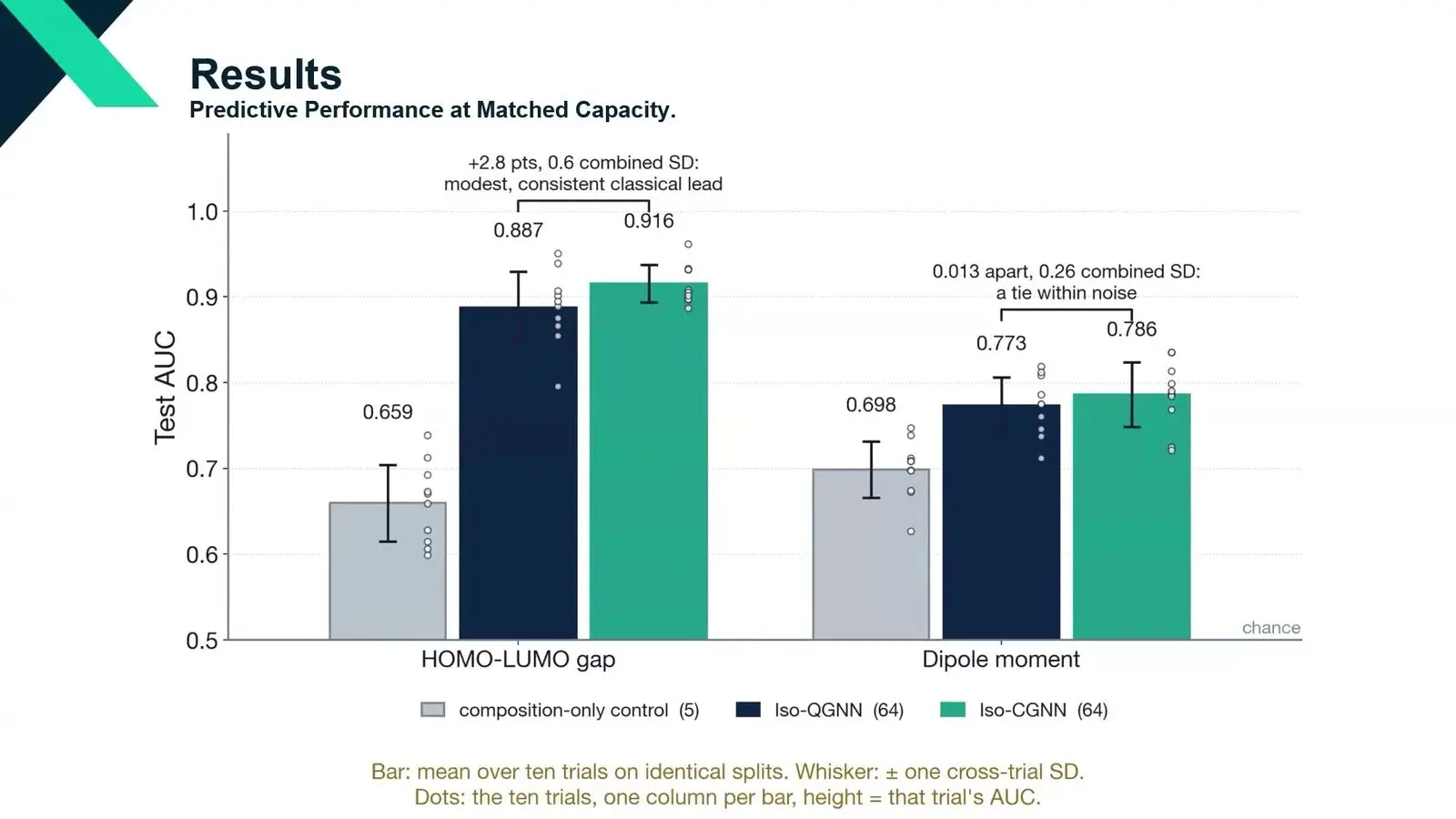
Over ten trials on QM9 molecules, the twin scored 0.916 on the gap between two energy levels, against 0.887 for the circuit, and the two tied on the dipole. With small training sets the classical model learned faster. It reached 90 percent of its best at 100 molecules, where the quantum one needed 250 to 300, and the whole test ran on a noiseless simulator.
Bit-string collisions sink a quantum head on drug molecules
Shunji Matsuura, with Sonika Johri of Cascade Quantum, put a 10-qubit quantum head on ChemBERTa, a language model for chemistry, to predict whether a drug gets into the brain. ChemBERTa turns each molecule into a list of numbers. A 10-qubit head needs that list cut down to 10 bits, and in the end the head scored 0.761 against 0.821 for plain logistic regression.
Matsuura blamed clashes. Two molecules that a model with smooth numbers can tell apart may land on the same bit string, and then no head can split them. On a four-qubit version Matsuura counted over 10,000 such clashes among 600 training molecules. A fix called DAFT tunes the numbers so molecules land on different strings, though no new test score was shown.
Istanbul matches a random forest on IBM hardware
Maral Mahmoudi Kamelabad of Istanbul Technical University worked on the same question with three co-authors. Each molecule was mapped onto 12 qubits. The test set held 250 molecules, half that get into the brain and half that do not, and each model was scored ten times over on fresh splits of the data.
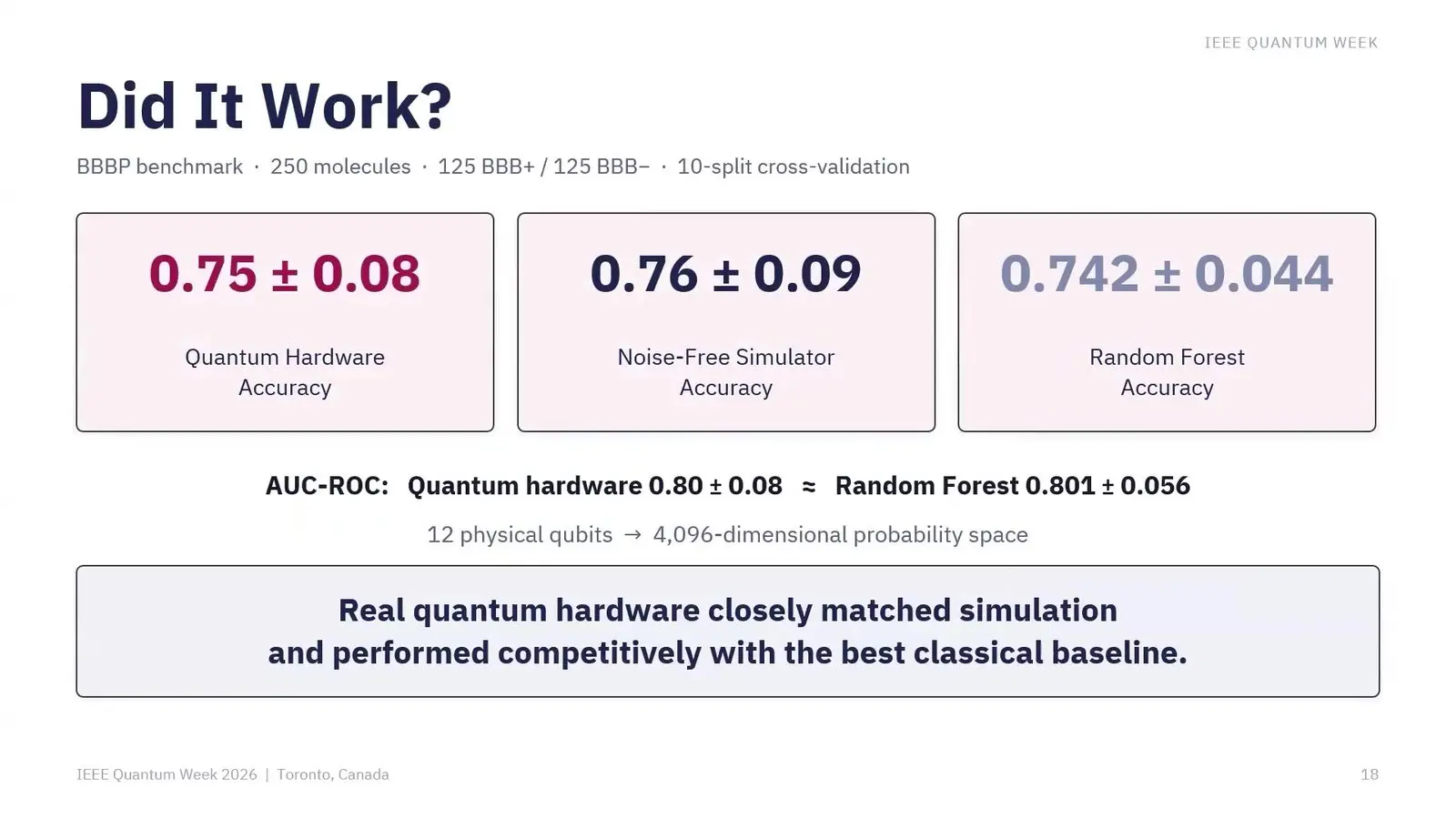
On IBM hardware the classifier scored 0.75, against 0.76 for a noiseless simulator and 0.742 for a random forest. More qubits did not help. Across six layouts accuracy fell as low as 0.67 at the widest, which the team blamed on routing and noise as the register grew from 10 to 16 qubits.
Rensselaer finds the readout decides an IVF model’s fate
Mehtap Agirsoy of Rensselaer, with Batuhan Yalcin and Matthew Oehlschlaeger, tried to predict live birth against miscarriage for 1,017 IVF patients who were already pregnant. Agirsoy called it a first look. The study made no claim of use in the clinic or of quantum advantage, and four inputs fed a four-qubit circuit run on a simulator, a noise model and a 127-qubit IBM Eagle.
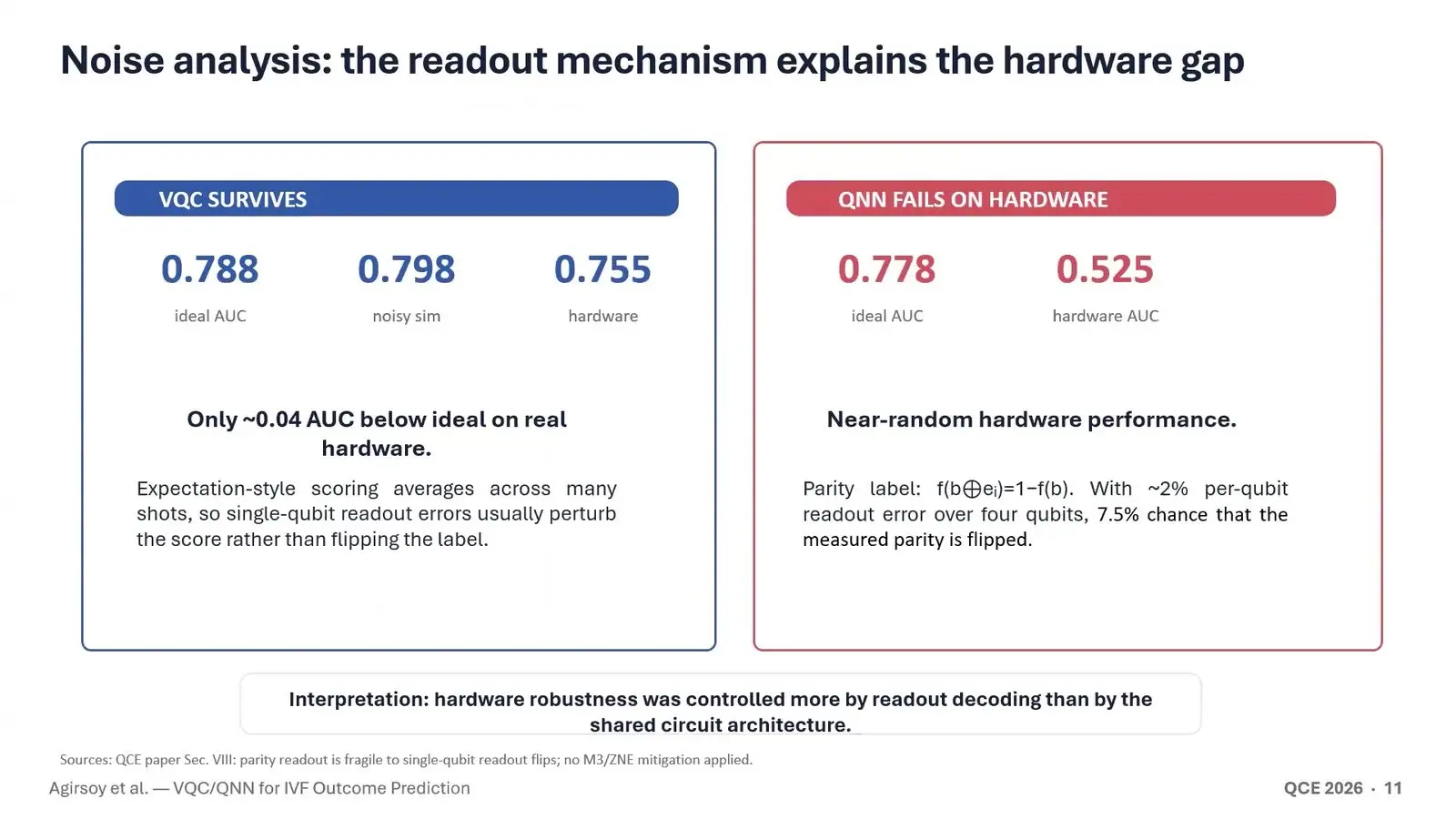
The classifier that averages many shots into a score kept an AUC of 0.755 on hardware. A network that reads the parity of each bit string fell to 0.525, close to chance, because about 2 percent readout error per qubit flips the parity 7.5 percent of the time. A random forest on the same four features reached 0.85. The hardware test covered 30 patients.
Cascade Quantum counts the qubits a cancer data set needs
Sydney Leither of Cascade Quantum counted about 49 published papers that apply quantum machine learning to cancer data, some of them claiming an edge from half a point of accuracy. The team’s fix has three parts. It works out how many qubits each data set needs, tunes the classical rivals by search in place of default settings and then runs Cascade’s own quantum model.
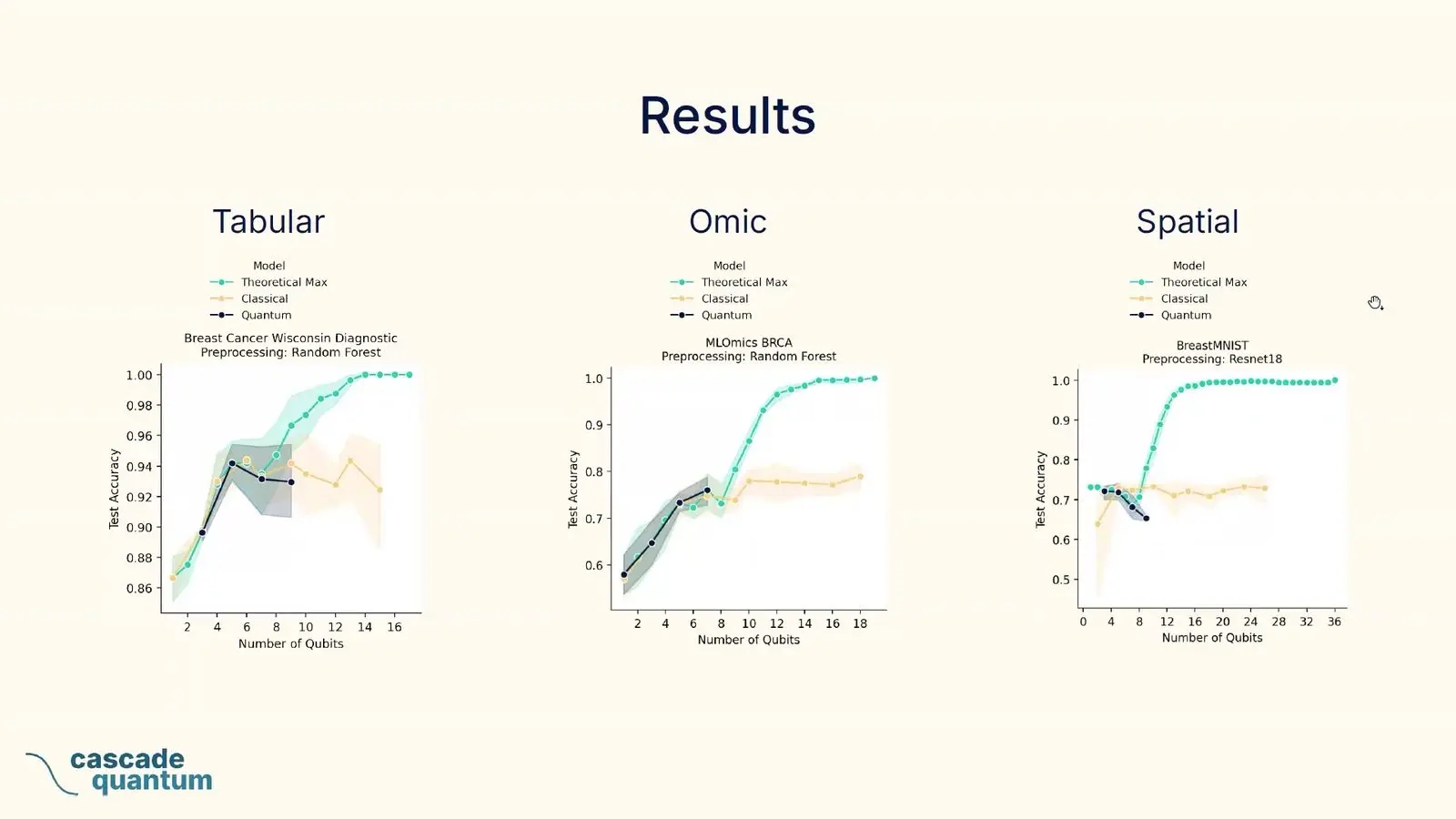
The count splits each input into bins and finds where two classes land in the same bin, which caps the score any model could reach. The Wisconsin breast cancer set splits cleanly at 17 qubits. A laptop can handle that. There the best classical model sat near 95 percent and the simulated quantum model kept pace, while the image set BreastMNIST needed 37 qubits.
Bengaluru’s tiny hybrid ties a classical network of the same size
Sachin Namdeo of the Centre for Development of Advanced Computing in Bengaluru wanted small image models for hospitals that are short of money and machines. PEVN shrinks each scan to six numbers with classical layers and then runs them through a six-qubit circuit. It has about 1.33 percent of the settings of ResNet-18. All of it was simulated.
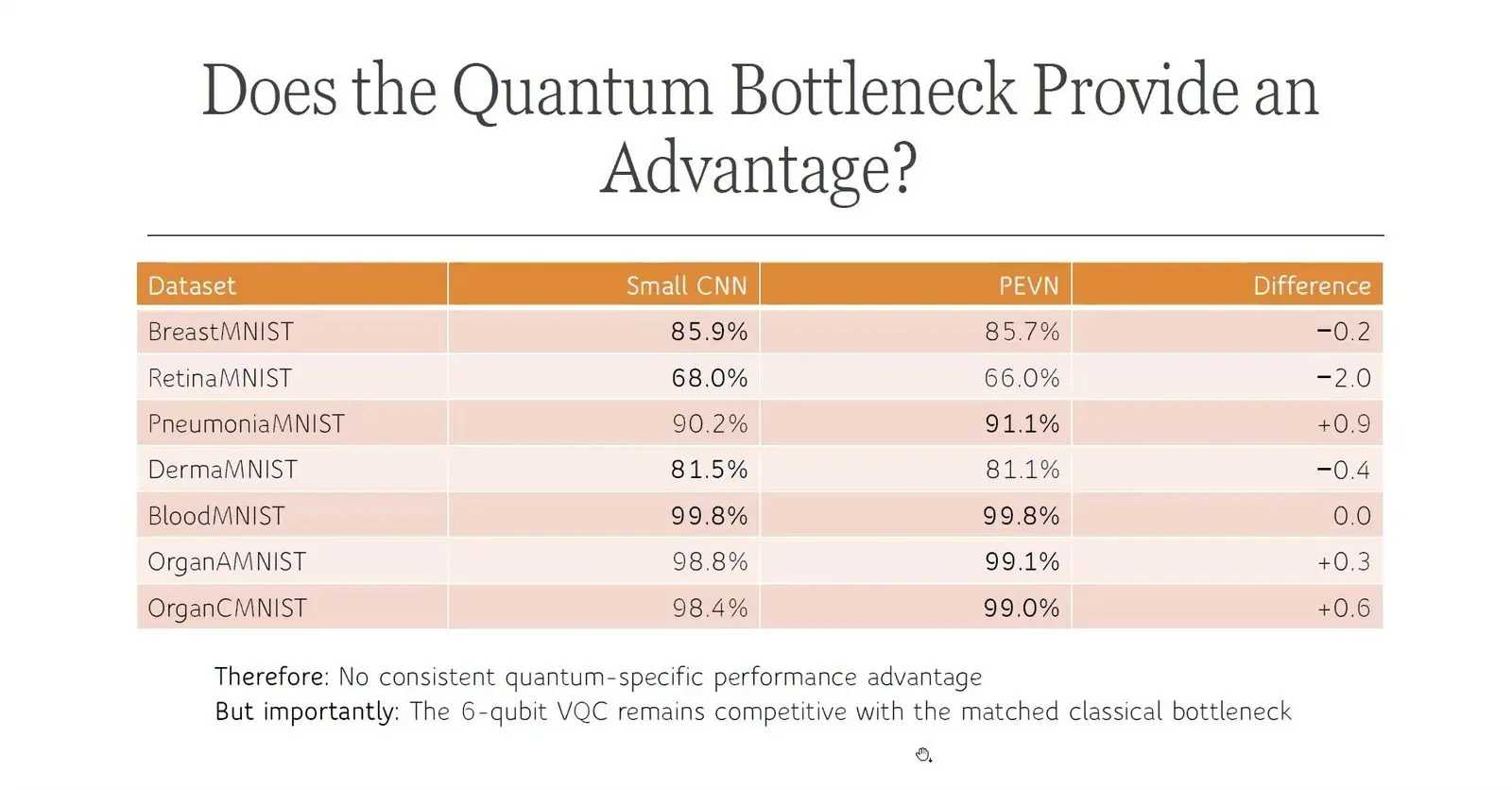
PEVN reached up to 99.8 percent on the easier MedMNIST sets. A classical network of the same size stayed within 2 points on all seven, from 2.0 points below on RetinaMNIST to 0.9 points above on PneumoniaMNIST, which is no gap worth the name. Namdeo claimed a lean model and no steady quantum edge.
Searching for the circuit before training it
Before a quantum model learns anything, someone has to choose its gates, its encoding, its measurement and its starting angles. Seven talks handed those choices to a search or a rule.
INSAIT’s mixed-state search beats its closest rival on max-cut
Swagat Kumar of INSAIT and NTU, with Jan-Nico Zaech, Colin Wilmott and Luc Van Gool, presented ρDARTS. A search of this kind picks which gates a circuit should hold. The smooth version makes that choice soft enough to train with slopes, and ρDARTS goes a step further by treating the choice of gate as a mixed quantum state.
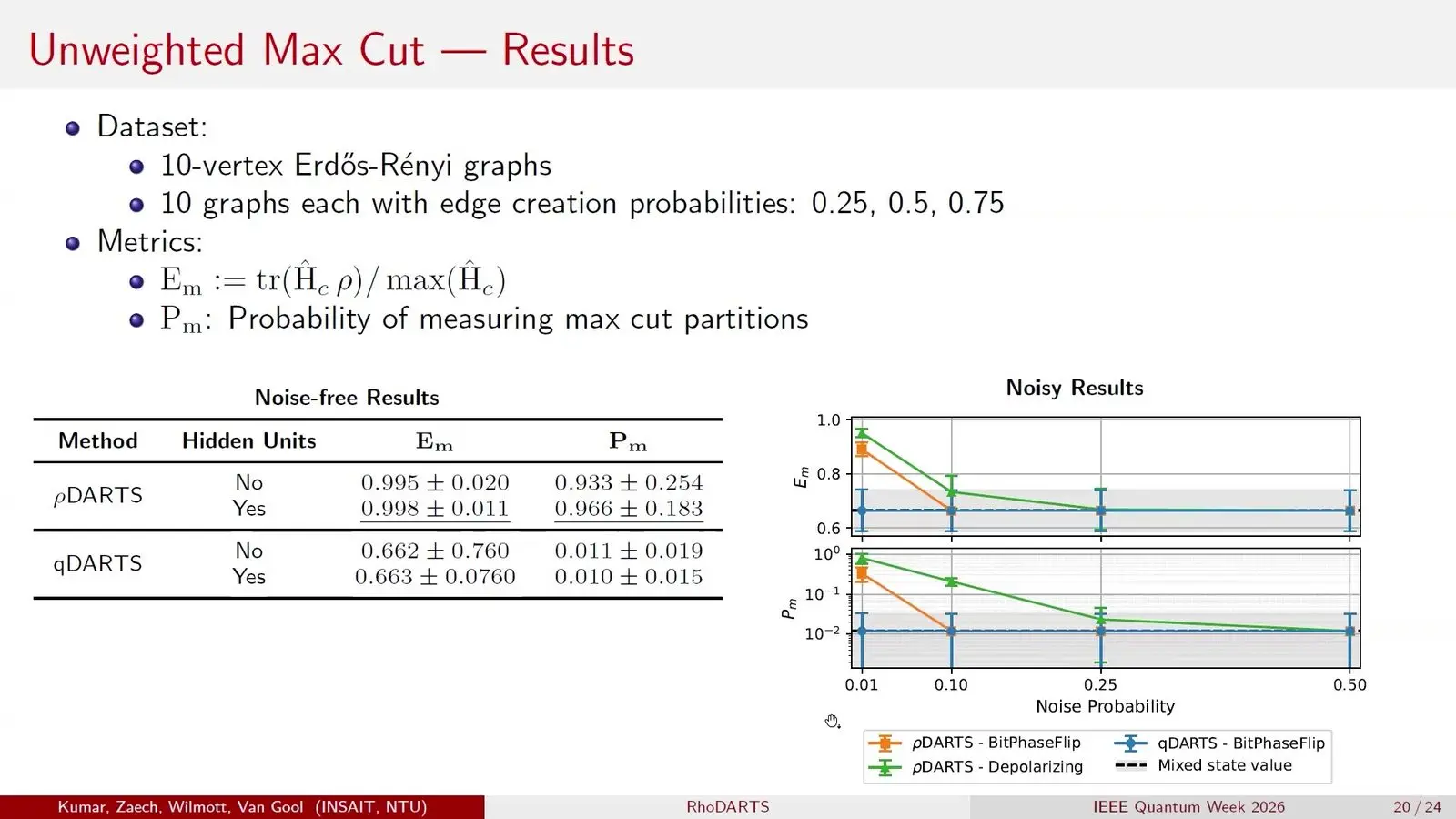
In simulation on graphs of 10 points, ρDARTS scored 0.998 and found a best cut with odds of 0.966. The older qDARTS scored 0.663. It found a best cut only about 1 percent of the time, and on molecules a rival method, CRLQAS, still did better on three of four test cases.
Western’s searched circuit sorts particle tracks better
Nadine Charaf of Western University worked with three co-authors, Samuel Yen-Chi Chen among them, on computer-made images from a particle detector filled with liquid argon. Each frame was 30 by 30 grey pixels. A search chose the layout of a quantum network in place of a fixed design, with 100 images for each of the seven kinds of particle in the set.

On seven particle types the searched network scored 70.9 percent against 56.3 for the fixed baseline, a gap clear of the spread over three runs. Each training epoch fell from 23.2 to 17.4 minutes. On a two-way task of muon against proton the gain was 1.7 points and the spreads overlapped.
Fraunhofer prunes the search for encodings by a third
Jeanette Miriam Lorenz of Fraunhofer IKS, with Lena Tokuhiro and Amine Bentellis, used Monte Carlo tree search, the method behind game-playing programs, to build the circuit that loads data into a quantum network. How data goes in sets which patterns the circuit can show at all. A cheap filter ranked the candidates and dropped the bottom 35 percent.
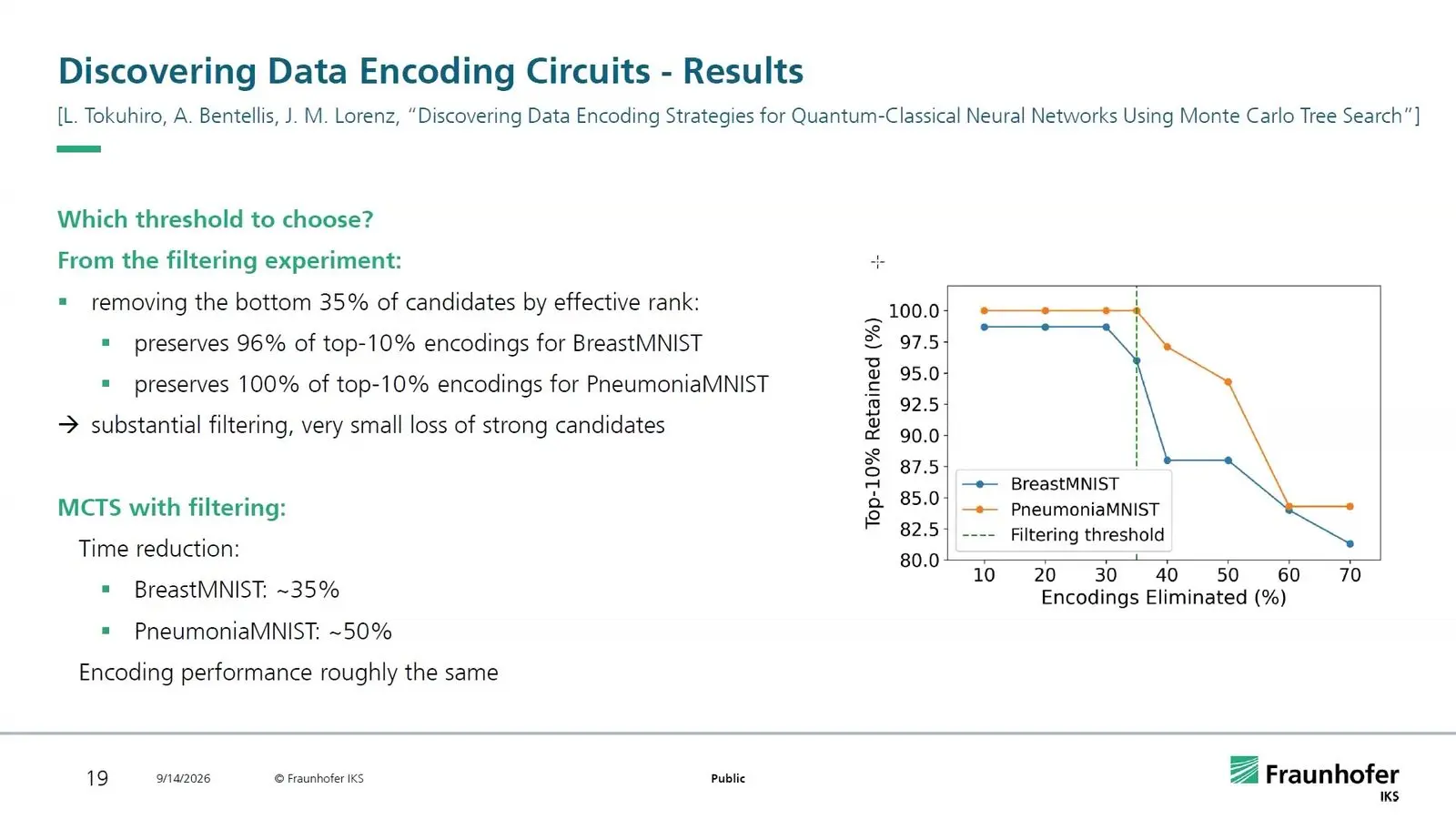
That kept 96 percent of the best tenth of encodings on BreastMNIST and all of them on PneumoniaMNIST, while search time fell by about 35 and 50 percent. The runs were noiseless simulations on small medical image sets. Lorenz made no claim of quantum advantage.
Wells Fargo screens out gates the measurement cannot see
Samuel Yen-Chi Chen of Wells Fargo presented work with Brookhaven National Laboratory and Stony Brook University. Some gates leave the final reading just as it was. So many circuits that look different do the same job, and the team gave each candidate gate a score from zero to one, where one means the reading cannot see it at all.
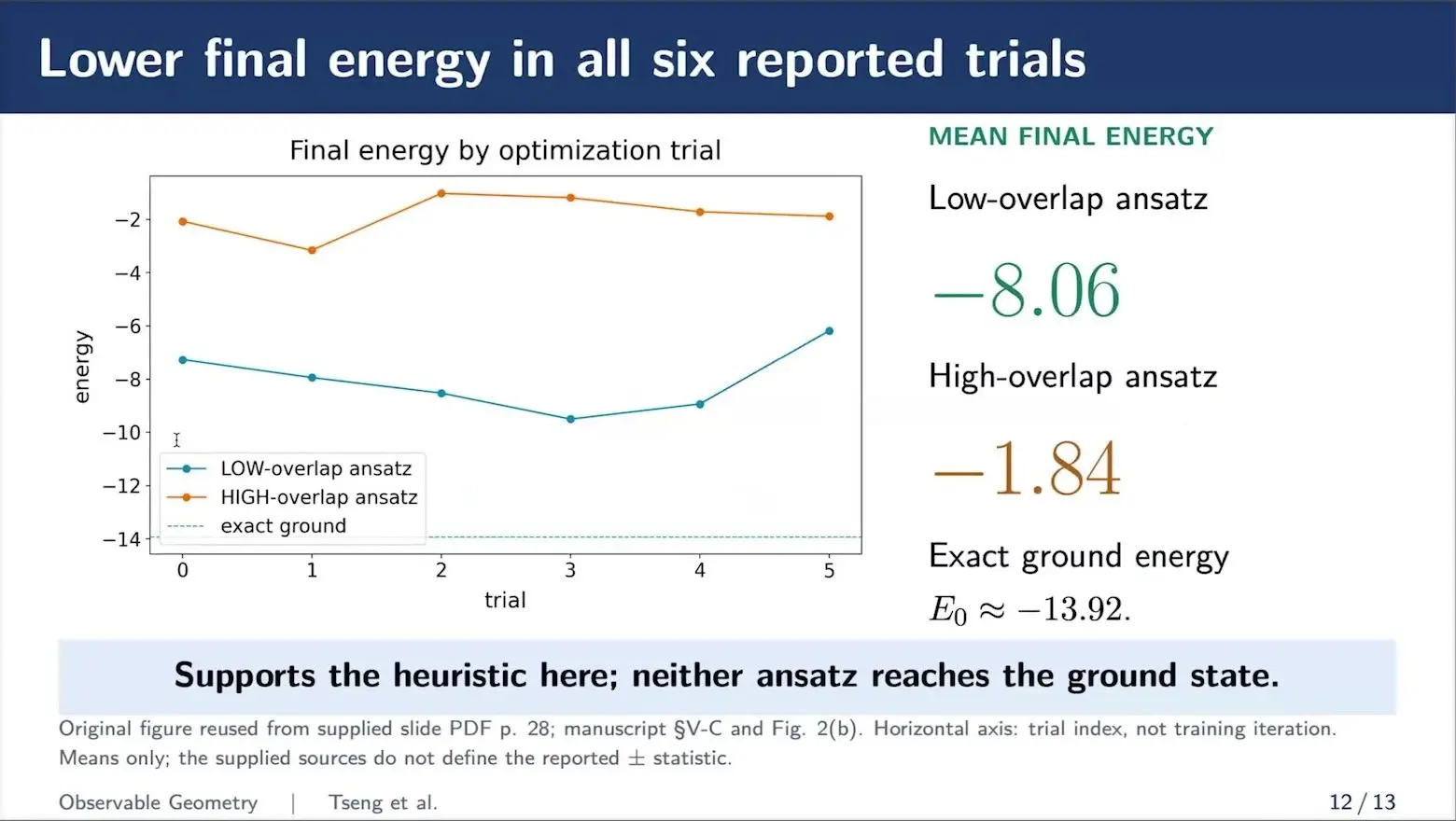
A circuit made of the 24 lowest-scoring gates reached a mean energy of minus 8.06 over six trials, against minus 1.84 for the 24 highest. The true answer was about minus 13.92. Neither got there. Chen offered the score as a way to screen gates before a search, tested so far on one problem.
Penn State trains the measurement and rescues a face classifier
A Penn State researcher in electrical engineering presented DANO, which trains what is measured as well as the circuit. The quantity measured is kept simple, with its values free to learn, and the circuit does the rest of the work by turning each input to face it. The saving is large. At eight qubits, the speaker said, about 60,000 settings shrink to about 300.
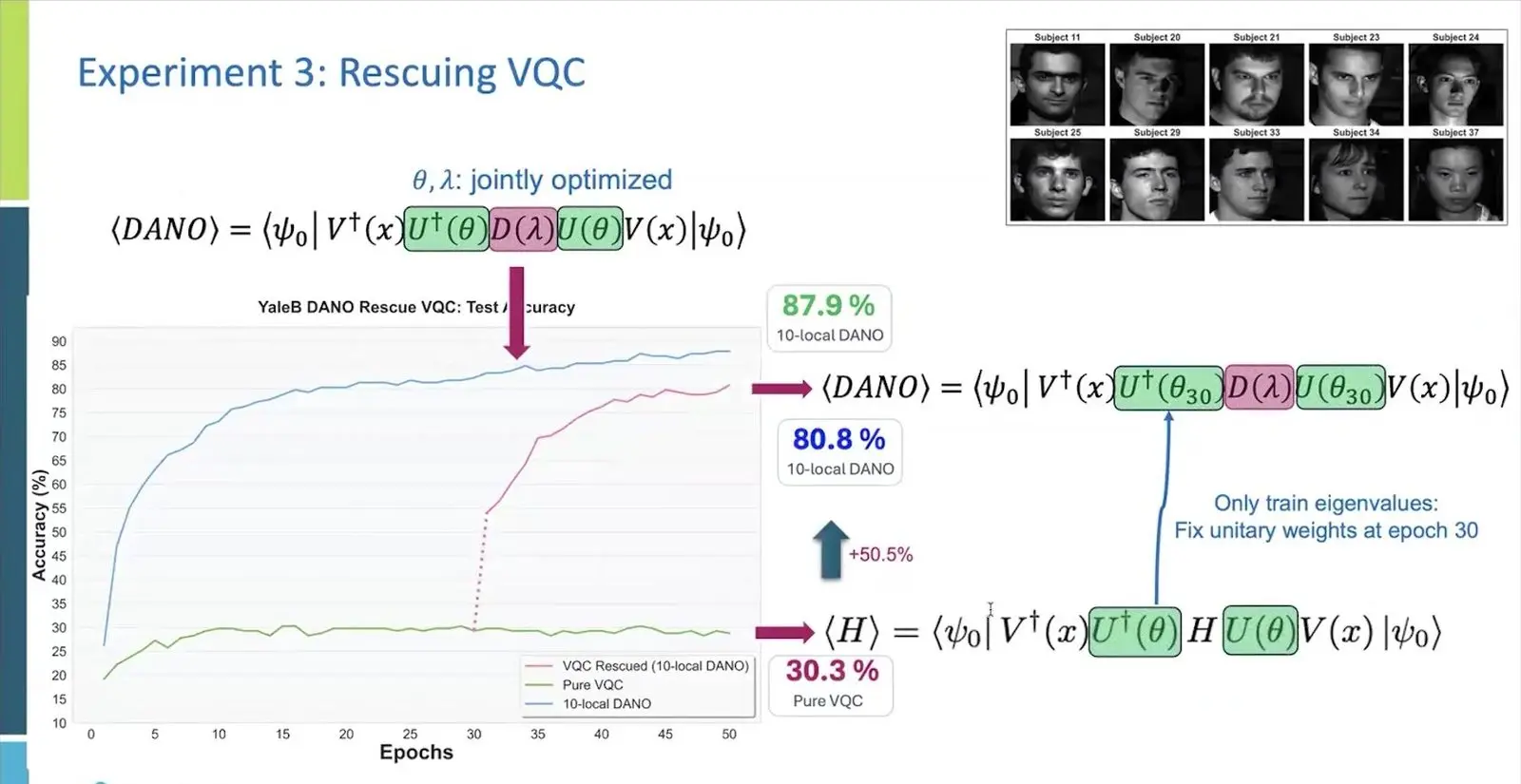
On the YaleB face set a plain variational circuit stalled near 30.3 percent. Training DANO jointly with the circuit reached 87.9 percent. Freezing the circuit at epoch 30 and training only the observable’s values climbed to 80.8 percent, and the speaker made no claim that DANO leads on every task.
Fujitsu tunes the dice that set a circuit’s starting angles
Ankit Kulshrestha of Fujitsu, with Sarvagya Upadhyay, argued that the rules for drawing a circuit’s first angles matter and have barely been studied. A tiny change to two shape numbers changed the spread of slopes. Kulshrestha scored each choice by how sensitive the output is to its settings, by how steep the slopes for the task are and by a blend of the two.
Tuned starts came close to the lowest energy of hydrogen in about 40 steps. On three sets of data to sort, the task-aware score beat hand-picked settings by at least 9 percent, and tuned starts neither caused flat training regions nor put them off. The catch was cost. Kulshrestha conceded that the test left out the cost of the search itself.
NYU Abu Dhabi tunes photonic noise as a setting
Nouhaila Innan of the Center for Quantum and Topological Systems at NYU Abu Dhabi treated the noise of a light-based chip as a dial to tune. In Quandela’s Perceval simulator, seven kinds of noise could be learned, among them how bright the source is and how alike its photons are. A genetic search then picked the noise for each data set.
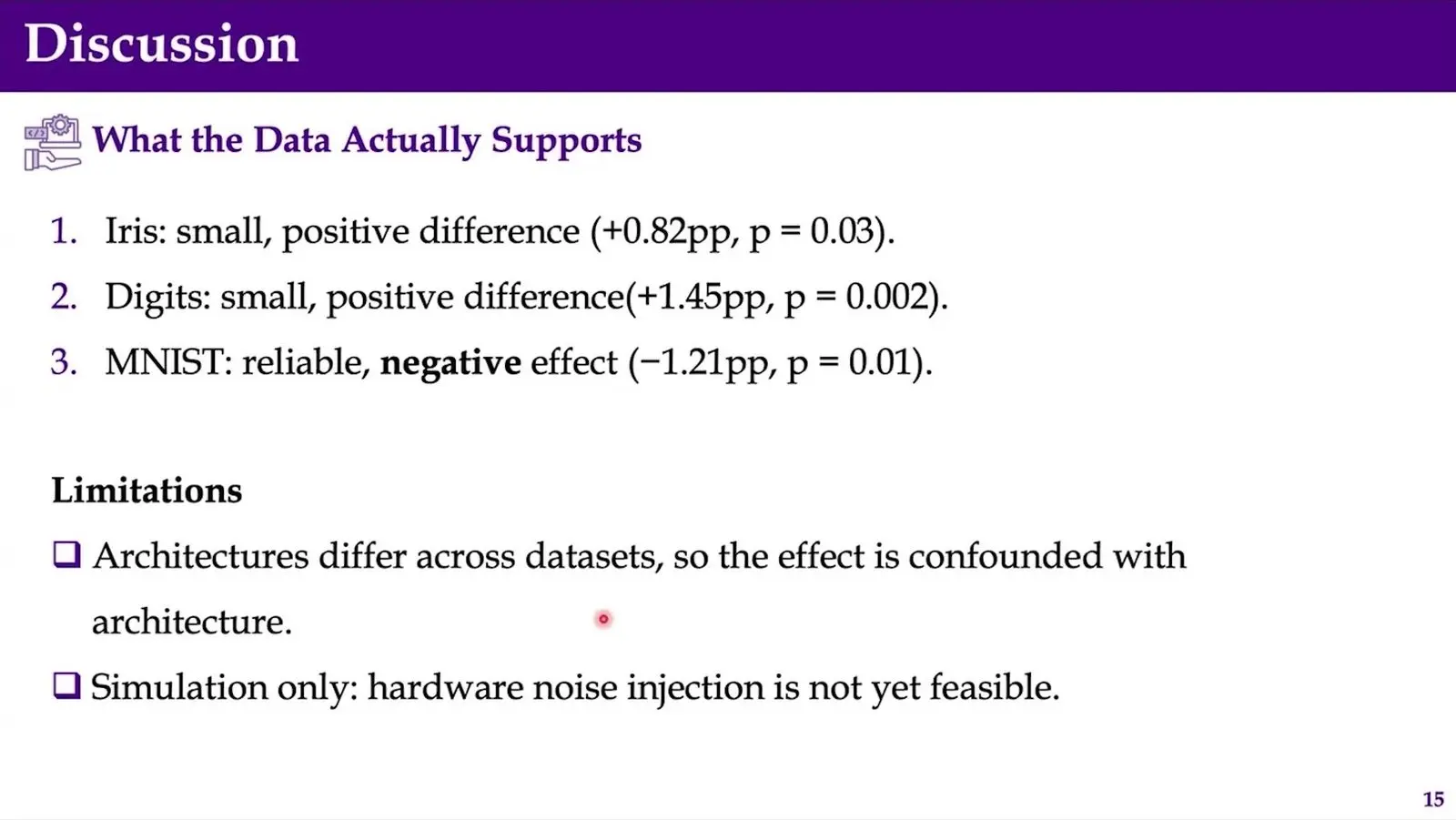
Against training with no noise, the tuned noise gained 0.82 points on Iris and 1.45 on Digits. On MNIST it lost 1.21 points. Everything ran in simulation, since nobody can yet add chosen noise on hardware, and the team said small noise acts a little like a penalty on sharp answers.
What it means for quantum machine learning buyers
Anyone weighing a quantum machine learning pilot should ask for Park’s rules before looking at the result. That means one tuning budget for every method, no test labels in the choice of model, several random seeds and a classical control given the same chances. Knitter’s study adds a second demand. A hardware result should report power and shots as well as accuracy.
For a plain introduction to the field, see our guide to quantum machine learning. Almost every number in this guide came from fewer than 20 qubits or from a simulator, so the good results are lessons in design. They fall short of proof of advantage. At QCE26 the scorekeeper had a better week than the players.
Frequently asked questions
What is quantum machine learning?
Quantum machine learning uses quantum circuits to classify, forecast or generate data. Data is turned into quantum states, a circuit acts on them and the results are measured. Most current work trains small circuits with a classical optimiser, and most of it still runs on simulators.
Does quantum machine learning beat classical machine learning?
Not yet on everyday data, on the evidence at IEEE Quantum Week 2026. Several talks reported small gains, but most came from simulators, used few qubits and faced only one or two classical rivals. Under a strict protocol from Yonsei University, a 10-of-10 winning record turned into a losing one.
What is a quantum kernel?
A quantum kernel uses a quantum circuit to measure how alike two data points are. A classical method such as a support vector machine then uses those scores to draw a boundary between classes. Kernels are among the easiest quantum models to compare fairly with classical ones.
What is a barren plateau?
A barren plateau is a flat region where a quantum circuit’s training signal almost vanishes, so learning stalls. It is linked to heavy entanglement and to large, random circuits. At QCE26 Jadwiga Wilkens showed a way to spot it early, and warned that hardware noise can mimic the warning sign.
Has quantum machine learning run on real quantum hardware?
Yes, at small scale. Luke James Miller used 66 IBM qubits to separate hard pairs of graphs, and IonQ ran a language-model head on 10 to 18 qubits that cut error by 15.7 percent against classical baselines. IonQ’s own study found the device used more energy than a simulator at every width it measured.
What happened at IEEE Quantum Week 2026?
IEEE Quantum Week 2026, also called QCE26, ran from 13 to 18 September at the Metro Toronto Convention Centre. This guide covers 69 of its quantum machine learning talks, from paper sessions, workshops and tutorials. The most useful of them were about how to judge a quantum model fairly.
This guide is based on 69 talks at IEEE Quantum Week 2026 (QCE26), held at the Metro Toronto Convention Centre from 13 to 18 September 2026, and on the published conference programme. Names follow the programme where it lists them. Affiliations and titles not listed there are as speakers gave them. Results are stated as each speaker presented them, and most come from classical simulators or small hardware runs. Company claims are the companies’ own.
- Qubit hardware and scaling roadmaps
- Photonics and quantum sensing
- Control electronics, calibration and readout
- Quantum error correction and decoders
- Fault-tolerant compilation and magic states
- Modular and distributed quantum computing
- Quantum computers in supercomputing centres
- Compilers, circuit synthesis and languages
- AI and language models for quantum software
- Testing and reproducible quantum experiments
- Benchmarks, error mitigation and quantum advantage
- Quantum state preparation, oracles and arithmetic
- Quantum optimisation, QAOA and annealing
- Chemistry, materials and life sciences
- Differential equations and fluid dynamics
- Power grids and energy
- Quantum finance
- Logistics, climate, databases and games
- Quantum networks and key distribution
- Quantum security and post-quantum cryptography
- Quantum education and workforce
- Policy, standards and the quantum business



See today’s quantum computing news on Quantum Zeitgeist for the latest breakthroughs in qubits, hardware, algorithms, and industry deals.