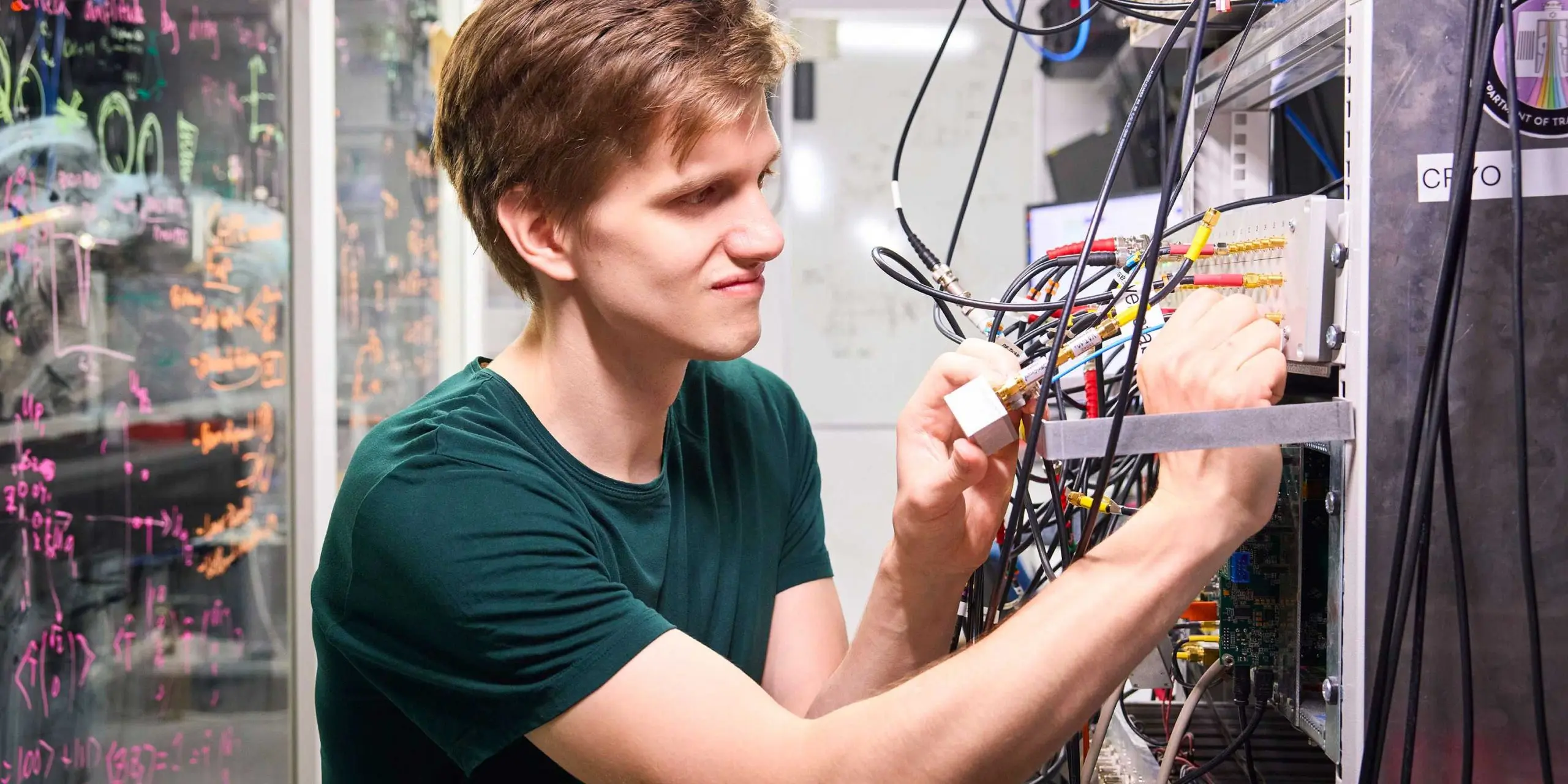
Three ETH alumni, Martin Stadler, Ferdinand Felder and Chidzahi Mabritto, founded Qendra to address a critical limitation hindering quantum computer scalability: inadequate control systems. The spin-off is building a central control device that functions like a conductor synchronizing lasers and cameras to ensure harmonious interaction with qubits. “Everyone listens to the conductor who ensures that the end result is a symphony and not just noise,” explains Stadler, a former Pioneer Fellow at ETH Zurich, describing how their system promises time savings and more reliable quantum operations for trapped ion and neutral atom platforms.
Qendra’s System Coordinates Quantum Operations with Trapped Ions & Neutral Atoms
Qendra’s system addresses a critical limitation in current quantum computing infrastructure. Existing control systems struggle with real-time error correction during calculations. Unlike conventional computers, quantum computers require immediate identification and rectification of errors, a capability absent in many platforms using trapped ions or neutral atoms. The company’s device doesn’t simply collect data after an experiment, but actively manages errors during the computation itself, a feature the founders believe is essential for building reliable machines.
“They collect measurement data during the experiment and then calculate what the result would have looked like with error correction. This is often sufficient for research purposes, but not for reliable and practical quantum computers, as errors need to be identified and rectified during the calculation,” explains Stadler. The control system functions by precisely synchronizing components like lasers and cameras, ensuring harmonious interaction between qubits, the fundamental units of quantum information.
This coordination is achieved through a central device that generates and manages the physical signals needed for quantum operations, effectively acting as a central component for the entire process. This approach contrasts with current methods, which often lack the responsiveness needed for complex quantum algorithms. Stadler, who recently held a Pioneer Fellowship at ETH Zurich, anticipates a substantial market for this technology, estimating potential revenues exceeding 1 billion USD within ten years as neutral atom quantum computing gains momentum.
The impetus to commercialize the technology arose during Stadler’s doctoral studies. “It became clear towards the end of my doctorate that the technology needs to be continued within a business environment in order to bring the product to market,” he says.
Qendra aims to establish itself as the standard provider of control systems for both trapped ion and neutral atom quantum computers within five years, a goal that reflects the growing demand for scalable and dependable quantum hardware. Stadler expressed personal enthusiasm for the work, stating, “I found it fascinating that you can apply the most powerful computing paradigm permitted by the laws of nature using a quantum computer.” He also acknowledged the challenges of balancing research and business leadership, admitting, “One of the biggest challenges is keeping up to date with both roles. I’m not so good at jumping from one role into the other.”
That’s fitting, as our control system will prove to be a central element in quantum computers.
Martin Stadler, Pioneer Fellow at ETH Zurich
Qendra Control System Addresses Limitations of Existing Quantum “Conductors”
Qendra’s system distinguishes itself from current approaches by incorporating real-time error analysis. Rather than simply executing instructions, the control system actively monitors qubit behavior and adjusts parameters on the fly. Quantum computer developers currently rely heavily on post-processing techniques, a workflow Qendra aims to streamline through integrated error mitigation. While the control system is already functional, the team acknowledges that large-scale deployment requires further refinement.
“Our control system is already pretty capable, but it isn’t quite ready yet to be rolled out on a large scale,” Stadler admits, outlining ongoing efforts to enhance robustness and scalability. The company’s name, derived from Old English and Sanskrit roots meaning “ruler” and “center” respectively, reflects its intended role as a central coordinating element in future quantum computers, as Stadler explains, “That’s fitting, as our control system will prove to be a central element in quantum computers.”
It became clear towards the end of my doctorate that the technology needs to be continued within a business environment in order to bring the product to market.
Martin Stadler, Pioneer Fellow at ETH Zurich
Qendra’s Device Employs Radio-Frequency Signals for Qubit Control & Correction
Qendra’s device generates radio-frequency signals with precision comparable to a radio broadcast, directing them to qubits via two distinct pathways: modulation of laser beams or direct transmission through antennas. This proactive error correction promises to improve the reliability and speed of quantum calculations.
This goal is to offer the standard solution for control systems for quantum computers using trapped ions and neutral atoms within five years, Stadler stated, outlining the company’s ambition to establish itself as a leading provider in the emerging quantum technology market. The device’s compact design, featuring numerous inputs, outputs and control lights, houses the complex circuitry responsible for synchronizing lasers, signal generators and oscilloscopes, allowing for precise control and analysis of electrical signals.
Our goal is to offer the standard solution for control systems for quantum computers using trapped ions and neutral atoms within five years.
Martin Stadler, Pioneer Fellow at ETH Zurich
Qendra Targets Billion-Dollar Market with Scalable Control System Technology
Stadler forecasts the market exceeding 1 billion USD within ten years, citing the suitability of neutral atoms for building quantum computers with a high number of qubits. This projection positions Qendra to capitalize on a growing demand for reliable and scalable control solutions, as the company aims to become a central element in the future of quantum computing. Chidzahi Mabritto now serves as CTO, allowing Stadler to focus on business development, a transition he previously found challenging while balancing technical and managerial responsibilities.
We believe that the market could well exceed USD 1 billion in ten years, as neutral atoms are currently gaining rapid momentum and offer a particularly suitable platform for quantum computers using many qubits.


See today’s quantum computing news on Quantum Zeitgeist for the latest breakthroughs in qubits, hardware, algorithms, and industry deals.