IEEE Quantum Week 2026 filled the Metro Toronto Convention Centre from 13 to 18 September, and this guide sorts 790 of its talks, panels and tutorials into 23 themes. Read together, they suggest that the ordinary machines around the qubits set most of the pace.
On the last morning of IEEE Quantum Week 2026, Friday 18 September, Matthias Troyer of Microsoft stood up in Hall G of the Metro Toronto Convention Centre and called the meeting engineering first and quantum second. Then Troyer described a quantum computer from the engineer’s side. Seen that way, it is mostly a classical machine joined to a fast network, and the qubits do their work only when classical signals tell them to. The quantum calculation, in Troyer’s phrase, is a side effect of those signals. Every one of them has to be paid for.
Troyer’s point was cost. Working back from what a chemist would pay to use a machine every day, Troyer arrived at about ten dollars a qubit for the electronics that drive and read it. At that price a rack of instruments for each qubit is out of the question, so the layer that shapes every pulse has to move into custom chips. Troyer’s model was Ethernet, which already turns a noisy wire into a near-perfect link with codes and checks. It was a plain vision of the most exotic machine in physics, and Troyer offered it without apology.
It was also the best summary of the six days before it. IEEE Quantum Week is the yearly IEEE conference on quantum computing and engineering, known as QCE, and its official site carries the full programme.
This series follows 790 of its talks, panels and tutorials from the qubit itself to the rules that will govern it. In most of them the hard limits and the firm results sat in the classical machinery around the qubits, in decoders, controllers, compilers and simulators, and in the people who check the claims. The quantum race is now being won or lost in the ordinary computer bolted to the quantum one. That is a less romantic story than the field likes to tell, and it is better news.
The strongest case against that reading came from the people who build qubits. On the Monday evening Rajeeb Hazra, who runs Quantinuum, reported a logical memory on the firm’s Helios machine that fails 4.6 times in 100,000 rounds for each qubit, with no runs thrown away. Ruslan Shaydulin of JPMorganChase ran a portfolio problem on qubits guarded by error correction. Rafal Janik of Xanadu put the objection most plainly, saying Aurora still loses so many photons that correcting its errors today would make its results worse. On this view the classical work is scaffolding, and it comes down once the hardware is ready.
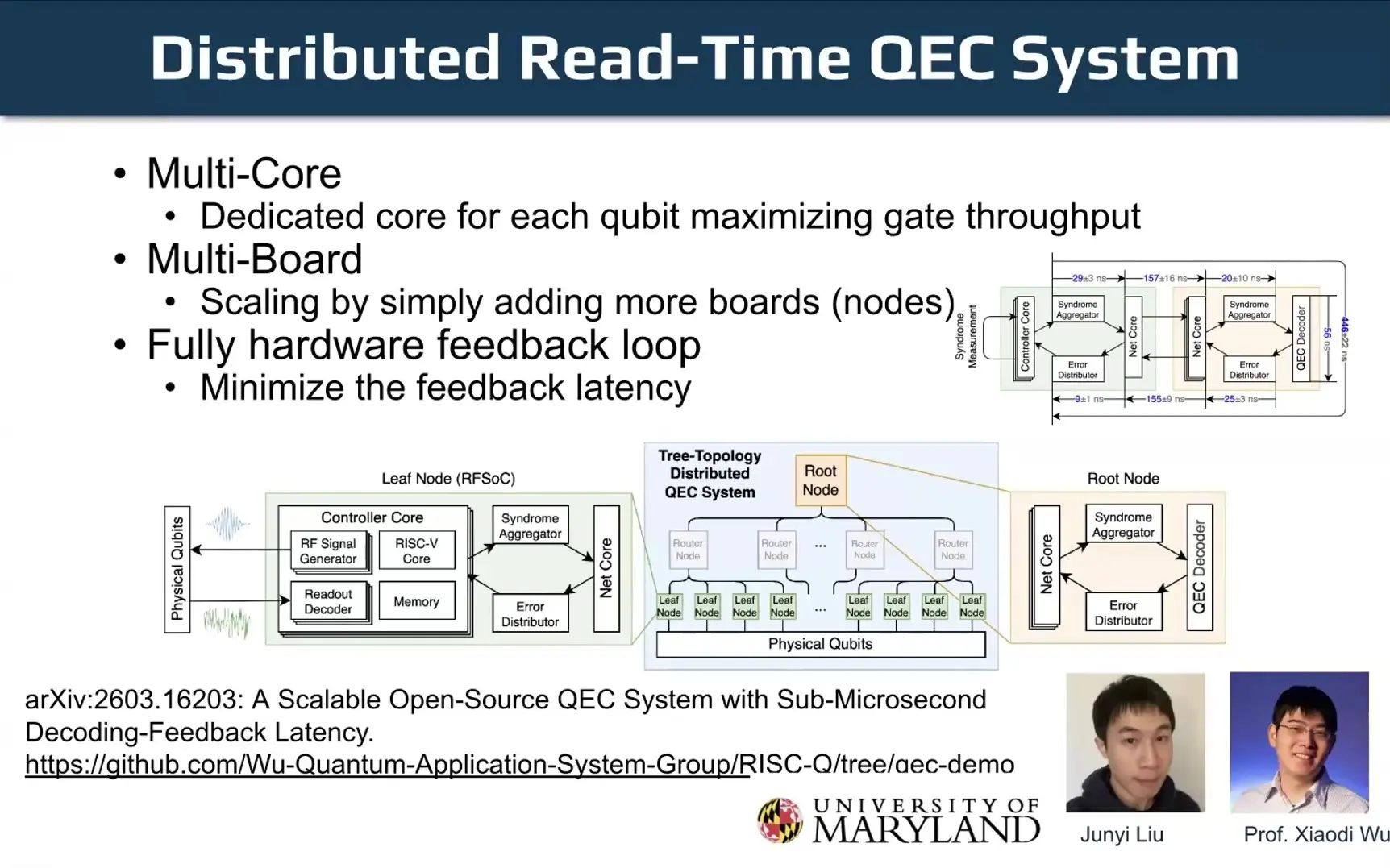
That case deserves its weight, and Hazra’s result is the best hardware number in this series. Yet scaffolding is the wrong picture. Error correction of the kind Hazra reported needs a classical decoder to read each round of checks and work out the fix. The only full superconducting loop timed in the error-correction talks, from the University of Maryland, took 446 billionths of a second with no qubits attached. Controller makers raced the same deadline mostly on stand-in qubits and looped-back cables, because the decoder and the electronics have to be ready before the qubits that will one day depend on them. The qubits will get better. Every gain will arrive through Troyer’s network.
The applications told the same story from the buyer’s side. Opening a Monday simulation workshop, Alán Aspuru-Guzik framed quantum chemistry as a race against classical methods that keep getting better. They kept gaining. Across the chemistry talks, classical and AI methods shrank the part of each problem left for a quantum step faster than the quantum machines could grow to meet it. The one saving in production in finance came from a bank’s scheduler for cash machines, and it runs on ordinary computers. In planning jobs from trains to vehicle routes, classical solvers matched or beat the quantum runs. Troyer’s affordable molecule is still some way off.
Strangely, the week’s most durable results were audits. A master’s student from Yonsei University watched a perfect record for quantum machine learning turn into a losing one once the test was made fair. Jonas Winklmann of the Technical University of Munich reran a famous compiler result under fair rules and watched a lead of more than 400 times shrink to about three. Nicole Hoess of Regensburg found that most published code packages in one study would not even start. Each of those checks ran on a classical computer, and each will outlive many of the claims it tested.
Troyer had a long view of why that matters. For 4,500 years, Troyer told the hall, the abacus and the latest graphics chip have shared one principle, and only the speed has changed. Computing has grown up the same way each time, as machines became things that people who did not build them could program, price and check. Troyer’s complaint that physicists like to keep quantum mysterious was aimed at that gap. An engineer, Troyer said, should not need a physics doctorate to help.
The rules are being written in the same spirit, and early. A US Department of Energy contest sets its bar in logical qubits, the error-corrected kind, and standards bodies count about 60 quantum projects under way. Both judge a machine by what its users can measure. That is Troyer’s test in another form, and Toronto was the week it became the field’s test too.
- Hardware and control
- Fault tolerance
- Systems and software
- Algorithms
- Applications
- Networks and security
- People and policy
What it was. IEEE Quantum Week 2026, or QCE26, ran from 13 to 18 September at the Metro Toronto Convention Centre. This series follows 790 of its talks, panels and tutorials, drawn from 340 sessions, in 23 themes and seven parts.
The pattern. In most themes the classical machinery around the qubits did the hard work and set the limits. Decoders, controllers, compilers and simulators drew more of the results than the qubits did.
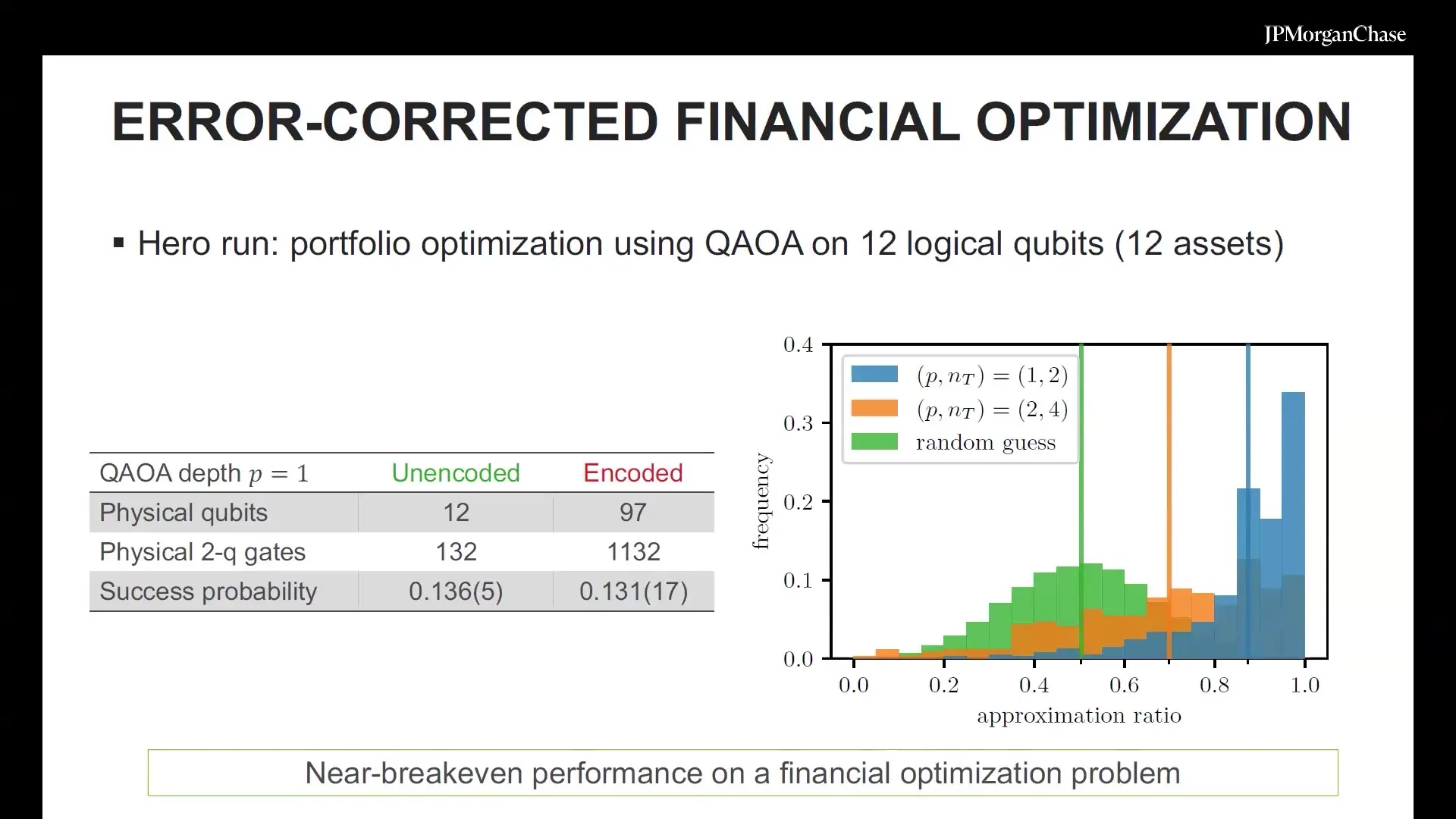
The best hardware results. Quantinuum reported logical memory on Helios that fails 4.6 times in 100,000 rounds for each qubit. JPMorganChase ran a 12-asset portfolio on 12 error-corrected qubits made from 97 physical ones.
The auditors. Classical simulators matched three experiments once billed as beyond classical reach. A fair rerun cut a 415.8-fold compiler lead to 3.26, and a strict test turned a 10-out-of-10 quantum record into a losing one.
The money. The one production saving reported in finance, 12.7 percent on cash for about 900 ATMs, came from a quantum-inspired method on ordinary computers. Most application results still ran in simulation or on small devices.
The rules. The US Department of Energy opened a competition worth up to 215 million dollars, with 100 million for machines of at least 100 logical qubits. Standards bodies count about 60 active quantum projects.
Hardware and control
Troyer’s bill of parts starts here. The qubit is one line on it, beside fridges, lasers, cables and racks of control gear, and the hardware talks spent more time on the other lines than on the qubit. At about ten dollars a qubit for control and readout, the racks have to shrink into chips before the machine can grow.
Qubit hardware and scaling roadmaps
The 19 hardware talks asked how a machine of a few hundred qubits becomes one of a million, and Xanadu, QuEra and IBM put dates between 2028 and 2033 on their plans. IonQ and Microsoft gave counts and costs instead. Rafal Janik of Xanadu argued that physics still sets the pace. Janik said Aurora still loses so many photons that correcting its errors today would make its results worse.
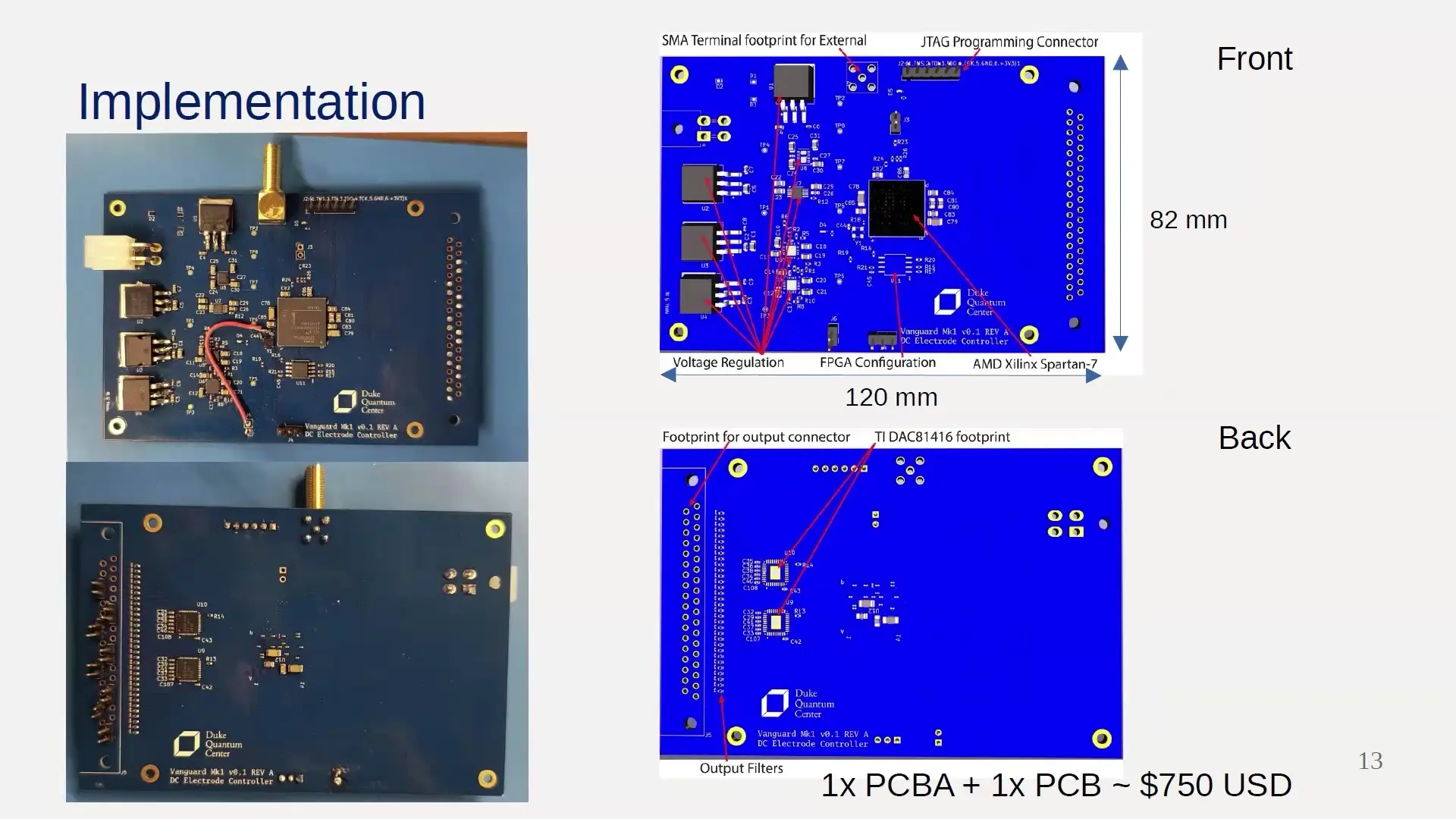
The firmest numbers came from small parts. A thin film of tantalum held its signal about four times longer, and a team at Duke built a voltage board for an ion trap for about $750 where a bought unit costs far more. Wiring came up in talk after talk, so our guide to quantum hardware at IEEE Quantum Week 2026 is mostly about cables.
Photonics and quantum sensing
The 15 talks on light and sensors treated each photon and each measurement as money. Quandela said its quantum dots give out a photon 80 percent of the times they are fired, and Fujitsu screened 29 diamond nodes on its chips and showed that linking them is still to come. Both were real devices.
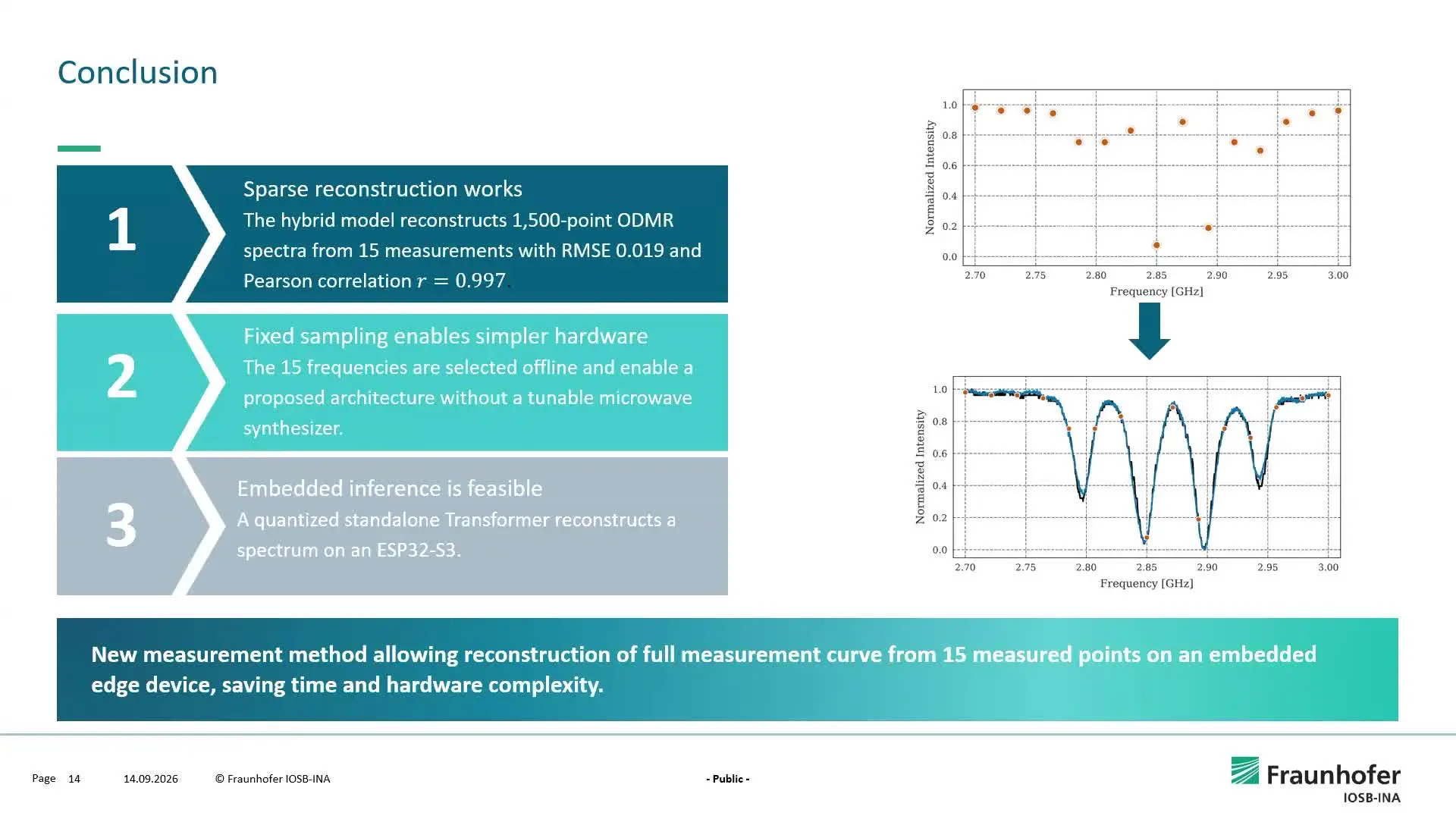
Several sensing talks cut the number of readings a task needs, such as rebuilding a full diamond sensor curve from 15 tones, though many of the largest gains came from simulation or from claims made on a panel. Few met a device. Our quantum photonics and sensing guide counts every photon.
Control electronics, calibration and readout
The 55 control talks raced one deadline. Error correction gives the electronics a few millionths of a second to read the qubits, decide and send a fix, and Quantum Machines, Qblox, Berkeley Lab and NVIDIA all showed loops inside that time. Qblox ran a tune-up of one qubit on its own box in 286 thousandths of a second, against more than five seconds the usual way.
Most of those loop times came from stand-in qubits, looped cables or made-up data. Most real hardware runs used small chips. Our guide to quantum control follows the race, and the deadline it runs against is set by error correction, where the second part begins.
Fault tolerance
Error correction lets a machine run long programs on noisy chips. It is also where the classical half of the machine becomes the hard half, because every round of checks has to be read, decoded and answered by ordinary electronics before the next one starts. Hazra’s memory belongs here. So does the decoder race it depends on.
Quantum error correction and decoders
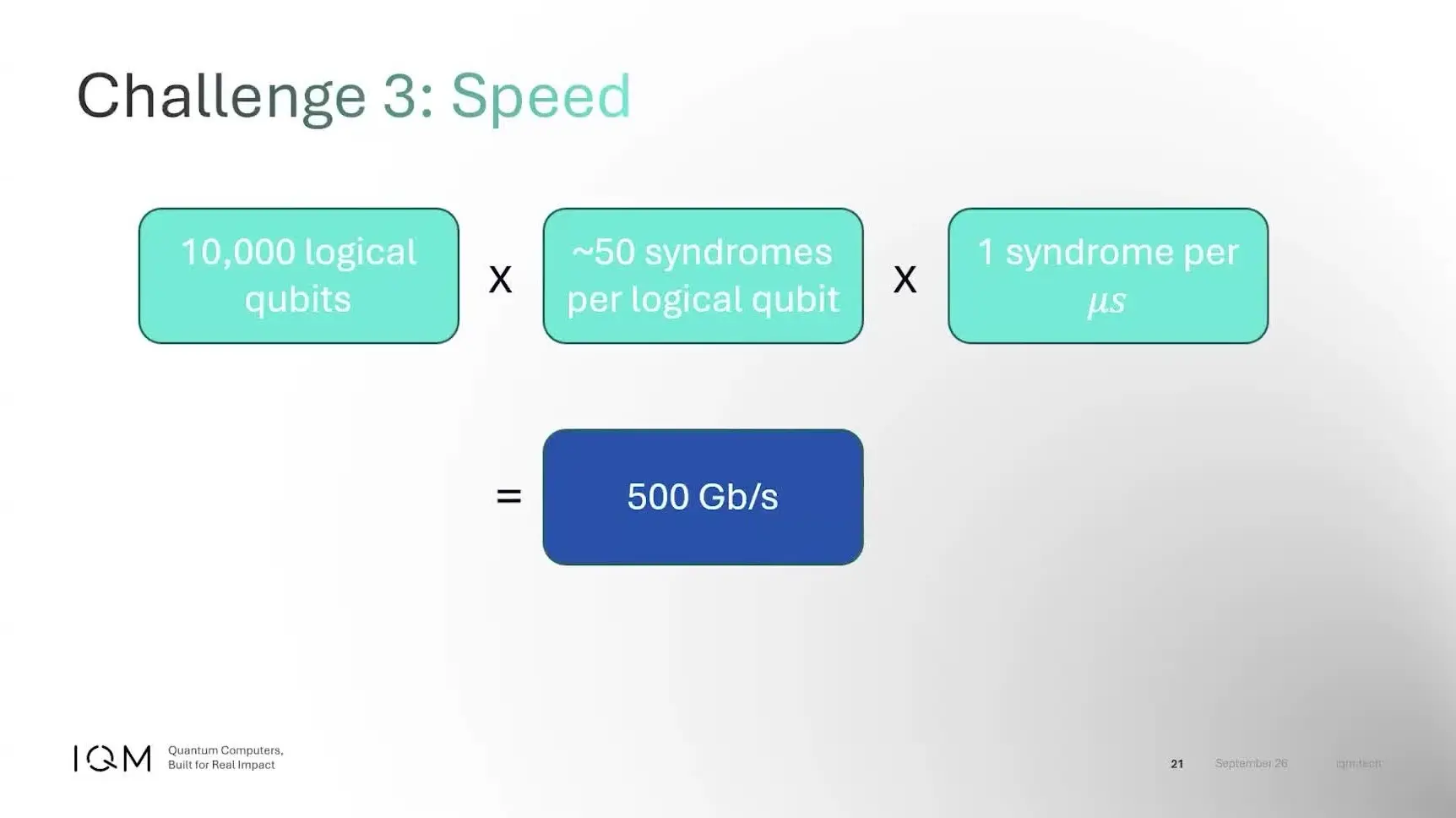
On the afternoon of Monday 14 September, Daniel Bulmash of IQM worked out that a large machine would send about 500 gigabits a second of check results to a classical program called a decoder. It must answer within a millionth of a second. Most of the 46 talks in this theme were about that classical side, from decoders built into chips to the control loops and schedules around them.
Hazra’s Helios result was the best hardware number. The sharpest warning came from Seokhyeon Son of Yonsei University, whose decoders that ranked best in simulation tended to rank lower on IBM chips and an IonQ stand-in. Our guide to quantum error correction covers all of it.
Fault-tolerant compilation and magic states
The 31 talks here asked what a long, error-corrected program really costs. Many priced their results in T gates, the costly step on such machines, and cut those counts by up to 70 percent, before several showed how layout and waiting can wipe out the gain. The price kept moving.
A toy circuit drawn with one T gate came out as seven, then 29, depending on the compiler settings, and PsiQuantum’s tutorial priced programs in a measure of the firm’s own. No talk ran such a program on hardware. Our magic state distillation guide traces the shifting price.

Systems and software
If Troyer is right, this is where the quantum computer is really built. The third part is the largest, and it covers how quantum machines are joined, scheduled, compiled, written, tested and judged by the software around them. All of it runs on ordinary computers. Several of the week’s sharpest corrections came from here.
Modular and distributed quantum computing
Most of the 34 talks on linking quantum machines had to price the link. Compilers claimed to cut the traffic over it by 59.7 to 98 percent, yet nearly all of them had to assume what a link costs, because few links yet run on working hardware. Only Oxford reported running even a two-qubit search across processors linked by entanglement.
IBM has joined chips inside one fridge with cables up to a metre long. Linking separate fridges needs a part that turns microwaves into light, and QphoX reported 14.5 percent per microwatt for its version, a figure that leaves a long way to go before such links carry real work. Our distributed quantum computing guide describes a road still being built.

Quantum computers in supercomputing centres
The 29 talks on putting quantum chips into big computer centres were mostly about words. Robert Wille of the Technical University of Munich said that two years into a joint project, the project’s physicists and computer scientists still used some of the same terms to mean different things. Shared interfaces and Slurm licences became the way to plug a chip in.
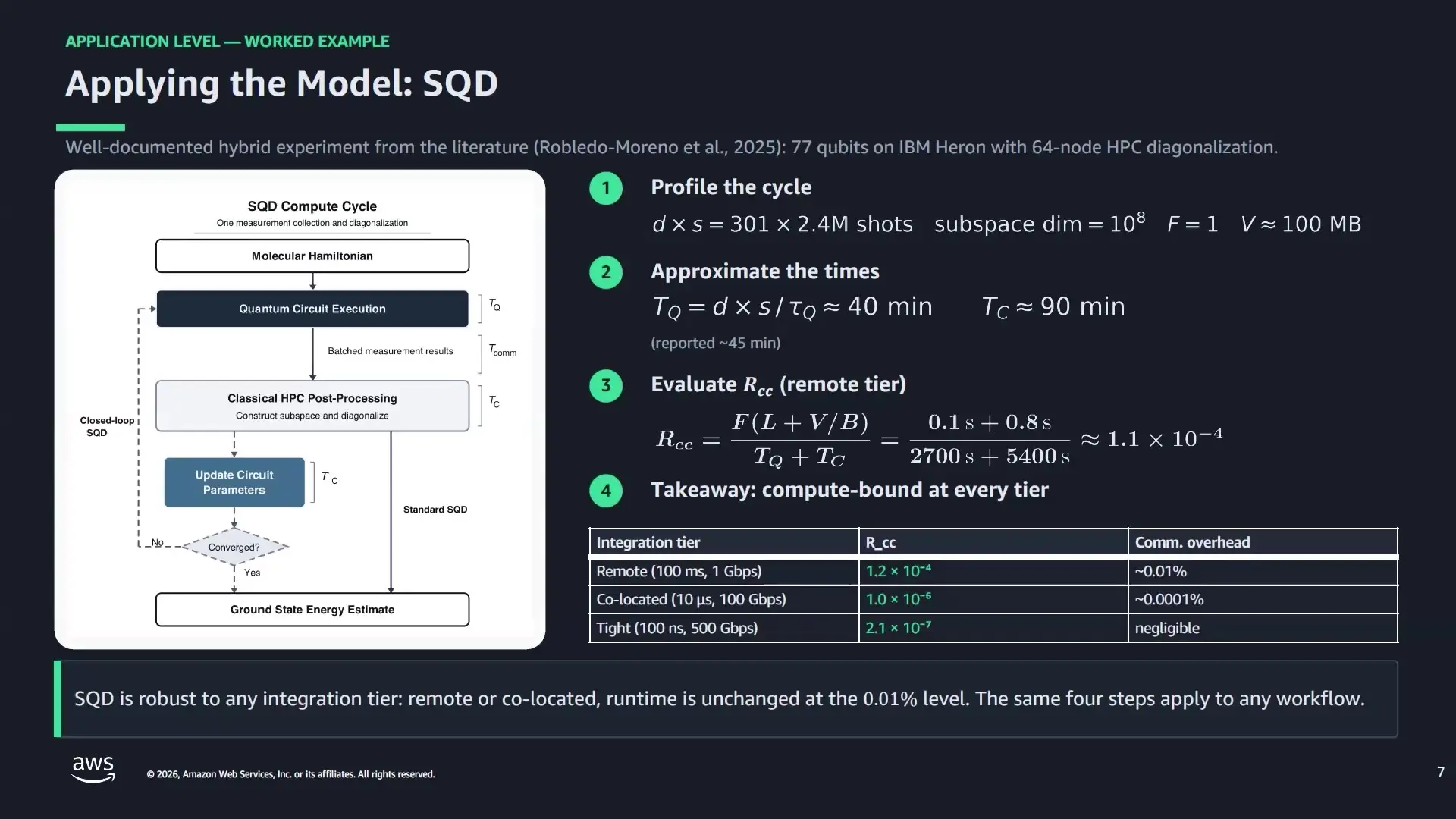
Distance matters little for now. For today’s chemistry runs, a model by Dimitar Trenev of Amazon Braket put the time spent sending data at about 0.01 percent of the run, so the cable can be long until live error correction arrives. Our quantum HPC integration guide asks who gets the machine, and when.
Compilers, circuit synthesis and languages
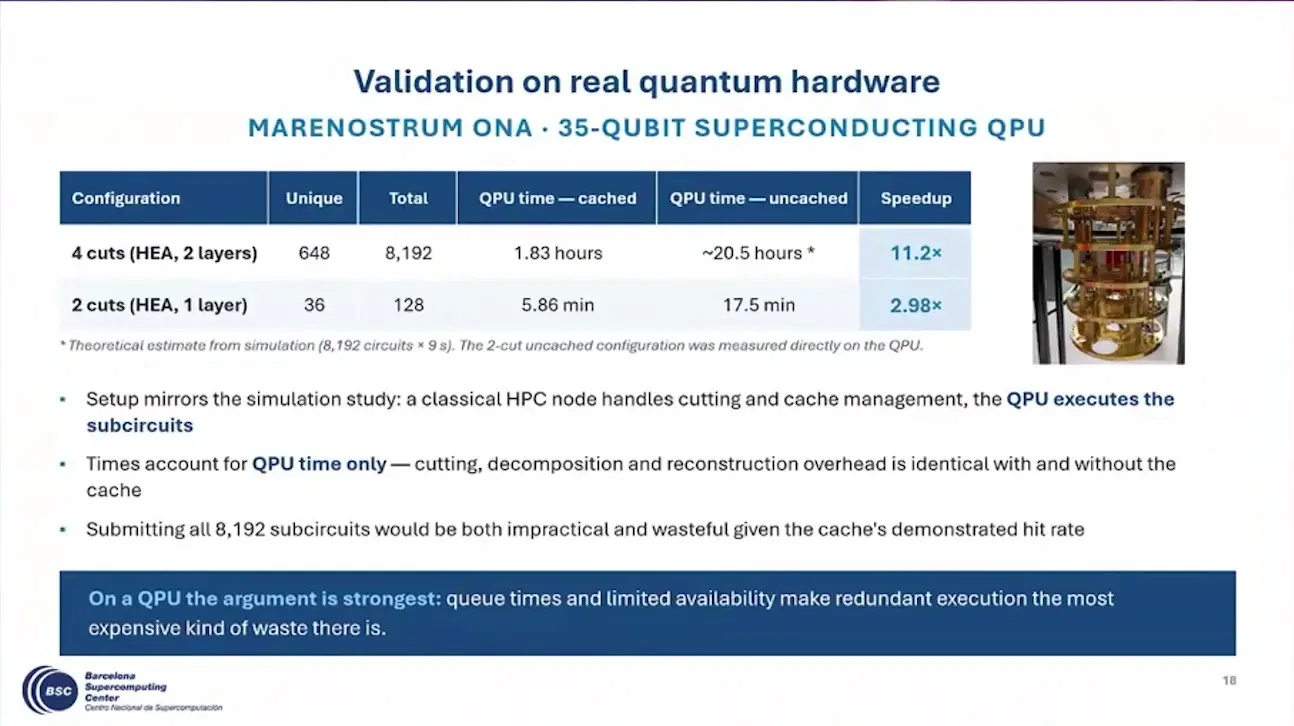
The 40 compiler talks mostly claimed fewer costly gates than a rival. Compilers also learned to remember. In one job that cut circuits into pieces, a cache found that about 92 percent of the small circuits were repeats and could be skipped.
Winklmann’s fair rerun was the lesson of the theme. Across the compiler talks, the size of a claimed gain leaned heavily on which rival was picked, on how that rival was set up and on whether both got the same rules. Our quantum compiler guide sets each result beside its baseline.
AI and language models for quantum software
The 51 talks in this theme put language models, learning agents and search by trial and error to work on quantum code, and the learners did best wherever an exact check existed to mark their work. That pattern held all week. A Quantinuum system that picks compiler steps removed 57.7 percent of the two-qubit gates on average.
Code that runs is often wrong. Cruz-Benito’s quick score was up to twelve times too kind. Speakers from qBraid and NVIDIA named the checking of agent output as the new bottleneck, and our guide to AI for quantum computing is built around that referee.

Testing and reproducible experiments
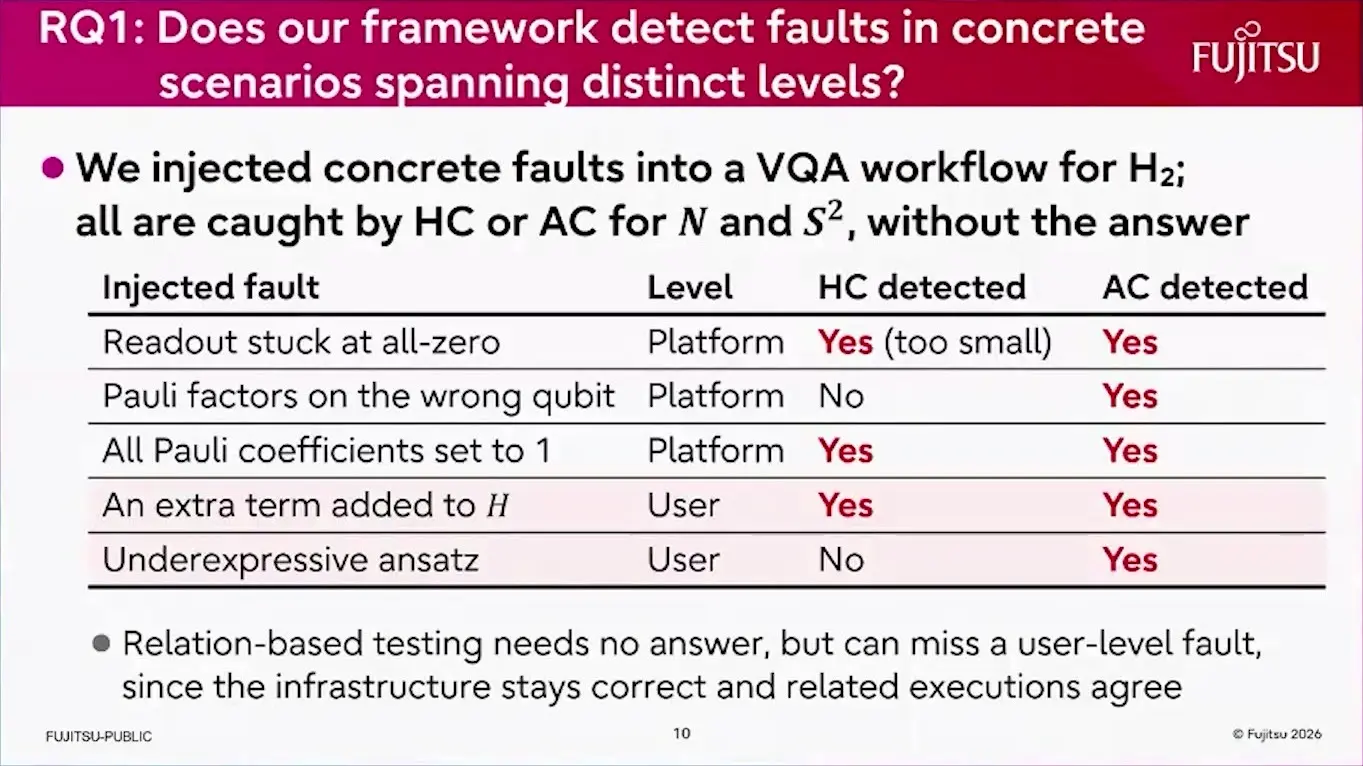
The 22 talks on testing brought sharper tools. Testers built their own ways to tell a right answer from a wrong one, and a Fujitsu check based on quantities that should never change threw out 73.7 percent of the failing hydrogen runs and none of the good ones. It is no proof, since the tests used only simulated noise.
The records behind the tools stayed thin. Hoess’s team could start only 11 of the 31 code packages it fetched, and a team from Jyväskylä reported that a single unset compiler seed changed the compiled circuits by 14 to 16 percent on two of three targets. Our quantum software testing guide lists the cheap fixes.
Benchmarks, error mitigation and quantum advantage
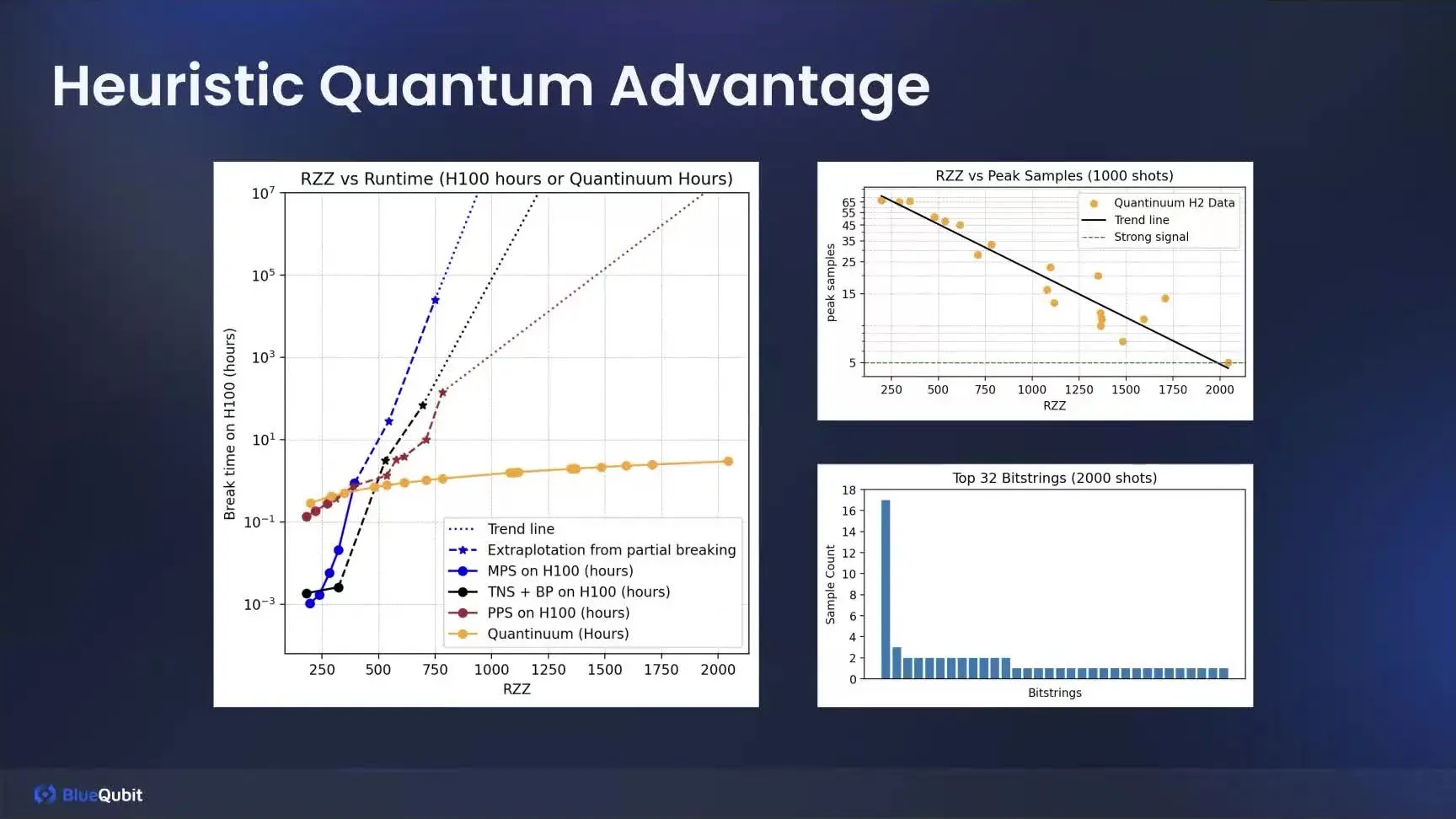
The 55 talks in this theme decided how far a quantum result can be trusted. Classical simulators matched or beat three experiments, from IBM, D-Wave and Quantinuum, that had once been billed as beyond classical reach, and one run that tried to clean up noise returned a value of 1.16. Physics forbids that.
BlueQubit and Quantinuum presented new candidates for a quantum advantage on 56 qubits of Quantinuum’s H2 machine, and both claims remain open to classical attack. Our quantum benchmarking guide treats the theme as an audit. Audits matter most where the algorithms promise speed, which is the fourth part.
Algorithms
The methods made the boldest promises. Their pattern was savings on paper, from the small routines inside every algorithm to the big hopes for optimisation and machine learning. Beside those savings grew a habit of testing them against fair rivals, and that habit, more than any single saving, was the best news in this part of the week.
Quantum state preparation, oracles and arithmetic
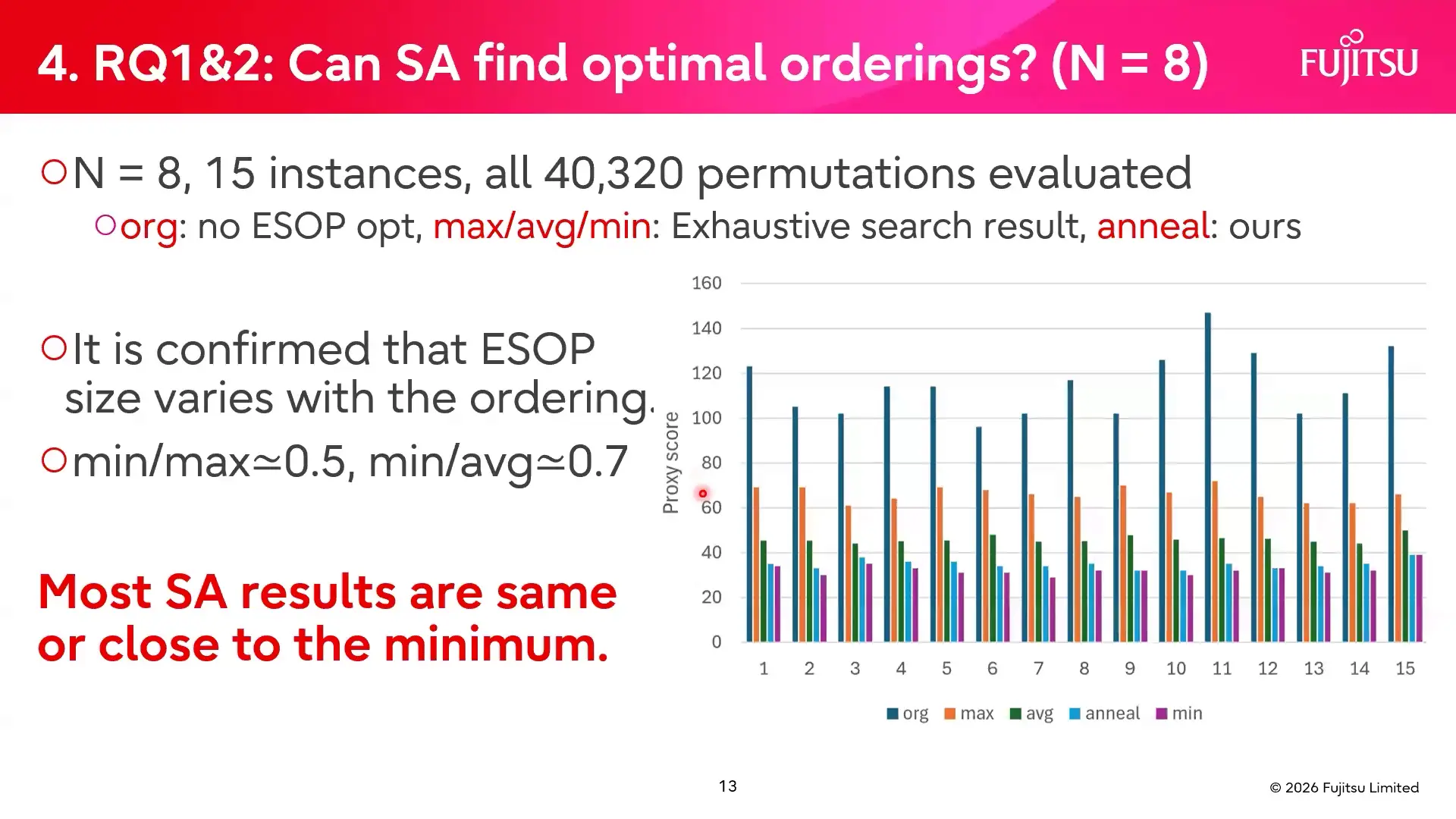
The 18 talks here worked on the standard parts that load data, mark answers, do sums and apply matrices. A Fujitsu paper by Yusuke Kimura and Yutaka Takita halved the Toffoli gates in a lookup table by putting its rows in a better order, and another team cut CNOT gates about a thousandfold for states that are mostly zeros. Both are paper gains.
Most of the savings came from classical work done before the circuit runs, such as sorting a table or merging steps, and nearly every result in the theme was a proof, a simulation or a count of gates on paper. None was timed against a classical rival. Our quantum state preparation guide prices each part.
Optimisation, QAOA and annealing
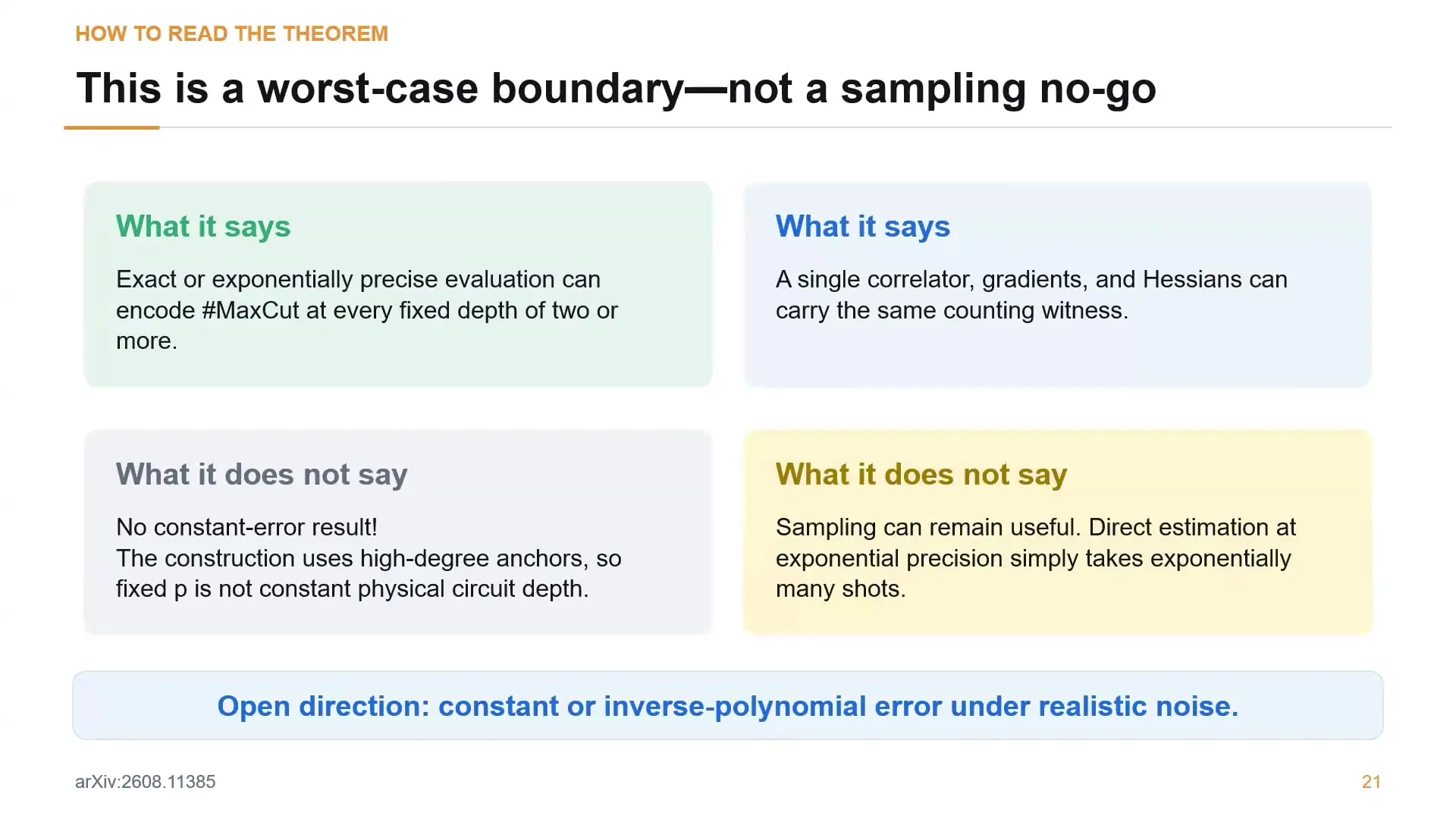
The 42 talks on optimisation tried to pick the best answer from a vast set. Stuart Hadfield of NASA presented a proof that working out exact QAOA scores becomes intractable from two layers on, and most of the gains came from the classical half, such as setting the circuit’s angles well. The quantum half mostly ran in simulation.
Most results on gate-based machines came from a simulator with no noise. A team from American Express tried an annealer on packing jobs of 50 items and said the noise was so bad that they stopped using the machine for that work at all. It was a frank result. Our quantum optimisation guide follows the classical half.
Quantum machine learning
The 69 talks on quantum machine learning fed data into quantum circuits and trained them to sort, forecast or generate, and the sharpest of them tested how such a model should be judged in the first place. Hyong Keun Park’s strict test at Yonsei turned a perfect record into a losing one.
The best hardware results were small. Luke James Miller of the University of Missouri-Kansas City told hard pairs of graphs apart on 66 IBM qubits, and IonQ’s device runs cut a language model’s error by 15.7 percent against classical baselines. Our quantum machine learning guide argues that the scorekeeper had the better week, and the next part asks what any of it does for a paying customer.

Applications
This is where Troyer’s chemist arrives, with a budget and a classical method that already works. Each team in this part had to beat such a method on a real job in chemistry, engineering, energy, finance or planning. Few did. Here the classical share of each result was easiest to see.
Chemistry, materials and life sciences
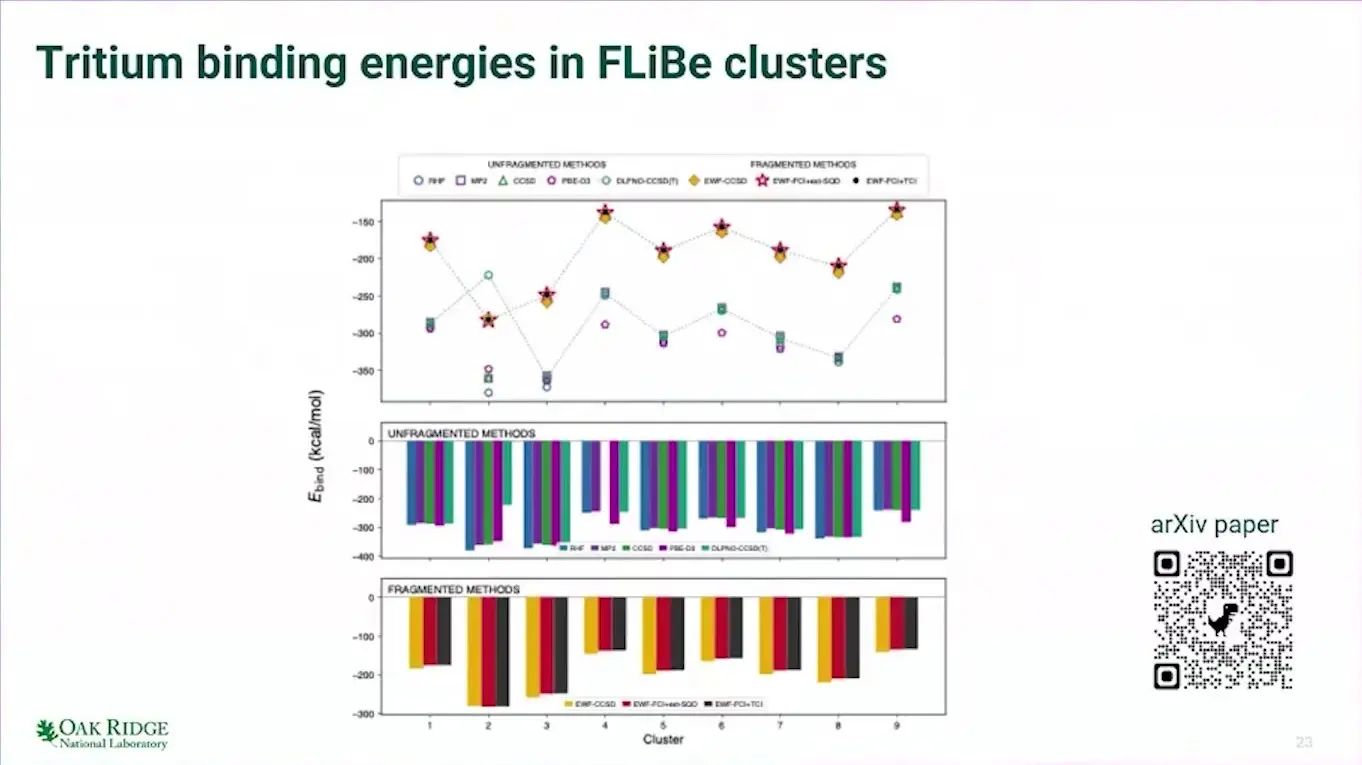
The 33 chemistry talks aimed quantum computers at the electrons that hold molecules together. Hardware runs reached 117 qubits on IBM chips, 61 on an IonQ machine and 256 atoms on Pasqal’s analogue machines, and Oak Ridge used IBM hardware to correct the energies of a salt meant for fusion reactors. Beck called these the first results on real quantum hardware for a fusion material.
Classical and AI methods moved faster still. They kept shrinking the part of each problem left for a quantum step. One speaker said a laptop still solves that speaker’s 16-qubit case, and others conceded that classical tools still handle the cases they had brought to Toronto. Our quantum chemistry guide follows that shrinking knot.
Differential equations and fluid dynamics
The 23 talks in this theme tried to solve the equations of flowing air, heat and stress on quantum computers. On Sunday 13 September, Krishnan Suresh of the University of Wisconsin-Madison said that the default way to load such a problem into a circuit throws away any quantum speed-up at the first step. The workshop put real prices on loading and readout.
For one small heat problem, a single time step compiled for an IBM chip would run 106 times longer than its qubits can hold their state. The methods closest to a payoff, by their makers’ account, are tensor networks, a classical way of compressing large sums that runs on ordinary hardware and needs no qubits at all. Our quantum CFD guide prices the doors in and out.

Power grids and energy
Most of the 14 grid talks ran on one Thursday. PNNL reported that a quantum method, run in simulation on an ordinary computer, cut the dispatch cost of a five-unit thermal plant by 3.97 percent against the GAMS solver. Real quantum runs used IBM and D-Wave machines on grids of 30 buses or fewer.
Harsha Nagarajan of Los Alamos brought the bluntest verdict. On public test grids of up to 78,000 buses, the problems a quantum linear solver must handle grew harder faster than the grids themselves, so on Nagarajan’s fit the promised speed-up was gone. Our guide to quantum computing for power grids explains why a classical judge keeps the last word.

Finance
The 17 finance talks covered risk, portfolios, credit and cash. Shaydulin’s portfolio run on 12 error-corrected qubits, made from 97 physical ones, scored 0.131 against 0.136 for the run with no protection. That is close to level.
The one saving in production came from Intesa Sanpaolo, whose scheduler cut the cost of cash in about 900 of its ATMs by 12.7 percent over a year, on ordinary computers. Our quantum finance guide shows why no hardware run showed a clear win over classical methods.
Logistics, climate, databases and games
Nine papers and one panel tested quantum planners on railways, water, databases and building sites. A database planner that sends its hardest step to an annealer reported gains of up to three times, though much of that was lost on the trip to the cloud and back. Distance cost time.
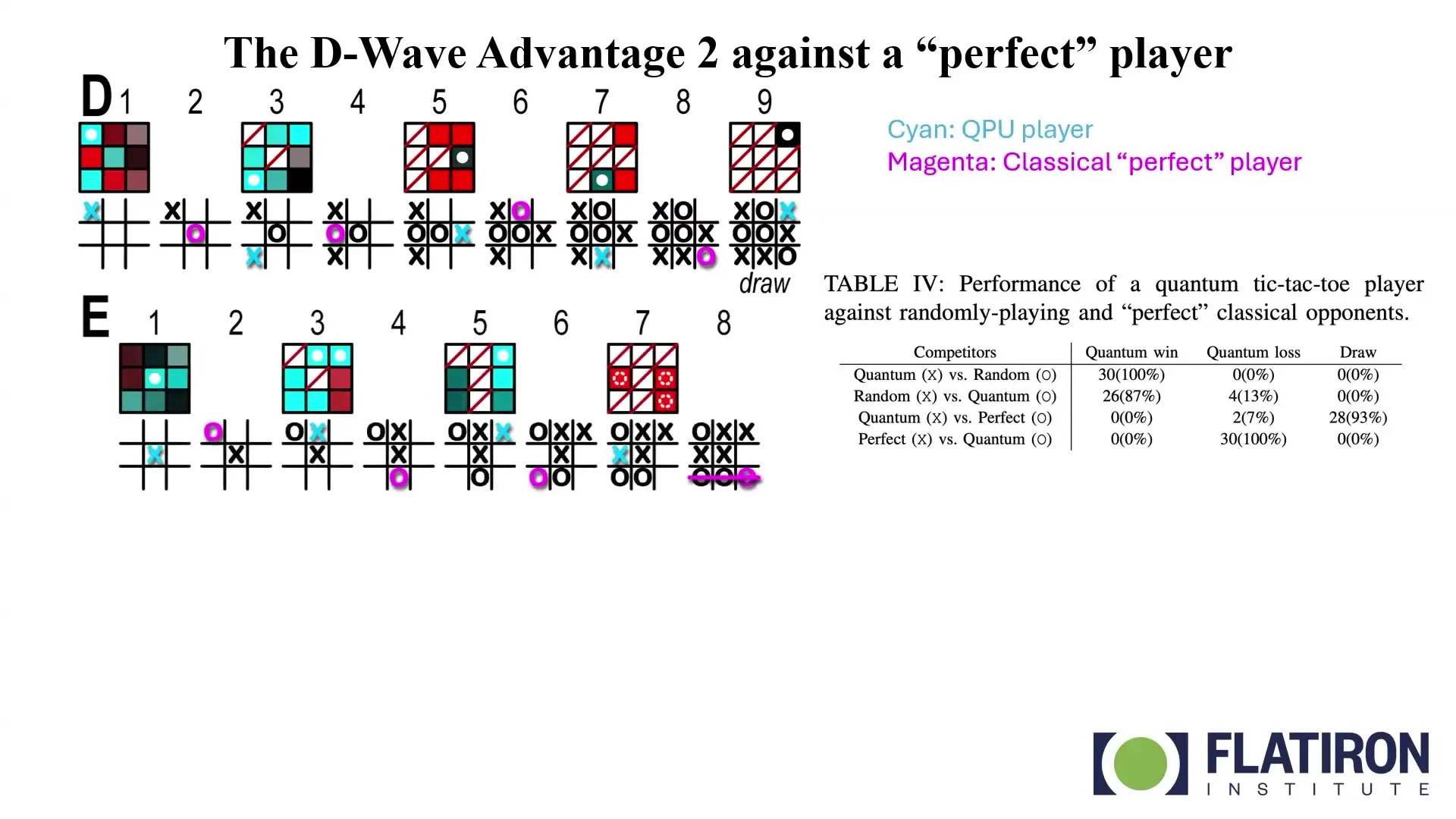
Vikram Mulligan’s annealer drew most of its tic-tac-toe games against perfect play when it moved first. It could not keep wedding guests off shared seats from five guests upward. On trains, vehicle routes, cables and water sites, classical solvers matched or beat the quantum runs in the talks that made the comparison, and the teams said so plainly. Our guide to quantum computing for logistics has the details, and the series then moves to machines that talk to each other.
Networks and security
Quantum networks promise security that rests on physics, and neither of the network attacks shown in Toronto broke it. Most of the weak points sat in the ordinary parts that the physics depends on, from control boxes and decoders to the computers that run key networks. It is Troyer’s point again, seen from the attacker’s side.
Quantum networks and key distribution
Most of the 67 network talks built networks inside simulators. A few field tests around Washington DC, Naples and Albuquerque, and a link for trapped ions in Berkeley, measured what sun, wind and traffic do to real fibre.
On Thursday 17 September, Thomas Gerrits of NIST kept entanglement usable on about 60 km of fibre hung from poles around Washington DC for about 93 percent of the time, by fixing the link each time its quality slipped. Our quantum networks guide follows the weather.

Security and post-quantum cryptography
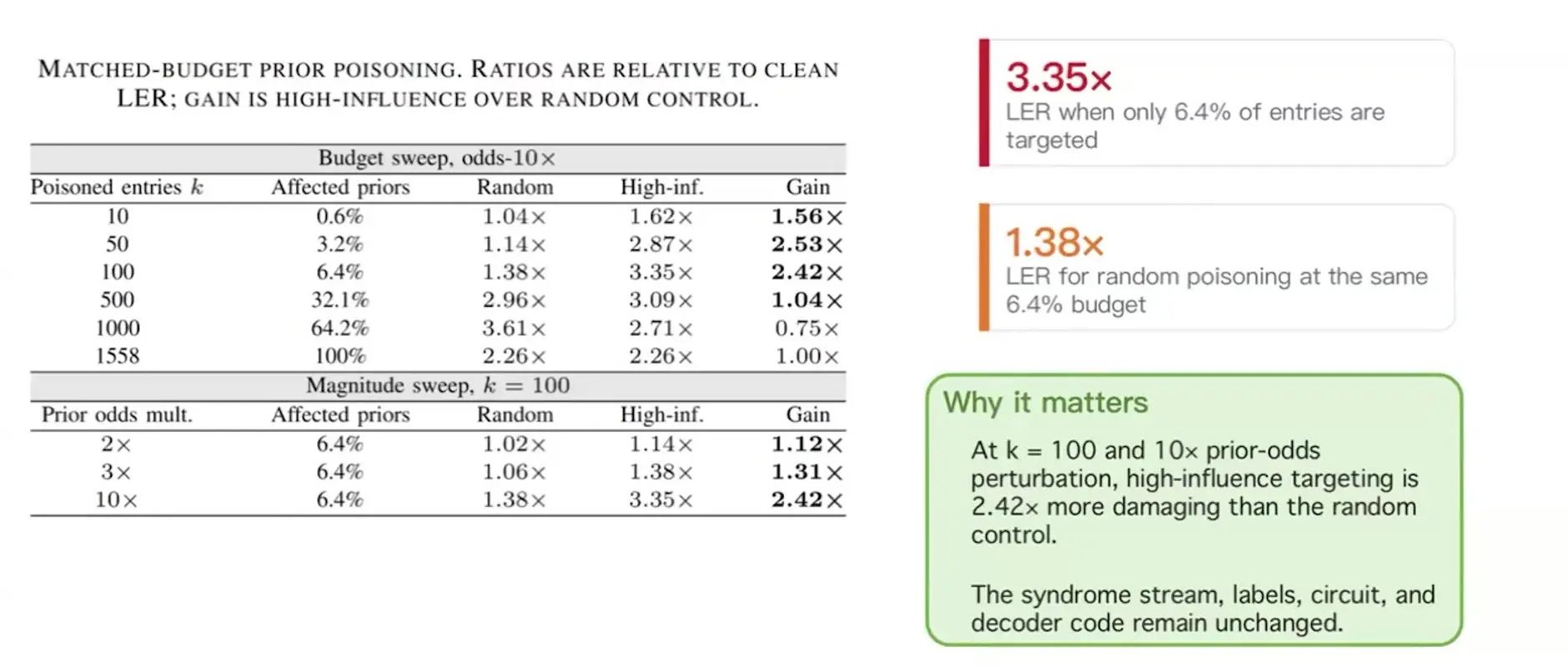
Most of the 33 security talks went after the quantum computer by its side doors, such as shared chips, control boxes and decoders, or the plain computers that run key networks. Xinyi Li of Stevens tested one such attack in simulation. Li changed 6.4 percent of the error data a decoder relies on, and its logical error rate rose 3.35 times. Nothing in the qubits changed.
Most attacks ran in simulation or on one cloud machine. A smaller group priced the switch to new codes that resist quantum attack, and found that the cost lands mostly in bigger keys, longer messages and extra round trips across the network. Our quantum computing security guide maps those side doors.
People and policy
The last part covers the people who will build and use these machines, and the rules that will govern them. It looked furthest ahead. Troyer’s complaint about mystery mattered most here, because a field that wants engineers without physics doctorates has to teach them, and a field that wants buyers has to agree on how to measure what it sells.
Education and workforce
The 39 talks on teaching and the workforce included a Sunday afternoon talk in which Ghislain Lefebvre of the Université de Sherbrooke shone a laser through a gate made of maple syrup and tape. The kit cost less than 100 Canadian dollars. One Canadian toolbox reached about 8,000 school students.
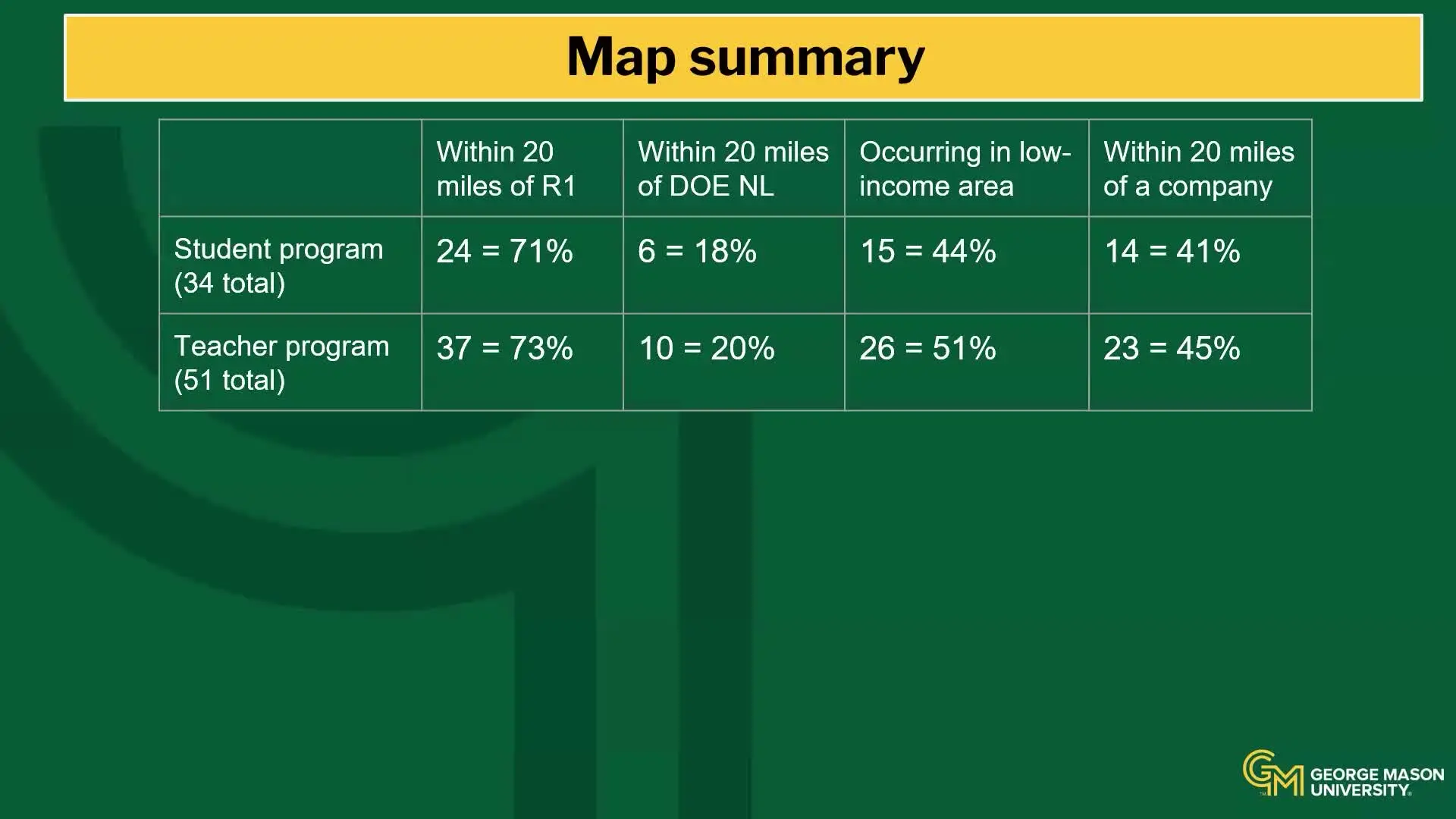
Most results rested on one small class and on what students said about themselves, and almost none used a comparison group to show that the students had learned more than they would have anyway. In one American count, 71 percent of student programmes sat within 20 miles of a top research university. Our quantum education guide asks what students keep.
Policy, standards and the quantum business
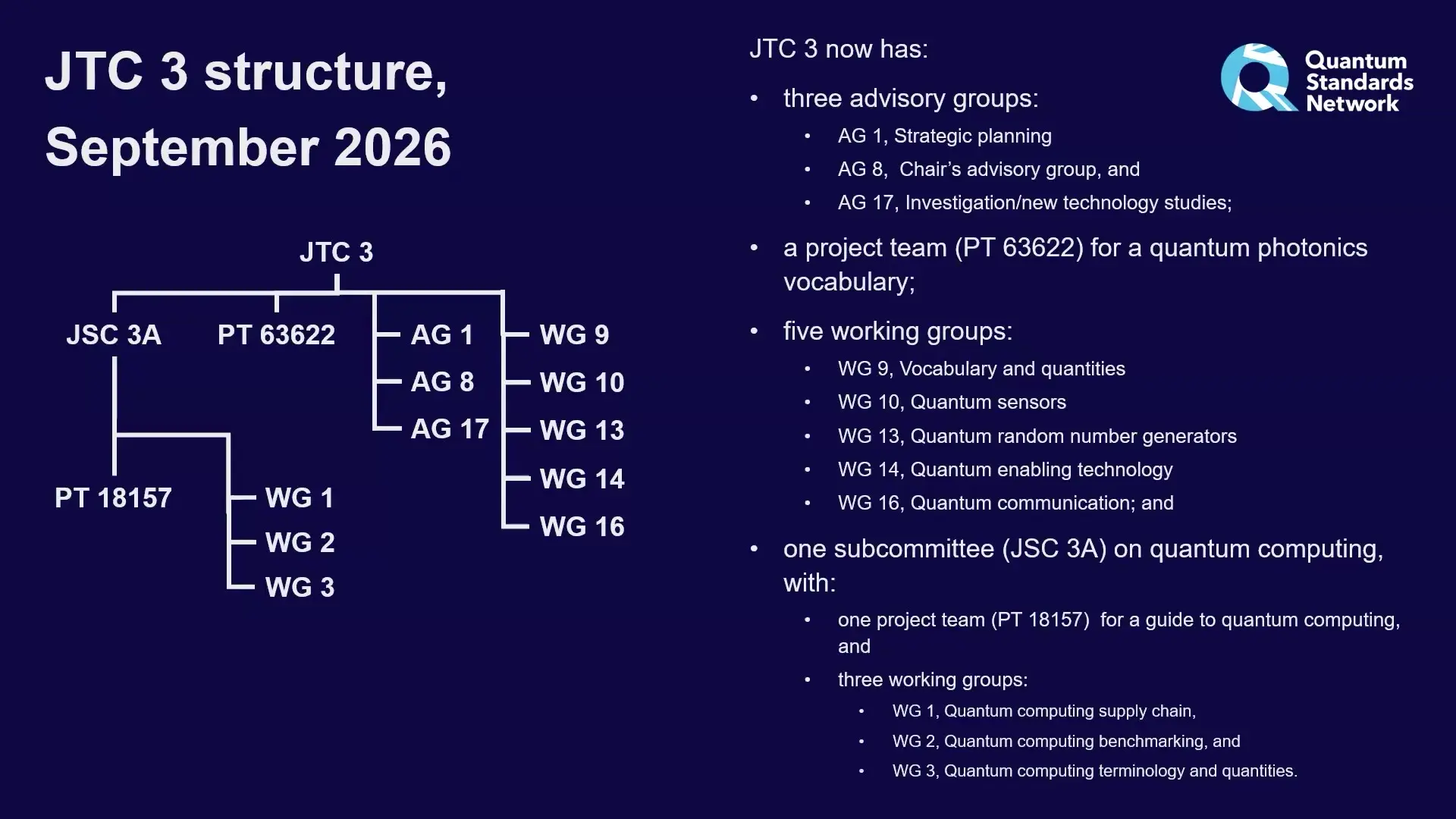
The 32 talks on policy covered the money, rules and standards around quantum computing. On Sunday 13 September, Tracey Forrest of the think tank CIGI asked a panel whether the field needs its own Asilomar. At that meeting in California in 1975, biologists tried to limit their own work on genes, and it became the founding story of scientists who govern their own dangerous ideas. Forrest wanted to know if quantum computing would do the same. Nobody proposed it.
The rules were already being drafted elsewhere, from the US funding contest to about 60 standards projects and Canada’s 2035 deadline for new ciphers. Our quantum policy guide covers who is writing them.
The ten keynotes
Ten keynote talks filled Hall G, one each morning and evening from Sunday night to Friday morning. Read in order, they are the best quick map of where the firms and national laboratories that build these machines think the field is going next, and why. Most are covered in a theme guide. Each guide is linked where its keynote comes up, and the conference lists all ten on its keynote speakers page.
Sunday evening, Gilad Ben-Shach of Quantum Machines
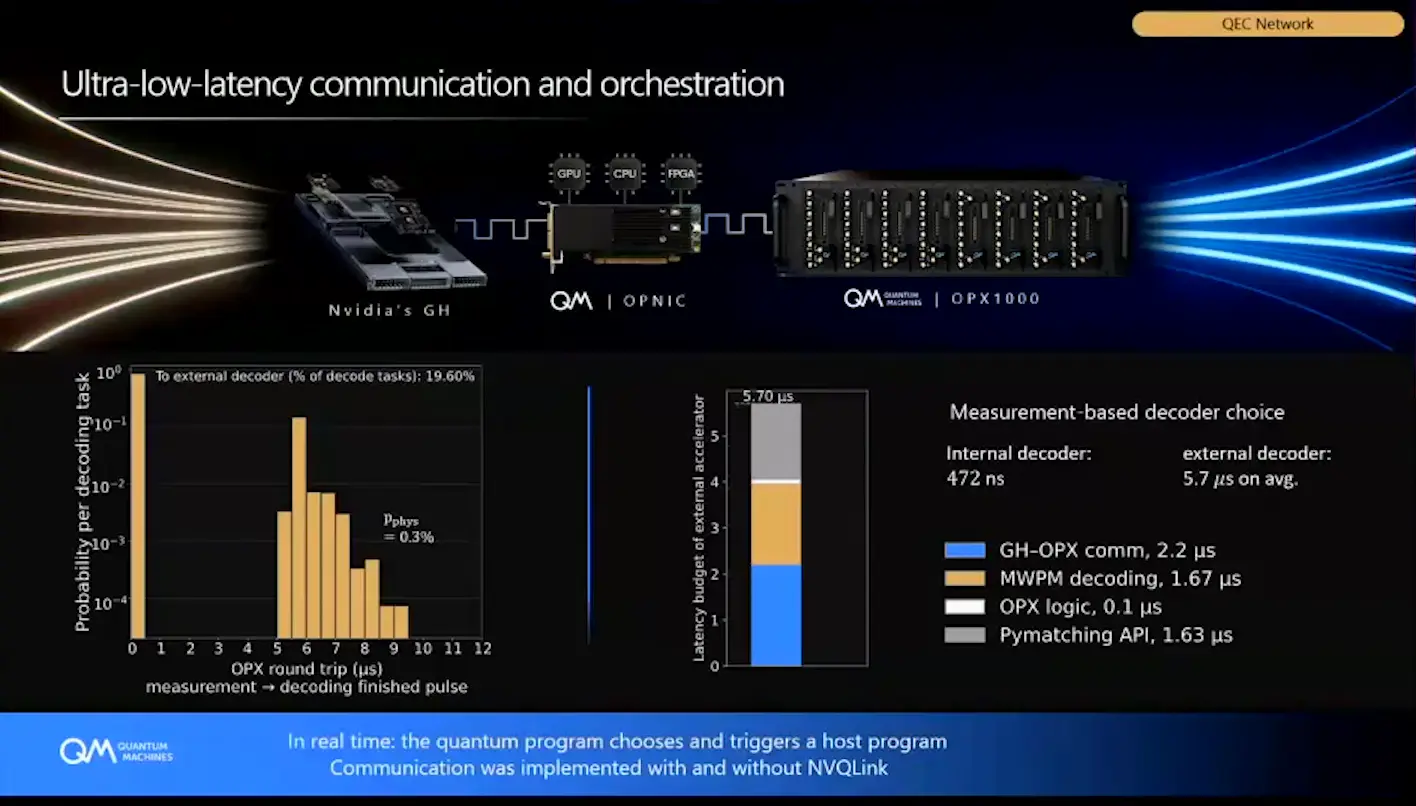
Ben-Shach gave the first keynote, on Sunday 13 September. The ten-microsecond budget set that night runs all through our control electronics guide.
Monday morning, Rafal Janik of Xanadu
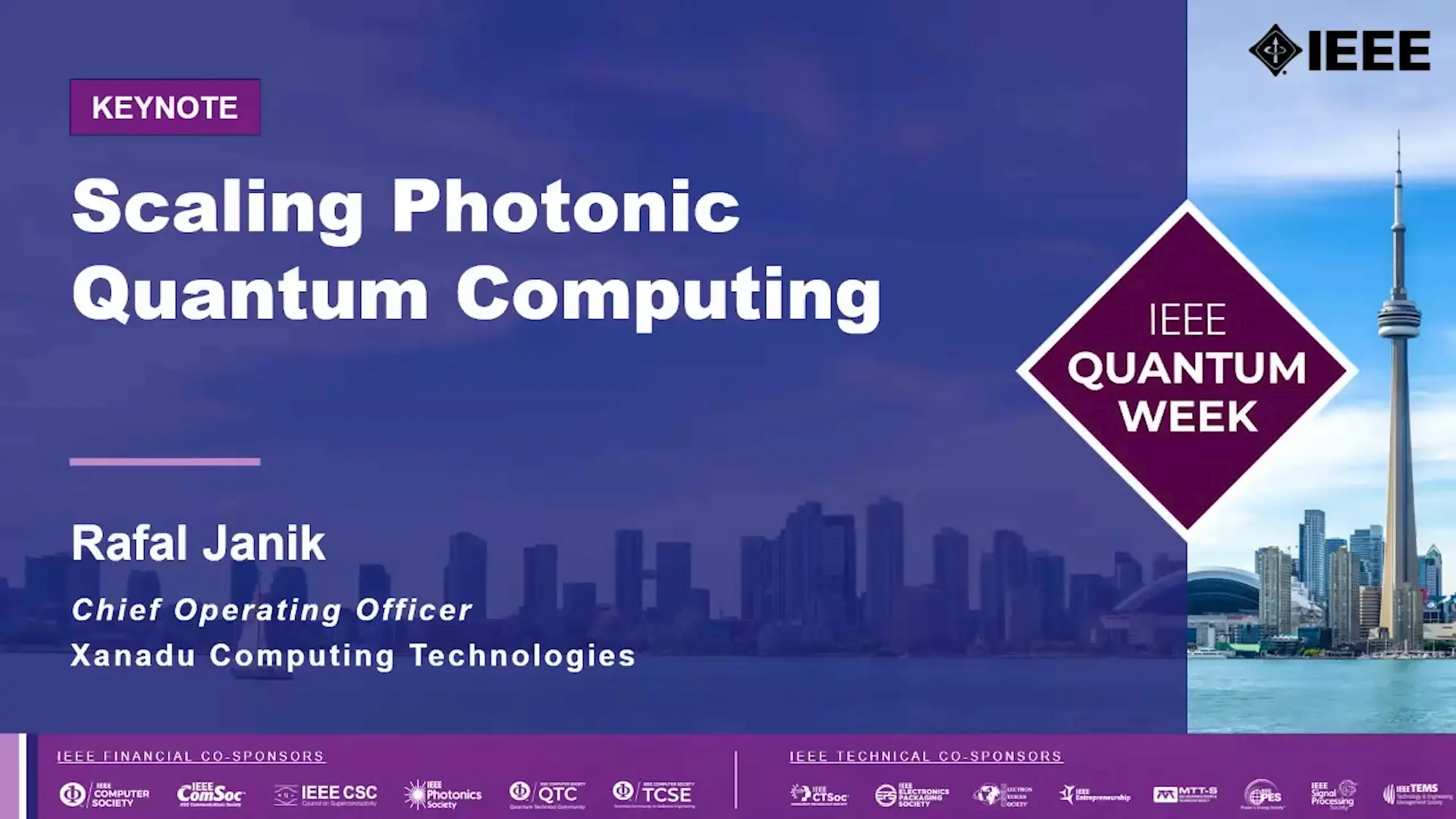
Janik spoke on how to scale up machines built on light. Our hardware roadmaps guide sets Xanadu’s dates beside the other roadmaps.
Monday evening, Rajeeb Hazra of Quantinuum
Hazra gave the keynote on error correction. The Helios results sit in our guide to quantum error correction decoders.
Tuesday morning, Lisa Lambert, John Gamble and Martin Roetteler of IonQ
IonQ filled the single Tuesday morning slot with two talks. Lambert spoke first on Canada, and Gamble and Roetteler followed on engineering for real-world use.
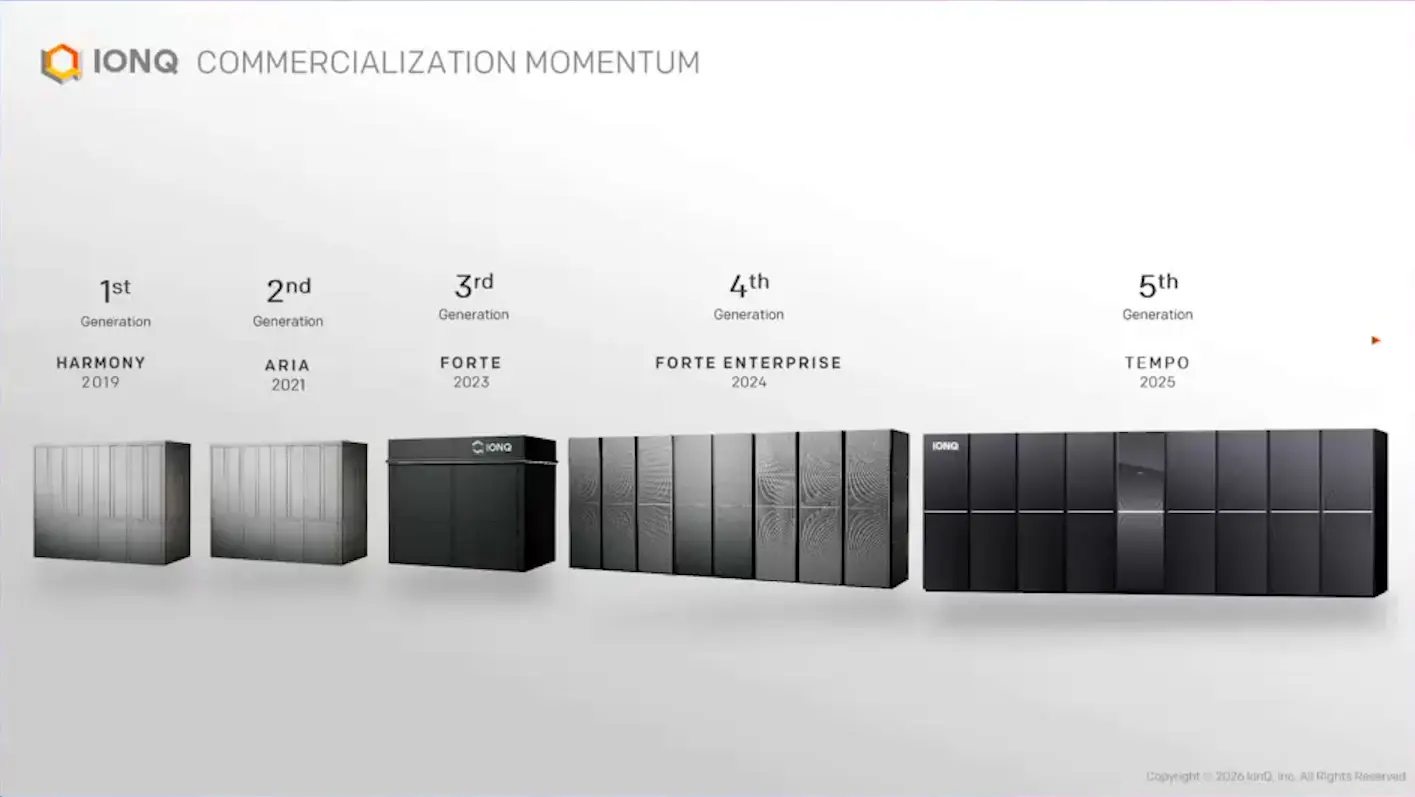
Our policy guide picks up Lambert’s scorecard. The hardware roadmaps guide follows IonQ’s chips.
Tuesday evening, Ali Javadi-Abhari of IBM Research
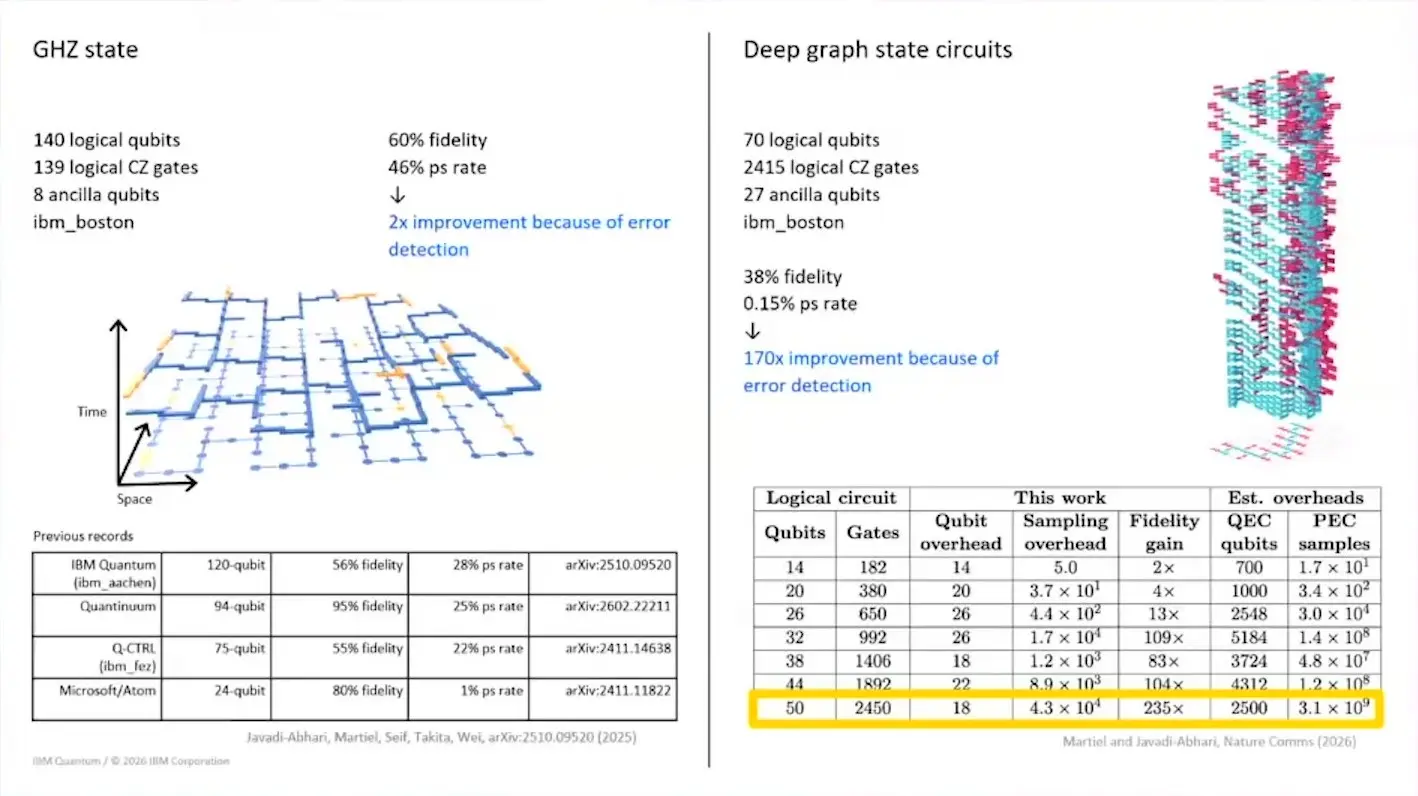
Javadi-Abhari gave the keynote on Tuesday evening. It was titled The Continuous Path from Error Mitigation to Fault Tolerance. Mitigation cleans up the harm that errors do once a run is done, while a machine that is fault tolerant fixes them as it goes. Our benchmarks and error mitigation guide covers the mitigation end of that path.
Wednesday morning, Yonatan Cohen and Alán Aspuru-Guzik
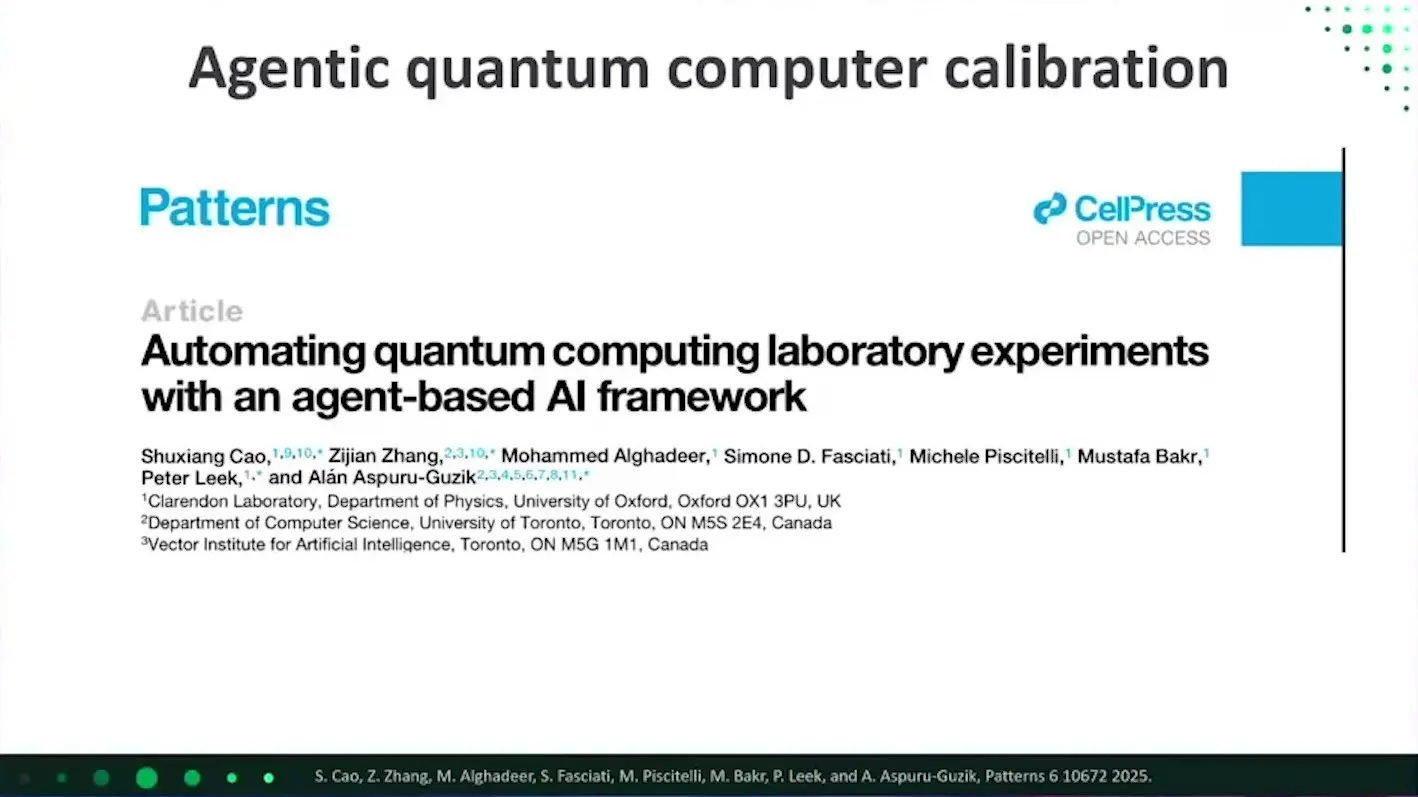
Cohen’s remarks sit with our guide to quantum control. Aspuru-Guzik’s agents, under the title Agents to the Rescue, are followed in our AI guide.
Wednesday evening, Krysta Svore of NVIDIA
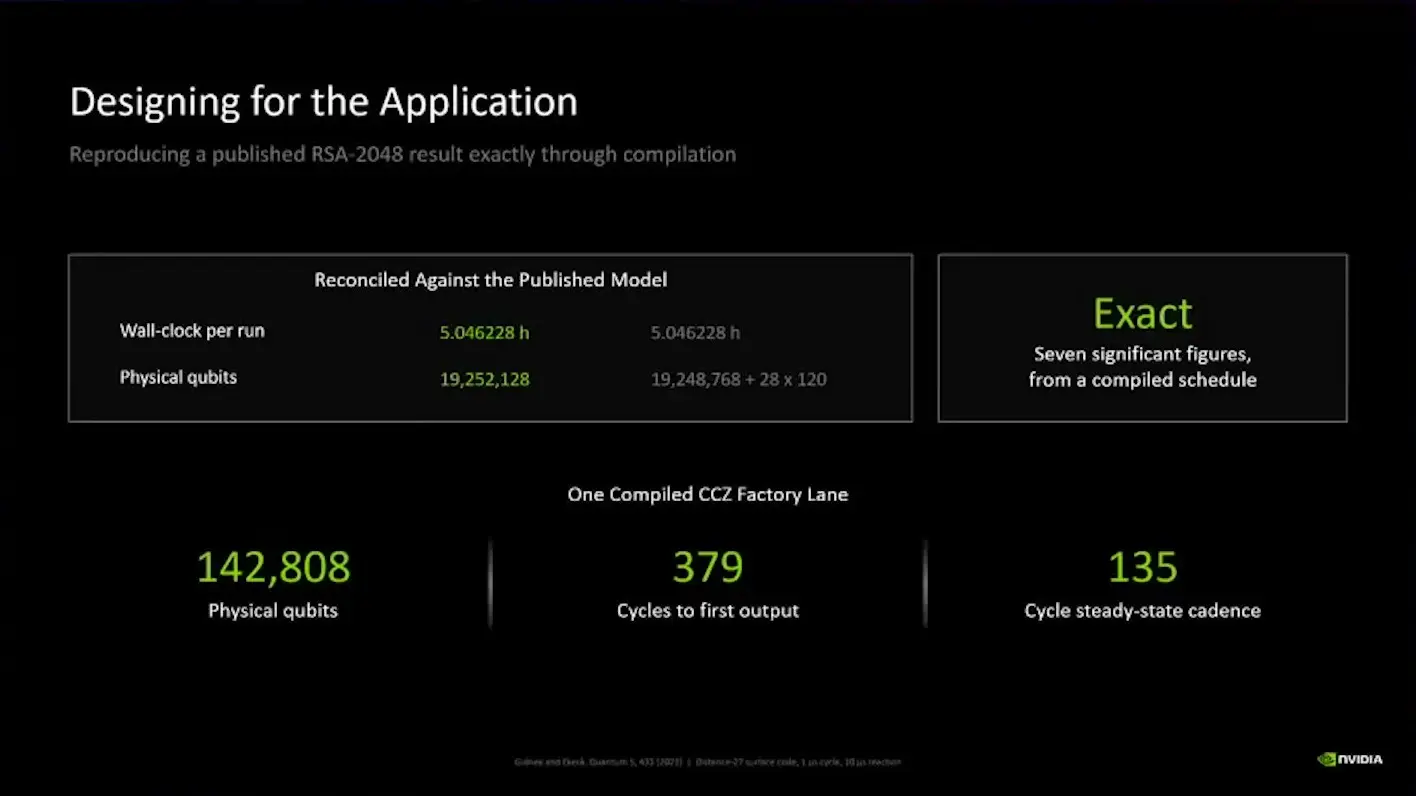
Svore set out a plan for how to build a quantum supercomputer. Our supercomputing guide covers both the decoding result and the compiler.
Thursday morning, Niels Bultink of Qblox
Bultink spoke on the layer of kit that runs a quantum machine. Our control electronics guide has the Qblox tune-up times.
Thursday evening, Travis Humble of Oak Ridge
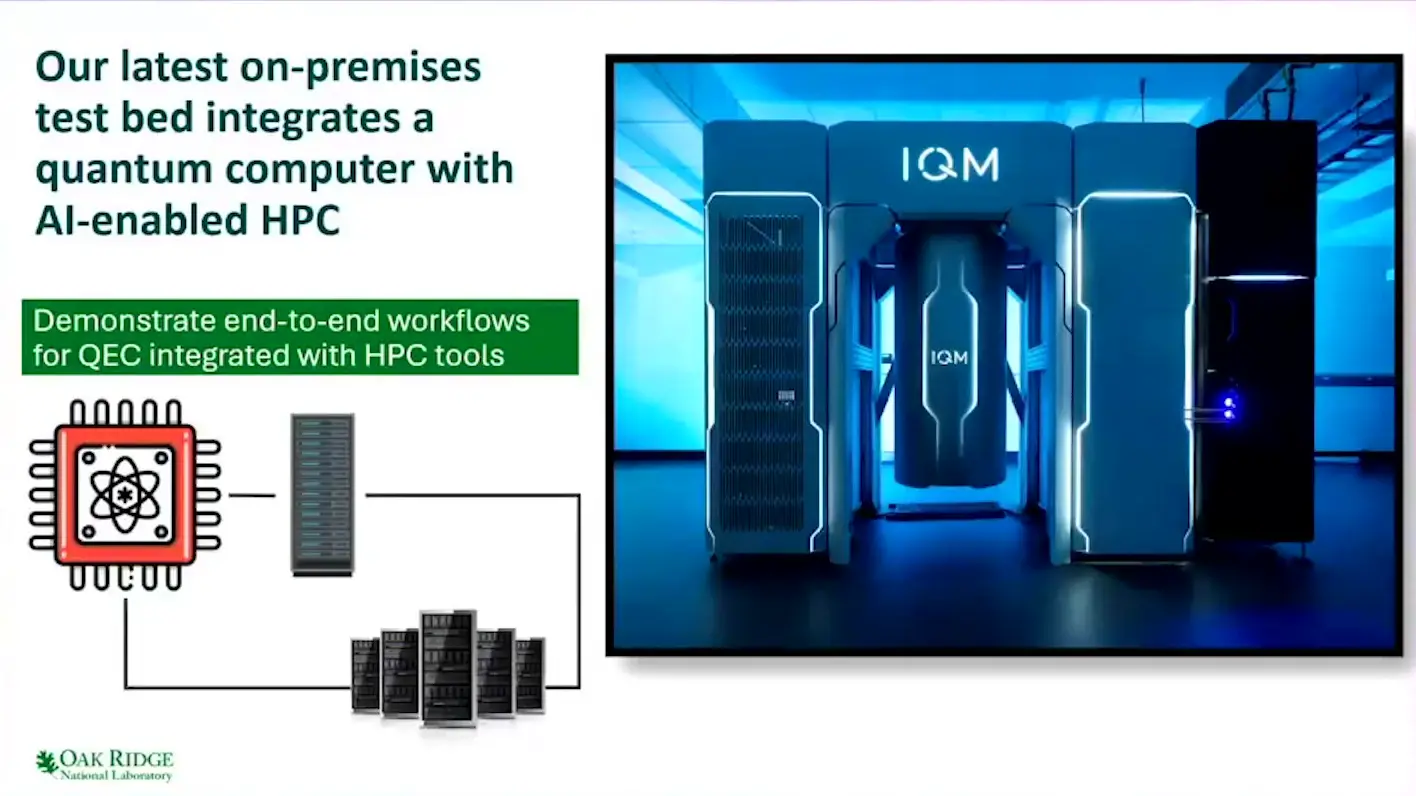
Humble spoke on quantum speed-ups in practice. Our supercomputing guide follows Oak Ridge’s test bed.
Friday morning, Matthias Troyer of Microsoft
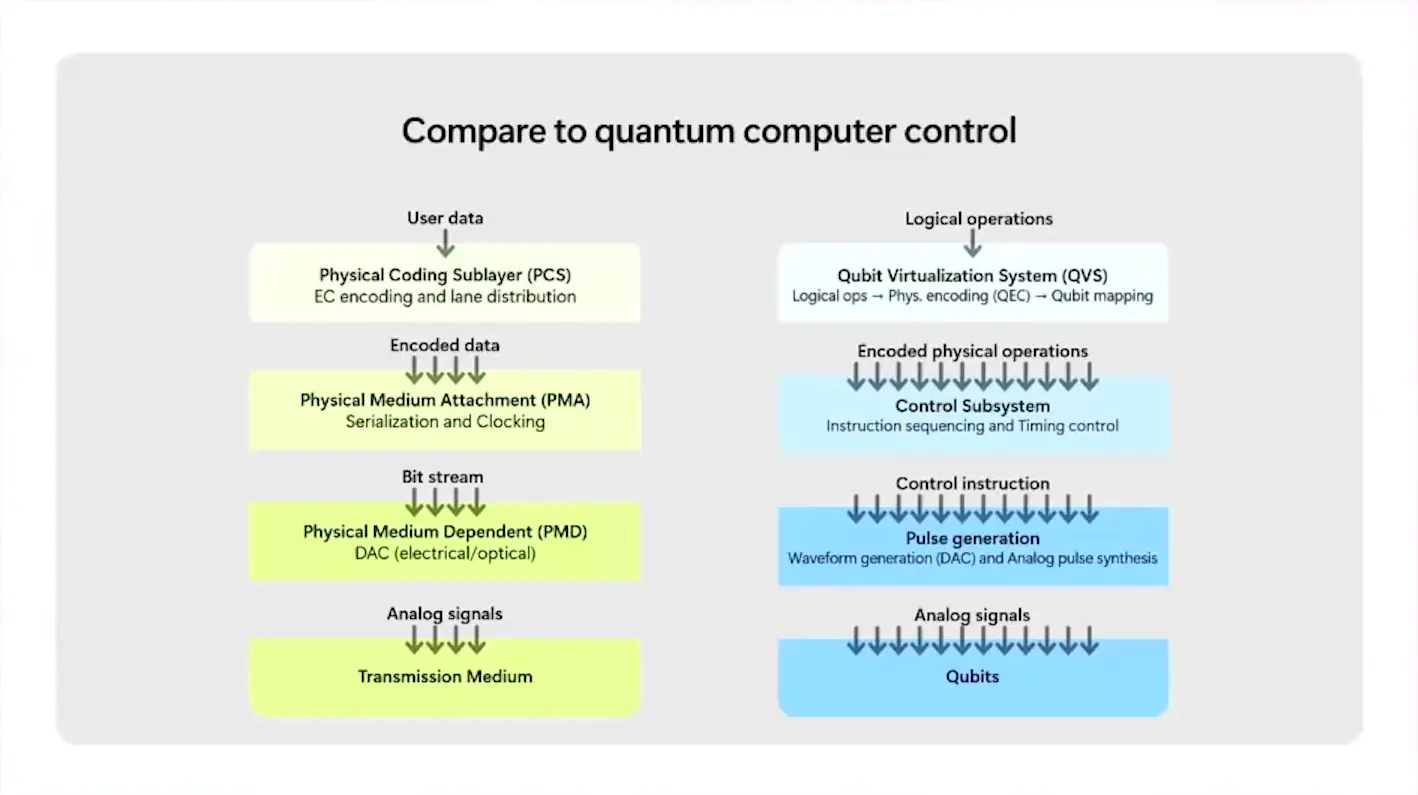
Troyer closed the run on Friday morning, and the talk opens this guide. Our hardware roadmaps guide returns to it.
What IEEE Quantum Week 2026 adds up to
For a buyer, the week offers three tests for any quantum claim. Ask which part ran on a quantum machine and which ran on a simulator, and ask which classical rival it was measured against and whether that rival got fair rules. Then ask who checked it.
For funders, the evidence from IEEE Quantum Week 2026 points at the plain layers. Shared interfaces, decoders that keep pace, test beds that measure real links and outside benchmarks drew the most solid results of the week, and most of them cost far less than a new chip. They are cheap bets.
For researchers, the cheapest gains are habits. Pin the versions, log the seeds, keep the raw data and state the baseline, because Hoess’s count of packages that would not start suggests the field can raise its standards a long way without any new physics at all.
None of this means the qubits stopped mattering. Hazra’s logical memory and Shaydulin’s protected portfolio are real steps, and the quantum part of the machine will decide in the end what can be done at all. The classical part decides what can be done this year, and what it costs.
Troyer’s affordable molecule is the right yardstick for all of it. It will come, if it comes, through cheaper control chips and fairer tests, and both of those are classical work done by people who may never touch a qubit themselves. On the last morning in Toronto, the engineers were told the calculation is a side effect. The cause is the machine they spent the week building.
Frequently asked questions
What is IEEE Quantum Week?
IEEE Quantum Week is the yearly meeting of the IEEE conference on quantum computing and engineering, known as QCE. It mixes peer-reviewed papers with tutorials, workshops, panels and keynotes on hardware, software, algorithms, networks, applications, teaching and policy. Its speakers come from universities, national labs and companies.
When and where was IEEE Quantum Week 2026?
IEEE Quantum Week 2026, also called QCE26, ran from 13 to 18 September 2026 at the Metro Toronto Convention Centre in Toronto, Canada. The last keynote, from Matthias Troyer of Microsoft, came on the Friday morning.
What were the main themes of IEEE Quantum Week 2026?
This series sorts 790 talks, panels and tutorials from 340 sessions into 23 themes in seven parts. The parts are hardware and control, fault tolerance, systems and software, algorithms, applications, networks and security, and people and policy. The largest themes were quantum machine learning, quantum networks, control electronics and benchmarking.
Did anyone show quantum advantage at QCE26?
BlueQubit and Quantinuum presented new candidates for a quantum advantage on 56 qubits of Quantinuum’s H2, and both claims remain open to classical attack. In the same week, classical simulators matched or beat three earlier experiments once billed as beyond classical reach.
What was the biggest hardware result at IEEE Quantum Week 2026?
Rajeeb Hazra of Quantinuum reported a logical memory on the Helios machine that fails 4.6 times in 100,000 rounds for each qubit, with no runs thrown away. JPMorganChase also ran a 12-asset portfolio problem on 12 error-corrected qubits made from 97 physical ones.
Is quantum computing useful for business yet?
Not on the evidence of QCE26, outside a few narrow cases. The one production saving reported in finance came from a quantum-inspired method on ordinary computers, and most application results ran in simulation or on small devices.
This guide is based on 790 talks, tutorials, panels and keynotes from 340 sessions at IEEE Quantum Week 2026 (QCE26), held at the Metro Toronto Convention Centre from 13 to 18 September 2026, and on the published conference programme. The series sorts those talks into 23 themes, each with its own guide. Results are stated as each speaker presented them, and company claims are the companies’ own. Most results here come from simulation, emulation or small devices, and each theme guide says which.
- Qubit hardware and scaling roadmaps
- Photonics and quantum sensing
- Control electronics, calibration and readout
- Quantum error correction and decoders
- Fault-tolerant compilation and magic states
- Modular and distributed quantum computing
- Quantum computers in supercomputing centres
- Compilers, circuit synthesis and languages
- AI and language models for quantum software
- Testing and reproducible quantum experiments
- Benchmarks, error mitigation and quantum advantage
- Quantum state preparation, oracles and arithmetic
- Quantum optimisation, QAOA and annealing
- Quantum machine learning
- Chemistry, materials and life sciences
- Differential equations and fluid dynamics
- Power grids and energy
- Quantum finance
- Logistics, climate, databases and games
- Quantum networks and key distribution
- Quantum security and post-quantum cryptography
- Quantum education and workforce
- Policy, standards and the quantum business




See today’s quantum computing news on Quantum Zeitgeist for the latest breakthroughs in qubits, hardware, algorithms, and industry deals.